Published: September 2025 | Last updated: May 2026 | Editorial review and quality control: Martina N.
You had a moment of uncertainty. Maybe a condom slipped. Maybe you skipped one. Maybe a partner mentioned something later. Whatever happened, the next morning your brain turned into a search engine, and every sensation started feeling like evidence.
Here is the part nobody says out loud: the panic that follows a possible exposure is almost never proportional to your actual risk, and it is almost never solvable by acting fast. It is solvable by acting correctly. This piece is the calm version of what a clinician would walk you through if they had an hour to sit with you. No lecture, no fear tactics, just current public-health guidance on what to do, what to wait for, and when to test.
Key Takeaways
- Most STIs cannot be reliably detected for at least 1 to 3 weeks after exposure, so testing too soon often produces a false negative and pushes people into a cycle of repeat testing.
- Stress and hyper-vigilance can produce real physical sensations (tingling, itching, irritation, pelvic tension) that mimic early STI symptoms but resolve as the anxiety eases.
Why Your Brain Throws You Into Worst-Case Mode the Morning After
The morning-after spiral has a name in cognitive science: threat surveillance. Your brain notices an ambiguous risk, and once it does, it starts scanning your body and the internet for confirmation of the worst possible outcome. The anxious brain does exactly what it evolved to do, which is scan for ambiguous threats and escalate until something resolves.
The problem is the system does not sort risks by probability. A two-second worry about a condom that may have slipped gets treated with the same urgency as a clear, ongoing danger. So at 8 a.m. a faint itch feels loaded. By noon a slight tingle feels conclusive. By bedtime you have searched “scared I have an STD” enough times that the algorithm is feeding you back exactly the worst-case scenarios it thinks you want.
What is actually happening in your body during this phase is mostly cortisol and adrenaline. Those two together heighten skin sensitivity, increase muscle tension, and amplify your awareness of normal sensations you would otherwise tune out. The CDC notes that many STIs cause no symptoms at all, which is why testing rather than symptom-watching is what answers the question (CDC: About STIs). The infections that do eventually cause symptoms follow incubation periods measured in weeks, not in the first night.
That gap, between when your brain starts panicking and when an infection could possibly be detected, is the most important window in this entire experience. Spend it doing the wrong things (repeat testing, repeat googling, repeat self-exams) and it gets worse. Spend it doing the right things (waiting, planning, treating the panic separately from the medical question) and it eases.
Acute stress floods the body with cortisol and adrenaline. Cortisol heightens skin reactivity, adrenaline ramps up muscle tone (including the pelvic floor), and both together amplify the brain's attention to internal sensations. The result is that perfectly ordinary feelings, dry skin, fabric brushing the thigh, a moment of urinary awareness, start registering as evidence of infection. The mechanism is real. The cause is your nervous system, on a clock measured in days, not the first morning.
What Genuinely Matters in the First 48 Hours After Exposure
In the immediate aftermath of a possible exposure, very little is a true emergency. There are exactly two things worth doing right away. First, write down what actually happened, with detail: what kind of contact, what protection was or was not used, what you know about the other person's status. This becomes your reference document so your brain stops asking the same questions on a loop. Second, look up the specific incubation and window-period times for the infections you are worried about. That gives you a calendar instead of an open-ended dread.
Almost everything else (the impulse to call a clinic in the next hour, the urge to do a swab in the bathroom, the obsessive symptom checking) falls into a different category. It feels like responsibility, but it is anxiety wearing a responsible coat.
The genuine exception is post-exposure prophylaxis for HIV, known as PEP. The CDC is explicit that PEP must be started within 72 hours of a possible HIV exposure, and that the sooner it is started the better (CDC: PEP). If HIV transmission is a realistic concern based on the type of contact (condomless sex with a partner whose status is unknown or positive, sharing injection equipment, a needlestick incident), contact a clinic or urgent care today, not tomorrow. Outside of PEP, the next 48 hours are mostly about deciding to wait correctly, which is what the rest of this article will help you do.
| Panic Thought | Reality Check |
|---|---|
| “I feel something already, this must be an STD.” | Most STIs do not cause symptoms within hours or even the first few days after exposure. |
| “I need to test right now to know for sure.” | Window periods make tests come back negative too early even when something is genuinely there. |
| “If I wait, I am being irresponsible.” | Waiting the correct amount of time is the responsible move because the result will mean something. |
| “No symptoms means I am definitely fine.” | Many STIs are silent. Testing, not symptom monitoring, is what confirms status. |
Window Periods: The Real Reason Testing Too Early Backfires
The single most useful concept for anyone in your situation is the window period. That is the interval between when an infection enters the body and when a test can actually detect it. Test before the window closes and your result can come back negative even though something is genuinely there. Biology sets the detection clock. The body needs time to either replicate the pathogen to detectable levels or produce the antibodies a test is looking for, and no kit or lab can shortcut that interval.
This is why people who test in a panic the morning after often end up testing two or three more times. The early negative did not feel trustworthy because, honestly, it was not fully meaningful yet. Each repeat test then feeds another round of anxiety.
Different infections have different windows. The CDC's HIV testing guidance is the most explicit set of numbers in this space: laboratory antigen/antibody tests can usually detect HIV 18 to 45 days after exposure, rapid antigen/antibody tests 18 to 90 days, antibody tests (including most at-home rapid kits) 23 to 90 days, and nucleic acid tests 10 to 33 days (CDC: HIV Testing). Bacterial STIs are faster. Current CDC screening recommendations and the labeling of FDA-cleared NAAT assays together support the general guidance that chlamydia and gonorrhea NAATs become reliable around one to two weeks after exposure, and syphilis antibody tests typically turn positive within three to six weeks. Exact figures depend on the specific test you use, so the kit's instructions for use or the lab's reporting notes are the authoritative source for any individual case.
The practical effect of knowing your window is enormous. Instead of asking “should I test right now,” you can ask “when does the test stop being a coin flip.” That single question takes a problem with no answer and turns it into a date on a calendar.
| Infection | Earliest reliable test | Most accurate window |
|---|---|---|
| Chlamydia (swab/urine NAAT) | 7 to 14 days | About 2 weeks |
| Gonorrhea (swab/urine NAAT) | 7 to 14 days | About 2 weeks |
| Syphilis (antibody) | 3 weeks | 6 weeks or more |
| HIV (rapid antibody, at home) | 23 to 90 days | Up to 12 weeks |
| HIV (lab antigen/antibody) | 18 to 45 days | 4 to 6 weeks |
| Hepatitis B (surface antigen / antibody) | 3 to 6 weeks | 6 weeks or more |
| Hepatitis C (antibody) | 8 to 11 weeks | 12 weeks or more |
Picking a Test Type Once You Know the Window
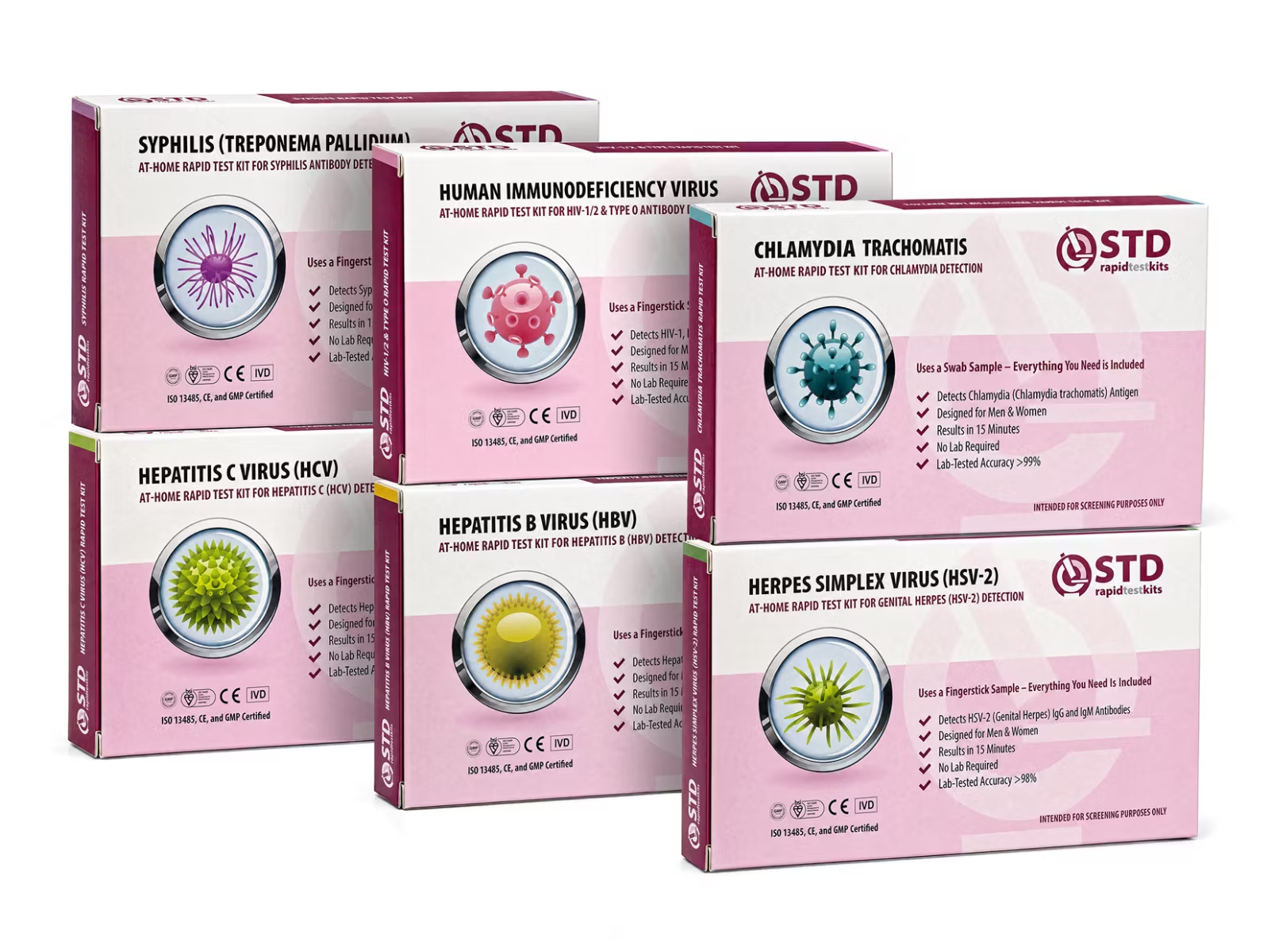
Once you know which window applies to your situation, the next decision is simply how you want to test. Clinic-administered NAATs remain the most analytically sensitive option for chlamydia and gonorrhea, and lab-based fourth-generation tests close the HIV window earliest. Rapid lateral-flow home tests use the same swab or fingerstick sample type as the lab equivalents but read out at home in about 15 minutes. They are useful as a screening tool, especially for people who would otherwise delay testing because of cost, schedule, or privacy. A positive at-home rapid test is worth confirming at a clinic; a negative result inside the correct window is generally meaningful.
This site sells at-home rapid STI test kits; the product links throughout this article connect to our own catalog. We recommend kits based on fit for the reader's concern, not commercial benefit.

Can Anxiety Really Create Physical Symptoms? Yes, and Here Is How
This is the part of the post-exposure spiral that almost nobody warns you about. Stress is not just psychological. It produces measurable physical effects, and several of those effects mimic the early signs people most fear. Once you understand the mechanism, the symptoms get less mysterious.
Acute stress activates the sympathetic nervous system. Cortisol rises, blood is redirected away from the skin and gut, muscle tension increases, and inflammation throughout the body ticks up. The skin in particular becomes more reactive. That can show up as itching, tingling, prickling, or a sense of warmth in areas you would otherwise pay no attention to.
Hyper-vigilance amplifies the effect. When you are scanning yourself for symptoms every 20 minutes, you start noticing baseline sensations that have always been there: a tiny patch of dry skin, the brush of fabric against the inner thigh, a faint awareness of the urinary tract that has been there for years. Each new noticing feels like evidence of something new, when really it is just attention being turned somewhere it never used to land.
Anxiety can also produce genuinely new sensations, especially in the genital region, because the pelvic floor is highly responsive to stress. Tightening pelvic muscles can create burning, pressure, or referred discomfort that has nothing to do with infection. The same pattern shows up around the mouth and throat when oral exposure is the worry.
Your body is producing those sensations as part of the stress response itself. Chronic activation of a system designed for short bursts of danger creates real physical effects, even when no pathogen is involved. The sensations are real, and their origin in most post-exposure spirals traces to your nervous system rather than to an infection. Once you give the mechanism a name, you can start sorting which sensations need attention and which will fade on their own.
| Anxiety-driven sensation | More likely real STI indicator |
|---|---|
| Random tingling that moves location or comes and goes within hours | Persistent discharge that has changed color, smell, or consistency |
| Heightened awareness of normal sensations, especially after symptom checking | A visible sore, ulcer, blister, or rash that stays in one spot for days |
| Symptoms that worsen when you focus on them and ease when distracted | Symptoms that persist regardless of focus or activity |
| Vague pelvic, urethral, or throat sensations that shift hour to hour | Painful urination or pelvic pain that follows a steady, predictable pattern |

What Responsible Action Actually Looks Like in Practice
The myth about responsibility is that it looks like constant vigilance. The reality is that responsible care is structured and quiet. It does the right thing once at the right time, then steps back. The two columns below split the actions worth taking from the behaviors that masquerade as responsibility but are really anxiety management.
| Responsible action after a possible exposure | Looks responsible but is actually anxiety |
|---|---|
| Document what happened in concrete detail so you stop re-litigating it from memory. | Daily symptom self-exams that are really re-checking for reassurance. |
| Identify the specific infections of concern and write down each one's window period. | Multiple home tests in the same week before any window has closed. |
| Set a single test date on a calendar based on the longest relevant window. | Googling the same symptom from different angles to find a different answer. |
| Contact a clinic about PEP within 72 hours if a high-risk HIV exposure is in question. | Treating uncertainty as a sign that something must be wrong. |
| Test once at the right time with a method you trust, then trust the result. | Repeated reassurance-seeking from friends, partners, or online forums. |
| Retest a single time at the outer window only if your first test fell at the early edge of its range. | Booking a second test the moment a negative comes back, before the window has closed. |
When a Symptom Is Worth Taking Seriously
The flipside of the “anxiety creates sensations” point is that some symptoms genuinely do warrant action sooner than the standard window. The trick is knowing which ones.
Symptoms that are worth contacting a clinician about right away, not waiting for a window to close, include:
- Persistent unusual discharge that has changed color, smell, or consistency.
- A visible sore, ulcer, blister, or rash in the genital, anal, or oral area that lasts more than a day or two.
- Painful urination that persists beyond a single episode.
- Significant unexplained pelvic, scrotal, or testicular pain.
- Fever or flu-like symptoms appearing two to four weeks after a possible exposure (a recognized pattern for acute HIV and other systemic STIs).
Each of those warrants a call to a clinician. The question has shifted from general screening to evaluating something specific that a clinician can act on directly, like swabbing a visible lesion, without waiting for the standard antibody window to close.
The contrast with anxiety-driven sensations is usually consistency and progression. A real symptom tends to stay put, behave the same way under different conditions, and follow a predictable arc over a few days. An anxiety-driven sensation shifts location and intensity, gets worse when you focus on it, eases when distracted, and often disappears for hours before returning stronger when you check again. When in doubt, take a photo of any visible finding so you have a record, then call a clinic and describe what you are seeing. You do not have to self-diagnose.
Call a clinic now if you have a visible sore, ulcer, blister, or rash that has stayed in one spot for more than a day or two, persistent unusual discharge, painful urination across more than one episode, significant pelvic or testicular pain, or fever and flu-like symptoms two to four weeks after exposure.
Wait for your window and test on schedule if your sensations are shifting, vague, brief, or worse when you focus on them and easier when you are distracted. Those patterns are anxiety, not infection, and re-checking does not change the answer.
How a Real Plan Replaces a Spiral
The single biggest panic-reducer in the entire process is a written plan. Not an elaborate one. A few lines on a calendar.
Something this small is enough:
- Test date: the exact date based on the longest relevant window.
- Test type: home kit ordered, or clinic appointment booked.
- Backup retest date: outer window for the highest-stakes infection.
- Symptom check-in: once per day at most, written down.
The plan works for a specific reason: it tells your brain there is an answer coming, and it tells it exactly when. The chronic activation of threat surveillance gets a stop signal. The “should I be doing something right now” question gets answered: yes, you are doing it; the doing is waiting until the calendar date, then executing.
Anyone who has been through a serious health-anxiety episode will recognize this pattern. The anxiety eases because you replaced an open-ended unknown with a defined process. Reassurance is a single-use band-aid. Structure is durable.
The hardest part is allowing the plan to do its work. Most people make a plan and then second-guess it eight times in the first week. If you find yourself doing that, the answer is to write the original plan in a visible place and refer back to it instead of relitigating it.
Many STIs have no symptoms or may only cause mild symptoms, so people can have an infection and not know it. That is why getting an STI test is important if you are having sex.
How to Survive the Waiting Period Without Losing It
The window between exposure and test date is where most of the suffering actually lives. The exposure itself is over. The testing decision is made. What is left is the waiting, which is the part the human brain handles worst.
A few practical things tend to help. Set a deliberate ceiling on the time you spend thinking about it each day. Some people give themselves 15 minutes in the evening to revisit everything and then close the topic until the next evening. Some block specific search terms in their browser. The mechanism is the same: contain the thinking instead of letting it spread across the whole day.
Keep your normal rhythm. Sleep, food, exercise, social contact. Anxiety scales with sleep deprivation, low blood sugar, and isolation; defending those three things is not avoidance, it is stabilization. The version of you that has been awake at 2 a.m. for four nights is going to interpret every sensation more catastrophically than the version of you that slept.
If checking your body is becoming compulsive, set a single time of day for it (morning shower, for example) and refuse to do it outside that window. Compulsive checking is one of the most reliable amplifiers of perceived symptoms; reducing the checks usually reduces the perceived symptoms within a few days.
Talk to one trusted person if you can. The act of saying what is happening out loud, to a friend or partner who is not going to spiral with you, takes a significant amount of charge out of it. The shame element of post-exposure anxiety is a major driver of how loud it gets in your head, and shame is the thing that loses power the fastest when you simply name it to one other person.
Four stabilizers for the waiting period
- Daily worry ceiling: pick a 15-minute window in the evening, revisit everything once, then close the topic until tomorrow.
- Defend sleep, food, and routine: anxiety scales steeply with sleep deprivation, low blood sugar, and isolation, so these three are stabilizers, not luxuries.
- Cap body-checking at once a day, at a set time: compulsive checking is the single biggest amplifier of perceived symptoms.
- Name it to one trusted person: shame loses power fastest when you say the situation out loud to someone who will not spiral with you.
Testing Once, Properly, at the Right Time
When your window date arrives, the test itself is anticlimactic, which is the point.
If you are testing at home, follow the kit's instructions to the letter. Most false results from home tests trace back to either testing inside the window or to user error: sample contamination, insufficient sample, or reading the result outside the timing window the kit specifies. Read the result inside the time the instructions specify, not before, not after.
If you get a negative result and your test fell inside the recommended window, the calmest interpretation is that the result is meaningful and the spiral can end. If your result was at the early edge of the window, the CDC's HIV testing guidance is straightforward: when an HIV test after a potential exposure comes back negative, get tested again after the window period for the test type you used (CDC: HIV Testing). For an at-home antibody test that opens its window around 23 days, that means a confirmatory retest closer to the outer end of the 23-to-90-day range.
If you get a positive result, it is the start of treatment, not the end of the world. Most bacterial STIs (chlamydia, gonorrhea, syphilis, trichomoniasis) are curable with antibiotics. Viral infections (HIV, hepatitis B and C, HSV) are now manageable with current care, often without significantly limiting daily life. The single factor that worsens outcomes is delay, and you have already done the hard part by testing in the first place. Get a clinician on the phone the same day if you can, follow their plan, and tell any recent partners so they can do the same.
The Short Version If You Got Lost Above
You had an uncertain moment, and your brain has been treating it like a five-alarm fire. The right response is not to react faster than the situation requires, and it is not to ignore the situation either; it is to give the situation exactly the structure it needs and nothing more.
In practice, that means writing the situation down so you stop interrogating it from memory, looking up the relevant window periods for the infections that fit the exposure, and then putting a single test date on the calendar based on the longest of those windows. The days in between are managed like any other uncomfortable stretch of waiting, with sleep and routine defended and the time you spend re-litigating the moment kept on a leash. When the date arrives, the test is taken once with a method you trust, the result is read inside the timing the instructions specify, and the result is allowed to mean what it says. Everything else happening in your body during the wait is your nervous system, and the calmer you are with it, the faster it eases off.
FAQs
- How long after a possible exposure should I actually wait before testing?
- It depends on the infection. Chlamydia and gonorrhea: around 1 to 2 weeks. Syphilis: 3 to 6 weeks. HIV antibody tests including most at-home rapid kits: the CDC's window is 23 to 90 days, with the outer end (around 12 weeks) used as the confirmatory retest point if you tested early. If you are uncertain which window applies, default to testing at the longest relevant window for a clean result, and only retest earlier if symptoms appear.
- Can stress really cause physical symptoms that feel like an STI?
- Yes, and it is more common than people realize. Acute stress activates the sympathetic nervous system, which heightens skin sensitivity, increases muscle tension (including pelvic floor), and amplifies your awareness of normal sensations. Tingling, itching, prickling, and pelvic burning are all common stress responses. They are real sensations, but the cause is your nervous system, not a pathogen.
- I had a low-risk exposure but I cannot stop panicking. What helps fastest?
- A written plan with a specific test date helps faster than any reassurance. Reassurance fades within hours; a calendar entry tells your brain the question has an answer coming. Combine that with a daily cap on how much time you spend thinking about it (15 minutes max), and protect your sleep. Anxiety scales steeply with sleep deprivation.
- If I test before the window closes, am I just wasting money?
- Mostly yes. A negative result inside the window is not reliable and usually drives more anxiety rather than less, because you cannot trust it. The exception is if symptoms appear that warrant clinical evaluation (visible sore, persistent discharge, fever), where a clinician can act on the symptoms themselves rather than relying solely on the screening test.
- When should I go to a clinic instead of testing at home?
- Go to a clinic if a high-risk HIV exposure happened in the last 72 hours and you want PEP, if you have visible symptoms that need evaluation, if you tested positive at home and need confirmation and treatment, or if your situation involves possible exposure to throat or rectal sites, which need swab tests not available in our at-home kit lineup.
- How accurate are at-home rapid tests compared to clinic tests?
- For most people, a home kit taken inside the correct window is enough to answer the question. Add a clinic visit when you specifically need earlier detection (e.g., a clinic NAAT for chlamydia or gonorrhea at the early edge of the window), confirmation of a positive home result before treatment, or evaluation of a visible symptom a screening test cannot interpret.
- Do I need to tell my partner before I get my result?
- Not necessarily. Many people choose to wait until there is a result to discuss. The exception is if you know your partner is also at risk and is waiting on the same window: telling them lets them start their own clock. If there is a positive result later, telling recent partners so they can be tested is part of responsible follow-through, but it is not an immediate first-48-hours task.
- What if I keep retesting and getting negatives but still feel something is wrong?
- If you have completed appropriate testing at the correct window and are still experiencing physical sensations or escalating anxiety, the issue has likely shifted from infection risk to health anxiety. That is a treatable problem in its own right and is worth discussing with a primary care clinician or therapist. Continuing to retest will not resolve it and tends to make it worse over time.
You Deserve Clarity, Not a Constant Spiral
Panic after possible STD exposure feels intense, but intensity does not equal accuracy. It turns normal sensations into “symptoms,” and uncertainty into something that feels urgent and dangerous. The goal is not to shut down your concern. The goal is to separate what actually matters from what your anxiety is trying to amplify.
If there was real risk, follow the timeline and test at the right moment. If you are in the waiting window, let time do its job instead of trying to force answers early. If symptoms show up clearly and consistently, take them seriously and see a clinician; if they shift and respond to your attention, treat the anxiety, not the sensation. Each step is about replacing guessing with something solid.
The three-step action path
- Wait: do nothing reactive in the first 48 hours unless a high-risk HIV exposure is in play (PEP within 72 hours).
- Test at the window: pick the longest relevant window for the infections that fit your exposure, set a date, and test once on schedule.
- Trust the result: a negative inside the correct window is meaningful; a positive is the start of treatment, not the end of the world.
- U.S. Centers for Disease Control and Prevention. About STIs, an overview of common sexually transmitted infections, including the point that many infections cause no symptoms and that testing is the only way to know.
- U.S. Centers for Disease Control and Prevention. HIV Testing, including window periods for antibody, antigen/antibody, and nucleic acid tests and the recommendation to retest after the test type's window if exposure occurred.
- U.S. Centers for Disease Control and Prevention. PEP (post-exposure prophylaxis) for HIV, including the 72-hour window in which PEP must be started.
- UK National Health Service. Sexually transmitted infections (STIs), an overview of testing options and when to seek clinical evaluation.
- World Health Organization. Sexually transmitted infections (STIs) fact sheet, global incidence and testing guidance.
