
Published: December 2025 | Last updated: May 2026 | Editorial review and quality control: Martina N.
There is a quiet moment when a partner’s confidence about their STI status starts to feel rehearsed. Maybe they answered too fast. Maybe they pivoted to a joke. Maybe you noticed, hours later, that they never actually said what they were tested for, or when. If that doubt has settled in, you are not paranoid. You are paying attention.
This guide walks through what dishonesty about STI status tends to look like, why it happens, and what to do next, whether you have already been hurt by a lie or you are trying to head off the harm before it lands. The goal is not suspicion. The goal is enough information to make a clear decision about your own body.
Key takeaways
- Most dishonesty about STI status comes through vague language, not outright denial. “I’m clean,” “I was tested,” and “I have no symptoms” each sound reassuring without telling you anything specific.
- A recent test is only useful if it covered the right infections at the right time. Window periods vary by infection, and what a panel actually screens for matters as much as the date on the result.
Why people lie about their STI status
Most people do not plan to deceive a partner. The lie usually grows out of something quieter: shame, embarrassment, an old diagnosis they have never said out loud, or a vague belief that “I feel fine” means “I am not infectious.” Public-health data is consistent on this point. Many people living with chlamydia, gonorrhea, herpes, or HPV are asymptomatic, especially in early or chronic stages. Someone can carry an infection for months or years and genuinely believe they are not a risk.
Other times the dishonesty is more deliberate. The person knows their status and chooses silence because disclosure feels too costly. They worry about rejection, about being labelled, about a partner who will not have sex with them once they know. Public-health stigma around STIs is the engine that makes this kind of silence common, even among adults who would otherwise treat their partner well.
There is also the half-truth category. “I was tested” can mean “I had an HIV test three years ago” or “the clinic took a urine sample and I never asked what for.” Those statements feel honest to the person saying them and still leave the listener exposed to risks they think they have ruled out.
Why someone lied shapes how you respond. Hiding a manageable diagnosis is a different situation from actively misleading you, but the consequence to your body is the same: you cannot make an informed choice about sex without accurate information. What helps is learning to ask better questions, and giving yourself permission to walk away when the answers stay vague.
Genuinely unaware. The person feels fine, last tested years ago, and equates “no symptoms” with “no infection.”
Deliberate silence. They know their status and choose not to disclose because they fear rejection.
Half-truths. “I was tested” is technically true, but the test was old, narrow, or done before the relevant exposure.
The quiet tells: patterns that often signal dishonesty
Sometimes the dishonesty is not in the words. It can show up in the pause, the redirection, the slightly too confident “trust me.” People who are hiding something often shift the conversation back onto you. They say things like “you are being dramatic” or “I know my body, I would know if something was wrong.” Both deflect rather than answer the question.
The table below is a pattern checklist. None of these signals is proof on its own. Some people are simply awkward about sexual health, and a single clumsy answer is not evidence of anything except that the conversation is hard. When several patterns cluster together, the cluster is what is worth paying attention to.
| Behavior or statement | What it may signal |
|---|---|
| “I don’t need to be tested. I’ve only been with clean people.” | Relies on past partners’ honesty rather than evidence. Often means they have not tested recently. |
| Changes the subject or jokes when you bring up testing | Discomfort that may be hiding something they do not want to discuss. |
| Says they test “regularly” but cannot say when, where, or what was checked | Vague enough to imply effort without committing to a specific result. |
| Calls your concern “paranoid” or “uptight” | Deflection. Reframes a reasonable question as your personal problem. |
| “I’m clean.” | “Clean” is a stigma word, not a medical status. It does not say which infections, when, or how. |
What “I got tested” actually means
“I got tested” is one of the most common things people say, and one of the least specific. A meaningful answer covers three things: which infections were screened, when the test was done, and whether enough time had passed since the last possible exposure for the result to be reliable.
That last piece is the window period, the gap between exposure and when a test can detect the infection. Window periods are not the same for every infection. A negative HIV test taken a week after a risky encounter is no guarantee of safety. Lab-based 4th-generation HIV antigen and antibody tests typically reach reliable detection within 18 to 45 days after exposure, while rapid (fingerstick) antigen and antibody formats can take up to 90 days. A herpes IgG antibody test taken three weeks after exposure can easily miss a new infection.
The ranges below come from current CDC and WHO testing guidance. They are general windows for typical cases, not guarantees for any individual.
| Infection | Common test type | Earliest useful result | More reliable window |
|---|---|---|---|
| Chlamydia | NAAT (urine or swab) | About 1 week | 2+ weeks |
| Gonorrhea | NAAT (urine or swab) | About 1 week | 2+ weeks |
| HIV | 4th-generation antigen/antibody | 18 days | 45 days (lab) / up to 90 days (rapid fingerstick) |
| Syphilis | Treponemal antibody blood test | 3 weeks | 6+ weeks |
| Hepatitis B | Surface antigen blood test | 3 to 6 weeks | 8+ weeks |
| Herpes (HSV-2) | Type-specific IgG antibody (blood test for herpes antibodies, not active viral detection) | 6 to 8 weeks | 12 to 16 weeks |
When you have already been lied to
For some readers this is not a hypothetical. You are not weighing whether to ask the question. You are staring at a result you did not expect. The clinic confirmed it. The at-home kit confirmed it. And the partner who said they were “fine” suddenly has a more complicated story.
Betrayal at the intersection of intimacy and health hits differently. On the physical side, most outcomes are workable. Common bacterial STIs (chlamydia, gonorrhea, syphilis, trichomoniasis) resolve with a course of antibiotics. Hepatitis B and HIV are managed with long-term care that has dramatically improved outcomes over the past two decades. Herpes and HPV are common, generally manageable, and rarely as life-shaping as the stigma around them suggests.
Rerunning every past conversation is a normal response after a betrayal like this. You may find yourself replaying every signal you might have missed, every time you let “I’m clean” pass without a follow-up. That spiral does not mean your instincts failed you. People who deceive partners about health usually do it well. The dishonesty rarely arrives loudly, and asking a reasonable question does not make you immune to a confident lie.
What helps next is structure. Get treated where treatment exists. Retest at the right window where re-testing is recommended. Find someone (a clinician, a counsellor, a trusted friend) to help you process the part that does not get fixed with antibiotics.
Confronting them: what actually helps
The instinct after a diagnosis is often to draft an angry message. Screenshot the result. Demand an apology. Some of those responses are valid. But it helps to know what confrontation usually accomplishes and what it usually does not.
What it does not accomplish: an admission, an apology that feels proportionate, or closure that survives the next day. People who lie about their status are often skilled at deflecting accountability. Some deny everything. Some pivot to gaslighting, suggesting you picked the infection up elsewhere or that you are exaggerating the diagnosis. That response is a defensive script people reach for when they feel cornered, not the truth.
What it can accomplish is communicating a clinical fact and protecting others. A short, factual message (“I tested positive for [infection]. You should get tested. You should also notify anyone else who may have been exposed.”) gives the other person what they need to act, and gives you the dignity of having said it plainly. You do not owe them politeness. You also do not owe them a fight.
Some public-health departments offer anonymous partner-notification services, which can deliver the message without revealing who sent it. They exist precisely for situations where a direct message would be unsafe or would not be heard, and reaching out through one of them protects both you and anyone else the person may have exposed.
Testing after a possible exposure
If a partner’s honesty is in question and you have not tested yet, the practical question is when. Testing too early misses recent infections. Waiting too long for the reassurance also has a cost. An anxious week is not a free week.
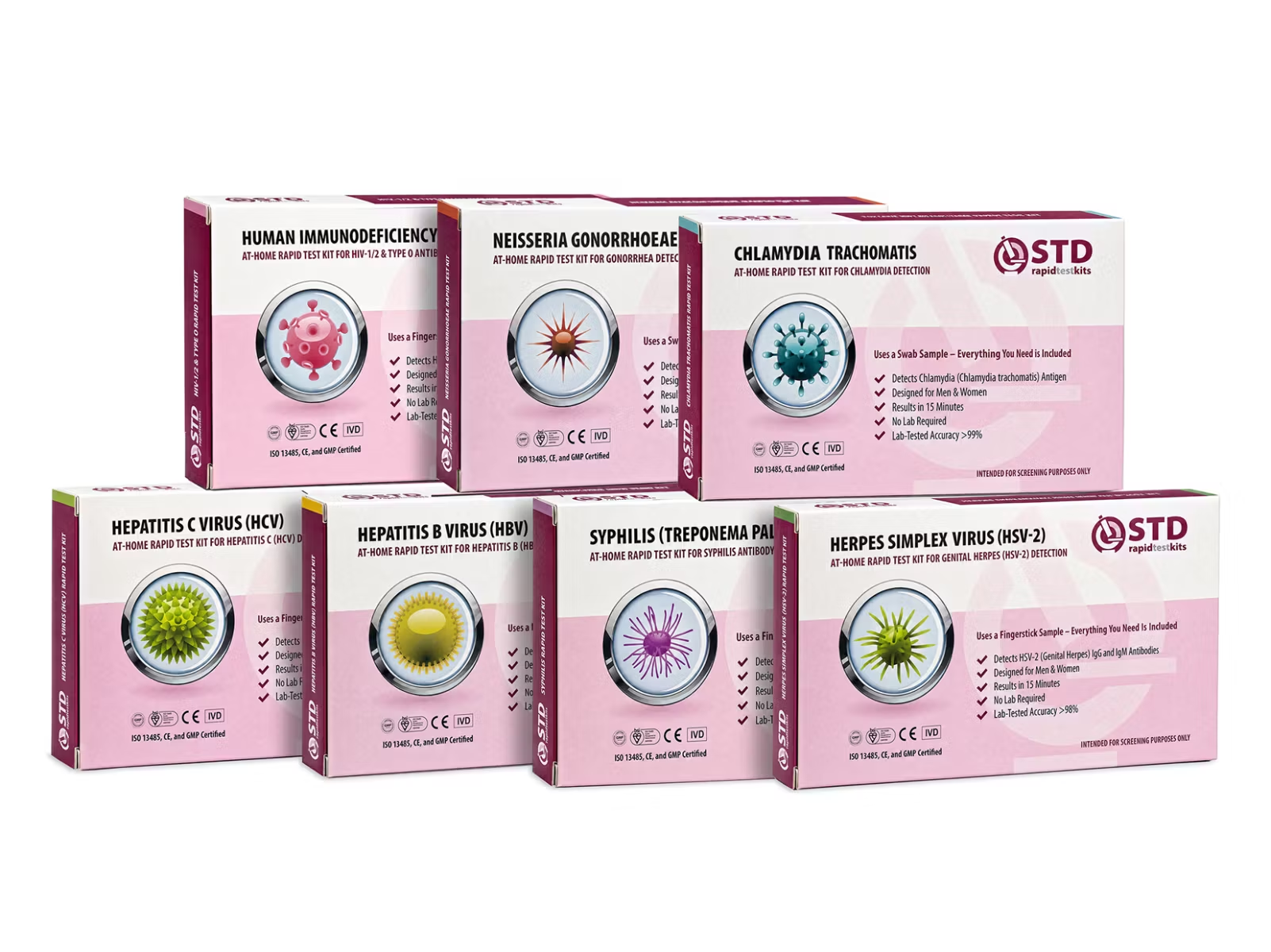
What follows is a general roadmap. It assumes a single possible exposure event. If you have had repeated exposures, treat the clock as starting again with each one. And a note on commercial context before the kit recommendation below: this site sells rapid at-home STI tests, so the kits linked in this article are our own products. Use them where the format fits your situation, and confirm any positive result with a lab.
| Days since possible exposure | What is reasonable to do |
|---|---|
| 0 to 6 days | Too soon for most tests to be reliable. Monitor for symptoms. Plan to test on or after day 7. |
| 7 to 13 days | Chlamydia and gonorrhea may now be detectable. Test, but plan to retest at week 3 to confirm. |
| 14 to 21 days | Reliable window for chlamydia and gonorrhea. Still early for HIV, syphilis, hepatitis B, and herpes. |
| 3 to 6 weeks | Workable window for HIV (4th-generation test) and for early syphilis serology. Still early for some herpes tests. |
| 6 to 16 weeks | Window for hepatitis B surface antigen and for most herpes IgG antibody tests. |
When lies cross into manipulation
Some dishonesty is clumsy. Some is calculated. There is a meaningful difference between a partner who did not know how to start the conversation and a partner who pressured you into unprotected sex, lied about testing, and then blamed you when the result came back positive. The second pattern crosses from dishonesty into coercion.
Many jurisdictions have laws covering knowing exposure to specific STIs without disclosure, especially HIV. Those laws are imperfect, and their application is contested by public-health advocates. Their existence reflects a basic principle: consent to sex is not informed consent if a partner has actively misled you about their status.
If you recognize yourself in this pattern, talking to someone outside the relationship often helps. A clinician, a partner-violence advocate, or a hotline that specializes in sexual and reproductive health can help you sort the immediate health steps from the longer emotional aftermath. The harm here is real, and it is not measured only by what happened in the lab.
Pressure to skip protection despite your explicit ask. Repeated refusal to disclose testing details after multiple direct questions. Blame shifted to you after a positive result the other person should reasonably have anticipated. Any of these patterns is worth raising with a partner-violence advocate or a sexual-health hotline, not only with a clinician.
Scripts for asking about testing
Asking about STI testing is hard mostly because nobody has taught you the language for it. The goal is to ask early, plainly, and without apologizing for the question. A few examples:
Before things get physical. “Before we go further, I want to share my last test result. Can you share yours? Recent panels usually cover chlamydia, gonorrhea, syphilis, and HIV, and I want to confirm what was on yours.”
After things have already been physical and you have started to wonder. “I realize I didn’t ask you about testing the last time we saw each other. Can we catch that up? I’d like to know when you were last tested and what the panel covered.”
When they say “I’m clean.” “I get what you mean, but ‘clean’ is doing a lot of work in that sentence. Can you tell me what you were tested for and roughly when?”
When they get defensive. “I’m not accusing you of anything. I’m asking the same question I’d ask anyone, and the same question I’d want asked back.”
Directness is not rudeness, and a partner who treats it as rudeness is showing you something useful. Asking for specifics does not ruin the moment. The much worse outcome is finding out later, after a diagnosis, that the moment cost you a lot more.
Many sexually transmitted infections have no signs or symptoms. The only way to know if you have an STI is to get tested.
Rebuilding your sense of safety
After being deceived, the idea of “safety” can feel hollow. You asked the right question, used protection, and trusted what you were told, and the infection still arrived. That outcome does not mean your instincts failed. What helps next is shifting from a single-question model (“Have you been tested?”) to a smaller habit set: asking for specifics, sharing your own results when reasonable, retesting after new partners, and treating evasive answers as their own kind of answer.
This shift is not about becoming cynical. It is about respecting your body’s right to accurate information. People who care about you will not be offended by a clear question. The ones who are, are sometimes telling you the truth about themselves by being offended. You do not have to confront that. You can simply walk away.
Therapists, advocates, and peer support groups all exist for the aftermath of sexual betrayal. Reaching out to them is a practical step that most people who have been through this are glad they took.
Moving forward, on your terms
There is no policy that prevents someone from lying. There are habits, though, that make it less likely you will be caught off guard.
- Ask about testing before sex, not after.
- Share your own most recent result. Modeling specificity makes evasive answers stand out.
- Treat “clean” as a follow-up cue, not an answer.
- Plan to retest after new partners, even when protection was used.
- Walk away from people who mock or punish you for asking.
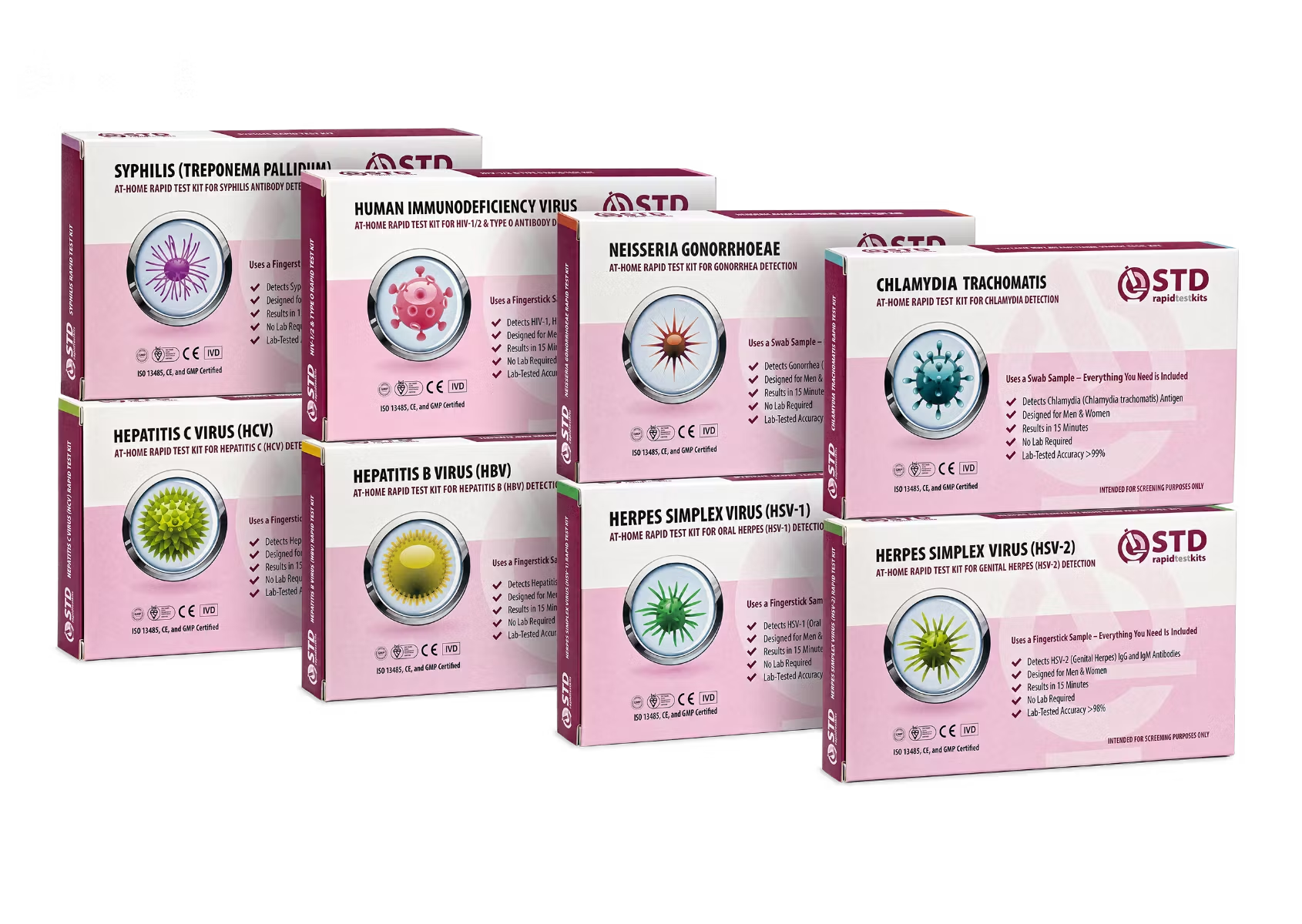
A broad at-home combination kit is a reasonable backstop when you want answers without scheduling a clinic visit. Use it at the right window for each infection. Confirm positives with a lab. The point is not to replace medical care. The point is to close the gap between an uncertain situation and a clear next step. Wanting accurate information before making decisions about your own body is a reasonable standard, and one worth holding to with any partner you sleep with.
FAQs
- Is it really common for people to lie about their STI status?
- Yes, more common than most people would like to admit, and usually quiet rather than dramatic. Surveys of adults consistently find that significant minorities have not disclosed an infection to at least one past partner, most often citing fear of rejection or judgment. That is why specificity matters more than promises. Asking what was tested, when, and at what point after a possible exposure is the part that does the actual work.
- They told me they were “clean.” Does that actually mean anything medically?
- Ask for the three specifics: which infections were on the panel, when it was done, and how long after a possible exposure. If they cannot answer all three, the “clean” claim does not actually tell you anything useful. Treat it as an opener for a clearer conversation rather than as a final answer.
- How long after a possible exposure should I wait before testing?
- It depends on the infection. Chlamydia and gonorrhea NAATs are typically reliable about a week after exposure, with two weeks more dependable. HIV antigen and antibody tests are most reliable from 45 days for lab-based formats, or up to 90 days for rapid fingerstick formats. Herpes IgG tests can return a result as early as 6 to 8 weeks after exposure, though 12 to 16 weeks is considered more reliable for ruling out a new infection. A single test the day after an exposure rarely tells you what you want it to.
- A routine STI panel didn’t include herpes. Is that normal?
- Yes, and it is worth asking about. Current CDC recommendations generally do not include routine herpes screening for asymptomatic adults, partly because antibody tests can return false positives in low-prevalence populations. If you specifically want a herpes result, you usually need to ask for a type-specific IgG test directly.
- We used a condom. Can I still have caught something?
- Yes, although consistent condom use significantly reduces transmission for most STIs. Condoms work best against infections spread through fluids, including chlamydia, gonorrhea, HIV, and hepatitis B. They reduce, but do not eliminate, risk from skin-to-skin infections such as HSV and HPV, because those can spread from areas a condom does not cover.
- I tested positive after someone lied to me. What do I do first?
- Get treatment if the infection is treatable. Most common bacterial STIs are. Then think about partner notification. You do not have to confront the person directly. Anonymous partner-notification services, offered through some public-health departments, will pass the message along without revealing your identity. Your own health choices come first.
- Do I have to tell future partners that I caught this from someone who lied?
- You are not obligated to share the backstory. Disclosure focuses on the current infection rather than how you got it. For long-term conditions such as HSV and HPV, disclosing before sex is part of informed consent for the next partner. How much context you add beyond that is your call.
- Can an at-home rapid test really replace a clinic test?
- It depends on the question you are trying to answer. Lateral-flow rapid tests are useful for a confidential first look at the right window for each infection. For positives, confirm with a lab, especially for HIV, syphilis, and hepatitis. For complicated cases such as symptoms or recent unprotected exposure, a clinic gives you treatment in the same visit. Home tests and clinic care work as complements, with each filling a different need.
How we sourced this article. This guide summarizes current public-health and clinical guidance on STI testing, window periods, partner notification, and consent. Sources include the U.S. Centers for Disease Control and Prevention, the World Health Organization, the UK National Health Service, and Planned Parenthood. It is editorial information, not clinical advice. For symptoms, recent exposures, or a confirmed diagnosis, see a licensed clinician.
- U.S. Centers for Disease Control and Prevention. Getting Tested for STIs: general guidance on STI testing and which infections to consider.
- U.S. Centers for Disease Control and Prevention. HIV Testing: reference for HIV window-period figures and 4th-generation antigen/antibody testing.
- World Health Organization. Sexually transmitted infections (STIs) fact sheet: prevalence framing and global context on asymptomatic STIs.
- U.S. Centers for Disease Control and Prevention. Talking with your partner about STIs: conversation framing and partner-notification context.
- U.S. Centers for Disease Control and Prevention. STI Treatment Guidelines: Genital Herpes. Background on why routine STI panels often do not include herpes serology.
- Planned Parenthood. Get Tested for STDs: overview of STI testing options, timing, and partner notification.
- UK National Health Service. Sexually transmitted infections (STIs): general patient-facing testing and symptom guidance.
