
Published: October 2025 | Last updated: May 2026 | Editorial review and quality control: Martina N.
What happens if syphilis is never treated?
It moves through four stages over years. The early sore and rash heal on their own, then the infection goes quiet for months or decades. In roughly 15 to 40 percent of untreated cases it eventually damages the heart, brain, eyes, or nerves. Penicillin cures it at any stage, so testing is what matters most.
Marcus is not a real patient. He is a constructed case built from the symptom patterns that the CDC and Mayo Clinic describe in their syphilis guidance: a painless sore that heals on its own, a rash that looks like stress hives, a long quiet stretch where nothing seems wrong, and then nerve symptoms that finally force the conversation. Using one composite story makes the timeline easier to follow, but the science underneath is what matters. This article walks through each stage of untreated syphilis, what testing looks like at each point, and why catching it early changes everything.
The short answer to how long syphilis stays in the body without treatment is: for life, in many cases. The bacterium responsible, Treponema pallidum, does not self-clear. The CDC notes that untreated infection can progress to serious late-stage disease, and historical natural-history studies from the pre-antibiotic era, including the Oslo cohort, estimate that roughly 15 to 40 percent of untreated cases eventually reach that point, sometimes 30 years after the original infection. The majority do not progress that far. No one can predict in advance which group they will land in.
Key Takeaways
- Untreated syphilis moves through four stages. The early sore and rash often go away on their own, but the bacteria stay in the body and can damage the brain, heart, eyes, and nerves years later.
- Penicillin cures syphilis at every stage. Damage already done in late disease may not fully reverse, so testing at 6 to 12 weeks after a possible exposure is the move that matters most.
The Silent Start: Primary Syphilis and the Vanishing Sore
The story always starts the same way. A few weeks after exposure, Marcus notices vague soreness in his groin area. He thinks it is an ingrown hair. Three to six weeks later, the spot has disappeared on its own. He decides his body handled it.
That is exactly how primary syphilis is supposed to read. The hallmark sign is a chancre, a single round ulcer that appears at the point where the bacteria entered the body, typically 10 to 90 days after exposure with an average around three weeks per the CDC 2021 STI Treatment Guidelines. It is usually painless, firm, and roughly 1 to 2 centimeters across with a clean base and raised borders. It can appear on the genitals, the anus, inside the rectum, on the lips, or in the mouth, and some people develop more than one chancre at once. Because the sore does not hurt and can sit somewhere out of sight, many people never notice it.
Here is the trap. The sore heals whether or not you treat the infection. The healing is real, the infection is not gone. The bacteria, Treponema pallidum, slip out of the local skin lesion and into the bloodstream, where they begin to spread to other tissues. By the time the chancre disappears, the disease has already moved on to its next phase.
If a chancre is still present, a clinic can swab fluid from the sore and look for the bacterium directly under a microscope. That direct test does not depend on antibodies and works even when blood serology has not yet turned positive. In Marcus's story, the visible chancre comes and goes before anyone sees it. The hidden interval that follows lasts about eight weeks. No fever, no fatigue, nothing that would push him toward a clinic.
The most dangerous thing about primary syphilis is that the sore goes away on its own, usually within 3 to 6 weeks. Many people read that as the body fixing the problem. It is not. The bacteria have already moved into the bloodstream and the disease is on its way to the next stage. A chancre that disappeared without treatment still needs follow-up testing.
Stage 2: Secondary Syphilis Shows Itself, Sort Of
Around the two-month mark, Marcus notices a faint rash across his torso. It does not itch. He assumes it is heat rash, or maybe a reaction to a new detergent. Then he sees the same pattern on his palms and on the soles of his feet, which strikes him as strange but not alarming. Within days he feels generally lousy: low-grade fever, achy joints, swollen glands in his neck, a headache that comes and goes.
This is the calling card of secondary syphilis. By this phase the bacteria have spread widely and the immune system is reacting. The Mayo Clinic describes the classic features as a non-itchy rash that often includes the palms and soles, sore throat, patchy hair loss, swollen lymph nodes, fever, and muscle aches. Wart-like growths called condylomata lata can also appear in moist areas like the groin or under the breasts. None of it is subtle in the way the primary chancre was, but most of it can pass for something benign: a viral illness, an allergic reaction, stress.
The diagnostic problem is that the rash looks like many other conditions. Pityriasis rosea, drug reactions, and viral exanthems all share elements of the pattern. Without a blood test, even experienced clinicians can misattribute the rash, and the patient gets reassurance instead of treatment. If a non-itchy rash appears weeks or months after a possible exposure, asking specifically for syphilis testing is reasonable regardless of what the rash looks like.
The cruelest part is what happens next. These symptoms fade, often within a few weeks, without any treatment. A lot of people read the disappearance as proof they were fine all along. They are wrong. The infection has just moved into its next phase, called latency, where it does its slow work without showing up on the skin.
Marcus describes the same illusion. "I felt better for a few days," he says, "so I told myself it passed." Meanwhile he had been infectious during both stages. Anyone with whom he had skin-to-skin sexual contact during that window was at real risk of catching it from him.
Secondary Syphilis: Signs to Know
These symptoms fade within a few weeks even without treatment. Fading symptoms do not mean the infection has cleared, only that it has moved into the latent stage. Only a blood test can confirm syphilis.
- Non-itchy rash on the trunk that often spreads to the palms and soles, easy to mistake for heat rash, eczema, pityriasis rosea, or a viral rash Common
- Fever, sore throat, muscle aches, and swollen lymph nodes that read like a stubborn flu that never quite hits hard Common
- Patchy hair loss on the scalp, eyebrows, or beard area Less common
- Wart-like growths (condylomata lata) in moist body folds: groin, under the breasts, between the buttocks Less common
Latent Syphilis: The Quiet Years
Latent syphilis is the stage with no obvious symptoms. The bacteria are still in the body, still capable of doing damage, but the immune system has tamped them down enough that the rash, the fever, and the swollen glands are gone. The CDC 2021 STI Treatment Guidelines divide latency into early latent (less than a year from infection) and late latent (a year or more), because the early window still carries a meaningful risk of transmission to sexual partners through relapses of the secondary rash and mucous patches, while later latency carries much less.
Late latent and unknown-duration latent syphilis is generally not transmitted sexually, but pregnancy transmission to the fetus remains possible at any stage of the parent's infection. That is one of the most important reasons screening exists at all.
This middle stretch can last years or even decades. For the 15 to 40 percent who eventually develop tertiary disease, much of the slow vascular and neurological damage plays out during this phase. The majority will never reach that stage, but the uncertainty is the point.
Marcus spends about a year in latency. He has stiff mornings in his back. Twice he gets a flicker of blurred vision that resolves the same day. He chalks it up to overwork. The bacteria are still active inside small blood vessels, in nerve tissue, and in slow inflammatory damage to the aorta.
Without treatment, syphilis can spread to the brain and nervous system (neurosyphilis), the eye (ocular syphilis), or the ear (otosyphilis).
Tertiary Syphilis and Neurosyphilis: The Damage Becomes Visible
Marcus's nerve symptoms eventually worsen. He stumbles in his kitchen. He gets shooting electric pains in his legs. His memory feels patchy. His mood swings unpredictably. By the time he sees a neurologist, the workup confirms what the latent years had been building toward: neurosyphilis.
Tertiary syphilis is what doctors call the late, organ-damaging phase. According to the Mayo Clinic, it can show up as cardiovascular syphilis (most often affecting the aorta), gummatous syphilis (soft tissue lumps that can invade bone and skin), or neurosyphilis when the central nervous system is involved. Any of the three can occur years or decades after the initial infection.
Neurosyphilis itself has classic patterns. Tabes dorsalis is a degeneration of the back parts of the spinal cord that produces stabbing leg pains, loss of reflexes, balance problems, and bladder issues. General paresis is a slow erosion of memory, judgment, and personality that, untreated, can progress to dementia. Vision loss from ocular syphilis and hearing loss from otosyphilis can also happen in earlier stages, and current CDC guidance and recent clinical literature emphasize that they can appear in patients still in the primary, secondary, or latent phases. Both are medical emergencies. Anyone with new vision or hearing symptoms plus any history of possible syphilis exposure should be evaluated urgently.
Once tertiary damage develops, antibiotic treatment can still stop the infection from progressing further, but it cannot reverse existing tissue damage. Aortic aneurysms do not shrink, dementia does not improve, and lost vision does not return. The CDC notes that, left untreated, syphilis can ultimately cause serious medical problems and even death. The CDC and WHO both flag these complications as preventable: catching the infection in stage 1 or stage 2 makes the entire tertiary path moot.
For Marcus, the diagnosis lands hard. A painless sore he barely noticed, a rash he attributed to stress, and a year of feeling tired had compounded into something that now needed a spinal tap to characterize.

The Full Progression at a Glance
Each stage has its own typical window and its own signature. The table below pulls together the timing and the dominant features so it is easier to map a possible exposure to the right testing decision.
| Stage | Typical timeline (if untreated) | Main features | What is happening internally |
|---|---|---|---|
| Primary | 10 to 90 days post-exposure | Single painless sore (chancre), often unnoticed | Bacteria entering at the site of contact and spreading to the bloodstream |
| Secondary | 4 to 10 weeks after the chancre | Non-itchy rash including palms and soles, fever, swollen lymph nodes, hair loss | Bacteria circulating widely; immune system mounting a systemic response |
| Early latent | First 12 months after infection | No outward symptoms; still sexually transmissible | Bacteria persisting in tissues; occasional secondary-stage relapses possible |
| Late latent | Beyond 12 months, often years to decades | No outward symptoms; sexual transmission unlikely, congenital transmission still possible | Slow vascular and neurological damage in 15 to 40 percent of untreated cases |
| Tertiary / neurosyphilis | 10 to 30 plus years after infection | Aortic damage, gummas, neurological decline, vision loss, hearing loss | Cumulative organ damage; central nervous system involvement in neurosyphilis |
How Testing Works and Why Timing Matters
Syphilis testing is mostly blood work. The Mayo Clinic diagnostic protocol uses a two-step approach. A first screen looks for non-treponemal antibodies (RPR or VDRL); a positive result is then confirmed with a treponemal test that detects antibodies specific to Treponema pallidum. If a primary chancre is still present, fluid from the lesion can be examined directly under a microscope. If the central nervous system might be involved, a cerebrospinal fluid (CSF) test through a lumbar puncture is added.
An important nuance about the two test types. Non-treponemal tests (RPR and VDRL) detect antibodies the body makes against cellular material released during infection. They are useful for screening and for monitoring response to treatment, because the titer drops after successful therapy. They occasionally produce false positives during pregnancy, with autoimmune conditions, or after recent vaccinations. Treponemal tests (TP-PA, FTA-ABS, EIA, CIA) detect antibodies that specifically target Treponema pallidum. They are more specific but typically remain positive for life in most people, even after a fully successful treatment course. That is why a positive treponemal result on an at-home rapid test does not, on its own, tell you whether the infection is current or already treated decades ago. Lab confirmation with RPR or VDRL titers plus clinical history sorts that out.
The catch is timing. Antibodies take time to build to detectable levels after exposure, typically around three weeks. Test too early and the result can come back negative even when the infection is real. CDC treatment guidance and clinical practice both support waiting roughly 6 to 12 weeks after a possible exposure before considering a single negative result reliable for primary syphilis screening. If your exposure was high-risk and your first test is negative, the right move is to retest at the end of that window rather than walking away reassured.
For Marcus, the first test happens too soon and comes back negative. He takes that as the all-clear. The confirmatory test, run months later when he finally seeks care for the rash, is the one that catches it.
If you were possibly exposed and your test was negative inside the first six weeks, treat that result as preliminary, not conclusive. Re-test at the 6 to 12 week mark. If you were definitely exposed (a partner has tested positive, or there was a confirmed risk event), do not wait for symptoms before testing again, and tell your provider so they can recommend the right confirmatory work.
Where and How to Get Tested
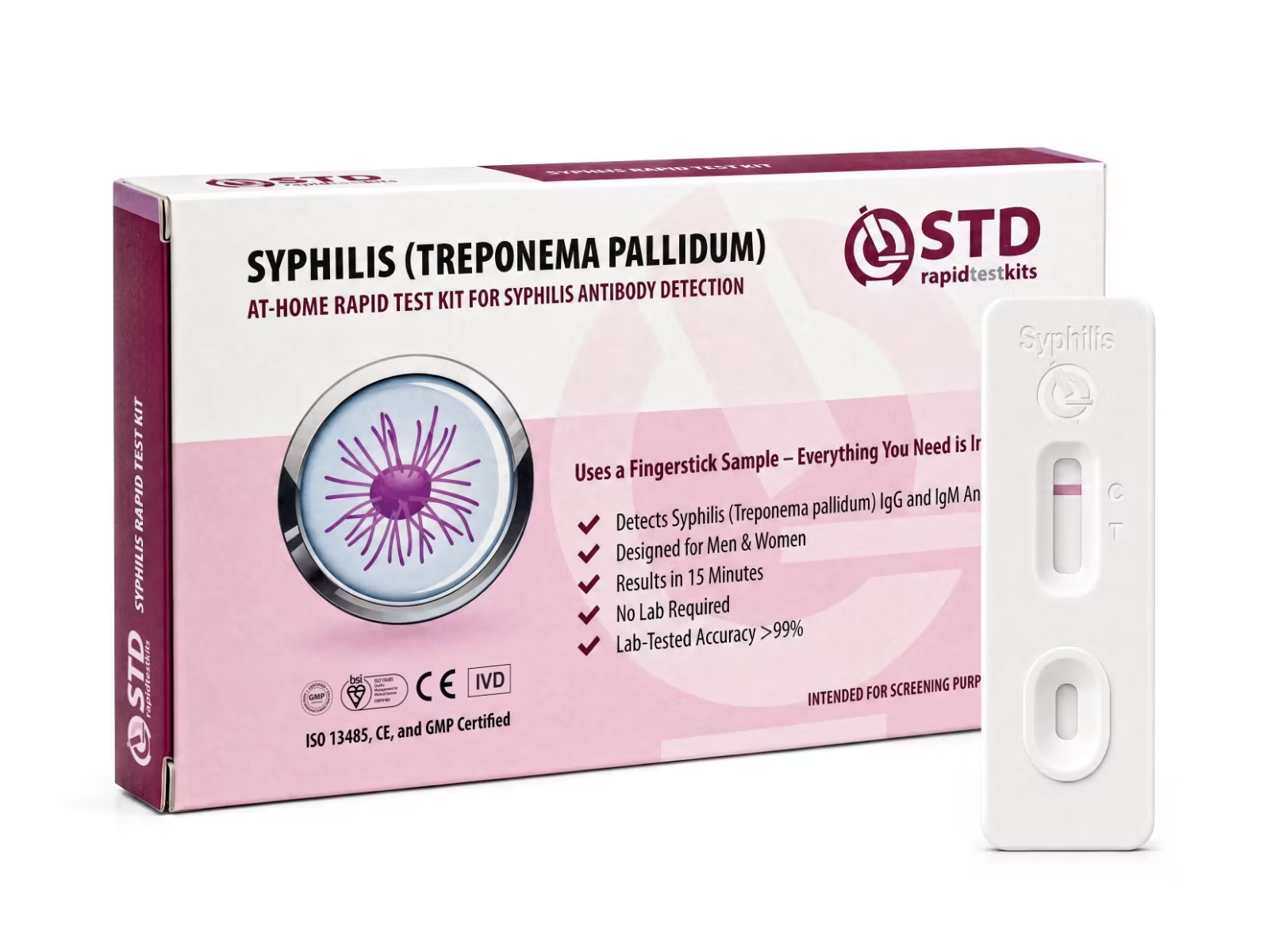
Three practical paths exist for a syphilis test, and they trade off privacy, speed, and follow-up support differently. For routine screening when you have no symptoms and want a fast, private first look, you can start with an at-home syphilis test and read the result in about 15 minutes. A clinic blood draw is the better choice when symptoms are present, when pregnancy is involved, or when treatment will be needed regardless of result, because the clinic can confirm, treat, and screen for other infections in one visit. Mail-in lab kits sit in between: lab-grade testing without a clinic trip, at the cost of a few days waiting for the sample to process.
Whichever route you pick, the same rule applies. A reactive or positive screening result should be confirmed with a laboratory test (an RPR or VDRL titer plus a treponemal test) through a provider before any treatment decision.
Three Ways to Get a Syphilis Test
| Feature | At-home rapid test | Clinic blood draw | Mail-in lab kit |
|---|---|---|---|
| Privacy | Very high, nothing leaves home | Moderate, visit on record | High, sample ships to a lab |
| Time to result | About 15 minutes | Same day to several days | 2 to 5 days after mailing |
| Sample type | Fingerstick, self-collected | Venous blood draw by staff | Fingerstick, self-collected |
| Cost shape | Flat kit price, no copay or lab fee | Copay plus possible separate lab fee | Kit price plus lab processing fee |
| Best for | Routine screening, privacy, fast first look | Symptoms, pregnancy, immediate treatment | Thorough screening without a visit |
For routine screening with no symptoms, an at-home rapid test is a fast, private first step; a clinic remains the right call for symptoms, pregnancy, or confirming a positive result.
Why People Wait, and What It Costs
Most stories like Marcus's are not about ignorance. They are about denial, shame, and the very human tendency to read "my symptoms went away" as "I am fine." Syphilis is unusually well-suited to that interpretation because at two different points (after the chancre, and after the secondary rash) the visible signs do disappear on their own. Each disappearance feels like resolution. Neither one is.
The cost of waiting is not abstract. Tertiary complications, when they happen, can be partly irreversible. Treatment after the central nervous system is involved arrests further damage but cannot always undo what is already done. Pregnant people with untreated syphilis can pass it to a fetus, causing congenital syphilis with miscarriage, stillbirth, or severe newborn illness, which is why the WHO syphilis fact sheet and the NHS syphilis overview both treat screening in pregnancy as essential rather than optional. The U.S. has seen a sharp rise in congenital syphilis over the past decade, which public-health authorities link to missed or delayed maternal screening. Treatment with penicillin during pregnancy is highly effective at preventing transmission to the fetus, particularly when given more than 30 days before delivery. That timing rule is what makes early prenatal screening the highest-impact decision in the whole protocol.
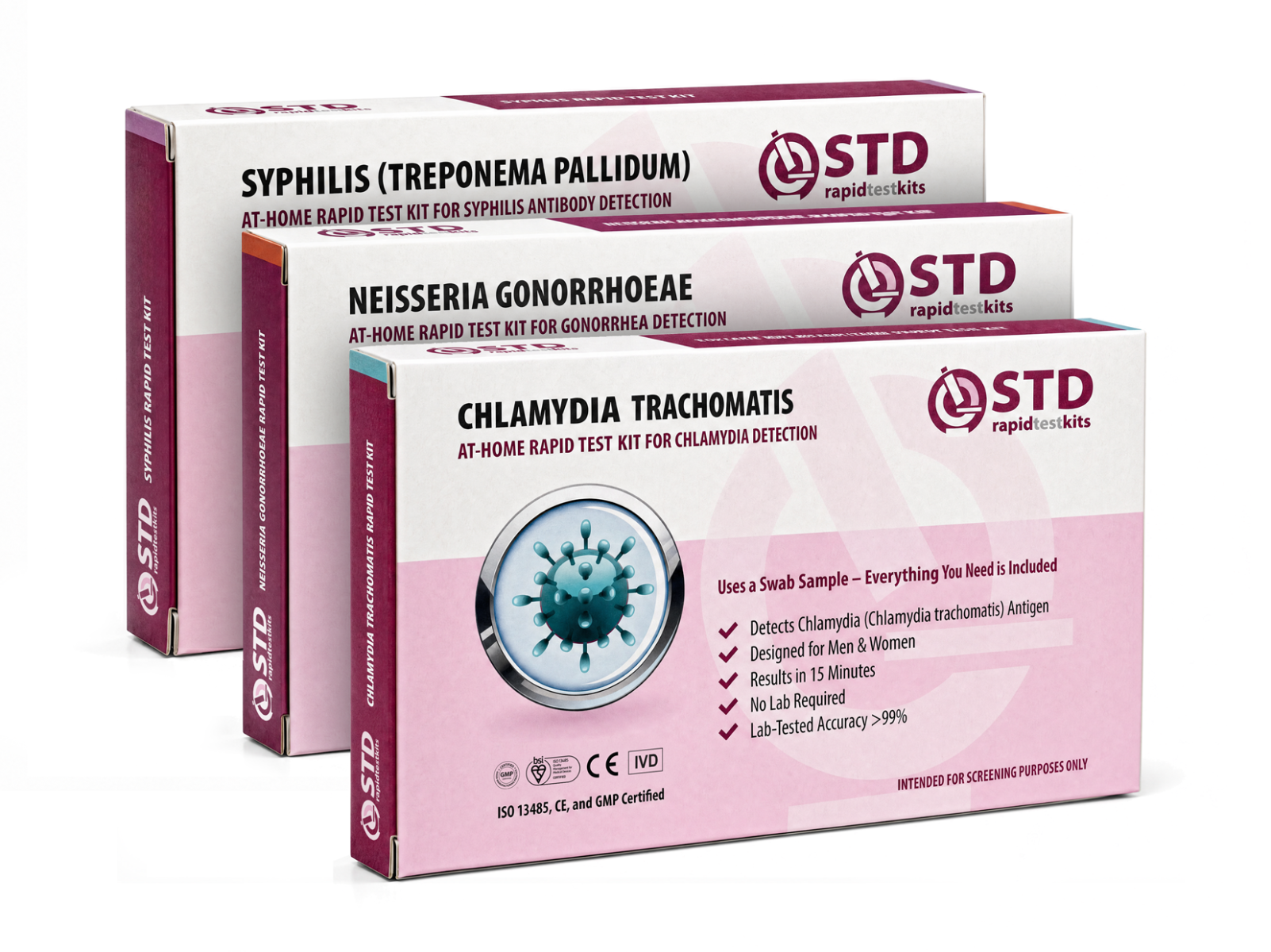
This site sells at-home rapid blood tests for syphilis and other STIs, a private option for the routine screening described here.
What Treatment Looks Like in Practice
Here is the part of the story that almost never gets enough attention: syphilis is curable at every stage. The standard treatment, per the CDC 2021 STI Treatment Guidelines, is benzathine penicillin G given as an intramuscular injection. For primary, secondary, and early latent syphilis, a single dose is usually enough. Late latent syphilis, latency of unknown duration, and tertiary syphilis without neurosyphilis call for three weekly doses. Neurosyphilis, ocular syphilis, and otosyphilis require a more intensive course of aqueous crystalline penicillin G given intravenously over 10 to 14 days.
Doxycycline is an alternative for non-pregnant adults with early syphilis who have a documented severe penicillin allergy, although the data for late syphilis are weaker. Pregnant patients with penicillin allergy are recommended to undergo desensitization and receive penicillin anyway, because no alternative regimen reliably prevents congenital infection.
Post-treatment monitoring is part of the protocol. Non-treponemal titers (RPR or VDRL) are typically checked at 6 and 12 months for early syphilis, and at 6, 12, and 24 months for late or latent syphilis. A four-fold drop in titer is the standard marker of successful treatment. In neurosyphilis, repeat cerebrospinal fluid testing may be needed to confirm clearance.
Marcus's regimen is the intensive intravenous course because of the neurosyphilis diagnosis. The Jarisch-Herxheimer reaction (fever, chills, headache, muscle aches in the first 24 hours of treatment) hits him on day one and resolves on its own. Over the following months the leg pains recede and his cognition improves. The aorta and the optic nerve do not bounce back as completely.
Some people get a flu-like reaction within the first 24 hours of starting penicillin treatment for syphilis. Fever, chills, headache, and muscle aches are the typical pattern. The reaction happens because the immune system responds to large numbers of bacteria dying off at once during early treatment. The spike usually resolves within a day and does not signal an allergy to penicillin. If you start treatment and feel suddenly worse, contact your provider so they can confirm what you are experiencing, but do not stop the regimen on your own.
Who Is Most at Risk, and What Changes the Odds
Anyone sexually active can contract syphilis, but the CDC surveillance data consistently flag higher rates among people living with HIV, men who have sex with men, people with multiple sexual partners, and people who do not have regular screening. Co-infection with HIV is its own complication: it can accelerate the progression of syphilis and complicate the immune response, and the genital sores of primary syphilis make HIV transmission easier in both directions, so screening for both at the same time is standard practice.
Pregnancy is the other case where screening is unambiguous. The WHO and CDC both recommend syphilis testing at the first prenatal visit, and again later in pregnancy and at delivery for anyone at higher risk. Congenital syphilis is one of the most preventable severe pregnancy complications, and prenatal screening exists precisely to catch it before the infection reaches the fetus.
For everyone else, the practical question is simpler: have you had a new sexual partner, sex without consistent condom use, or any reason to think you were exposed? If yes, get tested 6 to 12 weeks later. If you are in a higher-risk category, test more often, not less. Because the same exposure that risks syphilis can carry chlamydia or gonorrhea too, screening for several infections at once is often the more honest move.
Higher-risk profiles for syphilis
- People living with HIV. Co-infection accelerates syphilis progression and complicates treatment.
- Men who have sex with men. CDC surveillance shows consistently higher rates in this group.
- Anyone with multiple sexual partners or new partners since the last screening.
- Pregnant people. Untreated syphilis in pregnancy can cause stillbirth, miscarriage, or congenital syphilis. Routine prenatal screening is standard, and treatment more than 30 days before delivery prevents most transmission.
- Anyone with a partner recently diagnosed with syphilis. Get tested even with no symptoms.
What You Can Actually Do Right Now
If you have a possible exposure you cannot stop thinking about, do not wait for symptoms. Order a home rapid test, walk into a clinic, or ask your provider for a syphilis screen at your next visit. If your first test is negative but the exposure was recent, retest at the 6 to 12 week mark before deciding the result is final. The CDC's standard test interpretation rests on antibodies that take time to develop, and a too-early negative result is a real failure mode of the test, not a clean bill of health.
If you test positive, do not skip doses, do not stop short of the full regimen, and make sure your provider follows up with serologic titers at 6 and 12 months for early syphilis, or 6, 12, and 24 months for late or latent syphilis. The standard marker of cure is a four-fold drop in non-treponemal titer. People with HIV co-infection may be monitored on a closer schedule per their provider's judgment.
Notify recent sexual partners so they can be tested and treated. The recommended lookback windows from CDC guidance are partners from the past 90 days for primary syphilis, six months for secondary, and one year for early latent. Most state and local public-health departments offer confidential or anonymous partner-notification services that can handle those conversations for you if you would rather not have them alone. Treating a partner before they develop symptoms prevents onward transmission and reduces the chance they will develop late complications themselves.
Once you have completed treatment and your provider confirms successful response, sexual activity is back on the table. Being treated does not make you immune, though. A new exposure can reinfect you, which is why regular screening matters more than the one-time test that caught it the first time.
Should You Test for Syphilis Now?
Was there a high-risk exposure in the last 72 hours, or has a partner tested positive?
Yes: Contact a clinic now to discuss baseline testing and next steps, then plan a follow-up test at the 6 to 12 week mark.
Was there a possible exposure more than three weeks ago and you have no symptoms?
Yes: Test now with an at-home rapid test or a clinic draw. If it is negative but the exposure was recent, retest at 6 to 12 weeks before treating the result as final.
Did a rapid screening test come back reactive or positive?
Yes: Confirm with an RPR or VDRL titer plus a treponemal test at a clinic before any treatment, and notify recent partners using the CDC lookback windows (90 days for primary, six months for secondary, one year for early latent).
No: Keep routine screening on your calendar, especially with new partners. A past cure does not make you immune, and reinfection is possible.
Guidance only. A healthcare provider can advise based on your specific situation.
Frequently Asked Questions
- Can syphilis ever go away on its own?
- No. The visible symptoms of primary and secondary syphilis do resolve without treatment, but the infection itself does not. Treponema pallidum does not self-clear, and the bacteria persist in the body, where they can cause organ damage years or decades later. The visible signs go away while the infection stays, which is why every chancre or rash that resolved on its own still needs follow-up testing.
- How long can untreated syphilis stay in the body?
- Indefinitely. Treponema pallidum does not self-clear, so most people with untreated infection remain seropositive for life. Studies of untreated cohorts estimate that about 15 to 40 percent eventually develop tertiary complications. There is no way to predict who that will be, which is why getting tested matters even when nothing feels wrong.
- If the chancre healed by itself, am I in the clear?
- No. The chancre healing is part of the natural course of untreated syphilis, not a sign of recovery. By the time the sore disappears, the bacteria have already entered the bloodstream and lymphatic system. From there the infection either produces secondary-stage symptoms within weeks to months, or moves silently into latency with no further outward signs.
- Can you transmit syphilis when you have no symptoms?
- Yes, especially during the primary stage (when a chancre may be present but unnoticed), the secondary stage, and early latent syphilis (first 12 months), when secondary-stage relapses can still occur. Late latent syphilis is generally not transmitted sexually but can still pass to a fetus across the placenta during pregnancy.
- How long after exposure should I wait before testing?
- For most people the right approach is two tests: one around three weeks after exposure for an early data point, and a confirmatory test at 6 to 12 weeks. Treat a single negative inside that window as preliminary rather than final. If a partner has confirmed syphilis or the exposure was high-risk, tell your provider, since they may recommend faster re-testing or treatment regardless of the first result.
- Is penicillin really the only treatment?
- For now, mostly yes. Benzathine penicillin G is the standard for primary, secondary, and latent syphilis, and aqueous crystalline penicillin G is used intravenously for neurosyphilis, ocular syphilis, and otosyphilis. Doxycycline is an option for non-pregnant adults with early syphilis who have a documented severe penicillin allergy. Pregnant patients with penicillin allergy are referred for desensitization because no equally effective alternative exists for preventing congenital infection.
- Can treatment reverse the damage?
- Treatment stops further progression at every stage, and earlier stages typically resolve fully. Damage already done in tertiary disease, especially to the heart, brain, optic nerve, and inner ear, may be partly irreversible. Catching syphilis in stage 1 or stage 2 avoids the tertiary damage entirely.
- Should my partners get tested too?
- Yes. CDC partner-notification lookback windows are 90 days for primary syphilis, six months for secondary, and one year for early latent. Anyone who had sexual contact with you during the relevant window should be tested and treated, even with no symptoms. Public-health departments in most areas can help with confidential or anonymous notification.
- Does a positive at-home rapid test mean a current active infection?
- Not necessarily. The treponemal antibodies that at-home rapid tests detect typically remain positive for life, even years after the original infection and even after successful treatment. A positive at-home result usually reflects either a current infection or a past treated infection. Lab confirmation with an RPR or VDRL titer plus medical history review distinguishes the two and guides any further treatment decision.
- U.S. Centers for Disease Control and Prevention. About Syphilis: stages, symptoms, transmission, and progression to late-stage disease. Basis for the four-stage timeline, the progression-to-tertiary risk framing, and CDC surveillance descriptions of higher-risk populations.
- U.S. Centers for Disease Control and Prevention. 2021 Sexually Transmitted Infections Treatment Guidelines, syphilis section. Source for the 10 to 90 day primary incubation window, early/late latent staging definitions, the 6 to 12 week serologic window, partner-notification lookback periods, post-treatment titer schedule, and the penicillin and doxycycline regimens.
- Mayo Clinic. Syphilis symptoms and causes. Source for the secondary-stage rash pattern including palms and soles, condylomata lata, and the broader symptom catalog at each stage.
- Mayo Clinic. Syphilis diagnosis and treatment. Source for the two-step diagnostic protocol (RPR/VDRL followed by treponemal confirmation) and the CSF examination criteria when neurosyphilis is suspected.
- World Health Organization. Syphilis fact sheet. Source for global epidemiology, congenital syphilis prevention, and the public-health case for screening in pregnancy.
- U.K. National Health Service. Syphilis: symptoms, testing, and treatment overview, including prenatal screening guidance.
