
Published: August 2025 | Last updated: May 2026 | Editorial review and quality control: Martina N.
How long can a man have an STD without knowing?
Months, sometimes years. Urethral chlamydia is often silent in men, throat and rectal gonorrhea are usually silent, HSV-2 stays mostly invisible for life, and untreated HIV can persist a decade before AIDS-defining illness. Testing on schedule, after a new partner, or after a possible exposure is the only reliable signal.
Most men who carry a sexually transmitted infection do not know they have one. Per the CDC, chlamydia often has no symptoms, and similar invisible-carrier patterns hold for HPV, herpes, syphilis, and untreated HIV. A man can pass an infection to a partner for months, sometimes years, while feeling perfectly healthy. Most men reading this are not currently infected, but asking the question and testing periodically is exactly the habit that keeps it that way.
This article answers the specific question, “how long can each common STI stay quiet in a man’s body,” against current CDC, WHO, and NHS guidance. It covers incubation periods, the asymptomatic window by infection, the subtle signs men commonly mistake for something else, what damage happens silently, when to test, and where an at-home chlamydia and gonorrhea test or broader home rapid panel fits alongside a clinic visit.
Key Takeaways
- A substantial share of male urethral chlamydia infections produce no symptoms, per CDC guidance, and rectal or pharyngeal infections are silent at even higher rates. HPV and untreated HIV behave similarly: years can pass before any signal.
- Annual screening is the CDC baseline for sexually active men with new partners. Men with multiple partners, or men who have sex with men, generally test every 3 to 6 months including pharyngeal and rectal sites where exposure occurred.
Chlamydia often has no symptoms, but it can cause serious health problems, even without symptoms. If symptoms occur, they may not appear until several weeks after having sex with a partner who has chlamydia.
Why STIs Stay Silent in Men’s Bodies
Most STIs depend on a small initial inoculum reaching a mucosal surface. Once they’re there, the body’s local immune response varies by pathogen. Some bacteria and viruses provoke an obvious inflammatory reaction (discharge, burning, swelling, fever). Others establish themselves quietly, with the host barely noticing.
For men, three biological factors push these infections toward the silent end of the spectrum:
- Many male infections sit at sites that don’t hurt. Bacterial pathogens like Chlamydia trachomatis often colonize the urethra without producing the inflamed, painful urination men typically associate with infection. Pharyngeal and rectal infections are even quieter, because those tissues have fewer pain receptors than skin.
- Asymptomatic shedding is common. HSV-1, HSV-2, and HPV all transmit from skin and mucosa during stretches when the carrier sees nothing on examination. Per the WHO HSV fact sheet, the majority of people with HSV-2 globally are undiagnosed, because outbreaks can be mild, infrequent, or absent.
- Some pathogens enter latency by design. Treponema pallidum, the syphilis spirochete, transitions from a brief primary sore into a years-long latent stage that produces no outward symptoms while still damaging tissues. NHS guidance notes that if syphilis is not treated, the infection remains in the body even when symptoms have resolved.
Add cultural reluctance to seek testing without symptoms, and the result is a population of carriers who feel fine, have no medical reason to suspect infection, and only learn the truth after a partner’s diagnosis or a routine screen. The WHO STI fact sheet puts it bluntly: STIs are often asymptomatic, and when symptoms occur, they can be non-specific.
Subtle Signs Men Commonly Dismiss
None of these confirm an STI on its own. They are the everyday signals that get attributed to soap, friction, dehydration, or a passing cold, when sometimes the underlying cause is an STI worth testing for.
- Mild clear or cloudy urethral discharge, often noticed only on the underwear Common
- Brief burning during urination that comes and goes, blamed on dehydration or spicy food Common
- A single painless sore on the penis, scrotum, or anal area, written off as razor burn or an ingrown hair Common
- Flu-like illness 2 to 4 weeks after a possible exposure (fever, sore throat, rash, fatigue), often attributed to a passing virus Common
- Mild testicular ache or heaviness without obvious swelling Less common
- Small painless bumps in the genital area mistaken for skin tags or sebaceous cysts Less common
- A diffuse rash on the trunk, palms, or soles that resolves on its own within weeks (possible secondary syphilis) Less common
- Persistent sore throat without obvious cold symptoms, especially after oral exposure Less common

How Long Each STI Can Stay Hidden in Men
The honest answer to “how long” varies by pathogen. Some infections become detectable in days, others in weeks, and a few can stay below the symptom threshold for a decade. The breakdown below covers the six STIs men most often carry asymptomatically, with the timeline drawn from CDC, WHO, and NHS guidance.
Chlamydia: weeks to years of silent infection
Chlamydia is the most reported bacterial STI in the United States. Per the CDC, chlamydia often has no symptoms, and a substantial share of male urethral infections produce no urinary symptoms at all. Pharyngeal and rectal infections in men are silent at even higher rates. When urethral symptoms do appear, they may not show up until several weeks after exposure and often present as mild urethral discharge or a burning sensation while urinating. Many men dismiss the discharge as soap irritation or dehydration.
Without treatment, chlamydia can persist for months or years in male reproductive tissue. Some men eventually develop pain and swelling in the testicles or in the tubes attached to them (known clinically as epididymitis), but most untreated cases stay quiet from the patient’s side while remaining transmissible to partners.
Gonorrhea: weeks to months
Gonorrhea has a reputation as the “loud” STI, with greenish-yellow discharge and painful urination. In reality, the CDC’s gonorrhea page notes that rectal infections may produce no symptoms at all, and many urethral and pharyngeal (throat) infections can also be asymptomatic. Asymptomatic carriage is one of the main reasons gonorrhea continues to spread despite available treatment.
Untreated, urethral gonorrhea typically resolves the immediate inflammation within weeks, but the bacteria can persist in less-symptomatic sites for months. Antibiotic-resistant gonorrhea strains are spreading globally and add a separate concern: a strain that’s quiet to the patient and resistant to first-line antibiotics is the worst combination from a public-health standpoint.
HIV: weeks to over a decade
HIV has the longest silent window of any common STI. Per HIV.gov, within 2 to 4 weeks of infection about two-thirds of people experience flu-like symptoms (fever, chills, rash, sore throat, fatigue). The acute symptoms resolve within a few weeks and are easy to attribute to any other viral illness.
What follows is the chronic phase, also called clinical latency. Per the CDC, this stage may last a decade or longer without antiretroviral treatment. During that period the virus continues to replicate and slowly destroys CD4 T cells. The carrier looks and feels healthy. Detection in this period depends entirely on testing, since symptoms reappear only when the immune system has been substantially compromised.
Genital herpes (HSV-2): a lifetime, mostly invisible
Once HSV-1 or HSV-2 establishes infection, it does not leave. The virus retreats into sensory ganglia and reactivates intermittently. Per the CDC’s genital herpes page, many people never recognize their first outbreak: the lesion gets attributed to razor burn, an ingrown hair, or friction. The WHO HSV fact sheet estimates the global majority of HSV-2 carriers go undiagnosed.
The first outbreak, when it appears, often surfaces within the first two weeks after exposure, and many people never recognize it at all. After it resolves, recurrences average a handful in the first year, with frequency tapering over subsequent years. Asymptomatic shedding occurs on a meaningful fraction of days, especially in the first years after acquisition. Men with HSV-2 who never see a single sore can still transmit the virus.
Syphilis: months to over a decade
Syphilis has a multi-stage course that looks designed to evade detection. The primary chancre (a single painless sore at the inoculation site) typically appears about three weeks after exposure, per NHS guidance. Per the CDC, the sore usually lasts 3 to 6 weeks and heals on its own, even without treatment.
The secondary stage produces a more diffuse rash and flu-like symptoms weeks to months later. After secondary syphilis resolves, the infection enters latency, a period the CDC describes as having no visible signs or symptoms. Clinically, latent syphilis is divided into early latent (less than one year after infection, still transmissible sexually) and late latent (beyond one year, generally not sexually transmissible but still capable of organ damage). Untreated, the CDC notes tertiary complications can surface 10 to 30 years after the original infection.
HPV: months to years, mostly silent
Human papillomavirus is among the most common sexually transmitted infections globally. The CDC states that nearly everyone who is sexually active will get HPV at some point in their lives. Most infections cause no symptoms and clear within 2 years through immune response. Some persist.
For men, low-risk HPV strains can produce genital warts after weeks to months of incubation, but most strains stay invisible. High-risk strains (HPV 16 and 18 most prominently) can persist for years and cause cancers of the throat, anus, or penis. Routine HPV screening for men is not part of standard care, which means an HPV-positive male partner is most often identified through a partner’s cervical screening result.
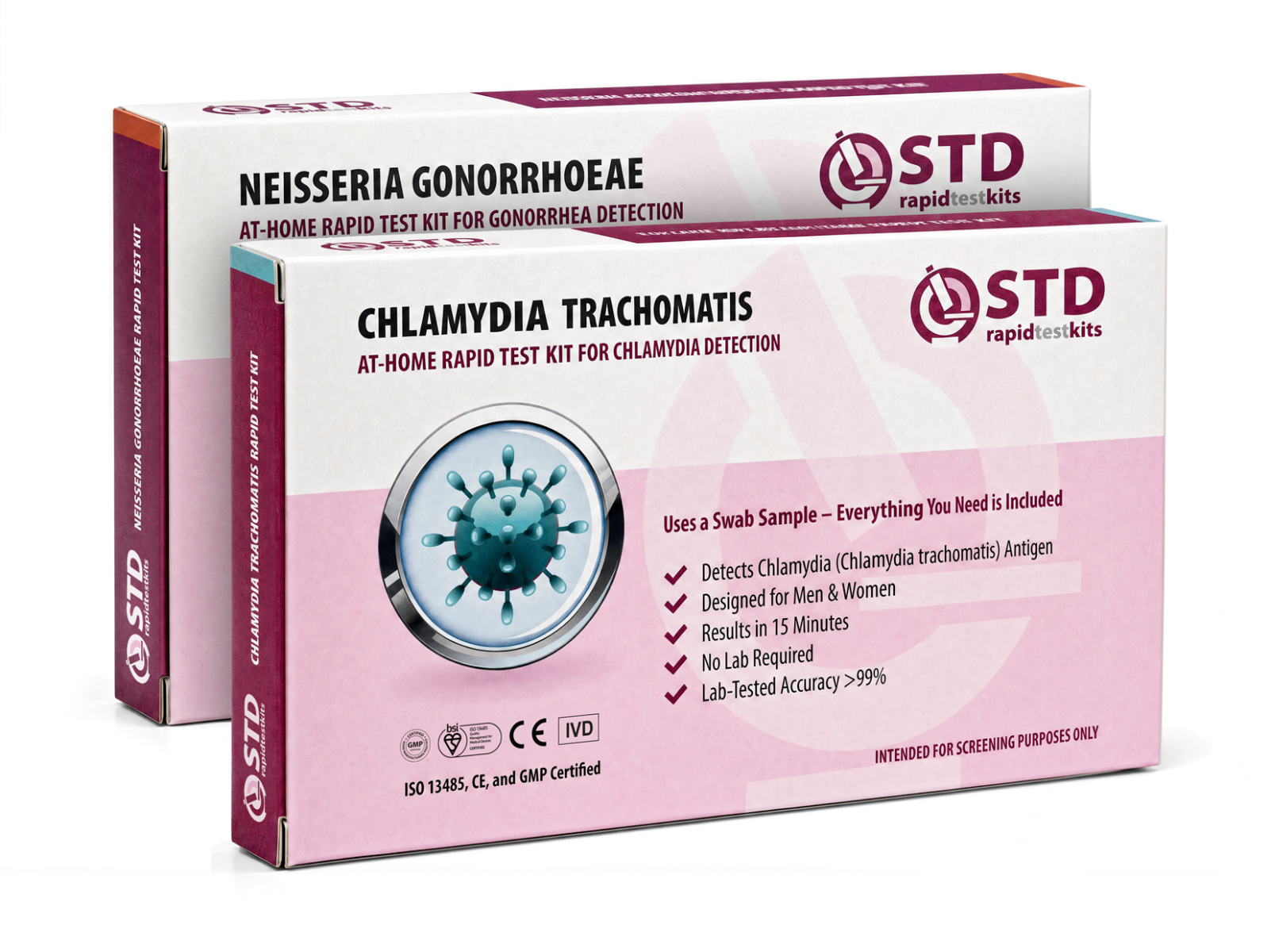
Disclosure: stdrapidtestkits.com sells rapid lateral-flow home tests for several of the infections described above. Product links appear in context, inside the section whose topic the kit most directly serves.
| Infection | Symptom-free in men | Typical incubation | How long it can stay hidden |
|---|---|---|---|
| Chlamydia | Often (CDC); higher at throat and rectum | Several weeks before symptoms | Months to years untreated |
| Gonorrhea | Common in throat and rectum, sometimes urethral | Days to weeks before symptoms | Weeks to months untreated |
| HIV | Most after the acute phase | 2 to 4 weeks for acute symptoms | A decade or longer to AIDS untreated |
| HSV-2 (genital herpes) | Most carriers are unaware (WHO) | First outbreak within ~2 weeks; often unrecognized | Lifelong, reactivates |
| Syphilis | Latent stage produces no symptoms | About 3 weeks for chancre | 10 to 30 years untreated |
| HPV | Most infections | Weeks to months for warts (often none) | Months to years, some persist |
What an Untreated Silent Infection Does Over Time
Each silent STI continues its biological work whether the patient notices or not. The complications below accumulate during the asymptomatic phase, while the carrier feels fine. Treatment can stop an active infection, but it cannot always reverse what has already happened.
Chlamydia in men. Untreated urethral chlamydia can ascend to the epididymis. Per the CDC, chlamydial epididymitis can cause pain and swelling in the tubes attached to the testicles, with longer-term fertility effects possible after repeated infections. The bigger downstream concern from a public-health view is transmission to partners, who can develop tubal scarring and infertility from untreated chlamydia.
Gonorrhea complications. Disseminated gonococcal infection (joint and skin involvement) is uncommon but possible. The more pressing concern is the spread of antibiotic-resistant strains. Silent carriers transmit resistant gonorrhea further, narrowing future treatment options for everyone exposed downstream.
HIV during clinical latency. Continuous viral replication slowly destroys CD4 T cells. Years before AIDS-defining illness, immune function declines: more frequent infections, slower healing, harder-to-clear cancers. Antiretroviral therapy started early prevents almost all of this. The catch: it can only start once a positive test is on the chart.
HSV-2 during asymptomatic shedding. The damage to the carrier from shedding is generally minor (occasional outbreaks, rare neurological complications). The damage to seronegative partners can be substantial: HSV-2 acquisition in a long-term partner from an unaware carrier is a common pattern.
Latent syphilis. The spirochete continues to invade cardiovascular and neurologic tissue during latency. Cardiovascular and neurosyphilis can present 10 to 30 years after the original infection. Penicillin treatment in the latent stage prevents most of this damage.
Persistent high-risk HPV. Persistent infection with HPV 16 or 18 over years is the precursor to oropharyngeal, anal, and penile cancers. The lag from infection to cancer is decades. Vaccination is the only preventive intervention; treatment options apply only after a precancerous or cancerous lesion appears.
Most of the long-term complications of STIs in men build during the asymptomatic phase, while the carrier feels fine. Detection in that phase depends entirely on testing, since the body provides no warning signal.
When to Test, Even When You Feel Fine
The most common reason men skip testing is the same reason testing matters: they feel fine. That feeling is real. It is also unreliable. Asymptomatic does not mean uninfected, and a symptom-free carrier can still pass the infection along.
A few recurring assumptions keep men from booking a test, and none of them hold up against the biology:
- “I would know if I had something.” Most men with chlamydia, HPV, and even early HIV would not. The biology covered above does not produce reliable warning signs.
- “My partner is monogamous, so I am safe.” Many infections were acquired before the current relationship and never produced symptoms. Trust between partners does not change biology; unless both people have tested with appropriate timing, the carrier may genuinely not know.
- “Only certain people get STIs.” Per CDC surveillance, STIs are distributed across every age group, geography, and relationship structure. Risk concentrates with exposure patterns, not personality or lifestyle stereotypes.
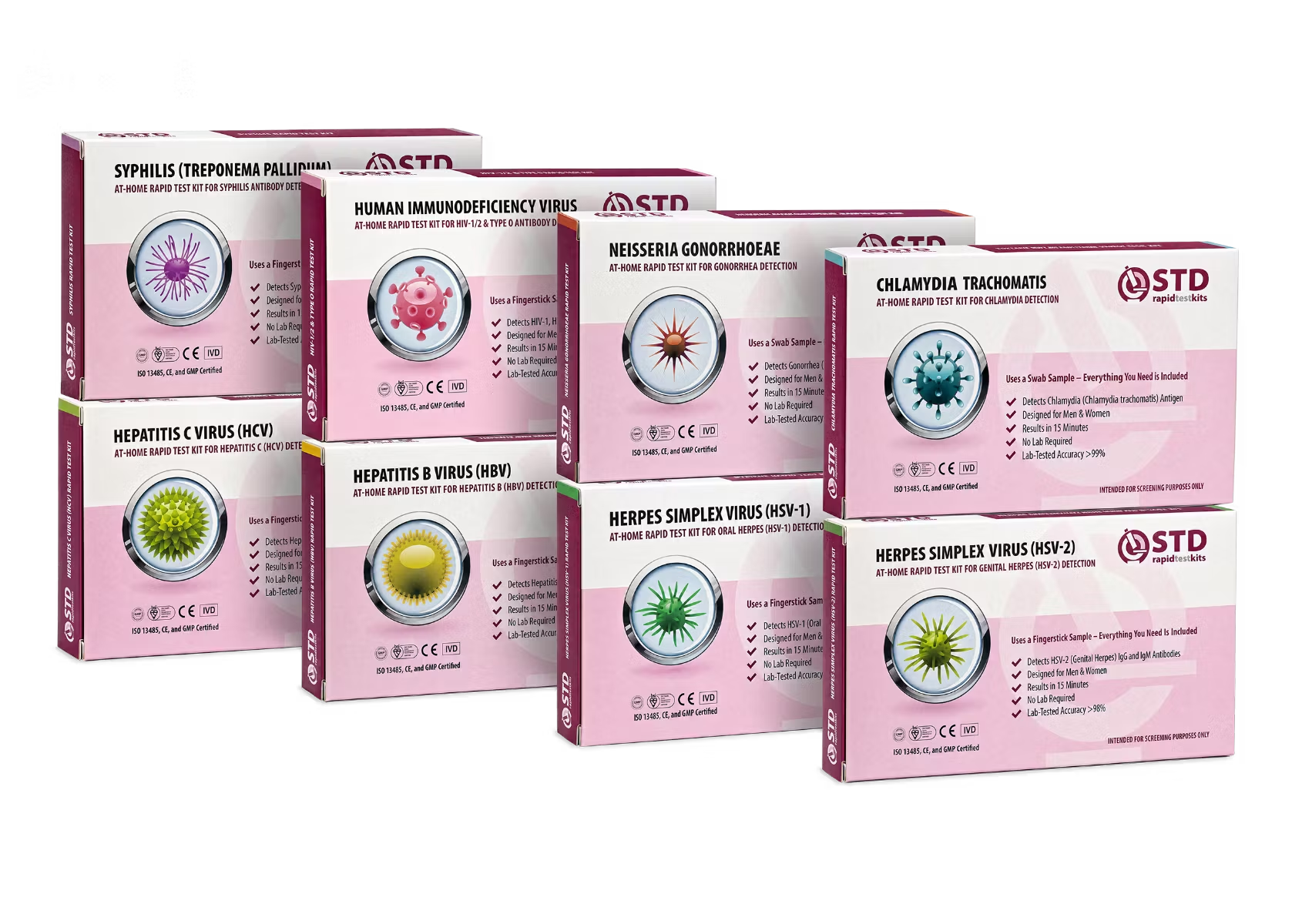
The CDC publishes baseline screening intervals based on sexual activity and risk profile. The summary below is for men; women have additional cervical-screening considerations covered elsewhere. For a broader screen across infections, see our at-home STI test kits category, which includes 2-in-1, 3-in-1, and 8-in-1 combinations.
Every adult, at least once. Per HIV.gov, everyone aged 13 to 64 should be tested for HIV at least once as part of routine health care, regardless of perceived risk.
Men with new or multiple partners (annual). Add chlamydia, gonorrhea, and syphilis screening once a year. After a new partner, retest 2 to 3 weeks into the relationship to capture infections inside the chlamydia and gonorrhea incubation window.
Men who have sex with men (every 3 to 6 months). The CDC recommends more frequent screening, including pharyngeal and rectal swabs for chlamydia and gonorrhea where exposure occurred. HIV and syphilis screening at the same interval. For pharyngeal and rectal sample types, plan a clinic visit, since at-home rapid swab kits are validated for genital sites only.
Symptoms of any kind. Test now. New discharge, sores, painful urination, or unexplained pelvic or testicular pain merits same-day testing or a clinic visit. Do not wait the full window if symptoms are active.
Test windows by exposure date
Different tests detect different things (the pathogen itself, an antigen it produces, or the antibodies the body has built), and that changes when each test becomes accurate after exposure. The summary below covers the standard windows for the test types relevant to men. Refer to each kit’s window-period chart, since at-home lateral-flow rapid tests have different sensitivity profiles than laboratory NAATs.
| Infection / Test | Earliest reliable result | Most accurate window | Notes |
|---|---|---|---|
| Chlamydia (swab) | About 1 to 2 weeks | 2 to 3 weeks | Same swab sample type as clinic NAAT |
| Gonorrhea (swab) | About 1 week | 2 weeks | Often combined with chlamydia testing |
| Syphilis (antibody) | 3 to 6 weeks | 6 weeks or later | Can miss very early infection |
| HIV (4th-generation lab antigen/antibody) | 18 days | 45 days | CDC standard for lab testing |
| HIV (rapid antibody home test) | 23 to 90 days | 90 days | Antibody-only, longer wait for full reliability |
| Hepatitis B and C (antibody) | 3 to 6 weeks | 8 to 12 weeks | Antibody-based |
| HSV-2 (antibody) | 6 to 12 weeks | 12 to 16 weeks | Seroconversion can be slow |
If You Have Been Waiting Longer Than You Meant To
If you are reading this and realizing the gap has stretched into months or longer, you are not unusual. The longer the delay, the more the question shifts from “did I wait too long?” to “what is the smartest next step from here?” In most cases, that step is the same: test now, with the right test for the time elapsed.
Long gaps actually make some tests more reliable, not less. A syphilis antibody test taken at 6 weeks captures infections the same test would have missed at 2 weeks, and an HIV antibody test at 90 days is more accurate than one taken at 3 weeks. The scenarios where a long gap genuinely changes your options are mostly viral and mostly about how much damage may have already happened, not about whether testing still works.
For HIV, a long gap means your CD4 count and viral load become more relevant, both very treatable on current therapy. For chlamydia or gonorrhea you have been carrying without symptoms, a current test plus a follow-up after treatment is the same straightforward path it would have been three months ago. For persistent HPV, a long gap means the question shifts toward downstream screening (anal or oropharyngeal evaluation when risk factors warrant), since there is no routine male HPV test.
Delay is rarely about not caring. It is fear of the result, time pressure, lack of nearby testing, or the quiet hope that whatever it is will resolve on its own. None of those reasons make the body hold still. Two costs build over time. The first is medical: epididymal scarring, organ involvement, immune decline, cumulative cancer risk from high-risk HPV. The second is relational: partners exposed during the silent stretch, conversations made harder by the time gap, decisions about disclosure that get heavier the longer they sit. Most STIs caught after a long gap are still curable (chlamydia, gonorrhea, syphilis) or well-managed on current therapy (HIV, HSV-2). Acting on the test result is what changes the trajectory.
How At-Home Rapid Tests Fit Into a Symptom-Free Strategy
Lab-based nucleic acid amplification tests (NAATs) for chlamydia and gonorrhea, and fourth-generation antigen-antibody combination tests for HIV, are the clinical gold standard. They run on PCR or immunoassay platforms in a certified lab, with high analytical sensitivity. The home rapid tests sold here are lateral-flow immunoassays. The two technologies are not equivalent. They are complementary, and each has its place.
Where a lateral-flow rapid test makes sense:
- Routine annual screening when you have no symptoms and no known exposure. The risk profile is low, and a screening result quickly tells you whether to escalate to a clinic NAAT.
- Follow-up after a clinic-confirmed treatment. A negative rapid test some weeks after treatment can document apparent clearance, with a confirmatory NAAT if warranted.
- When clinic access is limited. Privacy, cost, time, and travel can all delay testing. A rapid test at home gets you a result this week instead of next month, and the privacy element matters for men in religious communities, queer relationships, or family situations where a clinic visit is hard to schedule unobserved.
Where a lateral-flow rapid test is not the right tool:
- Acute symptoms with a negative rapid result. Active discharge, sores, or burning means a clinic NAAT and physical exam are the next step regardless of what the rapid says.
- Window-period testing immediately after exposure. Rapid tests need the post-exposure window to close. Testing in the first week is too early for most kits.
- Sample types we don’t cover. Pharyngeal (throat) and rectal swabs are not validated for our home kits. Men whose primary exposure was oral or anal should plan a clinic visit for those sites.
A practical rule: rapid tests are a screening layer, not a confirmatory layer. Positive results should be confirmed at a lab; negative results in the right window are reassuring screening data and a reasonable basis for routine annual coverage.
Rapid lateral-flow tests screen; they do not confirm. A reactive (positive) result always warrants a clinic NAAT or lab antigen-antibody test before any treatment decisions are made. A negative result inside the correct window is reassuring screening data, but it is not a substitute for a clinic visit if symptoms are present.
Next Steps
- If it has been more than a year since your last full screen, order a home rapid panel or schedule a clinic visit this week. The biggest single improvement in your status is going from “no data” to “data.”
- If you have active symptoms (discharge, sores, painful urination, testicular pain), skip the home test and contact a clinic today. A physical exam plus a lab NAAT is the right tool for active symptoms.
- If a rapid home test comes back reactive, plan a clinic NAAT or lab antigen-antibody test before treatment decisions. A reactive screen is a signal, not a diagnosis.
- If you have sex with men, add pharyngeal and rectal swab testing at a clinic every 3 to 6 months. At-home rapid swab kits cover genital sites only; oral and rectal exposures need clinic-administered swabs.
FAQs
- Can a man have chlamydia and feel completely normal?
- Completely. Most men with urethral chlamydia notice nothing: no discharge, no burning, nothing that prompts a clinic visit. The CDC reports that chlamydia often has no symptoms, and a man can carry it for months or years without urinary signs. Annual screening is the only reliable catch when nothing feels wrong.
- How long can gonorrhea stay quiet in a man’s body?
- Urethral gonorrhea most often produces symptoms within days to a couple of weeks, but pharyngeal (throat) and rectal gonorrhea in men are commonly asymptomatic and can persist for weeks to months. Both forms remain transmissible during the silent phase.
- Is there an STI that almost always has no symptoms in men?
- HPV is the closest. Most men with HPV never develop a visible wart and have no other symptoms. Detection in men is uncommon, since routine HPV screening is not standard for the male population, so partner notification or vaccination status are usually the main signals.
- What about HIV? Wouldn’t I notice flu-like symptoms?
- Acute HIV often causes a brief flu-like illness 2 to 4 weeks after exposure, but it’s mild and easy to attribute to any other viral infection. After acute symptoms resolve, HIV enters a clinical latency phase that may last a decade or longer without treatment, with no specific symptoms during that period.
- Can I transmit something I don’t know I have?
- Yes. This is the central public-health concern with silent STIs. Asymptomatic chlamydia, gonorrhea, HSV-2, HPV, and HIV are all transmissible. A man can carry and transmit any of these for months or years without ever knowing.
- Are at-home rapid tests as accurate as clinic tests?
- At-home rapid lateral-flow tests use the same swab or fingerstick sample types as many clinic tests, and good kits report sensitivity and specificity in the 95 to 99% range when used inside their validated window. They are not the same chemistry as lab NAAT testing, which has higher analytical sensitivity. A positive rapid result is worth confirming with a lab test.
- Do condoms eliminate the risk?
- Condoms substantially reduce transmission of fluid-borne infections (HIV, gonorrhea, chlamydia, syphilis at the genital site) when used consistently. Skin-to-skin transmitted infections (HSV, HPV, syphilis on areas the condom does not cover) are reduced but not fully prevented.
- How often should sexually active men test?
- At minimum, once a year for chlamydia, gonorrhea, syphilis, and HIV if you have new or multiple partners. Men who have sex with men generally screen every 3 to 6 months, including pharyngeal and rectal sites where exposure occurred. After a specific exposure, the right window varies: roughly two weeks for chlamydia and gonorrhea on a rapid lateral-flow test, and up to 12 weeks for syphilis antibodies.
- U.S. Centers for Disease Control and Prevention. About Chlamydia: states that chlamydia often has no symptoms, with onset (when symptoms occur) typically several weeks after exposure; describes epididymitis as pain and swelling in the tubes attached to the testicles.
- U.S. Centers for Disease Control and Prevention. About Gonorrhea: covers genital, rectal, and throat infection sites and notes that rectal infections may produce no symptoms.
- U.S. Centers for Disease Control and Prevention. About HIV: describes the three stages of infection (acute, chronic / clinical latency, AIDS) and notes that the chronic stage may last a decade or longer without antiretroviral treatment.
- HIV.gov. Symptoms of HIV: states that within 2 to 4 weeks of HIV infection about two-thirds of people experience flu-like symptoms (fever, chills, rash, fatigue, sore throat); HIV.gov testing-recommendations page covers who should get tested.
- U.S. Centers for Disease Control and Prevention. About Genital Herpes: notes that first outbreaks are often unrecognized or mistaken for other skin conditions, and describes asymptomatic shedding patterns.
- World Health Organization. Herpes simplex virus fact sheet: global prevalence estimates and the high proportion of undiagnosed HSV-2 infection worldwide.
- World Health Organization. Sexually transmitted infections (STIs) fact sheet: includes the statement that STIs are often asymptomatic and that symptoms, when they occur, can be non-specific.
- U.S. Centers for Disease Control and Prevention. About Syphilis: describes the chancre duration (typically 3 to 6 weeks, heals without treatment), latent phase, and tertiary complications surfacing 10 to 30 years after original infection.
- National Health Service (UK). Syphilis: notes that first symptoms can take 3 weeks or more to appear; describes painless sores at the inoculation site and the persistence of infection if untreated.
