Published: November 2025 | Last updated: May 2026 | Editorial review and quality control: Martina N.
You are probably booking a flight, lining up a gift, or eyeing the calendar to fit in one more dinner before the year closes. Sexual health screening rarely makes that list. It probably should sit somewhere on it. Late autumn and early winter offer a quiet window for the kind of routine testing that gets harder to schedule once the new-year rush starts, and the results you get now travel with you into every gathering, every reunion, every fresh beginning.
This guide covers what a pre-holiday STI check actually involves: which tests fit which exposures, how long after a possible exposure a result becomes reliable, what an at-home rapid kit can answer (and where it has practical limits), and how to handle a positive result with calm and a plan. It is written for adults who are sexually active, who would rather know than wonder, and who want to enter the holidays informed.
Key Takeaways
- Most STIs are silent. CDC surveillance data show that sexually transmitted infections are far more common than most adults assume, and many people never feel a symptom. An annual screen is the only way to know.
- Plan around testing windows. Chlamydia and gonorrhea are reliable about 14 days after exposure; HIV antibody covers 23 to 90 days, and syphilis and hepatitis C run 6 to 12 weeks depending on the test.
Why winter is a useful time to schedule a check
The case for testing in November or December rests on logistics more than on biology. Most workplaces hit a natural slowdown after the early-November push. Annual deductibles often reset on January 1, which can change what a clinic visit costs out of pocket if you do need follow-up. Holiday travel and family gatherings put many people in closer contact with friends and partners they have not seen since summer. A clean result going into that calendar is genuinely useful for peace of mind, and a positive result caught now is much easier to treat before holiday plans get complicated.
There is also a behavioral reason. Sexual health screening tends to drift indefinitely without a trigger. A new partner, a notification from a previous partner, or a worrying symptom each prompts testing in the moment. Annual routine testing in the absence of those triggers is what catches the asymptomatic cases that account for most undiagnosed infections. Anchoring that screen to the same season each year (winter works for many people because it pairs with year-end physicals and benefits paperwork) makes the habit stick.
The U.S. Centers for Disease Control and Prevention has long recommended at least annual chlamydia and gonorrhea screening for sexually active women under 25 and for men who have sex with men, and at least one lifetime HIV screen for everyone aged 13 to 64, with more frequent screening for higher-risk groups (CDC STI screening recommendations by population). The exact cadence that fits you depends on your situation; the underlying message is that routine testing matters.

Who should add an STI test to their winter routine
Not everyone needs the same screen at the same cadence. The U.S. Preventive Services Task Force and CDC publish risk-tiered guidance worth matching against your own situation. A few common patterns cover most readers.
Sexually active women under 25 are advised to screen for chlamydia and gonorrhea annually, regardless of symptoms (CDC screening guidance). Both infections are commonly silent in this group, and untreated chlamydia is a leading preventable cause of pelvic inflammatory disease and tubal-factor infertility. Women over 25 with a new partner, multiple partners in the past year, or a partner with a recent positive result should also screen annually.
Men who have sex with men are advised to screen at least annually for HIV, syphilis, chlamydia, and gonorrhea, with the cadence increasing to every 3 to 6 months for those with multiple or anonymous partners. Anyone with a recently diagnosed partner should test immediately, then again after the relevant window period closes.
People with no specific symptoms and no new partners since their last clean screen still benefit from at least one HIV test in their lifetime, with rescreening on each new partner. Per CDC hepatitis C testing guidance, every adult 18 and older should receive at least one hepatitis C test in their lifetime, regardless of risk factors (CDC hepatitis C testing).
If you are pregnant or planning to be in the next year, your prenatal-care provider will run a full screen as part of first-trimester labs. A pre-pregnancy at-home check can catch infections early enough to address them before that visit.
If you noticed a symptom (unusual discharge, burning during urination, a sore that has not healed in a week, a rash that came on after a possible exposure), do not wait for a routine winter check. See a clinician now. Pre-holiday screening is for asymptomatic risk; active symptoms get evaluated in person.
What at-home rapid tests can and cannot do
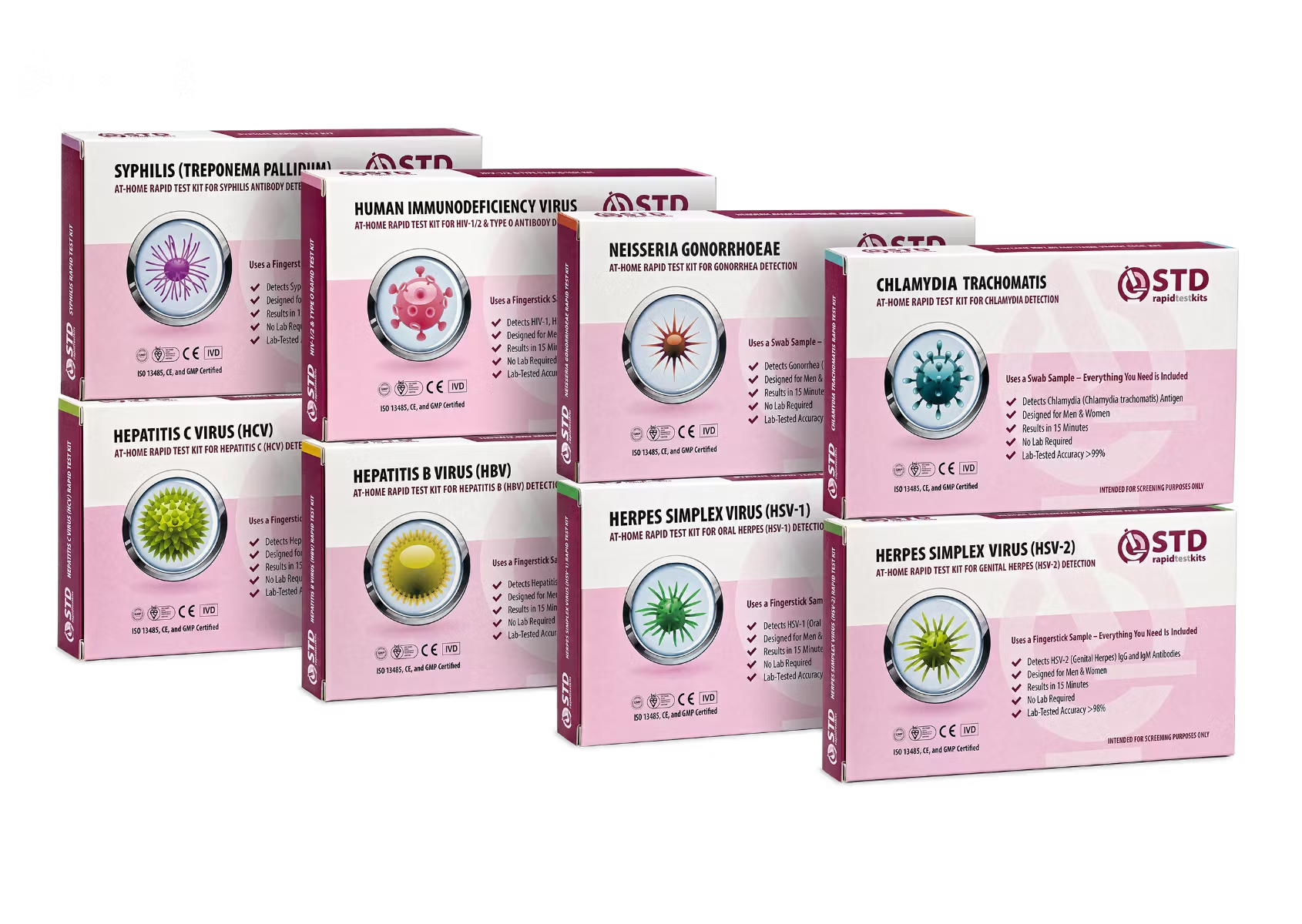
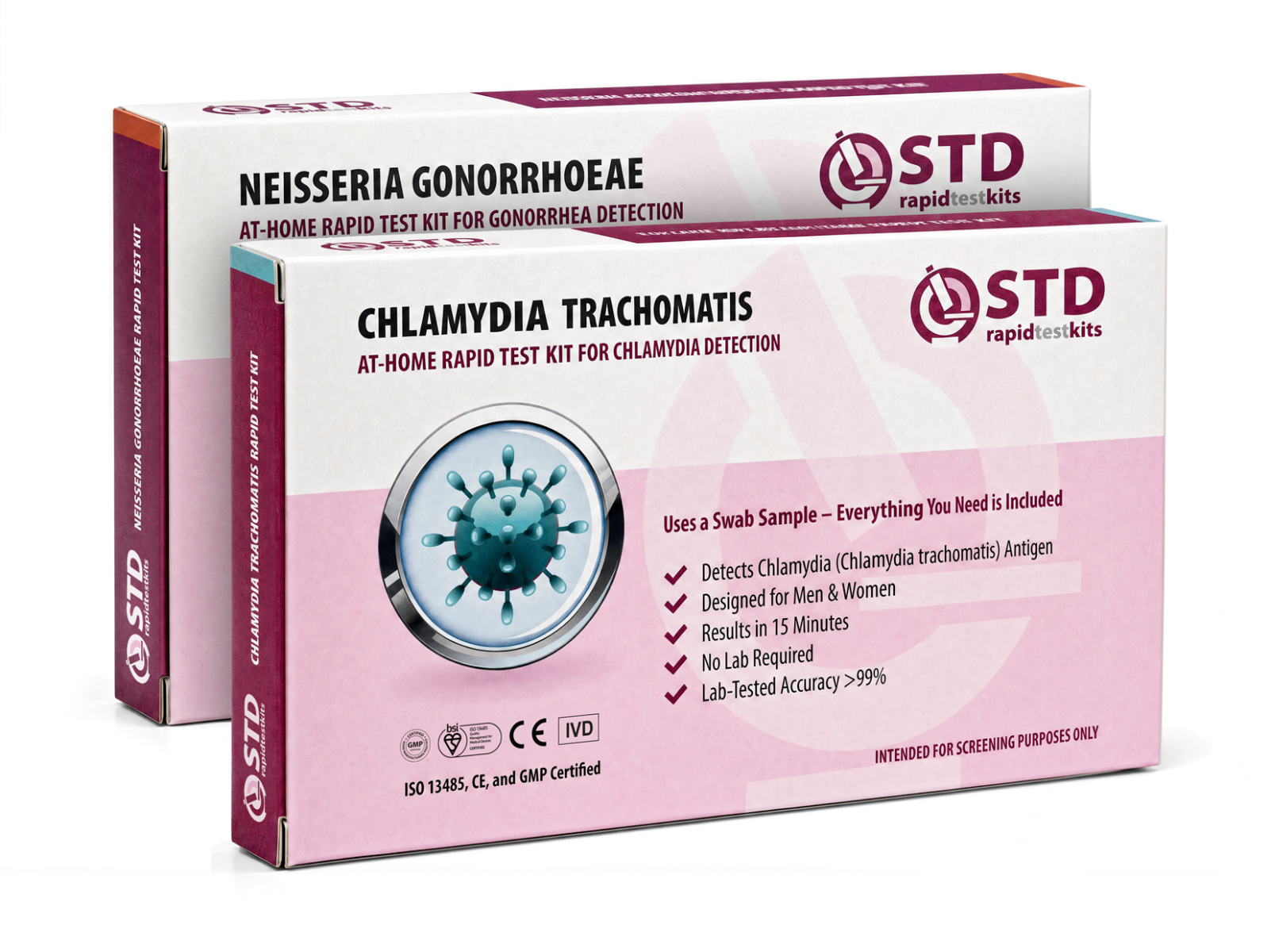
This site sells the rapid at-home kits described in this article, and recommends them based on which sample type fits which exposure rather than on commercial benefit. Rapid lateral-flow home tests use the same immunoassay chemistry as the rapid screens many sexual-health clinics run during a same-day appointment. A sample collected at home (a fingerstick blood drop for HIV, syphilis, hepatitis, and herpes; a self-collected swab for chlamydia, gonorrhea, trichomoniasis, and HPV) flows across a test strip, and a visible result line appears within roughly 15 minutes.
What home rapid tests do well: they give a result at home, in private, on your own schedule. Per CDC, rapid HIV tests can produce a reactive result well within the antibody window when used as directed (CDC HIV testing overview). They are particularly useful as a screen between routine clinic visits, or as a first look when a clinic appointment is days away.
Where they have limits: lateral-flow chemistry is generally less analytically sensitive than nucleic-acid amplification testing (NAAT or PCR), which laboratories use on chlamydia and gonorrhea samples. The gap matters most for very early infections, where bacterial or viral load may still sit below the rapid test's detection threshold. Lab and home approaches work best together. A positive home result is worth confirming at a clinic before starting treatment. A negative home result taken close to a possible exposure is worth repeating once the window period has passed.
What home rapid kits do not cover at all: throat (pharyngeal) and rectal swabs for chlamydia and gonorrhea, which the CDC recommends for people whose exposures include oral or anal sex, are not available as at-home kits anywhere on this site. If your exposure was oral or anal and you want a complete screen, plan a clinic visit that can collect the correct anatomic sample. Our HPV and trichomoniasis home kits are validated for vaginal self-swab in women only; we do not currently offer a male home test for either.
| Infection | Sample type at home | Who can use the home kit |
|---|---|---|
| Chlamydia | Self-collected swab | Any adult |
| Gonorrhea | Self-collected swab | Any adult |
| HIV | Fingerstick blood | Any adult |
| Syphilis | Fingerstick blood | Any adult |
| Hepatitis B | Fingerstick blood | Any adult |
| Hepatitis C | Fingerstick blood | Any adult |
| Herpes (HSV-2 antibody) | Fingerstick blood | Any adult |
| Trichomoniasis | Self-collected vaginal swab | Women only |
| HPV | Self-collected vaginal swab | Women only |
| Throat or rectal chlamydia/gonorrhea | Pharyngeal or rectal swab | Clinic visit only |
Match the test to the exposure
The cleanest way to decide which test to run is to ask: what kind of exposure could have happened since your last clean screen, and what infections are most plausibly carried by that route?
For most asymptomatic adults with one new partner since the last screen, the four-infection rapid screen of HIV, syphilis, chlamydia, and gonorrhea covers the bulk of the population-level routine-screening recommendation. That core matches the CDC's recommended baseline for sexually active adults and is what most clinics run at an annual visit (CDC screening guidance).
For someone whose situation includes a possible exposure to a partner with unknown status, multiple new partners since the last screen, or a notification from a previous partner who tested positive, a broader panel is reasonable. Combination kits on this site bundle the four-infection core with hepatitis B, hepatitis C, herpes (HSV-2 antibody), and, in the women-only panels, trichomoniasis. A 7-in-1 or 8-in-1 kit lets you screen for everything our at-home swab and fingerstick chemistry covers in a single sitting.
For someone who only needs to confirm one specific concern (a positive partner result, a single risky encounter, a recurring symptom previously evaluated by a clinic), a single-infection kit is the right tool. Pay close attention to the testing window for that infection specifically, since the right kit at the wrong time will give an unreliable result.
We do not offer pharyngeal or rectal swab kits. For exposures involving oral or anal sex, a clinic visit is the right next step for those sample types. The home rapid panel covers the genital and bloodborne side of the same exposure event in parallel.
Testing windows: when results are actually reliable
A test taken too soon after a possible exposure can come back negative even when an infection is present. Each infection has a window period: the time between exposure and when there is enough of a measurable target (DNA, antigen, or antibody) for the test to detect it. Knowing these windows is the single biggest difference between a result you can act on and false reassurance.
Approximate windows for the at-home rapid tests on this site, drawn from CDC and U.K. NHS guidance:
- Chlamydia and gonorrhea (swab): typically reliable by 14 days after exposure. Earlier than that, the bacterial load may sit below the lateral-flow detection threshold.
- HIV (rapid fingerstick antibody): the detection window is 23 to 90 days. Most people test reactive by 6 weeks; the full window closes at 90 days. A practical pattern is to test at around 45 days for a useful early read and again at 90 days after a high-risk exposure for definitive confidence (CDC HIV testing).
- Syphilis (antibody): reliable by 6 weeks for most people, with a long tail out to 12 weeks.
- Hepatitis B (HBsAg): typically detectable 4 to 10 weeks after exposure.
- Hepatitis C (antibody): typically reliable by 8 to 11 weeks; CDC recommends a repeat at 6 months for highest-risk exposures.
- Herpes (HSV-2 antibody): most seroconvert by 12 weeks; a minority take up to 16 weeks. Antibody testing confirms past exposure, not an active lesion.
If your possible exposure was within the last two weeks and you still want a complete pre-holiday screen, the practical sequence runs in two steps. Test the swab-based infections now (chlamydia, gonorrhea). Retest the bloodborne infections at 6 weeks and again at 90 days for HIV (and 12 weeks for syphilis). A single rapid panel run on the day of a fresh exposure will miss almost every infection that was actually transmitted.
A test for a sexually transmitted infection is most accurate after the window period for that specific infection has passed. Testing too soon after a possible exposure can result in a false-negative.
How to bring this up with a partner before holiday plans
For many people, the kit is the easy part. The conversation is harder. The kit arrives, the strip is easy, the result line shows up in about 15 minutes. The script for telling a partner that you tested, or asking them to test, often does not come as easily.
A few patterns work better than others. Lead with your own action. "I ordered a home kit before the holidays and figured I would ask if you wanted one too" lands differently than "have you been tested." The first frames the conversation as a routine you are already running. The second sounds like a question expecting a defensive answer.
Choose a neutral moment for the conversation. A walk, a car ride, or a Sunday morning at home gives both people room to react. Avoid raising it in bed, in front of family, or the night before a flight.
Share what your timeline looks like. If you tested clean three weeks ago and have been monogamous since, say that. If you tested clean three weeks ago and had a new partner ten days ago, the ten-day gap matters. You are inside the chlamydia and gonorrhea window for a retest, and well inside the HIV and syphilis windows for a reliable result on those.
If your partner tests positive for something, the response that builds the most trust is a practical one. Help them book a clinic appointment for confirmation and treatment. Ask if they want company. Test yourself at the right window for whatever they were diagnosed with. Most bacterial STIs are fully curable with a short course of antibiotics, and the CDC's Expedited Partner Therapy framework allows treatment for partners in many states without a separate clinic visit.

What to do if a result comes back positive
A positive home test result starts a treatment path. The next steps depend on which infection showed up and what the standard clinical response looks like.
For bacterial infections (chlamydia, gonorrhea, syphilis), a positive home result calls for a clinic visit to confirm with a NAAT or laboratory antibody test and to prescribe the standard antibiotic regimen. Chlamydia and gonorrhea respond to short courses of antibiotics in most cases. Early syphilis is treated with a single intramuscular injection of benzathine penicillin. Treatment cures the infection; it does not prevent reinfection from an untreated partner.
For HIV, a positive rapid antibody result needs confirmation with a laboratory antigen/antibody test and an HIV RNA viral-load test. A confirmed diagnosis puts you on antiretroviral therapy quickly, often within days of confirmation. Modern ART regimens drive viral load to undetectable in most adherent patients within months, and undetectable viral load means HIV cannot be transmitted sexually (CDC on HIV treatment as prevention).
For hepatitis B and hepatitis C, follow-up labs determine whether the infection is acute or chronic and whether it is causing measurable liver inflammation. Hepatitis C is now curable in most patients with a short course of direct-acting antiviral pills; hepatitis B is managed long-term with antivirals when indicated.
For herpes (HSV-2 antibody positive), the antibody result tells you the virus is present in your system. It does not by itself confirm that any current symptom is herpes-related, since most adults with HSV-2 antibody never have visible outbreaks. Episodic or daily suppressive antiviral therapy reduces outbreak frequency and transmission risk.
Tell partners from the relevant exposure window. Most state and local health departments offer anonymous partner-notification services if direct conversation is not safe or feasible.
Make pre-holiday testing a yearly habit
The single most useful change most adults can make in their sexual-health routine is to anchor an annual STI screen to a specific time of year and run it whether or not anything feels off. Most undiagnosed infections are silent. The job of a routine screen is to find those silent cases before they cause complications, before they get transmitted, and before a symptom turns the conversation urgent.
Pairing the screen with another fixed event helps the habit stick. An annual physical, a birthday, a New Year's resolution week, or, as this article suggests, the lead-in to the holiday season all work. The point is the consistency more than the calendar date. People who run an annual at-home rapid screen tend to catch infections months earlier than people who only test in response to a symptom or a partner notification, and earlier detection makes most STIs trivial to treat.
Set a calendar reminder for next November. Order the same kit. Run the same screen.
Frequently Asked Questions
- Can I trust an at-home rapid STI test as much as a clinic test?
- For routine asymptomatic screening, a home rapid test is a reasonable first look. It uses the same lateral-flow strip chemistry as many clinic rapid screens and works best when run after the full window period has passed. The main gap versus a laboratory NAAT (nucleic-acid amplification) test is analytical sensitivity in very early infections, which is why any positive at home should be confirmed with a clinic NAAT before treatment starts.
- How soon after a possible exposure can I test?
- The shortest reliable window is 14 days for chlamydia and gonorrhea on a rapid swab. For bloodborne infections, plan for at least 6 weeks for HIV and syphilis, 8 to 11 weeks for hepatitis C, and up to 90 days for definitive HIV antibody confidence. If you are inside one of these windows right now, run the swab-based infections and mark the calendar to retest the rest once the clock clears.
- Does insurance cover at-home STI tests?
- Direct insurance coverage of at-home STI kits is uncommon, but most U.S. Health Savings Accounts (HSAs) and Flexible Spending Accounts (FSAs) reimburse them as eligible medical expenses. Save the receipt and submit it through your plan's reimbursement process. Coverage of clinic-based STI screening and follow-up is much broader; most preventive STI testing is covered without a copay under ACA preventive-care rules.
- What if I only have time for one test before the holidays?
- If you have to pick one, the four-infection screen of HIV, syphilis, chlamydia, and gonorrhea covers the bulk of the routine-screening recommendation from the CDC. If your exposure history points to one specific concern, run the single-infection kit for that. Pick the test that matches your situation rather than the cheapest or fastest.
- Do I need to tell a partner if my home test is positive?
- Telling partners from the relevant exposure window is the public-health and ethical baseline. Many state and local health departments offer anonymous partner-notification services if direct conversation is not safe or feasible. Most bacterial STIs are fully curable with a short antibiotic course, and earlier treatment of partners prevents reinfection ping-pong.
- Can I screen for STIs if I have not had a new partner this year?
- Yes, and many clinicians recommend at least an annual screen for sexually active adults regardless of new-partner status. Many infections are silent and can be present from an older exposure. A clean annual screen also gives you a reliable baseline for any future partner conversation.
- What about throat or rectal infections from oral or anal sex?
- At-home rapid kits do not cover pharyngeal (throat) or rectal swabbing. The CDC recommends pharyngeal and rectal swabs for people whose exposures include oral or anal sex, because the bacterial infections can colonize those sites without genital symptoms. A clinic visit can collect those samples; the home kit can cover the genital and bloodborne side of the screen in parallel.
- U.S. Centers for Disease Control and Prevention. STI Treatment Guidelines, Screening Recommendations by Population, including chlamydia, gonorrhea, syphilis, and HIV.
- U.S. Centers for Disease Control and Prevention. HIV testing overview, including rapid antibody-test characteristics and the 23-to-90-day detection window.
- U.S. Centers for Disease Control and Prevention. Hepatitis C testing, including the recommendation that all adults 18 and older receive at least one hepatitis C test in their lifetime.
- U.S. Centers for Disease Control and Prevention. HIV treatment and the Undetectable = Untransmittable (U=U) evidence base.
- U.K. National Health Service. Sexually transmitted infections (STIs) patient information, including testing windows and screening pathways.
- Mayo Clinic patient education on STD testing and what to expect from clinical and home testing.
