
Published: September 2025 | Last updated: May 2026 | Editorial review and quality control: Martina N.
For many Asian and Asian American men, the topic of sexually transmitted infections sits behind layers of cultural silence. Whether you are a second-generation Filipino in Los Angeles or a recent international student from Korea in Toronto, the pressure to keep things "clean" and avoid sexual scandal can feel intense. It shows up at home, in the apps you use, in the people you date, and most of all in the health visits you put off.
This guide is for the guy who once Googled "STD burning but no discharge" at 2 a.m. and clicked away. For the guy who thinks he is too careful to get chlamydia. For the guy who has already had it and is scared it might come back. Prevention is straightforward, and it depends on more than just science. Culture, access, and trust shape whether men actually follow through. We cover all three below, then point to a clearly labeled at-home option if you want one.
Key Takeaways
- Most chlamydia infections in men produce no obvious symptoms in the first weeks, which is why testing, not waiting for signs, is the only reliable way to know your status.
- Cultural silence is the prevention barrier most worth breaking. An at-home rapid kit gives you a starting point that does not require a clinic visit or a family conversation.
What Chlamydia Is and Why It Is So Easy to Miss in Men
Chlamydia is a bacterial infection caused by Chlamydia trachomatis. It spreads through vaginal, anal, or oral sex with someone who is infected. The problem? It rarely announces itself. According to the CDC's About Chlamydia consumer fact sheet, most people with chlamydia do not have symptoms. When symptoms do appear in men, they show up as a burning sensation during urination, a thin watery discharge from the penis, or pain in one or both testicles.
Many men mistake these signs for mild irritation from new underwear, post-sex sensitivity, or a passing urinary issue. Asian men face an extra layer here. A common cultural pattern is to minimize physical complaints and avoid medical attention until something feels "serious." That delay can turn a silent infection into a real problem. Left untreated, chlamydia in men can cause epididymitis (inflammation of the tubes near the testicles), prostatitis, or urethral damage, as documented across general clinical references including Mayo Clinic. More often, it continues to spread quietly from one partner to the next, especially when men assume they are symptom-free and therefore safe.
Most chlamydia infections in men produce no obvious symptoms, particularly in the first weeks after exposure. Waiting for a sign you can feel is not a screening strategy. Testing on a defined cadence is.
Why Asian Men Get Skipped in STI Conversations
Sexual health conversations in many Asian families are coded as taboo or unnecessary. Cultural values around modesty, family reputation, and "cleanliness" as a moral virtue can make any talk of condoms, testing, or casual sex feel disrespectful or off-limits. In some households, sex is not mentioned at all. Chlamydia not only goes undetected, it goes unnamed.
Layer onto that the model minority stereotype, the assumption that Asian men are academically focused, obedient, and sexually invisible, and you get a public health blind spot. Clinicians may not think to recommend STI screening. Partners may assume you are low risk. You might quietly believe you do not need to worry. But the bacteria does not read stereotypes. The CDC's health-disparities data reports a chlamydia rate of about 132.1 per 100,000 among Asian people in 2018, a figure many public health researchers argue understates true exposure given documented low testing uptake in this group.
In communities where culturally competent testing services have expanded, clinics report catching more infections earlier. Where they have not, the silence keeps the chain going.

How Chlamydia Is Actually Prevented
Prevention is a combination of consistency, access, and communication. If you are having sex (vaginal, anal, or oral), you have some level of risk. If you have had more than one partner in the past year, that risk increases. If your partner has not been tested, or if barriers are not used every time, prevention starts now.
External (male) condoms reduce chlamydia transmission substantially when used correctly during every sexual encounter, a point reinforced across the CDC STI treatment guidelines. Dental dams reduce risk during oral sex. Water- or silicone-based lubricant prevents condom breakage. None of this is groundbreaking, and none of it is easy when sex happens in the heat of the moment. Perfection is not the point. The aim is to build habits that hold up even when you are not thinking clearly.
Testing is the second pillar. The CDC recommends annual chlamydia screening for sexually active men who have sex with men, with retesting every three to six months for those with multiple partners. For sexually active men who have sex with women, the CDC's chlamydia screening guidance considers testing especially worthwhile for men under 25 and for those with multiple partners. If you have new partners between annual screens, retest. If your partner discloses an infection, get tested even if you feel fine.
The third pillar is the one most men avoid: talking about it. With your partner, your doctor, or a sexual health hotline if you do not have a regular provider. Honesty about your risk is how prevention becomes real. If you are not ready for that conversation yet, ordering a discreet at-home test is a defensible first step.
The three prevention pillars at a glance
- Consistent barrier use: external condoms for vaginal and anal sex, dental dams for oral, plus water- or silicone-based lubricant to prevent breakage.
- Regular testing on a defined cadence, not just when something feels off. Annual at minimum, every three to six months with new or multiple partners.
- Honest partner communication before sex, after a positive result, and when retesting cadence changes.
The Myths That Stop Men From Testing
Many of the reasons Asian men skip testing trace back to assumptions that do not survive contact with the data. Most are inherited, not chosen, and most fall apart when you look at them in writing. Disclosure: we sell the at-home rapid chlamydia test linked below; we recommend it based on fit for the topic, not on commercial benefit.
| Common assumption | What the evidence shows |
|---|---|
| "Asian guys do not really get chlamydia." | Under-testing in a population is not the same as low prevalence. Surveillance data for Asian populations is widely understood to be limited by lower testing rates rather than meaningfully lower exposure. |
| "If I had chlamydia, I would feel something." | The CDC reports that most chlamydia infections in men produce no obvious symptoms, especially in the first weeks after exposure. |
| "Only people with many partners get chlamydia." | One exposure with one partner is enough. People in monogamous relationships have been infected by partners who did not know they were carriers. |
| "Anonymous testing means exposing myself somehow." | Mail-order at-home kits ship in plain packaging and do not report to insurance or primary care unless you ask them to. |
Why Testing Matters More Than Symptoms
Testing does not just detect an infection. It interrupts transmission. That is the part most men miss. A negative result lets you plan around real information. A positive result, treated promptly, prevents you from passing it on.
Many Asian men still do not test regularly, even when sexually active. The reasons stack up: shame, access, fear of being judged, worry about what the result might say about identity. If you are queer and closeted, if you live with extended family, if you have never had a frank sexual health conversation in your life, walking into a clinic can feel like an exposure event in itself.
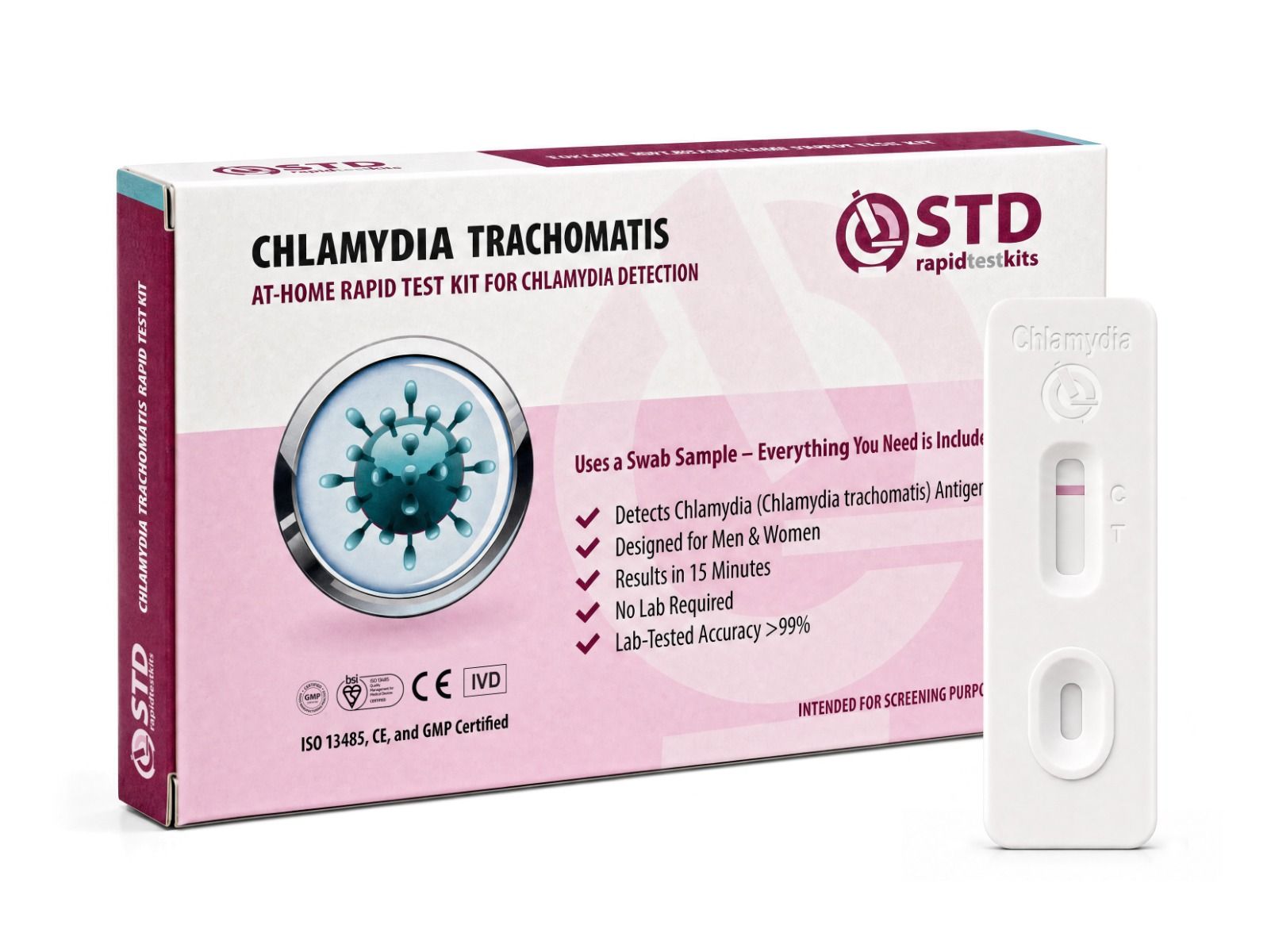
At-home testing changes the math. No appointment. No awkward check-in at a clinic reception desk. No one asking questions you are not ready to answer. You self-collect a genital swab, run the test, and read the result in roughly 15 minutes for a rapid lateral-flow kit, or send the sample to a lab for higher-sensitivity NAAT processing. Discreet kits arrive in plain shipping materials with no visible product branding on the outside.
A negative test is useful information you can plan around. A positive result is actionable: you can start treatment, notify partners, and break the chain. Either outcome beats waiting for symptoms that may never arrive.
Practical Testing Options Compared
Different routes suit different lives. Use whatever option you will actually follow through on. For a guy living with parents in a multi-generational household, mail privacy matters more than lab certainty. For someone with active symptoms, a clinic visit unlocks treatment the same day.
| Testing method | Privacy level | Time to result | Best for |
|---|---|---|---|
| At-home rapid lateral-flow kit | Very high | About 15 minutes | Men living with family, students in shared housing, anyone wanting full privacy |
| Mail-in lab NAAT | High | 2 to 5 days after the sample reaches the lab | Men wanting laboratory-grade analytical sensitivity without a clinic visit |
| Clinic NAAT (urine or swab) | Moderate; visible visit but confidential record | Same day to 3 days | Men with symptoms, recent throat or rectal exposure, or who want three-site testing |
Apps, Travel, and the Risk Mix We Do Not Discuss
Dating has changed. For many Asian men, especially those navigating queer spaces or intercultural relationships, apps are the default. Apps are useful for meeting people. They are not useful for sexual health communication. The unspoken assumption that someone is "clean" because they look healthy or seem nice is one of the most common reasons chlamydia spreads silently in app-driven dating pools.
Travel adds another layer. Visiting family in Asia, weekend getaways with friends, hookups while abroad. Each of these shifts your risk profile, and clinics overseas may be harder to navigate. Insurance might not cover testing in another country. You might not know how to ask for a chlamydia screen in the local language. Prevention has to travel with you. A rapid kit in your travel bag is a low-cost way to do that, and it doubles as a clear signal to a new partner that you take this seriously.
A rapid kit in your bag gives you a private testing option when clinic access is uncertain abroad. Same use case for international hookups or extended visits where local sexual health services are unfamiliar.
Throat and Rectal Transmission: Where Our At-Home Kit Does Not Reach
Chlamydia can infect the throat (pharyngeal chlamydia) and the rectum (rectal chlamydia), not just the urethra. Oral sex can transmit it. Receptive anal sex without a condom carries notably higher risk. Most testing in primary care defaults to a urethral or urine sample, which does not detect throat or rectal infections.
Our at-home rapid kit is a genital swab. It is validated for urethral chlamydia, not for pharyngeal or rectal sites. If you have had recent oral or receptive anal sex with new or multiple partners, the right test for those sites is a clinic-collected swab processed by NAAT (nucleic acid amplification testing). Most sexual health clinics will offer three-site testing on request. Ask for it by name.
This is not a reason to skip our kit. A negative genital chlamydia result still tells you something useful about your urethral status. But if your concern is throat or rectal exposure specifically, see a clinic for those sites. Pretending one sample type covers everywhere your body has been is the kind of half-information that keeps the infection moving.
Our kit: urethral swab only. Recent oral or receptive anal exposure? Ask your clinic for three-site NAAT testing by name. The home kit is still useful for ruling in or out a urethral infection; it just cannot screen pharyngeal or rectal sites.
Preventing Reinfection After Treatment
Testing positive is not the end of the story. Reinfection is common, particularly when one partner is treated and the other is not, or when sexual activity resumes too soon after antibiotics. The CDC recommends retesting roughly three months after a chlamydia diagnosis, regardless of symptoms, specifically because reinfection rates run high in the months after treatment.
The protocol after a positive test, based on current CDC STI treatment guidelines:
- Complete the full antibiotic course. The CDC's current first-line treatment for uncomplicated urogenital chlamydia in non-pregnant adults is doxycycline 100 mg twice daily for seven days.
- Abstain from sex for seven days after starting treatment, or until both you and your partner(s) have completed treatment, whichever is later.
- Tell your recent sexual partners. Most public health departments offer anonymous partner notification services if you cannot make the call yourself.
- Retest at three months. Use a fresh sample, not a leftover one from before treatment.
Forgive yourself in the meantime. Reinfection is not a moral failure. It is a sign that the chain is still alive somewhere in your network and needs another break.
Most people who have chlamydia do not have symptoms. Without testing, an infection can spread to sex partners and lead to serious health problems.
How to Talk to Partners Without Making It Weird
The conversation does not have to be a dramatic sit-down. A short check-in works. A text before the next hookup works. A calm moment in bed when things are going well works. Aim to include your partner in the same standard of care you hold for yourself.
Try one of these openings:
- "I started testing regularly. Want to compare results before things go further?"
- "I tested last month, all clear. Have you tested recently?"
- "I tested and something came up. It is treatable, I am handling it, and I wanted you to know."
Simple, direct, respectful. You are not accusing anyone. If someone reacts badly to that level of honesty, that is information too. Anyone worth being intimate with can hear the word "chlamydia" without blaming, ghosting, or shaming. If the conversation ends a situationship, it saved you time. If it deepens a connection, you are building trust that goes beyond physical.

When Culture Says Do Not Talk About It, Talk About It Anyway
If you grew up in a household where sex was not discussed, where dating was discouraged, or where STI talk was dismissed as a "Western" concern, you are not alone. Breaking the cycle does not require a full coming-out moment with your family. It can start much smaller. Acknowledge to yourself that your sexual health is yours to manage, full stop.
Then find your tools. An at-home test. A sex-positive primary care provider. A community health center that offers culturally competent care. A subreddit or podcast that does not make you feel like a problem for asking questions. Prevention makes space for your reality within your culture; it does not require changing either. You can honor your background, love your family, respect tradition, and still test for chlamydia.
Where to Start Today
Pick one action. Do not try to overhaul your sexual health overnight. The men who follow through tend to start small: ordering a single test, having one honest conversation, putting condoms somewhere they will actually get used.
If you have never tested, that is the first move. The at-home chlamydia rapid test is designed for self-collection and gives a result in about 15 minutes. It is a lateral-flow screen, not a lab NAAT, so a clear positive still benefits from a confirmatory clinic test. For ruling in or ruling out a urethral infection at home, it is a defensible starting point.
If you have tested before and it has been a while, test again. If you have already had chlamydia, schedule your three-month retest now.
FAQs
- Can I really have chlamydia and not feel it?
- Yes. The CDC notes that most chlamydia infections produce no obvious symptoms, particularly in the first few weeks after exposure. You can carry it for months without any sign and pass it on. Testing is the only reliable way to know your status.
- How often should I test?
- The CDC's baseline for sexually active men who have sex with men is annual screening, with retesting every three to six months for those with multiple partners. For men who have sex with women, annual screening is reasonable, especially under 25 or with multiple partners. If you are dating actively and using apps, every three to six months is a sensible cadence.
- Does the at-home test cover throat or rectal chlamydia?
- No. The swab in our kit collects a urethral sample only. Throat (pharyngeal) and rectal infections require swabs collected by a clinician and processed via lab NAAT. If you had unprotected oral or receptive anal sex with a new partner, tell your clinic you need three-site testing.
- Are at-home rapid tests as accurate as clinic tests?
- Rapid lateral-flow tests are a private screening tool. The clinic gold standard for chlamydia diagnosis is NAAT (nucleic acid amplification testing), which has higher analytical sensitivity. A clear positive on an at-home rapid test is worth confirming with a clinic NAAT for full clinical certainty.
- What happens if my test is positive?
- Don't panic. Chlamydia is treatable. The CDC's current first-line treatment for uncomplicated urogenital chlamydia in non-pregnant adults is doxycycline 100 mg twice daily for seven days. Avoid sex for seven days after starting the course, notify your recent partners, and retest at three months.
- Will my insurance see the result if I use an at-home kit?
- No, unless you ask your provider to add it to your medical record. At-home kits do not bill insurance and do not transmit results to your primary care file automatically. Packaging arrives in plain, unmarked shipping materials.
- How do I tell a partner I tested positive?
- Keep it short and factual. A text like, "I tested positive for chlamydia. You should get tested too. It is treatable and I am getting care," is enough. Many public health departments also offer anonymous partner notification if you cannot make the call yourself.
- Can I keep getting chlamydia after I am treated?
- Yes. Reinfection is common, usually because a partner was not treated or sex resumed before both people finished antibiotics. The CDC recommends retesting roughly three months after a diagnosis, regardless of symptoms. Recurrence is a network issue, not a personal failure.
- U.S. Centers for Disease Control and Prevention. About Chlamydia, consumer fact sheet covering symptom prevalence and partner-spread guidance.
- U.S. Centers for Disease Control and Prevention. STI Treatment Guidelines, Chlamydial Infections, covering first-line antibiotic regimens and three-month retest guidance.
- U.S. Centers for Disease Control and Prevention. Health Disparities in Asian People, reported case rates by race and ethnicity for chlamydia and other STIs.
- Mayo Clinic. General clinical reference for chlamydia symptoms, complications in men (epididymitis, prostatitis), and laboratory testing.
