
Published: October 2025 | Last updated: May 2026 | Editorial review and quality control: Martina N.
Sexually transmitted infections (STIs) are among the most common reportable conditions in the United States, and the vast majority of cases produce no symptoms in the first weeks or months after exposure. The U.S. Centers for Disease Control and Prevention's 2024 provisional surveillance data reported approximately 2.2 million combined cases of chlamydia, gonorrhea, and syphilis (CDC 2024 STI surveillance), the third consecutive year of decline yet still well above pre-2014 levels. Many more cases go uncounted simply because the person carrying the infection feels fine.
This guide covers the seven STIs that account for most of the disease burden in adults: HPV, syphilis, HIV, chlamydia, gonorrhea, herpes (HSV-1 and HSV-2), and hepatitis B and C. For each one you will see what the typical symptoms look like, when they tend to show up, what is curable versus what is manageable, and which test (and which testing window) actually answers the question you have.
Key Takeaways
- Most common STIs are silent for weeks to months. CDC and WHO recommend routine screening for sexually active adults regardless of symptoms.
- Window periods vary by infection. A negative test taken too soon after exposure cannot rule out infection. Match the test to the window that matters for your exposure date.
Most genital symptoms are not STIs. Razor irritation, yeast infections, urinary tract infections, ingrown hairs, friction blisters, and normal anatomical variation account for the majority of complaints clinicians evaluate. That said, several STIs look like ordinary skin issues, and the only way to tell for certain is to test. The sections below cover what each major STI tends to look like, when symptoms typically appear, and which test answers your specific question. This article is published by stdrapidtestkits.com, which sells at-home STI testing kits; we recommend products based on fit-for-purpose for the reader, not commercial benefit.
HPV and genital warts: what to look for
Human papillomavirus (HPV) is the most common STI in the United States. The CDC reports that nearly everyone who is not vaccinated will acquire HPV at some point in life, and 9 out of 10 infections go away by themselves within two years (CDC about HPV).
The strains that cause visible warts are different from the strains that cause cancer. Low-risk types 6 and 11 are responsible for roughly 90% of genital warts. High-risk types, especially 16 and 18, drive cervical, anal, throat, and penile cancers but produce no visible signs at the skin or mucosal surface.
Genital warts appear as small flesh-colored or slightly darker bumps in clusters, often described as cauliflower-like. They show up on the vulva, vagina, cervix, penis, scrotum, or around the anus. Warts can be flat, raised, single, or grouped. Most are painless, though they can itch, bleed, or become irritated by friction. A wart on the vulva or shaft of the penis is the visible tip of the infection. The high-risk strains that drive cancer risk are invisible and only show up on a Pap smear, an HPV DNA test, or after symptoms of advanced disease. Cervical cancer typically develops over years to decades after persistent high-risk HPV infection, which is why regular Pap smears and HPV DNA testing catch pre-cancerous changes early enough to treat effectively.
Vaccination remains the strongest preventive tool. ACIP recommends routine HPV vaccination for everyone through age 26, with shared clinical decision-making for adults ages 27 through 45 who were not previously vaccinated. The vaccine prevents new infections; it does not treat infections that already exist.
Different HPV questions need different tests. A Pap smear looks for abnormal cervical cells caused by persistent high-risk HPV; clinical guidelines recommend it every 3 years from age 21 to 29 and every 5 years from 30 to 65 (often combined with HPV DNA testing). An HPV DNA test identifies high-risk strains directly from a cervical sample and is the screen of choice for cervical cancer risk. An at-home HPV rapid swab screens for HPV presence on a self-collected vaginal swab and is useful for an initial check before scheduling a clinic visit. Our HPV rapid swab kit is validated for vaginal self-swab only. Visible warts are diagnosed visually by a clinician; no laboratory test is required.
Syphilis: a four-stage infection that can hide for years
Syphilis is caused by the bacterium Treponema pallidum. After decades of decline, U.S. syphilis cases have climbed sharply, and the CDC has reported the highest level in decades (CDC about syphilis). Untreated, the infection moves through four stages, each with its own pattern.
Primary syphilis (3 to 90 days after exposure)
The first sign is a single firm, round, painless ulcer called a chancre. It appears at the site where the bacterium entered the body, usually the penis, vulva, vagina, anus, or mouth. The chancre is often missed because it does not hurt and heals on its own in three to six weeks, even without treatment. Healing of the chancre is not cure; the bacterium is still circulating in the bloodstream.
Secondary syphilis (4 to 10 weeks after the chancre)
A non-itchy reddish-brown rash develops, classically on the trunk and extending to the palms of the hands and the soles of the feet. The palm-and-sole pattern is one of the most distinctive findings in clinical medicine. Other secondary symptoms include flat moist lesions in body folds (condyloma lata), patchy hair loss, fever, sore throat, weight loss, and swollen lymph nodes. These symptoms also resolve on their own without treatment, which is why so many cases progress undetected.
Latent syphilis (months to years)
The infection goes underground. There are no symptoms, but blood tests remain positive and transmission to sexual partners or to a developing fetus is still possible. Latent syphilis can persist for years before progressing.
Tertiary syphilis (10 to 30 years after initial infection)
A minority of untreated cases eventually progress to tertiary disease, which can damage the heart, blood vessels, brain, nerves, eyes, bones, and joints (CDC about syphilis). Neurosyphilis, ocular syphilis, and otosyphilis can occur at any stage of disease. All forms of syphilis are curable with antibiotics, with intramuscular benzathine penicillin G the first-line treatment; tissue damage from late disease may not reverse.
HIV: the acute phase often looks like flu
Many people who acquire HIV develop a flu-like illness called acute retroviral syndrome 2 to 4 weeks after exposure. Symptoms include fever, fatigue, sore throat, swollen lymph nodes, muscle aches, and a non-itchy maculopapular rash that can appear on the trunk, face, palms, and soles (CDC about HIV).
The acute illness usually resolves within one to two weeks. After that, HIV becomes silent for years. Without treatment the virus quietly destroys CD4 T-cells, and this chronic stage can last a decade or longer before progressing to clinical AIDS (CDC about HIV stages). The catch is that during the acute phase the viral load in blood and genital fluids is extremely high, which is also why this is the period of highest transmission risk.
Modern fourth-generation antigen-antibody combination lab tests can detect HIV from about 18 to 45 days after exposure; rapid antigen-antibody tests detect from 18 to 90 days, and antibody-only tests need 23 to 90 days (CDC HIV testing). Rapid at-home antibody tests are designed for use after the longer window period to confirm seroconversion. A negative rapid test taken within 4 weeks of a known exposure does not rule out infection; it needs to be repeated at the appropriate window.
Modern antiretroviral therapy is highly effective. People who start treatment early and maintain an undetectable viral load have life expectancies approaching the general population, and they cannot sexually transmit the virus to partners (the principle known as Undetectable equals Untransmittable, or U=U).
Testing windows by infection
- Chlamydia and gonorrhea: detectable from about day 14 after exposure on swab-based rapid tests.
- Syphilis: most rapid antibody tests detect infection from 3 to 6 weeks; retest at 3 months for clearance.
- HIV: rapid antibody home tests need 23 to 90 days; lab fourth-generation tests detect from 18 to 45 days (per CDC HIV testing guidance).
- Hepatitis B and C: antibody tests detect infection from about 8 to 12 weeks.
- Herpes (HSV-1 and HSV-2): IgG seroconversion can take up to 16 weeks or more (per CDC herpes testing guidance).
Chlamydia: the most common bacterial STI
Chlamydia, caused by Chlamydia trachomatis, is the most commonly reported bacterial STI in the United States. CDC's 2024 provisional surveillance data reported approximately 1.5 million chlamydia cases, the second consecutive year of decline (CDC 2024 STI surveillance). The infection is most common in sexually active people under 25.
Chlamydia is famously asymptomatic. Most women and roughly half of men with chlamydia have no symptoms at all. When symptoms do appear, they typically show up 7 to 21 days after exposure: abnormal discharge from the vagina or penis, burning during urination, pain or bleeding during sex, lower abdominal pain, or testicular discomfort. Pharyngeal (throat) and rectal infections often produce no symptoms even when a swab from those sites tests positive.
Untreated chlamydia is the leading preventable cause of pelvic inflammatory disease (PID) in women. PID can scar the fallopian tubes, leading to chronic pelvic pain, ectopic pregnancy, or infertility. In men, untreated chlamydia can cause epididymitis. Reactive arthritis is an uncommon complication of either sex.
The infection is curable with a short course of antibiotics, typically doxycycline 100 mg twice daily for 7 days. Sexual partners need treatment too to prevent reinfection, and the CDC recommends retesting at three months after treatment to catch reinfection from an untreated partner.
Test from: day 14 after exposure on a self-collected genital swab. Standard treatment: doxycycline 100 mg twice daily for 7 days. Retest: at 3 months after treatment to catch reinfection from an untreated partner. Partner treatment: all sexual partners from the past 60 days should be tested and treated.
Gonorrhea: rising over the long term, recently declining
Gonorrhea, caused by Neisseria gonorrhoeae, is the second most commonly reported bacterial STI. U.S. cases roughly doubled between 2014 and a 2021 peak before declining for three consecutive years through 2024, though rates remain substantially above pre-2014 levels and antibiotic resistance continues to narrow treatment options. CDC's STI Treatment Guidelines recommend a single 500 mg intramuscular dose of ceftriaxone for persons weighing under 150 kg as first-line treatment for uncomplicated gonococcal infection (CDC STI Treatment Guidelines: gonococcal infections in adults).
Like chlamydia, gonorrhea is often silent. Most women and a meaningful share of men have no symptoms when they are infected. When symptoms appear, they show up 1 to 14 days after exposure: thick yellow or green penile discharge, painful urination, vaginal discharge, intermenstrual bleeding, or pelvic pain.
Pharyngeal gonorrhea (throat) and rectal gonorrhea are increasingly common, especially in people who have receptive oral or anal sex, and most pharyngeal cases produce no symptoms whatsoever. Disseminated gonococcal infection is a rare but serious complication that can cause a sparse pustular rash on the limbs, joint swelling, and fever.
A substantial proportion of gonorrhea diagnoses involve concurrent chlamydia infection, which is why current testing protocols screen for both at the same time. Sexual partners from the past 60 days should be notified and tested. Pharyngeal and rectal infections need clinic-administered NAAT swabs from those sites; we do not sell throat or rectal swab kits.

Genital herpes: HSV-1 and HSV-2
Herpes simplex virus comes in two types. HSV-1 is the classic cold-sore virus that historically caused most oral herpes, and HSV-2 is the classic genital herpes virus. The line between them has blurred. Some cases of genital herpes in the U.S. are caused by HSV-1 acquired through oral sex (CDC about genital herpes).
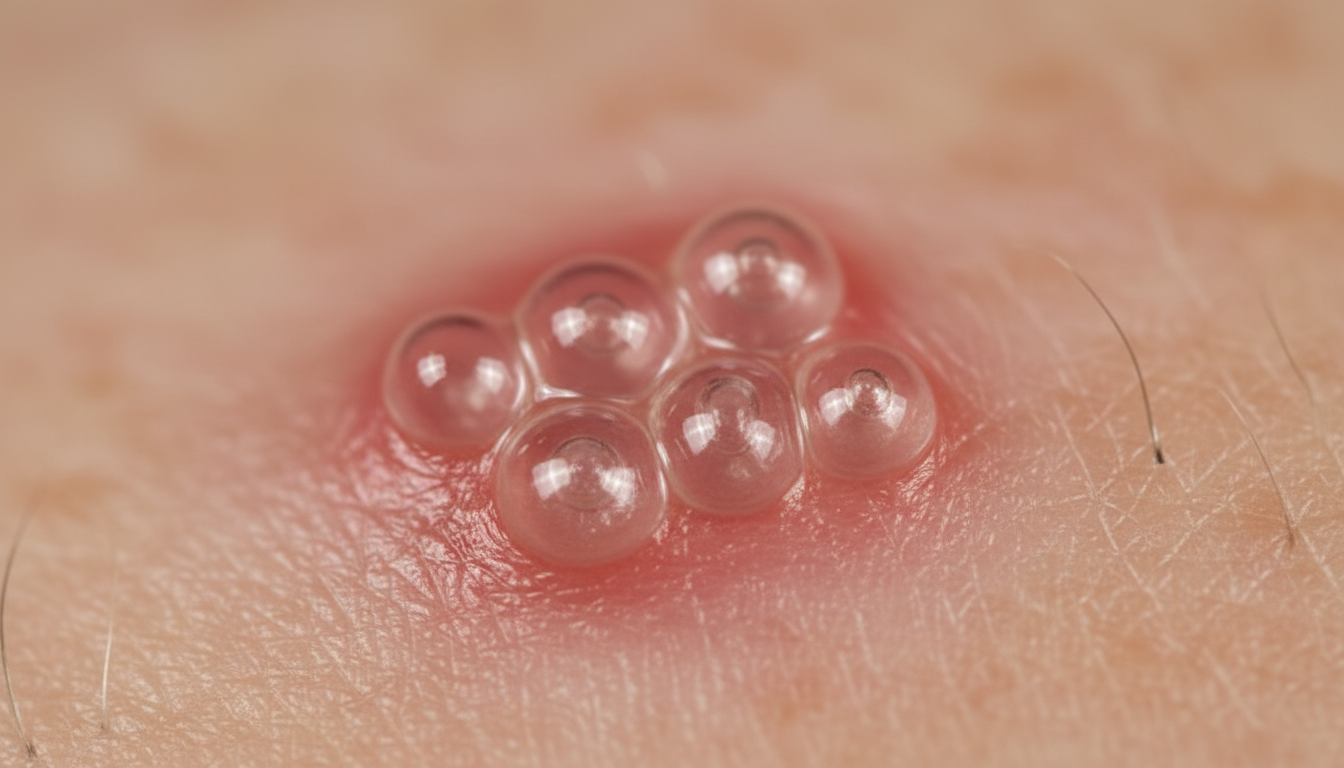
The first outbreak (primary herpes) is usually the worst. Two to twelve days after exposure, painful clusters of small fluid-filled blisters appear on the genitals, anus, thighs, or mouth. The blisters break open into shallow ulcers with a red base and crust over within one to two weeks. Primary outbreaks are often accompanied by fever, body aches, and tender lymph nodes in the groin.
After the primary outbreak the virus retreats into nerve ganglia and becomes latent for life. Roughly half of people with HSV-2 will have one or more recurrences in the first year, and recurrences are usually milder and shorter than the primary outbreak. Many people learn they carry HSV-2 only when an asymptomatic partner is diagnosed and they are tested as part of the workup, or after an antibody test taken for an unrelated reason returns positive. Antibody (IgG) tests are not immediately useful after a possible exposure: CDC notes that current herpes tests can take up to 16 weeks or more to detect infection (CDC herpes testing).
Antiviral medications (acyclovir, valacyclovir, famciclovir) shorten outbreaks and reduce transmission risk to partners; they do not cure the infection. Daily suppressive therapy is an option for people with frequent outbreaks or whose partners are HSV-negative.
Hepatitis B and hepatitis C: liver infections that often hide
Hepatitis B and hepatitis C are bloodborne viral infections that can be sexually transmitted, with hepatitis B being the more easily transmitted of the two through sexual contact. The CDC's clinical overview reports that an estimated 2.4 million to 4 million people had hepatitis C in the United States during 2017 to 2020 (CDC hepatitis C clinical overview). Most chronic infections are silent until significant liver damage has already occurred.
Acute hepatitis can cause fatigue, loss of appetite, nausea, abdominal pain on the right side under the ribs, dark urine, pale stools, and jaundice (yellowing of the skin and the whites of the eyes). The yellow tone comes from bilirubin building up in the bloodstream when the inflamed liver cannot clear it efficiently. Many acute infections are mild enough that the person never seeks care.
Hepatitis B becomes chronic in roughly 5% of adult cases and up to 90% of infections acquired at birth. Chronic infection raises the risk of cirrhosis and liver cancer over decades. There is a highly effective vaccine, and antiviral medications can suppress the virus indefinitely.
More than half of people who become infected with hepatitis C develop chronic infection (CDC hepatitis C clinical overview). Direct-acting antiviral medications cure more than 95% of cases with an 8 to 12 week course of oral therapy. There is no hepatitis C vaccine, which is part of why screening matters: the CDC recommends one-time hepatitis C testing for all adults aged 18 to 79, and one-time hepatitis B testing for all adults at least once in a lifetime.
Test from: 8 to 12 weeks post-exposure on a fingerstick blood antibody test. Screening recommendation: CDC advises one-time hepatitis C testing for all adults aged 18 to 79 and one-time hepatitis B testing for all adults at least once in a lifetime. Outlook: Hepatitis C is curable with direct-acting antivirals in more than 95% of cases; hepatitis B is manageable long-term with antivirals, and partners can be vaccinated to prevent transmission.
The asymptomatic majority
The single biggest reason routine STI screening exists is that most infections do not announce themselves. The numbers in the sections above are conservative estimates from CDC and WHO surveillance: most people with chlamydia, gonorrhea, HPV, hepatitis B, hepatitis C, and HIV will have no symptoms in the early infectious phase. HSV-2 commonly produces such mild first outbreaks that they are mistaken for a yeast infection, urinary tract infection, or razor irritation.
Because of this, CDC recommends:
- Annual chlamydia and gonorrhea screening for all sexually active women under 25, and for older women with risk factors.
- HIV testing at least once for everyone aged 13 to 64, and yearly for people with ongoing risk factors.
- One-time hepatitis C testing for all adults aged 18 to 79.
- One-time hepatitis B testing for all adults at least once in a lifetime.
- Syphilis screening for pregnant people, men who have sex with men, and people with HIV.
If you had unprotected sex with a new partner, sex with someone who has multiple partners, or any sexual contact when condoms broke or were not used, the safe assumption is that you cannot rule out infection on the basis of how you feel. The home-testing section below explains which rapid tests cover which infections and when to use them.
Most people with an STI have no symptoms. Routine screening is the most reliable way to detect infections early and prevent serious complications, including infertility, organ damage, and onward transmission to partners.
Home testing: what is possible, what still needs a clinic
The home-testing landscape has changed considerably since 2020. Rapid lateral-flow tests for chlamydia, gonorrhea, syphilis, HIV, hepatitis B, hepatitis C, HSV-1, and HSV-2 are available over the counter and produce a visible result in 15 to 20 minutes. They use the same antibody and antigen targets as the lateral-flow tests used in clinics, though laboratory NAAT (nucleic acid amplification testing) remains the gold-standard confirmatory method and is more sensitive in early infection.
Two practical points are worth knowing before you choose a kit:
- Different tests use different sample types. Chlamydia, gonorrhea, trichomoniasis, and HPV rapid tests use a self-collected genital swab. HIV, syphilis, hepatitis B, hepatitis C, and herpes (HSV-1 and HSV-2) rapid tests use a fingerstick blood drop. None of the at-home rapid tests offered on this site use urine or saliva samples.
- Window periods still apply. A negative test taken too soon after exposure cannot rule out infection. The window-period takeaways above list the specific timing per infection.
What home tests do not replace: a pharyngeal or rectal swab for oral or anal exposures (those need a clinic-administered NAAT, which we do not sell), a Pap smear or HPV DNA test for high-risk HPV strains, and a confirmatory laboratory test after any positive at-home result. Home rapid tests are screening tools designed to flag a likely infection. A positive result on any rapid test should be followed up with a confirmatory laboratory test before starting treatment.
Our HPV and trichomoniasis kits are validated for vaginal self-swab only; male readers who need testing for those two infections specifically should see a clinic. The eight-infection panel below covers the eight most common STIs that work with at-home swab and fingerstick collection in any-gender users.

Frequently asked questions
- What are the most common STIs in adults?
- By case volume in the United States: HPV (most common overall), chlamydia (most common bacterial), genital herpes (HSV-1 and HSV-2 combined), gonorrhea, trichomoniasis, syphilis, hepatitis B and C, and HIV. HPV and herpes are by far the most prevalent because they are lifelong infections; chlamydia and gonorrhea generate the highest annual new-case counts.
- Can I have an STI without any symptoms?
- Yes, and it is the norm rather than the exception. Most HPV, early HIV, pharyngeal gonorrhea, and chronic hepatitis B and C present with no symptoms at all. Feeling well after a possible exposure does not mean you are negative; a scheduled test taken at the right window is the only reliable answer.
- How long after a possible exposure should I wait to test?
- Window periods range from about 14 days (chlamydia and gonorrhea swabs) to 16 weeks or more (herpes IgG antibody tests). HIV antibody home tests need 23 to 90 days; lab fourth-generation tests detect from 18 to 45 days. Syphilis rapid tests work from 3 to 6 weeks, with a retest at 3 months. Hepatitis B and C antibody tests detect from about 8 to 12 weeks. Use the longest applicable window for the infection you are most concerned about.
- Are at-home rapid STI tests as accurate as lab tests?
- They are accurate enough for screening, though they use different chemistry than the most sensitive laboratory methods. At-home rapid tests are lateral-flow immunoassays. Laboratory NAAT (nucleic acid amplification) is more sensitive in early infection and remains the gold standard for chlamydia and gonorrhea. The two are complementary: a rapid home test is fast and private; a lab confirmatory test follows up any positive result before treatment.
- Which STIs are curable?
- Chlamydia, gonorrhea, syphilis, and trichomoniasis are bacterial or parasitic infections that are fully curable with antibiotics or antiparasitics. Hepatitis C is curable with direct-acting antivirals in more than 95% of cases. HIV, herpes (HSV-1 and HSV-2), HPV, and hepatitis B have no current cure; all four are manageable long-term with antivirals, lifestyle measures, and (for hepatitis B) partner vaccination.
- What is the difference between HSV-1 and HSV-2?
- HSV-1 is the classic cold-sore virus and historically caused most oral herpes; HSV-2 is the classic genital herpes virus. Both viruses can infect either site through skin-to-skin contact. Genital HSV-1 outbreaks tend to be milder and recur less often than genital HSV-2. A blood antibody test can identify which type a person carries.
- Should I test for STIs even if my partner says they are clean?
- Yes. Most STIs are silent for weeks to months, and a partner can have a recent infection they are not aware of. CDC screening recommendations are intentionally based on activity and risk, not on partner self-report. A baseline screen at the start of a new sexual relationship is a reasonable habit even when both partners feel well.
- What should I do if my home test is positive?
- Treat a positive at-home rapid result as a strong signal, not a final diagnosis. Contact a clinic or telehealth provider for a confirmatory laboratory test (NAAT for bacterial STIs, follow-up antibody and antigen testing for HIV, RPR or VDRL for syphilis). Treatment should begin only after confirmation. Notify recent sexual partners so they can also test.
- U.S. Centers for Disease Control and Prevention. 2024 STI annual surveillance, including chlamydia case counts and combined chlamydia, gonorrhea, and syphilis totals.
- U.S. Centers for Disease Control and Prevention. STI Treatment Guidelines: gonococcal infections in adults and adolescents, including 500 mg ceftriaxone IM single-dose recommendation.
- U.S. Centers for Disease Control and Prevention. About syphilis: four-stage progression, palm-and-sole rash pattern, and tertiary disease.
- U.S. Centers for Disease Control and Prevention. HIV testing and stages of infection: window periods for fourth-generation, antibody-only, rapid, and NAT tests; chronic stage may last a decade or longer; U=U principle.
- U.S. Centers for Disease Control and Prevention. Herpes testing: antibody (IgG) seroconversion can take up to 16 weeks or more after exposure.
- U.S. Centers for Disease Control and Prevention. Hepatitis C clinical overview: prevalence estimate of 2.4 million to 4 million U.S. residents from 2017 to 2020 and chronic infection rate.
