







Quick Answer: Herpes symptoms in men usually appear 2 to 12 days after exposure, with most first outbreaks starting around days 4–6. Some men experience early tingling or itching before sores appear, while others may not notice symptoms for weeks, months, or even years.
The Herpes Incubation Period in Men
When people talk about how long herpes takes to show up, they’re referring to something called the incubation period. This is the time between exposure to the virus and the moment symptoms appear.
For Herpes Simplex Virus (HSV-1 or HSV-2), the incubation period is surprisingly short compared with many other infections. In most cases, the virus begins affecting the skin and nerves within just a few days.
The majority of men who develop symptoms experience them somewhere within the first week after exposure. But biology is messy, and bodies don’t always follow neat timelines.
| Time After Exposure | What May Happen |
|---|---|
| Day 0 | Exposure occurs through skin-to-skin sexual contact. |
| Days 2–4 | Some men notice tingling, itching, or mild irritation in the genital area. |
| Days 4–6 | Common window for first symptoms to appear. |
| Days 6–10 | Blisters or sores may develop. |
| 1–2 weeks | Sores crust over and begin healing. |
That 2–12 day window is the reason doctors often ask patients about sexual encounters from the previous couple of weeks when investigating symptoms.
But there’s an important twist: not everyone experiences an obvious first outbreak.
Why Some Men Notice Symptoms Immediately, And Others Don’t
One of the most confusing parts about herpes is that two people can contract the same virus and have completely different experiences.
Some men develop painful sores within a week of exposure. Others carry the virus silently for months or even years before they notice anything unusual.
This happens because herpes is in the nervous system. The virus gets into the body through small cuts in the skin and then moves to nearby nerve cells, where it can stay dormant.
When it reactivates, it travels back to the skin and triggers an outbreak.
There are a number of things that can affect whether someone notices the first outbreak:
- Immune response: A strong immune response may suppress symptoms.
- Viral strain: There are some differences in how HSV-1 and HSV-2 act.
- Location of exposure: Oral vs genital contact can change symptom patterns.
- Stress or illness: These can trigger outbreaks later.
This is why someone might assume they “just caught herpes” from a recent partner when in reality they may have been carrying it quietly for a long time.
It’s also why testing and honest communication are so important.
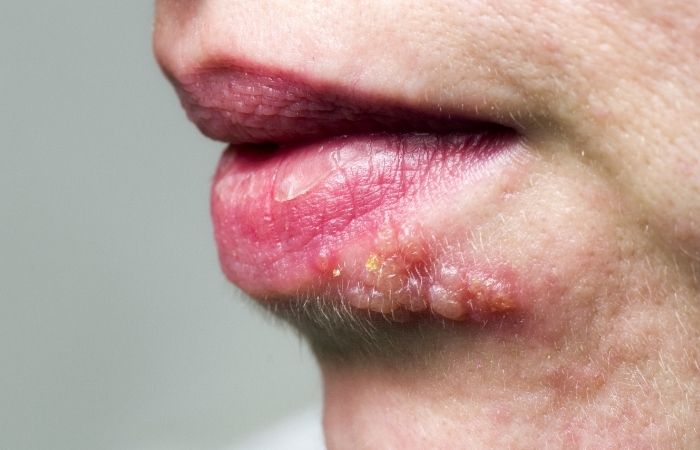
People are also reading: Yes, You Can Give Someone Genital Herpes With a Cold Sore
The First Signs Men Usually Notice
Most people imagine herpes starting with obvious blisters. In reality, the earliest stage often feels subtle.
Doctors call this phase the “prodrome.” It’s essentially the body’s early warning system that an outbreak is beginning.
Many men describe the sensation in surprisingly similar ways.
“It felt like a patch of skin that just wouldn’t stop itching. I thought it was irritation from shaving.”
“There was this weird electric tingling down my thigh before anything showed up.”
“My skin felt sore, like a bruise under the surface.”
Common early symptoms can include:
- Tingling around the penis, scrotum, or thighs
- Burning sensation on the skin
- Mild itching that doesn’t go away
- Redness or small bumps in the genital area
- Flu-like symptoms during the first outbreak
These early sensations often appear one to two days before visible sores develop.
That small window is actually when the virus is most active on the skin.
What the First Outbreak Usually Looks Like
If symptoms progress beyond the early tingling phase, the first outbreak tends to follow a predictable pattern.
At first, small red bumps show up in the area around the genitals. These bumps fill with liquid and turn into blisters. The blisters eventually break open and turn into shallow sores.
The sores can feel tender, raw, or painful, especially during urination or friction from clothing.
| Stage | Description |
|---|---|
| Red spots | Small irritated patches appear on the skin. |
| Blisters | Fluid-filled bumps develop. |
| Ulcers | Blisters pop and turn into painful sores. |
| Scabbing | Sores dry and begin healing. |
For a first outbreak, the entire process often lasts around 7–14 days.
Future outbreaks, if they occur, are usually shorter and less severe.
Can Herpes Show Up the Next Day?
This is one of the most common panic searches after sex.
In short, herpes is very unlikely to show up the next day.
The virus needs time to replicate inside skin cells and travel along nerves before symptoms appear. That process usually takes at least two days.
If someone notices irritation the morning after sex, it’s far more likely to be something else, friction, shaving irritation, allergic reaction to lubricant, or an ingrown hair.
That doesn’t mean symptoms should be ignored, but immediate next-day changes are rarely caused by herpes.
Understanding that simple timing rule can save people a lot of unnecessary stress.
Check Your STD Status in Minutes
Test at Home with Remedium8-in-1 STD Test Kit

 For Men & Women
 Results in Minutes
 No Lab Needed
 Private & Discreet
Order Now $149.00 $392.00
For all 8 tests
When Testing for Herpes Actually Works
Testing is another area where timing matters.
There are two primary ways herpes is diagnosed:
| Test Type | Best Time to Use |
|---|---|
| Swab test | When an active sore is present |
| Blood test | About 4–12 weeks after exposure |
A swab test is the most accurate when a blister or sore is visible because the virus is present on the skin.
Blood tests look for antibodies created by the immune system. Those antibodies take several weeks to build up, which is why testing too early can lead to false negatives.
If you’re unsure about symptoms, getting reliable information quickly can help you make better decisions about your health and your partners.
Many people now choose discreet options like at-home STD testing kits that allow them to check for multiple infections privately.
When anxiety is high, clarity can make a huge difference.
A Quick Reality Check About How Common Herpes Is
One of the reasons herpes creates so much anxiety is the stigma around it. But statistically, the virus is incredibly common.
Worldwide, billions of people carry some form of the herpes simplex virus.
Many of them never experience noticeable symptoms.
That means a person can unknowingly pass the virus to a partner even when everything looks and feels normal.
This concept is called asymptomatic shedding, and it’s a key reason why herpes spreads even among people who are careful about their sexual health.
Understanding that reality doesn’t remove responsibility, but it does help replace shame with awareness.
When Symptoms Take Longer Than Expected
Not everyone who contracts Herpes develops symptoms within the classic 2–12 day window. In fact, a significant percentage of people never recognize their first outbreak at all. The virus can enter the body quietly, settle into nearby nerve cells, and remain dormant.
That dormancy is one of the reasons herpes can feel so confusing. Someone might notice symptoms months after a sexual encounter and assume the infection came from a recent partner, when the virus may have been present for much longer.
Doctors see this situation frequently. A patient comes in worried about a new bump or sore, convinced it must be from a recent encounter, but testing sometimes shows antibodies that suggest the infection happened earlier.
The truth is that herpes doesn’t always follow a neat script. Sometimes the first visible outbreak occurs during periods of stress, illness, fatigue, or hormonal changes, anything that temporarily weakens the immune system.
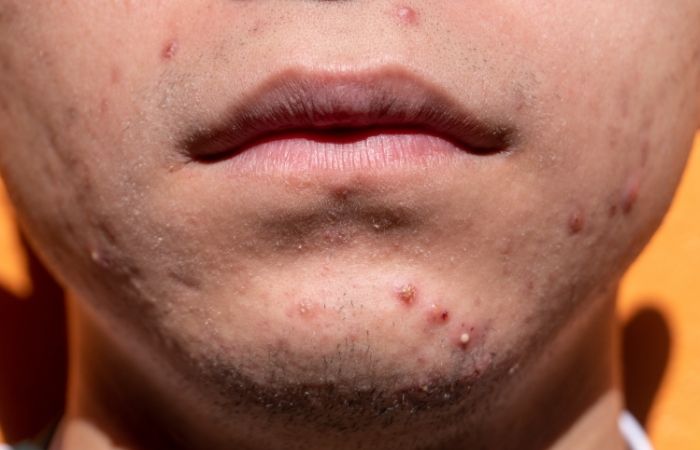
Common Skin Issues That Get Mistaken for Herpes
Because the early symptoms can be subtle, a lot of harmless skin conditions get mistaken for herpes. Dermatologists and sexual health clinics see this confusion constantly, especially when someone starts closely examining their skin after a new sexual partner.
Many normal conditions can look suspicious at first glance.
| Condition | How It Usually Appears | Key Difference |
|---|---|---|
| Ingrown hair | Small red bump around a hair follicle | Usually has a visible hair in the center |
| Razor burn | Patch of irritated red skin | Appears shortly after shaving |
| Friction irritation | Redness or soreness after sex | Improves quickly with rest |
| Fordyce spots | Tiny pale bumps | Painless and permanent |
One of the defining characteristics of herpes sores is that they usually appear as clusters of blisters that eventually open and form shallow ulcers. They may also feel painful or tender.
If bumps stay small, painless, and unchanged for weeks, they’re usually something else.
People are also reading: It’s Not Just Sex: The Real Reasons Black Gay Men Face Higher HIV Risk
How the Virus Actually Moves Through the Body
Understanding how herpes behaves biologically can make the timeline easier to grasp.
After exposure, the virus enters the body through microscopic breaks in the skin. From there it begins replicating in nearby cells. Within a short time it travels to nerve endings located near the infection site.
Those nerve cells act almost like a long-term hiding place.
The virus remains there in a dormant state until something triggers it to reactivate. When that happens, it travels back along the same nerve pathway toward the skin, creating the symptoms people recognize as an outbreak.
This cycle explains two things that confuse many people:
- Why outbreaks tend to appear in the same location.
- Why symptoms can suddenly appear long after exposure.
The virus isn’t “new” each time, it’s simply reactivating.
What Happens After the First Outbreak
The first outbreak is usually the most noticeable one. During this stage the immune system is encountering the virus for the first time, so symptoms may be stronger.
After the body produces antibodies, future outbreaks, if they happen, tend to be milder and shorter.
Some men experience occasional recurrences once or twice a year. Others may go many years without another episode. Many never experience another outbreak at all.
“My first outbreak was the only one that really hurt,” one patient explained during a clinic visit. “After that, if anything shows up, it’s tiny and gone in a couple days.”
Triggers that sometimes cause outbreaks include stress, lack of sleep, illness, or skin irritation. Learning personal triggers can help people manage symptoms over time.
What To Do If You Think You Were Exposed
That waiting period after a possible exposure can be stressful. It’s common to analyze every sensation and inspect every small bump.
Instead of relying on guesswork, a few simple steps can make the situation clearer.
First, pay attention to the time. If symptoms appear within a week or two of exposure, especially clusters of painful blisters, a medical evaluation is worthwhile.
Second, avoid sexual contact if sores are present until a diagnosis is clear.
Finally, think about testing. It's now easier than ever to discreetly check for common infections thanks to modern testing options.
A lot of people, for instance, choose a combo STD home test kit that can find more than one infection at a time. This method can be very useful because some sexually transmitted infections can make you look like you have herpes.
Getting accurate information quickly often replaces days of anxiety with a clear next step.
Check Your STD Status in Minutes
Test at Home with Remedium7-in-1 STD Test Kit
 For Men & WomenResults in MinutesNo Lab NeededPrivate & Discreet
Order Now $129.00 $343.00
For all 7 tests
Why Panic Searches After Sex Are So Common
Late-night searches about herpes timelines usually come from a place of fear and uncertainty. People replay encounters in their head and start connecting dots that may not actually be related.
A small irritation becomes suspicious. A pimple becomes alarming. A normal body sensation suddenly feels meaningful.
Health professionals see this pattern constantly, especially among people who care about their sexual health but may not have received clear information about how infections actually behave.
The good news is that the body usually provides fairly recognizable signals if something truly is wrong. And when symptoms are unclear, testing can provide answers far more reliably than internet speculation.
The Waiting Window After Exposure
The hardest part for many people isn’t the symptoms themselves, it’s the waiting. After a sexual encounter that suddenly feels uncertain, time starts moving differently. A normal itch feels suspicious. A tiny bump seems louder than it should.
But biology rarely works on panic timelines. Herpes needs time to replicate in the skin before the body reacts to it. The virus enters through microscopic breaks in the skin, multiplies locally, and then travels to nearby nerve endings. That process is why most symptoms don’t appear instantly.
During the first few days after exposure, the virus is still establishing itself. The immune system hasn’t fully recognized the threat yet, and the skin usually looks completely normal. For many men, days two through five are when subtle sensations may begin, tingling, mild irritation, or a strange sensitivity in a small patch of skin.
Sometimes nothing happens at all. And that’s not unusual. Many exposures never lead to noticeable symptoms, even when transmission occurs. The body may suppress the virus so effectively that the person never realizes it’s there.
That uncertainty is exactly why sexual health professionals focus less on guessing and more on timing. If something does develop within that typical one-to-two-week window, especially clusters of blisters or tender sores, it becomes easier to evaluate and test.
Until then, the smartest approach is patience and perspective. Skin changes happen for dozens of reasons, and most of them have nothing to do with sexually transmitted infections. Knowing the real herpes timeline helps you stay calm during the waiting period instead of worrying.
FAQs
1. Can herpes really show up the next day after sex?
Almost never. Herpes usually needs a few days to settle in before symptoms appear. Most men who notice a first outbreak see it somewhere around day four or five after exposure. If something pops up the very next day, it’s far more likely to be friction, shaving irritation, or just your skin reacting to a long night.
2. How long does herpes actually take to show up in men?
The typical window is about 2 to 12 days after exposure. Most people who do get symptoms notice them within the first week. Think of it less like a light switch and more like a slow build, first the tingling, then irritation, then sometimes small blisters.
3. What does the very beginning of a herpes outbreak feel like?
Many men say it starts with a weird sensation that’s hard to describe. Some call it tingling, others say it feels like a tiny sunburn under the skin. One patient described it perfectly: “It felt like my skin knew something was coming before I could see anything.” A day or two later, that area might develop small bumps or blisters.
4. Is every bump after sex something to worry about?
Definitely not. In fact, most bumps people panic about turn out to be completely harmless. Ingrown hairs, clogged pores, friction irritation, even a little razor burn can look suspicious if you’re staring at it under bright bathroom lighting at midnight.
5. Can someone have herpes and never notice symptoms?
Yes, and it happens more often than people think. Many people carry the virus without obvious outbreaks. They might never see sores, or they may have symptoms so mild they mistake them for something else.
6. Where do herpes sores usually appear in men?
They usually show up somewhere in the genital region, the penis, scrotum, groin, buttocks, or sometimes around the anus. Because the virus travels along nerves, outbreaks often return to roughly the same area each time.
7. Does the first herpes outbreak hurt?
It can. The first outbreak is often the most noticeable because your immune system hasn’t seen the virus before. Some men experience tender blisters or sores for a week or two. Later outbreaks, if they happen at all, are usually much milder.
8. When should someone get tested if they’re worried?
If there’s an actual sore or blister, that’s the best time to get it checked because a doctor can swab it directly. Blood tests are also available, but they work best a few weeks after exposure once the body has produced detectable antibodies.
9. Can herpes spread even when nothing looks wrong?
Yes, and this surprises a lot of people. The virus can occasionally shed from the skin without visible sores. That’s one reason herpes is so common worldwide, people can pass it on without realizing they’re contagious.
10. Should someone panic if they think they were exposed?
Panic rarely helps. The smarter move is to pay attention to your body, understand the timing of symptoms, and test if something genuinely looks suspicious. Most scares turn out to be false alarms, but getting real information always beats guessing.
You Deserve Clarity, Not Guesswork
Noticing something unusual after sex can flip a switch in your brain. Suddenly every sensation feels suspicious. A small bump becomes a theory. A little irritation becomes a late-night spiral through search results.
The goal isn’t to panic over every symptom. The goal is to understand timing, recognize patterns, and separate normal skin changes from signals that actually deserve attention. Herpes usually follows a predictable window, a few days after exposure, sometimes longer, and knowing that timeline helps bring the situation back into perspective.
If something still doesn't seem or feel right, get more information. The Combo STD Home Test Kit is a discreet option that can quickly and privately screen for several infections. Guessing makes you anxious. Real answers give you back control.
How We Sourced This Article: This article draws on guidance from major sexual health organizations along with peer-reviewed research on the herpes simplex virus. We reviewed studies on incubation periods, transmission, and symptom patterns to understand when herpes typically shows up in men. Our goal was to turn that clinical information into explanations that are clear, practical, and actually helpful in real-world situations.
Sources
1. Centers for Disease Control and Prevention – Genital Herpes Overview
2. Fact Sheet from the World Health Organization about the Herpes Simplex Virus
3. Mayo Clinic – Genital Herpes Symptoms and Causes
5. National Institutes of Health – Research on HSV Incubation and Transmission
6. Planned Parenthood – Herpes Information
About the Author
Dr. F. David, MD is a board-certified infectious disease specialist focused on STI prevention, diagnosis, and treatment. His work centers on translating complex sexual health science into clear, stigma-free guidance that helps people make informed decisions about their bodies and their relationships.
Reviewed by: Michael R. Levin, MD, Urology | Last medically reviewed: February 2026
This article is only for informational purposes and should not be used instead of professional medical advice, diagnosis, or treatment.


