
Published: August 2025 | Last updated: May 2026 | Editorial review and quality control: Martina N.
Georgia's chlamydia and gonorrhea numbers are not abstract. In 2023, the state reported 71,294 chlamydia cases (646.4 per 100,000 residents) and 30,307 gonorrhea cases (274.8 per 100,000), placing it among the top five US states for chlamydia and the top three for gonorrhea per CDC surveillance data. The harder truth sits behind those rankings: most early infections produce no obvious symptoms, which is why so many of them go untreated long enough to spread, scar reproductive tracts, or cycle back to a partner months later. This article walks through what the Georgia data actually shows, why both infections so often travel together, and how at-home combination screening fits into the answer.
Key Takeaways
- Georgia ranked top 5 for chlamydia (646.4 per 100,000) and top 3 for gonorrhea (274.8 per 100,000) in 2023 per CDC surveillance data, with 71,294 and 30,307 cases respectively.
- Both infections are frequently asymptomatic. Routine screening, not symptom-watching, is the only reliable way to catch and treat them before complications develop.
Why Symptom Confusion Keeps Cases High
Here is the trap. Early chlamydia and gonorrhea often produce no symptoms at all. When something does show up, it tends to look like ordinary life: a little burning when you pee, some spotting after sex, a sore throat you chalk up to pollen, rectal discomfort you blame on spicy food. The CDC is direct that both infections are frequently asymptomatic, which is exactly why screening, not symptom-watching, drives prevention and care.
When symptoms do appear, they overlap with so many non-STI issues that people do the human thing and wait it out. That delay fuels Georgia's numbers more than any single risky weekend ever could. The advice from national and clinic sources is consistent: do not wait for drama to test, because most people never get the dramatic version. It is quiet more often than not, which is why home kits you can use on your own schedule make sense when a clinic visit is hard to schedule or feels too exposed.
Authoritative guidance from places like the Mayo Clinic underlines that testing is straightforward, accurate when used correctly, and the entry point to antibiotics that actually cure these infections. Treatment is short. The wait for clarity should be too.
Leah messages a friend, "It's probably nothing." Then she types what she really means, "I need to know." The difference between those two sentences is the difference between a rumor of a problem and a plan.
- Burning when you pee: often blamed on a UTI or dehydration.
- Light spotting between periods or after sex: often blamed on cycle irregularity or rough sex.
- Sore throat or scratchy throat: often blamed on pollen, dry air, or a passing cold.
- Mild rectal discomfort: often blamed on spicy food or hemorrhoids.
Any of these can be a non-STI cause. None of them rule out chlamydia or gonorrhea on their own. Testing is the only way to tell.
Georgia by the Numbers: Where the Hotspots Are
Zoom out to the map. In 2023, Georgia reported 71,294 chlamydia cases, a rate of 646.4 per 100,000 residents, the fifth highest statewide rate in the country. Gonorrhea landed even harder: 30,307 cases for a rate of 274.8 per 100,000, third highest nationally. Those figures come from the CDC's 2023 STI surveillance tables, which pull together all state reports and rank them side by side for context.
The Georgia Department of Public Health points residents to its OASIS portal for county-level maps and trend charts, and that is where the picture gets local fast. Metro counties like Fulton and DeKalb routinely sit in the upper tiers for both infections, which tracks with population density, mixing patterns, and clinic access. Coastal Georgia tells its own story: in Chatham County, gonorrhea's 2023 rate sat well above the state average, while nearby Bryan County's rates were far lower, a reminder that these epidemics are not one uniform wave but clusters and currents that shift by zip code.
County-level differences are not about morality. They are about movement. College towns spike when semesters start. Tourism corridors swell on long weekends. Smaller counties face longer drives, fewer clinics, and more eyes watching the front door. That is how stigma, just the fear of being seen, turns into missed tests, which turns into missed treatment, which turns into one more dot on a map that never needed to be there.
How common are chlamydia and gonorrhea in Georgia, and what should I do?
In 2023, Georgia reported 71,294 chlamydia cases (646.4 per 100,000) and 30,307 gonorrhea cases (274.8 per 100,000), placing the state in the top five for chlamydia and top three for gonorrhea nationally per CDC data. Most cases produce no symptoms, so the CDC and Georgia Department of Public Health recommend annual screening for all sexually active adults under 25, and more often for people with new or multiple partners. At-home combination kits are an accurate, private option when a clinic visit is not feasible. Confirm any positive at-home result with a healthcare provider before treatment.
Two Infections, One Pattern: Why Chlamydia and Gonorrhea Travel Together
Ask a frontline clinician in Atlanta what they see and you will hear a version of the same story: when one of these bacterial STIs shows up, the other is often not far behind. Peer-reviewed research backs the pattern with numbers. Studies have documented that people diagnosed with gonorrhea often carry concurrent chlamydia, sometimes in startling proportions among teens and young adults, and that pelvic or throat sampling can reveal infections you would never spot from a urine sample alone. Other analyses in primary care show the asymmetry too: co-infection is more common when gonorrhea is present than the other way around.
The mechanism is simple. The bacteria spread through the same routes (vaginal, anal, and oral sex) and through the same partner networks. If you have been exposed to one, the conditional probability of the other rises with the type of contact and how recent it was. Long-standing CDC clinical guidance has reflected this reality by addressing the two infections side by side in treatment recommendations and surveillance, so Georgia providers will typically screen and treat for both when one is found. See the CDC's overview pages on gonorrhea and chlamydia for the patient-facing summary, and the STI Treatment Guidelines for the clinical detail behind those decisions.
Practically, combination at-home screening makes sense when you need clarity in one step. Treating quickly, treating correctly, and notifying partners breaks chains of transmission before isolated cases turn into county-level trends.
"I felt fine," says Miles, a 21-year-old student in Athens, thinking back to a positive chlamydia result that did not feel real. "No fever. No pain. Just nothing. If my girlfriend hadn't said let's test together, I would have never known."
This article is published by stdrapidtestkits.com, which sells at-home STI testing kits. We recommend products based on fit for the reader's concern, not commercial benefit. Editorial guidance and clinical sources are independent of product selection.
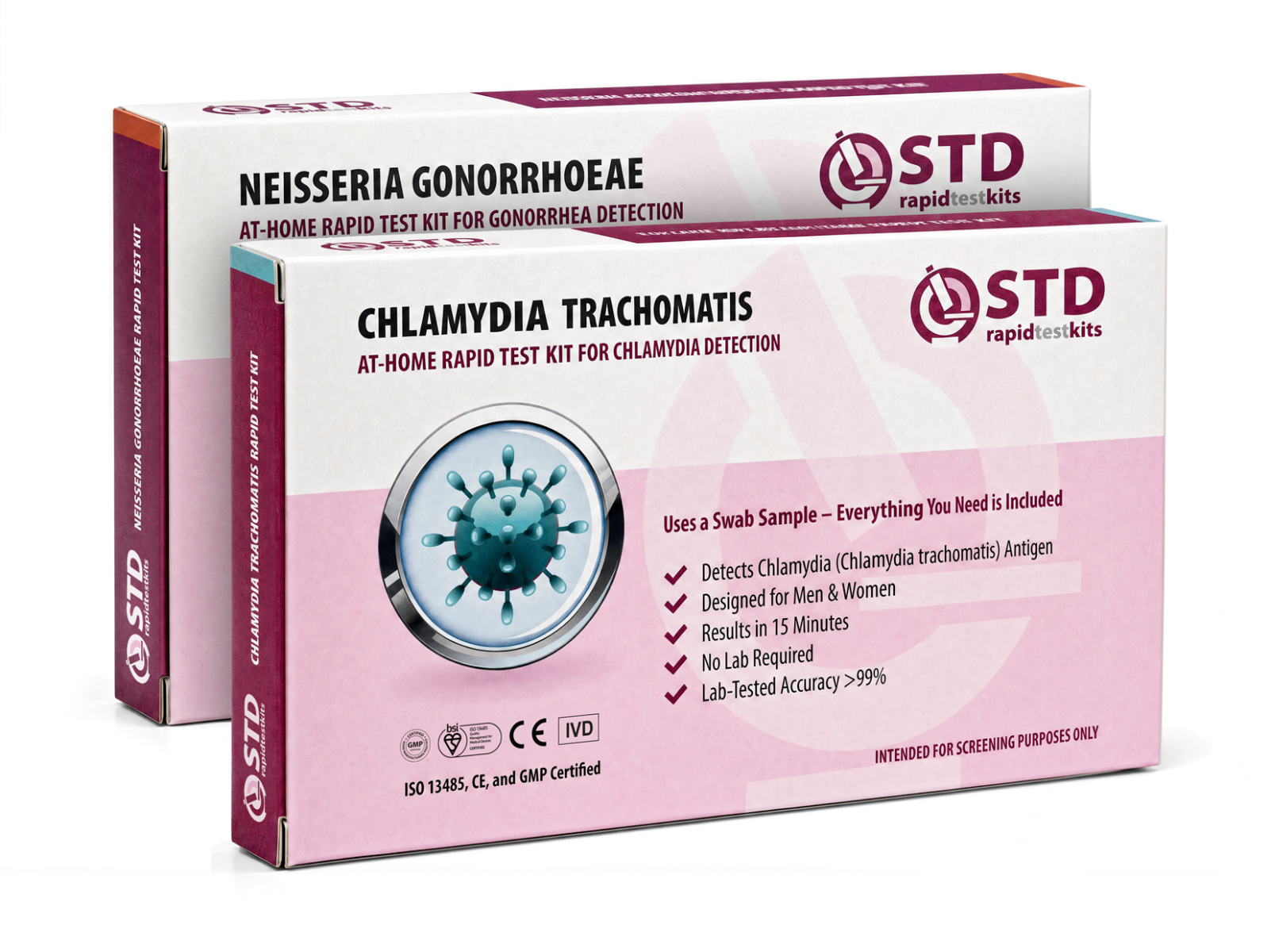
How Co-Infection Looks on the Ground
In a Buckhead coffee shop, Rina scrolls through her lab portal, cheeks flushing when she forgets to dim her screen. Negative on gonorrhea. Positive on chlamydia. She had expected the opposite because of something she read about color and discharge. That is not how biology works, and she laughs once, sharp and tired, at how confidently wrong the internet can be.
Across town in College Park, Dev stares at a text he needs to send to a recent partner. "I tested positive. You should test too." He writes, deletes, writes again, then just hits send. The bubble turns to Delivered and the dread does not swallow him after all. That single message is, statistically, one of the most consequential things he will do all month: it cuts a possible chain of transmission and gives his partner the same thirty-second decision he just made.
Down in Savannah, a coastal health district physician finishes a clinic day and says, "It is getting a little better." A local TV segment had flagged that statewide rates are leveling in some categories compared with 2022. People are coming in sooner. They are using home kits and then following up. The shift is incremental, but it is measurable, and it starts with people deciding to act instead of arguing with their search bar.

Myth: "If I Had an STI, I'd Know"
This belief runs deep in conversations across Georgia, but the truth is harder. The CDC emphasizes that both chlamydia and gonorrhea are frequently asymptomatic. Even when symptoms appear, they can be subtle: a little burning when you pee, light spotting between periods, throat irritation that feels like allergies. People often treat them as minor inconveniences or write them off as yeast infections or UTIs. By the time symptoms are bad enough to spark action, the bacteria may have already caused complications like pelvic inflammatory disease, infertility, or chronic pelvic pain in women, and epididymitis or urethritis in men.
What does "frequently asymptomatic" actually mean in numbers? Population-level estimates summarized on the CDC chlamydia information page indicate that most women and a large share of men with chlamydia have no symptoms at the time of diagnosis. For gonorrhea, asymptomatic infection is also common, particularly in pharyngeal (throat) and rectal sites that a urine-only sample cannot reach. The infection is doing its work quietly, which is exactly the design problem that screening was created to solve.
In Atlanta's Old Fourth Ward, Marcus remembers thinking his mild discomfort was from cycling too much. He only tested after his partner urged him to. "If she hadn't pushed, I would still be riding around thinking my bike seat was the problem," he says, shaking his head at how close he came to missing it entirely. Treatment, once he tested, was a short course of antibiotics. The hard part was not the cure. The hard part was getting to the test.
Chlamydia often has no symptoms, but it can cause serious health problems, even without symptoms.
County Maps Tell the Same Story in Different Accents
Scroll through Georgia's OASIS interactive map and patterns emerge. In 2023, Fulton County's chlamydia and gonorrhea counts were among the highest in the state, with DeKalb close behind and Clayton, Chatham, and Muscogee in the upper tier as well. College towns like Clarke County (home to Athens) and rural hubs like Dougherty County also show up in bright colors. These are not just dots; they are reminders that infection thrives anywhere testing is irregular and conversations about sex carry stigma.
Yet the numbers do not always mean what people assume. High case counts can also reflect strong testing programs, which catch and treat infections that would otherwise go uncounted. In some smaller counties, low numbers may be less about safety and more about under-testing. Without consistent screening, infections hide, spread, and resurface later in more complicated, and more expensive, ways.
The OASIS portal is also where you can spot local trends over time, including the Department of Public Health's own observations about which counties are climbing and which are leveling off. None of that data is meant to shame a county. It is meant to show where the next public health dollar should land, and where individuals can quietly normalize testing in their own communities.
One way to read the map fairly: a county with rising rates is often a county where testing is finally catching up to reality. The infection was already there. The map is just starting to see it.

Myth: "Testing Is Only for People With Multiple Partners"
This one keeps far too many people from getting checked. Chlamydia and gonorrhea do not care about relationship status, gender identity, or sexual orientation. A monogamous person can still get infected if a partner is carrying the bacteria unknowingly. Both infections pass through vaginal, anal, and oral sex, even with imperfect barrier use. The Planned Parenthood guidance is clear: anyone sexually active should get tested at least once a year, and more often with new or multiple partners or a partner with symptoms.
Lena, a 32-year-old from Columbus, remembers the look on her husband's face when their test results came back. "We were faithful. We thought that meant we were safe. But he had had gonorrhea years ago and never knew," she says. The bacteria do not literally hide in the body for years, but a person can carry an asymptomatic infection for months without realizing, and a chain of partners that predates the current relationship can resurface in ways that feel impossible until you see the data.
Annual screening is not a comment on your relationship. It is hygiene, the same way a yearly dental cleaning is not an accusation about your brushing habits. Many couples in monogamous relationships still benefit from a one-time baseline test together at the start of the relationship.
Who CDC recommends test annually
- Sexually active women under 25, regardless of partner count or relationship status.
- Sexually active women 25 and older with risk factors (new or multiple partners, a partner with an STI).
- Men who have sex with men, with site-specific testing (urethral, pharyngeal, rectal) based on exposure.
- Couples starting a new relationship may benefit from a one-time baseline test together.
The Stigma Equation: Why Where You Live Shapes Whether You Test
Drive through some of Georgia's smallest counties and you will see the challenge: one public health clinic, limited hours, a waiting area where you recognize three people instantly. Even in metro areas, fear of being seen in a sexual health clinic keeps people away. In rural settings, anonymity is almost impossible, and in communities with tight social networks, gossip moves fast. This stigma is not just awkward; it is dangerous. It delays diagnosis, prolongs infectious periods, and creates clusters that county health maps can trace months later.
The Georgia Department of Public Health acknowledges this barrier in its STI prevention messaging, and several rural districts have moved toward expanded telehealth visits and mail-out kits to close the gap. Pharmacy-based testing programs are slowly expanding too. Each of these channels exists for the same reason: lowering the friction between "I should probably test" and the test itself is the single largest lever public health has on these infections.
In a laundromat off Macon's Vineville Avenue, Tasha folds jeans with one hand and scrolls her phone with the other. A news alert about rising STI rates in Bibb County slides across her screen. She swipes it away. Her best friend had told her last week that her gonorrhea test came back positive, caught early only because she went in for a pregnancy test.
Tasha has never been tested for chlamydia or gonorrhea in her life. She figures she would know if something was wrong. The hum of the dryers is a low, constant soundtrack as she tells herself she will look into it next month. That gap between deciding and doing is where Georgia's statistics quietly grow.

Sex-Positive Doesn't Mean Careless, It Means Proactive
In a bright kitchen in Savannah, Andre pours coffee and opens a package that came in the mail yesterday. It is an at-home chlamydia and gonorrhea test. He had ordered it on a whim after reading a local news story about Chatham County's rising rates. There is no shame in it, just curiosity and a commitment to his own health. Being sex-positive is not about ignoring risk; it is about managing risk in a way that supports pleasure and connection without fear hanging in the background. For Andre, that means knowing his status as easily as he checks his bank account.
The Department of Public Health has been clear: routine testing is one of the strongest tools for reducing the state's STI burden. Yet for many, the idea of sitting in a clinic for a urine sample or swab feels intimidating or inconvenient. This is where at-home kits change the script. They allow people to test on their own schedule, in their own space, with privacy guaranteed.
The results are accurate when the kit is used correctly. A positive at-home result should be taken to a healthcare provider for confirmatory laboratory testing (NAAT/PCR is the laboratory standard) and treatment, often the same day. A negative result, especially when used after the right window period, is reassuring and a useful baseline for the next routine check.
At-home rapid swab is a lateral-flow immunoassay. It's useful as a screening tool: fast, private, and accurate when used correctly per the kit instructions. A positive result should always be confirmed by a clinician.
Laboratory NAAT/PCR is the analytical gold standard used by clinics and public health labs. It detects bacterial nucleic acid with higher sensitivity, especially at lower bacterial loads. This is what your provider will use to confirm a positive home result and to guide treatment.
The two are complementary, not equivalent. Home rapid screening lowers the barrier to testing; lab NAAT confirms and treats.
Why "No Symptoms" Is Never a Free Pass
In Athens, Kai thought he was in the clear. No burning, no discharge, no discomfort, just a couple of sore muscles from soccer practice. Then his partner tested positive for chlamydia. He took an at-home combo test the same night and found out he had it too. According to the CDC's 2023 STI surveillance summary, a large share of chlamydia and gonorrhea cases are asymptomatic at diagnosis, which means they are only found because someone decided to test proactively. Left untreated, these infections can lead to serious complications: infertility or chronic pelvic pain in women, epididymitis or urethritis in men, and increased risk of HIV transmission and acquisition for both.
"I was shocked," Kai admits. "But I was also relieved I found out before I passed it back to her. Now we can both get treated and move on." The simplicity of that resolution (diagnosis, treatment, prevention of further spread) is exactly why regular screening matters more than waiting for a symptom to appear.
Georgia is not unusual in carrying a heavy bacterial-STI load. It is unusual in how concentrated that load is, and how readable the county-level patterns are if you actually look. The OASIS map is one of the most generous public-health tools any state offers its residents. The reciprocal action is to make testing itself ordinary: at home, at the clinic, after a new partner, after a missed-condom moment, or just at the same point every year.
Prevention as Shared Responsibility
Prevention does not have to feel like policing. It can feel like care. Using condoms or dental dams, communicating openly with partners about STI status, and incorporating regular screening into your sexual routine are all part of a sex-positive approach. Georgia's college towns, tourist areas, and urban centers see constant movement of people in and out, which raises exposure risk. But the same principle applies whether you are in downtown Atlanta or a small town in Tift County: the more consistently people know their status, the less room there is for silent transmission.
This is not about making anyone feel bad about the choices they make. It is about keeping yourself and the people you care about healthy, whether they are a long-term partner or someone you met last weekend.
It also matters that partners get treated. The CDC recommends partner therapy when feasible, including expedited partner therapy in many states, so the infection does not just bounce back to the original case. Ask your provider about this when you treat. Georgia clinicians are familiar with the protocol, and the Department of Public Health publishes county-level resources on confidential partner notification.
The goal of all of this is not zero risk; it is zero surprise. Most people in Georgia who get treated for chlamydia or gonorrhea will be fine. The ones who run into long-term complications are usually the ones who never knew.
Three core prevention behaviors
- Use condoms or dental dams consistently, especially with new or non-monogamous partners. Barrier protection lowers but does not eliminate risk.
- Have honest conversations about STI status and recent testing with new partners before sexual contact.
- Test on a regular cadence: annually as a baseline, more often (every 3-6 months) with multiple or new partners, and any time a current partner has been diagnosed.
From Map Dots to Clear Results: Your Next Step
In Albany, Sharon looks at a Georgia OASIS map on her laptop and traces the cluster of high-rate counties in southwest Georgia. She does not see data points; she sees her neighbors, her coworkers, her nieces and nephews. "This isn't just numbers," she says. "These are people who maybe don't know. Or they know and don't know what to do next."
She is right. The most stubborn part of Georgia's STI challenge is not just new cases; it is the cases that go untreated long enough to cause complications or spread further. Every home test, every clinic visit, every honest conversation is a small disruption to that cycle. When the result is positive, treatment is straightforward: a short course of antibiotics that clears the infection. When the result is negative, it is confirmation that your current prevention methods are working, and a reminder to keep testing on schedule. Either way, you walk away informed and able to make choices from a place of knowledge rather than assumption.
Whether you are in the heart of Atlanta or a small town along the Georgia coast, the first step to protecting yourself is knowing your status. Chlamydia and gonorrhea are common, often silent, and easily treatable, but only if you test. With discreet at-home combo kits, you can get reliable results without the friction of scheduling, travel, or being seen. Make your own data point. The one that says "tested" today, and, if needed, "treated" tomorrow.
FAQs
- How common are chlamydia and gonorrhea in Georgia?
- Georgia's 2023 CDC surveillance report ranked the state in the top five nationally for chlamydia (646.4 per 100,000) and top three for gonorrhea (274.8 per 100,000). Both rates have outpaced the national average for multiple consecutive years, driven in part by under-testing in some rural counties and delayed diagnosis from asymptomatic presentations.
- Which Georgia counties have the highest rates?
- Fulton, DeKalb, Clayton, Chatham, and Muscogee counties have the highest case counts in absolute terms. College-heavy counties like Clarke (Athens) and rural hubs like Dougherty also rank high relative to their populations. The Georgia OASIS portal lets you check rates county by county.
- Why are chlamydia and gonorrhea often missed?
- Both infections are frequently asymptomatic. When symptoms do appear (mild burning, light spotting, throat irritation, rectal discomfort), they overlap with non-STI causes like UTIs, allergies, or dietary issues, so people often wait it out instead of testing.
- Can I have both chlamydia and gonorrhea at the same time?
- Yes. Co-infection is common because the bacteria spread through the same sexual contact and the same partner networks. Studies show that people diagnosed with gonorrhea often also have chlamydia, which is why CDC clinical guidance has historically addressed treatment for the two infections together.
- How accurate are at-home chlamydia and gonorrhea tests?
- When used correctly, at-home rapid swab tests for chlamydia and gonorrhea are highly accurate as a screening tool, but the laboratory standard remains NAAT (PCR-based) testing. A positive at-home result should be confirmed with a healthcare provider before treatment.
- How often should I get screened?
- The CDC recommends annual chlamydia and gonorrhea screening for sexually active women under 25 and for older women with risk factors. At-risk men should also screen at least annually, and more often based on partner numbers and exposure.
- What happens if chlamydia or gonorrhea goes untreated?
- In women, untreated infection can lead to pelvic inflammatory disease, infertility, chronic pelvic pain, and increased risk of ectopic pregnancy. In men, it can cause epididymitis or urethritis. Both increase the risk of HIV transmission and acquisition.
- Where can I get tested in Georgia without anyone knowing?
- An at-home combo test kit is the most private option. The Georgia Department of Public Health also lists confidential, free or low-cost clinic options across the state, and pharmacy-based testing is expanding in several Georgia counties.
- U.S. Centers for Disease Control and Prevention. STI Surveillance, 2023 (national tables and state-level rankings used for the Georgia chlamydia and gonorrhea figures cited above).
- U.S. Centers for Disease Control and Prevention. Chlamydia: About page, including the asymptomatic-prevalence statement quoted in the article.
- U.S. Centers for Disease Control and Prevention. Gonorrhea: About page, patient-facing overview of symptoms, testing, and treatment.
- U.S. Centers for Disease Control and Prevention. STI Treatment Guidelines, 2021 (clinical reference for combined chlamydia and gonorrhea treatment decisions).
- Georgia Department of Public Health. Statewide STI prevention, surveillance, and clinic locator resources; OASIS portal for county-level case counts and trend data.
- Mayo Clinic. Chlamydia: symptoms, causes, and treatment overview for patients.
