Flu-Like Symptoms After Sex: Could It Be Hepatitis B?
When flu-like signs after sex might point to Hep B



- Hepatitis B surface antigen (HBsAg) tests reach reliable accuracy around 4 to 6 weeks after exposure. A negative result taken earlier than that window often needs to be repeated.
- Most adults newly infected with Hep B have no obvious symptoms, so feeling fine is not the same as being in the clear (per the CDC).
Published: November 2025 | Last updated: May 2026 | Editorial review and quality control: Martina N.
A few weeks after a new sexual encounter, mild flu-like signs can quietly arrive: a low fever, deep fatigue, a queasy stomach, maybe a stretch of lost appetite. Most people chalk those up to stress, a hangover, jet lag, or whatever they ate. Sometimes that explanation is right. Sometimes the same vague feelings are an early window into Hepatitis B, a bloodborne virus that spreads through sexual contact and often hides behind ordinary illness.
This guide is for the in-between moment: you feel a bit off after a recent hookup or new partner, and you are trying to decide whether to test now, wait, or both. We will walk through what symptoms can and cannot tell you, why timing matters more than how you feel, what at-home and clinic tests are looking for, and what to do with the result you get back. No fear tactics, no judgment, just the public-health basics in plain language.
Key Takeaways
- Hepatitis B surface antigen (HBsAg) tests reach reliable accuracy around 4 to 6 weeks after exposure. A negative result taken earlier than that window often needs to be repeated.
- Most adults newly infected with Hep B have no obvious symptoms, so feeling fine is not the same as being in the clear (per the CDC).
Why Hepatitis B Often Hides Behind Other Illness
Hepatitis B is sneaky in two directions. First, many adults who catch it never feel sick at all. According to the CDC, most adults newly infected with Hep B have no symptoms or only mild illness, and a large fraction first learn about the virus during routine blood work years later. Second, when symptoms do appear, they look like a dozen other minor things.
Per the CDC clinical overview, the average incubation period from exposure to onset of signs and symptoms is about 90 days, with a typical range of 60 to 150 days. That said, milder non-specific malaise (low fever, fatigue, queasiness) can show up earlier or later than that classic window, which is one more reason timing your test by the calendar matters more than reading your symptoms. The most common early signs are subtle: a low-grade fever, fatigue that does not lift after a good night's sleep, nausea, loss of appetite, mild discomfort over the upper right belly where the liver sits. Some people develop dark urine, pale stools, or a yellow tint to the eyes (jaundice) later. Many people develop none of those.
That subtlety is part of why Hep B is one of the most under-recognized STIs. Relying on how you feel to decide whether to test is unreliable; the virus does not need to make you sick to spread, to settle into the liver long-term, or to surface as a surprise on a future blood panel.
- Low-grade fever
- Fatigue or muscle soreness
- Nausea or vomiting
- Loss of appetite
- Mild discomfort in the upper right abdomen
- Dark urine or pale stools
- Yellow tint to the skin or eyes (jaundice), usually later in the course
Window Period and Incubation: Why Timing Matters More Than Feelings
The frustrating truth at the heart of Hep B testing: if you test too early, the result can come back negative even when you are infected. Not because the test is faulty, because the virus has not yet produced enough surface antigen for the test to detect.
The window period is the gap between exposure and when a test can reliably catch the infection. For Hep B, that window depends on which marker the test looks for. Surface antigen (HBsAg), a protein on the outer shell of the virus, is usually the first detectable sign of active infection and what most rapid kits measure. Antibodies (anti-HBc, anti-HBs) appear later as the immune system responds. In practical terms, HBsAg generally reaches reliably detectable levels around the 4-to-6-week mark after exposure, with the exact timing varying by assay and individual immune response.
Here is roughly how the timeline plays out for a standard rapid HBsAg test:
| Time After Exposure | What is Happening | Can a Standard HBsAg Test Detect It? |
|---|---|---|
| 0 to 7 days | Virus may have entered the bloodstream but is not replicating at detectable levels | No |
| 1 to 4 weeks | Virus replicates in the liver; very early antigen may be present but variable | Sometimes; often still in the window |
| 4 to 6 weeks | HBsAg typically reaches reliably detectable levels | Yes for most people |
| 6 to 12 weeks | HBsAg present; anti-HBc antibodies begin to appear; some people start showing symptoms | Yes; multiple markers can confirm |
| 3 to 6 months | Most acute cases either resolve or progress to chronic infection | Yes; full panel clarifies which |
What the Detection Timeline Means in Practice
Figure 1. Hep B detection timeline. Surface antigen (HBsAg) is the earliest reliable marker of active infection; antibodies confirm the body's response and whether infection is current, past, or vaccine-induced.
The practical takeaway from the timeline above: a negative HBsAg test taken in the first 10 to 14 days after a possible exposure cannot rule out infection on its own. Lab-based PCR / DNA tests can detect the virus earlier than antigen tests, but they are expensive and usually reserved for clinical settings. For most readers, the smart sequence is one rapid test at 4 to 6 weeks, with a confirmatory clinic blood draw if anything looks off.
How soon after sex should I test for Hepatitis B?
For a standard at-home or clinic HBsAg (surface antigen) test, the most reliable window is 4 to 6 weeks after the suspected exposure. You can test earlier, but a negative result before week 4 should be confirmed with a repeat test around week 6. If you also want to rule out an older chronic infection (where antibodies have already developed), ask a clinician for a full Hep B panel that measures HBsAg, anti-HBc, and anti-HBs together.
How Exposure Really Happens (It is Not Only Sex)
People often assume they cannot have Hep B because they did not have penetrative sex. The virus does not need penetration to move; it needs blood or, less commonly, certain body fluids reaching a mucous membrane or a break in the skin. Per the CDC clinical overview, HBV is infectious for at least 7 days on surfaces, which is why shared razors, toothbrushes, and unsterilized tattoo or piercing equipment carry meaningful risk alongside sexual exposure.
Common real-world routes that count as a possible exposure:
| Exposure Type | Risk Level | Why It Matters |
|---|---|---|
| Unprotected vaginal or anal sex | High | Genital and rectal mucous membranes absorb fluids easily; viral load can be high |
| Oral sex (giving or receiving) | Low to moderate | Risk rises with bleeding gums, dental work, or sores in either partner |
| Shared razors, toothbrushes, or nail clippers | Moderate to high | HBV is infectious for at least 7 days on surfaces (CDC) |
| Tattoos, piercings, or acupuncture in non-sterile settings | Moderate to high | Contaminated needles or tools can deliver the virus directly to the bloodstream |
| Needlestick injury or shared injection equipment | High | Direct blood-to-blood transfer; the highest-yield route per dose of virus |
| Casual kissing, hugging, sharing food or utensils | Negligible | Saliva alone is not a reliable transmission route |
Vaccination: Your Strongest Shield
Figure 2. Common exposure routes and relative risk. Blood-to-blood contact carries the highest risk per event, even outside sexual contexts.
One reason Hep B spreads so effectively is that people underestimate what counts as exposure. If skin is broken or blood is involved, even in microscopic amounts, transmission is possible. Vaccination changes this picture substantially; the CDC recommends the Hep B vaccine for all adults aged 19 through 59, and for adults 60 and older with risk factors. If you are unsure whether you completed the full series or built immunity, an anti-HBs blood test ordered by a clinician can answer that.

What Kind of Hepatitis B Test Do You Actually Need?
There is no single Hep B test. Different markers show up at different stages of infection, and a full Hep B panel measures three of them. If you have ever stared at a result page full of HBsAg, anti-HBs, and anti-HBc and wondered which was which, you are not alone. The plain-English version is in the table below.
For someone who thinks they were exposed recently, the relevant test is HBsAg, and that is exactly what an at-home Hep B rapid kit measures. To establish whether you are protected by past vaccination, ask a clinician for an anti-HBs blood test. To rule out an older silent infection, ask for the full three-marker panel.
| Marker | What It Detects | When It Typically Appears |
|---|---|---|
| HBsAg (surface antigen) | A piece of the virus's outer shell. If positive, the virus is in the body now. | About 4 weeks after exposure, sometimes earlier |
| Anti-HBs (surface antibody) | Immune-system response that signals immunity, from past resolved infection or vaccination. | After the body clears HBV, or after a completed vaccine series |
| Anti-HBc (core antibody) | Tells you whether you have ever been infected. Stays positive for life once seen. | Several weeks after exposure; persists indefinitely |
How Accurate Are At-Home Hepatitis B Tests?
Accuracy is not just about the test; it is about when you take it, how carefully you follow the instructions, and how you read the result. Used after the window period, modern lateral-flow rapid tests for HBsAg report sensitivity and specificity broadly in the high 90s, with exact figures varying by manufacturer and validation study (check the package insert that comes with your kit).
A few things to keep in mind:
Lateral-flow vs lab NAAT: At-home rapid kits are lateral-flow immunoassays. They look for antigen on a strip with chemistry similar to a pregnancy test. Lab tests use immunoassays plus, if needed, NAAT / PCR for higher analytical sensitivity. The two are complementary, not equivalent. A positive at-home result is worth confirming with a clinic blood draw; a clearly negative at-home result, taken at the right time, is reassuring but not the same as a full clinical workup.
Faint lines count: With Hep B rapid tests, a visible line, even a faint one, is treated as positive. This is unlike pregnancy tests, where a faint line can be inconclusive. If you see any line in the test region, follow up with a clinician for confirmatory testing, especially if you also have symptoms.
Timing trumps repetition: Testing every other day in the first two weeks does not improve accuracy; it just produces more uncertain results. One test taken at 4 to 6 weeks is more useful than four tests crammed into the first ten days.
Hepatitis B virus is infectious for at least 7 days on surfaces.
When a Repeat Test Makes Sense
Retesting is not about second-guessing a result; it is about catching what an early test could miss. If you are unsure whether to retest, run through the checklist below: was your last test taken at or after week 4? Were you exposed again since then? Are you still feeling off? Any yes is a reason to test again or to talk to a clinician.
Four times a repeat Hep B test is the right move
- Your first test was within the first 4 weeks after exposure. Repeat at the 6-week mark to give surface antigen time to reach reliably detectable levels.
- You had symptoms but tested negative. Fatigue, fever, dark urine, or upper-right abdominal discomfort that does not resolve are reasons to retest, especially if the first test was on the early end of the window.
- You were exposed again. Every new risk event resets the clock. New exposure means a new window period and a new test scheduled accordingly.
- You want to rule out chronic infection. If you suspect a much older exposure, ask a clinician for a full Hep B panel (HBsAg, anti-HBs, anti-HBc), which distinguishes current infection, past resolved infection, vaccine-induced immunity, and chronic infection.
What If You Test Positive for Hepatitis B?
First, take a breath. A positive result is not a verdict on you as a person, and it is not a death sentence. Hep B is a manageable virus; the WHO estimates that around 254 million people globally are living with chronic Hep B, and a large share manage the infection well with the right care.
The next step after a positive at-home test is confirmatory testing at a clinic. A provider will usually order a full Hep B panel (surface antigen, surface and core antibodies) and liver function tests to clarify whether the infection is acute (recent) or chronic (more than 6 months) and how the liver is doing.
On the question many readers actually want answered: chronic Hep B that goes unmonitored over decades carries an elevated risk of cirrhosis and liver cancer (hepatocellular carcinoma, or HCC), per the CDC clinical overview. That risk is exactly why the standard of care for people living with chronic Hep B is regular monitoring: periodic liver-function blood work, viral-load checks, and (at clinician-recommended intervals) liver ultrasound and AFP testing to catch early changes. Caught early, those changes are very manageable; the diagnosis itself is not the danger, going unmonitored is.
Vaccination matters here too: a confirmed Hep B diagnosis is a prompt to make sure your sexual partners and close household contacts are vaccinated and tested. Treatment, partner notification, and routine monitoring are all parts of a normal life with the diagnosis. People with Hep B can have healthy sex lives, healthy pregnancies, and healthy careers; the diagnosis changes some logistics, not your worth.
Acute vs chronic Hep B at a glance
- Acute Hep B is a recent infection. Most healthy adults clear it on their own within several months; care is mainly monitoring, hydration, and rest, with watching for the rare progression to severe liver inflammation.
- Chronic Hep B means the virus has been present for more than 6 months. Antiviral medication plus regular liver monitoring (function tests, viral load, periodic ultrasound and AFP) suppresses the virus and lowers long-term cirrhosis and liver-cancer risk.
Privacy and Discreet Testing
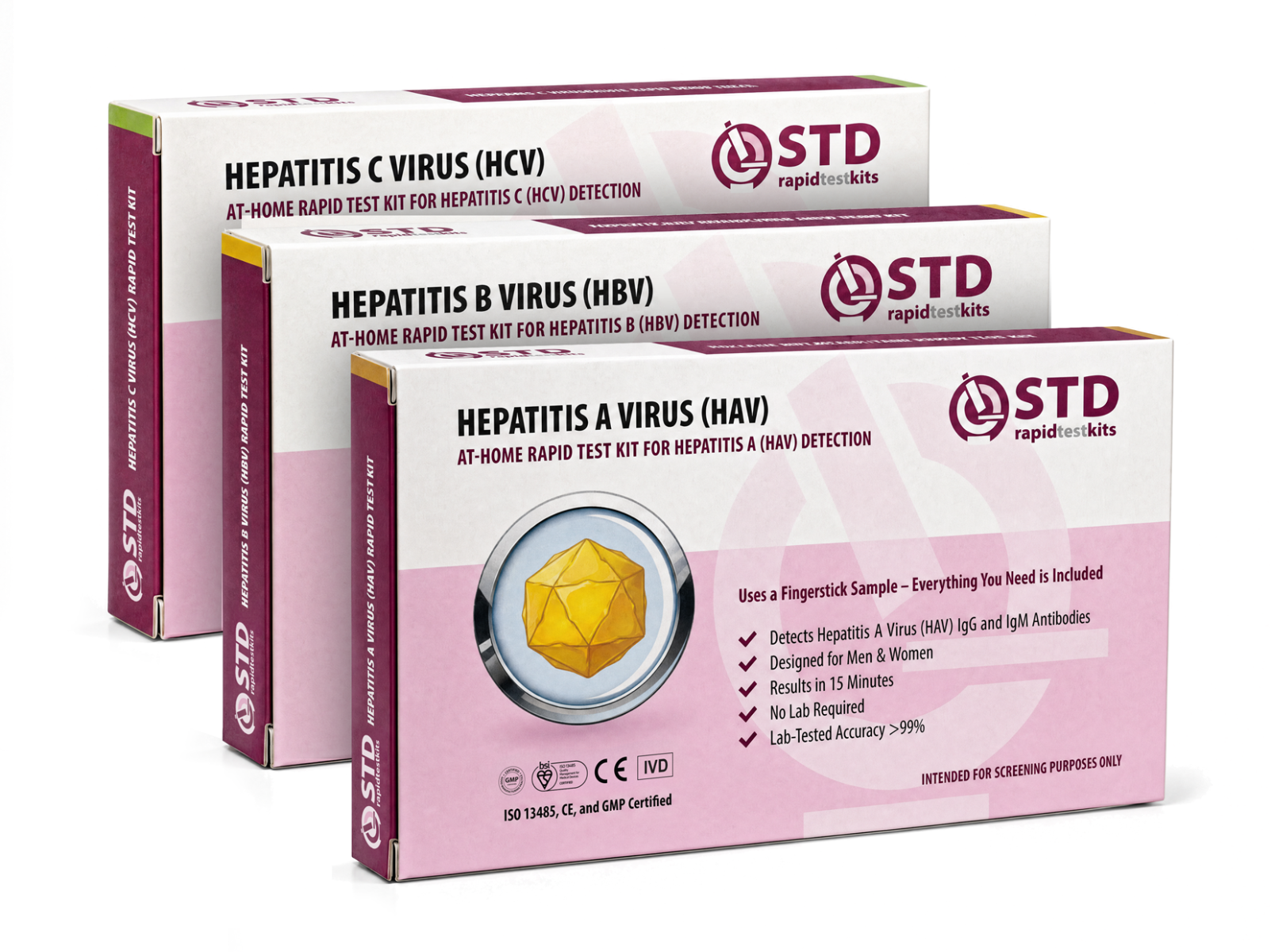
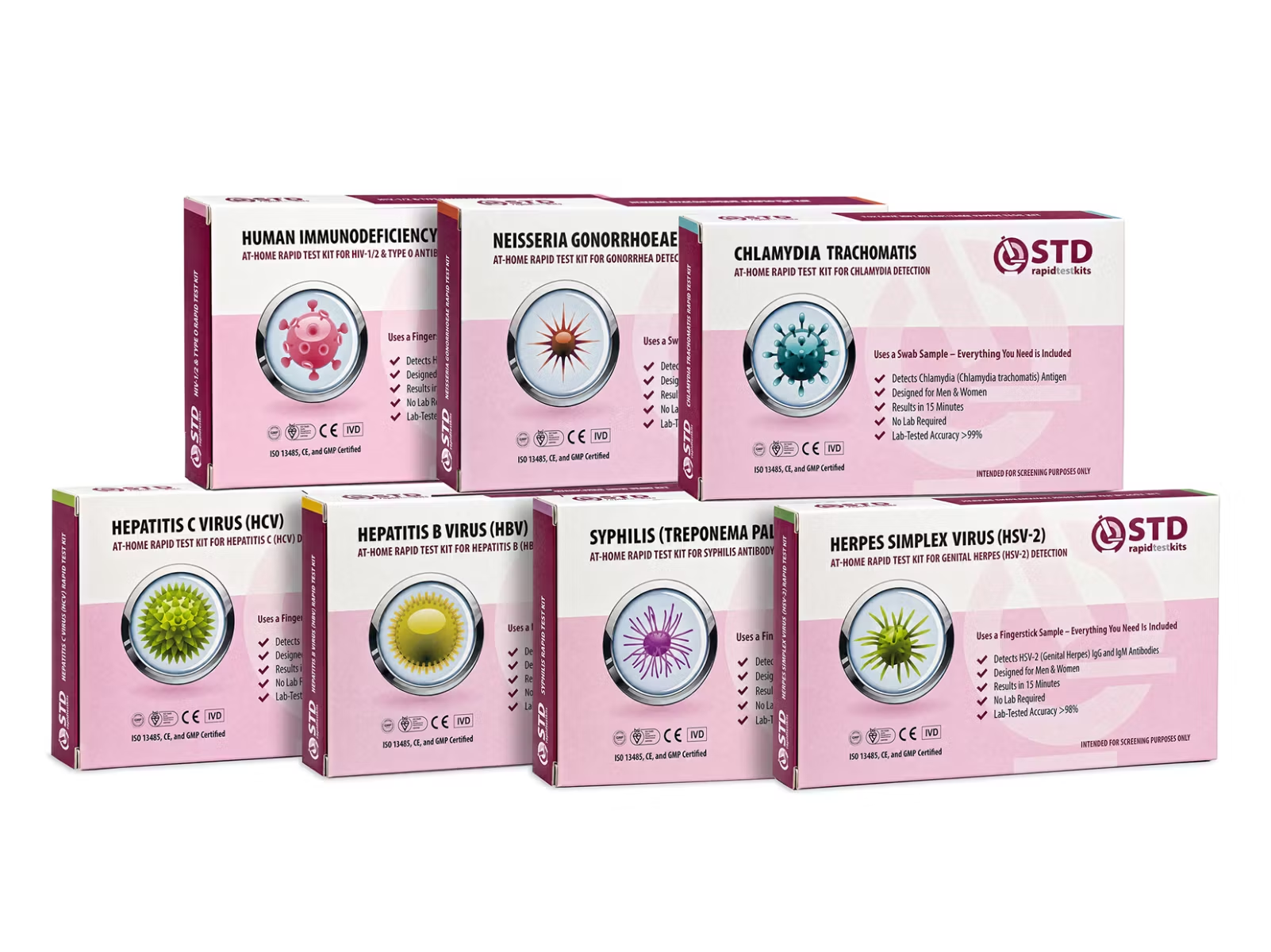
One of the most common reasons people delay STI testing is fear of being seen at a clinic. At-home testing exists to remove that obstacle. When you order from STD Rapid Test Kits, the package arrives in plain, unmarked packaging; the return address is generic; bank or card statements do not list the product type. The result, in roughly 15 minutes, is yours alone to interpret and act on.
If the result is positive, you decide who you tell and when, with the option of starting from a clinical confirmation rather than a clinic-floor moment. If it is negative but you tested before the window closed, plan a repeat test at week 6 instead of living with uncertainty.
This article is published by stdrapidtestkits.com, which sells at-home STI testing kits, including the Hep B rapid test referenced above. We recommend products based on fit for the reader's concern, not commercial benefit.
Prevention: Imperfect, but Powerful
Even with consistent condom use, residual risk for Hep B remains because the virus also spreads through small amounts of blood on shared personal items. The good news is that the most effective prevention tool, vaccination, is widely available and durable.
Practical steps that genuinely move the needle:
- Get vaccinated. The Hep B vaccine is a safe, well-studied series (usually 2 or 3 doses depending on the formulation). Per the CDC, it is recommended for all adults aged 19 through 59 and for older adults with risk factors. It is widely available at pharmacies, primary-care offices, and many free or sliding-scale clinics.
- Confirm immunity if your status is unclear. An anti-HBs blood test tells you whether you are already protected from a past vaccination series.
- Test after new partners and after possible exposures. The right cadence depends on your situation, but a baseline test after a new partner and a 4-to-6-week follow-up after a known exposure covers most cases.
- Talk to partners. A short, low-drama opener works: 'I just tested for a few things; have you ever been tested for Hep B?' That is the level. The conversation protects both of you.
- Avoid blood exposure where you can control it. Do not share razors, toothbrushes, nail clippers, or needles. Use only sterile, single-use equipment for tattoos and piercings.
Bottom Line: Answers Beat Assumptions
Hepatitis B does not always announce itself, and when it does, the early signals can look like a stretch of bad sleep, a hangover, or a passing flu. Whether you had unprotected sex, shared a razor at someone else's place, or simply woke up feeling off after a recent encounter, you do not need to stay in guessing mode.
Testing puts the next move back in your hands. It does not change the past; it changes how clearly you can see what to do next. Order an at-home Hep B test here if you would like to start at home, on your terms.
1. Test at week 4 to 6 after a possible exposure, not earlier (a negative result before that is unreliable).
2. Repeat at week 6 if your first test was early, or if you had symptoms and a negative result.
3. Confirm any positive at-home result with a clinic blood draw, and ask about the full Hep B panel plus liver function tests.
Frequently Asked Questions
- Can Hepatitis B really feel just like the flu?
- Yes, and most people miss it because the symptoms arrive weeks later, not days. A low fever, fatigue, queasiness, and lost appetite can show up around 60 to 150 days after exposure (per the CDC). If you have had a recent possible exposure and the symptoms do not resolve in a few days, testing clears up the uncertainty.
- I had unprotected sex last weekend. Is it too soon to test?
- For a standard rapid HBsAg test, yes; testing within the first week after exposure is too early to be reliable. The most informative window is 4 to 6 weeks after exposure. If you are anxious or have symptoms, you can test now for a baseline, but plan a follow-up test at the 4 to 6 week mark before drawing conclusions from a negative result.
- I tested negative but still feel off. What now?
- A negative result before week 4 is not reliable; retest at week 6. If symptoms persist past that point, see a clinician for a full Hep B panel and liver function tests. Persistent symptoms after a negative early test are a reason to dig deeper, not to wait it out.
- Is oral sex risky for Hepatitis B?
- It is a lower-risk route than vaginal or anal sex but not risk-free. The risk goes up when there are bleeding gums, dental work, or sores in the mouth of either partner, since Hep B spreads through blood and certain fluids reaching a mucous membrane or break in the skin. If you are weighing whether to test after oral exposure, lean toward testing.
- My test line was very faint. Does that mean I am fine?
- No. Unlike a pregnancy test, where faint lines can be inconclusive, a visible line on a Hep B rapid test, however faint, is treated as positive for surface antigen. Follow up with a clinician for confirmatory blood work as soon as possible.
- What is the difference between acute and chronic Hep B?
- Acute Hep B is a recent infection; most healthy adults clear it on their own within several months. Chronic Hep B means the virus has been present for more than 6 months; it is manageable with antiviral medication and routine monitoring, but it requires ongoing care to protect the liver and lower long-term liver-cancer risk.
- I was vaccinated as a kid. Do I still need to test?
- If you completed the full Hep B vaccine series and built immunity, you are very well protected. Many adults are not certain they finished the series or that immunity took, in which case a clinician can order an anti-HBs blood test to confirm. If antibodies are present at protective levels, you are covered; if not, the vaccine is available at any age.
- Is there a cure for Hepatitis B?
- There is no curative one-shot treatment, but there is durable control. Most acute infections in healthy adults clear on their own. Chronic infections are managed with antiviral medications that suppress the virus, protect the liver, and lower the risk of transmission to partners.
- U.S. Centers for Disease Control and Prevention. Hepatitis B Clinical Overview, including the average 90-day incubation period (range 60 to 150 days from exposure to onset of signs and symptoms), the statement that HBV is infectious for at least 7 days on surfaces, and the elevated risk of cirrhosis and hepatocellular carcinoma in chronic infection.
- U.S. Centers for Disease Control and Prevention. Hepatitis B information for the public: symptoms, transmission routes, and the typical asymptomatic course in most newly infected adults.
- World Health Organization. Hepatitis B fact sheet, including the global estimate of approximately 254 million people living with chronic Hep B.
- U.S. Centers for Disease Control and Prevention. Hepatitis B vaccination recommendations: universal recommendation for adults aged 19 through 59, and for adults 60 and older with risk factors.
- NHS. Patient-facing overview of Hepatitis B: how it spreads, when to seek testing, and what treatment looks like.
- U.S. Centers for Disease Control and Prevention. Hepatitis B testing and diagnosis guidance for healthcare providers, including marker interpretation for HBsAg, anti-HBs, and anti-HBc.