
Published: October 2025 | Last updated: May 2026 | Editorial review and quality control: Martina N.
Discharge changes throughout the menstrual cycle and across all bodies. It responds to hydration, stress, arousal, ovulation, and even a new laundry detergent. Clear and stretchy mid-cycle fluid is usually normal, and so is creamy white discharge before a period. A mild scent that shifts after sex because semen temporarily changes vaginal pH is also expected.
What usually sends people online at midnight is the moment something feels different in a way that breaks pattern: a smell you have never noticed before, a color that makes you pause in the bathroom, or a texture that feels heavier or thinner than your usual. When people describe unusual discharge, they almost always reach for the same words: "It just didn't feel like me."
That instinct is worth listening to. This guide gives you a structured way to read what your body may be telling you, decide whether testing now will save days of anxiety later, and pick the right test for the right window.
Key Takeaways
- A fishy smell, green or yellow discharge, or sudden texture change can signal bacterial vaginosis, trichomoniasis, gonorrhea, or chlamydia, and each is treatable with a single antibiotic course.
- Discharge paired with pelvic pain, fever, bleeding between periods, or testicular tenderness needs same-day in-person care, since those signs can indicate ascending infection.
This Isn't Just Normal Variation, and Here's Why It Matters
The line between expected variation and a flag worth investigating usually shows up as a sudden shift after sexual contact. A new partner can change your vaginal microbiome enough to disturb the bacterial balance. Semen, lubricant, latex, spermicide, and oral contact each push your normal pH around for a day or two.
Persistent change is what flags attention: a shift that lasts past 48 hours, intensifies, or arrives with new symptoms like burning, itching, pelvic pressure, light bleeding, or fever. Your body is offering information, and the faster you read it, the faster you can act on it.
According to CDC data on sexually transmitted infections, chlamydia and gonorrhea remain the two most-reported bacterial STIs in the United States, and both can present with subtle discharge changes long before pain shows up. Quiet symptoms tend to get dismissed, which is exactly what makes them risky.
Temporary pH shifts (from a new partner, lubricant, or a longer-than-usual gap between washes) usually settle within 48 hours. Discharge that still looks, smells, or feels different past that 48-hour mark, or that arrives with burning, itching, pelvic pressure, or fever, is worth testing rather than waiting out.
Color, Smell, Texture: Reading the Pattern
Color alone doesn't diagnose an STI. When color shifts combine with odor, irritation, or timing, they begin to narrow the field. The table below maps the most common discharge patterns to their likely causes and how soon you should test.
One nuance many people miss: bacterial vaginosis and STIs can coexist. A new partner shifts your vaginal microbiome, and that shift alone can create odor. The CDC fact sheet on bacterial vaginosis notes BV is the most common vaginal condition in women aged 15 to 44, and it specifically increases the risk of acquiring other STIs because of microbiome disruption. If discharge becomes greenish, foamy, or painful, the pattern looks more like trichomoniasis or gonorrhea, and the decision shifts from monitor to test now.
| Appearance | Odor | Common Causes | Test Urgency |
|---|---|---|---|
| Thin gray or milky | Strong fishy smell | Bacterial vaginosis, sometimes trichomoniasis | Test within a few days |
| Yellow or green | Foul or strong | Gonorrhea, trichomoniasis | Test right away |
| Thick white, clumpy | Mild or none | Yeast infection | Test if unsure or recurring |
| Clear but excessive | None or mild | Ovulation, arousal, early chlamydia | Test if recent exposure risk |
| Brown or blood-tinged | Variable | Hormonal shifts, infection, cervical irritation | Test if outside normal cycle |
Is unusual discharge always a sign of an STI?
No. Hormonal cycles, ovulation, lubricant, and a new partner can all shift discharge color, smell, and texture without any infection. That said, sudden changes after sex (a fishy smell, yellow or green color, thickening, or burning) raise the odds of bacterial vaginosis, trichomoniasis, gonorrhea, or chlamydia. The fastest way to stop guessing is to test about 7 to 14 days after the exposure that worried you, depending on the infection.
Male Discharge: The Sign That's Easy to Miss
People with penises often dismiss discharge because it gets less airtime in health education. A small amount of clear pre-ejaculatory fluid is normal. Cloudy, white, yellow, or green discharge from the urethra that appears outside of arousal is a sign worth investigating. The CDC's gonorrhea fact sheet lists urethral discharge and burning during urination among the most common symptoms in men. Those symptoms typically appear within the first one to two weeks of exposure.
Male discharge tends to show up subtly: a damp spot in underwear in the morning, a sticky feeling at the tip, mild burning that gets blamed on dehydration or a new soap. Many men wait because the discomfort is minor. By the time pain escalates, the infection may have been present for days or weeks, and partners may have been exposed in the meantime.
Both gonorrhea and chlamydia can cause this pattern. Sometimes there is no pain at all, just discharge. The CDC's chlamydia overview notes that chlamydia often has no symptoms at all. Someone can carry and transmit it for weeks before a test or symptom prompts them to check, which is why early testing protects both you and anyone you have been with.
Subtle male symptoms worth flagging
- A damp spot or sticky feeling at the tip of the penis in the morning, even without pain.
- Mild burning during urination that gets blamed on dehydration, spicy food, or a new soap.
- A small amount of cloudy or yellow discharge that disappears between days but keeps coming back.
Timing Changes Everything: The Window Period Matters
This is where people get tripped up. They notice discharge and test the same day, then feel reassured by a negative result. But infections have window periods. Testing too early can produce a false negative because your body has not yet generated enough detectable signal. Biology needs time before a test can reliably register infection.
The window varies by infection. Chlamydia and gonorrhea typically need around 7 days post-exposure for reliable nucleic-acid detection in lab settings, with 14 days giving a higher-confidence answer. Trichomoniasis is often detectable within 5 to 28 days of exposure on direct vaginal sample testing, though the exact window varies by test type. Bacterial vaginosis is not an STI and has no incubation window: you test when symptoms appear.
If discharge appears within 48 hours of exposure, testing immediately may not capture chlamydia or gonorrhea yet. The right move is usually to test once at the 7- to 10-day mark and repeat at day 14 if symptoms persist. The exception: if discharge is heavy, green, painful, or paired with fever or pelvic pain, do not wait for a calendar date. Get in-person care.
| Infection | Earliest Detection | Optimal Testing Window | Retest Recommended? |
|---|---|---|---|
| Chlamydia | About 7 days | 14 days | Yes if tested very early |
| Gonorrhea | About 7 days | 14 days | Yes if symptoms persist |
| Trichomoniasis | 5 to 7 days | 1 to 4 weeks | Often, after treatment |
| Bacterial vaginosis | No incubation window | Test when symptoms appear | Only if recurring |
BV, Yeast, or STI? Why Guessing Backfires
Picture standing in the pharmacy aisle debating an over-the-counter yeast treatment because the discharge looks white. Something feels off. It isn't quite the cottage-cheese texture every package describes, and the smell is slightly stronger than usual. This is where people misstep. They treat first and test later, or they don't test at all.
Bacterial vaginosis, yeast infections, and sexually transmitted infections can overlap in symptoms. Yeast typically brings intense itching with thick clumps. BV often brings a thin gray discharge with a fishy odor that gets worse after sex. Chlamydia and gonorrhea can produce yellow discharge, but the symptoms are sometimes subtle or absent. The NHS guidance on vaginal discharge walks through similar overlap categories and recommends a clinical assessment whenever you are uncertain.
These conditions don't cancel each other out. You can have BV and an STI at the same time. You can treat yeast and still have lingering discharge because the underlying cause was something else entirely. Testing in this scenario gives you the one piece of information that prevents you from layering treatments on top of an undiagnosed infection.
| Feature | Bacterial Vaginosis | Yeast Infection | Chlamydia / Gonorrhea |
|---|---|---|---|
| Color | Gray or milky | White | Yellow, green, or cloudy |
| Texture | Thin, smooth | Thick, clumpy | Variable, often thicker |
| Odor | Strong fishy | Mild or none | Foul or strong |
| Itching | Sometimes mild | Often intense | Variable |
| Pelvic pain | Rare | Rare | Possible |
| Requires STI test? | If exposure risk present | If unsure or recurrent | Yes |
A Real-World Pattern: Treating One Thing While Missing Another
Consider a common scenario clinicians describe. A woman in her mid-twenties has dealt with BV before. She recognizes the fishy smell almost immediately after a new relationship begins. She isn't worried because she's had this before. She uses an over-the-counter approach and waits.
The smell fades. But the discharge stays slightly yellow, and she keeps telling herself it's leftover imbalance. Two weeks later, mild pelvic discomfort creeps in. Testing then reveals chlamydia alongside BV. The BV-targeted treatment improved odor but did nothing for the underlying chlamydia infection.
That pattern is common. Coinfections happen, and treating the obvious symptom doesn't always resolve the deeper issue. The CDC bacterial vaginosis page explicitly notes that BV increases the risk of acquiring other STIs because of microbiome disruption. When something shifts and exposure risk exists, testing removes guesswork and lets treatment hit the actual target.
Having BV can increase your chance of getting another sexually transmitted infection.
Discharge After Oral Sex: A Scenario People Underestimate
Oral sex often feels lower-risk, and in some respects it is lower-risk than unprotected penetrative sex. But infections do transmit orally. Throat gonorrhea is well-documented to be often asymptomatic in clinical literature, which is why it can be transmitted to a partner without either person realizing it. If you received oral and notice urethral discharge several days later, that timeline matters.
Vaginal discharge changes after giving oral can also signal a partner's untreated infection. These scenarios are common, just less discussed in mainstream health content. Discharge that follows oral contact deserves the same workup you would run for penetrative exposure: identify the date, count forward to the right window, and test.
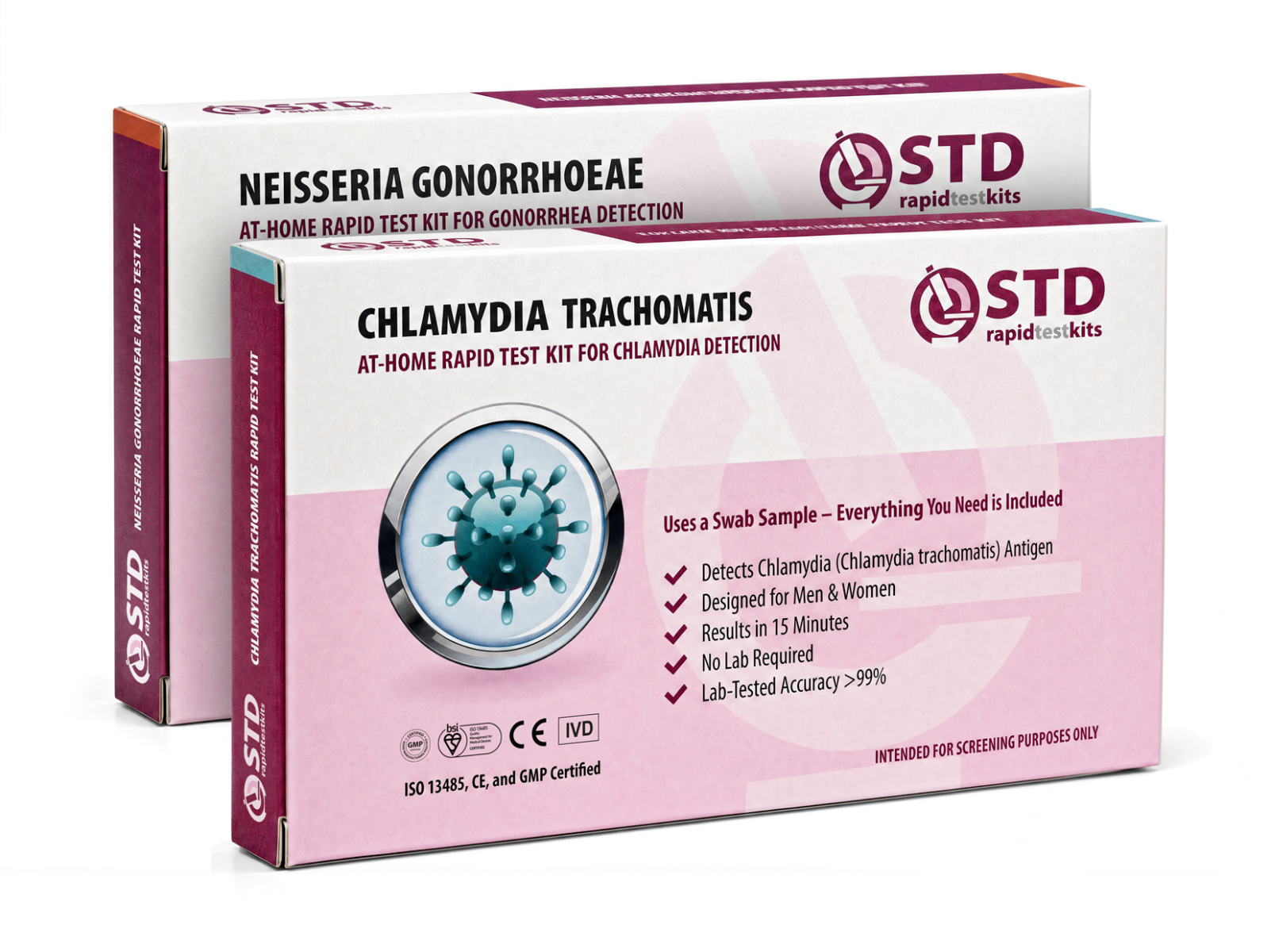
Our at-home rapid test kits use self-collected genital swabs or fingerstick blood, not pharyngeal swabs. For throat-specific testing, a clinic-administered pharyngeal swab is required. Our genital and bloodwork panels can still answer the related question of whether infection traveled from a throat exposure to a genital site or showed up in a partner's bloodstream.

When Discharge Crosses Into Urgent
There's a difference between something being unusual and something being urgent. If discharge is paired with lower abdominal pain, sharp pelvic pressure, fever, nausea, pain during sex, testicular pain, or bleeding between periods, those symptoms warrant immediate in-person care rather than home monitoring. The combined pattern can signal ascending infection, which gets harder to treat as it progresses.
According to the CDC chlamydia page, untreated chlamydia in women can lead to pelvic inflammatory disease, with long-term consequences including chronic pelvic pain, ectopic pregnancy, and infertility. In people with testicles, untreated infection can cause epididymitis, with swelling and tenderness. These complications usually build over weeks rather than appearing all at once, which is what makes quiet, easily-ignored discharge symptoms risky to dismiss.
If discharge changes are accompanied by pain or systemic symptoms, treat it as a clinic-day situation. At-home testing can still be part of your follow-up plan, but severe symptoms deserve in-person evaluation where a clinician can examine, take cultures, and prescribe.
Lower abdominal pain or pelvic pressure that doesn't ease with rest. Fever or chills. Nausea or vomiting. Bleeding between periods or after sex. Testicular pain or swelling. Pain during urination that worsens hour by hour. Any of these alongside unusual discharge can signal pelvic inflammatory disease, epididymitis, or another ascending infection that needs in-person evaluation rather than at-home monitoring.
False Negatives and the Early-Test Trap
This is the trap worth naming. You notice unusual discharge three days after sex. You test immediately. The result is negative. Relief floods your system. But three days is biologically too early for chlamydia or gonorrhea to register reliably on most tests. The negative result reflects the timing of the test rather than the absence of infection.
Picture testing on day five. Negative. Discharge continues. You assume it's hormonal and move on. By day fourteen, symptoms escalate. A second test returns positive. The infection had been there all along, but it took time to register at detectable levels.
Testing at the right window doesn't mean waiting while suffering. If symptoms are significant, seek in-person care immediately. Retesting at day 14 (or up to 4 weeks for trichomoniasis) is responsible follow-up rather than a sign that the first test failed.
- Chlamydia and gonorrhea: retest at day 14 if your first test was on or before day 7 and symptoms persist.
- Trichomoniasis: retest up to 4 weeks after exposure if symptoms continue and your first test was earlier than that window.
- If symptoms are significant (pelvic pain, fever, heavy or green discharge), seek in-person care now rather than waiting for a calendar date.
If a Test Is Positive: What Comes Next
First, breathe. Most common infections that cause discharge are treatable with antibiotics. Treatment is straightforward, and the emotional weight is often heavier than the medical reality.
Cure rates are high. The CDC's STI treatment guidance notes that chlamydia and gonorrhea both respond reliably to first-line antibiotics, though antibiotic-resistant gonorrhea remains an ongoing concern, which is why testing and adherence to the full prescribed course matter. Trichomoniasis clears with metronidazole or tinidazole. BV clears with metronidazole or clindamycin. Most people move from a positive result to cleared status within days or weeks, depending on the infection and adherence to the full treatment course.
Post-positive action sequence
- Confirmatory lab test if your at-home result was positive (rapid lateral-flow tests are useful for screening, but a positive is worth confirming with a lab nucleic-acid test where possible).
- Antibiotics prescribed by a clinician, taken for the full course even if symptoms resolve early.
- Partner notification so anyone you've recently had sexual contact with can also test and treat.
- Temporary abstinence until treatment is complete and your clinician confirms you are cleared.
- A retest about three months after treatment, since reinfection rates are real even when the first treatment worked.
Retesting, Reinfection, and the Partner Conversation
Discharge sometimes returns after treatment, and the assumption is often that treatment failed. More commonly, reinfection occurs because a partner was untreated or because exposure continued. The CDC's STI treatment guidelines recommend retesting around three months after treatment for chlamydia and gonorrhea, even when symptoms have resolved, specifically because reinfection rates are real.
The partner conversation does not have to be dramatic. A direct, respectful message works: "I tested positive for an infection. You should get tested too." That single message protects both of you and short-circuits the cycle of bouncing the infection back and forth.
Testing too soon after finishing antibiotics can detect residual bacterial DNA fragments and produce a false-positive on some platforms, even when infection has cleared. For most bacterial STIs, the standard is to wait until the three-month mark for routine retesting unless symptoms persist sooner. If symptoms continue right after finishing medication, that is a clinician follow-up rather than another at-home test.
Clarity Beats Constant Guessing
Unusual discharge is unsettling because it's visible and tangible. It feels like proof that something is happening inside your body without your permission. Most causes are treatable, and many are common. Some are temporary shifts in bacterial balance. When infection is present, early testing shortens the path to resolution and lowers the risk of long-term complications.
If a fishy smell, strange color, or sudden texture change has been sitting in the back of your mind, you don't have to wait for symptoms to escalate. Anchor the change to the date of any recent exposure, count forward to the right testing window, and pick the test that matches your concern. Private testing options through stdrapidtestkits.com can move you from speculation to a useful answer in about a week.
Frequently Asked Questions
- How can I tell if discharge is an STI versus something else?
- Testing is the only path to a real answer. If the change appeared after a new partner or persists past 48 hours, that's the cue, not closer inspection of the discharge itself. Smell and color narrow the field, but they don't confirm a cause; a swab or blood test does.
- If it smells fishy but doesn't hurt, can I just ignore it?
- Pain isn't required for an infection to be real. Bacterial vaginosis often produces a strong fishy odor with no pain at all, and chlamydia or gonorrhea can show up subtly. If the odor lingers more than a few days or keeps recurring, that is the cue to test rather than wait.
- What if it's just stress or hormones?
- Hormonal discharge doesn't usually arrive overnight with a foul smell or bright yellow color. When those features show up alongside recent sexual contact, testing beats attribution to hormones. Stress and ovulation shift discharge gradually, not abruptly with a new odor.
- I tested negative but something still feels off. Now what?
- Timing might be the missing piece. Testing very early after exposure can miss infections that haven't yet reached detectable levels. Retesting at the 14-day mark (or up to 4 weeks for trichomoniasis) often clarifies things. If STI tests stay negative and symptoms persist, evaluate for BV, yeast, or cervical irritation with a clinician.
- Can men have urethral discharge without realizing it?
- Yes, and it's often subtle. A sticky feeling at the tip, a cloudy drop in the morning, mild burning that gets blamed on dehydration. Many men wait because the discomfort is minor. But urethral discharge that appears outside of arousal is a real sign worth testing for chlamydia and gonorrhea.
- Is testing overkill if I'm not in pain?
- No. Testing is maintenance, much like checking your bank balance or getting an oil change. Sexual health works on similar logic: catching infection early protects future you and lowers complication risk. Pain is a late signal in many bacterial STIs, so it shouldn't be the only trigger to test.
- What if my partner says they're "clean"?
- Biology is the reason shared test results matter more than a partner's reassurance. Anyone can carry chlamydia, gonorrhea, or trichomoniasis without knowing it, since most STIs are asymptomatic in their early stages. "Clean" isn't a clinical category; recent test results are.
- Can I treat yeast first and test for STIs later?
- You can, but if symptoms only partially improve, don't keep layering treatments. That pattern is how one issue gets masked while another continues underneath. If discharge doesn't fully resolve after a yeast treatment course, step back and test for chlamydia, gonorrhea, BV, and trichomoniasis.
How We Sourced This Article: This guide draws on current public-health guidance from the U.S. Centers for Disease Control and Prevention, the National Health Service (UK), and the World Health Organization. Window-period and retesting recommendations follow CDC STI treatment guidance current at the time of publication. Patient-experience framing reflects published clinical reviews and educational resources rather than first-person clinical anecdote.
- U.S. Centers for Disease Control and Prevention. Sexually Transmitted Infections overview, screening recommendations, and treatment guidelines.
- U.S. Centers for Disease Control and Prevention. Chlamydia fact sheet covering symptoms, testing windows, and complications including pelvic inflammatory disease.
- U.S. Centers for Disease Control and Prevention. Gonorrhea fact sheet covering urethral discharge symptoms and antibiotic-resistance trends.
- U.S. Centers for Disease Control and Prevention. Bacterial vaginosis prevalence, symptoms, and association with increased STI acquisition risk.
- U.S. Centers for Disease Control and Prevention. Trichomoniasis fact sheet covering testing recommendations and post-treatment retesting.
- NHS (UK). Vaginal discharge information including normal variation and when to seek clinical assessment.
- U.S. Centers for Disease Control and Prevention. Pelvic inflammatory disease (PID) overview covering long-term reproductive consequences of untreated STIs.
- World Health Organization. Sexually transmitted infections (STIs) global fact sheet on prevalence and prevention.
