
Published: August 2025 | Last updated: May 2026 | Editorial review and quality control: Martina N.
You woke up and the night is missing. Maybe there are fragments, a face you half remember, a place you almost recognize, but the actual sequence is blank. Now your brain is doing what brains do when they hit a gap. It fills the silence with worst case scenarios.
This article is for the moment right after. The part where you do not yet know what happened, you do not have answers, and you want a plan that is calm rather than catastrophic. Here is what current public health guidance from the CDC and the WHO say about possible STI exposure after a night you cannot reconstruct, and how to move through the next few weeks without spiraling.
Two facts will anchor the rest of this piece. Most single exposures do not become infections. Most STIs are quiet at first. Both are true at the same time, and both are going to matter.
Key Takeaways
- Memory is not the risk factor. The kind of physical contact and the partner's status are, and most single exposures do not become infections.
- Testing follows a window period. A calm timeline (early read at one week, retest at three weeks, final HIV screen at six weeks) replaces guessing.
This Anxiety Has a Shape, and It Is Not Rare
There is a specific kind of anxiety that hits when memory is missing. It is not the same as the anxiety after a regretted decision. It is the anxiety of not knowing what your own body did, and trying to assess risk without a story to attach it to.
People searching for help in this moment often type the same handful of phrases into search engines. The CDC's STI prevention guidance frames the calm path forward as structured testing rather than self diagnosis.
Risk does not come from what you cannot remember. Risk comes from what could have happened physically. Even then, most exposures do not automatically lead to infection. Holding both of those ideas at once is the goal of this article.
The most common searches in this exact situation include:
- "I was drunk and don't remember sex what to do"
- "Can you get an STD if you don't remember"
- "Blackout hookup STI risk"
- "No symptoms but worried after hookup"
- "I don't remember if we used protection"
These are reasonable questions, and they all have the same calm answer: structured testing on a real timeline, not symptom-checking at 3 a.m.
Step One. Pause the Spiral and Define Possible Exposure
Right now your brain might be jumping straight to worst case combinations. Herpes, HIV, syphilis, everything at once. Medical risk is not built that way. It is built around specific types of contact and the status of the partner.
If you do not remember the night, work with categories rather than scenes. The contact buckets below are the ones the CDC's STI prevention pages organize risk around. Match where you can, default to the broader category where you cannot.
| Type of Contact | Relative STI Risk | What That Actually Means |
|---|---|---|
| Kissing only | Very Low | Oral HSV-1 only if the partner had an active sore at that moment |
| Oral sex | Low to Moderate | Gonorrhea, chlamydia, syphilis, and herpes can transmit through oral routes per CDC |
| Vaginal sex, unknown protection | Moderate | Chlamydia and gonorrhea are most common; HIV, syphilis, HSV-2 are possible |
| Anal sex, unknown protection | Moderate to Higher | Higher per act transmission efficiency for several infections, including HIV |
Step Two. Your Body Is Not a Lie Detector Yet
One of the most common thoughts after a night like this is, "I feel fine, so I am probably okay, right?" The opposite shows up just as often. "I feel weird, something must be wrong."
Both reactions can mislead you this early. Most STIs do not produce symptoms in the first few days. Several never produce noticeable symptoms in the people who carry them. The WHO's STI fact sheet describes most STIs as either asymptomatic or only mildly symptomatic in ways that go unrecognized.
What that means in practice: your body is not a reliable source of reassurance or alarm at 24 to 72 hours post exposure. It is neutral. Population level screening exists precisely because so much infection circulates without any outward signal, so your situation is the norm rather than an outlier.
If you are searching things like "no symptoms but worried after hookup," you are not overreacting. You are early on a timeline that has not produced visible information yet.
| STI | Early Symptoms? | Common Reality |
|---|---|---|
| Chlamydia | Often no | Most people feel completely normal, which is why annual screening exists |
| Gonorrhea | Sometimes | Can be silent for weeks, especially in throat or rectal sites |
| Herpes (HSV-1 / HSV-2) | Variable | Lesions may take 2 to 12 days to appear or may never appear visibly |
| HIV | Delayed | Acute symptoms 2 to 4 weeks in are often mistaken for flu |
| Syphilis | Delayed | Primary chancre takes 10 to 90 days; painless and often missed |
STIs are often asymptomatic. When symptoms occur, they can be non-specific.
Step Three. Build a Testing Timeline Instead of Guessing
This is where anxiety tends to settle. There is now something concrete to do, which is different from waiting in the dark. Replace "what if" with "what now."
Testing works on window periods. A window period is the gap between when an infection can be present in the body and when a test can reliably detect it. Testing inside the window can produce a falsely reassuring negative. The post exposure schedule the CDC HIV testing guidance and the broader STI testing guidelines outline for adults with possible exposure looks roughly like this.
If you may have been exposed to HIV in the last 72 hours: PEP (post-exposure prophylaxis) is a 28-day course of HIV medication that can significantly reduce the chance of infection if started within 72 hours of exposure. Contact a clinic, urgent care, or emergency room as soon as possible. PEP is separate from the testing schedule below; it does not replace it, and the 72-hour window is firm.
| Time After Exposure | What to Do |
|---|---|
| First 72 hours (HIV concern) | If higher-risk HIV exposure is plausible, ask a clinic about PEP today, not next week. |
| 1 to 3 days | Too early for any meaningful test. Hydrate, eat, sleep, ground yourself. |
| 5 to 7 days | Optional early read for chlamydia and gonorrhea; positives reliable, negatives still preliminary. |
| 2 to 3 weeks | More reliable results for most bacterial STIs (chlamydia, gonorrhea). |
| 3 to 6 weeks | Reliable window opens for syphilis and most HIV antigen/antibody tests. |
| 3 months | Final confirmatory HIV screen for complete peace of mind. |
The Part No One Talks About. The Emotional Aftermath
This is not only about infections. It is about not remembering your own experience. That can feel unsettling in a way physical risk does not capture.
You might be thinking, "Did I make a choice I would not normally make?" or "What if something happened I did not consent to?" Those thoughts deserve space rather than dismissal. Medical clarity is one part of this. Emotional clarity is another, and you are allowed to take both seriously without rushing either to a verdict.
Looking at body signals will not give you back the memory. Symptom checking and message scrolling are forms of trying to reconstruct the night. They tend to amplify anxiety rather than resolve it. The next steps are about taking care of the version of you that is here now.
- Medical clarity track. Follow the testing schedule. Data comes back inside a few weeks and answers a specific question (am I infected?).
- Emotional processing track. Talk to a person you trust, or a counselor. This track resolves on a different timeline and answers a different question (how do I feel about what may have happened?).
Working on one does not block the other. Working on neither tends to keep both stuck.
What Actually Helps Right Now
Strip everything down to something you can follow without overthinking.
Right now: hydrate, eat, ground yourself. The nervous system is in overdrive and clarity does not come from inside a spiral.
Within a few days: decide whether to do an early at home read or wait for the more reliable window. Either choice is reasonable.
Within a few weeks: complete the full testing schedule. When the testing window opens, real data replaces the guessing.
This article is published by stdrapidtestkits.com, which sells at home rapid STI test kits. We recommend products only when they fit the reader's situation, not by default.
Fears Versus What Is Statistically More Likely
When memory is missing, the brain fills the gap with extremes. Herpes. HIV. "What if something permanent happened?" Fear is understandable. It is also a poor map of how transmission probability actually works.
Most STIs are common, treatable, and far less dramatic than what anxiety produces at two in the morning. The CDC's prevention pages note that chlamydia, gonorrhea, syphilis, and other reportable STIs are at high but manageable population levels in the United States, and most diagnosed cases are treatable in straightforward ways.
This is not about minimizing the situation. It is about putting probability into proportion. A structured testing plan gives you something real to do while the brain settles down.
| Common Fear | More Likely Reality | Why |
|---|---|---|
| "I probably got HIV" | Low probability unless specific higher risk exposure occurred | Per act transmission risk for most exposure routes is well under 1 percent |
| "It must be herpes already" | Too early to tell; many people never get visible lesions | HSV onset is variable and asymptomatic infection is common |
| "I would know if something was wrong" | Many STIs have zero early symptoms | Silence is the rule, not the exception |
| "One night equals guaranteed infection" | Transmission is possible, not automatic | It depends on partner status, contact type, and timing |
The "I Don't Remember Protection" Spiral
This is one of the most searched and least talked about fears: "I don't remember if we used protection."
The brain treats that gap as confirmed unprotected contact. Medically, it is still an unknown. Transmission depends on whether the partner was infected, the type of contact, and timing factors that none of us can answer by thinking harder.
The thought pattern usually runs in a straight line from no memory to worst case. Three stacked assumptions, each one amplifying the next. Pulling them apart is how the spiral slows.
Bring it back to what is actionable. You do not need certainty about the past to take control of the present. The testing schedule above gives you actual data inside a few weeks, which is faster than the brain can resolve a missing memory on its own.
- I do not remember a condom.
- So there probably was not one.
- So something bad must have happened.
Each step is an assumption. None is a fact. When you separate the three, the anxiety has fewer places to live.
Testing Is Also Psychological Relief
People often think STI testing is purely about diagnosis. After a night you cannot remember, it is also about ending the mental loop.
Constantly checking the body, the phone, the memory. That loop does not resolve. It just keeps the system on. A clear test result, even an inconclusive early one with a planned retest, gives the brain a landmark to settle around.
Many people choose to test simply because the uncertainty is exhausting, and exhaustion is a legitimate enough reason on its own.
A clear test result gives the brain something it has been missing: a landmark. The loop of checking and re-checking quiets down when there is an actual data point to land on, even if that data point arrives in stages over a few weeks.
Symptoms in the Next Few Days. What to Watch and What to Ignore
After a possible exposure, it is common to start scanning the body constantly. Every itch and sensation feels meaningful.
Early on, most of what you feel is awareness rather than infection. The brain is hyper focused and the body feels louder than usual because you are paying attention in a new way. A few things are worth noting without obsessing.
- Burning during urination or unusual discharge: can indicate chlamydia or gonorrhea, but typically takes 3 to 14 days to appear per CDC.
- Sores, blisters, or ulcers in the genital or oral area: 2 to 12 days for HSV; primary syphilis chancre can take 10 to 90 days.
- Flu like symptoms two to four weeks in: can be acute HIV seroconversion, but the symptoms are nonspecific and can be many other things.
What an At-Home Rapid Test Can and Cannot Do
An at home rapid lateral flow test screens for the presence of antibodies or antigens against specific infections. It can tell you, with reasonable accuracy after the window period closes, whether your body has started responding to an infection. It cannot tell you what happened on a specific night, and it cannot replace a lab confirmed diagnosis when a rapid result is positive.
Used inside its proper window, a rapid test is a useful first read. Used outside it, a negative result can be falsely reassuring. The image below shows the kind of cassette format these tests use; the same chemistry sits behind most at home STI screens.

A Simple Plan You Can Screenshot
Strip everything down to a single reference card you can come back to when the brain starts racing again.
| Timeframe | What to Do |
|---|---|
| Right now | Pause, hydrate, eat, ground yourself, stop trying to reconstruct the night |
| First 72 hours | If higher-risk HIV exposure is plausible, ask a clinic about PEP today |
| Next 1 to 3 days | Decide on early read at home vs waiting for accurate window |
| Around 1 week | Optional early test for chlamydia and gonorrhea |
| 2 to 3 weeks | Retest for bacterial STIs to close that window |
| 3 to 6 weeks | Test for HIV (4th gen) and syphilis |
| 3 months | Final confirmatory HIV screen for full peace of mind |
When You Want Answers Sooner Rather Than Later
Waiting weeks for clarity can feel unbearable. The waiting period is often the hardest part. The body is quiet, but the mind is not.
This is where people look for faster, more private options. Something that lets them take action without explaining the entire night to a clinic.
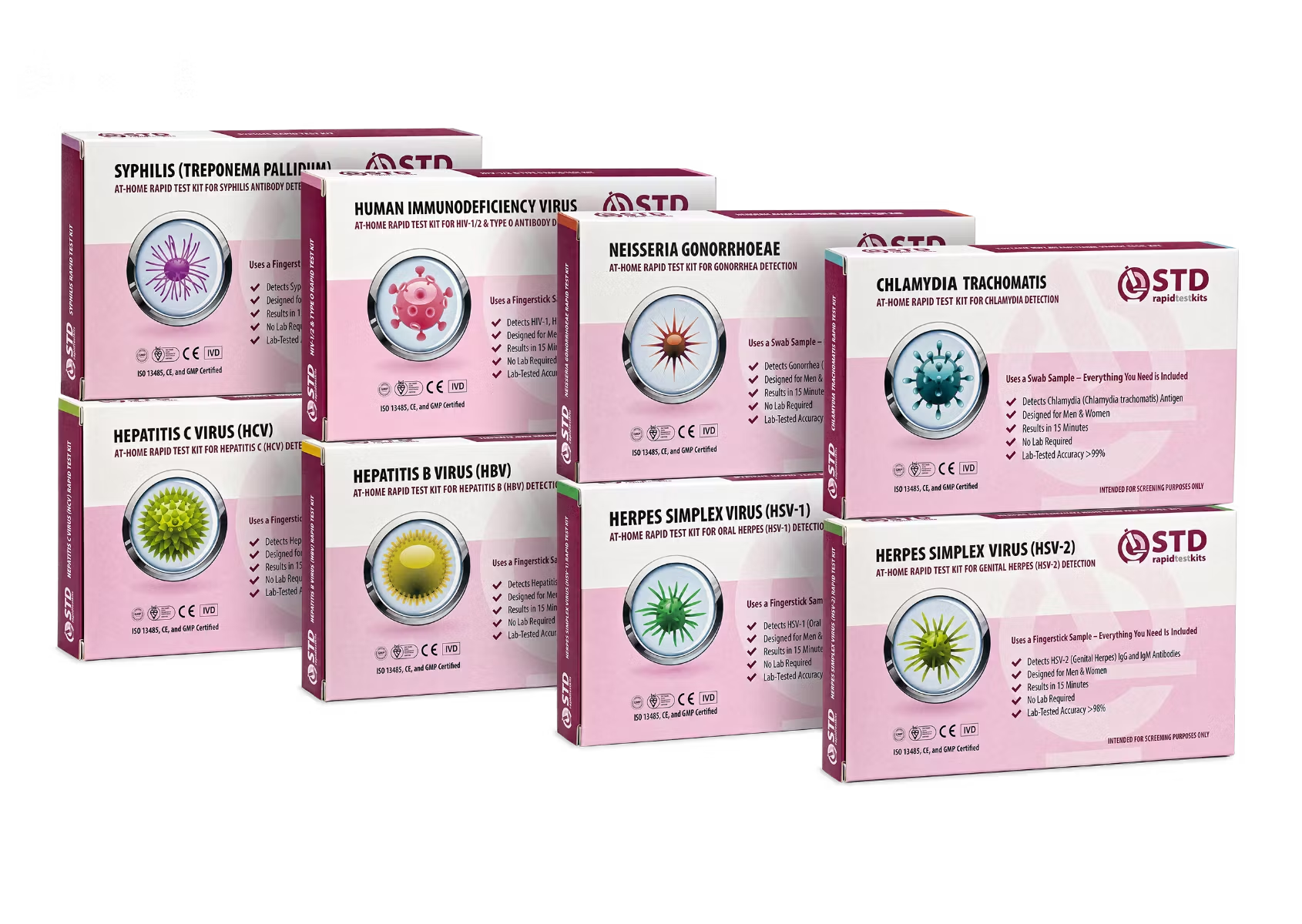
A discreet combo at home kit can give an early read on the most common bacterial infections (chlamydia and gonorrhea) starting around day 7, with full bacterial accuracy by week 2 and HIV plus syphilis screening at four to six weeks. The combo covers several common possibilities in one round, which is usually more useful than buying single test kits one at a time. It is less about panic testing and more about regaining a sense of control.
What If You Are Still Not Sure What Happened
This is the part that lingers. People often arrive with two questions running side by side: "what is my STI risk," and "what actually happened to me." These are different questions, and they do not have to be solved at the same pace.
Medically, full memory is not required to take care of your health. The testing schedule does not need a narrative. Emotionally, the gap can feel heavy. People often check messages, location history, ride logs, looking for clues that make the night make sense. Sometimes pieces appear. Sometimes they do not. Both outcomes are valid.
It is okay to keep the two tracks separate. One for physical health, one for emotional processing. They do not have to share a timeline.
- Physical health track: follow the testing schedule above; consider PEP within 72 hours if HIV exposure is plausible; talk to a clinician about anything in the symptom callout.
- Emotional processing track: tell one person you trust, write down what you do remember, consider a counselor if the gap keeps replaying; the support hotline below applies if consent is a concern.
If Consent Feels Unclear, That Matters Too
This is not always in STI guides. It needs to be said clearly. If you do not remember what happened, you are allowed to question whether you were able to consent.
Alcohol changes awareness, memory, and decision making capacity. Waking up unsure does not automatically mean something nonconsensual happened. It also does not mean you have to ignore the possibility. Both interpretations stay open until you have more information.
You might notice thoughts like, "I do not think I would have said yes to that," or "Something feels off, even if I cannot explain why." Those thoughts deserve attention rather than dismissal.
Confidential support hotlines exist for people who are uncertain about what happened to them. Talking to a counselor or a trusted person is not the same as making a report. It is a way to externalize the thought so it stops circling.
The RAINN National Sexual Assault Hotline (1-800-656-HOPE) provides free, confidential support around the clock. Calling is not the same as making a report. It is simply a space to talk through what happened, sort through how you feel, and decide what (if anything) you want to do next. The online chat at <a href="https://hotline.rainn.org/" target="_blank" rel="noopener">hotline.rainn.org</a> offers the same support if calling feels like too much.
How to Handle the Waiting Period Without Losing Your Mind
The hardest stretch is the wait before testing makes sense. The space between "something might have happened" and "I have real answers."
During that time the brain will fill the silence. It might convince you something is wrong, or swing the other way and tell you you are overreacting. Neither extreme is helpful. What actually works is structure.
- Limit symptom checking. Constantly analyzing the body increases anxiety without producing reliable information this early.
- Set the test dates now. When the brain knows exactly when answers are coming, it stops searching for them constantly.
- Avoid late night search loops. Fear escalates fastest in that environment and facts get distorted.
- Talk to someone you trust. Even one sentence ("I do not fully remember last night and I feel weird about it") can take the pressure off.
When to Actually Worry. A Quick Calibration
Not every situation carries the same weight. Not every symptom (or absence of symptom) means something serious.
- Higher concern: clear evidence of unprotected contact, partner is known to be at higher risk, symptoms appear in the typical incubation window for a specific infection.
- Moderate concern: unknown protection, unknown partner status, no symptoms yet, but the contact type was higher risk (anal or unprotected vaginal).
- Lower concern: no memory of contact beyond kissing, no physical indicators, no evidence of higher risk exposure.
Most people land in the middle category. Not zero risk, not an emergency. The middle is exactly what structured testing is designed for.
You Deserve Clarity, Not Guesswork
Not remembering can feel worse than knowing. The brain keeps trying to solve it, replay it, reconstruct it. There is a point where more thinking does not produce better answers. It just keeps you stuck.
The goal here is not to recover every detail from that night. The goal is to take back control now. Define the timeline. Test when it makes sense. Let real information replace assumptions. Each step pulls you out of uncertainty and back into something solid.
If there is even a small chance of exposure, an early read with a private at home option is one reasonable starting point, and the full bacterial and viral panel at three to six weeks closes the loop. You do not need a perfect memory to make smart decisions, and you do not need certainty to take action.
Your testing anchor, in one glance
- First 72 hours: ask a clinic about PEP if higher-risk HIV exposure is plausible.
- Days 5 to 7: optional early read for chlamydia and gonorrhea.
- Weeks 2 to 3: reliable retest for bacterial STIs.
- Weeks 3 to 6: HIV (4th gen antigen/antibody) and syphilis screening.
- Month 3: final confirmatory HIV screen.
FAQs
- I blacked out and don't remember anything. Am I overreacting by wanting an STI test?
- No. When memory is missing, the brain tries to fill the gap with worst case scenarios. Testing is not panic. It is how you replace uncertainty with real data. Most clinicians would consider testing in this situation a reasonable, measured response.
- What if nothing even happened and I'm stressing for no reason?
- That is completely possible, and it is not something you can confirm by thinking harder. People get stuck replaying the night for days. A test does not mean something happened. It means you have decided to replace guessing with information.
- I keep checking my body for signs. Is that helpful?
- Not really, this early. In the first few days, your body is not going to give reliable answers, but your brain will try to interpret every sensation as a clue. Most of what you are noticing right now is heightened awareness rather than symptoms.
- If I don't remember using protection, should I assume the worst?
- No. The spiral usually goes: "I don't remember" turns into "there definitely wasn't protection," which turns into "something bad must have happened." That is three assumptions stacked on top of each other. You do not need to assume anything. You need to follow a testing plan.
- What about PEP for HIV? When does it come up?
- PEP (post-exposure prophylaxis) is a 28-day course of HIV medication that can significantly reduce infection risk if started within 72 hours of a higher-risk exposure. It is most relevant when there is reason to suspect unprotected anal or vaginal contact with a partner whose HIV status is unknown or positive. If that describes your situation, contact a clinic, urgent care, or emergency room today rather than waiting; the 72-hour window is firm.
- Is one drunk hookup enough to actually get an STI?
- It can be, but it is not automatic. Transmission depends on the kind of contact, whether the other person had an infection, and timing. A single night can carry risk. It does not equal certainty, and that distinction matters more than people give it credit for.
- I feel completely normal. Is that a good sign?
- It is neutral rather than reassuring. The WHO notes that most STIs are asymptomatic or only mildly symptomatic early on. Feeling fine in the first week does not mean nothing happened. It usually means it is too early for your body to tell you anything useful.
- Would an at-home test actually help, or is it too early?
- It depends on timing. Even early testing can help you feel like you are doing something instead of just waiting, with the understanding that a clean early read still needs a follow up test at the 2 to 3 week mark. Many people use it as a first step, then close the loop with the full panel at four to six weeks.
- I'm more anxious about what happened than the STI part. Is that normal?
- Completely, and for many people the missing memory is the harder part rather than the medical risk. You are dealing with two questions at once: "what if I got something," and "what did I agree to." Both deserve attention, and neither cancels the other out. If consent is part of the worry, the RAINN hotline (1-800-656-HOPE) is a confidential place to talk through it.
How we sourced this article: Our article was built around current advice from the most prominent public health and medical organizations (CDC, WHO, MedlinePlus) and then translated into plain language around the situations people actually live through, the confusion, the overthinking, the "what did I miss?" feeling. The medical claims about window periods, symptom onset, transmission risk, and PEP eligibility reflect those primary sources. The voice and reassurance framing reflect how this question is asked in the real world.
- U.S. Centers for Disease Control and Prevention. STI Prevention overview. General guidance on contact types and risk reduction strategies referenced for the exposure category table.
- U.S. Centers for Disease Control and Prevention. HIV Testing overview. Source for window period guidance on 4th generation antigen antibody tests and final confirmatory screen timing.
- World Health Organization. Sexually transmitted infections (STIs) fact sheet. Source for the asymptomatic-presentation language quoted in the article and global context.
- U.S. Centers for Disease Control and Prevention. About STI risk and oral sex. Source for the statement that gonorrhea, chlamydia, syphilis, and herpes can transmit through oral routes.
- MedlinePlus. Sexually transmitted infections topic page. Used for general symptom and incubation period guidance.
- U.S. Centers for Disease Control and Prevention. STI Testing overview. Used for plain language framing on testing decisions, access options, and the recommended schedule after possible exposure.
