
Published: September 2025 | Last updated: May 2026 | Editorial review and quality control: Martina N.
Testicle pain is one of those symptoms that sends men straight into a search-engine spiral. It is private, hard to talk about, and tied to fertility worries that make every twinge feel urgent. If you have landed here wondering whether genital herpes might be behind it, the honest short answer is yes, herpes can occasionally produce testicular or groin discomfort, but it is rarely the most common cause. Most men with isolated testicle pain have something else going on, often something more straightforward to identify and treat. This guide walks through what current public-health and clinical guidance actually says about the herpes link, when HSV-2 is worth testing for, and which other causes need ruling out first, including the ones that genuinely cannot wait for any home-test result.
Key Takeaways
- Herpes can occasionally cause referred nerve pain in the groin or testicles, but isolated testicle pain without sores is far more often caused by other conditions, including bacterial epididymitis, varicocele, or testicular torsion.
- Sudden, severe testicle pain is a medical emergency. Get an in-person evaluation before assuming any STI cause, because conditions like testicular torsion can permanently damage the testicle within hours.
Yes, herpes can cause testicle pain, but it is rarely the main symptom
Genital herpes, the infection caused by herpes simplex virus type 2 (HSV-2) and sometimes HSV-1, primarily produces sores or blisters on the skin of the genital area. According to the CDC overview of genital herpes, the classic signs of a first outbreak are clusters of small painful blisters or open ulcers, often accompanied by fever, body aches, and swollen lymph nodes in the groin.
Pain that radiates into the testicles, groin, or inner thigh during a herpes outbreak is documented but uncommon. When it does happen, it is usually because of how HSV-2 affects nearby sensory nerves rather than because the virus has infected the testicle itself. Clinicians sometimes see this presentation during a primary infection, when nerve involvement (called sacral neuralgia or sacral radiculopathy) can produce discomfort across the lower back, perineum, buttocks, and occasionally the scrotum.
The part most articles skip is this: testicle pain WITHOUT visible sores is a much weaker signal for herpes than for other conditions. The CDC's STI treatment guidelines for epididymitis, one of the more common causes of testicle pain in adult men, identify chlamydia and gonorrhea as the typical sexually-transmitted bacterial triggers, not herpes. Testicular torsion, a true surgical emergency, presents as sudden severe pain on one side and has nothing to do with infection at all.
So when a reader searches "does herpes cause testicle pain," the medically honest framing is this: it can, but the search itself often points to a different problem. Use the rest of this guide to figure out which scenario fits your symptoms, and do not skip the ruling-out steps for the conditions that need urgent care.
The mechanism: how a herpes infection produces pelvic nerve pain
To understand why herpes can cause sensations far from the visible site of infection, it helps to know where the virus lives in the body. After initial exposure, HSV-2 travels along sensory nerve fibers and establishes lifelong latency in the lumbosacral ganglia, a cluster of nerve cell bodies near the base of the spine. The NIH StatPearls reference on Herpes Simplex Type 2 describes how the virus reactivates from these ganglia during outbreaks, traveling back down sensory nerve pathways toward the skin.
Those sacral nerves do not only innervate the skin where you see lesions. They also serve the perineum, the inner thighs, the buttocks, the lower back, and parts of the male genital structures. When the virus reactivates and inflames a nerve, the brain can interpret pain signals from the entire territory that nerve covers, not just the visible outbreak site. Neurologists call this referred pain, and it explains why some men feel deep aching, burning, or tingling in their testicles during an outbreak even when the sores are elsewhere or absent.
Inflammation around nearby tissues can also play a role. The epididymis, the coiled tube on the back of each testicle that stores and matures sperm, sits close enough to the inguinal lymph nodes that swelling during a primary herpes outbreak can produce a heavy, achy sensation on one side. Primary herpes infections can produce inguinal lymphadenopathy and scrotal heaviness without infecting the epididymis directly, which is part of why the pain can feel localized to the testicle even when the testicle itself is unaffected.
The takeaway is that herpes-related testicular discomfort is a nerve and lymph-node phenomenon, not a direct infection of the testicle. That is why it tends to come and go with outbreaks rather than producing the localized swelling and tenderness that mark bacterial infections.
HSV-2 reactivates in the lumbosacral nerve roots, which serve a wider body territory than just the skin where sores appear. A single reactivation event can produce sensations in the perineum, inner thighs, lower back, buttocks, and scrotum, even when no visible lesion forms on the skin those nerves cover.
Comparing herpes to the more common causes of testicle pain
When testicle pain hits, herpes is one of many possible causes, and not the most likely. The table below compares the candidates by typical presentation, common triggers, and whether STI testing is part of the standard workup.
The honest picture is that most cases of testicle pain in adult men have a non-herpes explanation. Bacterial epididymitis from chlamydia or gonorrhea is the most common STI-related cause and typically presents with swelling, urinary symptoms, and unilateral tenderness. Testicular torsion, while rarer, is a surgical emergency that can permanently damage the testicle within roughly four to six hours if not treated. Conditions like varicocele, hydrocele, or inguinal hernia produce pain without infection at all.
Standard clinical workups for testicle pain skip herpes testing at the outset because more common and more urgent causes need ruling out first. The usual order is: rule out torsion (urgent ultrasound), test for chlamydia and gonorrhea (usually a urine NAAT), check urinalysis for infection, examine for hernia, and consider less common causes if the picture does not fit. HSV antibody testing enters the workup later, when more common causes are excluded and the timing or pattern fits an outbreak.
| Cause | Typical presentation | Common triggers | STI-related? |
|---|---|---|---|
| Genital herpes (HSV-2) | Burning, tingling, or aching in genital region; sometimes with sores; occasionally referred to testicle | Sexual exposure; reactivation during stress or illness | Yes |
| Bacterial epididymitis | Unilateral swelling, warmth, and tenderness; often urinary symptoms | Chlamydia, gonorrhea, urinary tract bacteria | Often (younger men) |
| Testicular torsion | Sudden severe one-sided pain; high-riding testicle; nausea | Trauma or no obvious trigger | No (surgical emergency) |
| Varicocele | Dull aching heaviness, worse with standing | Enlarged scrotal veins | No |
| Inguinal hernia | Groin bulge, ache during lifting or straining | Abdominal wall weakness | No |
| Prostatitis | Deep pelvic ache, urinary symptoms, ejaculation pain | Bacterial infection or chronic inflammation | Sometimes |
When herpes-related testicle pain typically shows up
If herpes is the cause of your discomfort, the timing usually follows a recognizable pattern.
During a primary (first) outbreak, herpes-related groin and testicular discomfort tends to begin within the first one to two weeks of exposure, alongside the classic systemic symptoms of fever, body aches, and swollen inguinal lymph nodes. Sores in the genital area typically appear within the first week or two as well. The NIH StatPearls reference on Herpes Simplex Type 2 describes primary infections as often more severe than recurrences, with constitutional symptoms more common during this first episode.
Recurrent outbreaks tend to be shorter and milder. Many men experience a prodrome in the hours or day before a sore appears, described as tingling, itching, or burning along the same nerve distribution where the lesion will develop. For some men, that prodromal sensation includes testicular or groin discomfort that fades as the outbreak resolves.
Asymptomatic patterns also exist. The CDC notes that most people with HSV-2 do not know they are infected, either because they have no symptoms or because the symptoms are mild enough to be mistaken for something else. In that scenario, vague pelvic or testicular discomfort might be the only signal, and even then it is more likely to indicate something other than herpes.
One pattern should never be assumed to be herpes: sudden severe pain in one testicle without warning, with or without nausea or vomiting. Treat that presentation as possible testicular torsion until a clinician has examined the testicle and a doppler ultrasound has confirmed normal blood flow.
Sudden, severe pain in one testicle, especially with nausea, vomiting, a testicle that sits higher than the other, or pain that woke you from sleep, can indicate testicular torsion. This is a surgical emergency. The testicle can lose function within roughly 4 to 6 hours of symptom onset. Get to an emergency department immediately rather than waiting on any home-test result, regardless of what other symptoms you do or do not have.
How HSV testing actually works
If you suspect herpes is contributing to your symptoms, the test you choose matters because the right tool depends on whether you have visible sores.
The HSV-2 IgG blood test detects antibodies your immune system makes in response to HSV-2 infection. Per the CDC's STI treatment guidelines for herpes, antibody testing is the appropriate option when there are no visible sores to swab. The window period varies between individuals: most people develop detectable IgG antibodies within roughly 6 to 12 weeks of infection, with some seroconverting earlier and a smaller proportion taking longer. A negative test less than 12 weeks after a suspected exposure may simply mean you have not seroconverted yet.
A positive HSV-2 IgG result confirms past or current infection but does not tell you when you were infected, where the virus is shedding, or whether your current symptoms are from herpes specifically. Because roughly one in eight US adults aged 14 to 49 carry HSV-2 antibodies per the CDC NCHS NHANES data brief, a positive result alone is not proof that herpes is the cause of any specific present-day symptom. Interpretation matters, especially when symptoms are atypical.
PCR testing of a swab from an active sore is the most sensitive way to confirm a herpes outbreak in real time, but it is only useful when there is an open or freshly broken lesion to sample. If your symptom is testicle pain without any visible sores, the swab test is not an option, and the antibody blood test is what is available.
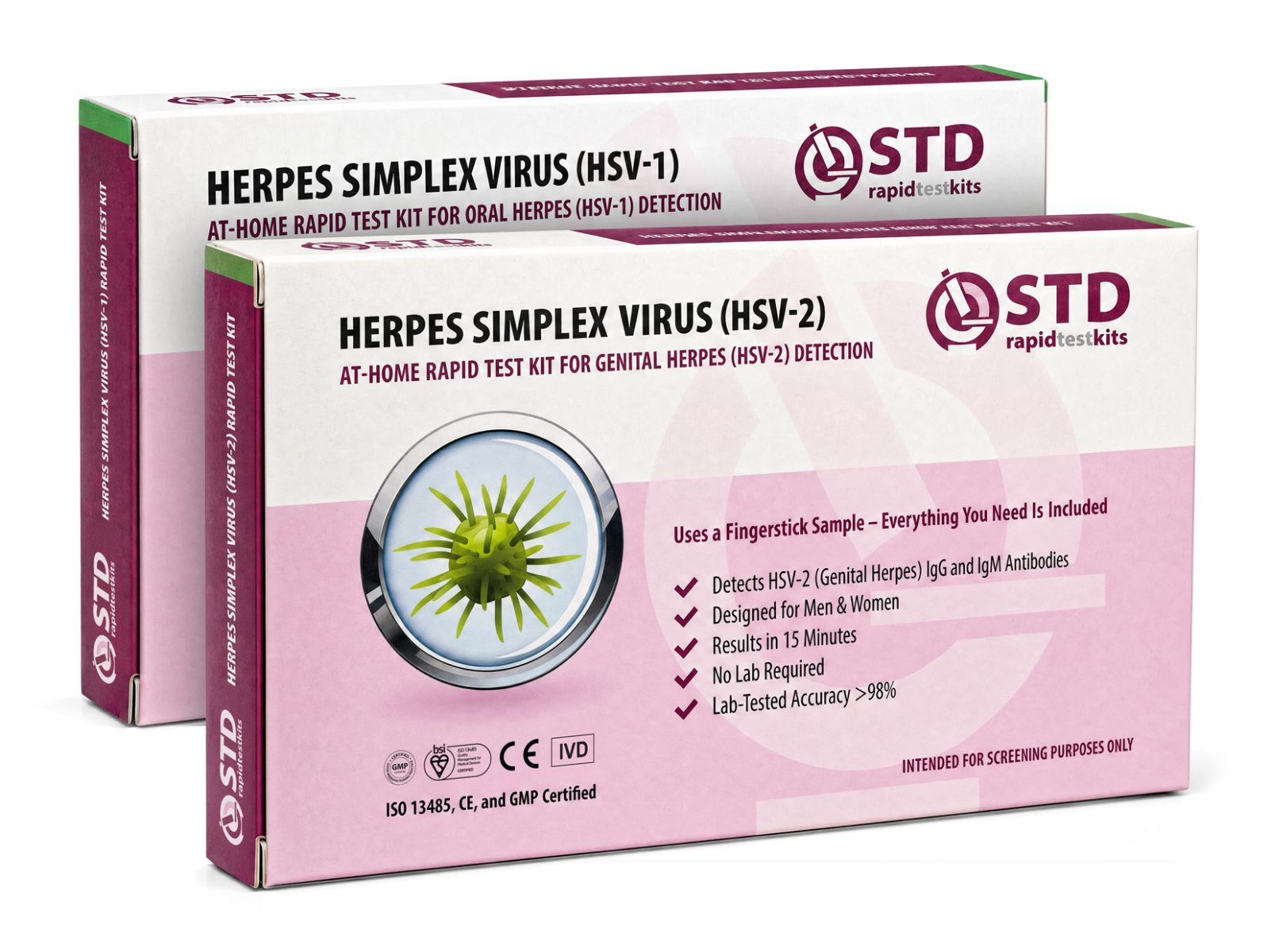
For at-home testing, fingerstick blood antibody kits provide a private way to screen for HSV antibodies without a clinic visit. They detect the same antibodies a lab antibody test would, and a positive result is worth confirming with a clinician for context and treatment planning.
| Test type | What it detects | When to use | Limitations |
|---|---|---|---|
| HSV-2 IgG blood test (lab or at-home) | Antibodies to HSV-2 | No visible sores; at least 12 weeks after suspected exposure | Window period varies; does not date the infection; antibody positivity does not prove current symptoms are from herpes |
| HSV PCR swab | Viral DNA from an active sore | When you have a fresh, unhealed lesion to swab | Useless without an open sore; needs lab processing |
| HSV viral culture | Live virus from an active sore | Same as PCR, less commonly used now | Less sensitive than PCR; harder to find labs that still offer it |
Why testicle pain gets misdiagnosed (in both directions)
Men with persistent testicle or pelvic pain often cycle through multiple appointments without a clear answer. There are real reasons this happens, and knowing them helps you advocate for the right workup.
Most clinicians correctly think of bacterial causes first because they are more common and more readily treated. A workup that starts with a urine NAAT for chlamydia and gonorrhea, a urinalysis, and a physical exam for hernia or torsion catches the majority of cases. When that workup comes back negative and the pain persists, the differential broadens, but herpes is not always the next thing tested.
HSV antibody tests are not routinely included in standard STI panels in many clinics, particularly for asymptomatic patients. The CDC explicitly does not recommend population-wide HSV-2 antibody screening because of the false-positive rate at low pretest probability and the limited treatment implications for asymptomatic infection. That is a defensible clinical position, but it can leave individual men in a frustrating gap when symptoms persist and the standard workup comes back clean.
The other side of the misdiagnosis problem is over-attribution. Symptoms that bear no real relationship to herpes sometimes get blamed on it, especially when a patient pushes for a specific diagnosis and a positive antibody test happens to be present. Per the CDC NCHS data brief on HSV-1 and HSV-2 prevalence in persons aged 14 to 49, roughly half of US adults in that age range carry HSV-1 antibodies and around 12% carry HSV-2 antibodies, so antibody positivity alone does not prove that herpes is the cause of any specific current symptom.
A productive path forward when testicle pain is persistent and unexplained: rule out the common bacterial causes with a NAAT panel, rule out structural causes (varicocele, hernia, torsion) with imaging if indicated, and consider HSV testing when other causes are excluded and the timing or pattern fits an outbreak.
Nerve pain vs inflammatory pain: telling them apart
The character of the pain itself can offer clues about whether nerve involvement (consistent with herpes) or inflammation (consistent with bacterial epididymitis or prostatitis) is the more likely driver.
Nerve pain tends to feel burning, electric, tingling, or shooting. It can travel along a path rather than staying in one spot, and it often appears or worsens without an obvious physical trigger. Some men describe it as a pins-and-needles sensation that radiates from the lower back or groin into the testicle or inner thigh. There is typically no visible swelling or redness in the testicle itself, and pressing on the area does not consistently reproduce the pain.
Inflammatory pain tends to feel deeper, achier, and more constant. It often comes with localized tenderness when you press on the affected structure, and there may be visible swelling, warmth, or redness in the scrotum. Inflammation from bacterial epididymitis often comes with urinary symptoms (burning during urination, increased frequency, urgency), since the underlying infection usually involves the urethra as well.
Both types of pain can overlap in the same person, especially during a primary herpes infection where local nerve irritation, regional lymph-node swelling, and systemic symptoms occur together. The pattern matters more than any single descriptor: nerve pain that comes and goes in episodes lasting hours to days fits a different picture than a steady deep ache that has been worsening over a week.
| Where the pain is | Possible herpes-related cause | Other conditions to consider |
|---|---|---|
| One testicle, sudden sharp pain | Unlikely to be herpes | Testicular torsion (emergency), trauma |
| One testicle, gradual swelling | Uncommon for herpes | Bacterial epididymitis, varicocele, hydrocele |
| Groin or inner thigh, burning or tingling | Possible prodromal nerve activity | Muscle strain, nerve impingement, inguinal hernia |
| Perineum or behind scrotum, deep ache | Possible sacral nerve involvement | Prostatitis, pelvic floor dysfunction |
| Lower back or buttocks | Possible reactivation in sacral ganglia | Sciatica, lumbar disc issue |
What to do next
Given how easily testicle pain can be misattributed in either direction, the productive plan is to take action in the right order rather than trying to diagnose yourself.
If your pain is sudden, severe, or accompanied by nausea, vomiting, or a high-riding testicle, get to an emergency department or urgent care now. Testicular torsion is the priority to rule out, and a doppler ultrasound at a clinic is the only reliable way to do that.
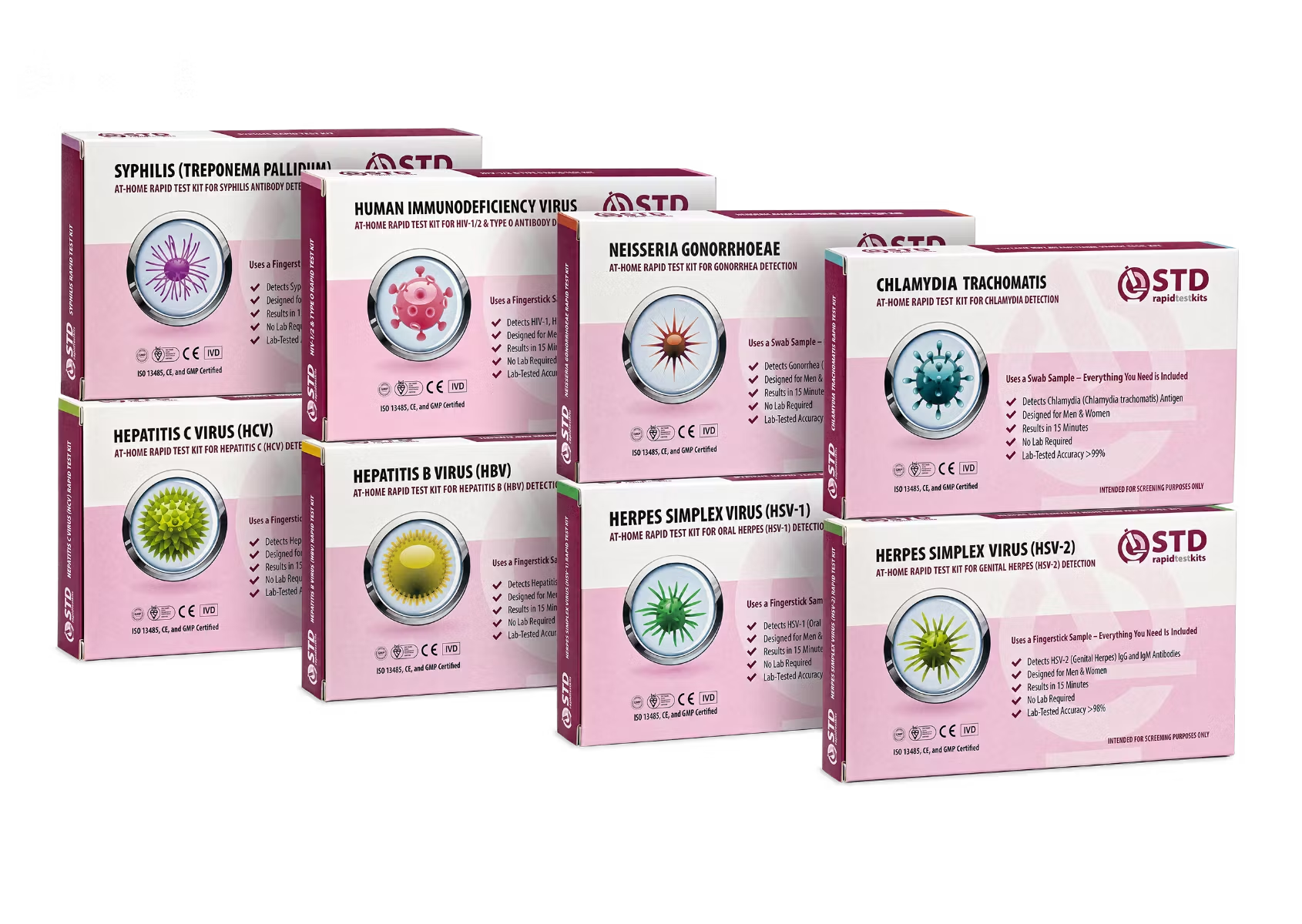
If your pain is mild, persistent, or has been ongoing for days or weeks without an emergency presentation, the next steps depend on what is available to you. An in-person visit gives you a physical exam, a urine NAAT for chlamydia and gonorrhea (the most common bacterial STI causes of epididymitis), and a urinalysis. If a clinic visit is genuinely impossible or you want privacy on the bacterial side first, an at-home chlamydia and gonorrhea combo swab kit is a reasonable starting point for ruling out the most common STI-related cause of epididymitis. For HSV antibody screening when there are no visible sores, a fingerstick blood test detects HSV antibodies after the window period.
Treatment, when herpes is confirmed, typically involves antiviral medications like valacyclovir or acyclovir to shorten outbreak duration and reduce viral shedding. The CDC's herpes treatment guidelines describe both episodic treatment (taken at the start of each outbreak) and suppressive therapy (daily, for people with frequent recurrences). Nerve-pain symptoms that persist between outbreaks are sometimes managed with neuropathic pain medications under a clinician's supervision.
If you have ruled out bacterial causes and antibody testing is negative for HSV after the appropriate window, the next sensible step is a urology consultation, pelvic floor evaluation, or scrotal imaging to look at the structures themselves, depending on what your clinician thinks fits the symptom pattern.
The CDC notes that most people with genital herpes have no symptoms or only very mild ones, which is why most infections go unrecognized. An HSV antibody test can confirm exposure history even when current symptoms point to a different cause, which makes it useful when other workups come back negative.
FAQs
- Can herpes cause testicle pain without any visible sores?
- Yes, but it is uncommon as an isolated symptom. When it does happen, it is usually because the virus is irritating the sacral nerves, which serve a wider area than just the visible outbreak site. If testicle pain is your only symptom and there are no sores, herpes is one possibility, but other causes (bacterial epididymitis, varicocele, muscle strain, hernia) are statistically more likely. An HSV-2 IgG blood test can help rule herpes in or out after the window period.
- How long does herpes-related testicle pain typically last?
- During a primary outbreak, discomfort can last 1 to 2 weeks, often alongside fever, swollen lymph nodes, and visible sores. Recurrent outbreaks tend to be shorter, typically a few days. Prodromal nerve sensations before a visible outbreak usually last hours to a couple of days. Pain that lasts weeks without resolving deserves a clinician evaluation regardless of suspected cause.
- Can I pass herpes to a partner if my only symptom is testicle pain?
- Yes. Herpes can be transmitted even when you do not have visible sores, through a process called asymptomatic shedding. The risk is highest right before and during outbreaks but exists at lower levels at other times. If you have been diagnosed with HSV-2, talk to your partner about it, use barrier protection, and discuss with a clinician whether suppressive antiviral therapy is appropriate for reducing transmission risk.
- What is the difference between herpes pain and epididymitis?
- The clearest single sign is swelling: bacterial epididymitis usually causes visible testicular swelling and tenderness on one side, while herpes-related discomfort typically does not. Epididymitis also commonly brings urinary symptoms (burning during urination, frequency, urgency) because the underlying infection involves the urethra. Epidemiologically, epididymitis from chlamydia or gonorrhea is far more common in younger sexually active men than herpes-related testicle pain, which is why a urine NAAT for those bacteria is usually the first test ordered.
- When should I see a doctor in person instead of testing at home?
- Get in-person evaluation now if your pain is sudden and severe (especially on one side), if the testicle appears higher than usual, or if you have nausea or vomiting. Testicular torsion is a surgical emergency. Also see a clinician for swelling, fever, urinary symptoms, blood in urine or semen, or any pain that is worsening over hours. At-home testing is reasonable for milder, persistent symptoms after emergency causes have been ruled out, or as a screening step for STI antibodies and bacterial STIs.
- If my HSV-2 antibody test is negative, can I rule out herpes as the cause?
- Mostly, but the timing matters. Antibody tests detect your immune response, which can take weeks to months to develop after a new infection. A negative test less than 12 weeks after suspected exposure may simply mean you have not seroconverted yet. If you tested before 12 weeks and symptoms persist, retest at the 12-week mark. A smaller proportion of people seroconvert later, so a negative at 12 weeks provides good but not absolute confidence, and a negative test at the right interval makes herpes a much less likely cause of your symptoms.
- Will antiviral medication relieve herpes-related nerve pain?
- Antivirals like valacyclovir and acyclovir target the virus itself, which can shorten outbreaks and reduce viral shedding. They tend to help most when started early in an outbreak. For nerve pain that persists between outbreaks, neuropathic pain medications like gabapentin or pregabalin are sometimes used under a clinician's supervision. Discuss treatment options with a healthcare provider rather than self-medicating, particularly if you are considering daily suppressive therapy.
How we sourced this article: We summarized current public-health guidance from the CDC, NHS, and NIH on herpes, epididymitis, and the differential diagnosis of testicle pain in men. Specific clinical claims (window periods, lumbosacral-ganglia latency, comparative prevalence of causes) are linked inline to root-domain references. This article is editorial summary, not personal medical advice. For symptoms that concern you, see a licensed clinician.
- U.S. Centers for Disease Control and Prevention. About Genital Herpes overview, including transmission and symptom variability.
- U.S. Centers for Disease Control and Prevention. STI Treatment Guidelines: Genital Herpes, including antiviral treatment regimens and antibody testing guidance.
- U.S. Centers for Disease Control and Prevention. STI Treatment Guidelines: Epididymitis, identifying chlamydia and gonorrhea as the typical sexually-transmitted bacterial triggers.
- U.S. Centers for Disease Control and Prevention, National Center for Health Statistics. Data Brief No. 304: Prevalence of Herpes Simplex Virus Type 1 and Type 2 in Persons Aged 14-49: United States, 2015-2016.
- National Institutes of Health, StatPearls. Herpes Simplex Type 2, including pathophysiology of latency in the lumbosacral ganglia and clinical features of primary infection.
- UK National Health Service. Genital herpes overview, including symptom course and treatment options.
- National Center for Biotechnology Information, InformedHealth.org. Genital herpes: Overview, including primary and recurrent outbreak patterns.
