
Published: November 2025 | Last updated: May 2026 | Editorial review and quality control: Martina N.
The claim showed up everywhere in late March: Houston supposedly logged 42,000 STD cases over spring break, all in one week, all tied to one stretch of beach trips and parties. It set off a wave of panicked DMs, late-night Google searches, and TikTok videos calling out specific towns. The number sounded specific enough to feel sourced, and the timing made it feel personal.
Here is the short version. That figure does not represent a one-week outbreak in any U.S. city. Public health departments do not track sexually transmitted infections by “spring break week.” The number almost certainly came from a much larger surveillance dataset, possibly an annual or multi-year case total, then got reframed by someone chasing engagement.
Post-trip testing still earns a place in this picture on its own merits. STIs are common, often silent, and easy to miss without screening. The honest answer sits between the panic and the dismissal: the viral number is wrong, your personal risk depends on what actually happened on your trip rather than on a screenshot circulating in your feed, and sorting it out takes about five minutes.
Key Takeaways
- The viral “42,000 STD cases in Houston during spring break” claim is not a real one-week outbreak figure; it appears to be a cumulative surveillance number stripped of its actual time frame.
- Spring break does shift risk behavior, and most common STIs (chlamydia, gonorrhea, early syphilis) can be silent for weeks, so screening roughly 2 weeks after exposure is the most useful move regardless of what is trending.
Where the 42,000 Number Actually Came From
Take the figure at face value and it sounds like one Texas metro had a one-week catastrophe. That is not how STI reporting works anywhere in the United States.
State and local health departments collect lab-confirmed cases on a continuous, rolling basis. Those cases get reported up to the CDC's STI topic hub and aggregated into monthly, quarterly, and annual summaries. A 42,000-case figure for a single Texas metro is plausible only as a cumulative count over many months. It is not a measurable spike from one week of beach trips.
So where does a viral number like this usually start? A few patterns repeat:
- A real cumulative statistic (for example, all reportable STIs in a county over a calendar year) is stripped of its date range and reposted as if it happened during one event.
- Two unrelated datasets are mashed together (citywide HIV plus chlamydia plus gonorrhea totals stacked into a single shock number).
- The figure is simply invented and circulated until it gets repeated enough to feel sourced.
None of those patterns require malice. They require attention. A specific-sounding number tied to a specific city and a specific moment will outperform the same data presented honestly, every single time. Algorithms reward shock, and a clean round number like 42,000 is exactly the shape that travels.
The result is a number that feels reportable but does not survive contact with the actual public health record. No state surveillance report, CDC update, or peer-reviewed analysis attributes a one-week 42,000-case event to Houston or to any U.S. city.
Did Houston really log 42,000 STD cases during spring break?
No. That number is not a single-week outbreak figure and is not how any U.S. health department tracks STIs. Real surveillance covers months or years, not “spring break week.” If you had a possible exposure during a trip, what matters is your own testing timeline: roughly 2 weeks after exposure for chlamydia or gonorrhea, with HIV and syphilis needing longer windows for reliable results.
How STI Surveillance Actually Works
Real STI trends do not spike overnight the way viral content does. They climb slowly, driven by changes in testing access, screening guidelines, sexual networks, and the fact that many infections spread silently for months before anyone is diagnosed.
Chlamydia, gonorrhea, and syphilis are all reportable diseases in the United States. Every confirmed positive lab result flows through a state-level system and then up to the CDC. The aggregate takes months to assemble and another stretch to validate before publication, which is why CDC STI surveillance reports typically appear a year or two after the year they cover.
A city with a large young-adult population like Houston will, year over year, have tens of thousands of reportable STI cases. That is not unique to Houston, and it has nothing to do with any particular spring break week. It tracks the size of the city, the age profile, and the screening volume.
To make the comparison concrete, here is how surveillance differs from a viral post:
| How Public Health Reports STIs | How a Viral Claim Reframes the Same Data |
|---|---|
| Annual or quarterly cumulative case totals | Framed as a single weekend spike |
| Population-adjusted rates per 100,000 | Stripped down to a raw shock number |
| Includes lab-confirmed asymptomatic cases | Assumes everyone counted had visible symptoms |
| Collected month after month | Implied to have happened overnight |
The Underlying Concern Is Real, Even If the Number Isn't
Here is the part that actually matters: even though the 42,000 claim is misleading, the post-trip testing concern under it is legitimate. Vacations shift behavior. People meet new partners, take chances they would not at home, and sometimes drop the condom-and-conversation routine in the moment.
The bigger issue is that most common STIs do not announce themselves. The World Health Organization's STI fact sheet notes that STIs are often asymptomatic, and when symptoms do appear they can be non-specific and easy to confuse with other things.
Chlamydia is the textbook example. Public health agencies routinely describe it as “silent” because a large share of infections in both men and women produce no noticeable symptoms in the early weeks, per the CDC's STI topic pages. The same is true for early gonorrhea, primary syphilis (which can present as a painless internal sore that is easy to miss), and a meaningful share of trichomoniasis cases.
HIV specifically tends to dominate post-trip anxiety, so the math is worth grounding. Per CDC HIV resources, per-act transmission risk for most heterosexual exposures is well under 1%, even when one partner is infected. Two timing facts change that picture: PEP (post-exposure prophylaxis), a 28-day antiretroviral course started within 72 hours of a high-risk exposure, substantially cuts the chance of seroconversion. Past that 72-hour window, CDC HIV testing guidance puts the fourth-generation antibody/antigen window at 18 to 45 days for the lab version and 18 to 90 days for the rapid finger-stick version, with 12 weeks as the standard confirmation point.
So while the viral 42,000 claim is wrong, it accidentally points at something real: people underestimate their risk because nothing feels off. Symptom timing varies considerably by infection:
| STI | Typical Symptom Onset (if any) | Often Asymptomatic? |
|---|---|---|
| Chlamydia | 1 to 3 weeks | Very common, especially in women |
| Gonorrhea | 2 to 14 days | Common, especially pharyngeal and rectal sites |
| Syphilis (primary) | 10 to 90 days | Often missed; painless sore can be internal |
| Herpes (HSV) | 2 to 12 days | Many people never recognize a first outbreak |
| HIV (acute) | 2 to 4 weeks if symptoms appear | Frequently silent in the early weeks |

The Timing Trap: Why Testing Too Early Misleads You
This is where most post-trip testing goes sideways, and it has nothing to do with TikTok or Houston. It is timing. You can do everything right (decide to test, find a clinic or order a kit, follow through) and still get a false-negative result because you tested before the infection became detectable.
The gap between exposure and reliable detection is the “window period.” During that window, the bacteria or virus is in your body but the test cannot yet pick it up. Test too early and you walk away thinking you are clear when you are not.
Each infection has its own window. Drawing on NHS STI guidance and the CDC's HIV testing windows, here is the practical post-exposure timeline. (The “fourth-generation” HIV test referenced below is the modern rapid assay that detects both the p24 viral antigen and HIV antibodies, which is why it picks up infection earlier than older antibody-only tests.)
| STI | Earliest Detectable | Best-Accuracy Window |
|---|---|---|
| Chlamydia | 5 to 7 days | 2 weeks |
| Gonorrhea | 5 to 7 days | 2 weeks |
| HIV (4th-gen antibody/antigen, lab) | about 18 days | by 45 days, confirmed at 12 weeks |
| HIV (4th-gen rapid finger-stick) | about 18 days | by 90 days, confirmed at 12 weeks |
| Syphilis | around 3 weeks | 6 weeks |
| Herpes (type-specific antibody) | 4 to 6 weeks | 12 to 16 weeks |
Why a Single Post-Trip Test Often Isn't Enough
A single test taken three days after a trip is rarely the complete answer. A two-stage approach makes more sense: an early test (roughly two weeks after exposure) covers the fastest-detectable infections such as chlamydia and gonorrhea, then a confirming round at six to twelve weeks picks up HIV and syphilis once they have had time to register. If herpes is a concern, a type-specific antibody test at twelve to sixteen weeks rounds the picture out.
STIs are often asymptomatic. When symptoms occur, they can be non-specific.
What Actually Raises Your Risk (It Isn't Geography)
It is easy to blame a moment: spring break, a beach city, one particular night. But STI risk does not come from a calendar event. It comes from specific behaviors, and those behaviors travel with you regardless of zip code.
The factors that actually move your risk needle are well established in public health screening guidance from the CDC's STI topic hub and equivalent NHS materials:
| What Actually Raises Risk | What People Tell Themselves |
|---|---|
| Sex without a condom, even once | “It was just one time, so it's low risk” |
| Multiple new partners in a short window | “Everyone there seemed healthy” |
| Oral sex without barriers | “Oral doesn't really count for STIs” |
| No recent testing for either partner | “They said they were clean” |
| Genital skin-to-skin contact (HSV, HPV) | “We used a condom, so we're covered” |
Geography Doesn't Determine Your Risk
Notice what is missing from that table: cities, viral numbers, beach towns. None of those determine your actual risk. The pattern of contact does. A weekend at home with a new partner you did not vet carries the same exposure structure as the equivalent night during spring break.
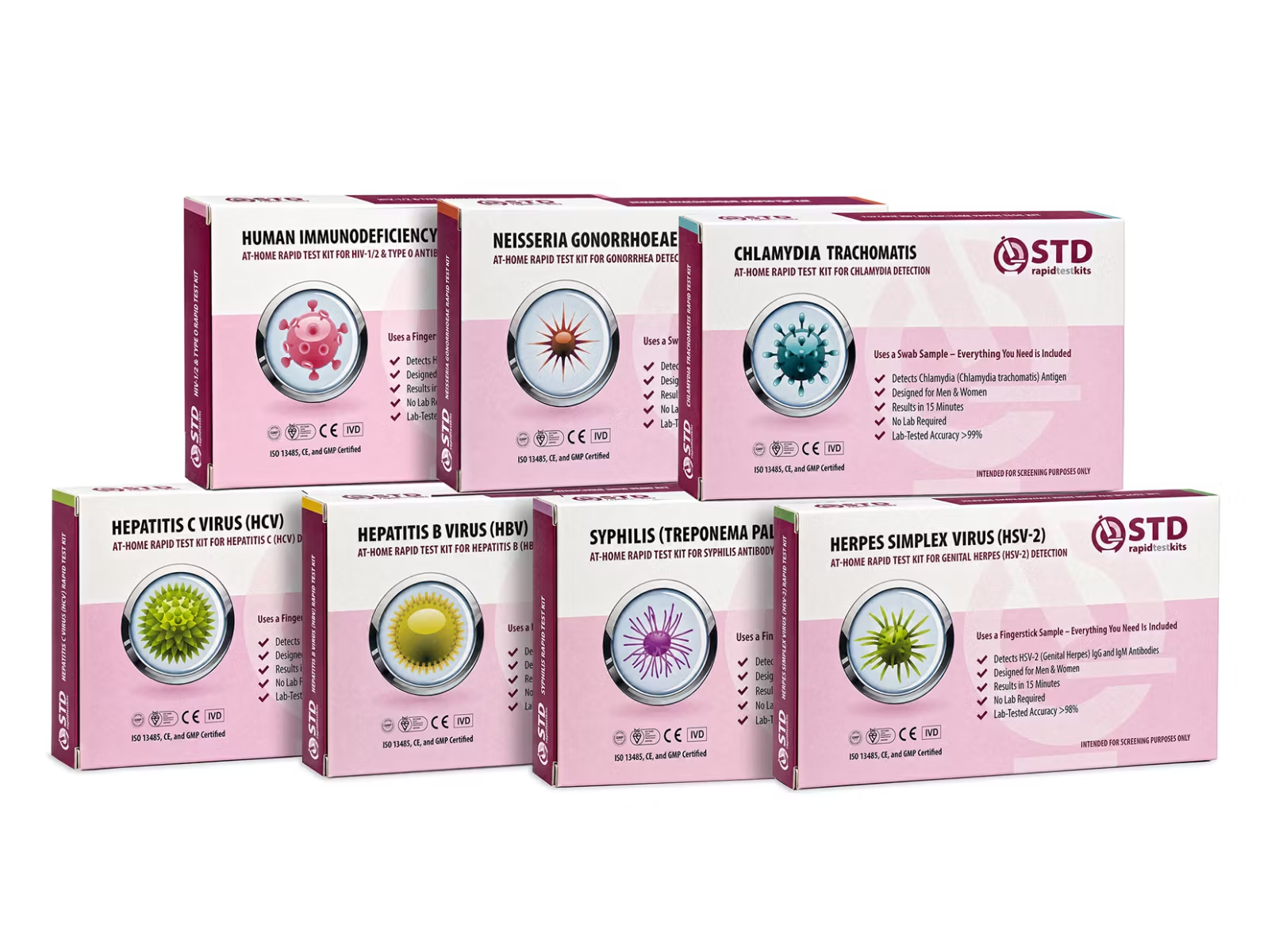
One quick disclosure before the next section: stdrapidtestkits.com publishes this article and sells the at-home rapid kits referenced below. We recommend kits by fit-for-purpose for the reader's concern, not by commercial benefit.
Why a Number Like “42,000” Spreads So Fast
STI misinformation moves faster than most infections ever could. The content is engineered to grab you. Big number, specific city, urgent tone, plausible timing. It feels real, immediate, and personal, and people share it because the format itself reads as credible.
The “42,000 cases in Houston” claim is almost a textbook example. Large enough to shock without sounding cartoonish. Specific enough to feel sourced. Tied to spring break, which already carries cultural baggage about risk. Then dropped onto a feed already trained to reward outrage and alarm over context and caveats.
Viral health claims rarely start with full context. They start with a fragment. Sometimes the fragment is a real statistic pulled from a yearly report and stripped of its time frame. Sometimes it is two datasets stitched together. Sometimes it is fabricated outright. Once the post is out, it gets reshaped, screenshotted, and reposted until it feels like common knowledge, which is exactly when it stops being questioned.
The timing of these posts is not accidental either. They tend to hit in late March and early April, exactly when post-trip anxiety is highest. Your brain connects the dots before you have time to verify anything, and the worry feels confirmed.
The shape is consistent: a specific shock number, a real city name, and an emotionally loaded moment (spring break, a holiday, a college week). That combination outperforms accurate framing on every social platform because the algorithms reward emotional reaction, not context. Recognizing the shape is what makes the next claim easier to second-guess before sharing it.
What Public Health Actually Watches For
Real STI clusters do not look like viral posts. They are slower, quieter, and tracked through patterns rather than headlines. State epidemiologists and the CDC look for things like:
- Gradual month-over-month case-rate increases in a defined geographic area
- Lab-confirmed reportable cases flowing through state surveillance systems
- Demographic and contact-tracing patterns that suggest a real cluster (a specific cohort, a defined social network)
- Official notifications from state and local health departments, not screenshots from anonymous accounts
STIs are still climbing nationally. CDC's STI surveillance program has documented reportable STI cases at near-record levels in the U.S., with gonorrhea and syphilis up substantially over the last decade. But those increases are measured year over year, not in one-week explosions. The contrast between how surveillance speaks and how virality speaks is exactly the distortion the Houston rumor sits inside:
| Real Public Health Signal | Viral Signal |
|---|---|
| Multi-month case-rate trend | One-week spike claim |
| Lab-confirmed reportable cases | Screenshots and reposted claims |
| Geographic and demographic analysis | One city plus one shock number |
| Official reports from health agencies | TikTok, anonymous posts, viral threads |

Action, Not Panic: What to Actually Do Next
The Houston rumor manufactures urgency, but not the useful kind. It pushes you toward panic or dismissal, both of which leave you with no information about your actual situation. Real urgency is quieter. It sounds like, “I should probably check, based on what actually happened on my trip.”
That is the shift that matters: moving from guessing to knowing. You do not need a viral number to justify a test. You do not need symptoms to qualify. You do not need to match yourself to a statistic from a city you may not even live in.
If the rumor is in your head and you are honest about your own trip, work through three quick questions:
- What is the earliest infection I could test for now? Chlamydia and gonorrhea are detectable from about a week out, fourth-generation HIV rapid tests from about 18 days, syphilis closer to 3 weeks.
- Where do I prefer to get screened? A primary care visit, a sexual health clinic, or an at-home rapid kit are all valid. Pick the option you will actually follow through on.
- What is my follow-up window? A confirming round at 6 to 12 weeks covers HIV and syphilis; a separate herpes antibody test at 12 to 16 weeks rounds out the picture if HSV is a concern.
For people who do not want to schedule a clinic visit, options like an at-home STI test kit remove the friction of the first step. If you are uncertain which infection to screen for, broader combination panels exist precisely for the “I am not sure what to test for” situation.
The Bottom Line
Strip the noise away and the picture is straightforward.
Houston did not suddenly log 42,000 STD cases during one spring break week. That figure has no basis in any state or federal surveillance reporting. It is a distorted version of how public health data actually works, repackaged for engagement.
STIs are common in the U.S., and risk after new sexual encounters is real. But that risk depends on what happened on your specific trip, not on a viral statistic. The honest move is to ignore the rumor entirely and look at your own situation: did anything happen that warrants screening, and if so, what is the right testing window?
If something is sitting in the back of your mind from spring break, you do not need symptoms to justify a test. The lingering “what if” thought is itself a useful signal. Better to spend 15 minutes screening at the right window than to spend the next six weeks rehearsing worst-case scenarios.
If something happened on your trip and you want a clean schedule: test at about 2 weeks for chlamydia and gonorrhea, run a confirming round at 6 to 12 weeks for HIV and syphilis, and add a separate herpes type-specific antibody test at 12 to 16 weeks if HSV is on your mind. If the exposure was within the last 72 hours and was high-risk for HIV, ask a clinic about PEP today, not tomorrow.
FAQs
- Did Houston really have 42,000 STD cases during spring break?
- No. That number does not appear in any state or federal STI surveillance report tied to a single week. It is most likely a much larger cumulative figure (annual or multi-year) presented as if it happened during one event. Real STI surveillance covers months and years, never one-week beach-trip windows.
- Why did the number feel so believable to so many people?
- It hit at the exact wrong moment, when post-trip anxiety is already running high. The combination of a specific city, a specific number, and a culturally loaded time frame gives the brain something to latch onto before it can verify anything. That is the engineered part of viral health misinformation.
- Can you really get an STI from a single hookup?
- Yes. A single encounter where an infection is present and unblocked by protection is enough to transmit it. Per-encounter probability varies by infection and by route, often well under 1% for most heterosexual exposures and higher for some routes (such as receptive anal sex for HIV). One exposure does not guarantee infection, and it does not rule it out either, which is why testing exists.
- I feel completely fine. Doesn't that mean I'm probably clear?
- Not reliably. Chlamydia, early gonorrhea, primary syphilis, and acute HIV are all frequently silent in the first weeks. The absence of symptoms does not mean the absence of infection; screening, not symptom-watching, is what tells you where you stand.
- How long after a possible exposure should I actually test?
- For chlamydia and gonorrhea, about 2 weeks gives a reliable result. Fourth-generation HIV antibody/antigen tests detect infection from about 18 days, with lab versions reliable by 45 days and rapid finger-stick versions by 90 days; 12 weeks is the standard confirmation point. Syphilis becomes reliably detectable around 6 weeks. A single test right after the trip will under-detect; planning a follow-up round is normal.
- My early post-trip test was negative. Should I still re-test?
- Often yes. If you tested within a few days of exposure, you tested inside the window period for several infections and the result is incomplete. A confirming round at 6 to 12 weeks covers HIV and syphilis. Herpes type-specific IgG antibody takes longer to seroconvert reliably, so a separate herpes antibody check at 12 to 16 weeks post-exposure is the standard recommendation if HSV is a concern.
- Are spring break STI spikes actually a real thing?
- Not in the “overnight outbreak” sense the viral posts suggest. What does spike is post-trip testing volume and search interest. People come home, the moment lands, and they start thinking about it. It is a delayed awareness wave, not a single-event outbreak in any one city.
- Do I need to test if I used protection the whole time?
- Protection lowers risk substantially but does not bring it to zero. Condoms reduce, but do not eliminate, transmission of skin-to-skin infections like HSV and HPV, and imperfect use is common. If something is on your mind, testing is more about clearing the loop than about assuming something went wrong.
How we sourced this article: This piece draws on CDC surveillance data and HIV testing guidance, the WHO's STI fact sheet, and NHS STI guidance for window-period and symptom-timing information. We reviewed how STI case data is collected, validated, and reported in the U.S. to contrast that with how a single viral number gets reframed online. Behavioral framing around post-exposure anxiety and post-trip testing draws on published health-literacy research and clinical screening recommendations.
- U.S. Centers for Disease Control and Prevention. STI topic hub; describes how reportable STI case data is collected and published in the United States and provides chlamydia, gonorrhea, syphilis, and herpes symptom-and-screening guidance referenced throughout this article.
- World Health Organization. Sexually Transmitted Infections (STIs) Fact Sheet; source of the pull-quote on STIs being often asymptomatic and the global-burden framing in this article.
- NHS. Sexually Transmitted Infections (STIs) overview; window-period and testing-timeline guidance used in the post-exposure tables.
- Mayo Clinic. Sexually Transmitted Diseases (STDs): Symptoms and causes; clinical summary used for cross-checking the symptom-onset table.
- U.S. Centers for Disease Control and Prevention. HIV Testing; direct source for the 18-to-45-day lab and 18-to-90-day rapid finger-stick fourth-generation antibody/antigen testing windows cited in this article.
- U.S. Centers for Disease Control and Prevention. HIV (topic hub); reference for per-act HIV transmission risk context and PEP (post-exposure prophylaxis) 72-hour window guidance used in the HIV reassurance section.
