
Published: August 2025 | Last updated: May 2026 | Editorial review and quality control: Martina N.
Delaware's sexually transmitted infection numbers have been climbing for several years, and women are bearing a disproportionate share of the rise. Chlamydia leads the trend, gonorrhea is close behind, and trichomoniasis quietly drives a long tail of misdiagnosed cases that women often mistake for yeast infections or bacterial vaginosis. Most women who test positive for any of these had no clear warning sign first.
This guide walks through what national STI trends mean for women in Delaware, which symptoms warrant action versus reassurance, when to test after an exposure so the result is reliable, what your options are if you'd rather not sit in a clinic waiting room, and how Delaware privacy rules affect what shows up on your medical record or insurance paperwork. Where the conversation gets practical, you'll find clearly-labeled at-home test options that ship in unbranded packaging.
Key Takeaways
- About 70 percent of chlamydia cases in women cause no symptoms, and gonorrhea is similarly silent. The CDC therefore recommends annual screening for every sexually active woman under 25, and for older women with new or multiple partners, whether or not you feel anything.
- Test timing matters more than test choice. Most swab tests for chlamydia, gonorrhea, and trichomoniasis need 7 to 14 days after exposure to be reliable, and HIV antibody tests need longer. Testing the morning after an exposure is the most common reason a negative result later turns positive.
What national STI trends mean for women in Delaware
Delaware tracks its sexually transmitted infection caseload through the Division of Public Health and reports the data into the CDC's national STI surveillance system. National trends are the data we can cite cleanly: through the 2010s and early 2020s, U.S. chlamydia and gonorrhea cases climbed steadily, with women carrying the larger share of chlamydia diagnoses (CDC STI Statistics overview). The CDC's 2024 provisional surveillance data show a modest year-over-year decline in chlamydia and gonorrhea cases nationally (CDC STI Surveillance annual reports), but the multi-year trajectory remains well above pre-2015 baselines. State-level breakdowns of the 2024 data are not expected until 2026.
What that means for women in Delaware: even with the headline rate plateauing nationally in the most recent provisional year, the underlying drivers of new infections have not changed, and the screening behaviour that catches infections early is still the most reliable defence. Sexual-health surveys consistently show that women delay testing because they don't want a clinic visit on their insurance record, because they're worried someone they know will see them in the waiting room, or because they were told growing up that "nice girls" don't get STIs. Those are access and stigma barriers, both of which the routes later in this article are designed to work around.
Two factors elevate the risk for women specifically, regardless of state. Women's anatomy makes asymptomatic chlamydia and gonorrhea infections more common, so they go unnoticed longer. And male partners are even more likely to be asymptomatic per CDC surveillance data, which means an infection can cycle between partners until one person finally screens.
- Screening gaps. Women without a regular primary care provider miss the CDC's recommended annual chlamydia and gonorrhea screen.
- Partner-side blind spots. Chlamydia in men is frequently asymptomatic, so the infection cycles between partners until someone screens.
- Geographic access. Women in less-populated parts of the state often face a longer drive to a clinic that bulk-tests for STIs than women in the Wilmington corridor.
What testing options Delaware women have
You have four practical routes in Delaware, and the right one depends on how soon you need an answer, how much privacy you want, and whether you'd rather collect a sample yourself or have someone else do it.
At-home rapid tests are lateral-flow cassettes you collect a sample for and read at home in about 15 to 30 minutes. They cover the high-prevalence infections (chlamydia, gonorrhea, trichomoniasis, the herpes panels, HIV, syphilis, hepatitis B and C) and ship in unbranded packaging. Mail-in lab kits use the same sample-collection-at-home model, but you ship the sample to a lab and read results securely online a few days later. Walk-in clinics in Wilmington, Dover, Newark, Seaford, and Georgetown handle cases where you need a clinician's eyes on a symptom or where you want everything done in one visit. Your primary care provider can run an STI panel as part of an annual visit, which is what the CDC's screening guidance assumes; that route goes on your insurance record.
None of these routes are wrong. They serve different reasons for testing. The comparison table in the next section lines each option up against the things women in Delaware tell us matter most.
Which testing option should I choose if I just want a fast, private answer?
For a private, same-day answer at home, an at-home rapid lateral-flow test is the fastest route. Expect a 15 to 30 minute result for swab- and blood-based rapid panels, with discreet packaging and no clinic visit on your record. If you want a clinician to evaluate a visible symptom or you'd like immediate treatment if a result is positive, a walk-in public-health clinic is the right call. Many Delaware women use both: an at-home rapid kit to screen quickly, and a clinic if the result is positive or unclear.
How the four testing routes compare
The table below lines the four routes up against speed, privacy, and the best-fit reason for using each.
| Option | Privacy | Time to result | Best for |
|---|---|---|---|
| At-home rapid test kit | Very high | 15 to 30 minutes | Private, same-day answer at home |
| Mail-in lab kit | High | 2 to 5 days | Lab-grade results without a clinic visit |
| Walk-in public-health clinic | Moderate | Same day or 2 to 3 days | Visible symptoms, immediate treatment |
| Primary care provider | Low to moderate | Several days | Annual screening or follow-up after a positive |
Symptoms women shouldn't dismiss
Most chlamydia and gonorrhea infections in women cause nothing visible or even noticeable, which is why annual screening exists. When symptoms do appear, the most common ones are easy to confuse with things women already deal with: a yeast infection that just won't quit, a UTI that the over-the-counter remedy didn't fix, vaginal discharge that smells different from your usual baseline, post-coital spotting, or a low-grade pelvic ache that comes and goes.
Trichomoniasis is the one most often mistaken for bacterial vaginosis. CDC and OWH trichomoniasis resources describe the classic presentation as frothy yellow-green discharge with a faintly musty odor, vulvar itching, and burning during urination (CDC trichomoniasis topic page). It is also the easiest of the three to cure once you know what's actually causing the discharge, so it is worth not chalking it up to "BV that won't go away" past a couple of weeks.
Herpes is its own pattern. A first HSV-2 outbreak typically produces clustered painful blisters in the genital area, often with flu-like fatigue and tender lymph nodes in the groin. Later outbreaks are milder. HSV-2 also sheds asymptomatically, which is why so many people get infected from a partner who had no visible lesion at the time.
If a symptom is severe, that is an emergency-department conversation, not an at-home test conversation. Pelvic inflammatory disease is the complication women want to catch before it can affect fertility.
- High fever with chills, especially alongside abdominal or pelvic pain
- Severe pelvic pain that does not ease with ibuprofen
- Fainting or feeling near-fainting
- Heavy vaginal bleeding outside a normal period
Timing matters: when to test after exposure
Every STI has a window period between exposure and the point where a test can reliably pick it up. Test inside that window and you can get a false-negative result, which is the worst outcome because it can make you believe you are in the clear when you are not. The table below lists the earliest detection point and the window where a negative result becomes meaningful for the infections women in Delaware most commonly screen for. These windows follow CDC and FDA-cleared test guidance for lateral-flow rapid tests and lab assays.
If you have a known exposure, the safest pattern is to test at the earliest detection point and then again at the most-accurate point. The early test catches an early positive so treatment can start; the later test is what lets a negative result actually rule infection out.
| Infection | Earliest detection | Window where a negative rules infection out |
|---|---|---|
| Chlamydia (swab) | 7 days after exposure | 14 days and beyond |
| Gonorrhea (swab) | 7 days after exposure | 14 days and beyond |
| Trichomoniasis (swab) | 5 to 7 days after exposure | 1 to 2 weeks |
| Herpes (HSV-2 blood antibody) | Antibodies may appear from 3 weeks in some people, but early tests miss many infections | 12 to 16 weeks for full seroconversion; a negative before 12 weeks does not rule infection out |
| HIV (fourth-generation Ag/Ab) | 18 to 45 days after exposure (most people positive by day 45) | 90 days for a negative to be conclusive |
| Syphilis (blood antibody) | 3 weeks after exposure | 12 weeks |
Privacy, consent, and what gets reported in Delaware
Delaware law treats STI testing for minors aged 12 and up as confidential medical care that does not require parental consent. For adults, results are protected health information under HIPAA, which means a clinician cannot share your result with your partner or family without your permission.
What can show up against your wishes is an insurance explanation of benefits (EOB). If you use insurance for an STI test, the EOB may go to the policyholder, which can be a parent, a spouse, or in some self-funded plans an employer. Many women in Delaware choose at-home or out-of-pocket clinic options specifically to avoid that paper trail. You can also ask your insurer about confidential communications: federal rules allow you to request that EOBs be sent to a separate address.
Mandatory reporting is a separate question. Delaware clinicians and labs report positive cases of chlamydia, gonorrhea, syphilis, HIV, and several other infections to the Delaware Division of Public Health, which uses the data for surveillance and contact-tracing outreach. The Division may reach out to offer partner-notification help, but you decide whether to participate, and you can use anonymous tools like TellYourPartner.org if you prefer not to involve a state worker.
- Skip insurance billing to avoid an EOB landing on a shared policy.
- Request confidential communications from your insurer so EOBs are sent to an address only you can access.
- Use TellYourPartner.org for anonymous partner notification when you'd rather not involve a state worker.
- At-home rapid kits do not generate any insurance paper trail and ship in unbranded packaging.
Where to confirm a result or get walk-in care
If an at-home rapid test comes back positive, you'll want a confirmation, a prescription, and a clinician to talk through any follow-up. Delaware has a mix of public-health and nonprofit clinics that handle this without requiring insurance. The table below lists four well-established locations across the state.
| Clinic | Location | What they handle | Phone |
|---|---|---|---|
| Planned Parenthood of Delaware | 625 Shipley St, Wilmington | STI testing and treatment, contraception, HPV vaccination | (302) 655-7293 |
| Delaware Health and Social Services | 805 River Rd, Dover | STI testing, HIV services, partner notification | (302) 744-4700 |
| Henrietta Johnson Medical Center | 601 New Castle Ave, Wilmington | Full sexual-health services on a sliding-scale fee | (302) 655-6187 |
| La Red Health Center | 21444 Carmean Way, Georgetown | Sussex County access, bilingual staff, walk-ins welcome | (302) 855-1233 |
If you'd rather skip the clinic visit entirely
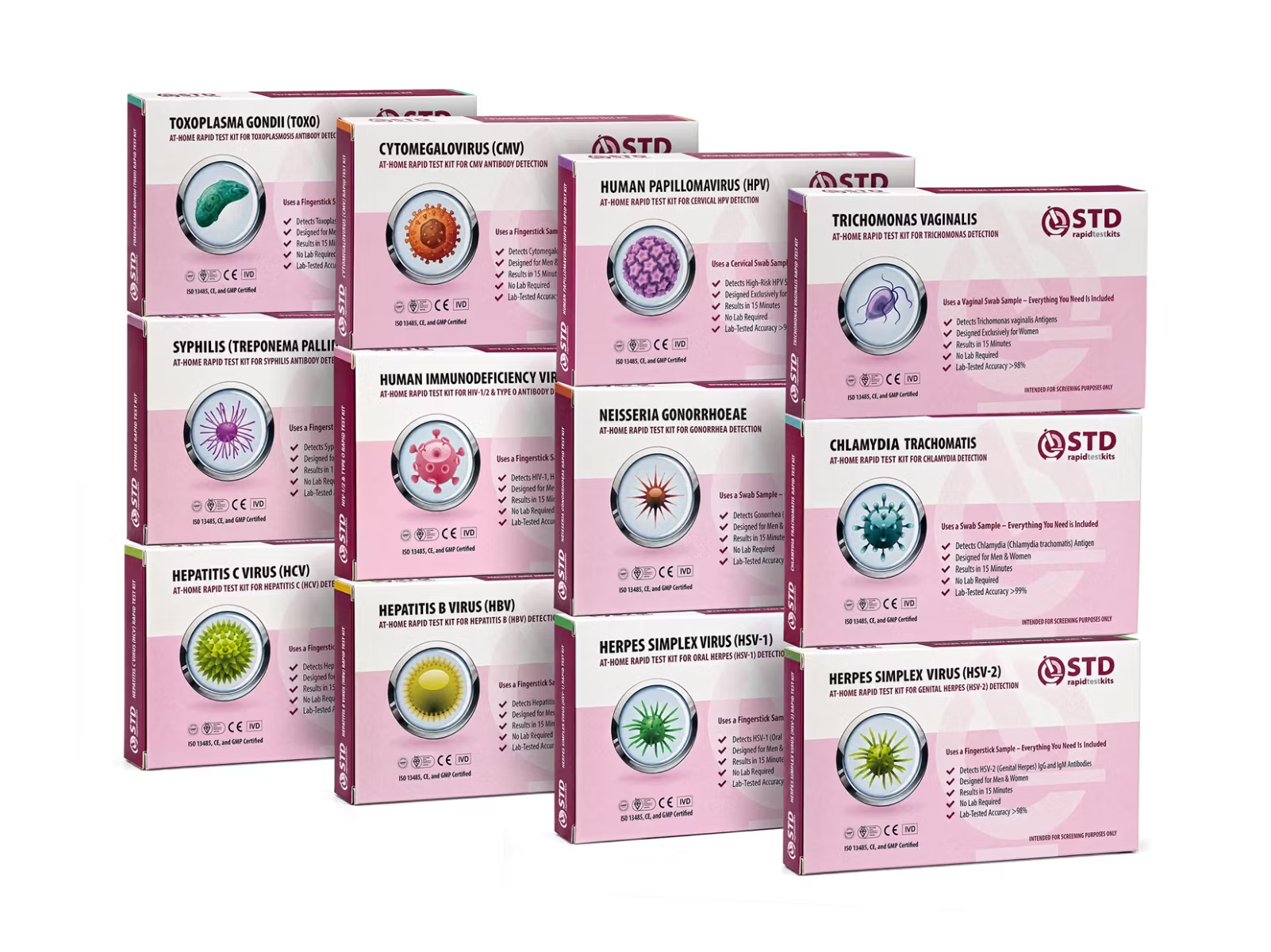
For women whose main barrier is the clinic visit itself (the time, the EOB paperwork, the chance of seeing someone you know in the waiting area), an at-home multi-panel kit covers the screens most commonly needed in a single shipment. The 10-in-1 panel below is validated for female anatomy and bundles the four self-swab tests with the six blood tests, so you get a full picture from one order. Results read at home in about 15 minutes for the rapid components. Any positive result is worth confirming at a clinic before starting treatment.
Note: the product links in this article go to our own at-home test kits. We recommend kits that fit the specific reader concerns the article covers, not based on commercial benefit.
What happens if you test positive
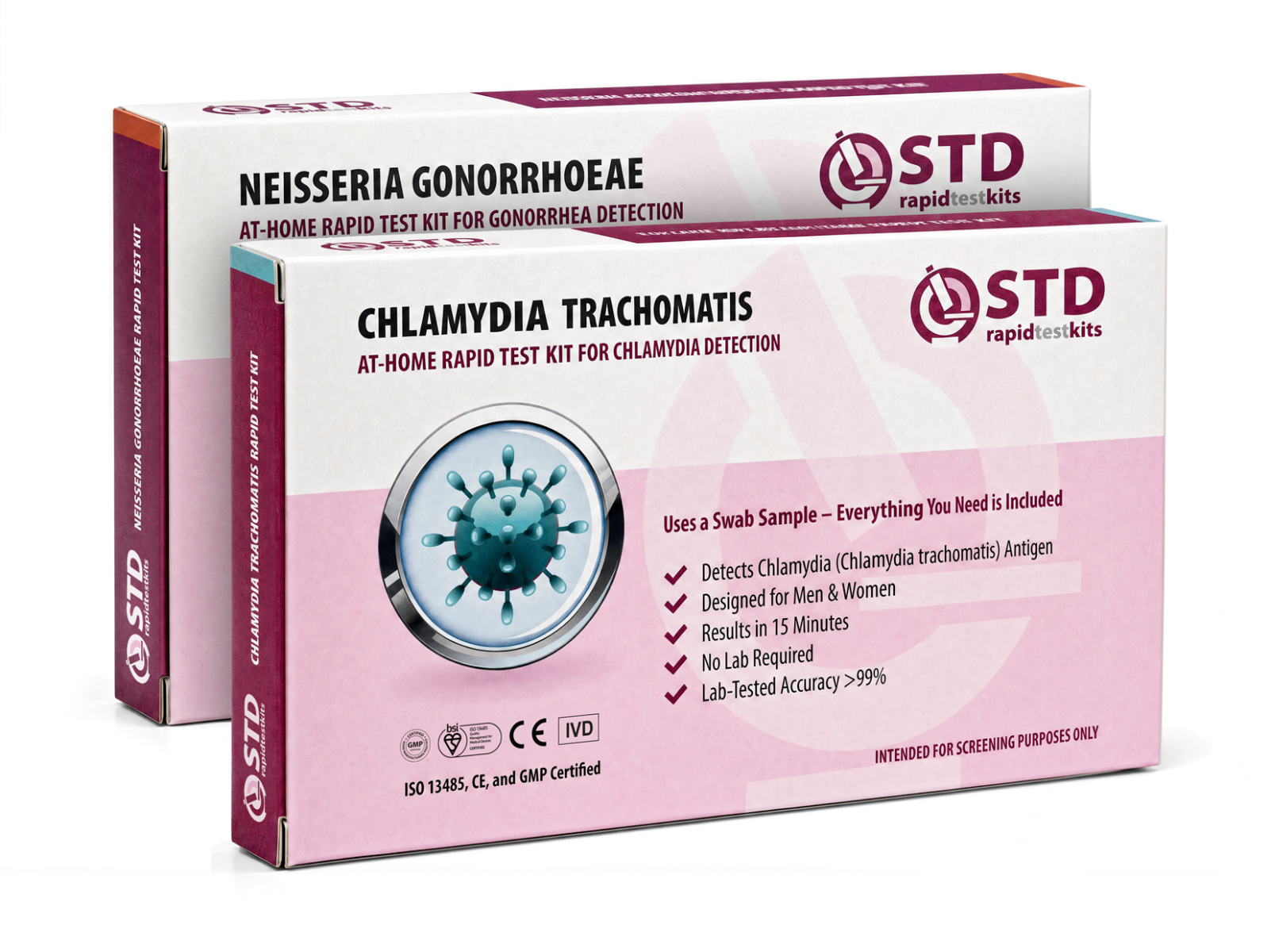
The first ten minutes after a positive result are usually the hardest part. The treatment itself, in most cases, is short and definitive. Chlamydia, gonorrhea, and trichomoniasis are bacterial or parasitic infections that respond to a one-time or short-course antibiotic. Syphilis is treated with a single intramuscular dose of penicillin in early stages. Herpes and HIV are not curable, though both are managed with daily antiviral medication that keeps the infection suppressed and (in HIV's case) reduces transmission risk to partners to near zero when viral load is undetectable.
In Delaware, expedited partner therapy (EPT) is permitted for chlamydia and gonorrhea. EPT means a clinician can write a prescription for your partner without seeing them in person, so you can hand the prescription off and your partner can fill it at any pharmacy. The CDC supports EPT as a way to interrupt the partner cycle that drives reinfection (CDC EPT clinical guidance).
Telehealth is another option if you'd rather not return to a clinic for treatment. Several services licensed in Delaware will review your test result and issue a prescription that ships to your home pharmacy. Costs are usually flat, around fifty to one hundred dollars for the consult plus the prescription, and the visit is typically same-day.
Treatment by infection
- Chlamydia, gonorrhea, trichomoniasis: short antibiotic course (often a single dose for trich and gonorrhea, one-week course for chlamydia).
- Syphilis: a single intramuscular dose of penicillin in early stages; longer regimens for late-stage disease.
- Genital herpes (HSV-2): daily oral antivirals (acyclovir, valacyclovir, famciclovir) suppress outbreaks and reduce shedding.
- HIV: daily antiretroviral therapy keeps viral load undetectable, which reduces sexual transmission risk to partners to near zero.
Retesting after treatment
Finishing a round of antibiotics is not the same as confirming you are clear. For chlamydia and gonorrhea specifically, the CDC recommends retesting three months after treatment because reinfection from an untreated partner is the most common reason women cycle back into the same infection (CDC STI treatment guidelines). The retest is not a test of cure; the antibiotics work. It catches a new infection from a partner who was not treated at the same time.
Retest in any of these situations, even outside the three-month rule:
- You develop new symptoms in the weeks after treatment
- You resume sex with a partner whose treatment status you cannot verify
- You have sex with a new partner before the three-month mark
- You had any unprotected sex during the treatment week before your partner finished theirs
- Your partner refused to test or be treated (in which case retest at three months regardless, since reinfection from an untreated partner is what drives pelvic inflammatory disease in women)
Talking to partners, even when it is awkward
The conversation that follows a positive result is often what readers dread more than the test itself. Two truths are worth holding onto. First, the most common reaction is not anger; it is relief, because the person on the other side often had the same worry and did not know how to bring it up. Second, you do not have to be eloquent. A factual one-liner does the job: "I tested positive for chlamydia. It is common and treatable, and I wanted to give you the heads-up so you can get tested too."
If the conversation goes sideways (defensiveness, accusations, blame), the cleanest exit is the same factual frame: "This is not about who gave it to whom. It is about both of us getting treated." If the partner is someone you are no longer in contact with, or someone you would rather not contact directly, anonymous notification tools like TellYourPartner.org will send a one-line text or email without naming you.
For partners you are still in a relationship with, the disclosure tends to land better when you also share what you have already done: tested, started treatment, and brought them the next-step path.
Expedited partner therapy is the clinical practice of treating the sex partners of patients diagnosed with chlamydia or gonorrhea by providing prescriptions or medications to the patient to take to his or her partner without the health care provider first examining the partner.
Where at-home rapid tests are strong, and where lab testing is stronger
At-home rapid kits use lateral-flow chemistry: the sample contacts a strip coated with antibodies, and a colored line appears if the target antigen is present. Lab-based screening for the same infections typically uses nucleic acid amplification tests (NAATs), which detect the pathogen's DNA or RNA directly and have higher analytical sensitivity. The two methods are complementary rather than equivalent.
Where at-home rapid tests are strong: privacy, speed (results in 15 to 30 minutes), no clinic visit, no EOB paperwork, and reliable performance when used inside the manufacturer's window-period guidance. Where lab NAAT testing is stronger: very early infections close to the window, very low bacterial-load infections, and pharyngeal or rectal swab samples that home rapid kits do not currently cover. For throat-swab or rectal-swab testing, a clinic visit is the right route; the at-home kits on this site are validated for genital and bloodborne sampling only.
The practical pattern many Delaware women use: an at-home rapid kit for routine screening or after a new partner, then a clinic visit for confirmation of any positive result or for a sample site the at-home kit does not cover.
This article is published by stdrapidtestkits.com, which sells at-home STI testing kits. We do not sell throat-swab or rectal-swab testing; for those sample sites, a clinic visit is the right route. Our HPV and trichomoniasis kits are validated for female anatomy only.
Take the next step on your own terms
The Delaware women who catch infections early are not the ones with the most dramatic symptoms or the most active social lives. They are the ones who screen on a regular cadence and who do not wait for symptoms to "get worse" before they act. Chlamydia and gonorrhea respond to a short antibiotic course. Trichomoniasis is a one-dose cure. Herpes and HIV are managed with daily medication that keeps the infection suppressed.
If you have been putting off a test because of the waiting room, the insurance paperwork, or the worry about who might find out, the at-home rapid panel earlier in this article removes most of that friction. If you would rather have a clinician walk you through it in person, the clinic table lists four well-established locations across the state.
- Want a private, same-day answer at home: see the at-home women's 10-in-1 panel earlier in this article.
- Want a clinician to evaluate a symptom in person: see the clinic directory table above.
- Tested positive recently and finished treatment: set a calendar reminder to retest at three months for chlamydia or gonorrhea.
Frequently asked questions
- Do I really need to get tested if I have no symptoms?
- Annual screening catches infections you cannot feel. Most chlamydia diagnoses in women come from routine screening visits, not symptom appointments, and an unchecked silent infection can quietly cause pelvic inflammatory disease over months or years. Skipping the screen is how women end up with fertility consequences from an infection they never knew they had.
- Will an STI test show up on my insurance record?
- Only if you use insurance. Insurance-billed STI testing typically generates an explanation of benefits (EOB) listing the visit and the test code, and that EOB goes to the policyholder. Out-of-pocket testing at a public-health clinic or an at-home rapid kit does not generate an EOB. You can also ask your insurer about confidential communications, which let you redirect EOBs to a separate address you control.
- How long do at-home rapid tests take to give results?
- Lateral-flow rapid tests typically show a result in 15 to 30 minutes after the sample contacts the test strip. The sample collection itself takes a few minutes. Mail-in lab kits use the same at-home sample collection but you ship the sample to a lab and view results securely online within a few days.
- How accurate are at-home rapid STI tests compared to lab tests?
- Lab-based nucleic acid amplification tests (NAATs) remain the analytical gold standard with the highest sensitivity. At-home rapid lateral-flow tests are reliable when used inside the manufacturer's window-period guidance, with sensitivity and specificity figures published on each product's data sheet. A positive at-home result is worth confirming at a clinic or lab; a negative at-home result inside the proper window period is generally trustworthy but worth retesting if your concern level is high.
- What if I tested too early and got a negative result?
- Retest at the appropriate window period for the specific infection. For chlamydia and gonorrhea, that means 14 days or more after exposure. For HIV with a fourth-generation Ag/Ab test, most people test positive between 18 and 45 days after exposure, with 90 days as the conclusive window for a negative result to stand. For HSV-2 antibody testing, full seroconversion can take 12 to 16 weeks, and a negative result before 12 weeks does not rule infection out.
- Can my partner be treated without their own clinic visit?
- Yes, for chlamydia and gonorrhea. Delaware permits expedited partner therapy (EPT). Your clinician can write a prescription for your partner that they fill at any pharmacy without needing to see a clinician first. This is CDC-endorsed practice for interrupting the partner cycle that drives reinfection.
- Are at-home HPV tests available to women in Delaware?
- Yes. At-home HPV swab kits are validated for vaginal self-collection in women and detect the high-risk HPV strains associated with cervical cancer. An at-home HPV test is a screen, not a substitute for a clinician-performed Pap test, but it is a useful interval check if you are behind on your regular cervical screening. The HPV kits on this site are validated for female anatomy only.
- I am in a long-term relationship. Do I still need to test?
- It depends. If you and your partner both tested at the start of the relationship and have been mutually monogamous since, retesting is optional. If either of you had sex outside the relationship, if either of you skipped baseline testing, or if either of you has a history of an STI that was not fully cleared, an annual screen is still smart. Many women in long-term relationships discover a chlamydia infection that had been silent for years.
This article draws on the CDC's national STI Surveillance system data, CDC clinical guidance on screening, treatment, and expedited partner therapy, and the Office on Women's Health screening recommendations. Where statistics or testing windows are cited, the source is linked inline. The article is editorial summary, not clinical diagnosis. For symptoms that concern you, see a licensed provider.
- U.S. Centers for Disease Control and Prevention. STI Statistics Overview, including national surveillance trends for chlamydia, gonorrhea, and trichomoniasis.
- U.S. Centers for Disease Control and Prevention. STI Surveillance Annual Reports, including the 2024 provisional national year-over-year trend data.
- U.S. Centers for Disease Control and Prevention. Sexually Transmitted Infections Treatment Guidelines, including the three-month retest recommendation after chlamydia or gonorrhea treatment.
- U.S. Centers for Disease Control and Prevention. Expedited Partner Therapy clinical guidance, including state-level legal status and clinical protocols.
- U.S. Centers for Disease Control and Prevention. Trichomoniasis topic page, including clinical presentation and symptom information.
- U.S. Office on Women's Health. Sexually Transmitted Infections, screening recommendations and symptom information for women.
