
Published: October 2025 | Last updated: May 2026 | Editorial review and quality control: Martina N.
Thick, white, clumpy discharge that looks a lot like cottage cheese tends to send people straight to the worst possible conclusions. It's one of the most-searched symptom patterns in sexual health, and most of the time the answer is reassuring: a yeast infection, treatable at home, not sexually transmitted. The catch is that a smaller but meaningful slice of cases look identical and are actually something else, usually chlamydia, gonorrhea, trichomoniasis, or bacterial vaginosis.
This guide walks through how to tell the difference, when to treat at home, when to test, and what timing matters for results that are actually accurate. The goal is not to alarm you. The goal is to help you stop guessing in circles.
Key Takeaways
- Thick, clumpy, odorless discharge with intense itching is most often a yeast infection and usually responds to an over-the-counter antifungal within a few days.
- When itching is mild, when there's a new sexual partner, or when symptoms return after treatment, an at-home STI test is the cleanest way to rule out chlamydia, gonorrhea, or trichomoniasis.
First, what "normal" vaginal discharge actually looks like
Before labeling anything as infection, it helps to ground the conversation in baseline biology. Vaginal discharge changes constantly. Hormones, ovulation, stress, sex, birth control, recent antibiotics, all of these shift texture and volume across a single cycle. Discharge can thicken before a period and turn slippery around ovulation. It can dry white in underwear and look more dramatic on fabric than it ever felt in the body.
Normal discharge is typically white or clear, mildly scented or odorless, and not accompanied by pain, itching, or burning. It can be thick one week and watery the next without anything being wrong. The vagina is self-cleaning, and discharge is part of that process.
Cottage cheese discharge is a more specific pattern. It's clumpy, curd-like, and often sticks to the vaginal walls or shows up as small white flecks in underwear. That texture is what sends most people spiraling, because it doesn't look like anything they've seen during a normal cycle.
Normal discharge varies in texture and volume across the menstrual cycle. A texture change without itching, burning, or odor shift is usually a hormonal response, not a sign of infection.
When it's almost certainly a yeast infection
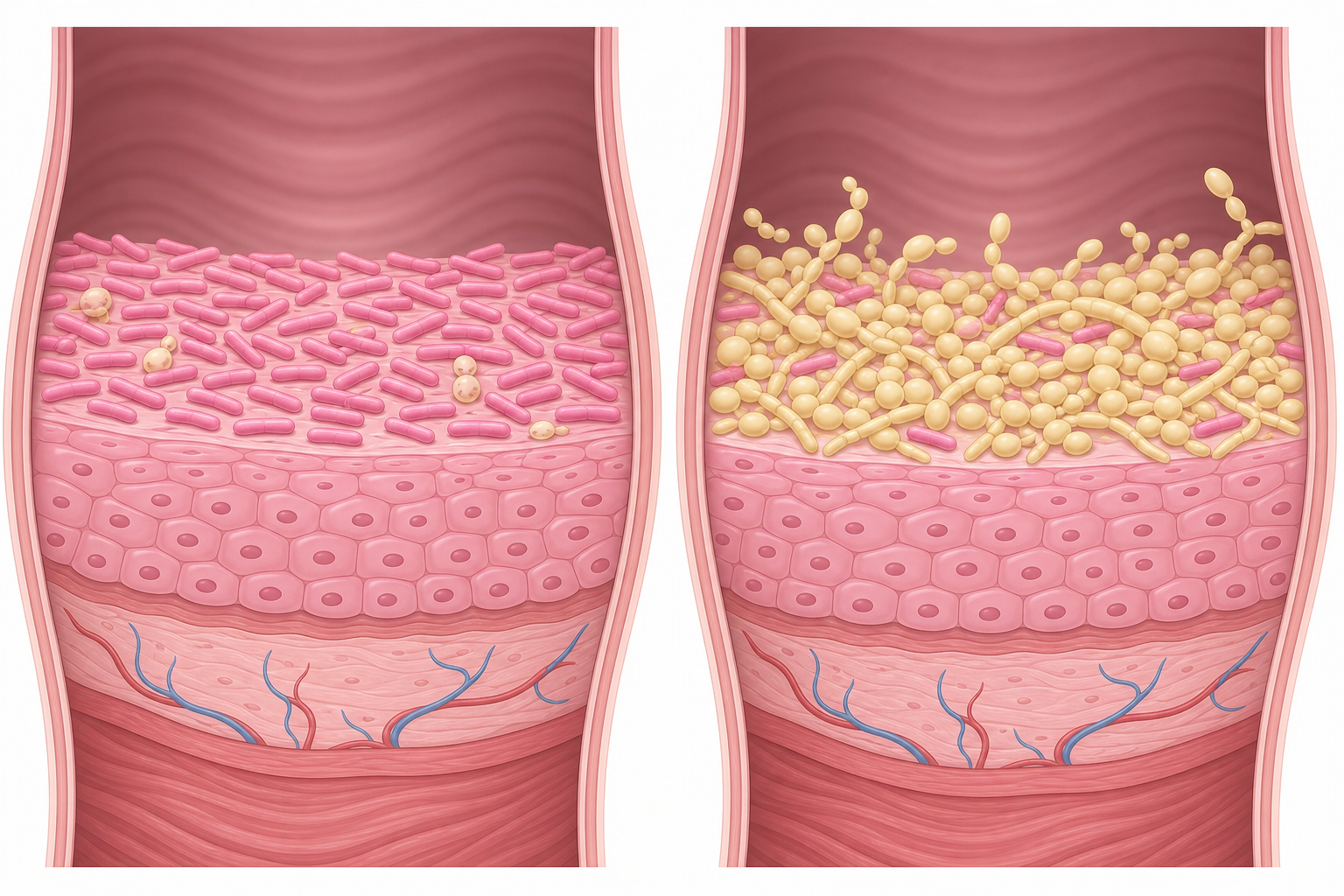
A classic yeast infection, medically called vulvovaginal candidiasis, happens when Candida yeast overgrows in the vagina. It is not a sexually transmitted infection, and it is not a hygiene problem. It's almost always a microbiome imbalance, usually triggered by something that disrupts the normal lactobacillus population. Recent antibiotics, hormonal shifts, tight synthetic underwear, uncontrolled diabetes, and pregnancy are commonly cited triggers, per Mayo Clinic guidance on vaginal yeast infections (mayoclinic.org).
Discharge texture is one data point; the combination of itching, burning, and redness showing up together is what makes yeast recognizable.
| Feature | Typical Yeast Infection Presentation |
|---|---|
| Discharge | Thick, white, clumpy, cottage cheese-like |
| Odor | Usually minimal or absent |
| Itching | Common and often intense |
| Burning | Common, especially during urination or sex |
| External redness or swelling | Frequent on the vulva |
When it's not yeast (even if it looks like it)
Here's the part that makes self-diagnosis tricky: discharge texture alone cannot diagnose anything. Texture helps, smell helps, and the symptoms surrounding the discharge help. But several infections, including some that are sexually transmitted, can produce white or off-white discharge that looks close enough to fool anyone. Sometimes the discharge is thinner, sometimes creamier, sometimes mild enough to ignore.
Chlamydia and gonorrhea are the classic mimics, mostly because they're often quiet. The CDC's chlamydia fact sheet notes that most chlamydia infections in women cause no noticeable symptoms at all, and when they do, discharge can be the main clue. Bacterial vaginosis is the other common cause of white-ish discharge, but its odor profile is usually different.
| Condition | Discharge Texture | Odor | Other Clues |
|---|---|---|---|
| Yeast infection | Thick, clumpy, white | Minimal or none | Intense itching, redness |
| Chlamydia | White, yellowish, or cloudy | Mild | Often no symptoms; possible pelvic pain |
| Gonorrhea | Creamy or pus-like | May have a mild odor | Pelvic pain, bleeding between periods |
| Trichomoniasis | Frothy, yellow-green (sometimes white) | Strong, often unpleasant | Burning, irritation |
| Bacterial vaginosis | Thin, gray-white | Fishy, especially after sex | Minimal itching |
If it's not obvious, how to decide what to do next
This is the moment most people get stuck. The discharge looks like yeast. Maybe there's itching, maybe there isn't. Maybe a recent sexual encounter is bouncing around in the background. Nobody wants to overreact, and nobody wants to miss something important.
A reasonable rule of thumb: if there's intense itching, thick clumpy discharge, no strong odor, and no recent new partner, treating for yeast first is fair. Over-the-counter antifungals (clotrimazole, miconazole, or a single oral fluconazole dose if available) usually deliver noticeable improvement within a few days, per Mayo Clinic guidance on vaginal yeast infections (mayoclinic.org).
If there's minimal itching, pelvic discomfort, bleeding between periods, pain during sex, or a new or untested partner in the last two months, that's when guessing gets risky. That's when testing makes more sense than running another round of antifungal cream. Symptoms returning after a completed course means the cause is still present and needs identification, not another round of the same treatment.
Timing matters more than texture
Here's something most people don't realize: sexually transmitted infections don't show up on tests immediately. Discharge can already be present while a test still reads negative, because the body hasn't produced enough detectable bacterial DNA or antigen yet. This gap between exposure and reliable detection is called the window period.
The window varies by infection and by test type. Lab NAAT tests for chlamydia and gonorrhea can become reliable in the second week after exposure, while at-home rapid lateral-flow tests typically work best closer to the optimal end of that window. Trichomoniasis testing windows are similar but a touch longer. Yeast and bacterial vaginosis don't have a window period in the same sense, because they're diagnosed from current symptoms or a current swab rather than from antibody or antigen response.
| Infection | Earliest Testing Window | Optimal Testing Window |
|---|---|---|
| Chlamydia | About 7 days after exposure | 14 days after exposure |
| Gonorrhea | About 7 days after exposure | 14 days after exposure |
| Trichomoniasis | 5 to 7 days after exposure | 2 to 4 weeks after exposure |
| Yeast infection | No window period | Diagnosed from current symptoms or swab |
| Bacterial vaginosis | No window period | Diagnosed from current symptoms or exam |
Note: stdrapidtestkits.com sells rapid at-home lateral-flow test kits; the panel below is one option for ruling out common STIs at home. We recommend kits based on fit-for-purpose for the reader's concern, not commercial benefit.
When discharge shows up right after sex
White discharge in the hours after sex is one of the most anxiety-inducing situations, partly because the timing feels accusatory. Semen mixing with natural lubrication can temporarily look thick and white, and that residue can stick around for a day or so without meaning anything beyond "sex happened." That alone is not infection.
The picture changes if the discharge keeps coming for several days, thickens, develops a different smell, or pairs up with itching, pelvic pain, or pain on urination. At that point the body is reacting to something more than residual fluid. Yeast overgrowth is one possibility, especially after sex with a new lubricant or condom material, but bacterial or sexually transmitted infections share that timeline too.
Recent antibiotics are another big trigger to keep in mind. If a course of antibiotics for something unrelated wrapped up in the last couple of weeks and cottage cheese discharge appeared after that, yeast becomes much more likely as the explanation, because antibiotics reduce the protective Lactobacillus population.
What about pregnancy discharge?
Early pregnancy can cause noticeably thicker white discharge, a phenomenon called leukorrhea. It's usually smooth or milky rather than clumpy, and it doesn't cause itching or burning. Rising estrogen increases blood flow to vaginal tissue and ramps up cervical mucus production, which thickens what shows up day to day.
Pregnancy discharge does not typically look like curds, though. If the texture is genuinely cottage cheese and itching is part of the picture, yeast is still more likely than pregnancy alone, even during a confirmed pregnancy. If pregnancy is possible and hasn't been confirmed, a home pregnancy test gives a faster answer than guessing.
Pregnant people are at higher risk for yeast infections because of the hormone shifts that come with pregnancy. Cottage cheese discharge during pregnancy is more often yeast than anything more serious, but treatment options change once pregnant, so it's worth confirming with a clinician rather than self-treating.
When discharge keeps coming back
Recurrent discharge is one of the clearest signals that something deeper might be happening. If a yeast course finishes, symptoms ease for a week or two, and then everything returns, that's worth pausing on before assuming the body is just being moody.
Recurring discharge usually points to one of a small handful of explanations. Incomplete treatment is the most common: stopping antifungal cream as soon as itching eases instead of finishing the full course. Resistant Candida strains (less common but real) need a prescription antifungal that an over-the-counter cream won't touch. Bacterial vaginosis can cycle in and out on its own pattern. And an untreated bacterial STI that was misidentified as yeast won't respond to antifungals at all, no matter how many rounds get used. Reinfection from an untreated partner is the quiet driver behind many "why won't this go away" stories.
| Possible Cause | Why It Happens | What To Do |
|---|---|---|
| Incomplete yeast treatment | Medication stopped too early when itching eased | Complete the full course; consult a clinician if it returns |
| Resistant yeast strain | Less common Candida species | Prescription antifungal may be needed |
| Bacterial vaginosis | Microbiome imbalance, not fungal | Requires antibiotic, not antifungal |
| Chlamydia or gonorrhea | Untreated bacterial STI misread as yeast | Test, treat both partners with antibiotics |
| Reinfection from a partner | Partner not treated alongside | Both partners test and treat at the same time |
The itching factor (and what it means when itching is missing)
Itching deserves its own moment, because this detail carries more diagnostic weight than discharge texture does. Yeast infections are inflammatory, and the immune system reacts strongly to Candida overgrowth, which is what makes the itching feel relentless rather than mild. "Yeast itchy" is the kind of itch that interrupts sleep and concentration, not the kind that's easy to ignore.
STIs like chlamydia and gonorrhea often cause discharge without significant itching, per the CDC's gonorrhea fact sheet. There may be mild irritation or a dull pelvic ache, but the dramatic, sit-still-and-still-want-to-scratch sensation is much more typical of yeast.
Thick white discharge without strong itching lives in the most ambiguous gray area. Sometimes hormonal shifts produce thicker cervical mucus around a period or in early pregnancy, and that's usually creamy rather than clumpy and comes with no redness or burning. But if the discharge is clearly abnormal compared to a personal baseline (different texture, different volume, persistent rather than cycling with the period), testing is the cleanest way to settle the question instead of running through another round of antifungal cream and hoping.

If you test positive, or if it's "just" yeast
It's worth talking about the two endings people quietly fear before they test.
If a test confirms yeast, that's confirmation, not a failure. Treating the full course matters even when symptoms ease after a couple of days, because stopping early is one of the main reasons yeast comes back. Harsh soaps, douching, and "vaginal detox" trends tend to inflame the tissue further rather than help, so the cleanest support is plain water externally and giving the microbiome time to rebalance. Probiotics with Lactobacillus strains are reasonable to try, though the evidence on cure rate is mixed.
If a test comes back positive for chlamydia or gonorrhea, the path is straightforward. Both are common, both are curable, and both are treated with a short antibiotic course. The bigger issue is partner notification and treatment, because reinfection happens far more often than people expect when one partner gets treated alone. The WHO fact sheet on sexually transmitted infections notes that treating sexual partners at the same time is a key component of interrupting STI transmission and preventing reinfection.
If everything comes back negative but discharge continues, that's not anxiety being dramatic. At that point a clinician can check vaginal pH, culture for resistant Candida strains, and distinguish bacterial vaginosis from product irritation with a swab. Sometimes clarity needs one more layer of investigation.
Most women with chlamydia have no symptoms. If symptoms do occur, they may include abnormal vaginal discharge or a burning sensation when urinating.
Before you spiral, here's the clean plan
Staring at thick white discharge and trying to decode it like it's a crime scene rarely helps. The honest probability map looks like this: most cottage cheese discharge is yeast. A meaningful slice is simple microbiome shift, hormonal change, or post-sex residue. A smaller percentage is a bacterial or sexually transmitted infection. The category that causes real harm is the one that goes untreated because someone was too uncomfortable to check.
If the symptoms are classically yeast (intense itching, clumpy white discharge, no odor, no recent new partner), an over-the-counter antifungal is reasonable as a first step. If the picture is unclear, recurring, or tied to new sexual exposure, testing is smarter than repeating antifungals on hope. If discharge continues despite finishing a full antifungal course, the next step is a clinician swab to identify what's actually driving the symptoms.
Anxiety around sexual health is common, and it doesn't have to drive the decision. Discreet at-home testing options are available at STD Rapid Test Kits. For readers whose main concern is unclear discharge specifically, a combination panel that screens for the common infections behind abnormal discharge tends to give the cleanest answer in one round.
FAQs
- If discharge looks exactly like cottage cheese, is it always yeast?
- Most of the time, yes, especially with intense itching. But bodies are not always textbook. When itching is mild, when there's been recent sexual exposure, or when symptoms don't clear with antifungal treatment, that's the cue to confirm with testing rather than assume.
- How intense is "yeast itchy" supposed to be?
- Classic yeast itching is severe enough to break concentration during the day. Discharge present with only mild or absent itching tips probability away from yeast (though it does not rule it out).
- If yeast treatment helps for a few days and then symptoms return, was it yeast?
- Not necessarily. When an antifungal reduces inflammation temporarily but does not clear the root cause, symptoms return as soon as the underlying conditions allow. That recurring pattern (ease, then relapse) is the clearest prompt to run an STI or bacterial vaginosis test rather than repeat the antifungal course.
- Can chlamydia cause white discharge with no other symptoms?
- Yes. Per the CDC, most chlamydia infections in women have no symptoms at all, and when they do, abnormal discharge or mild pelvic discomfort can be the only sign. That's why a discharge change in the context of new or untested partners is worth testing for, not just treating.
- What if there's discharge but no smell at all?
- Odor helps narrow things but isn't conclusive. Yeast usually has minimal or no odor. Bacterial vaginosis classically has a fishy smell. Some STIs have little to no scent. If discharge feels abnormal compared to a personal baseline, that observation itself is worth acting on.
- Could this just be cycle-related?
- Possibly. Discharge can thicken before a period, become stretchy around ovulation, and turn creamy in early pregnancy. The key difference from yeast or infection is that hormonal discharge usually doesn't itch, burn, or hurt. Texture without inflammatory symptoms generally points to normal cycle variance.
- Can a partner give someone a yeast infection?
- Yeast isn't classified as a sexually transmitted infection, but sexual activity can shift vaginal pH and microbiome balance enough to trigger overgrowth. Direct transmission is rare; indirect triggering happens more often. New lubricants, condom materials, or even semen exposure can tip a borderline microbiome into a full yeast episode.
- If an STI test is negative, does that mean yeast?
- Not automatically. A negative STI test narrows the field but doesn't end the conversation. Bacterial vaginosis, hormonal shifts, irritation from new products, and friction from sex are all possible explanations. If discharge continues after a clear STI result, a clinician swab can sort out what's actually happening.
How we sourced this article: This guide is built from current public-health guidance from the CDC, WHO, and Mayo Clinic, combined with peer-reviewed reference material on vaginal microbiome biology and STI symptom overlap. We compared discharge-pattern descriptions, treatment timing recommendations, and testing window guidance across these sources, and translated them into plain-English action items for at-home decision-making. This article is editorial summary, not clinical advice. For symptoms that concern you, see a licensed provider.
- U.S. Centers for Disease Control and Prevention. Chlamydia basic fact sheet covering symptom patterns, asymptomatic prevalence in women, and screening guidance.
- U.S. Centers for Disease Control and Prevention. Gonorrhea fact sheet covering symptom presentation in women and treatment guidance.
- U.S. Centers for Disease Control and Prevention. Trichomoniasis fact sheet covering discharge characteristics and partner-testing guidance.
- U.S. Centers for Disease Control and Prevention. Bacterial vaginosis basic fact sheet covering symptom differentiation from yeast and STIs.
- Mayo Clinic. Root-domain reference for vaginal yeast infection overview, including symptom presentation, common triggers, and over-the-counter treatment expectations.
- World Health Organization. Sexually transmitted infections fact sheet covering global epidemiology, symptom patterns, and the role of partner treatment in interrupting transmission.
