
Published: August 2025 | Last updated: May 2026 | Editorial review and quality control: Martina N.
A sore shows up somewhere it never showed up before. You felt fine yesterday. Today there is a stinging spot on your lip, or a tender bump on your genitals, and the same word keeps surfacing in your head: herpes. Before you spiral, here is the part most explainers skip. Cold sores and genital herpes come from the same virus family, herpes simplex virus, and that family has two members: HSV-1 and HSV-2. Either one can show up on either site. Location changes the label, not the virus.
This guide breaks down what each presentation actually looks like, why a cold sore on your own lip cannot migrate down your body on its own, how oral sex moves HSV-1 onto the genitals, and when an at-home blood antibody test is the right tool versus when a clinic swab is. The goal is calm clarity, not a scare.
Key Takeaways
- Both HSV-1 and HSV-2 can infect the mouth or the genitals; the virus type does not match the body site one-to-one.
- If you want to test, swab a fresh sore within days of symptoms, or use a blood antibody test 6 to 12 weeks after exposure for reliable results.
This Is Where People Get Confused
Most of us learned the simple version: cold sores are HSV-1, genital herpes is HSV-2. That is true on average, but the lines blur quickly in real life. The U.S. Centers for Disease Control and Prevention is direct about it: both HSV-1 and HSV-2 can infect the mouth or the genitals (CDC, About Genital Herpes).
That matters because oral sex is common, HSV-1 is even more common, and the virus does not care which body part it lands on. The World Health Organization estimates that roughly 3.8 billion people under age 50 carry HSV-1 globally, and about 520 million people aged 15 to 49 carry HSV-2 (WHO Herpes simplex virus fact sheet). Many of the people in those numbers do not know they are carriers, because most HSV infections are mild or completely silent.
So when a sore appears in a new place, the panic is understandable, but the math is not unusual. Plenty of new genital herpes cases in younger adults are now caused by HSV-1 transmitted through oral sex, not by HSV-2 (CDC STI Treatment Guidelines, Genital Herpes).
Either HSV type can live in either site. The location of the sore determines whether you call it a cold sore or genital herpes; the underlying virus type (HSV-1 or HSV-2) is a separate question, answered by a test rather than by where the sore appears.
What a Cold Sore and Genital Herpes Actually Look Like
Visually, oral and genital herpes can look strikingly similar. The difference is location and the surrounding skin or mucosa, not the virus itself. Both start as a tingling or burning sensation, then form small fluid-filled blisters that break open into shallow ulcers, then crust and heal. A typical cold sore usually resolves in about a week to ten days; a first genital outbreak commonly takes 2 to 4 weeks to heal (CDC STI Treatment Guidelines, Genital Herpes).
Self-diagnosis from a single photo is unreliable, which is why so many people land on Google searches like "pimple or herpes sore" or "herpes without blisters" at 2 a.m. The table below summarizes the most useful comparison points. (One small piece of vocabulary first: the "vermillion border" is the coloured edge of the lip, where lip tissue meets normal facial skin.)
| Feature | Typical Cold Sore (Oral HSV) | Genital Herpes (HSV-1 or HSV-2) |
|---|---|---|
| Location | Lips, vermillion border, sometimes inside mouth or near nose | Penis, vulva, vagina, perineum, anus, buttocks, inner thighs |
| Appearance | Small fluid-filled blisters in a cluster that crust over | Clusters of small blisters, shallow round ulcers, or paper-cut-like splits |
| Early sensation | Tingling, itching, or burning 12 to 24 hours before the blister | Itching, tingling, burning, or sharp pain in one spot |
| Healing time | About 7 to 10 days | 2 to 4 weeks for a first outbreak; days for recurrences |
| First-outbreak severity | Often mild and local | Can include fever, body aches, and tender groin lymph nodes |
What These Outbreaks Look Like in Real Clinical Photos
The figures below are clinical reference images of the patterns described above, plus the two most common differential diagnoses people mistake for genital herpes. Looking at images alone is not a diagnosis, but knowing the pattern helps you decide when to test versus when to wait it out.
Can a Cold Sore Turn Into Genital Herpes?
This is one of the most-googled myths in the entire HSV conversation, so it is worth answering directly. Your own cold sore on your own lip will not migrate down your body and become genital herpes on its own. The virus stays anchored in the nerve ganglia near where it first established. Recurrent cold sores come back to roughly the same spot, not somewhere new.
What can happen is transmission to a partner. If a person with oral HSV-1 performs oral sex on a partner, the virus can transfer onto the partner's genital skin and establish a genital infection. That infection is called genital herpes even though the virus type is HSV-1. The CDC notes that this route of transmission is now responsible for a meaningful share of new genital HSV-1 cases (CDC STI Treatment Guidelines).
And the part that catches people off guard: HSV can shed and transmit even when no visible sore is present. This is called asymptomatic viral shedding, and it is one of the main reasons people sometimes test positive after a partner who "never had anything" (WHO Herpes simplex virus fact sheet).
Most unexpected transmissions between partners happen during periods of asymptomatic viral shedding rather than during a visible outbreak. "They did not have a sore that night" is compatible with transmission. Daily antiviral therapy and condom use reduce this risk but do not bring it to zero.
Timing Matters More Than You Think
If you are wondering how long after exposure herpes shows up, the honest answer is that the window varies widely between people. The CDC describes first-outbreak symptoms as appearing within the first couple of weeks after exposure for those who develop noticeable signs, while many people never get a recognisable first outbreak at all (CDC, About Genital Herpes). Some people develop symptoms only several weeks later, and others stay symptom-free for years.
Testing follows a separate clock. A swab taken from a fresh sore can detect the virus directly in the first few days of an outbreak. Blood antibody tests need time, because the immune system has to produce detectable antibodies before the test can find them. The table below lays out the timeline.
| Stage | What is happening in the body | What testing makes sense |
|---|---|---|
| 0 to 2 days after exposure | Virus replicating silently at the entry site | Too early for any reliable test |
| First couple of weeks after exposure | Possible first outbreak symptoms appear | Clinic swab of an active sore is the most direct |
| 3 to 6 weeks after exposure | Antibodies developing in many people | Blood antibody test may begin to detect HSV |
| 6 to 12 weeks after exposure | Antibodies reliably detectable in most | Blood antibody test most accurate window |
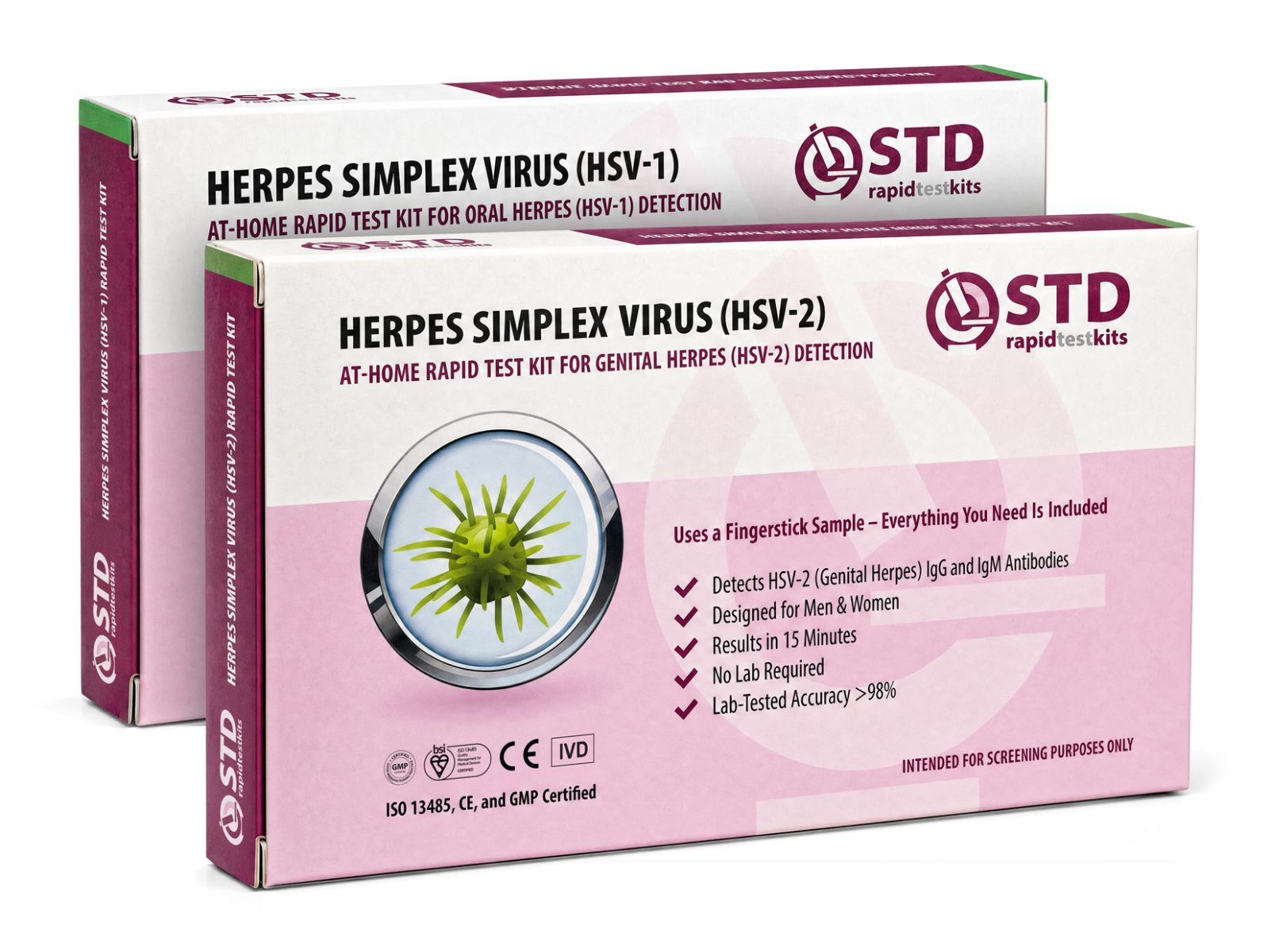
This guide is published by stdrapidtestkits.com, which sells at-home STI testing kits. We recommend products based on what genuinely fits your concern, not on what we want to sell. For an active genital sore, the most direct answer is a clinic swab; an at-home blood antibody test makes sense after the right window period or if you cannot get to a clinic.
HSV-1 vs HSV-2 on the Genitals: Does the Type Change Anything?
When people learn they have genital herpes, the next question is almost always: is it HSV-1 or HSV-2? Underneath that question is fear about outbreak frequency, relationships, and how long this is going to follow them.
Both types can live on the genitals. The practical difference is recurrence pattern. Genital HSV-1 typically recurs less often than genital HSV-2; many people with genital HSV-1 have one noticeable outbreak and very few, if any, after that. HSV-2 tends to reactivate more frequently, especially in the first year, with recurrence rates that decrease over time (CDC STI Treatment Guidelines, Genital Herpes).
Averages are not destiny. Some people with HSV-2 rarely have outbreaks; some with HSV-1 have more than expected. Stress, sleep, and overall immune health all influence how often the virus reactivates. There is no moral hierarchy between the two types.
| Feature | Genital HSV-1 | Genital HSV-2 |
|---|---|---|
| Typical route of acquisition | Oral sex from a partner with oral HSV-1 | Genital-to-genital contact with an infected partner |
| First-year recurrence frequency | Often one outbreak, sometimes none after the first | Several recurrences in the first year is common |
| Long-term recurrence trend | Tends to fade further over time | Tends to decrease over years, often still present |
| Severity of typical recurrence | Usually mild and short | Usually mild and short, but more frequent |
When It Is Probably Not Herpes
Not every genital sore is herpes. Friction burns, ingrown hairs, contact dermatitis, yeast infections, bacterial folliculitis, and allergic reactions can all mimic the early sensation of an outbreak.
A single bump with a visible coiled hair in the center is usually an ingrown hair. A diffuse, evenly itchy rash that started after a new soap or detergent is more likely contact irritation. Thick discharge with internal itching but no surface ulcers leans toward yeast.
Herpes sores tend to evolve through a recognizable arc: tingling, then a small cluster of fluid-filled blisters, then shallow ulcers, then crusts, then healing. A static bump that does not change over a week is much less likely to be herpes. If something has not resolved within 10 to 14 days, worsens, or recurs in the same spot, it is worth getting tested rather than guessing.
Ingrown hair: single bump, visible trapped hair, does not cluster. Contact dermatitis: diffuse pink patch, fine scaling, fades into normal skin, started after a new soap or detergent. Yeast infection: thick discharge with internal itching, usually no surface ulcers. Bacterial folliculitis: multiple small pustules around hair follicles. Herpes: a cluster of small blisters that evolves into shallow ulcers within a few days.
The Quiet Presentations: Herpes Without Obvious Blisters
This is where confusion spikes the most. The internet shows worst-case photos of angry clusters and severe ulceration, but real first outbreaks often look quieter. Some people notice only a small split in the skin that feels like a paper cut. Others describe mild itching they chalk up to friction, or tender lymph nodes in the groin without anything visible at all.
That is why searches like "herpes without blisters" and "can you have genital herpes and not know" are so common. The CDC estimates that the majority of people with genital HSV-2 are unaware of their infection because symptoms are mild or unrecognized (CDC, About Genital Herpes). And because the virus can shed without obvious sores, transmission can happen during what feels like a totally symptom-free stretch.
When to Test, and What Kind of Test Makes Sense
If you currently have a sore, a clinician swab from the lesion is the gold standard for immediate confirmation. Swabs detect the virus directly and do not have to wait for the immune system to catch up. If your local clinic offers PCR or NAAT swab testing, that is the most sensitive option for an active outbreak (CDC STI Treatment Guidelines).
If the sore has healed, or you never noticed one but you want to know your status, a blood antibody test is the right tool. The catch is timing. Testing too early can produce a false negative because antibodies have not built up yet. CDC clinical guidance recommends giving the immune system several weeks to produce detectable antibodies; most labs treat a result at 6 to 12 weeks after exposure as the most reliable timing (CDC STI Treatment Guidelines).
Home antibody tests trade some sensitivity for privacy and access. They are useful for people who cannot get to a clinic, for whom waiting rooms feel unsafe, or who simply want a baseline before deciding whether to escalate. They are screening tools, not absolute answers; a positive home result is worth confirming with a clinician, and a negative early in the window may need to be repeated.
Active sore on your body right now: get a clinic swab in the first few days, before it crusts. No sore, but a recent possible exposure: wait until 6 to 12 weeks after that exposure, then take a blood antibody test (clinic or at-home).
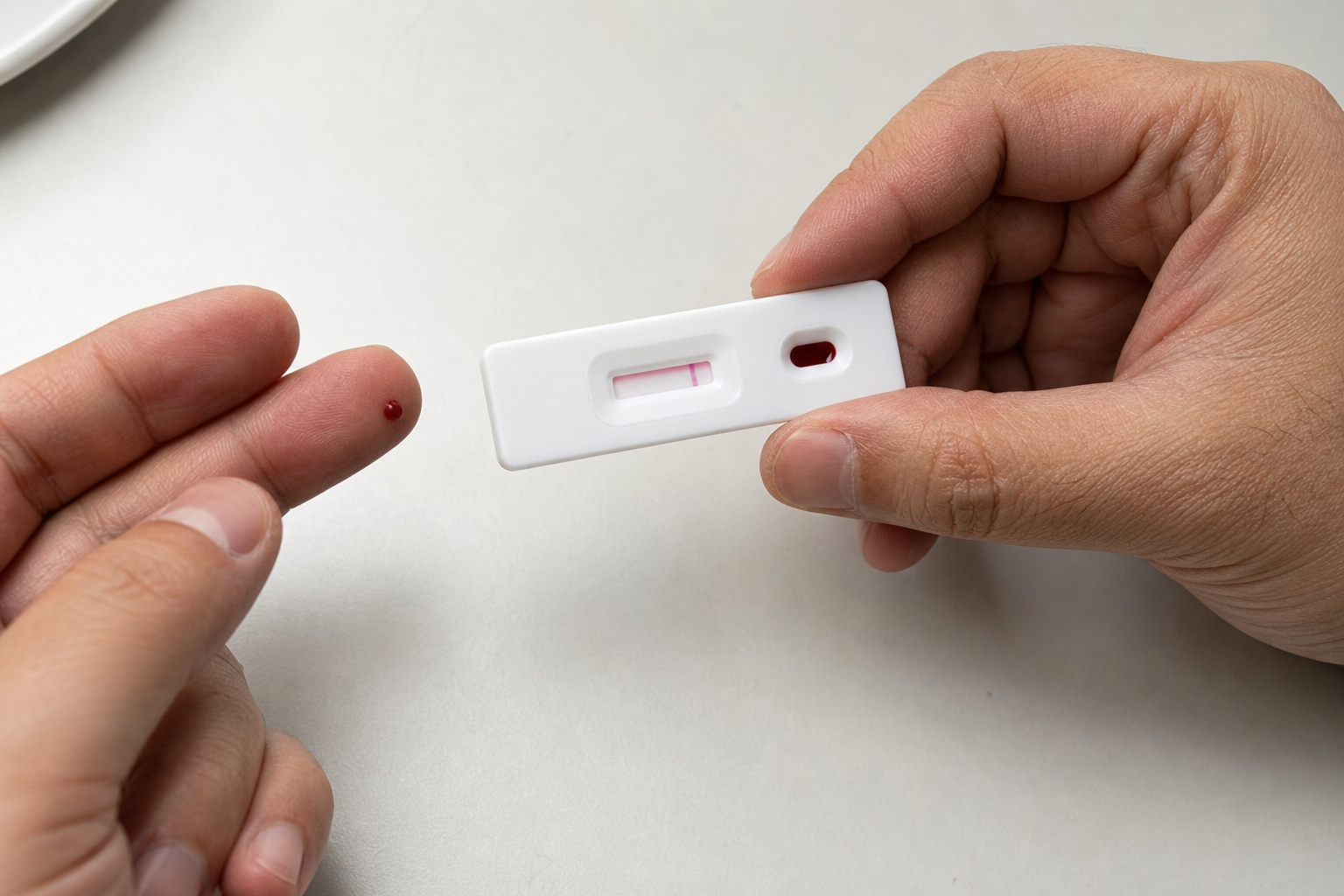
An at-home blood antibody test is more accessible than many people realize. The kit collects a few drops of blood from a fingerstick lancet, drops the sample onto a small test cassette, and adds a buffer solution. Results read in about 15 minutes. The whole process is private, requires no clinic visit, and can be done at a time that suits your schedule. For a screening starting point in someone who is past the 6 to 12 week window, this is a low-friction way to find out where you stand.
Telling a Partner Without Melting Down
Disclosure is often scarier than the diagnosis. The grounding fact is that herpes is extremely common. WHO estimates put global HSV-1 prevalence in the billions; many adults already carry it (WHO Herpes simplex virus fact sheet). Most partners are far more receptive than people fear.
A calm disclosure does not need a script, but it can sound something like this:
"I found out I carry HSV. It is manageable and very common. I wanted to talk with you about it openly so we can make decisions together."
That is enough. No apology, no shame spiral, just information. Antiviral therapy and condom use significantly reduce transmission risk, and open communication beats silent worry every time.
Many people who have genital herpes do not know they have it. Symptoms can be very mild, and they may go unnoticed or be mistaken for another skin condition.
Reducing Transmission Risk in Real Life
Herpes risk is not binary; it is layered. No single step eliminates it, but stacking measures lowers it substantially.
Condoms reduce the chance of transmission, though not to zero, because the virus can shed from skin not covered by the condom. Daily suppressive antiviral medication reduces both outbreak frequency and the risk of transmission to a partner. Avoiding sexual contact during active outbreaks, and during the prodrome (the tingling or burning that precedes a visible sore), is one of the highest-yield steps a person can take (NHS, Genital herpes).
Many couples navigate years together with one partner positive and the other negative without transmission. The point is not perfection. The point is informed, realistic prevention combined with honest conversation.

Before You Spiral, Read This
If you have made it this far, you are probably somewhere between worried and overwhelmed. The grounded version is short. Cold sores and genital herpes come from the same viral family. Location changes the label, not your worth. HSV-1 can live on the mouth or the genitals; HSV-2 can live on the genitals and sometimes orally. The virus does not define your hygiene, your choices, or your future relationships.
If there is an active sore, a clinic swab gives you the clearest immediate answer. If there is not, a blood antibody test after the appropriate window period offers clarity at home. The most concrete next step you can take right now is to look at your calendar, count weeks from the possible exposure, and pick a test date that lands at 6 to 12 weeks out. Putting that date on the calendar is what ends the loop of what-ifs.
Frequently Asked Questions
- Can a cold sore on my lip really turn into genital herpes?
- Not by itself. Your own lip cold sore stays anchored in the nerves near your mouth and recurs there. What can happen is transfer to a partner: if a person with oral HSV-1 performs oral sex, the virus can establish a genital infection in the partner. That is then called genital herpes even though it is HSV-1.
- I had oral sex last week and now I feel tingling. Should I assume the worst?
- Tingling alone is not a diagnosis, and anxiety can amplify normal sensations. Herpes symptoms typically appear within the first couple of weeks of exposure if they appear at all. If something evolves into a cluster of blisters or shallow ulcers, get a clinic swab while it is fresh. If nothing visible develops, blood antibody testing after 6 to 12 weeks gives the most reliable answer.
- Can I have genital herpes without any blisters?
- Yes. Many infections present as a paper-cut-like split, mild itching, or just tender groin lymph nodes. Some people notice nothing at all. The CDC notes that most people with genital HSV-2 are unaware of their infection. Quiet presentations are common, not unusual.
- Is genital HSV-1 better or worse than genital HSV-2?
- Genital HSV-1 tends to recur less often than genital HSV-2 on average, which many people consider a meaningful difference. Both are manageable. The bigger distinction is usually how the virus was acquired (oral sex vs. genital-to-genital contact) rather than long-term outlook.
- Can someone spread herpes when they have no visible sore?
- Yes. This is called asymptomatic viral shedding and it is one of the main reasons new infections happen between partners who do not realize anyone is infectious. Daily antiviral medication and condom use reduce this risk; they do not eliminate it.
- If I test negative one week after exposure, can I trust that result?
- A blood antibody test taken at one week is too early to be reliable, because the body has not produced detectable antibodies yet. A swab from an active sore at one week can be informative if a sore is present. For a definitive negative without symptoms, retest the blood antibody panel at 6 to 12 weeks after exposure.
- Is genital herpes lifelong?
- Yes, the virus stays in the body once acquired, but lifelong does not mean constant symptoms. Many people experience their worst outbreak first and then have few or no recurrences. Antiviral medications reduce both outbreak frequency and transmission risk for those who want suppressive therapy.
- What is my actual next step right now?
- Look at the facts. Do you have an active sore? If yes, get it swabbed at a clinic within the first few days. No sore but a recent exposure? Note the date; the most reliable blood antibody test window is 6 to 12 weeks later. If you want a discreet at-home blood antibody screen and you are past the early window, a home HSV test can give you a private starting point, with confirmatory clinic testing if anything is positive.
How We Sourced This Article: This guide draws on current public-health guidance from the U.S. Centers for Disease Control and Prevention, the World Health Organization, and the UK National Health Service. Specific claims about transmission routes, incubation timing, testing windows, and recurrence patterns are anchored to CDC About Genital Herpes and the CDC STI Treatment Guidelines, with WHO and NHS pages used where they cover the same point in plainer language. Editorial framing summarizes those public-health sources into plain-English action items; the author is not a clinician, and the content is reviewed for clinical accuracy by a medical doctor before publication.
- U.S. Centers for Disease Control and Prevention. About Genital Herpes: fact sheet covering transmission, symptoms, asymptomatic shedding, and the high share of undiagnosed infections.
- U.S. Centers for Disease Control and Prevention. Sexually Transmitted Infections Treatment Guidelines, Genital Herpes: clinical guidance on diagnostic testing, swab vs. serology timing, recurrence patterns, and the rising share of genital HSV-1.
- World Health Organization. Herpes simplex virus fact sheet: global HSV-1 and HSV-2 prevalence figures and asymptomatic shedding.
- UK National Health Service. Genital herpes: patient-facing guidance on incubation, recurrence, and avoiding sex during prodrome and outbreaks.
- Mayo Clinic. Genital Herpes: symptoms-and-causes overview including incubation period, antibody-test timing, and outbreak duration.
