How Long Can Hepatitis B Stay in Your Body Without Symptoms?
Hepatitis B is famous for moving in quietly. Most people who have it feel completely well, sometimes for decades, while the virus continues to live in the liver. This guide walks through how long it can stay symptom-free, when a test can actually detect it, and what a positive result on a healthy-feeling person means in practice.




- Hepatitis B can stay symptomless for weeks, months, or even decades. The CDC notes that people with chronic Hepatitis B often have no symptoms at all, sometimes for years.
- Reliable detection of HBsAg usually needs 6 to 12 weeks after exposure. A negative test inside that window may need a retest before it’s definitive.
Published: December 2025 | Last updated: May 2026 | Editorial review and quality control: Martina N.
The hardest thing about Hepatitis B is that you can carry it for years and never feel a thing: no fever, no yellow skin, no abdominal pain, just normal life with a virus quietly replicating in your liver. The liver is good at quiet work, and Hepatitis B is good at moving in without making noise. How you feel is a poor guide to what is going on inside it.
This guide breaks down how long Hep B can stay in your body without symptoms, what it’s doing during the silent years, when testing can detect it after a possible exposure, and what a positive result on a feel-fine person means in practice. The goal isn’t to alarm anyone; it’s honest information you can use to make a decision you’d back yourself on later.
How Hepatitis B Operates Quietly in the Body
Hepatitis B virus (HBV) gets into your bloodstream through contact with infected blood, semen, or vaginal fluids. The most common routes are unprotected sex, shared needles, accidental needlestick injuries, unsterile tattoo or piercing equipment, and from birthing parent to baby during delivery. Once in your blood, HBV travels to the liver and starts replicating inside liver cells.
What happens next depends mostly on how old you were when you got infected and how strong your immune response is. The World Health Organization notes that Hepatitis B infection acquired in adulthood leads to chronic hepatitis in fewer than 5% of cases, meaning the great majority of healthy adults clear the virus within six months, sometimes after a noticeable acute illness, sometimes silently. Babies infected at birth and young children clear it much less often, which is why most chronic Hep B globally traces back to perinatal or early-childhood infection.
Chronic Hepatitis B means the virus is still detectable in your blood after six months. From there it can sit in the background, sometimes flaring with a brief immune skirmish, sometimes doing nothing measurable for years. The CDC’s clinical overview of Hepatitis B notes that people with chronic Hepatitis B often have no symptoms at all, sometimes for years, even though the virus can cause serious liver damage in the background. The damage, when it occurs, is slow inflammation that gradually scars liver tissue.

Acute vs Chronic Hepatitis B: What Each One Can Feel Like
Hepatitis B has two clinical phases that look very different from the outside.
An acute infection covers the first six months after exposure. The CDC notes that some people with Hepatitis B have no symptoms or only a mild illness, while others develop fatigue, nausea, low appetite, dark urine, joint pain, or jaundice. Whether you feel sick or not, the immune system is fighting. Most adults clear the infection during this window.
A chronic infection is what we call it when HBV is still present after six months. Some people feel periodic fatigue, mild abdominal discomfort, or joint aches. Many feel nothing at all and only learn they’re carriers from a routine blood test, a pregnancy screening, or a blood donation. Both phases can be silent. The chronic phase is the one that drives long-term liver risk if it goes untreated.
| Phase | Duration | Common Symptoms | Can Be Symptom-Free? | Long-Term Risk |
|---|---|---|---|---|
| Acute Hepatitis B | Up to 6 months | Some people have no symptoms or only mild illness; others have fever, fatigue, nausea, jaundice, or dark urine (CDC) | Yes, often the case | Low if cleared |
| Chronic Hepatitis B | 6 months to lifetime | Often none; sometimes fatigue or mild discomfort | Yes, very common | Progressive liver disease including cirrhosis and hepatocellular carcinoma (WHO Hepatitis B fact sheet) |
How Long Can Hepatitis B Stay Hidden? Real Timelines
There isn’t one number that fits every case, because the timeline depends on whether your immune system clears the virus or it becomes chronic.
For acute infections, the virus is in your system anywhere from a few weeks to about six months. If your body clears it, the virus is gone and you’re left with antibodies that protect against future infection. If it persists past six months, you’ve moved into chronic territory, and the timeline opens up dramatically.
For chronic Hep B, the timeline runs from years to a lifetime. The World Health Organization estimates that 254 million people are living with chronic Hepatitis B globally. In high-prevalence regions, especially parts of sub-Saharan Africa, East Asia, and the Pacific, many were infected at birth and may go their entire adult lives without an obvious symptom. Across U.S. populations, large clinical cohorts show that more than half of newly diagnosed chronic carriers had no recollection of a symptomatic acute illness ever.
The phrase “silent killer” gets used a lot in health writing. It actually fits here. Slow inflammation produces fibrosis (early scarring), which can progress to cirrhosis (extensive permanent scarring), which sharply raises the risk of liver failure and hepatocellular carcinoma, the most common type of liver cancer. The progression from infection to cirrhosis can take 20 to 40 years. People often only find out something is wrong when liver enzymes come back abnormal on a routine blood panel, or when an ultrasound for an unrelated reason picks up a damaged liver.
People with chronic hepatitis B often have no symptoms and may not know they are infected, even though the virus can cause serious liver damage over time.
How long can Hepatitis B stay in your body without symptoms?
For chronic infections, decades, and sometimes a lifetime. The CDC and WHO both note that many adults with chronic Hepatitis B have no symptoms at all, even after years of infection. Reliable detection through HBsAg blood testing usually needs 6 to 12 weeks after exposure, since the body needs time to produce detectable surface antigen and antibodies.
The Window Period: When Can a Test Actually Detect It?
If you had a possible exposure last week and feel fine, it’s reasonable to want a test today. The result you get, though, depends heavily on timing.
The window period is the gap between when the virus enters your body and when a test can reliably detect it. During this window, the virus may be replicating quietly while your blood doesn’t yet carry enough markers to flag.
For Hepatitis B, the standard screening test looks for HBsAg, the surface antigen on the virus’s outer coat. HBsAg can become detectable as early as 1 to 9 weeks after exposure, with most people seroconverting between 4 and 10 weeks. A typical clinical recommendation is to test at 6 weeks for an early read and again at 12 weeks if the first test was negative and the exposure was real.
Clinicians who suspect early acute infection may also order IgM anti-HBc (antibody to hepatitis B core antigen). That marker shows up in early infection and helps confirm an acute case. The full diagnostic panel usually includes HBsAg, anti-HBs (the protective antibody, present after vaccination or recovery), and anti-HBc (which marks past or current infection).
Testing too early often produces a false negative. Home rapid tests are still the right tool for most people with a possible exposure when timed correctly: use them after the window period and plan a follow-up at 12 weeks if the first result was negative.
| Time Since Exposure | What’s Happening in the Body | Test Reliability | Recommended Action |
|---|---|---|---|
| 0 to 4 weeks | HBV replicating; surface antigen often below detection threshold | Low | Wait and retest at 6 weeks |
| 4 to 6 weeks | HBsAg may begin appearing; some early cases detectable | Moderate | Early test useful, retest at 12 weeks if negative |
| 6 to 12 weeks | HBsAg reliably detectable in most acute infections | High | Best practical window for screening |
| 12+ weeks | Acute infection has cleared or progressed to chronic | Very high | Reliable for ruling out infection or confirming chronic carrier status |
Choosing Where to Test if You Feel Fine
Several testing paths work for someone who feels well but has reason to check.
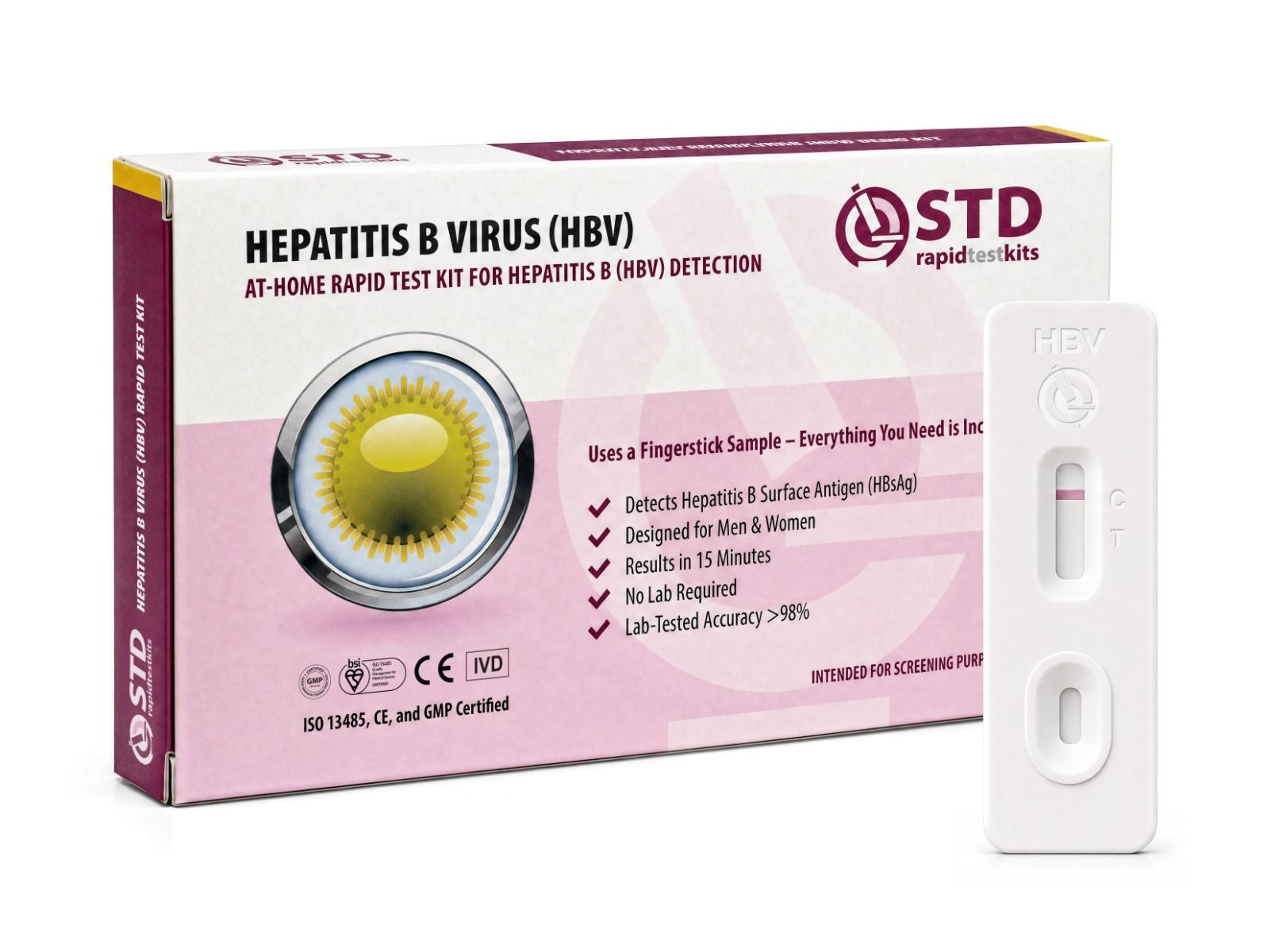
A rapid at-home antigen test detects HBsAg from a small fingerstick blood sample, with a result in about 15 minutes. These tests work well as a first screen once you’ve passed the window period. The chemistry is lateral-flow, the same family as a pregnancy test or a rapid COVID test, calibrated for a different target. Lab tests use more sensitive methods like chemiluminescent immunoassays and PCR, so a positive at-home result should always be confirmed with a full lab panel.
A mail-in lab kit uses a fingerstick or small capillary draw that you ship to a partner lab. You typically get results in two to five days. This route trades immediacy for higher sensitivity and often a fuller panel covering HBsAg, anti-HBs, and anti-HBc.
An in-clinic blood draw gives the most detailed picture. A clinician can order a full HBV panel plus a liver function test, viral load (HBV DNA) where appropriate, and Hep C and HIV at the same time. This is the right path if you’re symptomatic, pregnant, immunocompromised, or being evaluated for treatment.
For someone with a possible exposure who simply wants a private first answer, an at-home rapid Hepatitis B test gives a fast read. We sell that test, and we recommend it when it fits the reader’s actual question rather than as a default.
What Happens If You Test Positive Without Symptoms
A positive HBsAg in a person who feels fine is one of the most common starting points for Hepatitis B diagnosis. The follow-up steps are well-established and worth knowing in advance.
- Confirm with a full lab panel. The clinical workup usually includes HBsAg (to confirm active infection), anti-HBs (to check for protective antibody), anti-HBc and IgM anti-HBc (to estimate whether infection is recent or established), HBeAg and anti-HBe (markers of viral activity and replication), and HBV DNA viral load.
- Get a liver assessment. ALT and AST blood levels show whether the liver is currently inflamed. An ultrasound or transient elastography (FibroScan) can estimate fibrosis. Together these results show whether any scarring has already developed.
- Have a conversation about treatment. Not everyone with chronic Hepatitis B needs antivirals immediately. Treatment decisions consider viral load, ALT levels, liver imaging, age, family history, and other risk factors. Many people are monitored every six months without medication for years before treatment is recommended, if ever.
- Alert close contacts. People who have shared needles, razors, or unprotected sex with you should be tested. Partners who have not been exposed yet can be vaccinated to protect against future risk.
Most chronic Hepatitis B carriers live full, healthy lives with regular monitoring, provided that monitoring actually happens.
Antivirals like tenofovir or entecavir are recommended based on viral load, ALT enzyme levels, and signs of liver fibrosis on imaging. A clinician may monitor a chronic carrier every six months for years before recommending treatment, or may never recommend it at all. Feeling fine does not rule out the need for monitoring; feeling fine also does not automatically mean medication.
When and Why to Retest
Retesting matters in three different scenarios.
If you tested negative inside the window period (less than 6 weeks since possible exposure), the result isn’t yet definitive. Plan to retest at 6 weeks for an early read and again at 12 weeks for confirmation. A negative HBsAg at 12 weeks after a single exposure is highly reliable.
If your test result was unclear, faint, or inconclusive, retest with a fresh kit or move to a lab-based panel. Lateral-flow tests have a small but real rate of indeterminate results from sample handling, expired kits, or borderline antigen levels. A second test resolves most of these.
If you tested positive and started monitoring, retesting becomes part of routine care. People with chronic Hepatitis B typically have liver enzymes checked every 6 months and a viral load test every 6 to 12 months. The follow-up isn’t paranoia; it’s how a clinician spots the difference between an immune-tolerant phase, where the virus is present but doing little harm, and a reactivation that needs treatment.
Vaccination changes the calculus. If you completed the Hep B vaccine series and have documented anti-HBs above 10 mIU/mL, you don’t need routine screening. If you don’t know whether you finished the series, a single anti-HBs blood test answers the question.

Can You Clear Hepatitis B Without Knowing?
Yes. According to the WHO, Hepatitis B infection acquired in adulthood leads to chronic hepatitis in fewer than 5% of cases, which means the great majority of healthy adults clear the virus on their own within six months. Some clear it after a noticeable acute illness. Others clear it silently, never realizing they were infected.
People who cleared the virus develop two specific antibody markers: anti-HBs (the protective antibody, indicating immunity) and anti-HBc (which shows you were infected at some point in the past). On a blood panel, the pattern looks like this: HBsAg negative, anti-HBs positive, anti-HBc positive. That tells the lab you’ve had Hepatitis B and beat it.
There’s a complication worth knowing about. A small subset of people who appear to have cleared HBsAg still have HBV DNA detectable in liver tissue at very low levels. This is called occult Hepatitis B. It rarely causes problems on its own, but it matters in two situations. The first is significant immunosuppression (chemotherapy, organ transplant, certain biologics for autoimmune disease), where occult HBV can reactivate. The second is blood and organ donation screening, which uses sensitive nucleic acid tests for exactly this reason.
For most people who cleared the virus, the practical takeaway is lifelong immunity to Hepatitis B and no need for vaccination.
HBsAg negative + anti-HBs positive + anti-HBc positive = past infection that your immune system cleared, with lifelong protective antibodies in place.
HBsAg negative + anti-HBs positive + anti-HBc negative = vaccinated, never infected.
HBsAg positive = active current infection. Confirm with a full HBV panel and HBV DNA viral load.
Partner Care: Protection Without Panic
If you find out you have Hepatitis B, the natural next question is who to tell and how. There’s no perfect script, but the conversation gets easier when it focuses on protection rather than blame.
Hepatitis B spreads through blood, semen, vaginal fluids, and from birthing parent to baby during delivery. Risk to a current sexual partner is highest if you’ve had unprotected vaginal or anal sex, shared injection equipment, or shared items that draw blood (razors, toothbrushes with bleeding gums). Casual contact, sharing food, hugging, kissing, sneezing, and using the same toilet do not transmit Hep B.
The Hepatitis B vaccine is highly effective and widely available. A partner who hasn’t been exposed yet can complete the three-dose series and be protected from future risk. A partner who may have been exposed should be tested first, then vaccinated if non-immune. The Hepatitis B Foundation publishes patient-facing scripts and disclosure guides if you want a starting point.
Practical scripting: lead with what you know, what you don’t, and what you’d like them to do. Something like, “I just tested positive for Hepatitis B. I don’t know how long I’ve had it, and I’d like you to get tested too. The vaccine works really well if you’re not already immune.” Most people respond to clarity and a clear ask.

The Emotional Weight of an Asymptomatic Diagnosis
Testing positive without symptoms hits differently than testing positive after weeks of feeling unwell. There’s no body confirmation that the result is real. You’re working from one piece of paper that says one thing while everything else feels normal.
A few patterns are worth naming. Some people second-guess every past relationship and try to pinpoint where it came from. That detective work usually leads nowhere because Hepatitis B can stay silent for decades and the source is often unprovable. Some people feel shame, which is a clean thing to feel and a hard thing to feel honestly. Hepatitis B is a virus, not a verdict. Roughly half of all transmissions globally are perinatal, meaning the person had no agency in acquiring it. Most others come from contact in contexts that were considered safe at the time.
What helps, for most people, is moving from “what does this mean about me” to “what do I do next.” Each concrete step gives back a piece of control that the diagnosis itself takes away.
If your provider doesn’t volunteer a referral to a hepatologist or infectious disease specialist, ask. Asymptomatic chronic Hepatitis B benefits from someone who looks at this every day and can spot subtle shifts in liver markers earlier than a generalist might.
- Confirm the result with a full lab HBV panel and HBV DNA viral load.
- Book a liver workup: ALT, AST, plus an ultrasound or FibroScan if your provider recommends it.
- Tell current and recent sexual partners and anyone who has shared blood-contact items with you, and offer them the testing and vaccination options.
- Set a monitoring schedule with your provider, typically every six months for liver enzymes and once or twice a year for viral load.
Frequently Asked Questions
- Can you really have Hepatitis B and feel completely fine?
- Yes. The liver tolerates a lot of inflammation without causing pain, so the virus can replicate and slowly damage liver cells for years while you feel entirely normal. The CDC notes that many adults with chronic Hepatitis B have no symptoms at all, sometimes for years, which is why the only reliable way to know is a blood test.
- How long can Hepatitis B hide in your body?
- Acute infection lasts up to six months. Chronic infection can persist for decades, often a lifetime. Many chronic carriers were infected at birth and only learn their status as adults during a routine blood test, pregnancy screening, or blood donation.
- How soon after exposure can a Hepatitis B test detect it?
- HBsAg, the marker most rapid tests look for, can become detectable 1 to 9 weeks after exposure. Most people are reliably positive by 6 to 12 weeks. A test inside the first 4 weeks can miss an early infection, so a follow-up test is usually recommended.
- Can I still spread Hepatitis B if I have no symptoms?
- Yes. Hepatitis B is contagious during both acute and chronic infection regardless of whether you feel sick. Transmission happens through blood, sexual fluids, and from birthing parent to baby. Vaccination protects partners and household contacts who haven’t been exposed.
- If I test negative once, am I in the clear?
- Only if you tested at least 12 weeks after the most recent possible exposure. A negative test inside the window period needs a follow-up. After 12 weeks, a negative HBsAg result is highly reliable for that exposure event.
- Can Hepatitis B go away on its own?
- In healthy adults, yes, most of the time. The WHO notes that adult-acquired Hepatitis B becomes chronic in fewer than 5% of cases, so the great majority clear the virus within six months. Recovery leaves protective antibodies behind. People infected as infants or young children clear the virus far less often, which is why most chronic Hep B traces back to early-life infection.
- Is there a cure for chronic Hepatitis B?
- Not a complete cure yet. Antiviral medications such as tenofovir and entecavir suppress the virus and protect the liver indefinitely, similar to how HIV medications work. Many chronic carriers live full lives on monitoring alone, with treatment added only when liver markers shift.
- My partner just told me they have Hepatitis B. What do I do?
- Get tested first to establish your baseline. If you’ve completed the Hep B vaccine series, an anti-HBs test confirms whether you’re protected. If you’re not immune and not infected, start the vaccine series promptly. Post-exposure prophylaxis is also an option for recent exposures, and your provider can advise on timing.
Don’t Wait for Symptoms
Hepatitis B doesn’t telegraph itself. It moves in quietly, sometimes stays quiet for years, and only reveals itself through a blood test or, much later, through liver damage that’s harder to walk back.
Testing while you feel fine isn’t being overcautious. It’s the only timing that catches the silent cases, which are the majority of cases. A first test can be a fingerstick at your kitchen table or a clinic visit. Either way, the question it answers is whether this is happening to you right now, which is the only question worth asking.
If you’re due, get the test. If you’re vaccinated and unsure of your immune status, ask your provider for an anti-HBs check. If you’ve had a known exposure, time the test to after the window period and plan a retest at 12 weeks.
Three concrete next steps
- After a known exposure: test at 6 weeks, then again at 12 weeks if the first result is negative.
- After a positive HBsAg result: confirm with a full lab HBV panel, get liver enzymes checked, and book a hepatology or infectious-disease referral.
- Unsure of your vaccine status: ask your provider for an anti-HBs blood test. A level above 10 mIU/mL means you’re protected and don’t need routine HBV screening.
How we sourced this article: We built this guide from the CDC’s clinical overview of Hepatitis B, the CDC’s patient-facing About Hepatitis B page, the World Health Organization’s 2024 Hepatitis B fact sheet, the Hepatitis B Foundation’s patient resources, the Mayo Clinic’s patient summary, and current peer-reviewed literature on chronic Hep B natural history and screening. Where guidance differed across sources, we followed the most recent published recommendation from CDC or WHO.
- U.S. Centers for Disease Control and Prevention. Clinical overview of Hepatitis B, including recommended diagnostic panel composition and asymptomatic chronic infection.
- World Health Organization. Hepatitis B fact sheet, including 2022 global prevalence figures, transmission routes, the under-5% adult chronic-infection rate, and cirrhosis/hepatocellular carcinoma as long-term complications.
- U.S. Centers for Disease Control and Prevention. Hepatitis B basic information for the public, including qualitative description of acute symptom presentation.
- Hepatitis B Foundation. Patient-facing resources on living with chronic Hepatitis B, partner notification, and monitoring schedules.
- Mayo Clinic. Patient-oriented overview of Hepatitis B symptoms, causes, and treatment options for acute and chronic infection.
- U.S. National Library of Medicine, StatPearls. Clinical reference on Hepatitis B virus including window-period detection of HBsAg.