
Published: September 2025 | Last updated: May 2026 | Editorial review and quality control: Martina N.
People usually search this question for one of two reasons: they read something alarming online and want to know if it could really happen, or they had a specific moment with a partner and now they cannot stop replaying it. Both reasons deserve a calm, specific answer rather than a brush-off. The short version is that chlamydia is, in nearly every documented case, sexually transmitted, and the bacterium does not survive long enough on dry skin or under fingernails to behave like a flu virus on a doorknob. The longer version, which is what this article is for, walks through what the bacterium actually does, the narrow scenarios that public-health texts do mention, the symptoms most people miss entirely, and the testing path that puts the worry to rest one way or the other.
Key takeaways
- Genital chlamydia is overwhelmingly transmitted during vaginal, anal, or oral sex. The CDC's chlamydia page does not list fingernails, hand contact, or shared surfaces as routes of genital infection.
- Most chlamydia infections cause no symptoms at all, which is the real reason regular testing matters more than worrying about hygiene-based transmission.
Can you really catch chlamydia from someone's fingernails?
The honest answer: not in any way the public-health literature treats as a meaningful route for genital chlamydia. The U.S. Centers for Disease Control and Prevention is direct on this: "You can get chlamydia by having vaginal, anal, or oral sex without a condom with someone who has the infection," with the only additional route being mother-to-baby transmission during childbirth (CDC, About Chlamydia). The U.K.'s NHS uses similar language: chlamydia spreads through vaginal fluid and semen during unprotected sex (NHS, Chlamydia). Neither agency lists fingernails, hand-to-genital contact in passing, or shared towels as routes that produce real-world cases of genital infection.
So where does the fingernail story come from? It blends two true things into one misleading claim. First, Chlamydia trachomatis can survive briefly outside the body under the right conditions. Second, the same organism causes trachoma, an eye infection that does spread through contaminated fingers and shared cloths in low-hygiene settings. Both facts are real. Neither one means a swipe of someone's nails across your skin will give you a genital infection. Public-health texts treat the leap from brief environmental survival to a real-world genital infection as unsupported.
You can get chlamydia by having vaginal, anal, or oral sex without a condom with someone who has the infection.
How chlamydia actually spreads (the cases that fill the statistics)
The World Health Organization estimated 129 million new chlamydia infections among adults aged 15 to 49 in a single year, making it one of the four most common curable sexually transmitted infections worldwide (WHO, STI fact sheet). Practically every one of those infections traces to direct mucous-membrane contact during sex. The bacterium needs to reach a hospitable tissue surface (the cervix, urethra, rectum, or pharynx) and enter the cells there to establish an infection.
The documented routes are:
- Vaginal sex. The most common route in heterosexual transmission. Cervical and urethral cells are the target tissues.
- Anal sex. Produces rectal infection, which is often silent and missed without site-specific testing.
- Oral sex. Less efficient than vaginal or anal but documented; produces pharyngeal infection that the standard urine nucleic acid amplification test (NAAT) does not detect.
- Mother-to-baby during childbirth. Causes neonatal conjunctivitis or pneumonia in exposed newborns.
- Sharing sex toys without cleaning or covering them between users. Genital secretions ride along on the toy, which acts as a mechanical bridge between mucous membranes.
Across all five routes, fresh secretions from one mucous membrane reach another mucous membrane within a short window.
The narrow scenario where fingers can play a role
There is one carefully bounded scenario that medical microbiology texts do mention. NCBI's Medical Microbiology chapter on Chlamydia notes that "transmission of C. trachomatis from the urogenital tract to the eyes and vice versa occurs via contaminated fingers, towels, or other fomites" (NCBI Bookshelf, Medical Microbiology, Chapter 39). The clinical pattern described there is one infected person carrying the bacterium from their own infected genital site to their own eye, or the reverse, on freshly contaminated fingers. It is a documented mechanism in trachoma-endemic regions and in occasional case reports of inclusion conjunctivitis in adults.
What this does not describe is casual finger-to-skin contact between two people producing a fresh genital infection in the second person. For that, you would need fresh genital secretions on the hand, immediate transfer to a vulnerable mucous membrane on another person, and conditions that keep the bacterium viable in the seconds between. It is not zero, but it is also not the everyday transmission scenario most people imagine when they read "chlamydia from dirty fingernails." If your concern is a sexual encounter that involved hands as well as other contact, focus your testing decision on the sexual contact rather than the incidental hand contact.

Symptoms most people never notice (the real reason testing matters)
Most chlamydia infections cause no noticeable symptoms at all. The CDC's chlamydia page lists the symptoms that do show up (abnormal vaginal discharge, penile discharge, burning during urination, testicular pain, rectal pain, rectal discharge or bleeding) but adds that many infected people have none of them (CDC, About Chlamydia). The NHS gives an even clearer picture of the timing: when symptoms do appear, "they can start from 1 week to several months after infection" (NHS, Chlamydia).
That timing window is why "I feel fine, so I am probably fine" is unreliable. A meaningful share of people walk around with an active infection for months, transmit it during that time without realizing, and only learn about it from a routine screen, a partner notification, or a downstream complication. The mechanical, biological, and statistical reality is that you cannot tell from how you feel today.
Symptoms that should prompt testing sooner rather than later include:
- Unusual discharge from the penis, vagina, or anus.
- A burning or stinging sensation when urinating.
- Pelvic pain in women, or testicular pain or swelling in men.
- Bleeding between periods or after sex.
- Rectal pain, discharge, or bleeding after receptive anal sex.
None of those symptoms are unique to chlamydia. Gonorrhea and trichomoniasis produce similar patterns, and a laboratory test distinguishes one infection from another more reliably than the symptom picture alone.
Early chlamydia infection sits on the surface of cervical or urethral cells, where it rarely triggers the inflammation people associate with visible symptoms. Damage from untreated infection (scarring of the fallopian tubes, blocked sperm transport in men) develops over months or years. That gap between "infection started" and "symptoms force you to act" is the whole reason annual screening exists for sexually active adults under 25 and for older adults with new partners.
When to test, and how the testing window works
The body needs time to build up enough bacterial DNA at the infection site for a test to detect it. For chlamydia, the practical guidance most clinics use is to wait roughly 14 days after the suspected exposure for a urine or swab test to be reliable. Testing earlier than that does not cause harm, but a negative result before day 14 should be repeated rather than trusted. The NHS notes that symptoms, when they appear at all, start anywhere from one week to several months after infection (NHS, Chlamydia), which gives you a sense of how variable the biology is.
The two reliable patterns:
- You had a specific exposure event: wait until day 14 to test, sooner if symptoms develop, and re-test at three months if there is any reason to doubt the first result.
- You are sexually active without a specific concern: annual chlamydia screening is the CDC's standing recommendation for sexually active people under 25 and for older adults with new or multiple partners (CDC, About Chlamydia).
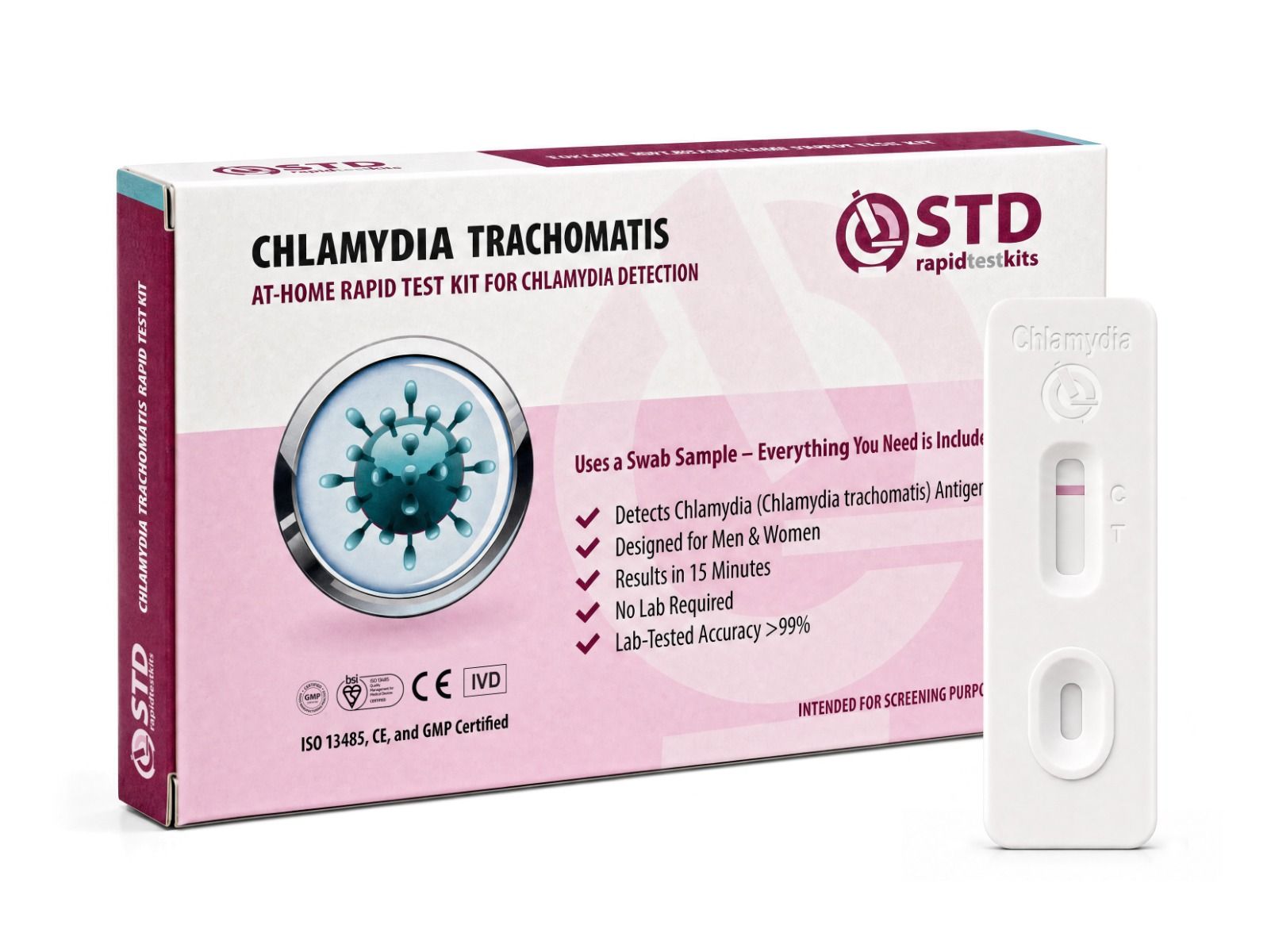
Lab-based nucleic acid amplification tests (NAATs) remain the gold standard for analytical sensitivity. Rapid lateral-flow home tests are useful screening tools for getting an answer at home in about 15 minutes; a positive result on any home test should be confirmed at a clinic before treatment, and a negative result on a test taken too soon after exposure should be repeated. This article is published by stdrapidtestkits.com, which sells at-home STI testing kits; we recommend products based on fit-for-purpose for the reader's concern, not commercial benefit.
What treatment looks like once you test positive
Chlamydia is treatable, and treatment is brief. Current CDC STI treatment guidelines list doxycycline 100 mg orally twice a day for 7 days as the first-line regimen. The guidelines note that available evidence supports doxycycline's efficacy for C. trachomatis infections of urogenital, rectal, and oropharyngeal sites, and the document specifically discusses doxycycline outperforming azithromycin for rectal infections (CDC, STI Treatment Guidelines: Chlamydial Infections). Single-dose azithromycin is still used in specific situations, such as pregnancy, where doxycycline is contraindicated.
A handful of practical points often get glossed over in shorter explanations:
- Finish the full course. Symptoms (when present) often improve within a few days, but the bacterial load does not clear that quickly. Stopping early is the most common reason people relapse and assume the medication failed.
- Avoid sex for seven days after starting treatment. Both partners need to complete treatment and clear the seven-day window before resuming sexual activity, otherwise reinfection is the predictable outcome.
- Plan a re-test at three months. Re-infection rates are high in the first year after a chlamydia diagnosis, and the CDC recommends re-screening at three months regardless of whether your partner was also treated.
Test of cure (a repeat NAAT three to four weeks after treatment) is not routinely recommended for non-pregnant adults completing a standard doxycycline course. It is recommended in pregnancy, in cases of persistent symptoms, or when adherence to the full course is uncertain.
What untreated chlamydia actually does
The complications list is the reason public-health agencies pay so much attention to a bacterium that often causes no symptoms. The CDC's chlamydia page documents that untreated infection in women progresses through pelvic inflammatory disease (PID), which can scar the fallopian tubes and produce ectopic pregnancy, infertility, and chronic pelvic pain. In men, the listed complications include rare fever and testicular tube pain, with infertility in uncommon cases. Across both, untreated chlamydia is associated with increased HIV acquisition risk (CDC, About Chlamydia).
The WHO frames the same picture at a population level: "STIs such as gonorrhoea and chlamydia are major causes of pelvic inflammatory disease and infertility in women" (WHO, STI fact sheet). The most reliable, well-supported story about chlamydia is the cumulative damage that builds up from undetected infection over months or years.
Untreated chlamydia in women can lead to pelvic inflammatory disease, which the CDC lists as a cause of infertility, chronic pelvic pain, and ectopic pregnancy (<a href="https://www.cdc.gov/chlamydia/about/index.html">CDC, About Chlamydia</a>). PID can damage fallopian tubes silently, with the consequences sometimes showing up years later. Treatment for established tubal damage is far more involved than a 7-day antibiotic course for the original infection, which is the practical case for testing on a schedule rather than only when something feels wrong.
Hygiene practices that genuinely reduce risk (and what doesn't)
Hand-washing is good for many reasons. Gastrointestinal infections, respiratory viruses, and trachoma in low-hygiene regions all benefit from clean hands. Reducing your risk of catching genital chlamydia is not the strongest argument for hand hygiene, because the underlying biology of genital chlamydia transmission is so dominated by direct sexual contact.
The interventions that actually move the needle on chlamydia risk:
- Consistent, correct condom use. Condoms reduce but do not eliminate chlamydia transmission risk during vaginal and anal sex. They also reduce risk of co-occurring infections that share the same transmission route.
- Cleaning or covering shared sex toys between users. Toys that move directly between partners without barrier or cleaning function as a transmission bridge.
- Talking with new partners about recent testing. A practical exchange of information that helps both people make informed decisions, with no moral judgment implied.
- Routine screening on the schedule that fits your life. Annual is the baseline for sexually active adults under 25; more frequent makes sense with multiple partners or a new partner.
- Treating partners alongside yourself when you test positive. Expedited partner therapy (EPT) is legal in many U.S. states and lets a clinician give you a prescription to pass to a recent partner without that partner needing a separate visit.
Scrubbing your hands harder, avoiding shared bathrooms, or worrying about door handles does not meaningfully reduce your chlamydia risk. The bacterium does not behave that way, and your time is better spent on the interventions above.
Why combined STI testing usually beats single-infection testing
Someone testing for chlamydia typically faces the same convergence of factors: the exposure that raised the chlamydia risk almost certainly raised it for at least one other STI; symptoms, when present, overlap heavily with gonorrhea and trichomoniasis, making a single-target test ambiguous; and the cost and inconvenience of testing for one infection versus several is roughly the same on a single-visit basis, so a broader panel often delivers more information per effort.
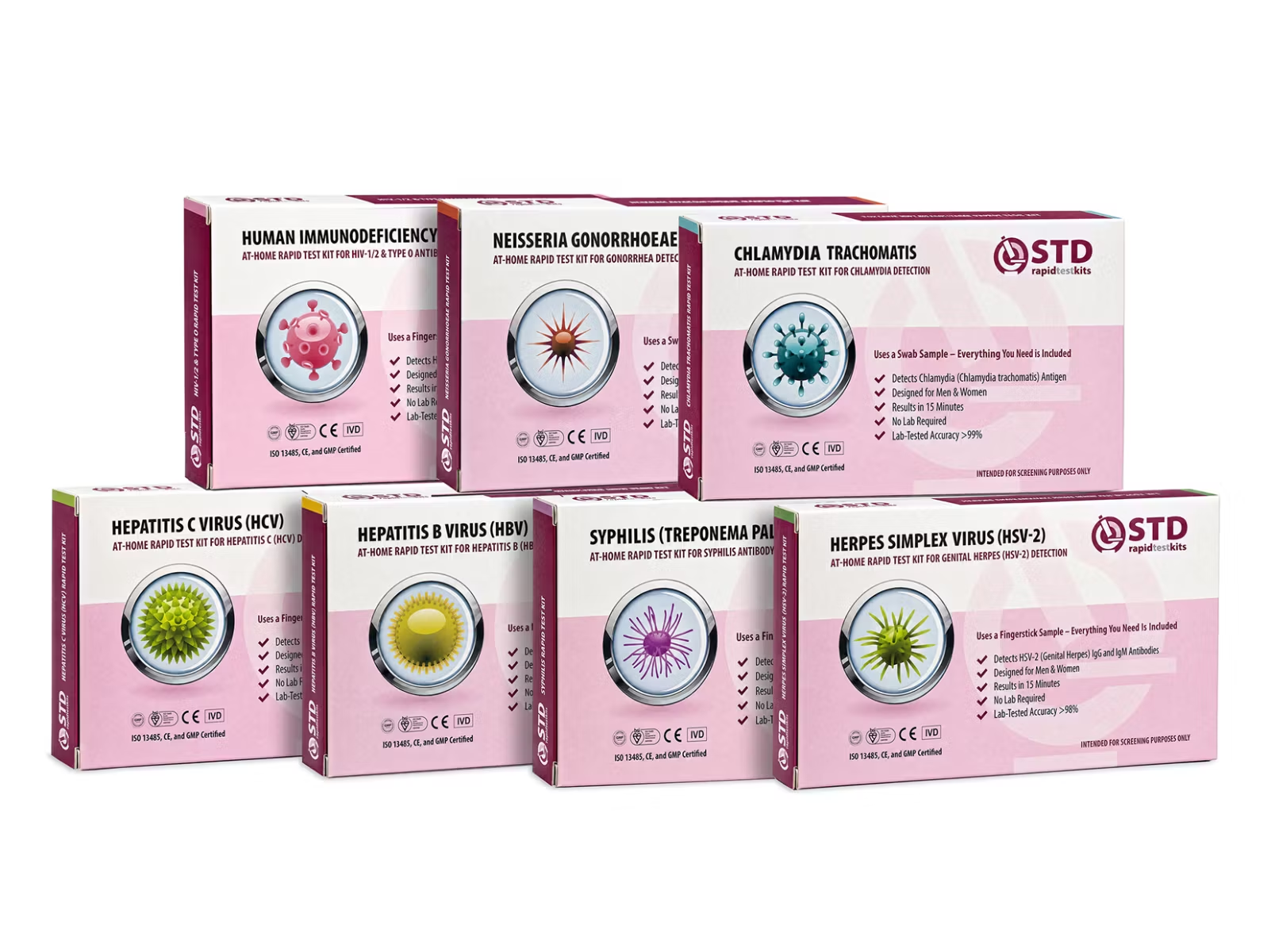
This is the practical case for thinking about a multi-infection panel rather than a chlamydia-only swab in a few specific situations: a new partner, a partner who has recently tested positive for something else, an exposure event you are uncertain about, or a symptom that does not point cleanly at chlamydia. The 7-in-1 panel in the box below covers the most common bacterial and viral STIs in a single take, with separate result lines for each infection.
Talking to partners after a positive result
This is the part of the process most people dread. It is also the part that breaks the chain of transmission and reduces the chance that you re-acquire the infection from the same partner you originally got it from. The standing public-health recommendation is to notify any sexual partners from the 60 days preceding diagnosis (or your most recent partner if it has been longer than 60 days) so they can test and, if needed, be treated.
You do not need to apportion blame when you reach out. Chlamydia is often passed by people who had no idea they were infected, and a notification message that says "I tested positive for chlamydia and you should get tested too" is sufficient. Many U.S. states allow expedited partner therapy, which lets a clinician write a prescription you can deliver to your partner without requiring them to be examined first; ask about it when you receive your own treatment. For situations where direct contact is not safe or workable, anonymous notification services exist (TellYourPartner.org and several state-run equivalents). They are imperfect substitutes for a direct conversation when one is possible, and they are still better than no notification at all.
Pulling it all together
The fingernail question is a useful entry point because it surfaces a genuine misunderstanding about how this particular bacterium spreads. Chlamydia trachomatis needs the specific conditions of mucous-membrane to mucous-membrane contact to establish a genital infection. The exotic transmission scenarios that pop up in search results (dirty fingernails, shared towels, toilet seats, swimming pools) are not where the 129 million annual infections are coming from. They are coming from the prosaic reality of unprotected vaginal, anal, and oral sex between partners who often did not know one of them was infected.
That last clause is the actionable part. The bacterium is silent in most carriers. The complications develop quietly over months. The single most reliable thing you can do for your sexual health is to test on a schedule that fits your relationship pattern, treat anything you find, and bring partners into the loop when a positive result arrives. For chlamydia specifically, the evidence consistently points to testing frequency, barrier use, and partner communication as the interventions that actually reduce transmission.
Three concrete next steps
- Test on a schedule that matches your relationship pattern: annual screening if you are sexually active and under 25, and after each new partner regardless of age.
- If you test positive, complete the full antibiotic course and avoid sex for seven days after starting treatment to prevent reinfection.
- Notify any sexual partners from the 60 days before your diagnosis so they can test and, if needed, be treated.
Frequently asked questions
- Can I really get chlamydia from someone's dirty fingernails?
- Genital chlamydia is overwhelmingly transmitted through vaginal, anal, or oral sex with an infected partner, and the CDC's chlamydia page lists no other route for genital infection besides mother-to-baby transmission during childbirth. Microbiology texts do describe rare finger-mediated transfer of the bacterium between a person's own genital site and their own eye, but that is a different scenario from catching genital chlamydia from incidental hand contact.
- How long can chlamydia survive outside the body?
- Chlamydia trachomatis is fragile outside its host and desiccates rapidly under typical indoor conditions. The fomite-mediated transmission documented in microbiology texts requires unusually favorable conditions and is specific to trachoma (eye chlamydia) in low-hygiene settings, not everyday genital infection.
- Can I get chlamydia from a toilet seat, towel, or swimming pool?
- There is no documented case of genital chlamydia transmitted through a toilet seat or a swimming pool, and the bacterium would not survive long enough on those surfaces to be infectious in real-world conditions. Shared damp towels are listed as a fomite vector for trachoma (eye chlamydia) in resource-limited settings; that is a different infection route from genital chlamydia.
- How soon after exposure can I test for chlamydia?
- Most clinics treat day 14 after a suspected exposure as the practical earliest reliable testing point. A negative result before that should be repeated. The NHS notes that if symptoms appear at all, they can start anywhere from one week to several months after infection, so a single early negative does not rule out a slowly developing infection.
- Can chlamydia clear up on its own without treatment?
- Some untreated infections do clear spontaneously over many months, but a meaningful share persist long enough to cause complications, particularly pelvic inflammatory disease in women. Because there is no reliable way to predict which infections will clear and which will not, the standing clinical recommendation is to treat every confirmed positive with the full antibiotic course rather than wait.
- Do I need to tell my partners if I test positive?
- Yes. The standing recommendation is to notify any sexual partners from the 60 days preceding your diagnosis so they can test and, if needed, be treated. Many U.S. states allow expedited partner therapy, where the clinician writes a prescription you can deliver to your partner without requiring a separate appointment. Anonymous notification services exist for situations where direct contact is not workable.
- How accurate are at-home rapid chlamydia tests compared with lab tests?
- Lab-based nucleic acid amplification tests (NAATs) remain the gold standard for analytical sensitivity. Rapid lateral-flow home tests are useful screening tools that give a result at home in about 15 minutes; they work best when taken at least 14 days after a possible exposure. Treat any positive home result as a strong signal to get a confirmatory clinic NAAT before starting antibiotics, and re-test if your home result is negative but you tested too early after exposure.
- U.S. Centers for Disease Control and Prevention. About Chlamydia: transmission, symptoms, complications, screening recommendations.
- U.S. Centers for Disease Control and Prevention. Sexually Transmitted Infections Treatment Guidelines: Chlamydial Infections, current first-line regimen and re-testing guidance.
- World Health Organization. Sexually Transmitted Infections fact sheet: global prevalence estimates and complications of untreated chlamydia.
- U.K. National Health Service. Chlamydia overview: transmission language, symptom-onset window, screening recommendations.
- Baron's Medical Microbiology, NCBI Bookshelf, chapter on Chlamydia: documented fomite-mediated transmission in trachoma and genital-to-eye transfer on contaminated fingers.
- U.S. Centers for Disease Control and Prevention. Sexually Transmitted Diseases home: prevention, screening, and STI treatment overview.
