
Published: August 2025 | Last updated: May 2026 | Editorial review and quality control: Martina N.
Most people asking 'am I safe if I didn't swallow' are looking for one piece of reassurance. Swallowing is rarely the moment that decides whether an infection passes. Most sexually transmitted infections cross during the contact itself, often through skin or through small amounts of fluid you would not notice. That sounds alarming, but knowing how transmission works also tells you when worrying is overblown and when a quick at-home test gives you a clear answer.
Oral exposure sits in a real but generally lower-risk category compared with vaginal or anal sex. The infections most commonly associated with oral sex (gonorrhea, chlamydia, and herpes in particular) can be detected and treated when caught early. This guide walks through which infections can transmit through oral contact, what symptoms can show up (and why most do not), when testing makes sense, and what at-home options can answer the question privately.
Key Takeaways
- Swallowing is not the deciding factor in oral STI transmission. Most infections pass during the contact itself, through skin contact or small amounts of pre-ejaculate that often go unnoticed.
- For the bacterial infections most often linked to oral sex (gonorrhea and chlamydia), testing around two weeks after exposure gives a reliable result and lets you act early if anything shows up.
The part most people get wrong about oral sex and STI risk
It is common to picture transmission as the moment something obvious enters the mouth. In that mental model, swallowing is the line between safe and not safe. Medically, that picture leaves out almost everything that matters. Sexually transmitted infections do not need a large dose to establish themselves, and they do not need to be swallowed to reach a site where they can grow.
When the mouth, tongue, lips, or throat come into contact with genital skin and the fluids naturally present there, several things can happen. Bacteria can attach to the lining of the throat (CDC, Gonorrhea Basic Information). Viruses on the skin around the genitals can transfer to the lips or perioral skin. Even small amounts of pre-ejaculate (the clear fluid released before orgasm) can carry organisms like Neisseria gonorrhoeae and Chlamydia trachomatis if the person is infected.
The lining of the mouth and throat also has tiny breaks that most people do not notice: small abrasions from brushing teeth, irritation from acidic or crunchy food, or normal wear at the gum line. These microscopic openings do not bleed, but they give bacteria and some viruses an easier route in.
The infection crosses during contact itself, not only if something is swallowed. Skin contact and trace pre-ejaculate are the primary routes, and both can occur without the person being aware of them.
Which STIs can actually spread through oral sex
Not every STI transmits efficiently through oral contact. Some spread mainly through fluids in deeper sexual exposure, while others spread through skin contact alone and do not need mucous membranes involved. The infections most consistently linked to oral transmission are gonorrhea, chlamydia, syphilis, herpes (both HSV-1 and HSV-2), and HPV (WHO, STIs Fact Sheet).
Each has a slightly different transmission story. Gonorrhea and chlamydia are bacterial; they need contact between an infectious surface and a susceptible mucous membrane, and the throat is one of those susceptible surfaces. Syphilis is also bacterial, but it spreads through contact with a primary sore called a chancre, which can be located anywhere on the genitals, mouth, or anal area. Herpes spreads through skin-to-skin contact with infected skin or mucous membranes, even when no visible sore is present. HPV is also a skin-contact virus, and the strains that can cause oropharyngeal cancers transfer through oral sex (CDC, HPV and Cancer).
HIV transmission through oral sex is possible but generally low compared with vaginal or anal exposure. The CDC describes oral HIV transmission as rare, with risk rising when there are open sores in the mouth, bleeding gums, or active genital infections at the contact site. Published research estimates the per-act risk of HIV through receptive fellatio at under 1 in 10,000 acts in the absence of those risk-raising conditions, substantially lower than vaginal sex and far lower than anal sex, though not zero. The table below summarizes which of the most common infections can transmit during oral contact and whether fluid exchange is required.
| Infection | How it transmits orally | Common oral or throat signs | Fluid required? |
|---|---|---|---|
| Gonorrhea | Bacteria colonize throat tissue from genital contact | Sore throat or no symptoms at all | No, contact is enough |
| Chlamydia | Bacterial exposure during contact with infected fluid or skin | Usually no symptoms | No |
| Syphilis | Contact with a chancre or rash on the partner | Painless oral ulcer or no symptoms | No |
| Herpes (HSV-1, HSV-2) | Skin contact with infectious viral shedding | Cold sores around the mouth, or genital lesions if oral-to-genital | No, fluids not required |
| HPV | Skin contact with the infected area | Often none; long-term risk of oropharyngeal lesions | No |
| HIV | Through visible sores, bleeding, or active mouth lesions | Generally no oral symptoms; rare via oral sex | Yes, and even then risk is low |
Why you might not notice any fluid at all
A common reassurance people give themselves is that 'nothing got in my mouth'. The trouble is that sexual transmission rarely involves the kind of obvious fluid contact people expect. Pre-ejaculate is a small amount of clear fluid the body releases before ejaculation. It carries the organisms that live in the urethra, which can include gonorrhea or chlamydia bacteria if the person is infected. Most people never see or feel pre-ejaculate during the encounter.
On the receiving side of oral sex, the body's natural lubrication and small amounts of cervical or vaginal fluid carry the same risk for the partner doing the giving. The amounts can be very small and the contact can feel brief.
For viruses like herpes simplex and HPV, fluids are not part of the picture at all. The infectious viral particles sit on the skin and mucous membranes around the genitals, and they can transfer during contact even when no sore or wart is visible (CDC, Genital Herpes Basics). People sometimes develop oral lesions or pharyngeal HPV after encounters where they felt no obvious exposure happened, because infectious viral particles shed from skin without visible lesions or noticeable fluid.
For herpes and HPV, fluid is not involved at all. The virus sits on the skin surface and transfers on contact even when no sore or wart is visible.
How throat infections hide in plain sight
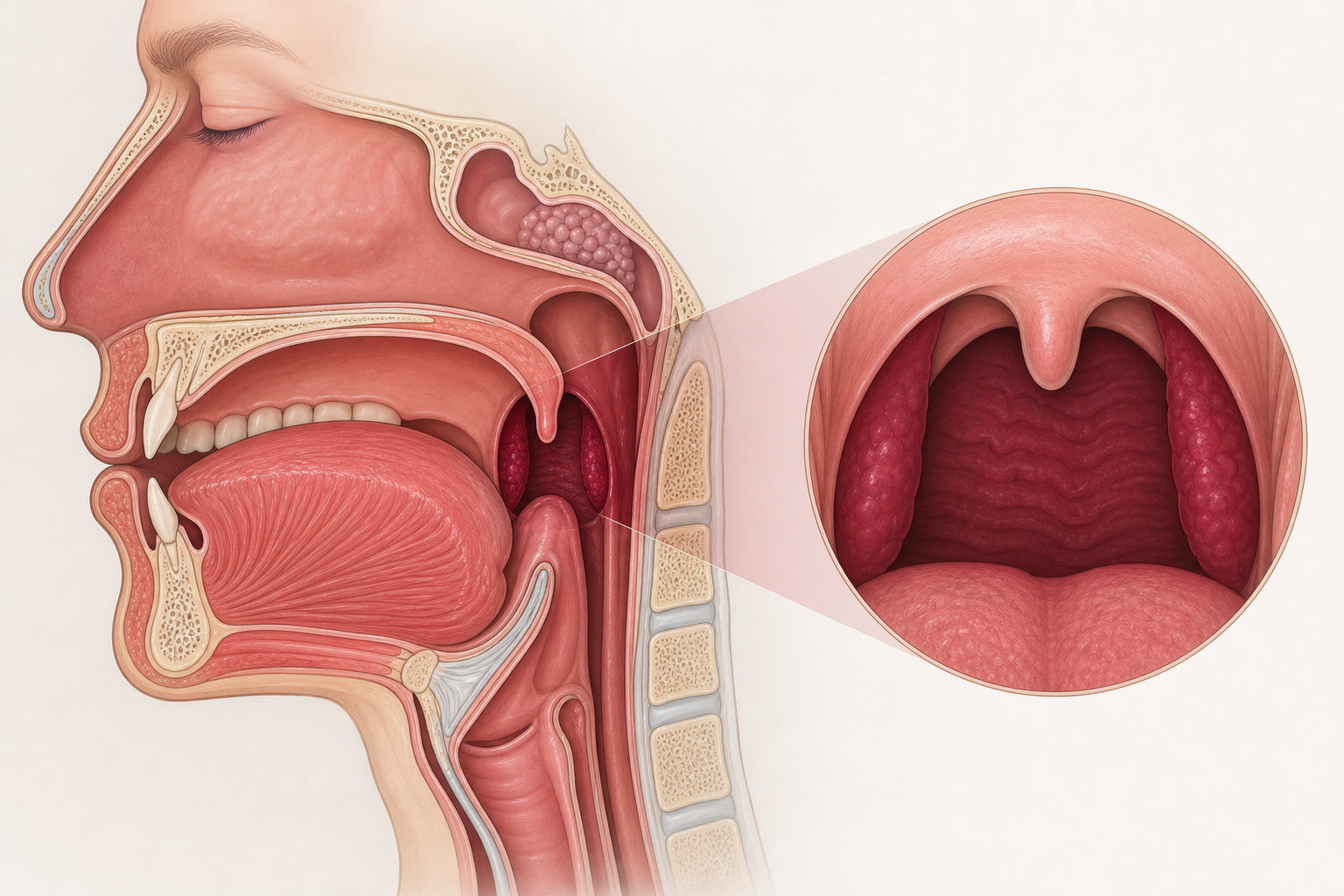
One of the more counterintuitive parts of oral STI transmission is how quiet a throat infection can be. People often expect a tonsillar infection to feel like strep: dramatic pain, swollen tonsils, visible exudate. Pharyngeal gonorrhea and pharyngeal chlamydia do not usually behave that way. Most cases produce no symptoms at all, and when symptoms do appear, a mild persistent sore throat is the most common presentation (NHS, Gonorrhoea).
This silent pattern is the reason most modern STI screening guidelines now recommend that the throat be sampled separately for people who give oral sex regularly. A urine sample tests only the urethra, so a throat infection will be missed entirely by a urine-only screen. When someone tests at a clinic for oral exposure, a clinician will often run a separate throat swab analyzed by laboratory NAAT.
The same hiding pattern means people can carry a throat infection for months without realizing it, and pass it to a partner during oral sex without intending to. Partner notification matters here: a positive throat result in one person often signals a current or recent genital infection in a partner who shows no symptoms.
Symptoms that can appear after oral STI exposure
Although most oral STIs are silent, some do produce symptoms. The catch is that most of those symptoms look exactly like ordinary illnesses or temporary irritations. A mild sore throat after oral sex is far more likely to be a common cold than gonorrhea, but the overlap means people sometimes dismiss real infections as a viral cold or seasonal allergies.
The symptoms worth paying attention to are the ones that persist, look unusual, or appear close in time to a new sexual exposure. A painless ulcer on the lip or in the mouth a few weeks after exposure can be a primary syphilis chancre. A cluster of small painful blisters on the lip or around the mouth can be HSV-1 reactivation, or new HSV-1 from oral contact with infected skin. A persistent sore throat with mild redness and no other cold symptoms is the most common (and still uncommon) presentation of pharyngeal gonorrhea.
For most readers this means symptoms are not a reliable rule-in or rule-out. If something appears within the typical incubation window after a new partner, getting it checked is the sensible move.
| What you notice | Possible STI cause | How common |
|---|---|---|
| Persistent sore throat | Pharyngeal gonorrhea | Uncommon (most pharyngeal cases are asymptomatic) |
| Swollen tonsils with mild exudate | Pharyngeal gonorrhea or chlamydia | Rare |
| Painless mouth or lip ulcer | Primary syphilis chancre | Distinctive but uncommon |
| Cluster of small blisters on or around the lip | HSV-1 (cold sore) or new HSV-1 from oral contact | Common with HSV-1 reactivation |
| No symptoms at all | Most oral STI infections | Most common presentation |
When to test after oral sex
Testing too early after exposure can produce a false negative because the infection has not yet reached detectable levels. The interval between exposure and reliable detection is called the window period. Different infections have different windows depending on what the test measures (bacterial DNA, antigens, or antibodies).
For most readers asking about oral exposure, the practical timing looks like this. Bacterial infections such as gonorrhea and chlamydia are usually detectable within about a week of exposure, with the most reliable result around two weeks; this is consistent with standard CDC STI screening guidance. Syphilis takes longer because most tests measure the body's antibody response, which can take three to six weeks to develop fully. Herpes is generally tested when symptoms appear; blood antibody testing for HSV reaches reliable detection at roughly twelve weeks after exposure. HIV fingerstick antibody tests reach definitive accuracy at around twelve weeks as well.
If symptoms develop sooner (an unusual mouth sore, persistent painful swallowing, a blister cluster on the lip, or unexplained swollen lymph nodes in the neck), seeking testing earlier is appropriate even if the window is short. A clinician can swab a visible lesion directly, which gives a faster answer than waiting for an antibody window to close.
| Infection | Earliest reliable test | Recommended testing window |
|---|---|---|
| Gonorrhea (throat or urethral) | 5 to 7 days after exposure | 2 weeks |
| Chlamydia (throat or urethral) | 5 to 7 days after exposure | 2 weeks |
| Syphilis (blood antibody) | 3 to 4 weeks | 4 to 6 weeks |
| HSV-1 and HSV-2 (blood antibody) | 4 to 6 weeks | 12 weeks for a definitive result |
| HIV (fingerstick antibody) | 3 to 4 weeks | 12 weeks for a definitive result |
What at-home rapid screening covers
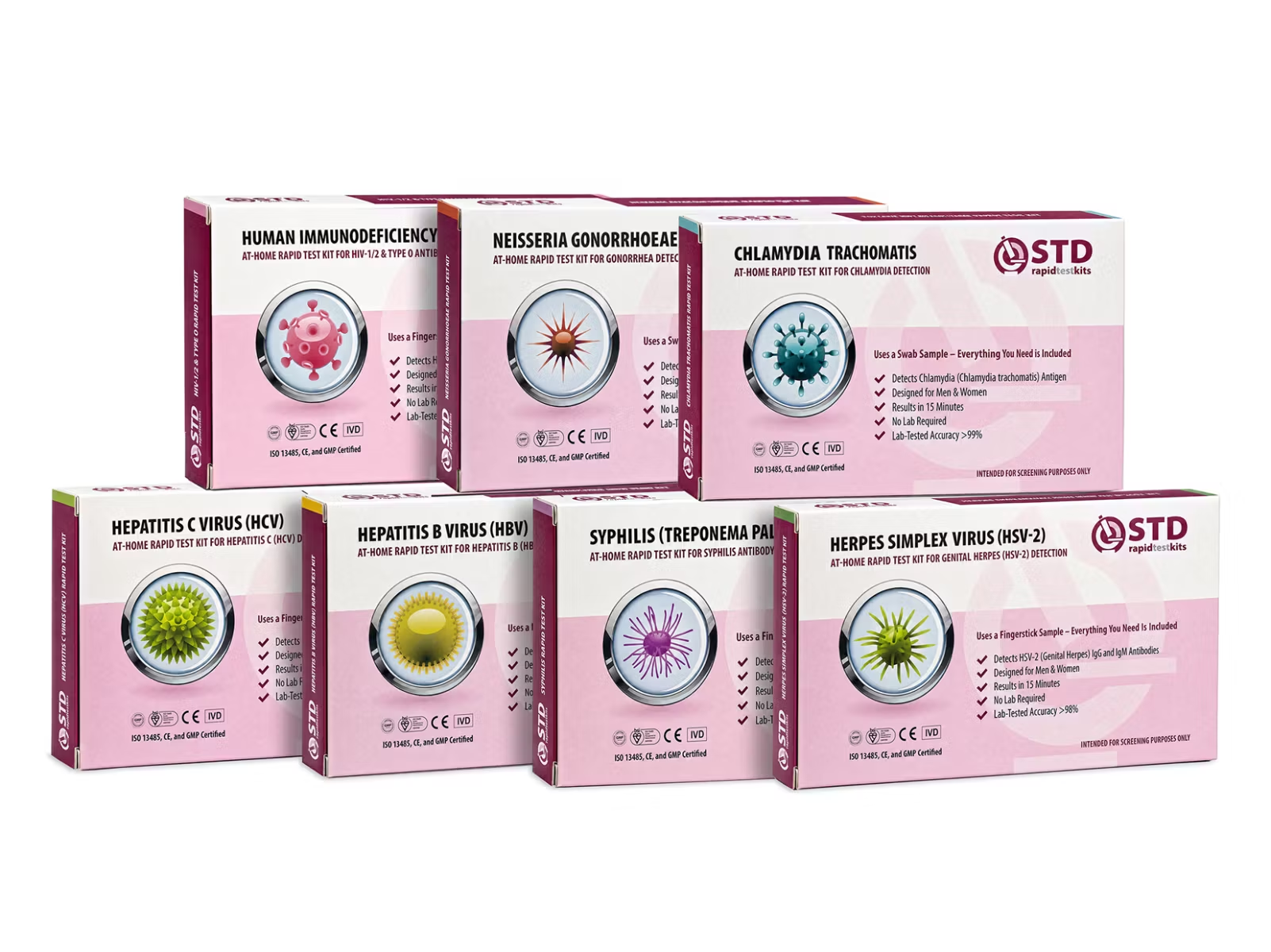
At-home rapid tests use lateral-flow chemistry: a self-collected sample (a fingerstick blood drop, or a swab for the appropriate infections) reacts with a test strip and gives a visual result in about fifteen minutes. They are screening tools, not diagnostic confirmations. A reactive result on a rapid lateral-flow test should be confirmed at a clinic or lab with a NAAT or a confirmatory antibody panel. The two technologies are complementary: at-home rapid tests give a fast, private starting point; laboratory NAAT gives the highest analytical sensitivity for confirmation.
For oral exposure specifically, the most common reason to use an at-home panel is to screen the broader infection picture from the same encounter, including the blood-borne tests (HIV, syphilis, hepatitis B, hepatitis C) and the genital swab tests (chlamydia, gonorrhea via self-collected swab). One important caveat: an at-home kit cannot perform the pharyngeal swab that a clinic uses to test the throat directly. If the primary concern is a possible throat infection and a clinic visit is feasible, an in-person throat swab is the most accurate option. The home test still answers the related question of what may have transferred to the genital or systemic side of the same encounter.
What actually reduces risk during oral sex
Knowing oral sex can transmit infections does not mean every encounter needs to feel risky. Sexual-health professionals tend to focus less on fear and more on practical risk reduction. The most reliable tools are also the simplest. A condom during fellatio prevents almost all direct contact between the throat and the urethra. A dental dam used during oral-vaginal or oral-anal contact creates a barrier between the mouth and the partner's mucosa. Both reduce transmission significantly when they are used consistently.
Other protective behaviors are practical rather than absolute. Avoiding oral sex when either partner has a visible cold sore or genital lesion significantly reduces herpes and syphilis transmission. Routine STI screening for new partners catches the silent infections that no one realizes they are carrying. Open conversation about each partner's last test result is the single most underrated step, because most STIs do not announce themselves and a partner with a recent infection may genuinely not know.
| Strategy | What it reduces | How effective |
|---|---|---|
| Condom during fellatio | Throat infection from urethral contact | High |
| Dental dam during oral-vaginal or oral-anal contact | Mouth contact with partner's mucosa | High |
| Avoiding oral sex during visible cold sores or genital lesions | Herpes and syphilis transmission | High |
| Honest partner conversation about recent test results | Silent infection transmission | High in combination with testing |
| Regular at-home or clinic-based STI screening | Catches asymptomatic infections early | Very effective for prevention |
Why people often assume oral sex is risk-free
Culturally, oral sex has long been treated as a safe alternative to intercourse. That belief is partly grounded in real epidemiology: HIV transmission through oral exposure is rare, and pregnancy is not a consideration. School health education in many regions also focuses almost entirely on intercourse, leaving oral transmission as a poorly covered topic. The combined effect is that many people reach adulthood believing oral sex is essentially free of STI risk.
The reality sits in the middle. Oral sex is generally lower risk than penetrative sex for many infections, but it is not zero. Public-health data consistently shows that pharyngeal gonorrhea and oral HPV are real, ongoing transmission routes.
Gonorrhea is an STI that can cause infection in the genitals, rectum, and throat.
When routine testing makes the most sense
Not every sexual encounter calls for a test. The situations where testing is genuinely useful tend to share a common feature: there is a real reason to want a clear answer, and an inexpensive answer is available. The most common triggers are a new partner whose recent testing history is unknown, multiple recent partners, symptoms that appear close to a new exposure, a partner who tests positive, or simply a regular screening schedule. Most sexually active adults benefit from screening every three to twelve months even without a specific incident.
- New partner whose last test result is unknown to you or was a long time ago.
- Multiple partners in the past month, since network exposure adds up quickly.
- Symptoms appear: a persistent sore throat, an unusual mouth sore, a lesion, or unexplained swollen lymph nodes.
- Partner reports a positive result, even if you have no symptoms yourself.
- Routine schedule: many sexually active adults screen every three to twelve months as a baseline.
You deserve clarity, not guesswork
It is easy for the mind to spiral after a sexual encounter that felt casual at the time. Oral sex sits in the middle of the STI-risk spectrum: lower risk than vaginal or anal sex for many infections, but not risk-free. The single most useful piece of clarity is that swallowing is not the deciding factor. Transmission usually happens during the contact itself, and the most common infections involved (gonorrhea, chlamydia, HSV, HPV, and occasionally syphilis) can all be detected and treated when caught early.
If there is a realistic chance an exposure happened, the right move is rarely panic; it is a test at the appropriate window. Choose the path that fits your specific concern.
- See a clinic for a throat swab if a pharyngeal infection is the specific concern, since at-home kits cannot sample the throat directly.
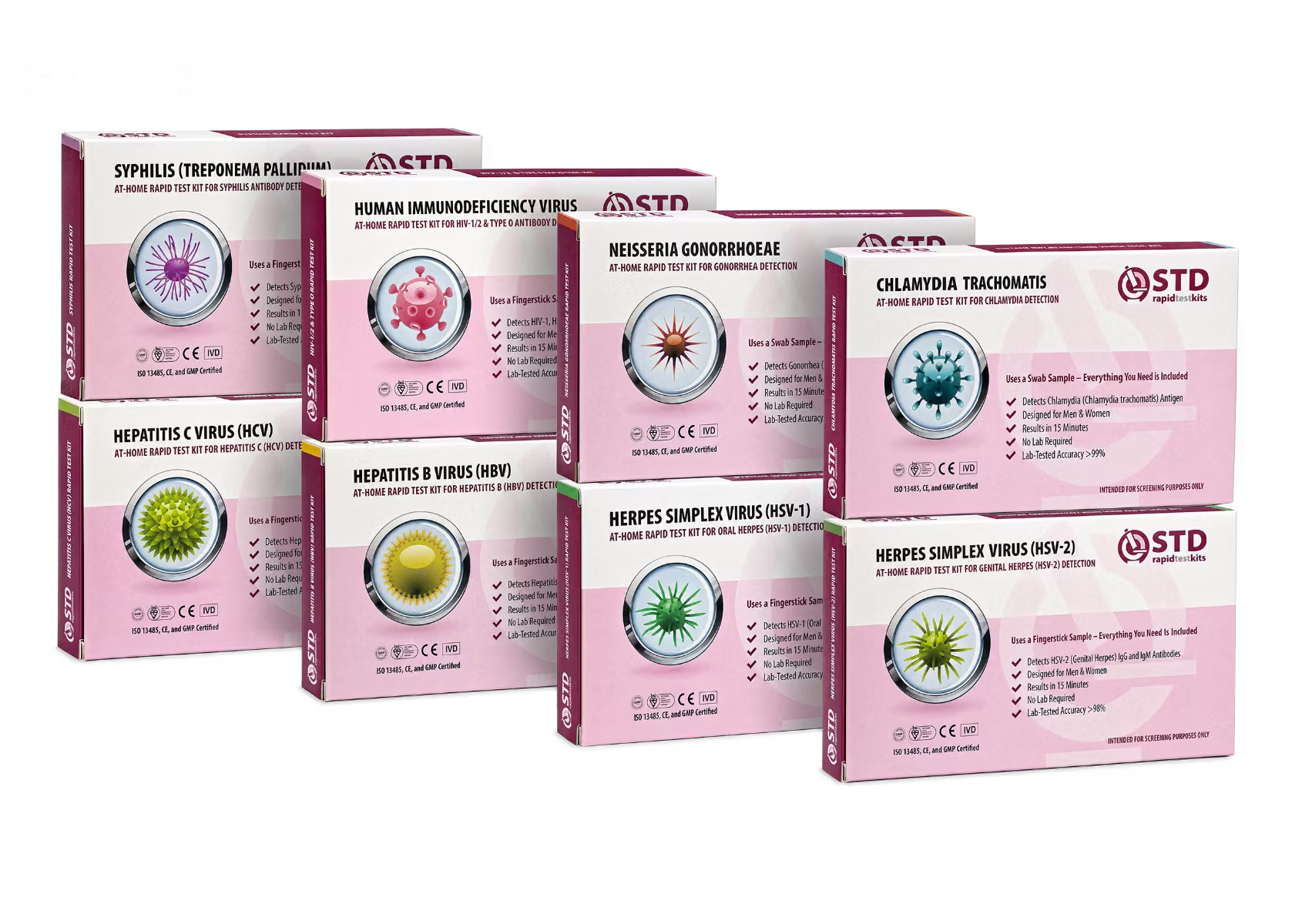
- Use an at-home panel to cover the systemic and genital infection picture from the same encounter, with results in about fifteen minutes.
- Retest at the twelve-week mark for HIV and HSV if your first test was within the window period, since those antibodies need time to develop.
FAQs
- If I did not swallow, am I basically safe?
- The contact itself is the exposure point, not whether you swallowed. Skin contact and trace pre-ejaculate can carry bacteria before ejaculation occurs, so by the time swallowing would be relevant, any transfer has already happened. The better question to ask is simply whether oral contact happened, not what came afterward.
- Can pre-ejaculate actually carry STIs?
- Yes. Pre-ejaculate is a small amount of clear fluid released before ejaculation and it can carry bacteria such as Neisseria gonorrhoeae and Chlamydia trachomatis if the person is infected. It is typically released in small enough amounts that most people do not notice it.
- I gave oral for only a minute. Does that count as exposure?
- Yes. Duration matters less than people think. Transmission can happen quickly when infectious bacteria or viruses are present at the contact site. A short encounter does not make infection likely, but the possibility is real.
- If I had a throat STI, would I feel it?
- Usually not. Pharyngeal gonorrhea and pharyngeal chlamydia are most often asymptomatic. When symptoms do appear, they often look like a mild seasonal sore throat that people dismiss as a cold or post-nasal drip.
- Can a throat infection pass to a partner later?
- Yes. A bacterial throat infection can transmit to a partner's genitals during a later oral encounter, even when the carrier has no symptoms. Routine screening catches these silent infections before they spread further.
- Would mouthwash or brushing my teeth right after help?
- Not in any reliable way. Some mouthwashes briefly reduce bacterial counts but they do not prevent STI transmission once exposure has happened. Brushing actually creates small abrasions in the gums, which may slightly increase rather than decrease vulnerability. Save brushing for general dental health, not as a post-exposure precaution.
- When should I actually test?
- If gonorrhea or chlamydia is your concern, two weeks is enough for a reliable result. Syphilis needs four to six weeks. HIV and herpes require the full twelve weeks for a conclusive negative; an earlier result can still be useful, but is not definitive. If you have symptoms, test or see a clinician right away regardless of the window.
- Is oral sex still considered lower risk overall?
- Yes. Compared to vaginal or anal sex it is generally lower risk for many infections including HIV. Lower risk is not zero risk though. The safer pattern is awareness, periodic testing, and honest conversation with new partners.
- U.S. Centers for Disease Control and Prevention. Sexually transmitted infections overview, screening guidance, and recommended testing intervals for sexually active adults.
- U.S. Centers for Disease Control and Prevention. Gonorrhea basic information including transmission routes, pharyngeal infection, and symptom patterns.
- U.S. Centers for Disease Control and Prevention. Genital herpes overview, skin-to-skin transmission, asymptomatic shedding, and testing options.
- NHS. Gonorrhoea symptoms, testing, and treatment guidance, including pharyngeal infection in people who give oral sex.
- World Health Organization. Sexually transmitted infections fact sheet covering global prevalence, transmission routes, and testing recommendations.
- U.S. Centers for Disease Control and Prevention. HPV and cancer, including oropharyngeal HPV transmission through oral sex and associated cancer risk.
