

Published: October 2025 | Last updated: April 2026 | Editorial review and quality control: Martina N.
A single price for an at-home chlamydia test does not exist. Kits sold online in 2026 range from roughly $19 to $129, and that spread reflects real differences in test chemistry, lab involvement, privacy handling, and what happens after the result. The cheapest option is not always wrong; the most expensive is not always best. What matters is matching the kit to your situation, your timeline, and the certainty you actually need.
This guide walks through what each price tier really includes, where the red flags hide in low-cost listings, how home-test pricing compares to a clinic visit, and when paying a little more buys something that genuinely matters. No shame, no upsell pressure, just a clear breakdown for a private decision.
How much does an at-home chlamydia test cost?
At-home chlamydia kits typically run $19 to $129. Rapid lateral-flow tests sit at the low end ($19 to $39), self-collected mail-in lab tests run $49 to $89, and multi-infection combo panels reach $90 to $129. Cheaper kits read at home in about 15 minutes; pricier kits ship the sample to a lab for higher analytical sensitivity. Match the kit to your exposure timeline and the level of certainty you actually need.
Key Takeaways
- Rapid at-home chlamydia kits typically cost $19 to $39 and read at home in about 15 minutes; self-collected mail-in lab kits run $49 to $89 with results back in a few days.
- A clinic visit without insurance often costs $90 to $250 once the swab fee, lab processing fee, and visit fee are added together, which is more than even the priciest at-home option.
What You Are Paying For at Each Chlamydia Test Price Tier
The plastic cassette in a $19 kit and the swab in a $99 kit can look almost identical. The real difference sits underneath: the chemistry used to detect the infection, whether a laboratory is involved, how the result reaches you, and what happens next if it is positive.
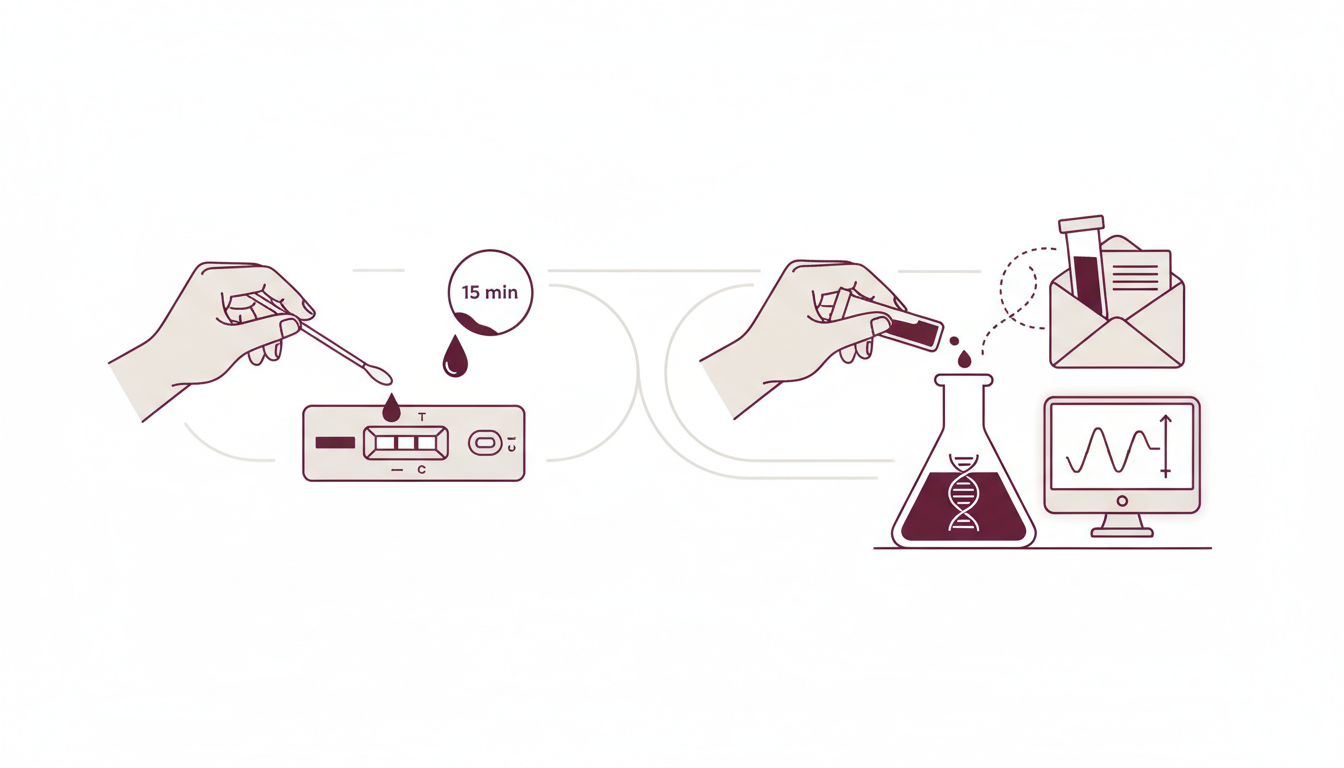
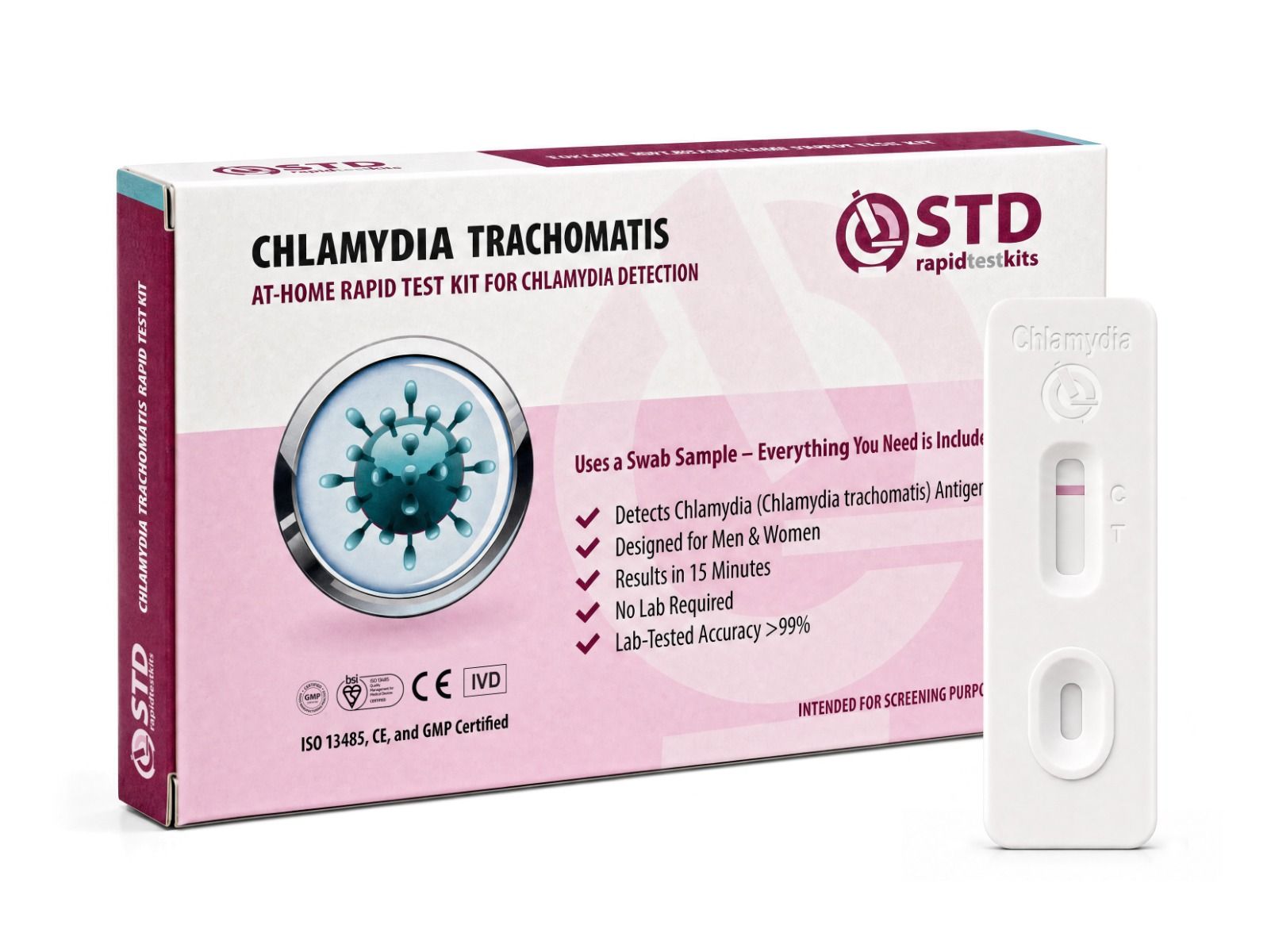
At the low end, $19 to $39 buys a rapid lateral-flow test you read yourself, similar in workflow to a home pregnancy test. A self-collected swab goes into a developing solution, the cassette shows one or two lines about 15 minutes later, and the workflow ends there. No lab, no return shipping, and usually no follow-up support.
The middle tier, $49 to $89, generally covers a mail-in collection kit. You self-collect a swab or urine sample at home, drop the prepaid envelope back in the post, and a certified laboratory processes the sample using nucleic acid amplification testing (NAAT) or another molecular method. Results return through a secure portal in a few days.
The upper tier, $90 to $129, usually means either a multi-infection combo panel (chlamydia bundled with gonorrhea, trichomoniasis, HIV, syphilis, or hepatitis) or a kit that adds clinician review of your result and a referral pathway for treatment.
| Price Range | What Is Included | Shipping & Privacy | Result Time |
|---|---|---|---|
| $19 to $39 | Rapid lateral-flow cassette, self-collected swab, self-read result, no lab involved | Often discreet; shipping varies by seller | About 15 minutes at home |
| $49 to $89 | Self-collected sample mailed to a certified lab, NAAT processing, results via secure portal | Discreet packaging usually included | 1 to 5 days after the lab receives sample |
| $90 to $129 | Multi-infection combo panel, clinician-reviewed results, treatment referral if positive | Fully discreet, tracked both ways | 2 to 5 days for combo lab kits |
Rapid Test vs Mail-In Lab Kit: Two Different Tools
Both are technically at-home, though rapid lateral-flow tests and mail-in lab kits answer slightly different questions. Knowing which one fits your situation prevents wasted money and false reassurance.
A rapid lateral-flow test detects bacterial protein on the strip itself. The chemistry is similar to a home pregnancy test: lines develop, and you read them. These tests are fast, private, and inexpensive. Their analytical sensitivity is lower than laboratory NAAT, which is why public-health bodies still treat lab NAAT as the gold standard for chlamydia (per the CDC's STI screening recommendations).
A mail-in lab kit ships your sample to a NAAT-equipped laboratory. NAAT amplifies bacterial DNA or RNA, so it can detect very low-level infections a rapid strip might miss. The trade-off is time: shipping, processing, and result delivery usually adds three to five days. You also lose the privacy of never letting your sample leave the bathroom.
Most readers do not need to choose forever. A common pattern works well: a rapid test now for fast reassurance, plus a lab-processed test later if a recent exposure falls inside the testing window or symptoms persist.
| Test Type | Sample | Result Time | Typical Price | Best For |
|---|---|---|---|---|
| Rapid at-home test | Self-collected swab | 10 to 15 minutes at home | $19 to $39 | Fast private screening, asymptomatic check before a new partner |
| Mail-in lab test | Self-collected swab or urine | 1 to 5 days after mailing | $49 to $89 | Higher analytical sensitivity without a clinic visit |
| Combo lab panel | Mixed swab plus fingerstick blood | 2 to 5 days | $90 to $129 | Screening for several STIs at once after a higher-risk exposure |
When a Rapid Chlamydia Test Is Genuinely Enough
A $19 to $39 rapid test is not a downgrade in every situation. For asymptomatic readers who want a private check before a new relationship, who are testing well outside the early window after exposure, or who simply cannot get to a clinic, a well-made rapid kit answers the question they are actually asking.
The conditions where a rapid kit fits comfortably:
- You have no symptoms and want a private screening before a new partner.
- Your possible exposure was at least two weeks ago, so the bacterial load has had time to climb above the rapid test's detection threshold.
- You are doing routine repeat screening and your last lab test was negative.
- A clinic visit is genuinely out of reach: cost, transportation, work hours, or fear of being recognized.
The conditions where a rapid kit is the wrong tool:
- Symptoms are present (discharge, burning, pelvic pain, post-coital bleeding). At that point you need a clinical evaluation, not a screen.
- Possible exposure was within the last 7 to 14 days. A rapid test taken too early can return falsely negative because the bacterial load is still low.
- You have a known partner-positive exposure. Treat first, test later, do not wait for a screen.
This article is published by stdrapidtestkits.com, which sells at-home rapid STI test kits. We recommend products based on fit-for-purpose for the reader's concern, not commercial benefit. When the right answer is a clinic visit or a mail-in lab kit we do not sell, we say so plainly.
Red Flags to Watch for in Cheap Online Kits
Listings under $20 can still be legitimate; the trust signals just thin out fast at that price point. Before buying any low-cost kit, run through the same checks a regulator would:
- FDA clearance or CE marking on the listing. A legitimate diagnostic device discloses its regulatory status. Vague phrases like "clinically validated" without specifics are a warning sign.
- A named manufacturer. Marketplace listings that hide the manufacturer or use generic language like "genital screening cassette" are usually drop-shipped, sometimes from expired stock.
- Published sensitivity and specificity figures. A real kit's data sheet states how often it correctly identifies infection (sensitivity) and how often it correctly clears uninfected samples (specificity). No numbers, no trust.
- Reachable customer support. A working email or phone number for result questions matters; if no one answers before purchase, no one will answer after a faint line either.
- Clear instructions and example results. Reputable kits include a labeled positive and negative reference image. If the instructions are blurry, photocopied, or in a language that does not match your region's regulatory profile, walk away.
The cost-saving you imagine from a $14 mystery cassette evaporates the moment you have to pay for a real test on top of it.
How At-Home Chlamydia Test Prices Compare to a Clinic Visit
The sticker shock that pushes most readers toward home testing is real. A clinic visit looks affordable on paper until the bill arrives.
Clinic costs are bundled. The visible "chlamydia test" charge is rarely the only line item. There is also an evaluation or office-visit fee, a sample-collection fee, the laboratory processing fee, and sometimes a separate result-review fee. Without insurance, the total typically lands between $90 and $250 in 2026, depending on the provider and region.
Sliding-scale clinics and Title X funded centers (including Planned Parenthood) bring those numbers down significantly, sometimes to zero, especially for readers under 25 or below specific income thresholds. The catch is access: limited hours, regional availability, advance scheduling, and intake paperwork that requires identifying yourself.
At-home testing strips out the clinic overhead. You pay for the kit, shipping, and (for mail-in) lab processing. There is no separate visit fee because there is no visit. A $99 home kit can still come in under the cheapest urgent-care swab once the visit fee, collection fee, and lab fee are totaled together.
| Testing Option | Typical Out-of-Pocket Cost | Hidden Fees | Result Time |
|---|---|---|---|
| Urgent care or private clinic without insurance | $90 to $250+ | Visit fee, lab fee, admin fee usually separate | 1 to 7 days |
| Planned Parenthood or Title X clinic | $0 to $150 (sliding scale) | Possible if uninsured and over income cap | 3 to 10 days |
| At-home rapid test kit | $19 to $39 | Shipping sometimes extra, no lab fee | About 15 minutes |
| Mail-in lab kit (chlamydia only) | $49 to $89 | None, kit is all-inclusive | 1 to 5 days after lab receives sample |
Are Free STI Tests Actually Free?
Public-health campaigns advertising free STI testing are real. Local health departments, university clinics, and federally funded centers do offer no-cost or sliding-scale testing, especially for younger readers and people without insurance. The CDC's Get Tested locator and Planned Parenthood's network are the most reliable starting points.
The conditions on "free" matter, though. Some clinics batch-process samples weekly, which lengthens the result wait. Walk-in availability is uneven; many sites require an appointment days out. Privacy is conditional too: you give your name, often your insurance details (even if not billed), and the test sits inside a medical record. For some readers, especially those still on a parent's insurance, that record is the dealbreaker.
If cost is the deciding factor, start with the CDC's Get Tested locator at cdc.gov/sti/testing or your nearest Planned Parenthood. Both list sliding-scale and no-cost options by ZIP code, and both can usually book chlamydia screening within a week.
Insurance, HSA, and FSA: What Gets Reimbursed in 2026
Most private insurance plans in the United States cover STI screening when ordered by a clinician, often at zero cost-sharing under the Affordable Care Act's preventive services rule. The catch is that this typically means clinic-administered or telehealth-ordered testing rather than a kit you bought directly off a retail site. Direct-to-consumer at-home kits are usually paid out of pocket.
Health Savings Accounts (HSA) and Flexible Spending Accounts (FSA) are different. The IRS generally treats FDA-cleared diagnostic test kits as HSA- and FSA-eligible medical expenses, so you can usually pay for an at-home chlamydia kit with those funds. Eligibility can vary by plan, so confirm with your administrator and save the receipt and order confirmation in case documentation is requested.
If using insurance is a priority, ordering through a telehealth platform that bills your plan is more likely to result in coverage than buying a kit retail. If privacy and speed are the priority and out-of-pocket cost is acceptable, retail at-home kits remove a layer of paperwork (and a paper trail) entirely.
| Payment Method | At-Home Retail Kit | Telehealth-Ordered Kit | Clinician-Ordered Lab Test |
|---|---|---|---|
| Private insurance (in-network) | Usually not reimbursed | Often partially or fully covered | Often zero cost-sharing under ACA preventive rule |
| HSA or FSA card | Eligible for FDA-cleared kits, keep receipt | Eligible, keep receipt and provider note | Eligible, processed through normal claim |
| Cash / out-of-pocket | Full retail price ($19 to $129) | Platform fee plus kit ($60 to $200) | Visit plus lab fees ($90 to $250+) |
| Paper trail | None on insurance record | Telehealth visit logged | Result enters medical record |
How to Spot a Legitimate At-Home Kit
If you have already decided to buy, the next question is which seller. The market has expanded fast since 2022, and not every listing is from a company that specializes in sexual-health diagnostics. Three checks separate a legitimate kit from a marketplace gamble:
- The seller specializes in STI testing. Companies that run a full STI catalog, including single-infection kits and combo panels, generally have invested in regulatory paperwork, manufacturer relationships, and customer support. Generic wellness retailers selling "STD kits" alongside teeth whitener and supplements have not.
- The product page lists sample type, sensitivity, specificity, and intended-use timing. A kit that does not tell you whether it is a swab or a fingerstick, or how soon after exposure to use it, is not giving you the information you need to interpret the result.
- Lab accreditation is named (for mail-in). CLIA-certified (Clinical Laboratory Improvement Amendments) or CAP-accredited (College of American Pathologists) laboratories are the standard for diagnostic processing in the United States. If a mail-in kit hides the lab name, that opacity is itself a red flag.
Two other small details catch a lot of bad listings: an expiration date printed on the kit (resale platforms sometimes circulate expired stock), and a return or refund policy in case the kit arrives damaged. Reputable sellers publish both.
If Your Chlamydia Test Comes Back Positive
A positive chlamydia result does not require emergency care, though it does need a real next step within days. Chlamydia is one of the most treatable bacterial STIs: a short antibiotic course, taken correctly, clears the infection in most cases (per Mayo Clinic's chlamydia guidance). Untreated chlamydia is what causes the harder problems: pelvic inflammatory disease, increased risk of ectopic pregnancy, and possible fertility impact in women, plus epididymitis in men.
If you used a rapid kit, the typical workflow is: confirm the positive with a laboratory NAAT (a clinician visit or a mail-in lab kit), get the prescription, take every dose, and abstain from sex for seven days after starting treatment. Notify recent partners so they can be tested and treated. The CDC's screening and treatment guidance also recommends a re-test about three months later, because reinfection from an untreated partner is the most common cause of repeat positives.
Get retested before resuming unprotected sex with anyone untreated. Many states allow expedited partner therapy by name, so a prescribing clinician can sometimes write a prescription for your partner without requiring them to book a separate visit first.
Chlamydia is the most commonly reported sexually transmitted infection in the United States. Most people who have it have no symptoms. Routine screening is the only reliable way to know your status.
Frequently Asked Questions
- How much should I expect to pay for a legitimate at-home chlamydia test?
- Most legitimate kits sit between $19 and $129 in 2026. Rapid lateral-flow tests anchor the low end at roughly $19 to $39, mail-in lab kits run $49 to $89, and combo panels reach $90 to $129. The risk at the low end is unbranded marketplace listings with no published sensitivity data or named manufacturer rather than the price itself; specialized STI-testing sellers compete in the $19 to $39 band with quality kits. Over $100 usually means a multi-infection panel or a clinician-reviewed result, not a higher-quality single chlamydia test.
- Are the cheapest rapid kits worth it?
- Sometimes. A $30 rapid kit from a specialized STI-testing seller, used at least 14 days after a possible exposure and on someone without symptoms, can give a useful screening result. The same $30 kit from an unbranded marketplace listing with no published sensitivity data is a different proposition. Specificity and seller reputation matter more than the dollar amount.
- How soon after exposure can I test for chlamydia?
- The general window is 7 to 14 days after a possible exposure. Earlier than that, the bacterial load may still be below detection thresholds for both rapid and laboratory tests. If you test early and the result is negative, plan a retest at the two-week mark. Symptoms appearing earlier still warrant a clinic visit, not a home retest.
- Will my insurance cover an at-home chlamydia kit?
- Direct-to-consumer at-home kits bought retail are usually not reimbursed by insurance. STI screening ordered through a clinic or telehealth provider often is, frequently with no copay under preventive-services rules. HSA and FSA funds typically do cover FDA-cleared at-home diagnostic kits; keep the receipt for documentation and confirm eligibility with your plan administrator.
- What is the difference between a rapid lateral-flow test and a NAAT?
- A rapid lateral-flow test detects bacterial protein on a strip and reads at home in about 15 minutes. A NAAT (nucleic acid amplification test) is a laboratory method that copies bacterial DNA or RNA millions of times until it is detectable, which is more sensitive for low-level infections. Lateral-flow is faster and private; NAAT is more analytically sensitive but slower. Both have their place.
- Can I test for more than just chlamydia in one kit?
- Yes. Combo kits commonly bundle chlamydia with gonorrhea (the most frequent co-infection), and broader panels add trichomoniasis, HIV, syphilis, hepatitis B, and hepatitis C. Per-test cost usually drops in a combo. If you are screening after a higher-risk exposure or do not know your partner's status, a panel is more cost-effective than buying single tests.
- What if the rapid test result is faint or unclear?
- Faint lines are a known quirk of lateral-flow chemistry and can mean a weak positive, an evaporation line, or that you read the cassette outside the manufacturer's stated time window. Do not guess. Repeat with a fresh kit, or send a sample to a NAAT laboratory for confirmation. A maybe is not a result you should plan around.
- Is it safe and private to buy STI tests online?
- Yes, when you buy from a seller that specializes in STI testing, ships in plain packaging, and delivers results to a secure portal that only you log into. Avoid unspecialized marketplaces that resell drop-shipped kits; the discretion and quality controls thin out there. Reputable sellers publish their privacy policy, lab accreditation, and customer support contact before checkout.
- U.S. Centers for Disease Control and Prevention. Getting tested for STIs: where to test, what to expect, and how to read your result.
- U.S. Centers for Disease Control and Prevention. STI screening recommendations: who should be screened, how often, and confirmatory testing guidance.
- Mayo Clinic. Chlamydia trachomatis: diagnosis and treatment, including antibiotic course, retest interval, and partner therapy.
- MedlinePlus (U.S. National Library of Medicine). Chlamydia test page covering sample types, collection instructions, and what results mean.
- Planned Parenthood. STD testing guide covering sliding-scale clinic options, what is screened, and partner notification basics.
- Planned Parenthood. Chlamydia overview: symptoms, treatment, and what to expect at a clinic visit.
