

Published: July 2025 | Last updated: April 2026 | Editorial review and quality control: Martina N.
An eye that turns red, sticky, or swollen the morning after oral sex is not always seasonal allergies. Most of the time it is something simple: a normal viral pink eye, eye-makeup irritation, or a stray eyelash. Sometimes it is not. Several sexually transmitted infections (STIs) can travel from a partner's mouth or genitals to the conjunctiva, the thin membrane that lines the eyelid and covers the white of the eye, and cause infections that need real medical attention.
This article covers what is plausible, what is rare, and what is genuinely urgent. It also explains where at-home STI screening fits in, and where it does not. Eye-only infections are diagnosed and treated in person; rapid home kits test genital or blood samples, not eye swabs. Both have a role.
Can you get an eye infection from oral sex?
Yes, but it is uncommon. Gonorrhea, chlamydia, herpes simplex (HSV-1 or HSV-2), and syphilis can all reach the eye when infected fluid or a contaminated finger touches the conjunctiva. Onset varies by pathogen: gonococcal eye infection appears within 12 to 48 hours, herpes within a few days, chlamydia typically in one to two weeks, and ocular syphilis can develop at any disease stage. Gonococcal eye infection is a same-day medical emergency because it can damage the cornea quickly. Eye symptoms after sex are evaluated in person; rapid at-home kits screen the underlying genital or blood-borne STI from a swab or fingerstick sample, not the eye itself.
Key Takeaways
- Gonorrhea, chlamydia, herpes simplex, and syphilis can each cause an eye infection when fluid or contaminated hands reach the conjunctiva, on a timeline that depends on the pathogen: gonorrhea within 12 to 48 hours, herpes within a few days, chlamydia in one to two weeks, and syphilis at any stage of infection.
- Eye symptoms after sex need an in-person eye exam first; at-home rapid kits then screen the genital or blood-borne source infection from a swab or fingerstick sample.
How an Oral STI Reaches the Eye
The eye is more vulnerable to infection than most people realize. The conjunctiva is a mucous membrane, the same tissue type that lines the urethra, vagina, and throat, and the same bacteria and viruses that infect those sites can colonize the eye if they get there.
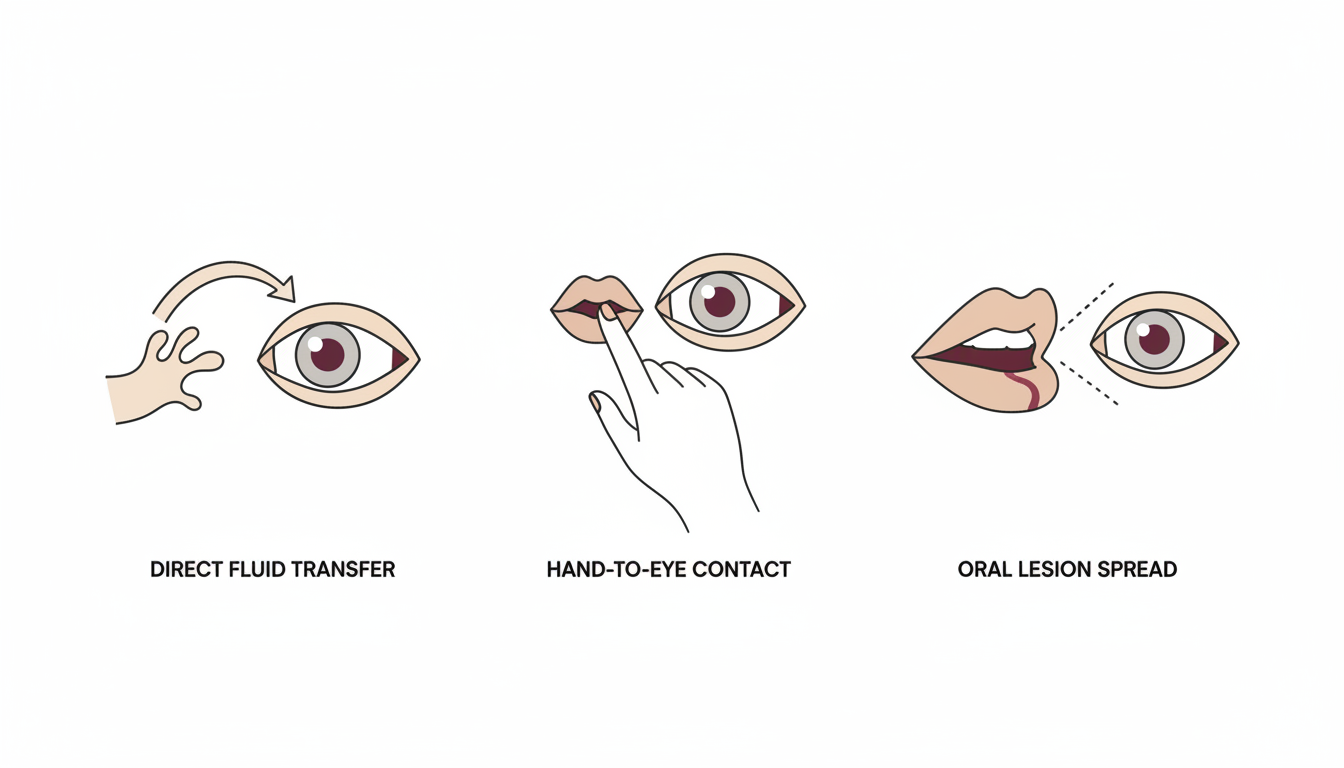
Three plausible routes account for nearly all reported cases of ocular STIs after oral sex:
- Direct fluid contact. A small splash of semen, pre-ejaculate, or vaginal fluid lands at or near the eye during oral sex. Even a quick blink does not always clear it before the bacteria or virus reaches the conjunctiva.
- Self-inoculation by hand. A partner or person performing oral sex touches a mouth, lip, or genital area, then rubs their own eye minutes or hours later. This is by far the most common route.
- Skin-to-mucous contact with active herpes lesions. An open cold sore on a partner's lip or in the mouth can shed HSV particles onto the area around the eye during close contact, even without a deep splash.
None of this requires unusual circumstances. The CDC notes that gonorrhea spreads through vaginal, anal, or oral sex without a condom (CDC, About Gonorrhea), and any infection that lives in the urethra, vagina, or pharynx can be carried on fingers to the eye in seconds.
Which Infections Cause Ocular Disease
Four STIs are responsible for nearly all eye infections traced back to sexual contact. The clinical pattern, the urgency, and the test that confirms each one are different.
Gonorrhea (gonococcal conjunctivitis)
Adult gonococcal conjunctivitis is the fastest and most aggressive of the bunch. Symptoms typically appear within 12 to 48 hours of inoculation: sudden, severe redness and swelling, copious thick yellow or green discharge, and an eye that may crust shut overnight. The pain is real, and the discharge volume is the giveaway clue against routine viral pink eye, which is usually watery.
Untreated, gonococcal conjunctivitis can ulcerate the cornea within days and is one of the few eye infections capable of causing rapid vision loss. It is treated with systemic antibiotics, not eye drops, and needs an emergency department or urgent ophthalmology visit, not a wait-and-see approach. The CDC confirms that gonorrhea is a notifiable, treatable bacterial STI and emphasizes prompt treatment to prevent complications (CDC, About Gonorrhea).
Chlamydia (adult inclusion conjunctivitis)
Chlamydial eye infection is slower and quieter. Onset is usually one to two weeks after exposure, sometimes longer. Common symptoms are mild to moderate redness, a gritty sensation, modest mucous discharge, and chronic irritation that does not respond to standard antibiotic eye drops because most over-the-counter and first-line topicals do not cover Chlamydia trachomatis. The CDC's chlamydia overview confirms transmission through vaginal, anal, or oral sex (CDC, About Chlamydia).
Worldwide, the same organism is responsible for trachoma, a chronic ocular infection that the WHO estimates causes vision impairment or blindness in approximately 1.9 million people (WHO, Trachoma fact sheet). Adult inclusion conjunctivitis is far less aggressive than trachoma but follows the same biology, and untreated chronic infection can scar the conjunctiva over time.
Herpes simplex (HSV-1 and HSV-2)
Herpes in the eye, called herpes keratitis when it involves the cornea, is more often caused by HSV-1 (the typical cold-sore strain) than HSV-2, but either can do it. Transmission to the eye usually happens through self-inoculation: an active cold sore is touched, then a hand goes to the eye. Less commonly, a partner with a visible lip or oral lesion shares the virus during close facial contact.
Symptoms include eye pain that is often disproportionate to how the eye looks, blurred vision, light sensitivity, and a watery discharge. Unlike bacterial infections, herpes keratitis tends to recur, and repeated outbreaks are the main reason ocular HSV remains one of the leading infectious causes of corneal damage in higher-income countries. The CDC notes that HSV-1 from oral herpes can spread from the mouth to the genitals through oral sex (CDC, About Genital Herpes); the same shedding pathways enable mouth-to-eye transmission via hands or fluids.
Syphilis (ocular syphilis)
Ocular syphilis is rarer than the other three but consequential. The CDC explicitly lists ocular syphilis among the complications of untreated infection, with potential signs that include eye pain, redness, changes in vision, and even blindness (CDC, About Syphilis). Presentations vary widely. Many cases look like uveitis, an inflammation inside the eye that can blur vision, throw off floaters, or cause a deep ache, and the eye finding may be the first clue to a syphilis infection that has been silent elsewhere in the body.
Ocular syphilis can occur at any stage. Treatment is the same as for neurosyphilis: an extended course of intravenous penicillin, not the single-shot regimen used for early syphilis without organ involvement.
- Same-day emergency: gonococcal conjunctivitis. Severe swelling and thick yellow-green discharge within 48 hours. Untreated, it can ulcerate the cornea in days and is the one ocular STI that can cause rapid, permanent vision loss.
- This-week clinic visit: chlamydial conjunctivitis (slow-onset gritty irritation), herpes keratitis (eye pain disproportionate to the redness, light sensitivity), and ocular syphilis (vision changes, deep ache, floaters). Serious, but not measured in hours.
STI Eye Infection Versus Routine Pink Eye
Most red eyes are not STIs. Knowing the pattern that distinguishes the two helps avoid both panic and false reassurance. The table below covers the features that matter clinically.
| Feature | Routine pink eye (viral or allergic) | STI eye infection |
|---|---|---|
| Onset speed | Gradual, or with allergy season | Hours to two weeks after exposure, depending on pathogen |
| Discharge | Watery, scant | Thick yellow-green, or copious mucous |
| Pain level | Mild itching or grittiness | Moderate to severe pain |
| Vision | Usually unaffected | Light sensitivity and blurring possible |
| Response to OTC drops | Often improves within days | Does not improve, may worsen |
| Recent sexual exposure | Coincidental | Direct exposure history |
Three Realistic Exposure Scenarios
The path from oral sex to an eye infection is almost always low-drama. Three patterns account for most cases reported in the literature.
The splash
Semen, pre-ejaculate, or vaginal fluid lands at or near the eye during oral sex. The volume can be small. A reflex blink does not always clear an infectious dose before the bacteria reach the conjunctiva.
The hand transfer
The most common route by far. A person performs oral sex, briefly touches their own face, or rubs an itchy eye minutes later, and bacteria from the partner's secretions ride along on their fingers. The same scenario applies in reverse: a partner whose hand contacted genital fluids touches the other partner's face during foreplay.
The cold-sore route
One partner has an active oral HSV-1 lesion. Close facial contact during or after oral sex deposits virus on the eyelid skin or directly into the eye. Herpes does not require fluid exchange; skin-to-skin contact with shedding tissue is sufficient.
Hand-to-eye transfer accounts for most ocular STI cases traced to oral sex. Washing hands before touching your face after any oral or genital contact is the single highest-impact thing you can do to prevent the infection in the first place. It outperforms barrier methods, eye protection, and partner-status assumptions combined.
What to Do If You Have Eye Symptoms After Oral Sex
Two principles guide the next 24 hours. First, rule out the urgent stuff. Second, do not self-treat with leftover drops or guesswork antibiotics.
Step by step:
- Rinse the eye gently with sterile saline or clean lukewarm water if fluid contact has just happened. This reduces, but does not eliminate, the infectious load.
- Stop wearing contact lenses immediately. Throw out the current pair if affordable; contacts trap bacteria against the cornea and worsen any infection.
- Wash hands thoroughly before and after touching the affected eye. Avoid the unaffected eye entirely.
- Do not share towels, washcloths, pillowcases, eye makeup, or lens cases until the eye is cleared.
- Get an in-person evaluation today if symptoms include severe pain, vision changes, light sensitivity, or thick yellow-green discharge. Walk-in eye clinics, urgent care, and emergency departments can all triage this; primary care can refer if needed.
The NHS lists eye pain, light sensitivity, and any vision changes such as wavy lines or flashing as red flags requiring immediate medical attention, since these can be signs of a more serious eye problem (NHS, Conjunctivitis).
Pain in your eyes, sensitivity to light, changes in your vision, like wavy lines or flashing... can be signs of a more serious eye problem.
Testing: What an At-Home Kit Can and Cannot Do
This is where reader expectations and product reality often diverge. The two test types answer different questions, and knowing which does what prevents wasted effort.
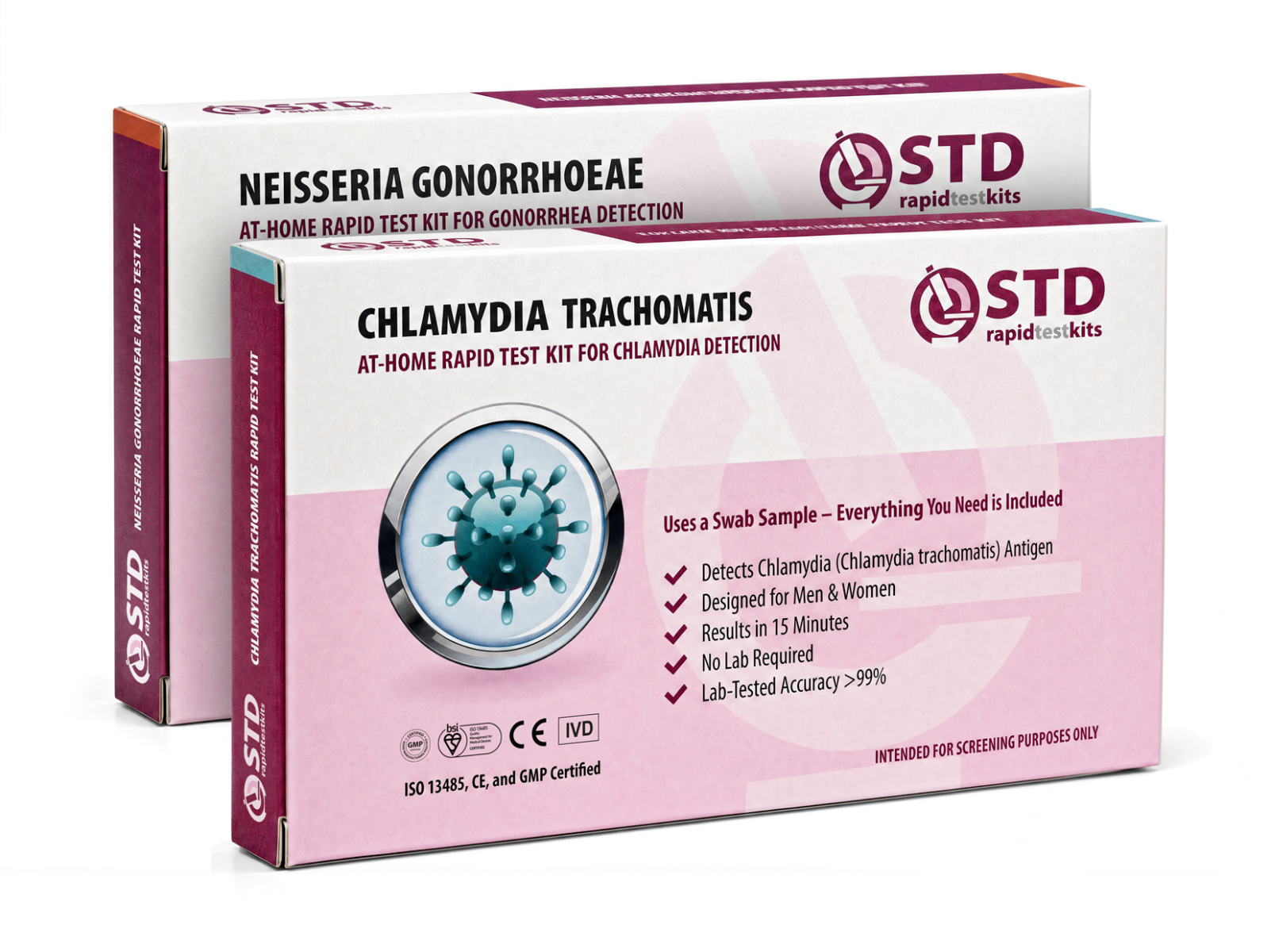
For eye symptoms specifically: a clinician swabs the conjunctiva and the lab runs a culture or molecular test. This is the only reliable way to confirm an ocular gonorrhea, chlamydia, or herpes infection, and it has to happen in person because the sample is collected with sterile technique against a delicate surface. Home rapid tests are not validated for eye samples, and the kits sold at stdrapidtestkits.com are not designed to be used on the eye. Be honest with the eye doctor about the exposure context; they will not be shocked, and it changes the test panel they order.
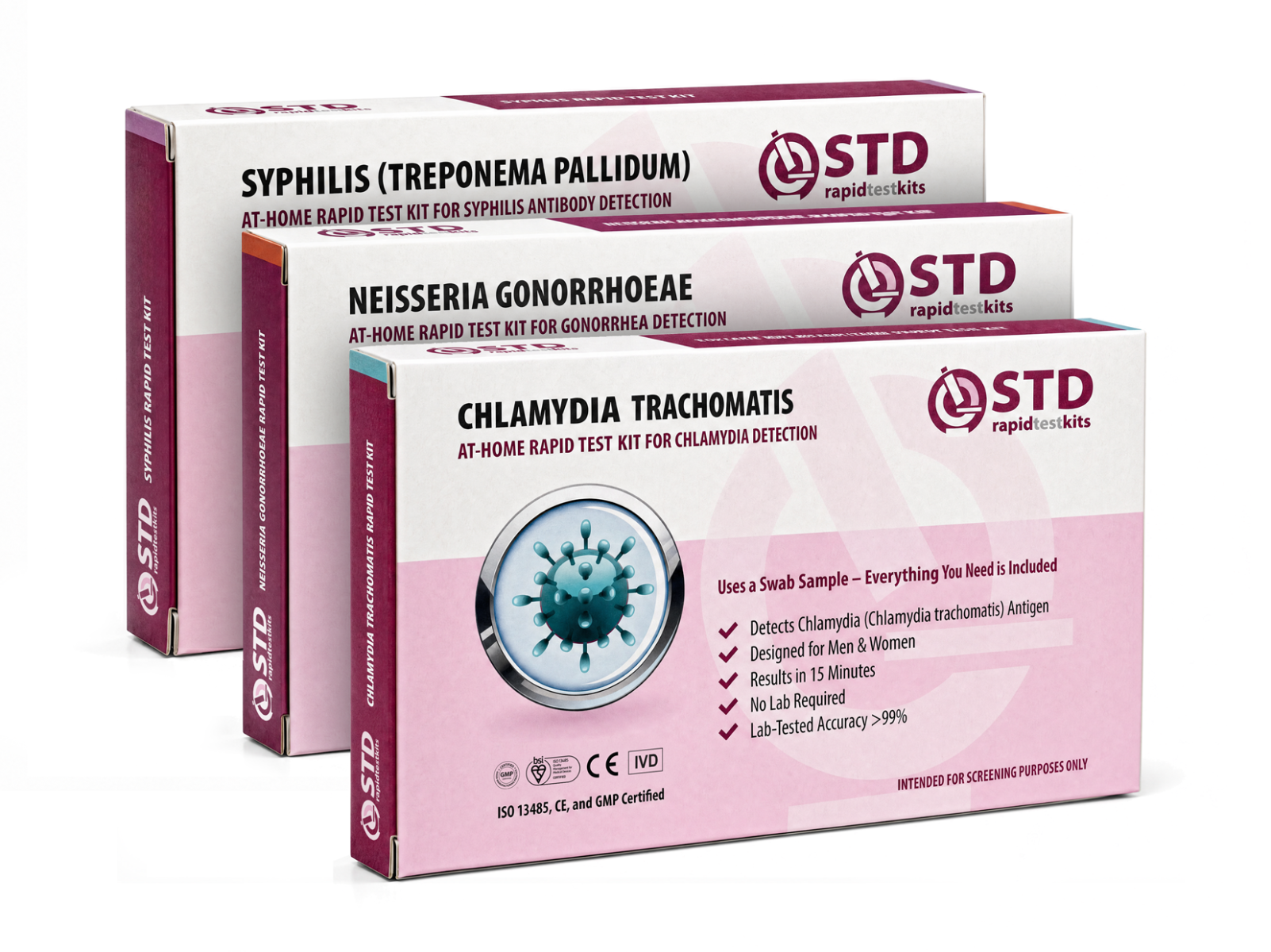
For the underlying source infection: if the eye is infected, the partner's mouth or genitals almost certainly were too. After the eye visit, a genital swab (chlamydia, gonorrhea) or a blood test (syphilis, HSV antibodies) is the standard follow-up to confirm whether the underlying STI is also present in your own genital or systemic compartment, where it might be silent. This is exactly what a rapid at-home kit is designed for. A positive result there can be confirmed with the clinician already managing the eye case, and partner notification becomes much easier with a documented result.
Practical sequence: eye doctor first, then at-home or clinic STI screening within a week, then a confirmatory laboratory test if anything comes back positive. Lab testing uses NAAT, the gold-standard molecular method, while home kits use lateral-flow chemistry; the two are complementary, not equivalent.
One disclosure before the recommendations below: the kits linked are sold by stdrapidtestkits.com. We have a commercial interest in recommending them, and we describe their limitations openly so the recommendation is honest.
How Ocular STIs Are Actually Treated
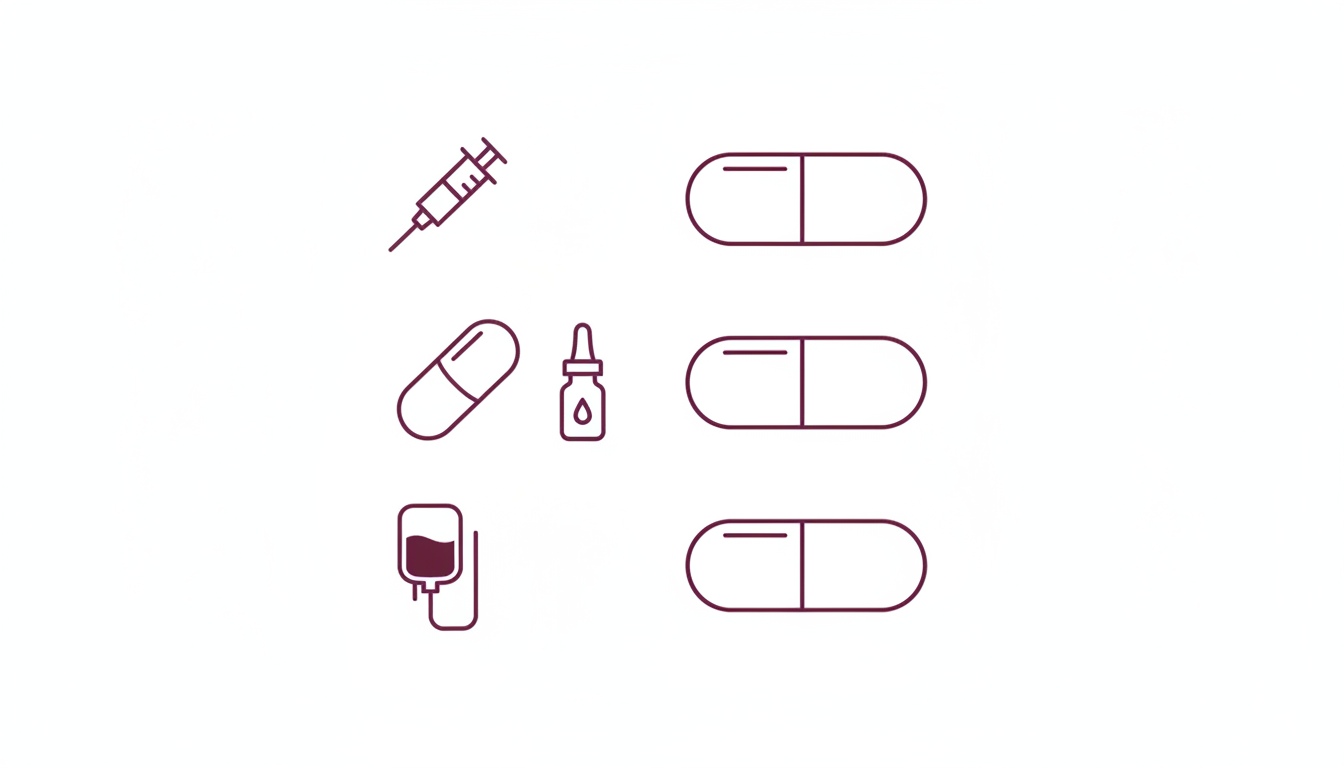
Treatment is straightforward when the diagnosis is clear, and it differs by pathogen. None of the regimens below are over-the-counter, and none should be self-administered.
- Gonococcal conjunctivitis: systemic antibiotics, typically intramuscular ceftriaxone, sometimes paired with saline lavage of the eye to reduce bacterial load. Topical antibiotics alone are inadequate for adult gonococcal eye infection.
- Chlamydial conjunctivitis: systemic antibiotics such as oral azithromycin or doxycycline. Topical drops alone do not eradicate the infection because the organism replicates inside the host's epithelial cells.
- Herpes keratitis: antiviral therapy, typically topical ganciclovir or oral acyclovir. Steroid drops are sometimes added under ophthalmology supervision but are dangerous if used wrongly.
- Ocular syphilis: intravenous penicillin G for 10 to 14 days, the same regimen used for neurosyphilis. This is an inpatient or infusion-clinic treatment.
Recovery is fastest when treatment starts within 24 to 48 hours of the first eye symptom. Bacterial infections clear in days; viral infections settle but can recur, especially HSV. Follow-up exams are standard; a single visit is rarely the end of care. Partners should be evaluated and treated in parallel; otherwise reinfection is the default outcome.
Prevention That Actually Works
The realistic baseline: do not eliminate oral sex, just remove the routes infection takes. Most ocular cases are preventable with habits that take seconds.
- Wash hands after touching mouths or genitals and before touching your face or eyes. This single habit prevents most cases.
- Skip oral contact when sores are visible. Cold sores, genital lesions, or unexplained genital discharge are not background noise; they are an active shedding event.
- Use barriers when feasible. Condoms during fellatio and dental dams during cunnilingus or anilingus reduce fluid exchange. They are far from universal in real-world use, but they do work.
- Keep contacts and eye makeup separate from sex spaces. Hands that have touched genitals should not be reinserting contact lenses or applying mascara. Sharing eye makeup with anyone is a separate small but real route for several pathogens.
- Test on a regular cadence. Anyone with new or multiple partners benefits from periodic STI screening so an asymptomatic infection is caught before it becomes a partner's problem.
Talking to a Partner Without Drama
This is the conversation people most often skip. The way to make it easy is to keep it factual and forward-looking, not accusatory. A neutral opener that works: "I had eye symptoms after we hooked up and the doctor confirmed an STI. I am being treated. You should get tested too so we can both move on cleanly." It is short, blame-free, and gives the partner an action item rather than a guilt assignment.
Most partners respond reasonably; those who do not are giving useful information about themselves. Whoever has been diagnosed should also notify any other recent sexual partners. Many local public health departments offer anonymous partner-notification services if direct contact is uncomfortable, and the clinician treating the eye can usually help facilitate.
- Direct conversation by text, call, or in person. Short and factual, with the diagnosis and a suggestion to test. Most people respond better than the worst-case scenario in your head.
- Anonymous public-health notification. Many local health departments contact partners on your behalf without naming you, especially for reportable infections like gonorrhea and syphilis.
- Clinician-facilitated notification. The doctor treating the eye case can often help draft the message or coordinate partner outreach as part of standard STI care. Ask at the appointment.
When Eye Symptoms Are an Emergency
Most red eyes are not emergencies. The ones that are share a small, specific pattern. Any of the following after oral sex (or after any sexual contact) means same-day in-person care, not a wait-and-see approach.
- Severe eye pain or a deep ache that does not improve with lubricating drops
- Any change in vision, including blurring, wavy lines, flashes, or new floaters
- Light sensitivity that makes ordinary indoor lighting uncomfortable
- Thick yellow or green discharge that crusts the eye shut overnight
- Eye swelling severe enough to close the eye partly or completely
- Symptoms that began within 24 to 72 hours of oral sexual contact
Walk-in ophthalmology, urgent care, or an emergency department are all reasonable starting points. Do not wait for an opening at a routine optometry appointment.
FAQs
- Can oral sex really cause an eye infection?
- Yes. The most common mechanism is hand-to-eye transfer: touching a partner's secretions and then rubbing your own eye shortly after. A direct fluid splash during oral sex is documented but less common. Gonorrhea produces the fastest and most damaging eye infection; chlamydia is slower but can scar the conjunctiva if left untreated. All four (gonorrhea, chlamydia, herpes simplex, syphilis) require in-person diagnosis, not home-kit testing on the eye itself.
- How soon after exposure do symptoms appear?
- Gonococcal conjunctivitis typically appears within 12 to 48 hours and is the fastest. Chlamydial eye infection is slower, often one to two weeks. Herpes keratitis can show within a few days, and ocular syphilis can develop at any disease stage. Symptoms beyond 72 hours after a sexual encounter are still worth evaluating, especially for chlamydia and syphilis.
- Will the eye drops I have from a previous pink eye work?
- No. Standard pink eye drops, including most over-the-counter and first-line antibiotic drops, do not cover Chlamydia trachomatis or Neisseria gonorrhoeae adequately, and they do nothing for HSV or syphilis. Self-treating delays the right care.
- Can I do an at-home test on my eye?
- No. The kits sold at stdrapidtestkits.com are validated for genital self-swabs and fingerstick blood samples, not eye swabs. For eye symptoms, an in-person clinician collects the conjunctival sample and orders the appropriate lab test. The home kit then screens for the underlying genital or blood-borne source infection.
- Is gonorrhea in the eye treatable?
- Yes, with prompt treatment. Adult gonococcal conjunctivitis is treated with systemic antibiotics, typically intramuscular ceftriaxone, ideally within 24 to 48 hours of symptom onset to prevent corneal damage. Delay is the main reason cases progress to permanent vision loss.
- Should I tell my partner if I get an eye STI?
- Yes. The same organism that infected your eye is almost certainly present in the partner's genital or oral compartment. A short, factual notification lets them get tested and treated, and prevents reinfection in both directions. Public health departments offer anonymous partner-notification options if a direct conversation is hard.
- Can I keep wearing contact lenses while the eye is treated?
- No. Remove contacts at the first sign of infection and discard the current pair if at all affordable. Contacts trap bacteria against the cornea, slow healing, and worsen damage. The treating clinician will tell you when it is safe to resume lens wear.
- U.S. Centers for Disease Control and Prevention, About Gonorrhea. Supports oral sex as a transmission route, adult gonorrhea symptoms, and treatment urgency.
- U.S. Centers for Disease Control and Prevention, About Chlamydia. Supports basic transmission routes for Chlamydia trachomatis including oral sex.
- U.S. Centers for Disease Control and Prevention, About Syphilis. Supports the existence and presentation of ocular syphilis (eye pain, redness, vision changes, blindness).
- U.S. Centers for Disease Control and Prevention, About Genital Herpes. Supports HSV-1 oral-to-genital and oral-to-mucosa transmission via oral sex and asymptomatic shedding.
- World Health Organization, Trachoma fact sheet. Supports the role of Chlamydia trachomatis in chronic ocular infection and the global figure of approximately 1.9 million people with vision impairment or blindness from trachoma.
- UK National Health Service, Conjunctivitis. Supports the red-flag symptom list (pain, light sensitivity, vision changes) requiring urgent in-person eye assessment.
