
Published: December 2025 | Last updated: May 2026 | Editorial review and quality control: Martina N.
There is a particular kind of quiet panic that arrives after a sexual encounter you weren't quite sure about. You check yourself in the mirror. Nothing looks off. Days pass. You feel fine. And still, the same question keeps loading into your phone at midnight: can you have an anal STD with no symptoms?
The honest answer is yes, and the asymptomatic case is closer to the rule than the exception for rectal chlamydia and gonorrhea. Most people who carry these infections in the rectum never notice. That isn't a failure of your body. The bacteria simply behave quietly at this anatomic site. Testing, not how you feel, is what tells you whether you have one (CDC chlamydia treatment guidelines).
This guide is for anyone weighing that 2 a.m. search against the absence of any physical signal. It walks through which rectal STIs commonly stay silent, when bacterial infections actually become detectable, how site-specific testing works, what at-home kits can and cannot do for rectal exposure, and what to do if the result comes back positive while you still feel completely normal.
Key Takeaways
- Rectal chlamydia and gonorrhea are commonly asymptomatic. The CDC recommends screening at the anatomic site of exposure for anyone who reports receptive anal sex, regardless of how the person feels.
- Bacterial rectal infections become reliably detectable around 14 days after exposure. Testing at the right window matters more than waiting for symptoms to appear or for reassurance from how the body feels.
When Silence Is the Symptom
Sexual-health clinicians describe a familiar pattern. Someone tests for rectal chlamydia or gonorrhea only because a partner disclosed an exposure, not because anything felt wrong. The swab returns positive even though the person had no discharge, no itching, and no soreness. The reaction is almost always the same: "But I felt completely fine."
That sentence captures the central problem with using your body as the screening tool. According to current CDC treatment guidance, a majority of rectal chlamydia cases and a substantial share of rectal gonorrhea cases are asymptomatic at the time of diagnosis. The infection is present. The reliable signal is missing.
That gap between what is happening and what you can feel is the whole reason testing protocols exist for asymptomatic people. The body is not always going to flag a rectal infection in a way you can recognize, and waiting for it to do so quietly extends the window during which the infection can be passed on.
Most rectal chlamydia detections in CDC screening data come from people who reported no rectal symptoms when they were tested. That is the basis for the extragenital screening recommendation: pick the test site by exposure, not by how you feel.
Which Anal STDs Are Commonly Asymptomatic?
Not every infection behaves the same way at the same anatomic site. Some are loud. Others, especially the two most common bacterial rectal infections, stay quiet. Here is how the major rectal infections compare in terms of symptom likelihood, what mild symptoms might feel like if they do appear, and what is worth knowing about each.
| Infection | How often asymptomatic in rectum | Typical rectal symptoms when present | Notes |
|---|---|---|---|
| Chlamydia | Very common (often the majority of cases) | Mild mucus, faint discomfort, sometimes nothing at all | Most often detected only through site-specific screening, not from symptoms |
| Gonorrhea | Common | Mild discharge, soreness, itching, or no symptoms | Can stay silent for weeks while remaining transmissible |
| Syphilis | Possible | Painless sore inside the rectum that may go unseen | Early chancre can occur internally and resolve without being noticed |
| Herpes (HSV-1 or HSV-2) | Less common but possible | Often painful sores; sometimes only pressure or mild irritation | Asymptomatic viral shedding is well documented |
| HIV | Yes, in early infection | Often no local rectal symptoms; flu-like systemic symptoms possible later | Detection depends on the test type and the window period |
How Common Are Asymptomatic Rectal Infections?
Public health surveillance consistently finds that a large share of rectal chlamydia and gonorrhea cases produce no recognizable symptoms. In screening studies, the majority of rectal chlamydia detections occur in people who reported no rectal symptoms at the time of testing. The pattern holds across multiple study populations, which is why the CDC recommends extragenital screening at exposed anatomic sites rather than waiting for clinical signs to appear.
If site-specific screening is not part of a clinical visit, an asymptomatic rectal infection can sit undetected for weeks or months while remaining transmissible.
In CDC screening data, the majority of rectal chlamydia detections come from people who reported no symptoms at the time of testing. The pattern is consistent enough across screening populations to drive the anatomic-site screening recommendation.
Why the Rectum Doesn't Sound the Alarm
The internal lining of the rectum does not have the same density of pain receptors as external genital skin. Mild inflammation can sit there for weeks producing nothing more dramatic than a slight change in mucus or a faint sensation during a bowel movement. Many people register those cues, if they register them at all, as a hemorrhoid flare, a spicy meal, or general digestive irritation.
Some bacterial infections produce only microscopic cell changes: no visible sore, no discharge a person would notice, no itching strong enough to interrupt the day. The bacteria are doing exactly what they evolved to do, which is to persist long enough to be passed on.

Window Periods: Timing Matters More Than Symptoms
The phrase "I'll know if I have it" often pairs with "I'll just test soon if I get worried." Both ideas trip over the same biology. Detectability depends on time since exposure, not on how the body feels. Testing too early can produce a falsely reassuring negative. Testing inside the right window gives results you can act on.
For bacterial rectal infections, nucleic-acid amplification testing (NAAT) can detect organisms within about a week of exposure, with the most reliable result around two weeks out. Other infections have longer windows because the test type relies on antibody production rather than direct organism detection. None of those windows depend on whether you have symptoms. You can be at day fourteen, completely asymptomatic, and have a positive rectal swab. The reverse is also possible: a swab at day three after a high-risk exposure can miss an active infection that a follow-up swab a week later will catch (CDC STI treatment guidelines). Patience inside the window is frustrating, but the math of detection is what makes a negative result actually meaningful.
| Infection | Earliest reliable detection | Most reliable testing point | Retest needed? |
|---|---|---|---|
| Chlamydia (rectal NAAT) | About 7 days | 14 days after exposure | Yes, if first tested earlier than 14 days |
| Gonorrhea (rectal NAAT) | About 7 days | 14 days after exposure | Yes, if first tested earlier than 14 days |
| Syphilis (blood test) | About 3 weeks | 6 weeks after exposure | Often recommended to confirm at 12 weeks |
| HIV (4th-generation antibody/antigen) | 18 to 45 days | 45 days after exposure, with confirmatory 12-week test | Yes, depending on test type and exposure risk |
Different Body Sites, Different Tests
One of the most useful pieces of testing knowledge is that bacterial infections often stay where they were planted. A negative urine or vaginal test does not rule out a rectal infection if the exposure happened in the rectum. The reverse holds too. A rectal swab won't catch a urethral or cervical infection.
This is the practical reason clinics ask uncomfortable but specific questions before screening. "Which sites have been exposed?" is the question that decides which swabs are needed. The answer is rarely "all of them," and over-testing every site is no substitute for testing the right ones.
| Exposure type | Recommended test site | Can another site be negative? | Why this happens |
|---|---|---|---|
| Receptive anal sex | Rectal swab | Yes | Bacteria can remain localized to the rectum |
| Vaginal or penile sex | Vaginal swab or urine test | Yes | An infection may not spread to the rectum |
| Receptive oral sex | Pharyngeal (throat) swab | Yes | Each mucosal surface acts independently |
What Rectal STD Testing Involves
Rectal screening usually involves a slim swab placed gently in the lower rectum. In a clinic, a trained provider performs it in seconds. At home, certain self-collection kits guide the user through the same step privately. Either way, it is not the dramatic procedure people sometimes imagine when they put testing off.
A note on what at-home rapid kits can and cannot do. Our home tests use rapid lateral-flow chemistry, which is well-suited to screening but is a different technology from lab-processed nucleic-acid testing. The CDC considers NAAT the gold standard for chlamydia and gonorrhea, including at extragenital sites like the rectum. Lateral-flow kits offer a fast, private screen, and a positive result is worth confirming with a clinic-based NAAT when that is available.
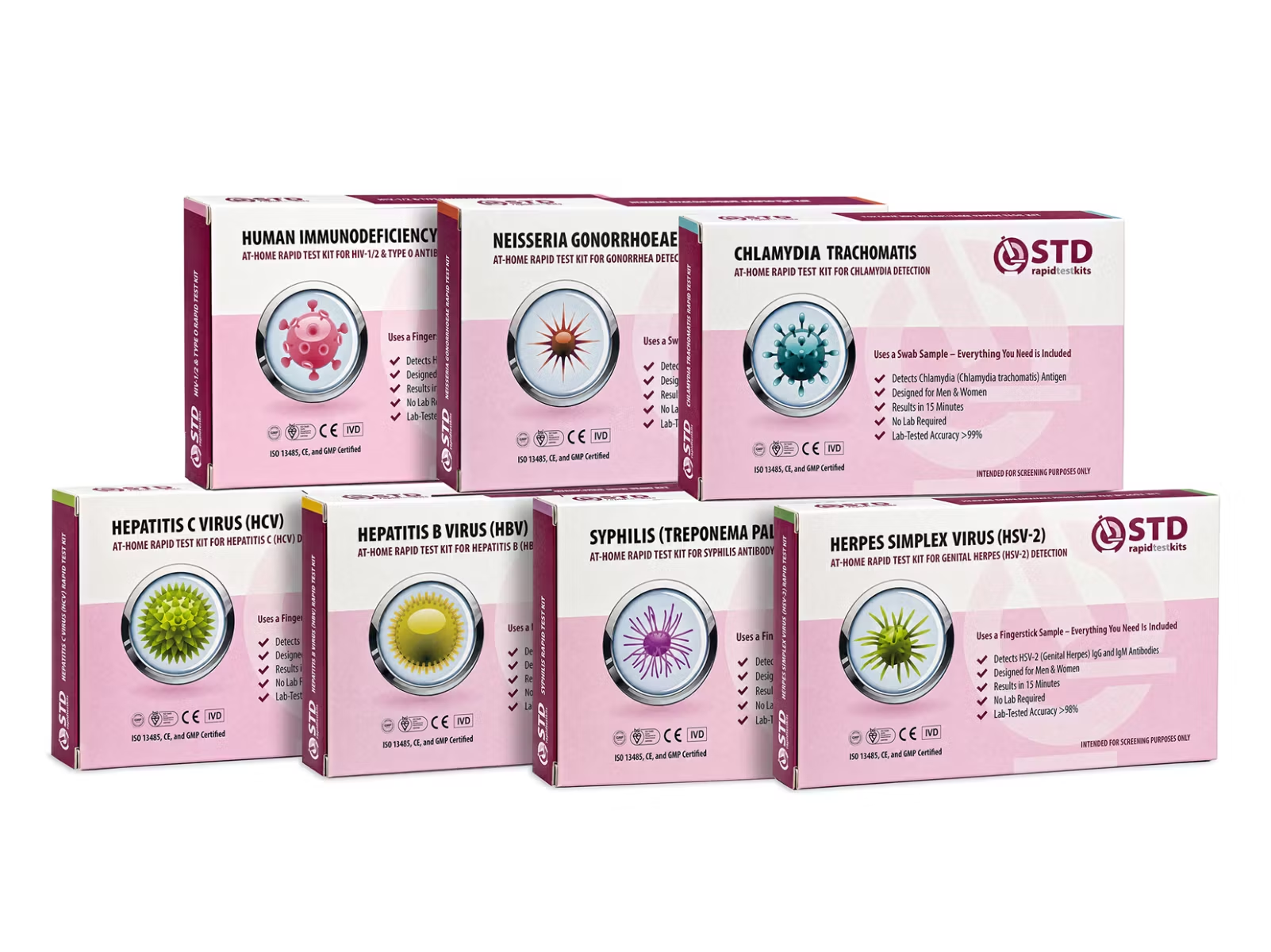
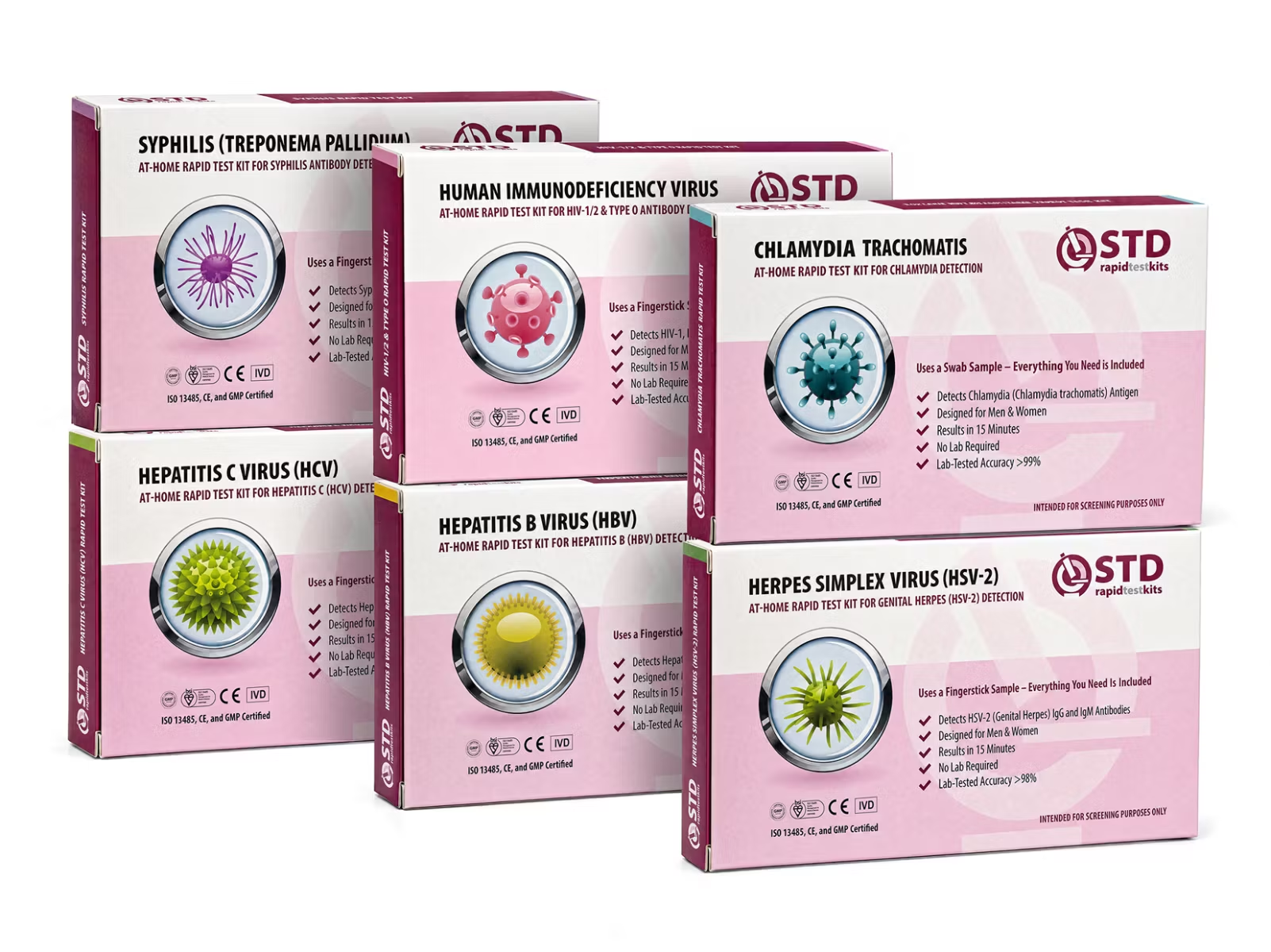
This site sells at-home rapid STI tests for bloodwork (HIV, syphilis, hepatitis B and C, herpes) and for genital self-swab (chlamydia, gonorrhea, plus trichomoniasis and HPV for women). We do not currently sell a rectal-swab home kit. For a targeted rectal NAAT after anal-sex exposure, a sexual-health clinic is the right route. The at-home kits below cover the bloodwork-and-genital side of the same exposure event and are useful as an adjacent private screen.
Anal Herpes Without Sores: Is That Possible?
Genital herpes around the anal area often presents as clusters of painful blisters or shallow ulcers. Sometimes it does not. Some people experience very mild internal episodes that feel like pressure, a brief sting during a bowel movement, or a vague tenderness that comes and goes within a day or two. Others have a first episode that registers only as systemic symptoms: low-grade fever, swollen groin lymph nodes, a few days of fatigue (NHS overview).
Asymptomatic viral shedding, the period when the virus is active on the skin without producing any visible lesion, is well documented. That is how herpes commonly transmits between partners who never see a sore. The same point applies as for bacterial infections: the absence of visible signs is not a reliable signal of the absence of infection. For HSV-2 specifically, a blood antibody test taken at least 12 weeks after a suspected exposure is the standard way to look for past infection. It is a fingerstick blood test rather than a swab of any visible area.
HSV-2 IgG antibody blood tests can detect past infection roughly 12 weeks after a suspected exposure, since seroconversion takes that long to develop reliably. Between visible outbreaks, asymptomatic viral shedding is a documented route of transmission, which is why a partner with no sores can still pass HSV-2 along.
If You Test Positive and Feel Fine
This is one of the more emotionally disorienting results in sexual-health testing. The line shows up, the diagnosis is bacterial, and the body still feels completely normal. The first reaction is often doubt: "This must be wrong. I don't feel anything."
Treatment recommendations are based on the test result, not on whether the person reports symptoms. Standard antibiotic regimens clear most uncomplicated rectal chlamydia infections. Single-dose ceftriaxone is the current first-line treatment for uncomplicated rectal gonorrhea. The result is what guides the prescription, regardless of how the person feels at the time. Finishing the full course matters even when nothing about the body seems sick.
Rectal chlamydia: doxycycline 100 mg twice daily for seven days, per <a href="https://www.cdc.gov/std/treatment-guidelines/chlamydia.htm" target="_blank" rel="noopener">CDC chlamydia treatment guidelines</a>. Rectal gonorrhea: single-dose intramuscular ceftriaxone, administered in a clinical setting, per <a href="https://www.cdc.gov/std/treatment-guidelines/gonorrhea.htm" target="_blank" rel="noopener">CDC gonococcal treatment guidelines</a>. Treatment follows the test result regardless of symptoms.
Reinfection and Partner Notification
A large share of repeat rectal infections happen because an untreated partner reintroduces the infection after the first person finishes their antibiotics. Picture the cycle. You take your prescription, you move on, and a few weeks later the same partner, who never tested, reintroduces what you both started with. Neither of you had symptoms the first time. Neither of you has them the second. The infection keeps cycling between two people who feel fine.
Partner notification serves a prevention function rather than an accusatory one, and a short, factual message tends to work better than a carefully constructed one. Something like: "I tested positive for rectal chlamydia. I had no symptoms. You should test too." Calm, direct, and respectful of the other person's agency. Many sexual-health programs also offer anonymous partner-notification services if a direct message feels too charged.
How Often Should You Screen If You Feel Fine?
For anyone with regular receptive anal sex, periodic site-specific screening is normal preventive care, similar in spirit to a dental cleaning. The CDC recommends at least annual screening for chlamydia and gonorrhea at relevant anatomic sites for men who have sex with men, and case-by-case screening for anyone else with receptive anal sex (CDC STI screening guidance). People with multiple partners, or those in settings with higher STI prevalence, sometimes test every three to six months.
Scheduled testing usually feels less stressful than reactive testing after every encounter that surfaces a worry. It moves the question from "should I be worried right now?" to "when is my next screen?" That single shift is one of the more reliable ways to reduce sexual-health anxiety while still catching what needs to be caught.
Screening intervals at a glance
- At least annually for men who have sex with men, at all relevant anatomic sites including the rectum, per CDC guidance.
- Case-by-case for others with receptive anal sex, based on partner number, condom use, and local STI prevalence.
- Every three to six months for people with multiple partners or those in higher-prevalence settings.
Long-Term Risks of Untreated Rectal STDs
The reason silent infections are worth treating is that the absence of symptoms is not the absence of consequences. Untreated rectal chlamydia and gonorrhea can:
- Persist and contribute to ongoing local inflammation in the rectal mucosa
- Increase the risk of transmitting the infection to partners during subsequent sex
- Increase vulnerability to acquiring or transmitting HIV when exposed, because rectal mucosa with active bacterial infection is more permeable to HIV (WHO STI fact sheet)
- Contribute to community-level spread, because people who don't know they're carrying an infection cannot take steps to interrupt transmission
The HIV bullet above warrants its own paragraph because it is the fear that brings many readers to this topic. Per-act HIV transmission risk from receptive anal sex with a partner who has HIV and is not on effective antiretroviral treatment is around 1 in 70 exposures (CDC HIV resources). An untreated rectal bacterial infection raises that figure further by disrupting the mucosal barrier and recruiting immune cells the virus targets. If HIV exposure is a specific concern after a high-risk event, a healthcare provider can assess eligibility for post-exposure prophylaxis (PEP), a 28-day antiretroviral course that has a 72-hour window from the exposure and is indicated whether or not symptoms are present.
None of this is meant to alarm. It gives weight to a practical point: testing, even when nothing feels wrong, interrupts a chain you cannot otherwise see, and clears an infection that would otherwise sit in place for an indefinite time.
Most rectal Chlamydia trachomatis and Neisseria gonorrhoeae infections among people who report receptive anal intercourse are asymptomatic, and identifying them depends on screening at the anatomic site of exposure.
You Deserve Answers, Not Assumptions
If "anal STD no symptoms" is the search that brought you here, the search itself tells you something. A small voice has been asking a question your body cannot answer. That is a reasonable response to an uncertain exposure, and it deserves a clear next step rather than another round of mental review.
Testing, even when you feel completely normal, is how you replace guesswork with information. It protects you. It protects the people you have sex with. And it ends the cycle of revisiting the same midnight search. If you are inside the right testing window, a private at-home screen is one available option for the bloodwork-and-genital side of an anal exposure. For the rectum itself, a clinic-administered NAAT swab remains the targeted test. Both options exist for a reason, and which one fits depends on what you have been exposed to, where, and how recently.
Whatever the result turns out to be, you handled it the right way by asking the question. That is what care looks like in practice.

FAQs
- If I had an anal STD, wouldn't I feel something?
- Often, no. Rectal chlamydia and gonorrhea are commonly asymptomatic, especially in early infection. The first warning is sometimes a partner's text saying they tested positive, or a routine screen returning an unexpected result. Testing at the right window is the only reliable signal.
- How common is it to have no symptoms at all?
- For rectal chlamydia, the majority of detected cases come from people who had no symptoms at the time of testing. Rectal gonorrhea is somewhat less predictably silent, but a substantial share still produces no noticeable signs. Prevalence in asymptomatic people is high enough that the CDC recommends routine anatomic-site screening rather than waiting for a clinical signal.
- What might mild symptoms feel like, if any appear?
- Subtle. A little extra mucus that gets blamed on diet. A faint discomfort during a bowel movement attributed to a hemorrhoid. A brief itch. Most people who notice anything dismiss it. Anything dramatic enough to be alarming is unusual for rectal chlamydia and gonorrhea.
- Can I test negative in urine but still have a rectal STD?
- Yes. Different anatomic sites act independently. A urine or genital test reflects what is in those sites; a rectal swab reflects what is in the rectum. After receptive anal sex, the rectum is the site that needs its own test.
- I'm straight. Do I really need rectal testing?
- If you have had receptive anal sex, yes. Bacteria do not reference orientation. CDC testing recommendations follow exposure, not identity. Anyone with rectal exposure can develop a rectal infection, and the testing pathway is the same regardless of how the person identifies.
- If I feel fine and my partner feels fine, are we probably okay?
- Two asymptomatic people can pass infections back and forth without either noticing. The reassurance of "we both feel fine" is not the same as "we both tested negative." Testing together turns the question from speculation into information.
- What if I test positive but I don't feel anything?
- Treatment is guided by the test result, not by symptoms. Bacterial infections like rectal chlamydia and gonorrhea respond to standard antibiotic regimens whether or not the person reports symptoms. Finishing the prescribed course matters even when the body never seemed sick.
- How soon after anal sex should I test if I have no symptoms?
- For most bacterial rectal infections, around 14 days post-exposure is the practical sweet spot. Testing earlier may detect a recent infection, but a negative at day three should be repeated. HIV and syphilis have longer windows; see the window-period table above. If you tested early because of anxiety, plan a follow-up at the right interval.
How we sourced this article: This guide synthesizes current STI screening and treatment recommendations from the U.S. Centers for Disease Control and Prevention, the World Health Organization, the NHS, and Mayo Clinic. It is written by editorial staff and reviewed by a licensed clinician for clinical accuracy. Where specific guidance is cited (window periods, recommended treatments, screening intervals), the source is linked inline. This article does not replace individual clinical advice. If you have symptoms or a known exposure, see a sexual-health provider.
- U.S. Centers for Disease Control and Prevention. Sexually Transmitted Infections Treatment Guidelines. Used here for the overall screening framework, extragenital screening recommendations, and window-period guidance.
- U.S. Centers for Disease Control and Prevention. Chlamydial Infections Treatment Guidelines. Source for the asymptomatic-rectal-infection prevalence statements and standard treatment regimens cited above.
- U.S. Centers for Disease Control and Prevention. Gonococcal Infections Treatment Guidelines. Source for the rectal-gonorrhea screening recommendation and single-dose ceftriaxone first-line regimen referenced above.
- U.S. Centers for Disease Control and Prevention. HIV resources, including transmission-risk estimates and post-exposure prophylaxis (PEP) guidance referenced above.
- World Health Organization. Sexually Transmitted Infections fact sheet. Source for the relationship between untreated bacterial STIs and increased HIV acquisition or transmission risk.
- Mayo Clinic. Patient-facing overview of chlamydia and gonorrhea, used to frame the asymptomatic-presentation pattern and symptom variability across anatomic sites in plain language.
- NHS. Sexually transmitted infections (STIs) overview. Used for the description of mild and atypical genital herpes presentations and general patient-facing context on STI testing pathways.
