
Published: August 2025 | Last updated: May 2026 | Editorial review and quality control: Martina N.
The short answer: yes, you can get tested for STDs without your name attached, but the level of anonymity depends on which route you take. At-home rapid tests give you the most direct control over what's collected and who sees the result. Clinic-based testing is confidential and protected by federal privacy law, but your identity is still on the record.
This guide walks through both paths honestly: what each one actually means for your information, how the underlying detection science works in either setting, and when each option fits the situation you're in. We also cover the part most readers underestimate, which is timing. Testing too early is a much bigger threat to a reliable result than the location you test at.
Key Takeaways
- Truly anonymous STI testing is rare in clinics. Most clinical testing is confidential, meaning your identity is recorded but legally protected under HIPAA.
- At-home rapid kits give you the most control over who sees your result, but window-period timing matters more than where you test for whether the result is reliable.
What “Anonymous” Actually Means (And Why It's Different From “Confidential”)
It's a fair question to type into a phone at 2 a.m. after a partner you weren't sure about, a symptom that showed up without warning, or just the realization that the last test was longer ago than you'd remembered. The friction usually isn't the test itself. It's the worry about where your name will end up.
The word “anonymous” gets used loosely. Medically and legally, it means something specific. According to NIH HIVinfo, “anonymous testing means you do not have to give your name when you take an HIV test. When you take the test, you receive a number. To get your HIV test results, you use the number instead of your name.” Confidential testing is different. The same NIH resource defines it as testing where your results aren't available to the public but are entered into your medical record and generally reported to local or state health departments for statistical surveillance.
Most clinic-based testing in the U.S. is confidential rather than anonymous. Anonymous HIV testing is offered at some testing sites, especially county health departments, but it's the exception. For other STIs, the standard is confidential testing inside the regular healthcare system, with strong privacy protections but a clear record of who was tested.
So which one do you actually need? If “keep my name off everything” is the priority, very few clinical pathways meet that bar strictly, and at-home testing usually gets closer. If “keep my information private but inside the system” is the priority, confidential clinic testing meets that well.
| Type | What happens to your identity | Where you'll usually find it |
|---|---|---|
| Anonymous | No name attached to sample or result | Some HIV-specific testing programs and county health departments |
| Confidential | Identity recorded, protected by HIPAA, with narrow public-health reporting exceptions | Most primary-care, urgent-care, and sexual-health clinics |
| At-home rapid test | Minimal information disclosed; result returned only to you | Direct-to-consumer rapid lateral-flow kits |
How Private Are STD Clinics, Really?
Picture the standard walk-in. You check in at the front desk, fill out a form with your name, date of birth, contact information, and often an insurance card. The intake itself answers the anonymity question. Your identity is now part of the process.
Clinics gather this information for practical reasons. Your sample, whether it's urine, blood, or a swab, has to be matched to your name so the right result reaches the right person. If something comes back positive, the clinic is responsible for making sure you get treatment, partner-notification support, and a follow-up plan. Certain infections (most commonly chlamydia, gonorrhea, syphilis, hepatitis B, and HIV) are reportable to state public-health departments in every U.S. state. Reporting is mandatory; the goal is tracking outbreaks rather than exposing individuals, and your identity is shielded inside that system, but the linkage exists.
What clinics offer, then, is privacy rather than anonymity. HIPAA covers everything in your chart, every lab requisition, every insurance claim line. The protection is robust, but the trail exists. If your concern is the trail itself, say, an explanation-of-benefits document that arrives in a shared mailbox, a chart that a family member on the same insurance plan might glimpse, or an employer-linked health record, that's worth weighing.
A few clinics, especially county health departments and some dedicated HIV testing sites, do offer anonymous HIV testing where you're assigned a code rather than identified by name. Outside HIV, that option is uncommon. For chlamydia, gonorrhea, or syphilis in a standard clinic visit, your name is on the requisition.
This article is published by stdrapidtestkits.com, which sells at-home rapid STI test kits. Products mentioned below are linked only where the kit genuinely fits the topic. If the testing approach we recommend isn't one we sell (a urine NAAT, a throat or rectal swab, a lab-processed PCR panel), we say so clearly.
At-Home Testing: What Changes When You Skip the Intake
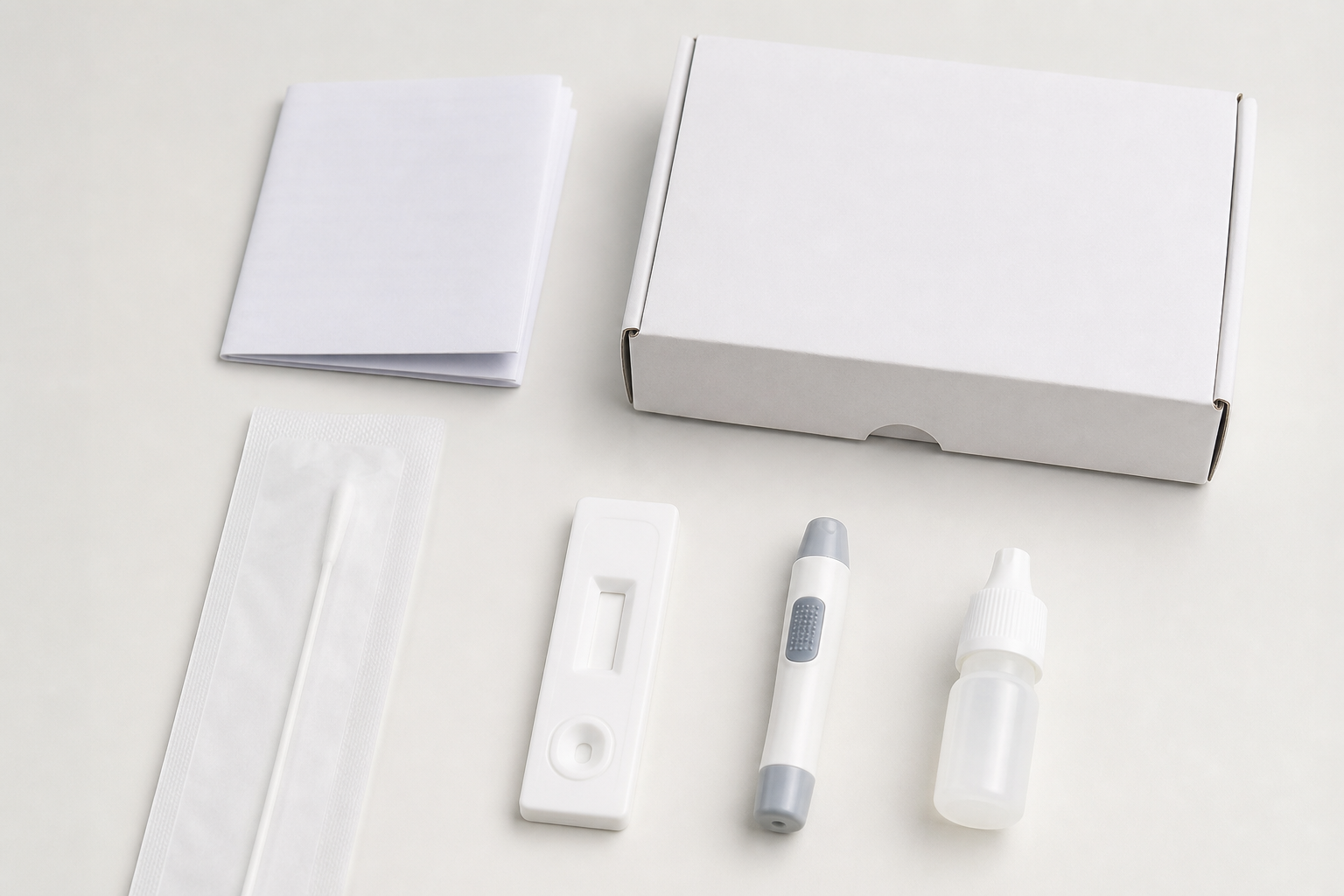
At home, the intake step disappears. You order the kit online, it arrives in plain unmarked packaging, you do the collection on your own time, and the result is returned only to you. There's no waiting room, no shared front desk, no insurance line item to explain.
Two things shift with that change. First, the kit company is not tied to a clinic system, so the result isn't filed into a medical chart unless you decide to share it with a provider. Second, you typically pay out of pocket, which removes the explanation-of-benefits and the insurance-claim trail that clinic testing usually generates.
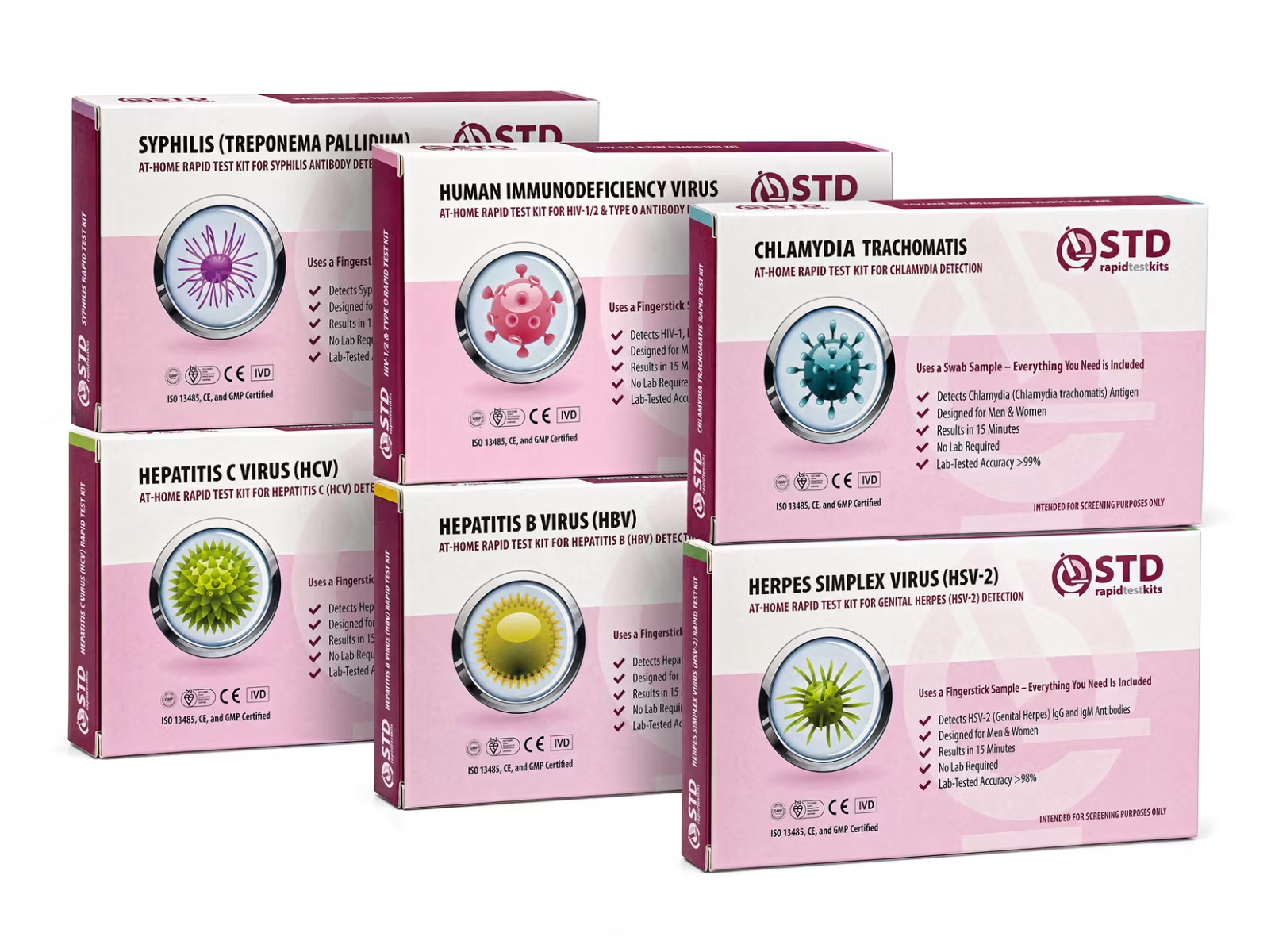
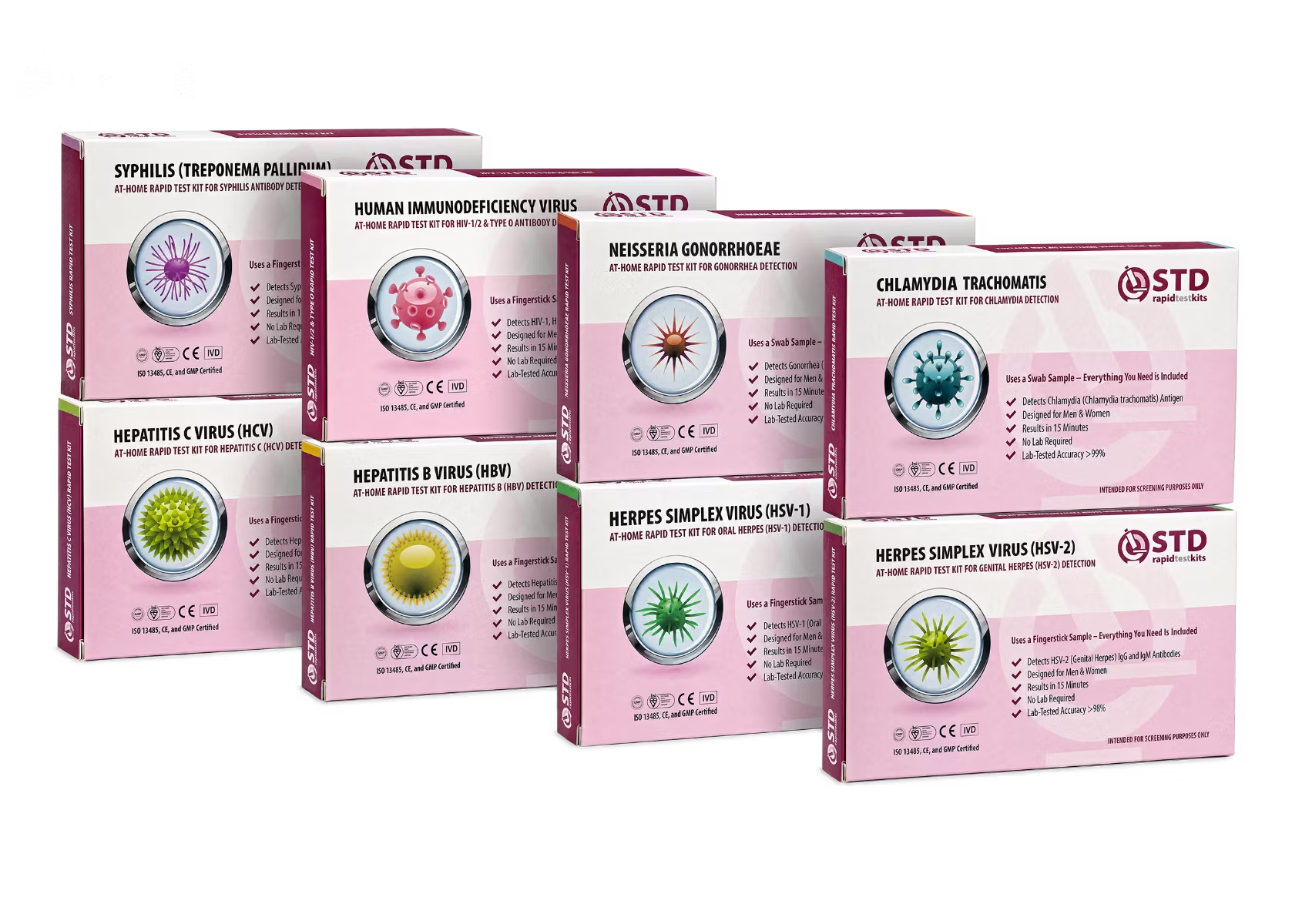
The detection science isn't identical between settings, and it's worth being precise about that. The rapid lateral-flow tests our site sells (swab-based for chlamydia, gonorrhea, trichomoniasis, and HPV; fingerstick blood for HIV, syphilis, hepatitis B, hepatitis C, and herpes) screen for the same biological markers a clinic looks for. But a clinic lab will often use NAAT (nucleic acid amplification testing) for bacterial infections, which is the laboratory standard for sensitivity. Lateral-flow rapid tests are not equivalent to NAAT; they're a faster, at-home screen with high specificity and very good (though slightly lower) sensitivity than a lab NAAT, especially for asymptomatic infections. A positive result on a rapid kit is worth confirming with a clinic-administered test before you start treatment.
Privacy doesn't mean isolation. If your at-home test is positive, the next step still involves a clinician, both for confirmation and for the prescription that treats the infection. Bacterial STIs respond to a short course of antibiotics; viral infections like HIV and hepatitis are managed long-term. The at-home path puts you in charge of when and how that contact happens, but it doesn't replace it.
One scope note: we don't sell urine-collection kits, throat-swab kits, or rectal-swab kits. If your specific exposure was oral or anal sex and you need a localized swab from those sites, a clinic visit is the right step for that part. Our rapid blood tests still cover the bloodborne risk from the same exposure event (HIV, syphilis, hepatitis), and our genital swabs cover the genital site, so the two paths can sit side by side in a complete-exposure plan.
How Timing Decides What Your Result Actually Means
The single biggest mistake people make is testing too early. The location doesn't change this. Whether you swab at home or sit in a clinic, your body needs time to reach a level the test can detect. That gap between exposure and reliable detection is called the window period, and it isn't the same for every infection.
Bacterial infections (chlamydia, gonorrhea, syphilis) and viral infections (HIV, herpes, the hepatitis viruses) all behave differently inside the body. NAATs amplify bacterial or viral genetic material, so they can flag an infection earlier than antibody tests. Antibody tests wait for your immune system to mount a response, which can take weeks. Antigen-antibody combination tests, used for HIV, sit between those two and catch infection earlier than antibody-only tests.
Approximate testing windows after a possible exposure, based on CDC STI testing guidance:
- Chlamydia: NAAT typically reliable from about 2 weeks; rapid at-home swab follows the same biology.
- Gonorrhea: NAAT reliable from about 1 to 2 weeks; rapid at-home swab is a similar window.
- Syphilis: blood antibody test typically detects from about 3 to 6 weeks; retest at 3 months if exposure is recent.
- HIV: fourth-generation antigen-antibody lab test is typically reliable from about 4 weeks, with most people detected by day 45; antibody-only rapid tests can take up to 90 days. Retest at 3 months for a definitive negative.
- Herpes (HSV-2 blood antibody test): seroconversion typically by about 12 weeks; some people take up to 16 weeks.
- Hepatitis B: blood test typically reliable from about 3 to 6 weeks.
- Hepatitis C: blood antibody test typically reliable from about 8 to 11 weeks.
A negative result inside the window period is not a definitive negative. It means the test couldn't see the infection yet, not that the infection isn't there. If exposure is recent, plan from the start to retest at the window's far end. A positive result, on the other hand, is rarely a false alarm and should be treated as a true positive while you arrange confirmatory testing.
This is why the choice between clinic and at-home matters less than it feels like it should. A clinic test taken at day 3 after exposure is no more reliable than an at-home test taken at day 3. The biology of detection is the same in both settings; timing is what changes the answer.
At-Home vs. Clinic, Side by Side
With the science and the timing set, the real comparison is about logistics: how private, how fast, how reliable for confirmation, and how connected to follow-up care. Each path has trade-offs, and the right answer depends on which trade-off you can absorb in your current situation.
Privacy wins more clearly at home. Speed depends on the test type more than the setting. Accuracy is comparable when the at-home test is timed correctly and the collection is done as instructed, though lab NAAT remains the highest-sensitivity option for confirming a positive. Follow-up is structurally easier in a clinic because the next steps are already inside the same system; at home, you take that step on your own time.
| Factor | At-home rapid test | Clinic-based testing |
|---|---|---|
| Identity recorded | Minimal (shipping name only); no medical chart entry | Full intake: name, date of birth, contact, often insurance |
| Result delivered to | You only | Clinic first, then you; also entered in your chart |
| Speed of result | Around 15 minutes for rapid lateral-flow | Same-day for in-clinic rapid tests; 1 to 3 days for lab-processed tests |
| Reliable when timed in window? | Yes; lateral-flow with high specificity and very good sensitivity | Yes; NAAT and lab blood tests with the highest sensitivity |
| Built-in follow-up | You arrange confirmation and treatment | Already inside a system that handles next steps |
| Insurance trail | None when paid out of pocket | Usually generates an EOB and a claim record |
When Privacy Should Drive the Decision (And When It Shouldn't)
The honest framing isn't “should I value privacy or not?” Most readers value both privacy and good care; the question is which of the two should weigh more in this specific situation.
Privacy is worth weighting heavily when the information itself feels exposed beyond your control. If you're on a family insurance plan and an explanation-of-benefits document arrives in a shared mailbox, a clinic visit can land in a place you didn't intend. If you live with people who might see your chart through a patient portal, or if you've moved between states and aren't sure where your records traveled, at-home testing removes that whole layer.
Privacy matters less when the clinical situation is urgent. If symptoms are worsening, if you've had a high-risk exposure that needs HIV post-exposure prophylaxis (PEP must be started within 72 hours of exposure to be effective), or if you suspect an ascending infection such as pelvic inflammatory disease, the connection to immediate clinical care is more valuable than the privacy benefit of at-home testing. Clinics are built for that hand-off. At-home testing is the better fit for routine screening, periodic check-ins, and the gap between exposure and a confirmatory clinic visit.
And biologically, your privacy choice doesn't change what your body is doing. A bacterial infection replicates whether you test anonymously or with full ID. HIV triggers the same immune response regardless of where your sample is processed. Privacy is about who sees the answer, not about the answer itself. Keeping that distinction clear helps you focus on what actually moves the needle: testing on time and acting on the result.
Confidential testing means that your HIV test results are not available to the public. Instead, your test results are included in your medical record and generally reported to local or state health departments to be counted in statistical reports. Anonymous testing means you do not have to give your name when you take an HIV test.
After You See Your Result: The Same Next Steps Either Way
The moment the result appears, the work shifts from “should I test” to “what now.” This is the part both clinic testing and at-home testing converge on, because the biological reality of a result is the same regardless of where it came from.
A negative result is reliable when you tested after the window period for that infection. If you tested earlier, the result is incomplete rather than wrong; retesting at the far end of the window is what turns “probably fine” into “definitely clear.” For higher-risk exposures, plan from the start to retest at 3 months for HIV and syphilis, and around 12 weeks for HSV-2 if you tested earlier than that.
A positive result means the test detected the infection. From there, the steps are practical: confirm with a clinic test, get the appropriate treatment, and inform recent partners so the infection isn't passed back and forth. Most bacterial STIs are treated with a single-dose or short-course antibiotic. Viral infections such as HIV and hepatitis B and C are managed long-term with medications that, for HIV in particular, can reduce the virus to an undetectable level where it can't be transmitted sexually. None of this is a personal failure; it's a medical fact pattern that's been solved many millions of times.
Partner notification is where the at-home and clinic paths look most similar. Either way, the recommendation is the same: tell recent partners so they can test and treat too. Some state health departments offer anonymous partner-notification services where they reach out on your behalf without naming you. Whether you started at home or in a clinic, that option is open to you.
FAQs
- Can I really get tested for STDs without my name attached?
- Mostly yes, depending on the route. At-home rapid testing keeps your name out of any medical system; only the shipping address and payment method touch your information, and no clinic chart entry is created. Clinic testing is confidential rather than anonymous, meaning your name is recorded but legally protected under HIPAA. True anonymous testing exists in some HIV-specific programs but is uncommon for other STIs.
- Will my health insurance see an at-home STD test?
- No, not when you pay out of pocket. At-home kits don't generate insurance claims or explanation-of-benefits documents because no insurance is involved. This is one of the most common reasons people choose at-home testing when they're on a shared family or employer plan.
- Are at-home rapid tests as accurate as lab tests?
- For screening purposes, yes, when timing is respected. Rapid lateral-flow kits catch most infections a clinic NAAT would flag, with high specificity. NAAT has higher analytical sensitivity, especially for asymptomatic chlamydia, which is why a positive rapid result is worth confirming at a clinic lab before starting treatment. The two technologies are complementary rather than interchangeable.
- What if I test too soon after a possible exposure?
- You may get a negative result that isn't actually accurate, because your body hasn't reached a level the test can see. This isn't a test failure; it's biology. Plan to retest at the far end of the window period: roughly 2 to 3 weeks for chlamydia and gonorrhea, around 3 months for syphilis, and 12 weeks for a definitive HIV negative on a fourth-generation lab test.
- Who actually sees my at-home test result?
- Only you. The result appears on the test cassette in your home; there is no automatic upload to a medical record or external database. You decide whether to share it with a clinician, a partner, or no one. If you choose to confirm a positive with a clinic afterwards, that confirmatory test enters the clinic's system normally.
- Do positive STD results get reported to the government?
- For certain infections (chlamydia, gonorrhea, syphilis, HIV, hepatitis B, and some others), yes, when the test is processed in a clinical or laboratory setting. Reporting is for public-health surveillance, not personal identification; your name is shielded inside that system. At-home rapid tests are not reported because there is no clinical entity processing the result.
- Should I retest if my first result is negative?
- If you tested inside the window period, yes. A negative inside the window isn't conclusive. Retest at the far end of the window: around 3 months for HIV and syphilis, around 12 weeks for HSV-2. If you tested outside the window for that specific infection and the result is negative, you can trust it.
- Clinic or at-home: which path should I pick?
- If privacy and self-paced timing matter most, at-home rapid testing is usually the better fit, especially for routine periodic screening. If you have active symptoms, a very recent high-risk exposure that needs PEP within 72 hours, or you want one visit that handles confirmation and treatment together, a clinic is the better fit. Both produce a real answer; the right one is the one you'll actually follow through on.
- U.S. National Institutes of Health, HIVinfo. Fact sheet on HIV testing, including the verbatim definitions of confidential and anonymous HIV testing used in this article.
- U.S. Centers for Disease Control and Prevention. STI testing guidance, recommended testing intervals, and reporting requirements.
- U.S. Centers for Disease Control and Prevention. Overview of the HIPAA Privacy Rule, the federal framework that protects identifiable health information.
- U.S. Centers for Disease Control and Prevention. HIV testing information, including test-type comparisons and where to find testing.
- NHS. Sexually transmitted infections overview, including testing process and result interpretation.
- U.S. Centers for Disease Control and Prevention. Hepatitis C information, including antibody testing window periods.
