
Published: September 2025 | Last updated: May 2026 | Editorial review and quality control: Martina N.
Pain feels like a fair warning system. When something hurts, you know to pay attention. When everything feels normal, the brain files it under fine and moves on. That instinct works for stubbing a toe. It works less well for sexually transmitted infections passed through anal contact, where the most common early picture is no symptoms at all.
Rectal chlamydia and rectal gonorrhea routinely cause nothing in the early stages. Acute HIV infection often produces only mild flu-like signs that get dismissed as a passing cold. Primary syphilis can leave a painless sore that fades on its own while the bacteria keep replicating. Treating sensation as a green light is one of the most common ways an infection gets passed to a partner before anyone realizes it is there. Public-health screening exists precisely because waiting for symptoms misses too many cases (CDC STI Treatment Guidelines).
Key Takeaways
- Most rectal chlamydia and gonorrhea infections are asymptomatic in the early window after exposure, which is why public-health bodies recommend routine screening rather than waiting for symptoms.
- Pain is not a reliable indicator. Window periods and testing timing decide whether a result is meaningful, not whether you feel fine afterward.
When "It Didn't Hurt" Doesn't Mean It Didn't Happen
A common reasoning chain after a new sexual partner goes something like this: nothing hurt during sex, nothing hurts now, so the encounter must have been low-risk. The logic is intuitive and almost always wrong for rectal infections. The rectal lining is dense in immune cells but sparse in the pain-sensing nerve endings the brain registers as alarming, especially compared with the genital tract. Inflammation can happen quietly.
That asymmetry between biology and sensation is well documented. Studies of receptive anal sex have shown that the majority of rectal chlamydia and rectal gonorrhea cases are picked up only because someone tests during routine screening, not because they noticed anything was wrong (CDC, Chlamydial Infections guidelines). The same pattern appears in heterosexual populations engaging in receptive anal sex and in clinics that screen regardless of symptoms.
Anal sex is not uniquely dangerous. The body simply does not consistently sound an alarm when a bacterial colonization begins in the rectum. Some people notice a vague pressure or an itch they assume is friction. Most notice nothing. By the time signs do appear, the infection has often been transmissible for weeks.
The rectal mucosa has far fewer pain-sensing nerve endings than external skin. Inflammation can begin and progress without producing the burning or sharp discomfort the brain registers as alarming. That difference is anatomical, not behavioral.
Why Anal Contact Carries a Different Biological Risk
The rectum is a transmission-friendly environment for several reasons that have nothing to do with stigma. The lining is one cell thick in places, compared with the multi-layer stratified epithelium of the vaginal canal. That single layer of columnar cells is where HIV can directly engage immune receptors and enter the bloodstream without needing a visible wound (WHO HIV/AIDS fact sheet).
Two other factors compound the risk. The rectum has a rich blood supply and is highly absorptive by design, which is helpful for water reabsorption and unhelpful for keeping pathogens out. Microabrasions during sex are common even when nothing feels rough, with most going unnoticed by the person they happen to. Pre-ejaculate fluid can also carry HIV, gonorrhea, chlamydia, and other pathogens, which means transmission does not require ejaculation to occur (CDC STI Treatment Guidelines).
Condoms reduce risk substantially when used correctly, and lubrication reduces microabrasions further. Neither tool eliminates exposure entirely. Skin-to-skin infections such as herpes and early syphilis can spread from areas a condom does not cover.
The rectal lining is one cell thick in places, compared with the multi-layer stratified epithelium of the vaginal canal. That single layer is where pathogens can engage immune receptors directly, which is why per-act HIV transmission risk during receptive anal sex is meaningfully higher than during vaginal intercourse.
What Rectal STD Symptoms Actually Look Like (When They Appear)
When symptoms do appear, they tend to be quiet rather than dramatic. The most commonly reported signs include mild rectal pressure, faint discharge noticed only on toilet paper, an unfamiliar urge to use the bathroom without much result, or a low-grade itch that comes and goes. None of these are specific to infection. All of them overlap with hemorrhoids, irritation from intercourse, or even a passing food sensitivity.
More definite signs include visible discharge from the rectum, rectal bleeding unrelated to a bowel movement, pain during defecation, painful regional lymph nodes, or a small ulcer too high in the canal to see. These tend to be less common as a first sign and more common in later or untreated infection. Primary syphilis can produce a painless rectal chancre that resolves on its own in three to six weeks, which is one reason the disease often progresses undiagnosed (Mayo Clinic, Syphilis symptoms and causes).
Routine screening exists precisely because waiting for sensation misses too many infections to be useful as a triage tool.
| Infection | Can be transmitted through anal sex? | Is pain typical? | Asymptomatic share |
|---|---|---|---|
| Chlamydia (rectal) | Yes | No | Very high (often 70% or more) |
| Gonorrhea (rectal) | Yes | Sometimes mild | High (around 40 to 60%) |
| HIV (acute) | Yes | No (mild flu-like at most) | Frequent |
| Herpes (HSV-1 or HSV-2) | Yes | Sometimes burning or sores | Can be mild or unnoticed |
| Syphilis (primary) | Yes | Usually painless chancre | Often unnoticed |
How Often Rectal Infections Stay Quiet
Surveillance studies and clinic-based screening data give a fairly consistent picture. For rectal chlamydia, the asymptomatic rate is high enough that most cases identified in routine screening would have been missed by symptom-based testing alone. Different studies report figures in the 70 percent range and higher among men who have sex with men, with meaningful asymptomatic rates among women practicing receptive anal sex as well (CDC, Chlamydial Infections guidelines).
Clinic-based screening studies report asymptomatic rates in the 40 to 60 percent range for rectal gonorrhea (CDC Gonococcal Infections guidelines). Acute HIV is often described as flu-like rather than absent, though the symptoms are mild and brief and frequently get attributed to a passing viral illness.
Primary syphilis is its own category. The chancre is classically painless and can sit inside the anal canal where the person never sees it. Many people only learn they had primary syphilis after a routine antibody screen picks them up during the secondary stage. Untreated rectal chlamydia and gonorrhea can persist for months, raising HIV acquisition risk and continuing to reach new partners whether the carrier notices anything or not.
| Infection | Approximate asymptomatic rate | Why it gets missed |
|---|---|---|
| Chlamydia (rectal) | Up to 70 to 80% in some populations | Few or no rectal symptoms |
| Gonorrhea (rectal) | Around 40 to 60% | Symptoms confused with irritation |
| HIV (early) | Variable; many cases mild or absent | Flu-like signs dismissed as a cold |
| Syphilis (primary) | Frequently asymptomatic externally | Chancre is painless and often hidden in the canal |
If You Feel Normal, Should You Still Test?
For sexually active adults with new or multiple partners, the CDC currently recommends STI screening every three to six months, with closer-interval testing for higher-exposure activity (CDC STI Treatment Guidelines). The recommendation is not based on whether someone feels symptoms. It is based on the asymptomatic-rate data above and the public-health goal of catching infections before they transmit further.
After a new partner, after a condom break or slip, after any encounter that leaves a small uncertainty in the back of the mind, testing converts that uncertainty into a definite answer. Anxiety after sex is one of the most common reasons readers search for STD information late at night. Acting on it through screening tends to resolve the worry faster than waiting for the body to produce a symptom.
Testing also opens the door to early treatment for anything that gets detected. Most rectal infections clear with appropriate antibiotics, and early detection of HIV allows treatment to begin while viral load is still low.
Can you have a rectal STD without any pain?
Yes, frequently. Rectal chlamydia is asymptomatic in roughly 70 percent of cases and rectal gonorrhea in 40 to 60 percent. Acute HIV is usually mild and flu-like rather than painful, and primary syphilis often produces a painless sore. Reliable detection depends on testing at the right point in the window period for each infection, not on whether you feel a symptom.
The Timing Trap: Why Day Three Lies
One of the most common testing mistakes is testing too early. Every infection has a window period between exposure and reliable detection. A negative test inside that window is not the same as a clean result. It is a snapshot taken before the test can pick up the signal.
For chlamydia and gonorrhea, nucleic acid amplification testing (NAAT, the laboratory standard that detects bacterial DNA or RNA in the sample) can pick up infection within about a week of exposure, with stronger reliability by day 14. For HIV, fourth-generation antigen-antibody tests usually become reliable somewhere between 18 and 45 days, with confirmatory retesting at six weeks for high-risk exposure. For syphilis, antibody-based testing typically requires three weeks or more, with full reliability by six to twelve weeks (Mayo Clinic, Syphilis).
A negative test inside any of those windows tells you only that the test could not yet detect the infection. It does not rule it out.

Protected Anal Sex Is Lower Risk, Not Zero Risk
Condoms are one of the most effective sexual-health interventions available. Used correctly and consistently, they substantially reduce transmission of HIV, gonorrhea, chlamydia, hepatitis B, and several other infections. None of those reductions reach zero.
Mechanically, condoms can break, slip, or be applied late after some skin-to-skin contact has already occurred. Real-world failure rates run higher than ideal-use rates. Anatomically, some infections (including herpes simplex virus and early syphilis) transmit through skin-to-skin contact in regions a condom does not cover. A perfectly used condom does not prevent contact between the base of the penis, the perineum, or the scrotum and a partner's skin (NHS, sexually transmitted infections).
Condom use changes the risk math substantially, but not to zero. After a condom failure, after a new partner, or after a high-risk encounter with intact protection, a test at the appropriate window period catches what prevention did not.
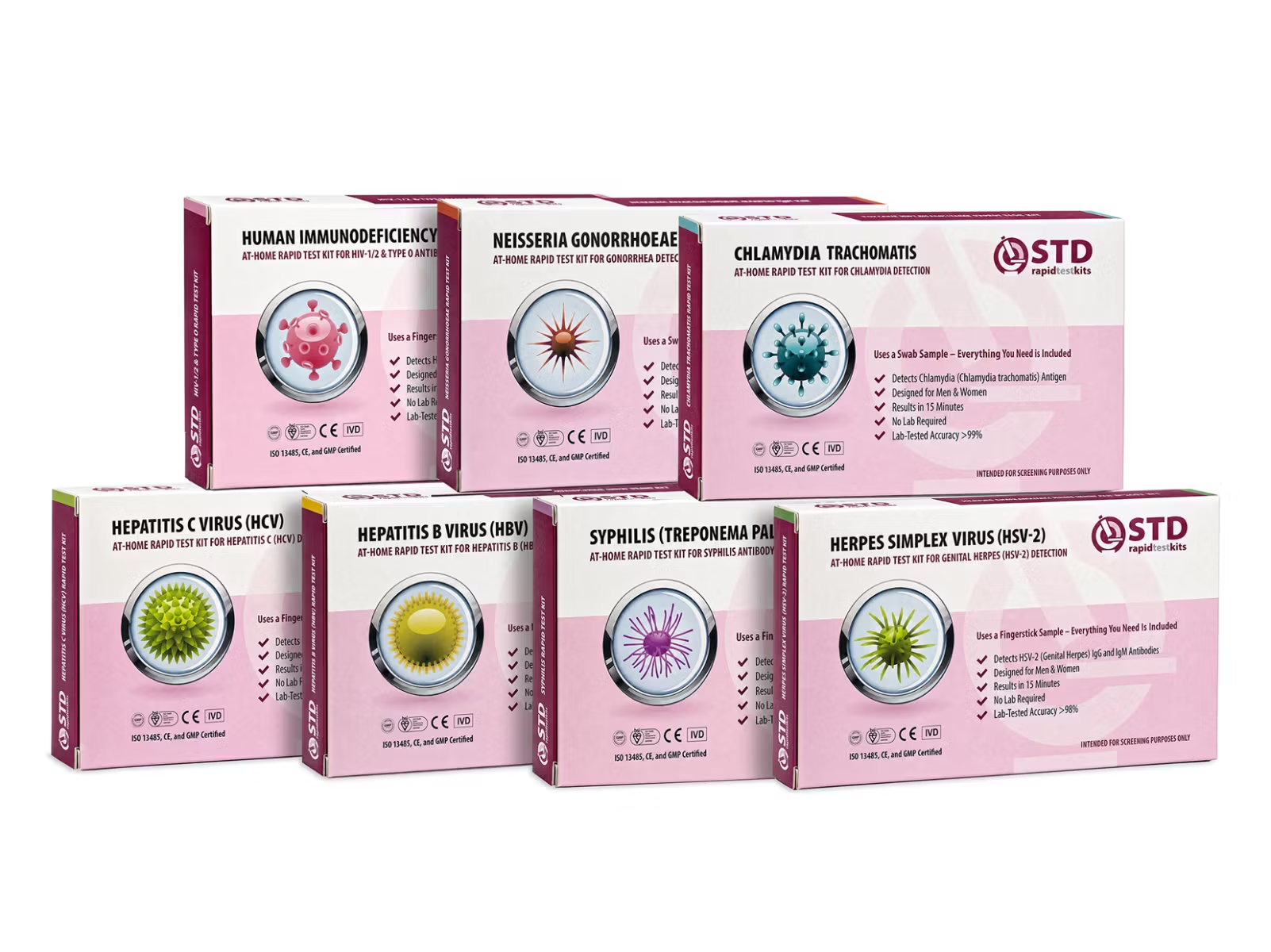
This site sells at-home rapid STI tests; the panel below covers the infections most relevant to a new-partner exposure.
Can You Get HIV Without Ejaculation?
HIV transmission without ejaculation is possible. Pre-ejaculate fluid can carry the virus when a partner's viral load is high, and receptive anal sex carries higher per-act risk than most other sexual activities because of the rectal lining's vulnerability (WHO HIV/AIDS fact sheet). What changes the picture entirely is effective antiretroviral treatment: a partner with a sustained undetectable viral load does not transmit HIV sexually, regardless of whether ejaculation occurs. Viral load and treatment status are the variables that matter most.
Pre-exposure prophylaxis (PrEP) shifts the risk further for the receptive partner. Taken consistently, PrEP reduces sexual HIV acquisition by roughly 99 percent. Post-exposure prophylaxis (PEP), started within 72 hours of a high-risk exposure, is also available through clinics and emergency rooms for events where neither partner was on PrEP and one is HIV-positive or status-unknown.
Whether ejaculation occurred is one variable among several. Treatment status, condom use, PrEP, and partner viral load all shape the underlying risk meaningfully.
A partner on effective antiretroviral therapy with a sustained undetectable viral load does not transmit HIV sexually. Large prospective studies of mixed-status couples confirm zero linked transmissions under these conditions, regardless of condom use.
Window Periods After Anal Sex: Reading the Calendar
Different infections become detectable at different speeds, and the type of test matters as much as the time elapsed. NAAT, the standard for chlamydia and gonorrhea, detects bacterial DNA or RNA and tends to become reliable sooner than antibody-based tests. Antibody-based tests for syphilis and HIV measure the immune system's response, which takes time to develop.
The table below summarizes typical testing windows. These are guidelines rather than hard cutoffs, and individual response varies. Earlier testing is useful for evaluating symptoms, while later testing inside the recommended window gives the most reliable negative result.
| Infection | Earliest reliable test | Best window for high accuracy | Retest recommended? |
|---|---|---|---|
| Chlamydia (NAAT) | About 7 days | Around 14 days | Yes if tested before day 14 |
| Gonorrhea (NAAT) | About 7 days | Around 14 days | Yes if tested early |
| HIV (4th-gen antigen/antibody) | 18 to 21 days | 45 days | Yes at 6 weeks to confirm |
| Syphilis (antibody) | About 3 weeks | 6 to 12 weeks | Yes if early test negative |
| Herpes (swab of active lesion) | 2 to 12 days | Blood antibody test after 6+ weeks | Depends on whether lesions present |
Hemorrhoids, Friction, or an STD?
A week or two after sex, mild rectal symptoms are easy to attribute to causes other than infection. Hemorrhoids are common and can produce itching, mild bleeding, and a feeling of pressure. Friction from sex without enough lubrication can cause minor irritation that resolves on its own. Anal fissures from straining are similarly common and unrelated to STIs.
Distinguishing these from rectal infection on symptoms alone is unreliable, because the early-infection picture overlaps almost perfectly with everyday irritation. The clinical tools that separate them are testing and time. Short-lived irritation typically resolves within days. A low-grade infection often does not, but it may also not get worse fast enough to force a clinic visit on its own.
If symptoms persist for more than a week after a recent exposure, or if anything looks unusual (visible discharge, rectal bleeding outside of a bowel movement, a new sore), the right step is testing or a clinic appointment (Johns Hopkins Medicine, STIs overview).
Routine screening for chlamydia and gonorrhea is recommended because most infections are asymptomatic, and untreated infections increase the risk of transmission to partners.
What Happens If a Painless Infection Goes Untreated
The word untreated sounds catastrophic in general health writing, and that framing does not match the actual outcomes for most rectal STIs. Antibiotics clear bacterial infections like chlamydia and gonorrhea reliably. Penicillin remains effective against syphilis at every stage. Modern HIV treatment produces near-normal life expectancy and prevents onward transmission.
The real issues with delayed treatment are different. Untreated rectal chlamydia and gonorrhea can persist for many months, during which transmission to partners continues. Persistent rectal gonorrhea can spread to the genital tract or contribute to pharyngeal infection through oral contact. Untreated syphilis progresses through stages with widening systemic consequences, including cardiovascular and neurological involvement if neglected long enough. Acute HIV that goes undetected can be transmitted at much higher rates because viral load is highest during the first weeks (CDC STI Treatment Guidelines).
If detection is delayed
- Untreated rectal chlamydia and gonorrhea remain transmissible for many months and can spread to genital or pharyngeal sites.
- Untreated syphilis progresses through secondary and tertiary stages, with cardiovascular and neurological involvement possible after years.
- Acute HIV (the first weeks after infection) carries the highest per-act transmission risk; early detection lowers both individual viral load and onward transmission.
Bottoming, Topping, and Activity-Based Risk
Conversations about anal sex sometimes assume one role carries all of the risk. The reality is more uneven. Receptive partners face higher per-act transmission risk for several infections, primarily because the rectal lining is more vulnerable to bacterial and viral entry than penile tissue. Insertive partners are not exempt. Transmission can occur through contact with rectal secretions, mucosal exposure at the tip of the penis, or skin-to-skin contact with infectious lesions.
Risk follows activity rather than identity. Someone who identifies as straight, gay, bisexual, or unlabeled can carry the same biological exposure pattern depending on the specific sexual practices involved. Survey data has long underestimated the prevalence of anal sex in heterosexual populations, which means screening recommendations that omit role-relevant questions miss a substantial share of cases (WHO STI fact sheet).
For anyone planning a testing strategy, the relevant variables are sample sites (urethra, rectum, throat) and the activities that involved them, not labels or assumed risk profiles. A useful conversation with a clinician centers on what happened anatomically, not on how someone identifies socially.
Prevention That Actually Fits Real Life
Fear-based messaging about STIs has a poor track record of changing behavior. What does work is access, information, and routine. Consistent condom use lowers transmission risk substantially. Adequate water-based or silicone-based lubrication reduces microabrasions during anal sex. When partners do not know their own status, infections pass silently, so honest conversations about testing history reduce a significant share of new transmissions.
For people with new or multiple partners, screening every three to six months keeps the asymptomatic-case load from accumulating. For people on HIV pre-exposure prophylaxis (PrEP), quarterly screening is already built into the prescribing protocol, which catches incidental STI exposures early. For people who use barriers inconsistently, a closer screening interval and a baseline conversation with a clinician about post-exposure prophylaxis (PEP) for HIV after high-risk events is worth having in advance.
Sustainable prevention looks like a few habits maintained over time: carrying condoms, using lube, testing on a schedule, and talking to partners before sex when possible.
Practical prevention checklist
- Use condoms consistently and pair them with water-based or silicone-based lubricant to reduce microabrasions.
- Test every 3 to 6 months if you have new or multiple partners; quarterly if you are on PrEP.
- Discuss PrEP with a clinician if exposure frequency warrants it.
- Know about PEP in advance: a 28-day antiretroviral course started within 72 hours of a high-risk exposure can prevent HIV seroconversion.
What to Do Right Now If You Feel Fine
Pain is not the gatekeeper of sexual health. Plenty of infections produce no discomfort, and plenty of discomfort points to something other than infection. Sensation is a poor decision-making tool in this category, which is why every credible public-health body recommends testing on a calendar rather than waiting for the body to give a signal.
Anal sex is a sexual activity with specific biological realities, the same way other practices have theirs. Understanding those realities makes the decision to test easier and the conversation with a partner less awkward.
If you are sitting with uncertainty right now, the practical move is to check the table of typical testing windows above, count the days since the encounter in question, and either test today or set a reminder for the appropriate window. A result at the right window period takes the uncertainty off the table.
Frequently asked questions
- If nothing hurt during or after anal sex, could I still have caught an STI?
- Yes. Rectal chlamydia is asymptomatic in roughly 70 percent of cases and rectal gonorrhea in 40 to 60 percent. The rectal lining has limited pain-sensing nerve endings, so the absence of discomfort reflects anatomy rather than the absence of infection. Routine screening exists for exactly this reason.
- How long should I wait to test if I have no symptoms?
- Window periods vary by infection. Chlamydia and gonorrhea (NAAT) are typically reliable by day 14. Fourth-generation HIV testing is most reliable by day 45 with a six-week confirmation. Syphilis antibody testing usually requires three weeks and is fully reliable by six to twelve weeks. Testing before these windows can produce a false negative.
- We used a condom the whole time. Am I in the clear?
- Condoms substantially reduce risk for HIV, chlamydia, gonorrhea, and hepatitis B but do not eliminate it. Breakage, slippage, late application, and skin-to-skin infections such as herpes and early syphilis can still transmit. Testing on the recommended schedule after a new partner is the standard recommendation regardless of condom use.
- Can you get HIV without ejaculation?
- Yes. Pre-ejaculate fluid can contain HIV if a partner is HIV-positive and not on effective treatment. The risk drops to effectively zero when a partner is on antiretroviral therapy with a sustained undetectable viral load. Viral load and treatment status matter much more than whether ejaculation occurred.
- Can a rectal STI feel like hemorrhoids?
- Often, yes. Mild pressure, itching, and a vague sense of fullness overlap heavily between minor irritation and early infection. Symptoms that persist beyond a week after exposure, or any visible discharge or rectal bleeding outside of bowel movements, should prompt testing rather than self-diagnosis.
- If I test positive without ever having symptoms, is the infection more serious?
- No. Asymptomatic infections are common, especially in the rectum, and treatment is the same as for symptomatic infections: appropriate antibiotics for bacterial infections, antivirals or treatment plans for viral infections, and partner notification to interrupt transmission. The earlier the detection, the simpler the resolution.
- How often should someone who has anal sex get tested?
- Every 3 months if you have multiple or new partners. Quarterly screening is already built into PrEP prescribing protocols and is the default for many sexual-health clinics serving high-exposure populations. The CDC's basis for this interval is the high asymptomatic-infection rate, not the frequency of symptoms.
- Does painless mean less contagious?
- No. Transmission risk is independent of how the infected person feels. Asymptomatic infections are transmitted at rates similar to symptomatic ones, which is the public-health reason routine screening exists in the first place.
- U.S. Centers for Disease Control and Prevention. STI Treatment Guidelines. General reference for screening recommendations and treatment protocols across rectal, urethral, and pharyngeal infections, and for the pre-ejaculate transmission framing.
- U.S. Centers for Disease Control and Prevention. STI Treatment Guidelines, Chlamydial Infections. Source for rectal chlamydia asymptomatic-rate context and treatment recommendations.
- U.S. Centers for Disease Control and Prevention. STI Treatment Guidelines, Gonococcal Infections. Source for rectal gonorrhea screening guidance and treatment recommendations.
- World Health Organization. Sexually transmitted infections fact sheet. Source for global STI overview and the under-screening framing for heterosexual populations engaging in receptive anal sex.
- World Health Organization. HIV/AIDS fact sheet. Source for HIV transmission risk framing, pre-ejaculate transmission, and the Undetectable equals Untransmittable principle.
- Mayo Clinic. Syphilis: symptoms and causes. Source for primary syphilis (painless chancre) presentation and antibody window.
- NHS. Sexually transmitted infections (STIs). Source for condom-effectiveness framing and UK public-health guidance.
- Johns Hopkins Medicine. Sexually transmitted diseases. Clinical reference summary used for triage between hemorrhoids and rectal infection.
