Dating Someone With an STD: How to Stay Safe
What actually keeps both partners safe when one has an STD




- Layered protection (treatment, condoms or barriers, vaccination, and routine testing) drops transmission risk for almost every STD to a level most couples can live with comfortably.
- For HIV, antiretroviral therapy that maintains an undetectable viral load means the virus is not sexually transmissible, which the CDC summarizes as Undetectable = Untransmittable.
Published: November 2025 | Last updated: May 2026 | Editorial review and quality control: Martina N.
Can you date someone with an STD and stay safe?
Yes. The right combination of layers (treatment for the positive partner, condoms or barriers, vaccination, PrEP for an HIV-negative partner, and routine testing) lowers transmission risk for nearly every STI to a level most couples are comfortable with. Bacterial infections clear with antibiotics; viral ones are managed long-term.
Dating someone who has an STD, or dating after you yourself have tested positive, is not the catastrophe a lot of people are afraid of. Most sexually transmitted infections are either curable with a short course of antibiotics, controllable with medication that drops transmission risk close to zero, or already so common in adult populations that the framing of who is and is not “clean” misses the point. The real questions are practical: which infection, which precautions, which medications, and how often you both test.
This guide walks through how to think about that calmly, from both sides. If your partner has the diagnosis, you will find honest math on transmission risk and the prevention tools that actually work. If you are the one who tested positive, there are specific scripts for telling someone new, timing rules for when you can have sex again, and a practical take on apps and disclosure. The information is synthesized from CDC, WHO, and NHS guidance plus the peer-reviewed studies the public-health agencies cite. Disclosure: this site sells at-home rapid STI test kits, and we reference our own products in this article where they fit the reader's situation; recommendations are based on fit-for-purpose, not commercial benefit.
Understanding the real transmission risk
The first thing to recalibrate is the size of the risk. A lot of dating advice treats every STD as roughly equivalent, but the actual transmission probabilities, treatments, and consequences are very different. The CDC's STI program groups infections by whether they are bacterial (curable with antibiotics), viral and manageable (controllable with medication), or viral and self-clearing (often resolve on their own).
Within those buckets, what matters for dating is four variables: how the infection transmits, whether the infected partner is on treatment, whether barriers are used consistently, and whether the uninfected partner has access to prevention tools like the HPV vaccine or pre-exposure prophylaxis (PrEP) for HIV. Change any of those variables and the risk profile shifts substantially.
It also matters whether the infection is currently active. Bacterial infections like chlamydia, gonorrhea, and syphilis stop transmitting once treatment is complete and the partner has been re-tested. Viral infections like herpes and HPV can transmit during asymptomatic periods, which is why suppressive medication and routine testing carry more weight in those relationships. HIV, paradoxically, has one of the most reassuring risk profiles of any chronic STI when the positive partner is on consistent treatment, per CDC HIV prevention guidance.
Four variables that move the risk
- Type of infection: bacterial (curable), viral and manageable, or viral and often self-clearing.
- Whether the positive partner is on consistent treatment that suppresses or eliminates the infection.
- Whether barriers (condoms, dental dams) are used correctly and consistently.
- Whether the uninfected partner has access to vaccines (HPV, hepatitis B) or PrEP for HIV.
Different STDs mean different strategies
The biggest practical mistake couples make is treating “my partner has an STD” as a single situation. It is not. The table below summarizes how the most common infections behave in a dating context, what tools meaningfully reduce risk, and the one consideration each one demands from a couple.
The point of the comparison is to show that the work in front of you depends on which infection you are dealing with. A relationship where one partner has fully treated chlamydia requires a re-test and routine future screening. A relationship where one partner has HIV on suppressive therapy is genuinely lower-risk than a serodifferent relationship (one where one partner has the infection and the other does not) with an untreated infection. A relationship involving herpes will lean more on suppressive medication and the willingness to abstain during outbreaks.
| Infection | Curable? | What lowers transmission | Key thing to know |
|---|---|---|---|
| Chlamydia | Yes, with antibiotics | Complete treatment, re-test, condoms | Often asymptomatic; complete the full antibiotic course before resuming sex |
| Gonorrhea | Yes, with antibiotics | Complete treatment, re-test, condoms | Some strains are increasingly drug-resistant; clinician-directed treatment matters |
| Syphilis | Yes, with antibiotics | Early treatment, condoms, abstain until cleared | Visible chancres are highly infectious; treatment is highly effective in early stages |
| Trichomoniasis | Yes, with antibiotics | Both partners treated, condoms | Reinfection rates are high if a partner is missed |
| Genital herpes (HSV-2) | No, but manageable | Daily suppressive antivirals, condoms, abstain during outbreaks | Can transmit during asymptomatic shedding |
| HIV | No, but manageable | Antiretroviral therapy to undetectable, PrEP for partner, condoms | Undetectable viral load = effectively no sexual transmission |
| HPV | Most clear on their own | HPV vaccination for the uninfected partner, condoms, cervical screening | Vaccine still useful even if partner has one strain; many adults clear infection within 1 to 2 years |
| Hepatitis B | Vaccine-preventable; chronic cases manageable | Hepatitis B vaccination, condoms | Vaccine is highly effective; partners should get it if not already immune |
How to reduce transmission
Most public-health guidance comes down to a layered approach: pick the tools that fit the specific infection, and use them consistently. No single tool is foolproof, but the layers compound, and the combined risk reduction in real-world relationships is substantial.
Barrier protection. Condoms, when used consistently and correctly, reduce the per-act probability of transmission for nearly every STI. The WHO STI fact sheet describes correct and consistent condom use as one of the most effective methods of protection against STIs. Dental dams reduce oral-genital transmission. Gloves help when there is contact with open sores or genital tissue and a partner has cuts on the hand.
Suppressive antiviral medication for herpes. Daily valacyclovir or acyclovir lowers the frequency and severity of outbreaks and reduces asymptomatic viral shedding. A 2004 placebo-controlled trial (Corey et al., New England Journal of Medicine) found that daily suppressive valacyclovir reduced transmission to the uninfected partner by roughly 48 percent compared with placebo, with further reductions when condoms were added. The CDC's genital herpes resources describe daily suppressive therapy as a way to lower the risk of spreading the virus to a partner.
Antiretroviral therapy for HIV. This is the single biggest shift in HIV prevention in the past decade. The CDC currently advises that a person who is on effective HIV treatment and maintains an undetectable viral load has effectively no risk of sexually transmitting the virus to an HIV-negative partner.
PrEP and PEP. The HIV-negative partner can take daily pre-exposure prophylaxis to reduce their own risk of acquiring HIV. The CDC's clinical PrEP guidance states that, when taken as prescribed, both oral and injectable PrEP reduce the risk of getting HIV from sex by about 99 percent. Post-exposure prophylaxis (PEP) is the 28-day emergency regimen for exposures within the previous 72 hours.
Vaccines. The HPV vaccine is routinely recommended through age 26 by ACIP, with shared clinical decision-making available through age 45 per the CDC's HPV vaccination program. The hepatitis B vaccine is similarly effective. If your partner has HPV or hepatitis B and you are not yet vaccinated, this is one of the highest-yield steps you can take.
- Barrier protection: condoms, dental dams, gloves where appropriate.
- Suppressive antivirals for herpes: daily valacyclovir or acyclovir.
- Antiretroviral therapy for HIV: maintains an undetectable viral load.
- PrEP or PEP: HIV-negative partner takes daily PrEP or a 28-day PEP course after a high-risk exposure.
- Vaccines: HPV and hepatitis B vaccination for the uninfected partner.
Testing as part of the relationship
Routine testing matters whether or not one partner already has a known infection. It catches asymptomatic infections, gives both partners a current baseline, and removes the awkward question of what changed since the last conversation.
The CDC and WHO both support at-least-annual screening for sexually active adults, with more frequent screening (every three to six months) if either partner has new partners, condomless sex with non-monogamous partners, or any new symptoms. UK guidance from the NHS is more risk-based, advising clinic testing when symptoms appear or after casual sex without a condom with a new partner. Couples in mutually monogamous relationships with both partners tested at baseline can often go longer between repeat tests.
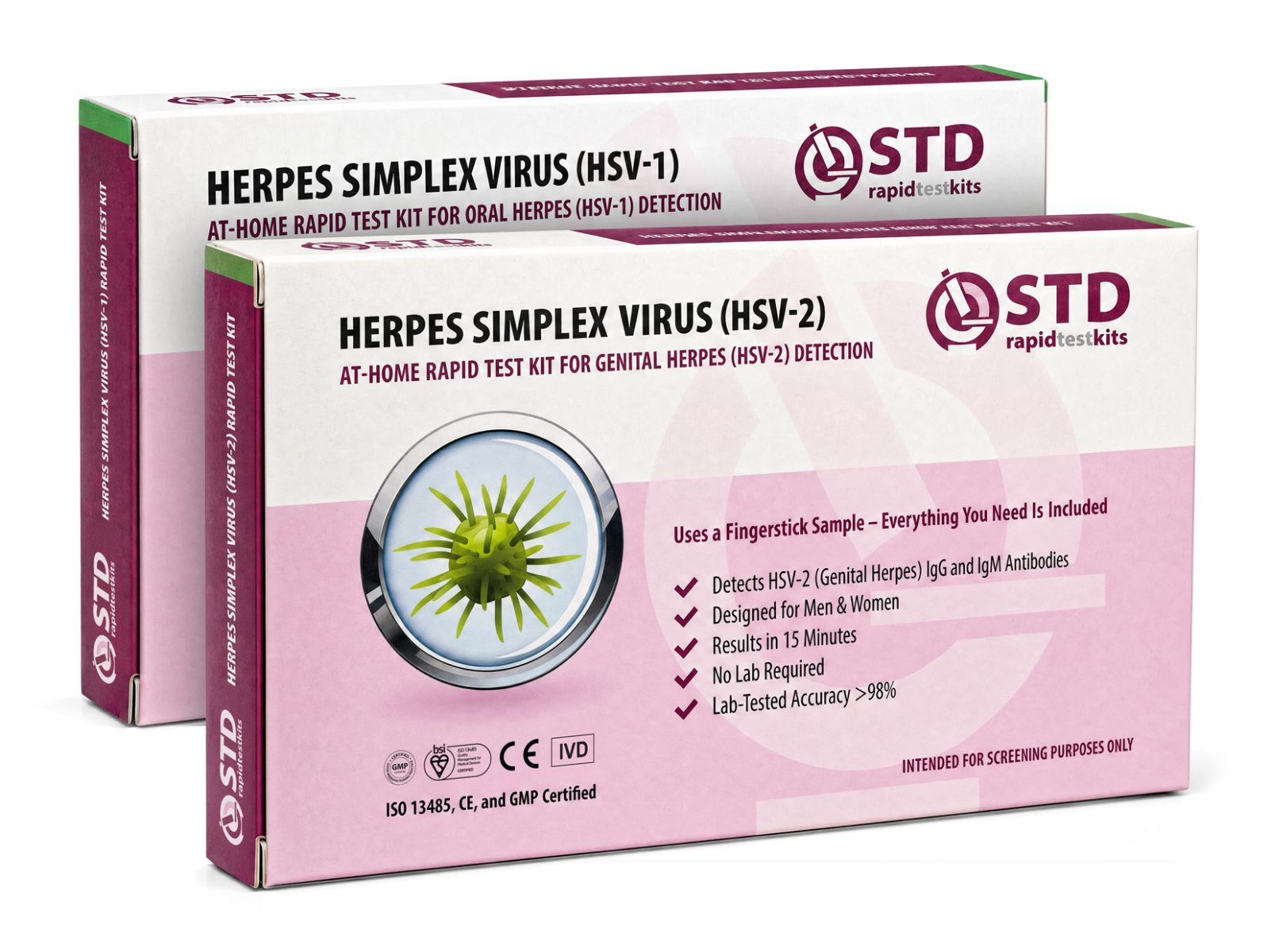
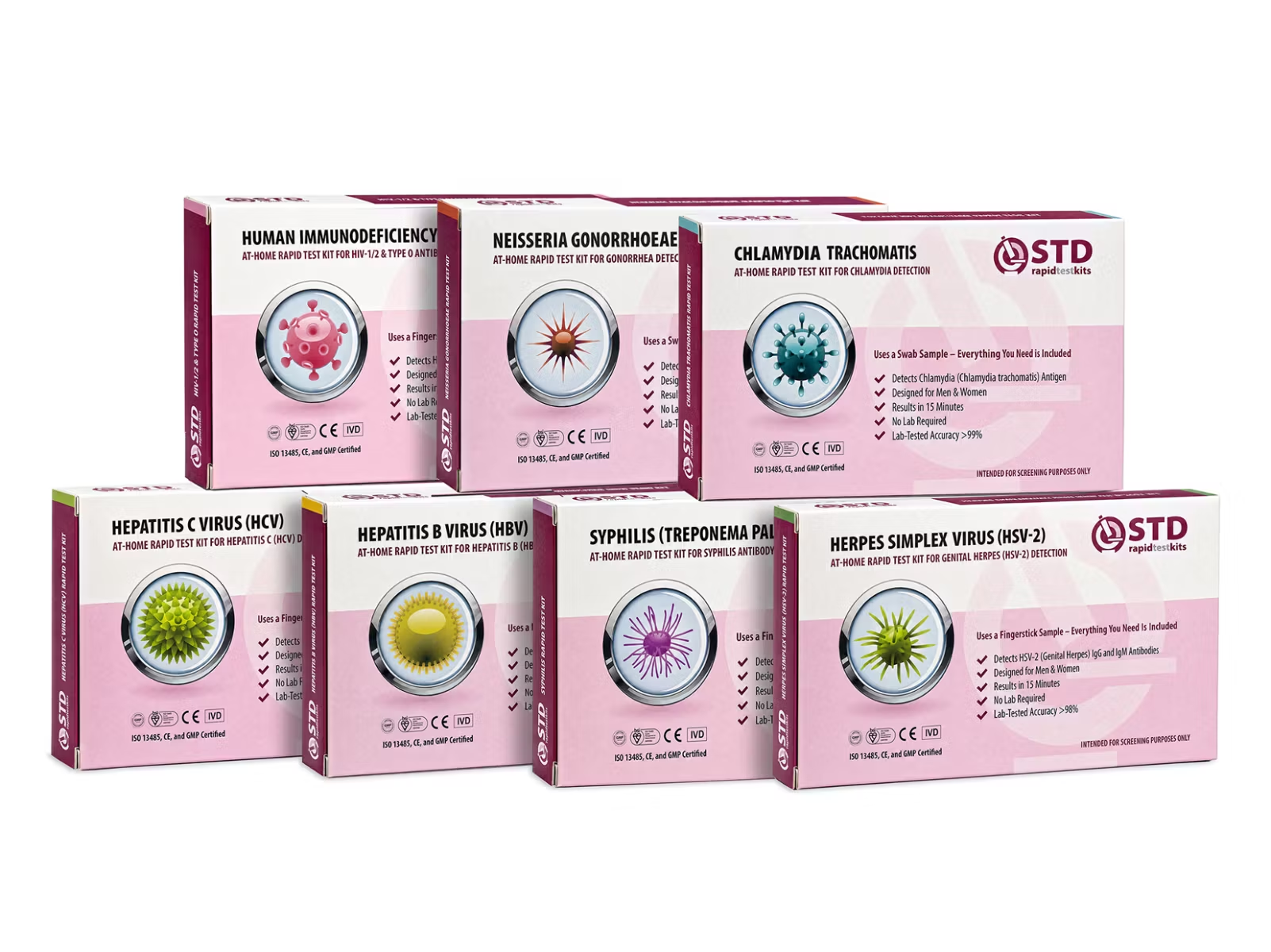
At-home rapid test kits are a reasonable complement to clinical screening, especially for routine check-ins. Our at-home STI test kits use lateral-flow chemistry, which is faster and more private than lab testing, though laboratory NAAT (nucleic acid amplification testing) remains more analytically sensitive for some infections. A positive at-home rapid result should be confirmed at a clinic; a negative result inside the correct window period is reliable enough for screening purposes.

Treatment as prevention is the biggest shift
The phrase “treatment as prevention” is shorthand for the public-health finding that effectively treating a chronic STI in the positive partner directly reduces or eliminates the partner-to-partner risk. It is one of the most consequential changes in STI medicine in the past two decades, and it is the single biggest reason that the cultural narrative of “dating someone with an STD is dangerous” has aged poorly.
For HIV specifically, the PARTNER and PARTNER2 studies tracked thousands of mixed-status couples over years of condomless sex where the HIV-positive partner was on effective antiretroviral therapy with a sustained undetectable viral load. Across tens of thousands of acts, those studies reported zero linked transmissions. The CDC has since endorsed the “Undetectable = Untransmittable” framing for clinical and public communication.
For herpes, the analogous finding is more modest in size but still meaningful: daily suppressive valacyclovir cuts transmission rates roughly in half compared with no medication, with further reductions when condoms are added. For chronic hepatitis B, effective antiviral therapy reduces viral load and the risk of transmission, alongside the standard prevention path of vaccinating the susceptible partner.
If your partner has a chronic STI, the practical first question is whether they are on the treatment regimen that lowers transmission, and whether you have been told their most recent results.
People who take HIV medicine as prescribed and get and keep an undetectable viral load have effectively no risk of sexually transmitting HIV to an HIV-negative partner.
If you are the partner with the positive result
The first thing most people feel after a positive test is some version of “I'm now contaminated.” That feeling is common. It is also inaccurate. An STI is an infection, not a verdict on your hygiene, your judgment, or your future relationships.
Two practical things shift after a positive result. First, you become someone who knows their status, which is more than many sexually active adults can honestly say. Second, you learn a few timing rules: how long to wait before sex, who needs to be told about a recent exposure, and what re-testing schedule the CDC recommends. The table below summarizes the current CDC STI Treatment Guidelines on resuming sex after treatment. None of this is medical advice for your specific case; if you have any doubt, ask the clinician who prescribed your treatment.
The emotional side will show up alongside the practical one. “No one will want me now” is one of the most predictable post-diagnosis thoughts. Logic is not what fixes the feeling; time and a small set of specific actions are. Talk to one other person who has been through it (online communities like the Herpes Resource Center, the H-Opp project, and moderated subreddits are reasonable starting points). Wait two to four weeks before dating again so the initial panic dies down, because disclosure conversations read worse than they are when your nervous system is braced for rejection. See a therapist if the shame stays loud; sex therapists and CBT-trained therapists handle this routinely, and sliding-scale options exist through Open Path Collective. The first disclosure conversation is the hardest. The ones after it get shorter and easier.
| Infection | When to resume sex | Key note |
|---|---|---|
| Chlamydia (azithromycin 1g single dose) | Wait 7 days from the dose | Make sure recent partners are treated. Retest at about 3 months. |
| Chlamydia (doxycycline 7-day course) | Wait until you finish the full 7-day course | Per CDC: refrain from sex until completion of 7-day therapy. Retest at about 3 months. |
| Gonorrhea (ceftriaxone injection) | Wait 7 days after the injection | Partners treated too. Antimicrobial-resistant gonorrhea is a growing concern; retest at 3 months. |
| Syphilis | Wait until visible lesions are fully healed and your provider clears you | Follow-up blood tests at 6 and 12 months track treatment response. |
| Trichomoniasis | Wait 7 days after both you and your partner finish the antibiotic course | Reinfection rates are notably high if a partner is missed. |
| HSV-1 / HSV-2 | Avoid sex during any visible outbreak or prodromal tingling | Daily suppressive antivirals plus condoms lower transmission risk; asymptomatic shedding can still occur. |
| HIV | Effectively zero sexual transmission risk once on ART with a sustained undetectable viral load (6+ months) | Per CDC Undetectable = Untransmittable. PrEP is an additional layer for HIV-negative partners. |
| HPV | No strict timing rule | Most infections clear within 1 to 2 years. Condoms reduce but do not eliminate skin-to-skin transmission. |
How to disclose your STD status
Disclosure is not a moral test you are failing. It is an information exchange that lets the other person make a real decision. The widely accepted standard is to disclose before any sexual contact, including oral, in a setting where neither person is rushed, paired with the relevant facts about transmission and treatment. The reason is informed consent: your partner should be able to make a real choice about the level of risk they are taking.
Pick a calm moment. Not in the bedroom, not on the way out the door. A walk, a coffee, a quiet evening at home. You want both of you to be able to think and ask questions. Disclosing in the moment before sex is the weakest option, because both people are physically committed and someone may feel pressure to say “it's fine” when it isn't.
Lead with the diagnosis, then the management plan. Naming the specific infection up front prevents the panicked version of the conversation. Bring sources: a CDC, WHO, or NHS page on the specific infection carries more weight than a verbal summary, and pointing your partner to those resources signals that you are not asking them to take your word for it.
Give them time. The reaction in the moment is rarely the final answer. Most people who initially hesitate come back with thoughtful questions once they have had a day to read.
Three sample scripts, calibrated to different infections and treatment stages. Each one names the specific infection rather than leaving it vague, describes the practical risk picture, and invites questions rather than demanding an immediate answer. Adapt the wording for your situation.
Script 1: Curable infection, recently treated.
“Before we get any further, I want to tell you something. I tested positive for chlamydia about three weeks ago. I finished the antibiotics and I'm past the 7-day window the CDC recommends, so I'm not contagious. I just like to be upfront with people I'm seeing. Any questions?”
Script 2: Long-term viral, well managed.
“There's something I'd want to know if it were me, so I'll mention it. I have HSV-2. I take daily suppressive medication, which lowers transmission risk a lot, and we'd use condoms. Outbreaks happen sometimes, and we'd just not have sex during those. I'm happy to talk through any questions before we decide what we want to do.”
Script 3: HIV, on treatment, undetectable.
“I'm HIV positive and on antiretroviral therapy. My viral load has been undetectable for over a year, which the CDC and other major health bodies say means the risk of transmitting it through sex is effectively zero. We can also use condoms or PrEP if you want extra layers. I'm open to any questions.”
- Pick a calm moment, away from sex and away from a rushed schedule.
- Lead with the diagnosis, then the management plan (medication, barriers, what the residual risk looks like).
- Bring sources. A CDC or NHS page on the specific infection beats a verbal summary.
- Give them time. The first reaction is rarely the final one; most thoughtful follow-up questions come a day later.
Disclosure on dating apps: bio, chat, or in person?
There is no universally correct answer to whether you put STI status on your dating profile. There are real tradeoffs, and the right choice depends on which infection you have and how much energy you have for repeating the same conversation.
Putting it in your bio filters aggressively. People who would not have been able to handle the conversation will not match. The ones who do match have already made a choice. The downside is that some people who would have been fine after a calm in-person conversation will swipe past based on one line of text. For chronic conditions like HSV-2 and HIV, profile-disclosure is increasingly common and there are established communities that handle it well.
Disclosing in chat after matching gives both of you more context. You have exchanged a few messages and can tell whether the other person is reading carefully. The downside is that you end up repeating the conversation across many matches, which gets exhausting.
Waiting until you meet works best when you have a reason to think the date will go somewhere physical. Body language and tone are present, which a chat app strips out. The downside is the risk of someone feeling they invested time in a date under incomplete information.
If you do put status in your bio, keep it short and matter-of-fact. “HSV-2 positive, on suppressive therapy, happy to talk” is enough. A long explanation reads as defensive and invites people to argue with the framing rather than ask real questions. Some people use disclosure-friendly platforms (Positive Singles, Hift) as a primary or secondary app. They are not for everyone, but they exist as an option for people who want to opt out of the disclosure question entirely.
- In your bio: filters aggressively. Saves time but also filters out some people who would have been fine after an in-person conversation.
- In chat after matching: gives both of you context before meeting, but requires repeating the conversation across many matches.
- In person, before things get physical: best body-language signal and the most empathy in the room. The tradeoff is that the other person may feel they invested time under incomplete information.
What to do if your partner discloses to you
If you are on the receiving end of a disclosure, the most useful thing you can do is buy yourself time before reacting. The temptation is to immediately give a verdict (“that's fine,” or worse, an impulsive rejection), but the right answer is closer to “thank you for telling me, I want to learn what this actually means for us.”
Then do the reading. CDC and NHS pages on the specific infection will tell you what the transmission risk actually is, what tools are available, and what routine care looks like. Once you understand the specific infection, you can have a second conversation that is grounded in facts rather than reflex.
It is also reasonable to ask whether your partner is on treatment, when they were last tested, and what their care plan looks like. Those are the same questions a clinician would ask in the first appointment.
- Buy yourself time before reacting. “Thank you for telling me, I want to learn what this means for us” beats an impulsive verdict.
- Read the CDC or NHS page on the specific infection before the follow-up conversation.
- Come back with concrete questions: treatment, most recent test, care plan.
What protection cannot fully cover
Condoms reduce risk substantially but do not eliminate it. For infections that transmit through skin-to-skin contact in areas a condom does not cover, the residual risk is non-trivial. Genital herpes, HPV, and syphilis (during the chancre stage) all fit that pattern.
That is not a reason to give up on barriers. It is a reason to combine them with the other tools: suppressive medication, vaccination, avoiding sex during active outbreaks for herpes or visible lesions for syphilis, and consistent communication when something feels different.
Herpes and HPV can transmit through skin-to-skin contact in genital areas that a condom does not cover. Pair condoms with suppressive antivirals (for herpes), HPV vaccination (for the uninfected partner), and abstinence during active outbreaks. Do not rely on condoms as your only layer.
Breaking the stigma without ignoring the work
The cultural framing of STIs is roughly two decades behind the medicine. Most adults will acquire at least one STI in their lifetime; the CDC estimated that on any given day in 2018, 1 in 5 people in the U.S. had a sexually transmitted infection, and that nearly half of new infections that year were acquired by people aged 15 to 24. Treating a diagnosis as a moral failure makes the problem worse: it discourages testing, discourages disclosure, and pushes infections further underground.
That said, reducing stigma does not mean handwaving away the work. Couples who do well in serodifferent relationships are the ones who treat sexual health as a shared, routine practice: test on a schedule, take medications as prescribed, use the prevention tools that fit the infection, and talk about it without drama. The couples who manage this consistently find that sexual health becomes a fairly ordinary part of the relationship, scheduled alongside other check-ups rather than treated as an ongoing source of anxiety.
What managing it together looks like
- Test together on a schedule: once a year, or every three to six months if either of you has new partners or symptoms.
- Stay current on treatment, and share recent results so you both know where things stand.
- Talk about it early, before any sexual contact. Each disclosure conversation gets easier with practice.
Your next steps as a couple
The work in front of you is concrete and short. Confirm what treatment your partner is on, agree on which prevention layers fit the specific infection, and set a testing rhythm you both keep. The quick flow below maps the most common situations to a sensible first move.
What to do next, by situation
Is the infection bacterial (chlamydia, gonorrhea, syphilis, or trichomoniasis)?
Yes: Finish the full treatment course, make sure recent partners are treated too, and wait the CDC-recommended window before resuming sex. Retest at about three months.
Is it a long-term viral infection (herpes or HIV)?
Yes: Ask a clinician about daily suppressive antivirals for herpes, or antiretroviral therapy for the positive partner plus PrEP for an HIV-negative partner.
Have both of you tested at a shared baseline in the last few months?
Yes: Set a repeat-testing rhythm: once a year, or every three to six months if either of you has new partners or new symptoms.
No: Start with a baseline test for both partners (a clinic visit or an at-home rapid panel), then agree on a repeat schedule.
Guidance only; the clinician who manages your care can advise for your specific case.
Frequently asked questions
- Can I date someone with an STD without getting infected myself?
- Yes, in most cases. The combination of treatment for the positive partner, barrier protection, vaccination where applicable, and routine testing reduces transmission risk substantially for nearly every common STI. The specific layer set depends on which infection it is.
- What is the safest way to have sex when one partner has an STD?
- Layered protection: treatment for the positive partner (antibiotics if curable, antivirals or antiretrovirals if chronic), consistent condoms or dental dams, vaccination for the uninfected partner against vaccine-preventable STIs (HPV, hepatitis B), and routine testing for both partners. Avoid sex during active outbreaks if the infection is herpes or visible-lesion syphilis.
- How do I bring it up with someone new without making it weird?
- Use a script that names the specific infection, names what it means in practical terms, and invites questions. Example: “Before we get any further, I want to tell you I tested positive for [X]. I'm on treatment / past the contagious window / managing it with [tool]. Happy to answer any questions.” Calm, brief, factual. Most people respond better than you expect, especially when you bring a CDC or NHS page rather than just a verbal summary.
- What if I had sex with someone before I knew I had an STI?
- Let any partner from your likely exposure window know so they can get tested and, if needed, treated. If reaching out directly feels too hard, the CDC and most state and local health departments offer confidential or anonymous partner-notification services that will pass on the message for you. This is about their health and yours, not about blame.
- How often should we get tested as a couple?
- Annual testing is the baseline for most sexually active adults. Move to every three to six months if either of you has new partners, recent condomless sex with others, or any new symptoms. A monogamous couple who tested together at the start of the relationship can usually wait longer between repeat tests.
- Are at-home STD test kits accurate?
- Yes, for screening purposes when used inside the correct window period for the specific infection. Rapid lateral-flow tests are less analytically sensitive than lab NAAT panels, so a small number of true infections (particularly very early or low-level ones) will be missed. Confirm any positive at a clinic; treat a negative inside the right window as reliable for routine monitoring, not for diagnostic confirmation.
- Will anyone still want to date me after a positive test?
- Yes. People meet, date, and form long-term relationships after every kind of STI diagnosis. Disclosure filters out partners who cannot handle adult conversations, which is functionally an upgrade to your dating pool. Most people find the conversation easier once they have a working script and a recent CDC or NHS page to share with the other person.
- What if someone reacts badly or ghosts after I disclose?
- It stings, and it also tells you something accurate: that person was not equipped to handle a straightforward adult conversation about sexual health. Their reaction is information about them, not a verdict on you. Give yourself a day, then keep going. Most people say each disclosure conversation gets a little easier than the last.
- Should I put my STI status in my dating profile?
- It depends. Profile-disclosure filters aggressively, which saves time but also filters out people who would have been fine in person. For chronic conditions like HSV-2 or HIV, profile-disclosure is increasingly common and there are dedicated communities for it. For curable infections you have already cleared, profile disclosure is generally unnecessary.
- Do I still need to disclose if I have no current symptoms?
- Yes for HSV, HIV, and HPV. Asymptomatic transmission is well documented for HSV (viral shedding can occur without symptoms) and HPV (most carriers are asymptomatic). For HIV, undetectable viral load reduces transmission risk to effectively zero, but disclosure remains the standard practice and is legally required in some U.S. states.
- U.S. Centers for Disease Control and Prevention. STI Treatment Guidelines, 2021. Source for the 7-day post-treatment / completion-of-therapy waiting periods for chlamydia, gonorrhea, and trichomoniasis, and recommended retest at 3 months.
- U.S. Centers for Disease Control and Prevention. HIV prevention, treatment as prevention, and the Undetectable = Untransmittable position on sexual transmission risk.
- U.S. Centers for Disease Control and Prevention, HIV Nexus. Clinical guidance for PrEP, including the statement that oral and injectable PrEP reduce the risk of getting HIV from sex by about 99 percent when taken as prescribed.
- U.S. Centers for Disease Control and Prevention. Genital herpes resources, including daily suppressive antiviral therapy lowering the risk of spreading the virus to a partner and the reality of asymptomatic shedding.
- U.S. Centers for Disease Control and Prevention. HPV vaccination program and ACIP recommendations for routine vaccination through age 26, with shared clinical decision-making through age 45.
- World Health Organization. Sexually transmitted infections fact sheet, covering global STI epidemiology and the role of correct and consistent condom use in prevention.
- U.K. National Health Service. Sexually transmitted infections overview, symptoms, and risk-based testing guidance for the general public.
- U.S. Centers for Disease Control and Prevention press release (2021 archive). CDC estimates that on any given day in 2018, 1 in 5 people in the U.S. had an STI, and that nearly half of newly acquired infections were in people aged 15 to 24.
- Corey L, Wald A, Patel R, et al. Once-daily valacyclovir to reduce the risk of transmission of genital herpes. New England Journal of Medicine, 2004 (PMID 14702426). Source for the roughly 48 percent reduction in HSV-2 transmission to the uninfected partner with daily suppressive valacyclovir.