
Published: August 2025 | Last updated: May 2026 | Editorial review and quality control: Martina N.
You notice something is off down there. A faint smell, an unfamiliar itch, a discharge that looks different from your usual. You wait a few days, hoping it passes the way the last yeast infection did. A week goes by. Then two. The over-the-counter cream does not quite work. You start to wonder whether your body will sort this out on its own, the way it usually does.
If what you have is trichomoniasis, the answer from the research is probably not, and not quickly. A minority of people do clear the parasite without treatment over weeks to months. The majority stay infected, and the entire time the infection is silent or shifting, it remains contagious to partners. This article walks through what the studies actually show about spontaneous clearance, why the wait-and-see approach carries real risk, and how to find out what is going on without sitting in a clinic waiting room.
Key Takeaways
- Most untreated trichomoniasis does not resolve on its own. Without antibiotics, infection commonly persists for months and stays contagious to partners the entire time.
- About 70% of people with trich have no obvious signs or symptoms, so feeling fine is not a reliable sign of being clear. A test is the only way to know.
What the research actually shows about clearance
The short answer is that trichomoniasis can clear without treatment in some people, but not reliably and not quickly. The literature is more nuanced than the usual blog headlines admit, and it is worth understanding both sides before you decide to wait.
In men, studies of untreated infection suggest a meaningful minority do clear the parasite within roughly four to six weeks. Some longitudinal data have reported spontaneous resolution in a substantial share of men within about a month, while other recent analyses have found that most men do not clear short-term. Some untreated men become culture-negative within weeks, but there is no way to predict in advance who will.
In women, the picture skews longer. Observational cohorts show a substantial share of untreated women remain positive at six months, and a portion stay infected for years. Persistence in women is influenced by factors like age, partner count, vaginal microbiome state, and concurrent infections.
Two truths sit side by side. First, your immune system can sometimes win this fight on its own. Second, you cannot predict whether you are in that lucky minority, and during whatever stretch of weeks or months the parasite is still present, you are infectious. The Cleveland Clinic notes plainly that untreated trichomoniasis can persist for months or years and that antibiotics are the only reliable way to clear it (Cleveland Clinic, Trichomoniasis).
A useful mental model: if a strep throat sometimes resolved without antibiotics but other times caused months of contagion and complications, you would still treat it. Trich works on similar logic. The infection is curable with a short course of oral antibiotics, with metronidazole and tinidazole as the standard FDA-approved options. The CDC summarises the public-health framing this way: trich is the most common curable STI in the United States, most infected people have no symptoms, and without treatment the infection can last for months or even years (CDC, About Trichomoniasis).
So can trichomoniasis go away on its own?
Sometimes, but not in most people, and not predictably. Research suggests a minority of untreated infections may clear over weeks to a few months, but the majority persist much longer, and women carry the infection longer than men on average. The infection is contagious the entire time. Untreated trich is associated with HIV susceptibility, preterm birth in pregnancy, and ongoing reproductive-tract inflammation. Antibiotics cure it in days; waiting does not.
Why trich symptoms blur into other things
If trichomoniasis produced unique, unmistakable symptoms, fewer people would shrug it off. The problem is that the signs overlap heavily with bacterial vaginosis (BV), yeast infections, and urinary tract irritation. The result is months of wrong guesses, wrong remedies, and untreated infection.
Classic trichomoniasis in women can include a thin, frothy, sometimes greenish-yellow vaginal discharge, a strong fishy odor that gets worse after sex, vulvar itching, burning during urination, and discomfort during intercourse. None of these are unique. BV can also produce a fishy odor. Yeast infections share the itch. A urinary tract infection shares the burning. Even a new lubricant or a rough night can mimic the irritation. So people reach for whatever worked last time: a yeast cream, a probiotic, a boric acid suppository, more water, cranberry juice.
In men, the symptoms tend to be subtler when they appear at all: mild urethral burning, a small amount of clear discharge, a vague irritation that comes and goes. Most men have no symptoms at all and only discover the infection because a partner tested positive.
This is why drugstore antifungals and home remedies often fail. They are not designed for a parasitic infection. Boric acid, cranberry juice, probiotics, and yeast-targeted creams do nothing to clear Trichomonas vaginalis. When symptoms briefly improve, it is usually because of normal cyclic changes in vaginal flora or local irritation settling on its own, not because the parasite has been treated. A few weeks later, the symptoms return, and the cycle of brief apparent improvement followed by returning symptoms is what keeps many people guessing instead of testing. NHS patient information notes that many people with trich have no symptoms at all, which adds to the confusion (NHS, Trichomoniasis).

What untreated trich can do over time
The reason public-health agencies push for treatment, even in symptom-free cases, is that ongoing inflammation from trichomoniasis does measurable damage. Public-health bodies including the CDC and WHO flag untreated STIs as contributors to several broader health risks, and the CDC specifically names trichomoniasis as a driver of genital inflammation that makes HIV transmission more likely (CDC, About Trichomoniasis).
HIV susceptibility is the most serious of these risks. Genital inflammation from trich creates microscopic mucosal disruption that makes it easier for HIV to enter the body during exposure, and for people already living with HIV, it can make onward transmission more likely. This is part of why dedicated STI clinics screen and treat trichomoniasis as a standard part of HIV-prevention care, not just a comfort issue.
In pregnancy, trichomoniasis is linked to preterm birth and low birth weight. The data are not perfectly clean. Treatment trials in pregnancy have not always shown that treating asymptomatic trich improves outcomes, and current guidance is to treat symptomatic infection and to discuss testing in higher-risk pregnancies. But the underlying association between active infection and adverse outcomes is well documented in CDC and MedlinePlus patient summaries (MedlinePlus, Trichomoniasis).
There are also more local consequences. Persistent inflammation can contribute to cervicitis and, less commonly, pelvic inflammatory disease. In men, untreated infection has been linked to urethritis and, occasionally, prostatitis. Trich also appears to interact with the vaginal microbiome in ways that can prolong BV and complicate post-treatment recovery. None of these complications are guaranteed for any one person, but each becomes more likely the longer the parasite sits in tissue.
If you are pregnant, breastfeeding, or planning a pregnancy and you suspect trichomoniasis, do not wait. Talk to your obstetrician or midwife before starting any treatment, including over-the-counter remedies. They will choose the right antibiotic and dose for pregnancy and decide whether your partner needs treatment at the same time. Self-treatment in pregnancy is not the right path here.
Testing without the clinic visit
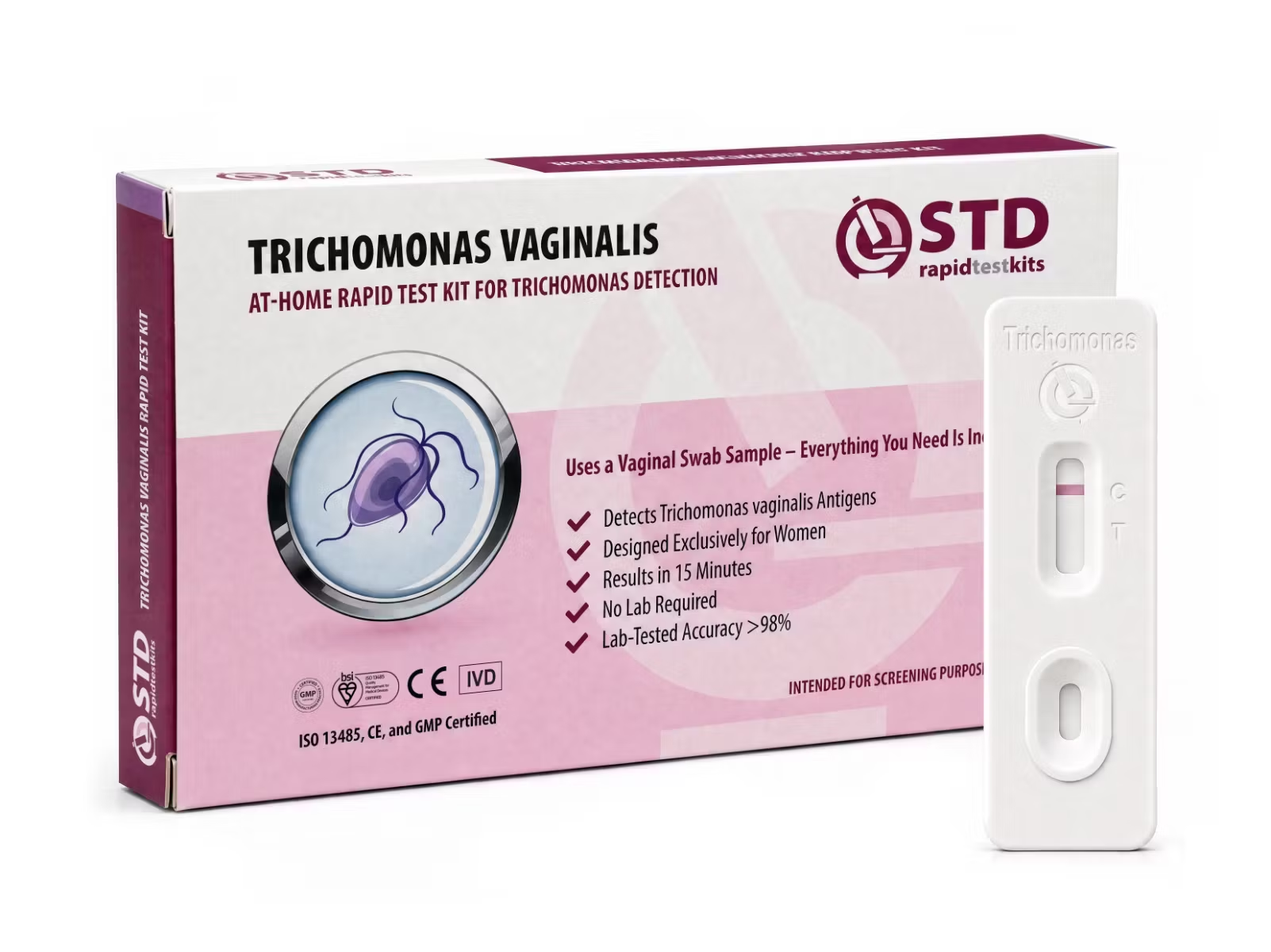
You do not need a clinic appointment to find out whether you have trichomoniasis. At-home rapid tests give a clear answer in about 15 minutes from a self-collected vaginal swab, with no shipping, no lab wait, and no awkward intake conversation.
A note on scope before you order: our at-home trichomoniasis swab test is validated for vaginal self-collection only. We do not currently offer a male-compatible trich home test. Men who want to be tested for trichomoniasis specifically should ask their clinician for a urine or urethral panel that includes T. vaginalis. More on testing in men in the next section.
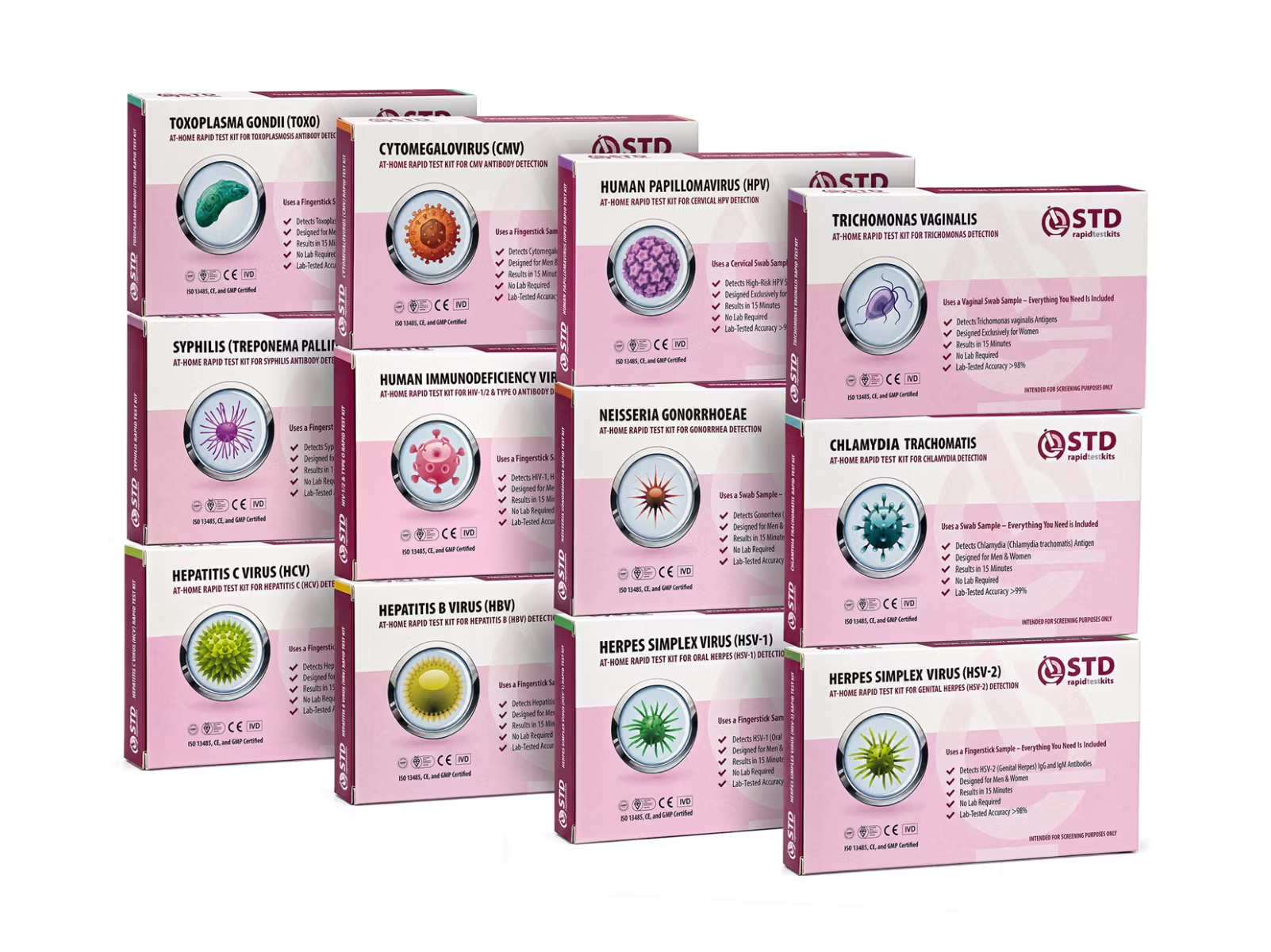
If you are testing because you have multiple concerns at once, such as a recent new partner, a partner who tested positive for something else, or several months without a routine STI panel, a combination kit that covers chlamydia, gonorrhea, trichomoniasis, and other common infections in one shipment is usually a better fit than a single-infection test. Same collection visit, more coverage.
Practical points for any at-home test:
- Read the instructions fully before you start. The most common cause of an unreliable result is a rushed collection step.
- Test inside the window the manufacturer specifies after your last possible exposure. Testing too early can miss a real infection.
- Confirm any positive result with a clinician. You need a prescription for metronidazole or tinidazole, and your partner needs to be treated at the same time.
- If symptoms persist after a negative at-home result, see a clinician anyway. BV, yeast, and UTI all need their own targeted treatment.
After a positive test: telling partners
Treating yourself and not your partner is the single fastest way to get reinfected. Current CDC guidance on trichomoniasis is clear: current sex partners should be treated at the same time, and both people should avoid sex until treatment is complete and any symptoms have resolved.
This is the part that feels hard. Trichomoniasis can sit silently in one person for months or years before causing symptoms, which means a positive result does not tell you when the infection started or with whom. It also does not necessarily mean anyone was unfaithful. People test negative on routine STI panels that did not include trich. Partners pass it without ever knowing. New symptoms can surface long after a relationship started. Treat the test result as information about your shared health, not as evidence about behavior.
A practical script that works: "I got tested and one of the results came back positive for trichomoniasis. It is curable with a short course of antibiotics, and we both need to take them at the same time. Can you set up a visit this week?" Short, factual, no blame. Many clinics will prescribe to a partner without requiring a separate visit when one partner has a documented positive test; ask whether expedited partner therapy is available in your state.
And to head off the question: yes, you can absolutely get trich again if your partner is not treated at the same time. Reinfection happens in about 1 in 5 people within three months after receiving treatment, and the CDC explicitly recommends retesting within three months to catch a recurrence (CDC, About Trichomoniasis).

Why trich in men gets missed
Standard STI panels in most clinics do not include trichomoniasis testing for men unless someone specifically requests it. Combine that with the fact that infected men are usually asymptomatic or have only mild urethral irritation, and you get the underdiagnosis pattern public-health researchers have documented for decades.
The cycle plays out predictably. A woman gets diagnosed with trich, takes antibiotics, and tells her partner. He has no symptoms, feels fine, and either skips treatment or gets antibiotics without a confirmatory test. Weeks later, her infection comes back. Without partner treatment, reinfection rates after trich treatment in women are notably high, and the male reservoir is the usual reason.
A few practical points if you are a man wondering whether you should test:
- Trichomoniasis testing in men typically uses a urine NAAT or a urethral swab. Both require a clinic visit or mail-in lab; the home swab kits validated for vaginal self-collection are not interchangeable.
- Most urgent-care clinics and Planned Parenthood locations can run a urine NAAT during a short visit, often the same day a partner shares a positive result.
- If you have any urethral burning, mild discharge, or a partner with a recent positive, ask explicitly: "Can you test me for trichomoniasis, not just chlamydia and gonorrhea?" The default panel often skips it.
The mythology around trich being a "women's STI" is part of what keeps it spreading. Trichomonas vaginalis infects all genders and is overwhelmingly passed through penis-to-vagina or vagina-to-vagina contact. Asymptomatic carriers are the engine of community-level transmission, and a quiet infection in a man can keep a household cycling through treatment-and-relapse for a year before someone thinks to test the partner properly.
Ask your clinician explicitly for a trichomoniasis test, not just the default chlamydia and gonorrhea panel. Most labs will not run a Trichomonas vaginalis assay on a urine NAAT unless you request it by name, even when partner-positive context is on your chart. A short conversation at the front desk is usually enough to get it added.
When a broader panel makes sense
Testing for trich alone is the right call in a few specific situations: you already know your other STI risk is low, you and your partner have both been tested recently for the major infections, or you are specifically following up on a partner's positive trich result.
For everyone else, a multi-infection panel is usually the better value. A combined kit covers the most common bacterial and viral STIs in one shipment and one collection session, which means one decision point instead of seven. The trade-off is cost; a broader panel runs more than a single-test kit. The upside is clarity. Either you get a clean read across the infections that typically need treatment, or you find something you would not have thought to test for.
Scope note for the broader panel below: it is validated for vaginal self-collection and fingerstick blood collection, so it is for women only. A male partner who needs a broader screen should ask a clinician for a full panel that includes a urine NAAT for chlamydia, gonorrhea, and trichomoniasis, plus the relevant blood tests.
Trich is the most common curable STI. About 70% of people with the infection do not have any signs or symptoms. Without treatment, the infection can last for months or even years.
FAQs
- Does trichomoniasis ever just go away on its own?
- Sometimes, but not predictably. Studies suggest a minority of men clear the parasite within four to six weeks, and a portion of women clear within several months. Most untreated infections persist longer, and you cannot tell in advance whether you are in the group that will clear. The infection is contagious to partners the whole time. Antibiotics resolve it reliably in days.
- I feel totally fine. Could I still have trich?
- Yes. About 70% of people with trichomoniasis have no obvious signs or symptoms, including most infected men, per <a href="https://www.cdc.gov/trichomoniasis/about/index.html" target="_blank" rel="noopener">CDC data</a>. Feeling fine is not a reliable sign of being clear, especially after a partner change or if a current partner tested positive.
- What does trich smell or look like?
- Classic trich in women involves a thin, frothy, sometimes greenish-yellow discharge and a fishy odor that worsens after sex. But BV produces a similar smell and yeast produces similar itching, so the symptom alone does not distinguish them. A test is the only way to be sure.
- Can men get trich, and how would they know?
- Yes. Most infected men are asymptomatic. Some notice mild urethral burning, a small amount of clear discharge, or vague irritation. Standard STI panels for men often skip trich unless requested, so a man with a partner who tested positive should specifically ask his clinician to test for Trichomonas vaginalis.
- Can I get trich from a toilet seat or a towel?
- Almost never. Trichomonas vaginalis survives only briefly outside the body and is overwhelmingly transmitted through genital-to-genital sexual contact. Rare laboratory-only cases of brief survival on damp surfaces exist, but real-world transmission outside of sexual contact is not a meaningful risk.
- What happens if I just ignore it?
- Months to years of infection in many cases, ongoing transmission to partners, increased susceptibility to HIV from genital inflammation, and in pregnancy, elevated risk of preterm birth and low birth weight. The personal risk varies, but the partner transmission risk is constant for as long as the infection is active.
- Do both partners need to be treated?
- Yes, every time. If only one of you is treated, the untreated partner reinfects the treated one within weeks. The CDC recommends concurrent treatment of all current sex partners and abstaining from sex until both people have completed treatment and any symptoms have resolved.
- How accurate are at-home trichomoniasis tests?
- Modern at-home lateral-flow swab tests perform well when used correctly, typically reporting high sensitivity and specificity from a vaginal self-swab. Exact figures vary by kit; check the data sheet on the product page. Any positive should be confirmed with a clinician so you can get a prescription for metronidazole or tinidazole.
The bottom line
Trichomoniasis sometimes clears on its own. The research is clear that some untreated men clear within weeks and some untreated women clear within months. But "sometimes" covers a minority of cases, with no way to know in advance whether you are in that group. During the entire time you are waiting, you are contagious to partners. The longer the parasite stays, the more local inflammation it causes, and the more it stacks risk for HIV exposure, pregnancy complications, and reproductive-tract irritation.
Fixing it is straightforward once you decide to test. The course is a short antibiotic regimen, concurrent partner treatment, and no sex until both people have finished. Compared to months of guessing, weeks of failed over-the-counter remedies, and the relational strain of a delayed diagnosis, testing and treating is the smaller and simpler step.
If you have read this far because something feels off, take it as the signal to find out. A 15-minute at-home test or a quick clinic visit answers the question. Then you can stop wondering.
- U.S. Centers for Disease Control and Prevention. About Trichomoniasis: prevalence, asymptomatic-carriage rate (about 70%), HIV-susceptibility link, pregnancy complications (preterm birth, low birth weight), partner treatment, and three-month retesting guidance.
- Cleveland Clinic. Trichomoniasis: persistence in untreated infection, symptom overlap with BV and yeast infections, and clinical management with metronidazole or tinidazole.
- NHS. Trichomoniasis overview, symptom patterns in women and men (including the high share who have no symptoms), and testing and treatment guidance for the UK population.
- MedlinePlus, U.S. National Library of Medicine. Trichomoniasis patient summary covering transmission, testing, treatment, and pregnancy complications (early birth, low birth weight).
- World Health Organization. Sexually transmitted infections fact sheet, with global prevalence framing for trichomoniasis as one of four curable STIs and population-level treatment guidance.
