
Published: December 2025 | Last updated: May 2026 | Editorial review and quality control: Martina N.
Both bacterial vaginosis and trichomoniasis can cause unfamiliar discharge, an off odor, and irritation. Because the symptoms overlap so much, plenty of people guess wrong about which one they have. Guessing wrong matters here: the treatments are different, and one of these is a sexually transmitted infection while the other is not.
This guide walks through what each condition actually is, how they spread (or do not), how clinicians tell them apart, and what realistic at-home testing looks like. According to the CDC, bacterial vaginosis (BV) is the most common vaginal condition in women aged 15 to 44. WHO 2020 data put trichomoniasis at roughly 156 million new infections worldwide that year, making it the most prevalent curable non-viral STI on the planet.
Both conditions are treatable. Both are worth confirming with a clinician before reaching for any medication. And only one of them is something your partner also needs to be checked for.
Key Takeaways
- Bacterial vaginosis is a flora imbalance, not an STI. Trichomoniasis is a sexually transmitted parasitic infection, and both sexual partners need treatment.
- Symptoms overlap heavily. A reliable diagnosis needs a swab, microscopy, or molecular test, not a self-guess.
Quick Comparison: BV vs Trichomoniasis
Before going section by section, here is the short version of how these two conditions differ. The discharge color and texture, the level of itching, and whether sexual transmission is in play are the three points that usually tell clinicians which test to run first.
| Feature | Bacterial Vaginosis | Trichomoniasis |
|---|---|---|
| Cause | Imbalance of vaginal bacteria (loss of Lactobacillus, overgrowth of Gardnerella and other anaerobes) | Trichomonas vaginalis parasite |
| Classified as an STI | No, though sexual activity influences risk | Yes |
| Typical discharge | Thin, gray-white, fishy odor | Frothy, yellow-green, often foul-smelling |
| Itching or irritation | Mild or absent | Often pronounced |
| Pain with urination or sex | Uncommon | Common |
| Affects men | No | Yes, often without symptoms |
| Standard diagnosis | Clue cells, pH greater than 4.5, Amsel criteria, or NAAT | Wet-mount microscopy, antigen test, or NAAT |
| First-line treatment | Oral or vaginal metronidazole, or vaginal clindamycin | Oral metronidazole or tinidazole |
| Partner treatment | Usually not needed | Required for sexual partners |
What Bacterial Vaginosis Actually Is
The healthy vagina hosts a community of bacteria dominated by Lactobacillus species. Lactobacilli produce lactic acid and hydrogen peroxide that keep the local pH around 3.8 to 4.5 and suppress the growth of less friendly bacteria. Bacterial vaginosis develops when that balance tips: Lactobacillus levels fall and anaerobic organisms such as Gardnerella vaginalis, Prevotella, and Atopobium take over.
BV is not caused by a single outside pathogen that one person passes to another. It is a state of the vaginal microbiome. That said, sexual activity influences the risk. According to CDC, having a new sexual partner or multiple partners, not using condoms, and douching are well-established risk factors. Female partners can share a similar imbalanced flora pattern, which is one reason BV recurs together in same-sex couples even though it is not classified as an STI.
Other common contributors include:
- Douching, which strips beneficial Lactobacillus and disrupts pH
- Perfumed soaps, bubble baths, vaginal washes, or feminine sprays applied to the vulva
- Smoking, which is associated with a less Lactobacillus-rich microbiome
- Some intrauterine devices, associated with shifted flora in some users
- Antibiotic courses that wipe out vaginal Lactobacillus along with the target bug
A large share of women with BV have no symptoms at all. The NHS notes that around half of women with BV are asymptomatic. Many only discover they have it when a clinician notices the characteristic features during an exam done for another reason.
Douching is the single most disrupting habit for vaginal flora. It physically washes out Lactobacillus and shifts the local pH within hours, leaving room for Gardnerella and other anaerobes to take over. Stopping douching entirely is the highest-yield change anyone with recurrent BV can make. Perfumed soaps, vaginal sprays, and scented intimate wipes work the same way on a smaller scale and are worth dropping too.
What Trichomoniasis Is (and Why It Is Different)
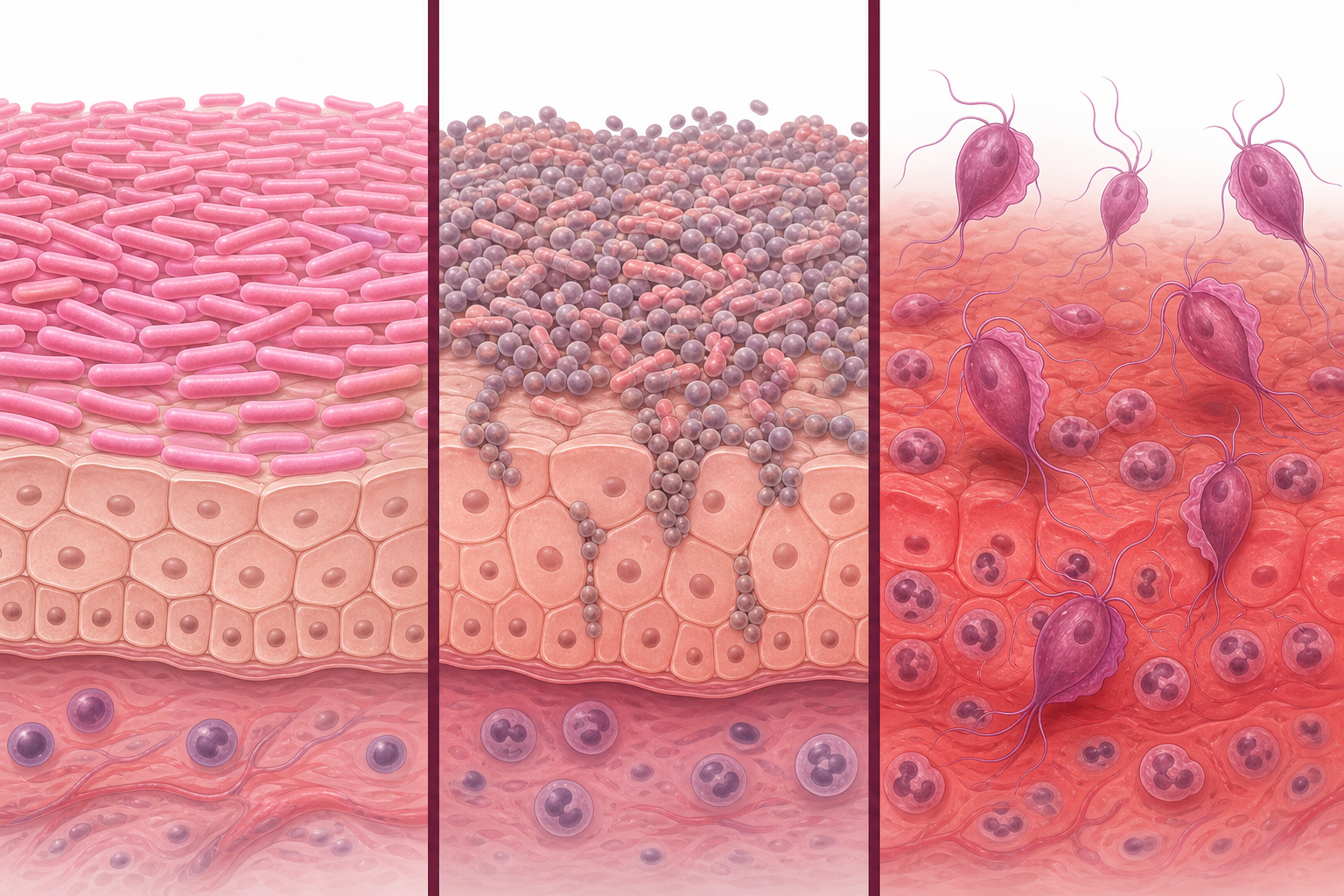
Trichomoniasis is caused by a single-celled parasite, Trichomonas vaginalis. The organism is large enough to see under a light microscope and moves in a distinctive jerky, flagellated way. It infects the urogenital tract: in women, the vagina, urethra, and sometimes the cervix; in men, the urethra and sometimes the prostate.
Trichomoniasis is sexually transmitted. The most common route is vaginal sex; NHS guidance also documents transmission through shared sex toys and skin-to-skin genital contact. Trichomonas does not survive long on dry surfaces, so casual contact such as toilet seats or towels is not a meaningful route.
The infection is widespread. WHO 2020 estimates put new cases at roughly 156 million worldwide per year (73.7 million in women and 82.6 million in men), making it the most common curable non-viral STI globally.
One reason trichomoniasis spreads so efficiently is that most carriers do not feel sick. Per the CDC, roughly 70 percent of infected people have no signs or symptoms at the time of infection. Men in particular often carry the parasite without noticeable irritation, which means they may pass it to a partner without realizing they have it. When women do develop symptoms, they typically start within 5 to 28 days of exposure, though some show up later or not at all.
Trichomoniasis is fully curable with a short course of antiparasitic medication. The challenge is identifying it in the first place, then making sure every recent sexual partner also takes the medication so the parasite cannot ping-pong back and forth.
Symptoms: Where They Overlap and Where They Differ
The reason BV and trichomoniasis get confused is that both can cause discharge, odor, and irritation. The differences sit in the texture, color, smell, and the severity of itching. Here is what each typically looks like when symptoms are present.
Typical bacterial vaginosis symptoms
- Thin, watery, gray-white discharge that coats the vaginal walls
- A distinctive fishy odor, often stronger after sex or during menstruation (this is the basis of the clinical "whiff test")
- Mild burning when urinating, in some cases
- Mild itching, or no itching at all
- No pain with sex in most cases
Typical trichomoniasis symptoms when they appear
- Frothy, yellow-green or off-white discharge, often with a strong unpleasant odor
- Itching, redness, or swelling of the vulva and vagina
- Burning or pain during urination
- Discomfort or pain during sex
- Light spotting after sex in some cases
- In men: irritation inside the penis, thin discharge, or burning after urination or ejaculation, though most men feel nothing at all per CDC
One detail clinicians sometimes flag: the cervix in trichomoniasis can show small punctate hemorrhages, occasionally described as a "strawberry cervix." This finding is uncommon but, when present, is suggestive of trichomoniasis rather than BV.
Roughly 70 percent of trichomoniasis infections produce no symptoms at the time of infection, per <a href="https://www.cdc.gov/trichomoniasis/about/index.html">CDC</a>, and around half of women with BV are asymptomatic per <a href="https://www.nhs.uk/conditions/bacterial-vaginosis/">NHS</a>. A reassuring exam is not the same as a negative test. If you have a new partner, recurrent symptoms, or you have been treated and the problem keeps coming back, ask for a swab or rapid test even if you feel fine.
How Clinicians Diagnose Each One
Because the symptom overlap is so significant, both conditions need a lab-based or clinical diagnosis. Both are confirmed quickly with standard lab tests available at most clinics and urgent-care facilities, often at the same appointment.
Diagnosing bacterial vaginosis
Clinicians typically use the Amsel criteria, four signs that together strongly suggest BV. A diagnosis usually requires at least three of the following four:
- Thin, homogeneous discharge coating the vaginal walls
- Vaginal pH greater than 4.5
- Positive "whiff test" (fishy odor when potassium hydroxide is added to a sample)
- Clue cells visible on microscopy (vaginal epithelial cells coated with bacteria, giving a stippled appearance)
Some clinics use a Gram stain scored by the Nugent system as an alternative, and molecular (NAAT) panels that detect BV-associated bacteria are increasingly common.
Diagnosing trichomoniasis
Wet-mount microscopy is the traditional test: a clinician examines a fresh vaginal sample under a microscope and looks for the moving parasite. It is fast and cheap, but it misses a meaningful share of infections. Modern diagnostics are more sensitive:
- Antigen-detection rapid tests (such as OSOM and similar lateral-flow assays): higher sensitivity than wet mount, results in around 10 to 15 minutes
- Nucleic acid amplification tests (NAATs): the most sensitive option, suitable for both women and men, often run on a vaginal swab or first-catch urine sample
If your symptoms could fit either condition, a clinician will usually test for both at the same visit, often alongside chlamydia and gonorrhea, to avoid the trap of treating only one and missing another.
About 70% of people with the infection do not have any signs or symptoms. Trich is the most common curable STI.
Treatment That Actually Works
Both conditions respond well to standard prescription medication. The two main differences are what gets prescribed and whether your partner is treated.
Treating bacterial vaginosis
Per the CDC STI Treatment Guidelines, first-line BV regimens are:
- Oral metronidazole 500 mg twice daily for 7 days
- Metronidazole 0.75 percent gel intravaginally once daily for 5 days
- Clindamycin 2 percent cream intravaginally at bedtime for 7 days
Alternative regimens include oral clindamycin, clindamycin ovules, secnidazole granules, and tinidazole. Skip alcohol while taking oral metronidazole and for 24 to 48 hours after the last dose; the combination can trigger flushing, nausea, and vomiting. Take the full course even if symptoms clear up early. BV often comes back after a successful course, and recurrence within 12 months is common; if it keeps returning, ask your clinician about extended suppressive therapy with metronidazole gel.
Treating trichomoniasis
CDC guidelines recommend:
- For women: oral metronidazole 500 mg twice daily for 7 days. Multi-dose regimens now have better cure rates in women than the older single 2 g dose.
- For men: oral metronidazole 2 g as a single dose, or tinidazole 2 g as a single dose
All recent sexual partners need to be treated at the same time, even if they have no symptoms. Hold off on sex until you and your partner(s) have finished treatment and any symptoms have resolved (typically about a week after the last dose). Retesting at 3 months is recommended for women, since reinfection is common: per CDC, around 1 in 5 people are reinfected within 3 months of treatment.
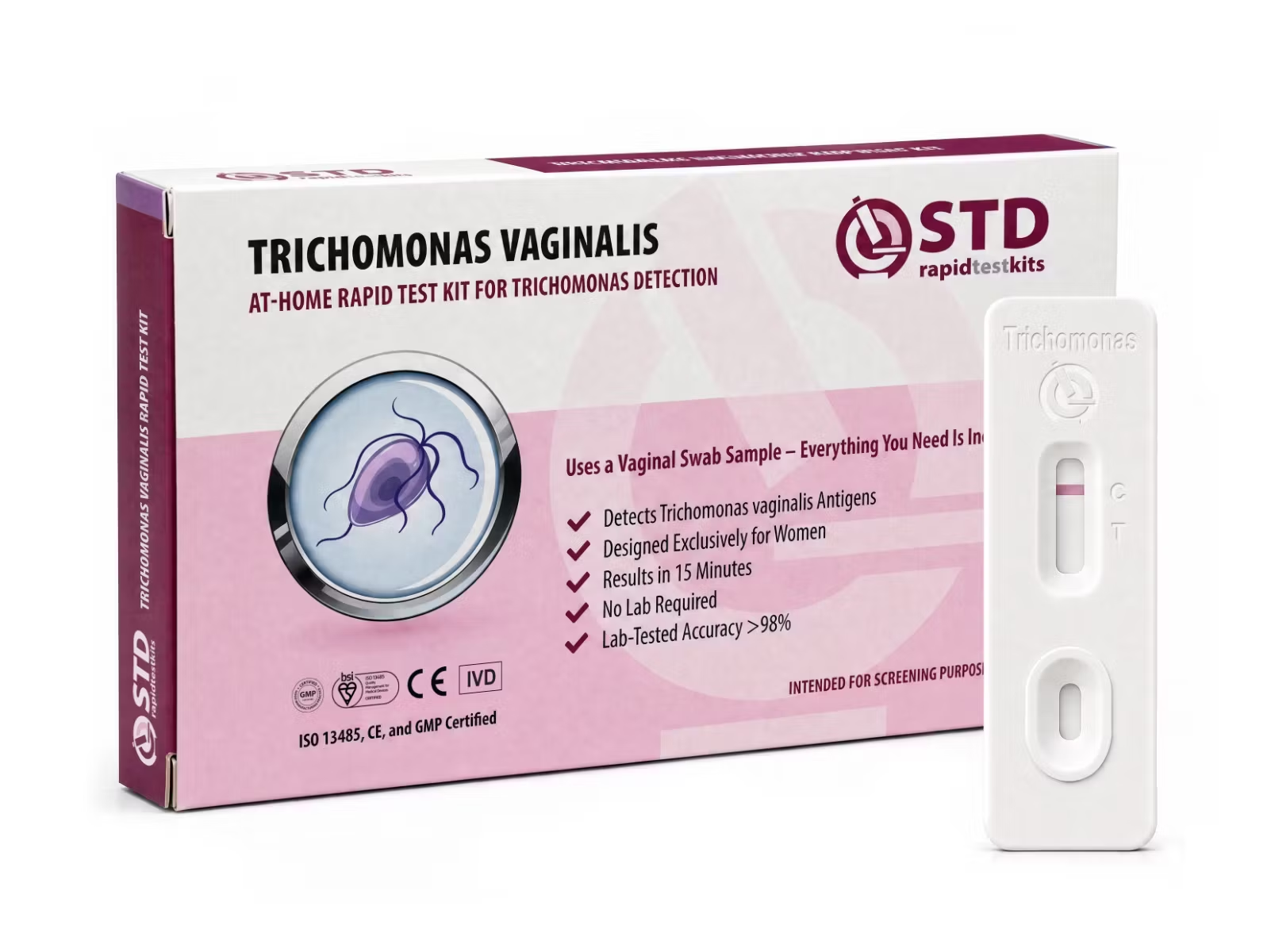
We offer a rapid at-home trichomoniasis test for women; it uses a self-collected vaginal swab and returns a lateral-flow result in about 15 minutes. Recommendations on this site are based on fit-for-purpose for the reader's concern, not commercial benefit.
Complications of Not Treating Either
Both conditions deserve to be treated even when symptoms are mild, because the longer-term consequences add up.
If bacterial vaginosis is left untreated
- Higher risk of acquiring HIV and other STIs, including chlamydia, gonorrhea, and herpes, because the disrupted flora reduces the natural protective barrier per CDC
- Increased risk of pelvic inflammatory disease (PID), especially if other STIs are present
- In pregnancy: a small but real association with premature birth and miscarriage per NHS. The NHS also notes that BV causes no problems in the majority of pregnancies.
- Higher risk of infection after gynecological procedures such as hysterectomy, dilation and curettage, or IUD insertion
If trichomoniasis is left untreated
- Higher risk of acquiring or transmitting HIV. Trichomonas infection is linked to a 1.5 times higher risk of HIV acquisition per WHO.
- Increased risk of PID, which in turn can lead to tubal infertility or ectopic pregnancy
- In pregnancy: associated with preterm rupture of membranes, preterm delivery, and low birth weight
- In men, occasional progression to urethritis, prostatitis, or epididymitis
Untreated trichomoniasis can persist for months or years; the infection does not resolve on its own. A clinician can confirm trichomoniasis in a single visit with an antigen test or NAAT, and the infection clears with a standard antiparasitic course once identified.
BV and trichomoniasis both increase the chance of acquiring HIV if exposed, but through different mechanisms. BV disrupts the protective Lactobacillus-dominant flora and the cervicovaginal mucosal barrier, making the local environment more permissive to HIV per <a href="https://www.cdc.gov/bacterial-vaginosis/about/index.html">CDC</a>. Trichomoniasis adds direct local inflammation: <a href="https://www.who.int/news-room/fact-sheets/detail/trichomoniasis">WHO</a> links infection to roughly a 1.5 times higher risk of HIV acquisition. Treating either one removes that extra layer of risk.
Preventing BV and Trichomoniasis from Coming Back
Reducing BV recurrence
- Skip douching entirely. It is the single most effective change you can make.
- Avoid perfumed soaps, bubble baths, vaginal deodorants, and scented wipes on the vulva.
- Wear breathable cotton underwear and change out of damp swimwear or workout clothes promptly.
- Use condoms consistently. Semen is alkaline and shifts vaginal pH temporarily, which can nudge flora out of balance after sex.
- Some probiotics with Lactobacillus crispatus or L. rhamnosus strains have modest evidence for reducing recurrence, particularly after a course of antibiotics. Talk to your clinician about whether this fits your situation.
Reducing trichomoniasis risk
- Use condoms or dental dams consistently. They are not perfect, since the parasite can colonize areas a condom does not cover, but they cut transmission substantially.
- Do not share sex toys without cleaning them between uses or covering them with a fresh condom.
- Get tested at least once a year if you have new or multiple partners, and ask any new partner about their last STI screen.
- Retest after treatment. CDC recommends a follow-up test at about 3 months for women, given how often reinfection happens.
| Condition | Single highest-yield prevention step |
|---|---|
| Bacterial vaginosis | Stop douching entirely. It strips Lactobacillus and shifts pH within hours, the trigger most consistently linked with recurrence. |
| Trichomoniasis | Use condoms consistently and treat all recent sexual partners at the same time. Untreated partners are the main reason the infection comes back after successful treatment. |
Can You Test for These at Home?
Home testing options are useful for screening when a clinic visit feels like a barrier, but the products available are different for the two infections.
For trichomoniasis
An at-home lateral-flow rapid test using a self-collected vaginal swab can give a result in about 15 minutes. The chemistry is the same antigen-detection approach used by point-of-care tests in clinics. A reactive (positive) home result still needs follow-up: a clinician needs to write a prescription for metronidazole or tinidazole, and any sexual partners need to be treated too.
Our at-home trichomoniasis kit is validated for vaginal self-swab samples, which means it is for women only. Male partners with symptoms or known exposure should see a clinic for a urethral swab, urine NAAT, or both. There is no at-home male trich test we are aware of that meets the same accuracy standard as a lab NAAT.
For bacterial vaginosis
We do not sell an at-home BV test. The clinical diagnosis depends on microscopy, Amsel criteria, or a molecular panel that is hard to replicate accurately at home. Some pharmacies sell over-the-counter vaginal pH paper. A vaginal pH above 4.5 is suggestive of BV, but it can also reflect trichomoniasis, recent unprotected sex, menstrual blood, or pregnancy. A high pH is a useful signal that you should see a clinician, not a diagnosis on its own.
If your symptoms look more like BV but you also have any STI-exposure concern, an at-home rapid panel can rule the common STIs in or out while you arrange the clinic visit for a definitive BV diagnosis.
Frequently Asked Questions
- Can I have BV and trichomoniasis at the same time?
- Yes. The two conditions share risk factors and can coexist, which is one reason clinicians often test for both at the same visit. The treatments are different, so a clear diagnosis matters before any medication is started.
- Can men get bacterial vaginosis?
- No. BV is a vaginal microbiome problem and is not described as a male condition. Trichomoniasis is different: men can carry the parasite and pass it to partners, usually without any symptoms of their own.
- Will BV or trichomoniasis go away on its own?
- BV occasionally resolves without treatment but more often recurs or persists. Trichomoniasis does not clear on its own; per WHO and CDC, it can persist for months or years untreated. Both should be treated to relieve symptoms and reduce complication risk.
- How soon after exposure will trichomoniasis show up?
- Symptoms, when they appear, usually start within 5 to 28 days of exposure per CDC and NHS. Many people never develop noticeable symptoms but can still pass the infection on. A rapid antigen test or a NAAT can detect the parasite once an active infection is established.
- Why does BV keep coming back even after antibiotics?
- BV recurrence is common because antibiotics clear the overgrowth but do not always rebuild a Lactobacillus-dominant flora. Recurrence often follows douching, new sexual partners, or another course of antibiotics. If BV keeps returning, ask your clinician about suppressive metronidazole gel and whether your contraceptive method or hygiene habits could be playing a role.
- Is BV a sign that my partner cheated?
- No. BV is not classified as a sexually transmitted infection. Sexual activity influences the vaginal flora, including with a long-term monogamous partner, and BV can show up without any change in partners. The presence of BV alone is not evidence of new exposure.
- Can I drink alcohol while taking metronidazole?
- Avoid alcohol for the full course and for 24 to 48 hours after the last metronidazole dose. Allow 72 hours after the last dose if you are taking tinidazole, which has a longer half-life. The reaction can include flushing, rapid heartbeat, nausea, and headache, sometimes strong enough to make people stop a course early, so it is worth planning ahead.
- When can I have sex again after treatment?
- Wait until you have finished the full course and any symptoms have resolved, typically about a week after the last dose. For trichomoniasis, also wait until any sexual partner(s) have completed their treatment; otherwise reinfection is highly likely.
- U.S. Centers for Disease Control and Prevention. About Bacterial Vaginosis. Source for prevalence (most common vaginal condition in women 15 to 44), risk factors including douching and new or multiple partners, and increased susceptibility to other STIs.
- U.S. Centers for Disease Control and Prevention. About Trichomoniasis. Source for asymptomatic prevalence (~70%), 5 to 28 day symptom window, sex-specific symptom patterns, and reinfection rate of about 1 in 5 within 3 months.
- U.S. Centers for Disease Control and Prevention. 2021 STI Treatment Guidelines, Bacterial Vaginosis. Source for first-line treatment regimens (oral metronidazole 500 mg twice daily for 7 days, metronidazole 0.75% gel, clindamycin 2% cream).
- World Health Organization. Trichomoniasis Fact Sheet (updated November 2025). Source for global incidence (approximately 156 million new infections in 2020) and 1.5x increased HIV acquisition risk.
- UK National Health Service. Bacterial Vaginosis condition page. Source for asymptomatic share (around half of women), and the small but real association with preterm birth and miscarriage in pregnancy.
- UK National Health Service. Trichomoniasis condition page. Source for transmission routes (vaginal sex, shared sex toys, skin-to-skin genital contact) and the typical 5 to 28 day symptom window.
