
Published: September 2025 | Last updated: May 2026 | Editorial review and quality control: Martina N.
The data tells two stories that almost never sit next to each other. People aged 15 to 24 account for roughly half of all new sexually transmitted infections reported in the United States each year, and chlamydia is the most common one. Adults over 55 are the fastest-growing age group for new STI diagnoses, with rates climbing steadily for more than a decade. Between those two ends of the curve sits a long stretch of relative stability. Both ends are climbing, both ends get missed, and both ends share the same diagnosis more often than most people realize.
If you are reading this because you are a teen wondering whether one unprotected encounter put you at risk, or because you are dating again at 65 and nobody ever brought up testing, this guide is for you. The biology is identical; the social context is not.
Key takeaways
- Chlamydia infections are climbing in both teens and adults over 55, and most cases in either group produce no obvious symptoms.
- After unprotected vaginal, anal, or oral sex with a new or untested partner, plan to test about two weeks later regardless of age and regardless of how you feel.
What chlamydia is, and how it sneaks past two generations
Chlamydia is an infection caused by the bacterium Chlamydia trachomatis. It transmits through vaginal, anal, and oral sex, and a pregnant person can pass it to a baby during delivery. The U.S. Centers for Disease Control and Prevention (CDC) describes it as a very common sexually transmitted infection, with millions of cases diagnosed in the United States each year (CDC chlamydia overview).
The infection is famous for staying quiet. The CDC and the U.K. National Health Service both note that most people who have chlamydia never develop obvious symptoms, especially in the first weeks after exposure (NHS chlamydia symptoms). When symptoms do show up, they tend to look like something else: a touch of burning when peeing, unusual discharge, a small amount of spotting, lower belly soreness, testicular ache. Easy to write off, easy to blame on a urinary tract infection or a tough workout or getting older.
Symptom-free people keep passing the infection back and forth without realizing it, which is part of why the case counts stay so high.
The most common signs are a mild burning sensation when peeing, unusual discharge, light spotting, or lower-belly or testicular soreness. Most people who have chlamydia experience none of these at all, which is why exposure-based testing matters more than symptom-watching.
Why teen rates are climbing
People aged 15 to 24 represent about a quarter of the sexually active population in the United States, but they account for roughly half of all new STI cases reported each year (CDC STI surveillance). The systems around young people were never built to catch their infections, which is why the count keeps growing.
Comprehensive, medically accurate sex education is uneven across the country. State-level policy tracking from the Guttmacher Institute shows that as of the most recent update, only 26 U.S. states require sex and HIV education to be medically accurate (Guttmacher sex-ed policy tracker). Roughly half of U.S. students therefore have no legal guarantee that what they are being taught about STIs is correct. The result is a generation that often learns from peers, social media, or a single awkward health-class hour.
On top of that, teens face barriers older patients do not. Insurance is usually under a parent's name. Confidential testing rules vary by state. Asking a clinician for an STI test still feels, to many young people, like asking for a permission slip from someone they would rather not tell.
| Teen risk factor | Impact |
|---|---|
| Inconsistent or absent sex education | Misconceptions about how STIs spread and which behaviors are protective |
| First-time sex with a more experienced partner | Power dynamics make condom negotiation harder; partner exposure history is often unknown |
| Stigma around asking for testing | Delays in diagnosis and treatment, sometimes by months |
| Asymptomatic infection | No external sign that anything is wrong, so testing never gets prioritized |
| Confidentiality worries about insurance billing | Avoidance of in-clinic testing even when a teen wants it |
Why senior rates are climbing
STI rates in adults over 55 have been rising for more than a decade in the United States, and chlamydia is part of that pattern. The CDC's surveillance data shows steady growth in this age group every year (CDC STI surveillance). The reasons are practical, and most of them have nothing to do with anyone behaving recklessly.
After menopause, pregnancy is no longer a worry, and condoms stop being a default. Online dating among adults over 60 is now common. Late-in-life divorce and widowhood put many people back into the dating world after decades with a single partner; the modern STI conversation never happened with a prior partner because it did not need to.
Hormonal changes after menopause also matter for comfort and safety during sex. The U.K. National Health Service notes that hormone changes around and after menopause can cause vaginal dryness, soreness, and pain or discomfort during sex (NHS guidance on vaginal dryness). Add in age-related symptoms that mimic STI symptoms (urinary urgency, mild burning, light discharge), and a real infection can hide behind a presumed bladder issue for weeks or longer.
| Senior risk factor | Impact |
|---|---|
| No pregnancy risk after menopause | Condoms get dropped without the conversation about STI risk being reopened |
| Post-menopausal hormonal changes | Vaginal dryness and discomfort during sex are more common |
| New partners after divorce or widowhood | Re-entry into the dating world without modern STI information |
| Online dating in retirement | More partners on average than the same demographic had a decade ago |
| Symptoms blamed on age | Burning, discharge, or pelvic discomfort dismissed as bladder or prostate changes |
Can teens and seniors both get chlamydia?
Yes. Chlamydia transmits through any unprotected vaginal, anal, or oral sex, and the bacteria do not care how old you are. Teens 15 to 24 account for about half of all new U.S. STI cases each year, and rates in adults over 55 have climbed steadily for more than a decade. Most infections in both groups produce no symptoms, which is why testing about two weeks after a new exposure matters more than waiting to feel sick.
What if you do not have any symptoms?
That is the most common state to be in, not the unusual one. The CDC's chlamydia fact sheet states plainly that most people with the infection have no symptoms (CDC chlamydia). Research papers put the asymptomatic share anywhere from roughly half to over 80 percent depending on sex, age, and how researchers counted, but the takeaway is the same: feeling fine is not evidence that you are not carrying the infection.
The clinical consequence of asymptomatic chlamydia is what makes testing worth it. Left untreated, the bacteria can move from the lower genital tract upward and cause pelvic inflammatory disease (PID), which is one of the leading preventable causes of infertility in the United States. In men, untreated infection can cause epididymitis, the painful inflammation of the tubes behind the testes. According to the CDC, untreated chlamydia may also increase a person's chances of getting or giving HIV during an exposure (CDC chlamydia fact sheet).
The progression often happens quietly. For some patients, the first sign is the pain of PID or the difficulty conceiving years later, by which point the damage has been done. Testing about two weeks after an unprotected encounter is the simplest way to avoid that path.
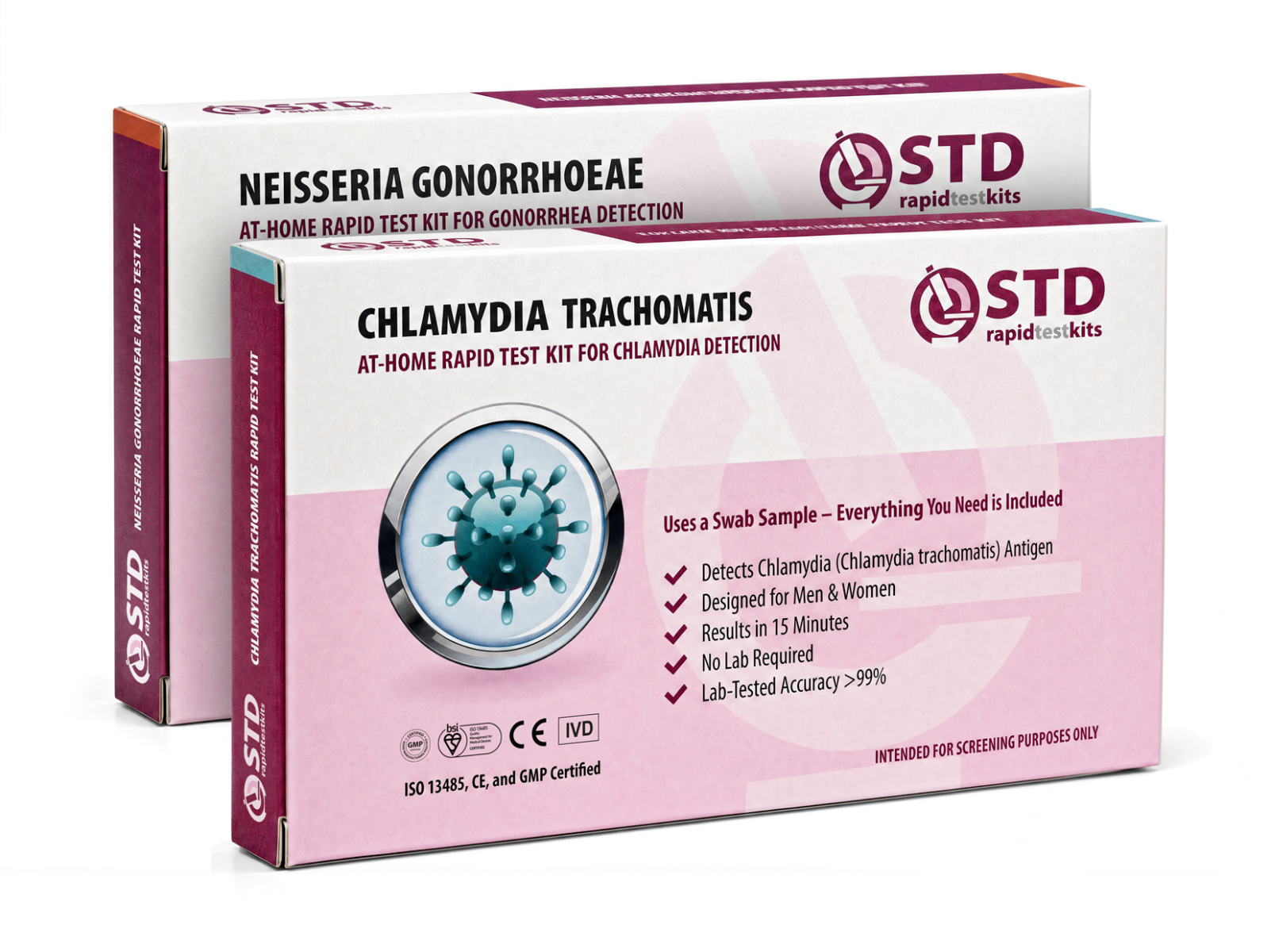
A note on transparency before the product callout below: this article is published by stdrapidtestkits.com, which sells the at-home testing kits described in this guide. We recommend products based on whether they fit the reader's actual concern, not commercial benefit.
Roughly half to over 80 percent of chlamydia infections produce no symptoms. Left untreated, those silent infections are the ones most likely to cause pelvic inflammatory disease, infertility, and epididymitis later on. A single well-timed test about two weeks after a new exposure is the practical way to avoid that path.
How long after sex should you test?
Timing matters because the test has to detect bacterial material that takes a few days to multiply to detectable levels. Test too early and a real infection can read as negative. Wait too long and the infection has more time to spread, both inside the body and to other partners.
For chlamydia, the practical timing breaks down like this:
- Days 0 to 3 after exposure: too early to test reliably. Bacterial load is usually below detection.
- Days 4 to 7: a result can be informative, but a negative at this point should be repeated in another week.
- Days 8 to 14: the typical sweet spot. Most people who are going to test positive will do so in this window.
- Day 15 and beyond: a result is still valid, especially if symptoms appear or a partner tests positive. If an early negative was followed by new information (a partner who tested positive, new symptoms), retest.
At home or in a clinic: which one fits your life?
There is no single right answer. The test you actually take is the one that protects you. What works for a teenager hiding the situation from a parent is not necessarily what works for a 68-year-old with a regular doctor. Both can be valid choices.
A few practical notes before the comparison below. The home rapid test gives a result the same day, which is its biggest advantage for both groups. Lab NAAT testing, the kind a clinic or mail-in lab uses, has higher analytical sensitivity than a home lateral-flow rapid test. If a home result is negative but the situation is high-risk (a partner tested positive, you have symptoms), a lab follow-up is the right next step. The two technologies serve different purposes: one gives speed and privacy, the other gives lab-grade sensitivity.
Here is how preferences tend to sort out by age:
| Testing option | Common teen preference | Common senior preference | Key benefit |
|---|---|---|---|
| At-home rapid lateral-flow test | High | Moderate | Private, results in about fifteen minutes, no clinic visit |
| Mail-in lab kit | Moderate | High | Higher analytical sensitivity using lab NAAT, discreet packaging |
| In-clinic testing | Lower | Moderate | In-person consultation, same-day treatment if positive, often free or low-cost at public clinics |
What to do if a test comes back positive
First, breathe. A positive chlamydia result is not a moral verdict and it is not unusual. Millions of new U.S. cases are diagnosed each year, and the treatment is straightforward: a short course of antibiotics, usually doxycycline taken twice a day for seven days, with azithromycin as a single-dose alternative when adherence is the bigger concern (CDC chlamydia treatment).
Telehealth has made the whole sequence easier. Many people complete a positive-result workup without setting foot in a clinic, which removes one of the most common reasons people delay starting treatment. The practical steps are:
- Confirm the result if you tested at home. A clinic or telehealth visit can order a NAAT test, the laboratory standard. Many providers will simply treat on the basis of a credible positive home result plus exposure history or symptoms.
- Start the antibiotic course and finish it. Stopping early is the most common reason for treatment failure.
- Tell any sexual partners from the past sixty days. They need to test and treat as well, or reinfection is likely. Most U.S. states allow expedited partner therapy, where a clinician can write a prescription for a partner without seeing them in person.
- Avoid sex for seven days after starting treatment, or until any symptoms have fully cleared, whichever is longer.
- Retest about three months later to confirm clearance and catch any reinfection. The CDC specifically recommends this re-screen.
Privacy, discreet shipping, and how at-home testing actually works
For a teenager, the privacy concern is usually a parent. For a senior in a long-term care community or living near adult children, it can be the visibility of mail at the front door or the questions an adult child might ask. Both concerns are valid, and both shape how at-home testing companies package and ship.
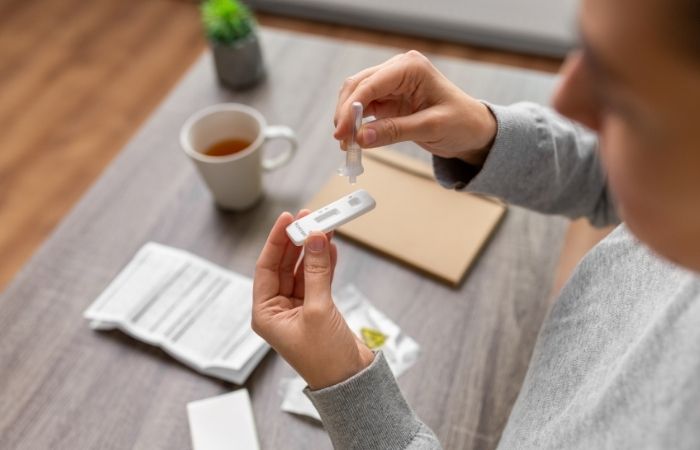
Kits from stdrapidtestkits.com ship in plain outer packaging with no health-related labeling. No clinic on the return address, no diagnostic words on the outside. The kit itself contains a sample-collection device (a swab for genital infections like chlamydia, a fingerstick lancet for blood-based tests like HIV or syphilis), a buffer, a lateral-flow cassette, and instructions. Results appear on the cassette in about fifteen minutes, similar to a home pregnancy test in workflow.
Confidentiality on the medical side is also a concern. Where in-clinic testing leaves a record with the insurer (visible on a parent's policy summary, for example), an at-home rapid test produces no insurer-visible record. The result is yours to do with as you choose, including taking it to a clinician for confirmation and treatment.
What this site sells, and what to do if you need something we do not
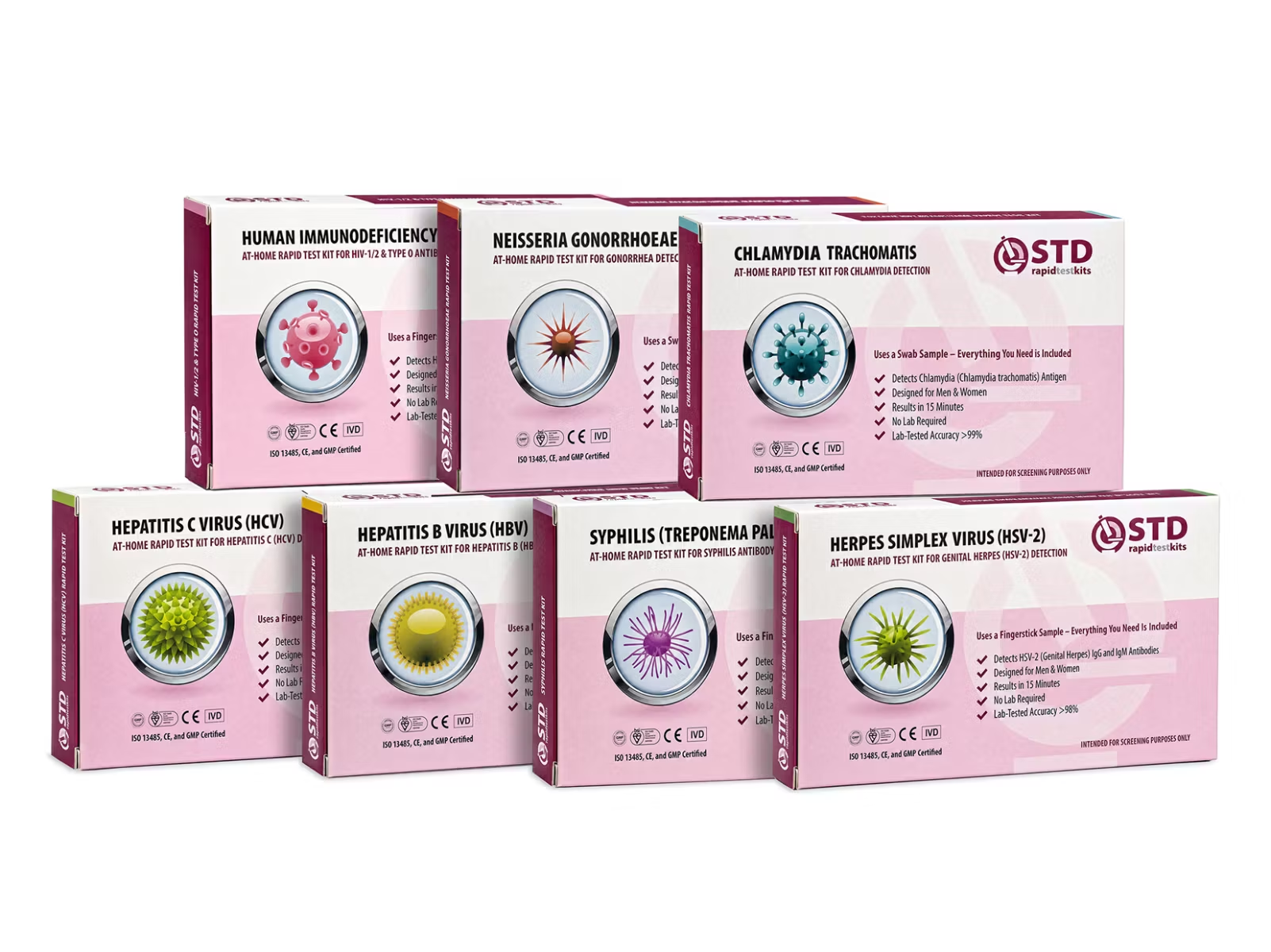
The at-home kits offered here are rapid lateral-flow tests using self-collected samples. They are designed for screening at home, fast and private. They fit most exposure patterns: a new partner, a condom failure, a partner who has tested positive, a routine yearly check.
If you need a throat or rectal swab (for example, after oral-receptive or anal-receptive exposure), an at-home kit will not cover that. Those sample types need a clinic visit. The combo kit below covers the genital and blood-based screening that is most useful for the majority of exposure scenarios, and we are explicit about the boundary rather than implying our kits do more than they do. Lab NAAT processing also has higher analytical sensitivity than home lateral-flow chemistry; a positive home result is still worth confirming with a clinic NAAT when one is accessible.
Frequently asked questions
- Can a teenager really get chlamydia the first time they have sex?
- Yes. One unprotected encounter with an infected partner is enough. The risk does not require multiple partners or a long sexual history. Many young people assume STIs only happen later in life or after many partners; that assumption is wrong and contributes to delayed testing.
- Why are chlamydia rates rising in adults over 55?
- Three reasons most often: condoms get dropped after menopause when pregnancy is no longer a concern, online dating has expanded the partner pool for retirees, and STI education was not part of the conversation when many of today's seniors first became sexually active. Combined, the result is a demographic with growing exposure and limited modern information.
- Can you get chlamydia from oral sex?
- Yes, although the per-encounter risk is lower than for vaginal or anal sex. Throat infections from oral exposure typically need a pharyngeal swab at a clinic, not a home test, since at-home kits use genital swabs. If your concern is throat exposure, see a clinic for the correct sample type.
- Is chlamydia treatable at any age?
- Yes. The standard treatment is a short course of antibiotics, usually doxycycline for seven days, with azithromycin as a single-dose alternative. Cure rates are high in both teens and older adults when the full course is completed and any sexual partners are also treated.
- Are at-home STI tests accurate for seniors?
- Yes. The same lateral-flow chemistry that works for a 22-year-old works for a 72-year-old; the test detects bacterial proteins, not anything age-dependent. For best accuracy, follow the kit instructions precisely on sample collection and on timing after exposure.
- Do parents find out if a teen orders or takes a home STI test?
- Plain-packaged at-home kits do not generate an insurance record, which is the most common way a parent would learn about a clinic visit. Many U.S. states also allow teens to consent to STI testing without parental notification. State laws differ, so a teen in a tightly monitored household may want to check the specific rules where they live.
- I tested negative but my partner tested positive. What should I do?
- Test again at two weeks and again at four weeks after the most recent exposure. Chlamydia has an incubation window, and a test taken before bacterial load is detectable can read negative even when infection is present. If new symptoms appear in the interim, do not wait for the four-week mark; test sooner or see a clinician.
- Can you get chlamydia again after treatment?
- Yes. The infection does not produce lasting immunity. If a partner is untreated or new exposures occur, reinfection is straightforward. The CDC specifically recommends re-screening about three months after treatment to catch reinfection early.
- U.S. Centers for Disease Control and Prevention. Chlamydia overview covering transmission, the high share of asymptomatic infections, treatment, the three-month re-screen recommendation, and the increased HIV acquisition risk associated with untreated chlamydia.
- U.S. Centers for Disease Control and Prevention. National STI surveillance data, including age-stratified case counts for chlamydia and the share of new cases attributable to people aged 15 to 24.
- U.K. National Health Service. Chlamydia overview, including the asymptomatic nature of most infections and standard testing and treatment.
- Guttmacher Institute. State policy tracker for sex and HIV education, used here for the count of U.S. states that require sex and HIV education to be medically accurate.
- U.K. National Health Service. Vaginal dryness guidance, used here for hormonal changes around menopause that can cause dryness, soreness, and discomfort during sex.
