

Published: September 2025 | Last updated: May 2026 | Editorial review and quality control: Martina N.
Cervical cancer used to be one of the leading causes of cancer death in women. In countries with well-run screening programs, it is now relatively uncommon, and the cases that do occur are far more often caught at a stage where treatment works. The reason for that change is not better cancer treatment. It is earlier detection of the virus that causes the disease, long before any cancer has developed.
That virus is human papillomavirus, or HPV. This article walks through what an HPV test actually checks for, how it differs from a Pap smear, when to test and how often based on your age, what a positive result really means, and where at-home self-testing fits into the larger screening picture. The goal is to give you a clear sense of what to ask your clinician at your next visit, and what kinds of testing you can reasonably do on your own time.
What is HPV testing, and how does it prevent cervical cancer?
An HPV test is a cervical sample test that looks for high-risk human papillomavirus, the virus responsible for nearly every case of cervical cancer. Detecting a high-risk infection early lets clinicians monitor the cervix and remove precancerous cells years before they could become cancer. The CDC and the National Cancer Institute recommend a primary HPV test every 5 years for most women aged 30 to 65 when results are normal, with co-testing or a Pap test alone as accepted alternatives.
Key Takeaways
- Nearly all cervical cancer is caused by long-term infection with high-risk HPV; HPV-16 and HPV-18 alone account for roughly 76% of cases according to the World Health Organization.
- A primary HPV test every 5 years from ages 30 to 65 catches the virus years before any cellular changes appear, which is why it has become the preferred cervical-screening tool in many national programs.
Why HPV causes nearly all cervical cancer
HPV is the most common sexually transmitted infection in the world per the CDC. There are more than 200 types of the virus, but only a small group of about 14 high-risk strains has been linked to cancer. Two of those strains, HPV-16 and HPV-18, account for roughly 76% of cervical cancer cases globally according to the World Health Organization fact sheet on cervical cancer.
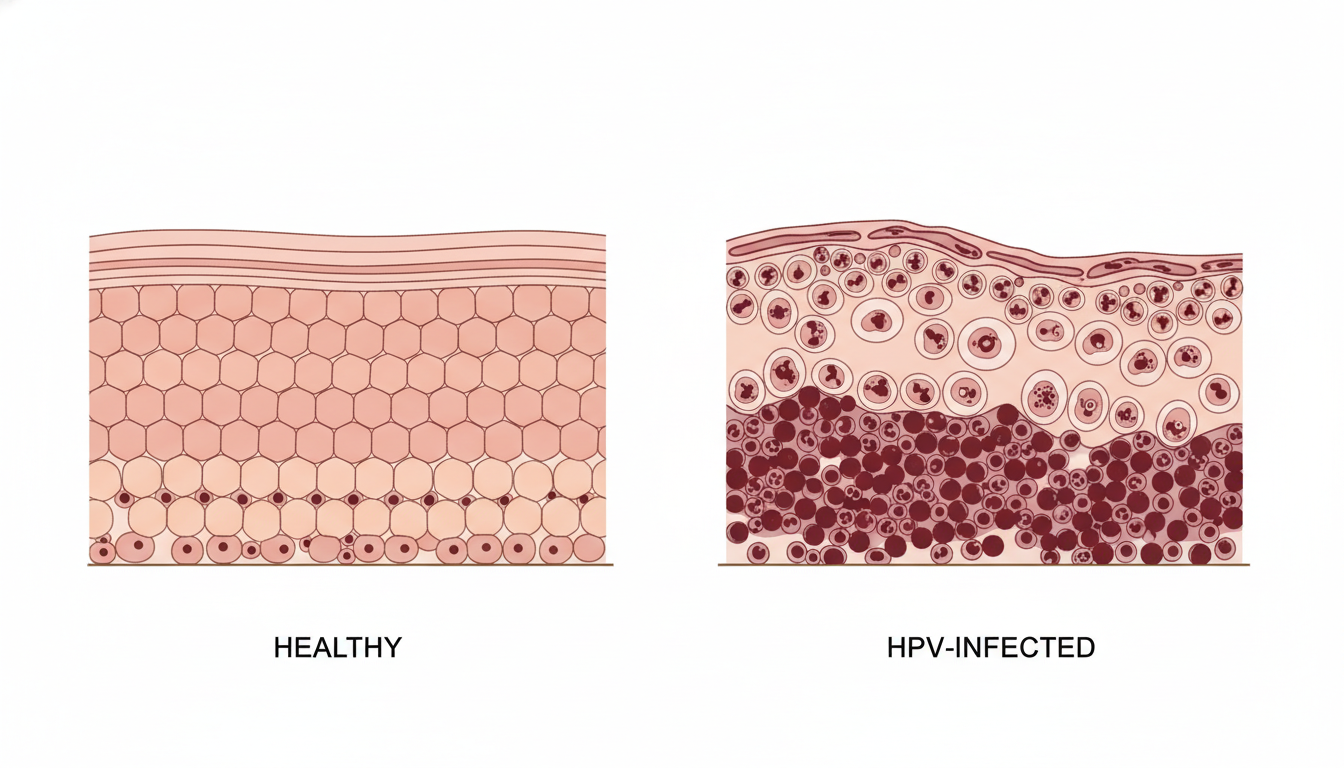
Most HPV infections never cause symptoms, and most never cause cancer. The CDC reports that in roughly 9 out of 10 cases, the immune system clears the virus within two years on its own. The infections that matter for cervical cancer risk are the ones that do not clear. When a high-risk strain stays in the cervix for years, it begins to disrupt the way cervical cells divide and mature. Over time those cellular changes accumulate. Cells that should be flat and orderly become irregular, then precancerous, then in some cases cancerous.
The progression is slow. MedlinePlus describes cervical cancer as the result of a long-lasting HPV infection, and clinical literature commonly describes a 10 to 15 year window between the original persistent infection and invasive cancer. That window is where screening earns its value. Catching the high-risk virus, or the precancerous cell changes that follow it, gives clinicians years to intervene before cancer ever develops.
HPV spreads primarily through vaginal and anal sex, and also through close skin-to-skin contact in the genital area during sex per the CDC. It is not a sign of infidelity or recent risk-taking; an infection picked up in your twenties can still be present a decade later. That is part of why screening is recommended on a fixed schedule rather than only when something feels wrong.
About 9 in 10 high-risk HPV infections are cleared by the immune system within two years, with no treatment and no lasting effect on the cervix. The roughly 1 in 10 that persist for many years are the ones that, in a small subset of women, eventually drive cellular changes. Screening exists because there is no symptom that distinguishes the infections that will clear from the ones that will not, and because the persistent ones can be caught and managed long before they cause cancer.
What an HPV test actually looks for
The phrase "HPV testing" covers two related but very different things: what laboratories do with cervical samples sent in by clinicians, and what at-home rapid tests do with self-collected samples at home. These are not interchangeable, and the distinction matters when you are deciding what to do next.
Laboratory HPV testing is a molecular test, often called a NAAT (nucleic acid amplification test) or HPV DNA test. It detects the genetic material of high-risk HPV strains directly. The CDC explains that the lab HPV test "looks for the virus (human papillomavirus) that can cause cell changes on the cervix," while a Pap smear "looks for precancers, cell changes on the cervix that might become cervical cancer if they are not treated appropriately." That is the core conceptual difference: one test detects the cause, the other detects the effect.
Because lab HPV tests pick up the virus at the genetic level, they can flag risk before any cell change has happened. A woman whose cervical cells still look completely normal under a microscope can still test positive for high-risk HPV, and that early signal is what lets her clinician follow her closely instead of waiting until something abnormal appears.
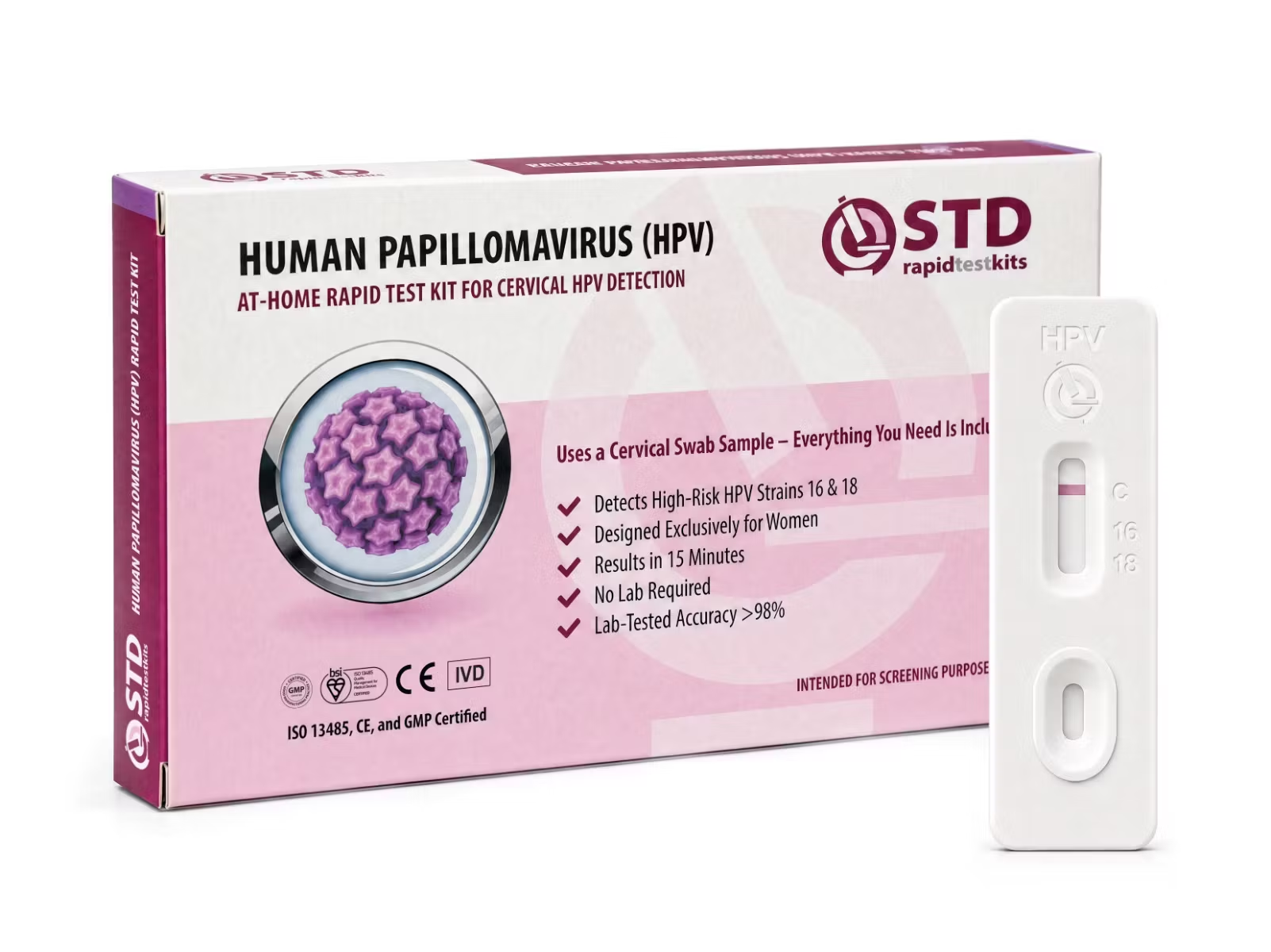
Rapid at-home HPV tests, including the kit on this site, use lateral-flow chemistry on a self-collected vaginal swab. They are screening tools rather than substitutes for the laboratory molecular test. A negative result on a rapid home test is reassuring but does not replace primary HPV screening at the recommended interval. A positive result is a strong signal to follow up with your clinician for a confirmatory laboratory HPV test and a clinical exam.
HPV test versus Pap smear, and when each makes sense
Both tests work on the same cervical sample, but they answer different questions. Knowing which test is being run, and at what interval, helps you read your own results and ask the right follow-up questions.
The National Cancer Institute lists three accepted screening strategies for women ages 30 to 65: a primary HPV test every 5 years, an HPV/Pap cotest every 5 years, or a Pap test alone every 3 years. The interval for HPV-based options is longer because the test is more sensitive, meaning it catches more underlying risk per screening event. Trading the shorter Pap interval for the longer HPV interval is not a downgrade in vigilance; it is a recognition that one molecular test does the work that previously required several cytology screenings.
In countries that have already moved to primary HPV screening, including the Netherlands, Australia, and the United Kingdom, women are typically tested every 5 years through age 65, with longer intervals than were used for Pap-only programs. The American Cancer Society now recommends starting screening at age 25 with a primary HPV test rather than waiting until 30, with HPV testing every 5 years through 65.
Co-testing combines both tests in a single visit and is still an accepted approach in U.S. guidelines. It catches a small additional number of women who would test negative on HPV alone but show abnormal cells on Pap. The trade-off is the higher rate of false positives that come from doing two tests instead of one, which can lead to extra colposcopies and biopsies.
| Question | HPV test | Pap smear (cytology) |
|---|---|---|
| What is detected | Genetic material of high-risk HPV strains | Abnormal cells on the cervix |
| How early can it catch risk | Before any cell change appears | Once cell changes have started |
| Recommended interval (ages 30 to 65, normal results) | Every 5 years | Every 3 years |
| Recommended start age | 25 (ACS) or 30 (USPSTF, WHO) | 21 (USPSTF) |
| Recommended stop age | 65, after several recent normal results | 65, after several recent normal results |
| Sample collection | Cervical swab; clinician-collected or self-collected at appointment | Cervical scrape, clinician-collected |
When to test, how often, and what changes by age
The right screening schedule depends on your age, prior results, and which guideline your clinician follows. Here is how the major recommendations break down.
Ages 21 to 24 (United States, traditional schedule). The CDC and USPSTF still note that Pap testing can begin at age 21 and continue every 3 years through 29 if results stay normal. HPV testing alone is generally not recommended in this age range because high-risk HPV infections in younger women very often clear on their own without intervention.
Ages 25 to 29 (newer ACS recommendation). The American Cancer Society now suggests starting screening at age 25 with primary HPV testing, repeating every 5 years through age 65 if results stay normal. Pap-only every 3 years and cotesting every 5 years remain acceptable alternatives.
Ages 30 to 65 (the main screening years). All three U.S. options are accepted: HPV alone every 5 years, cotest every 5 years, or Pap alone every 3 years. The WHO recommends screening every 5 to 10 years starting at age 30 in lower-resource settings, with a minimum of two lifetime screens by ages 35 and 45 as a global benchmark.
Over age 65. Most women can stop routine screening if they have had several recent normal results and no history of significant precancer. This is a conversation to have with your clinician, since stopping criteria depend on what those past results actually were.
Higher-risk situations call for a different rhythm. Women with HIV, women on long-term immunosuppression, and women previously treated for cervical precancer typically screen more frequently. The WHO specifically recommends screening every 3 to 5 years starting at age 25 for women living with HIV.
Cervical cancer screening intervals are measured in years, not months, which means it is easy to drift past the recommended date. Note your last test type and date in your phone calendar, and set a recurring reminder for the next one. If you switch clinicians, ask for a copy of your screening history so the next provider does not have to rebuild it from scratch.
Self-collected and at-home HPV testing: where it really fits
Self-collection has become one of the most important developments in cervical cancer screening, but the term covers two different things, and clearing up which one is which matters.
Clinical self-collection means a woman collects her own vaginal swab during a clinic visit, and the sample is sent to a laboratory for a molecular HPV test. Multiple large studies have found that self-collected samples processed by a laboratory molecular test are roughly as sensitive as clinician-collected samples for detecting high-risk HPV. The NCI notes that some U.S. clinics now offer this option, and the FDA cleared specific self-collection devices for use in clinical settings in 2024.
At-home rapid HPV testing is a different category. The kit on this site is a rapid lateral-flow test designed for self-collected vaginal samples. It is a screening tool, useful as an early prompt to seek confirmation, particularly for women who are between scheduled exams, anxious about clinical visits, or living in areas with limited access to gynecological care. It does not replace primary HPV screening at the laboratory standard, and a positive home test should be followed up with a confirmatory laboratory HPV test and a clinical exam. A negative home test is reassuring but does not reset your primary screening clock.
The kit is validated for vaginal self-swab and is therefore designed for women only. We do not currently offer a male-compatible HPV test; men who are concerned about HPV-related conditions, including genital warts or anal-cancer risk, should see a clinician for evaluation.
This site sells the rapid at-home HPV lateral-flow test described below; the recommendation to confirm any positive home result with a clinical laboratory HPV test and a clinician visit is genuine editorial guidance, not a disclaimer added for legal cover.
What a positive HPV test really means
A positive HPV test is not a cancer diagnosis, and it does not even mean you have abnormal cells. It means a high-risk strain of HPV is present in your cervical sample at the time of testing. Most positive results are followed by clearance of the virus within a year or two, especially in younger women.
What happens next depends on which HPV strain was detected and what your prior screening history looks like. HPV-16 and HPV-18 carry the highest cancer risk, so a positive for either of those strains usually triggers a colposcopy, an in-office procedure where the cervix is examined under magnification and small samples are taken for biopsy if anything looks abnormal. Positive results for the other 12 high-risk strains often trigger a follow-up Pap smear or repeat HPV test in 12 months to see whether the infection has cleared on its own.
If a colposcopy or biopsy finds precancerous changes, treatment is highly effective and is performed in an outpatient setting. Common procedures include a loop electrosurgical excision, where a thin layer of abnormal tissue is removed using a wire loop, or a cone biopsy. Both are designed to remove the precancerous tissue while leaving healthy cervical tissue intact. Treated correctly, precancer almost never progresses to invasive cancer.
The reason most women have never met someone who died of cervical cancer is exactly this. The disease is preventable at every step before it becomes cancer, and modern screening keeps catching it earlier. The hardest cases are women who have never been screened or who stopped going.
For HPV-16 or HPV-18: usually a colposcopy at your gynecologist's office, with biopsy of any visibly abnormal area. For other high-risk strains: typically a repeat HPV test or cotest in 12 months, or a colposcopy depending on your screening history. Treatment for actual precancer is outpatient and highly effective; the goal is to remove abnormal tissue before it ever becomes cancer.
HPV vaccination does not replace screening
The HPV vaccine, when given before exposure to the virus, prevents the great majority of cervical cancers. The CDC recommends routine vaccination at ages 11 to 12, with vaccination available starting at age 9, and catch-up vaccination through age 26 for anyone who did not complete the series earlier. ACIP guidance also supports shared clinical decision-making for adults aged 27 to 45 who may benefit from vaccination after discussing it with their clinician.
That said, vaccination does not eliminate the need for screening. Several reasons:
- The vaccine prevents new infection with the high-risk strains it covers, but it does not treat infections already present at the time of vaccination.
- Even the most current vaccines do not cover every high-risk HPV strain. Routine cervical screening catches risk from strains the vaccine does not target.
- Many women currently in the main screening years (30 to 65) were vaccinated late, were vaccinated with earlier vaccine generations, or never received the vaccine at all. Screening recommendations for these groups remain the same as for unvaccinated women.
The simple version: vaccination is the most powerful tool we have for primary prevention of cervical cancer, and screening is the most powerful tool we have for catching the cases vaccination did not prevent. Both are needed, and the two together are why cervical cancer mortality has fallen so sharply in countries with strong programs in both.
Almost all cervical cancer cases are caused by HPV. Cervical cancer can be prevented with timely vaccination, screening, and treatment of precancerous lesions.
Frequently asked questions
- How often should I get tested for HPV?
- Every 5 years from ages 30 to 65 is the standard interval if you are using a primary HPV test and your last result was normal. If your clinician uses Pap-only screening, the interval is shorter, every 3 years. The American Cancer Society now suggests starting at age 25 rather than 30. Whichever method your clinician runs, the schedule is fixed; do not wait for symptoms to prompt the next test, because most HPV-related cancer risk is silent until cell changes are already advanced.
- Can HPV go away on its own?
- Most of the time, yes. Roughly 9 in 10 infections resolve without any treatment within two years. The infections that matter for cervical cancer risk are the small minority that persist for many years; those are exactly what cervical screening is designed to catch before they cause cell changes. Clearance is the usual outcome, but it cannot be assumed without a screening result confirming the infection has gone.
- What does a positive HPV test mean?
- It means a high-risk strain of HPV is present in the cervical sample. It does not mean you have cancer or even precancer. Follow-up depends on which strain was detected; HPV-16 or HPV-18 usually leads to a colposcopy, while other high-risk strains often lead to a repeat test in 12 months.
- Can I test for HPV at home?
- Yes, with caveats. At-home rapid HPV tests use a self-collected vaginal swab and lateral-flow chemistry. They are useful for screening between clinical exams but are not equivalent to the laboratory molecular HPV test that primary screening uses. Confirm any positive at-home result with a clinician.
- Do I still need HPV testing if I got the HPV vaccine?
- Yes. The vaccine does not protect against every high-risk strain, does not treat infections already present at the time of vaccination, and is most effective when given before sexual debut. Vaccinated women still follow the standard cervical cancer screening schedule.
- What are the symptoms of HPV?
- Most HPV infections cause no symptoms at all. Low-risk strains can cause genital warts; high-risk strains typically cause no symptoms in their early years and only produce symptoms once they have caused significant cervical changes or invasive cancer. Because there are no reliable warning signs, the only way to know your high-risk HPV status is a clinical test at the recommended screening interval.
- Can men get HPV, and can men be tested?
- Yes, men can carry HPV and develop HPV-related cancers, including anal, penile, and oropharyngeal cancers. There is no FDA-approved routine HPV screening test for men, and our home kit is designed for vaginal self-collection only. Men with concerns about HPV-related symptoms should see a clinician.
- I have only had one partner. Can I still have HPV?
- Yes. HPV is highly contagious and can be transmitted through close skin-to-skin contact during sex, not only through penetration. A single partner who has had a previous partner is enough exposure for HPV transmission, which is part of why the CDC describes HPV as the most common sexually transmitted infection.
Bringing it all together
Cervical cancer is one of the success stories of public health. It used to be a leading cause of cancer death in women, and it still is in countries without strong screening programs. Where screening is well-implemented, it has become uncommon and survivable. The reason is straightforward: catch the virus before it causes cell changes, catch the cell changes before they become cancer, and treat at whichever step a problem is found. Each layer reduces risk, and together they form a near-comprehensive net.
If you are due for a screening, schedule one. If you are between scheduled visits and curious about your status, an at-home rapid test can give you a private check, with the understanding that any positive result needs a clinical follow-up. And if you have not been vaccinated, the conversation about catch-up vaccination is worth having with a clinician at any point through your forties.
- World Health Organization. Cervical cancer fact sheet. Source for HPV-16 and HPV-18 contributing roughly 76% of cervical cancers, recommended global screening intervals starting at age 30, and the WHO comprehensive prevention framework.
- U.S. Centers for Disease Control and Prevention. Cervical cancer screening guidance. Source for the U.S. recommendation of primary HPV testing every 5 years for ages 30 to 65 with normal results, and the conceptual difference between HPV testing and Pap cytology.
- U.S. Centers for Disease Control and Prevention. About genital HPV infection. Source for HPV being the most common sexually transmitted infection and the 9-out-of-10 clearance rate within two years.
- National Cancer Institute. Cervical cancer screening. Source for the three accepted U.S. screening strategies (primary HPV test, cotest, Pap alone), the move toward primary HPV testing, and the availability of clinical self-collection.
- MedlinePlus, U.S. National Library of Medicine. Cervical cancer overview. Source for the causal link between long-lasting HPV infection and cervical cancer, and the screening rationale.
- U.S. Centers for Disease Control and Prevention. HPV vaccination recommendations. Source for routine vaccination ages 11 to 12 (starting at 9), catch-up through age 26, and the ACIP-supported shared decision-making framework for adults 27 to 45.
