Published: July 2025 | Last updated: May 2026 | Editorial review and quality control: Martina N.
When symptoms fade after a possible exposure, the most natural reaction is to feel relief and assume the body handled the rest. With gonorrhea, that instinct can quietly mislead you. The bacteria are unusually good at staying put even after the burning, discharge, or throat irritation calms down. The immune system can dial back the inflammation that creates noticeable symptoms while the infection itself continues in the lining of the urethra, cervix, throat, or rectum.
If you landed here because your symptoms seemed to disappear on their own, this article walks through what happens biologically, why fading symptoms are not a reliable signal, what the realistic timeline looks like, and the simple step that turns weeks of uncertainty into a clear answer. That gap between feeling and biology explains why clinicians push so hard on testing even when symptoms have already faded.
Key Takeaways
- Gonorrhea almost never clears without treatment. Symptoms can fade because your immune system suppresses local inflammation, but the bacteria typically stay in mucosal tissue until antibiotics treat them.
- Untreated infection can quietly progress to pelvic inflammatory disease, infertility, epididymitis, or rare bloodstream spread. A single test replaces weeks of guessing.
Why so many people ask this question
Sexual health worry follows a predictable arc. Something feels off after sex. You search the symptoms. You stumble across forum posts where strangers describe their symptoms going away on their own. Suddenly it seems plausible that whatever was going on simply resolved itself.
That assumption is built on something real. Gonorrhea genuinely behaves differently from infections like strep throat or the flu, where you feel obviously sick until your body wins. Neisseria gonorrhoeae infections can produce a few days of irritation that fades long before the bacteria are cleared. According to the CDC, many infections are missed entirely because the early symptoms are mild, brief, or absent (CDC gonorrhea overview). That gap between how you feel and what is happening in your tissues is one of the reasons public health clinicians push so hard on testing after any possible exposure, even when symptoms are unclear or have already settled down.
A fading symptom is not the same as a clear result. A negative test taken at least a week after the exposure is the only reliable way to confirm you are in the clear. Until then, treat yourself as potentially contagious to partners.
What actually happens inside the body
Gonorrhea is caused by Neisseria gonorrhoeae, a bacterium that infects mucosal surfaces. After contact, it attaches to the cells lining the urethra, cervix, throat, rectum, or, less commonly, the eyes. Specialized surface proteins on the bacterium grip onto host cells so it isn’t easily flushed away by urine, saliva, or mucus.
Your immune system responds within hours. White blood cells flood the area and trigger inflammation. That inflammation is what produces the early symptoms people notice first: burning during urination, unusual discharge, irritation, or a sore throat that doesn’t feel like a normal cold.
The immune system can quiet that inflammation enough to make you feel better while the bacteria continue to live in the tissue, creating the feeling of recovery even when an active infection remains.
| Stage | What Happens | What You Might Notice |
|---|---|---|
| Initial infection | Bacteria attach to mucosal cells | Often no symptoms yet |
| Immune response | Inflammation and white blood cell activity | Burning urination, discharge, irritation |
| Partial immune control | Inflammation decreases temporarily | Symptoms may fade or change |
| Persistent infection | Bacteria remain in tissue | Symptoms may disappear entirely |
Why your symptoms can fade while the infection stays
One of the most confusing things about gonorrhea is that symptoms are unreliable indicators of whether you still have it. Many people get an early burst of irritation, then a quiet period that feels like recovery, then sometimes another flare later. The bacteria have evolved a handful of tricks for this.
Neisseria gonorrhoeae can shift the proteins on its outer surface to avoid being recognized by the same immune cells twice, and it can sit inside epithelial cells where it is partly shielded from antibodies. The immune system therefore reduces local inflammation, you feel less discomfort, and the bacterium continues to live and replicate in the tissue. According to the CDC, many gonococcal infections in women go unrecognized because symptoms are mild, mistaken for a bladder or vaginal infection, or absent entirely (CDC gonorrhea fact sheet). Feeling better is not the same as being clear.
Neisseria gonorrhoeae can change its outer proteins to avoid being recognized by the same immune cells twice. That lets the bacterium outlast the initial inflammatory response, even when local symptoms have quieted down.
How often there are no symptoms at all
The natural-recovery idea also spreads because a large share of infections never produce noticeable symptoms in the first place. People can carry the bacterium for weeks or months and feel completely fine. According to the CDC, many men with gonorrhea have no symptoms, and most women with gonorrhea do not have symptoms either; pharyngeal and rectal infections are also frequently silent (CDC gonorrhea fact sheet).
That matters here because someone who never felt sick in the first place is especially likely to assume they were never infected, or that any vague discomfort they did notice resolved on its own. Routine screening repeatedly shows otherwise. When a person eventually tests negative weeks or months later, it is tempting to read that as evidence the body fought the infection off. In most cases the real story is different. They may have been treated for something else with an antibiotic that happened to cover gonorrhea, or they were prompted to test only after a partner’s diagnosis.
| Location of Infection | Approximate Rate Without Symptoms |
|---|---|
| Cervix | Up to 50% |
| Urethra (men) | About 10-20% |
| Throat | Often asymptomatic |
| Rectum | Frequently unnoticed |

What the literature says about spontaneous clearance
Occasional reports describe spontaneous clearance, especially with pharyngeal infections, but these cases are unusual, unpredictable, and not something any clinician would recommend waiting for. The CDC, the WHO, and the NHS all consistently recommend antibiotic treatment for any confirmed infection, including asymptomatic ones found through screening (NHS gonorrhoea).
Part of the reason is biology. Even when partial clearance happens, recovery doesn’t leave behind protective immunity the way chickenpox or measles do. Neisseria gonorrhoeae shifts its surface proteins constantly, and the immune memory it leaves is weak. People can get reinfected through a single new exposure, and many do. The other reason is risk. While the body is trying to handle the infection, the bacteria can still spread to partners, climb into reproductive tissue, or, in rare cases, enter the bloodstream.
Many men with gonorrhea have no symptoms at all. Most women with gonorrhea do not have any symptoms. Even when a woman has symptoms, they are often mild and can be mistaken for a bladder or vaginal infection.
What can happen if untreated gonorrhea is left alone
Once an infection is established, it doesn’t stay parked in one place. Over weeks to months the bacteria can travel through reproductive or urinary tissues and produce complications that are far more serious than the original irritation.
For people with a cervix, untreated infection is one of the leading causes of pelvic inflammatory disease, which can scar the fallopian tubes and raise the long-term risk of infertility and ectopic pregnancy (CDC gonorrhea complications). For people with a penis, the bacteria can spread to the epididymis, the coiled tube behind the testicle, causing painful swelling that can also affect fertility if it goes untreated long enough.
In rare cases the bacterium enters the bloodstream, a syndrome called disseminated gonococcal infection, which can produce fever, skin lesions, and arthritis-like joint inflammation. Pregnant people with untreated gonorrhea can pass it to a baby during delivery, where it can cause newborn eye infections severe enough to threaten vision.
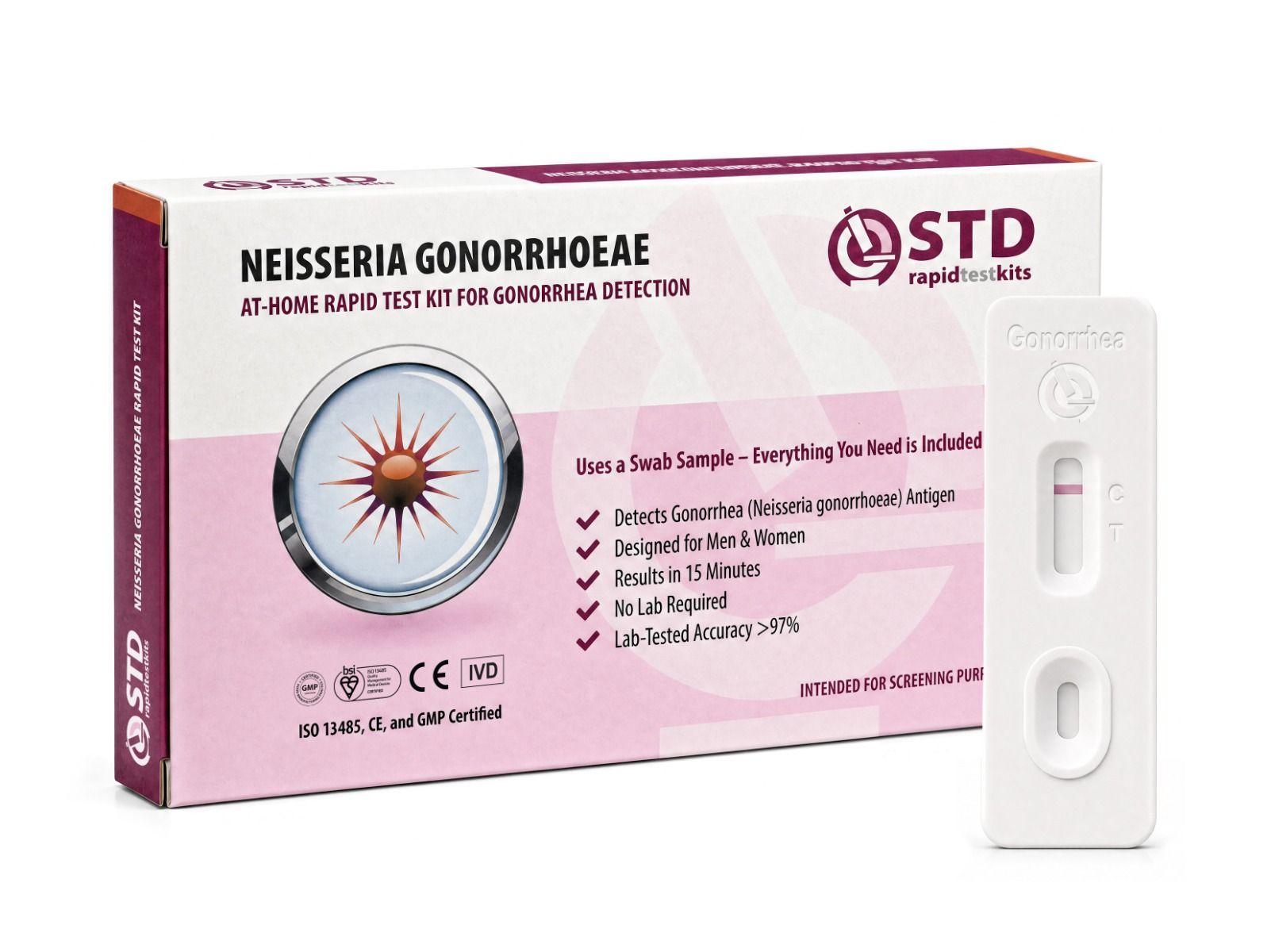
We sell rapid at-home STI tests, including a self-collected swab for gonorrhea. Details on the kit are below.
What testing involves now
Testing is the only reliable way to know whether an infection is still present. The good news is that it has gotten faster, cheaper, and more accessible. In a clinic setting, a urine sample (for urethral infections), a self-collected vaginal swab, or a clinician-collected throat or rectal swab is sent for nucleic acid amplification testing (NAAT), which the CDC identifies as the preferred diagnostic method (CDC gonococcal infections in adolescents and adults treatment guidelines).
At-home rapid tests use lateral-flow chemistry on a self-collected swab. They are designed for screening at home and give a visible result in roughly fifteen minutes, similar in format to a home pregnancy or COVID test. A positive at-home result is meaningful and should be followed up promptly with a clinician, who can repeat the test using lab NAAT and prescribe treatment. A negative result after a known exposure is most useful at least a week after the contact, since the bacterium needs a few days to multiply enough to be detectable.
Throat and rectal infections deserve a separate note. Pharyngeal and rectal gonorrhea are best diagnosed by anatomic-site-specific swabs collected at a clinic, since at-home swab tests sold for general use are validated for genital sampling. If your exposure was specifically oral or anal, a clinic visit gives the most accurate answer for those sites; our at-home swab covers the genital risk from the same exposure event, not the throat or rectum directly.
Can gonorrhea go away on its own without treatment?
Almost never. Symptoms can fade within days because your immune system suppresses local inflammation, but the bacteria typically remain in mucosal tissue and continue to be transmissible until antibiotics treat them. The CDC, WHO, and NHS all recommend antibiotic treatment for every confirmed infection, including asymptomatic ones found through screening.
How gonorrhea is treated today
Once a test is positive, treatment is usually quick. The current CDC recommendation for uncomplicated gonococcal infection is a single 500 mg intramuscular injection of ceftriaxone (1 g for people weighing 150 kg or more). If chlamydia hasn’t been ruled out, doxycycline is added to cover both. The full clinical guideline is publicly available (CDC gonococcal infections treatment guidelines).
Antibiotic resistance is the reason ceftriaxone is now the front-line drug. Neisseria gonorrhoeae has developed resistance, in turn, to sulfa drugs, penicillins, tetracyclines, and fluoroquinolones over the past several decades. Home remedies, leftover antibiotics, or older prescriptions found at the back of a medicine cabinet are unreliable, and sometimes harmful, because untargeted antibiotic use feeds further resistance.
After treatment, symptoms typically improve within a few days. Most clinicians recommend avoiding sexual contact until both you and any recent partners have been treated and at least a week has passed since the last dose. A retest after about three months is recommended for everyone treated for gonorrhea, primarily to catch reinfection, which is common.
| Step | Purpose | What Patients Should Know |
|---|---|---|
| Antibiotic treatment | Eliminate the bacteria | Medication must be taken exactly as prescribed by the provider |
| Partner notification | Prevent reinfection and onward spread | Recent partners (last 60 days) should also be tested and treated |
| Retest at 3 months | Catch reinfection, not treatment failure | Recommended for everyone treated for gonorrhea, per CDC guidance |
A realistic timeline from exposure to diagnosis
Knowing how the infection progresses helps explain why fading symptoms are such a misleading signal. The timeline below is a rough sketch, and individual cases vary widely; some people develop symptoms within days, others never develop them at all.
| Time After Exposure | What May Be Happening | Possible Symptoms |
|---|---|---|
| 2-7 days | Bacteria multiply at the infection site | Burning urination, discharge, or throat irritation |
| 1-3 weeks | Immune response fluctuates | Symptoms may improve or seem to disappear |
| Weeks to months | Persistent untreated infection | Often no symptoms, but still transmissible |
| Months and beyond | Possible complications | Pelvic pain, fertility issues, or rare systemic spread |

The mental loop of waiting it out
Sexual health questions rarely feel purely medical. They carry fear, embarrassment, and sometimes shame, and many people delay testing because they are hoping symptoms will quietly disappear or because they are worried about what a result might mean for a relationship.
Waiting rarely gives you useful information. Symptoms fluctuate. Some days they feel almost gone. Other days something new shows up. The uncertainty is exhausting, and it doesn’t tell you whether the underlying infection is resolved. A test does.
Testing is not a personality judgment, either. The CDC and the U.S. Preventive Services Task Force recommend annual gonorrhea and chlamydia screening for sexually active women under 25, and for women 25 or older with new or multiple partners. The CDC also recommends annual screening for sexually active gay, bisexual, and other men who have sex with men, regardless of symptoms.
The CDC and the U.S. Preventive Services Task Force recommend annual gonorrhea and chlamydia screening for sexually active women under 25, and for older women with new or multiple partners. The CDC also recommends annual screening for sexually active gay, bisexual, and other men who have sex with men. Routine screening catches infections that never produce symptoms.
When fading symptoms do not mean gone
One of the most misleading patterns is symptom fluctuation. Burning or discharge appears briefly, disappears, and sometimes returns weeks later. People interpret the calm windows as recovery. In reality, the bacterium may still be present and transmissible in tissues that don’t produce obvious symptoms, especially the throat and rectum.
Even if symptoms quiet down, the bacteria can still pass to partners through vaginal, oral, or anal contact, which is one reason untreated infections spread without anyone realizing it happened. If you were exposed and your symptoms eased before you ever got tested, you may still be contagious until a test rules it out.
When you don’t know which infection is most likely, a multi-test panel is often the most useful first step. A 6-in-1 essential at-home kit screens for the six most common STIs at once, including gonorrhea, which is helpful when symptoms could fit more than one infection or when you simply want broader reassurance in a single sitting.
The bottom line on natural clearance
So to answer the question directly: can gonorrhea go away on its own? Documented cases of spontaneous clearance exist, but they are uncommon and unpredictable, and no medical body recommends waiting them out. The bacteria are well adapted to hide from the immune system, the early symptoms are an unreliable proxy for whether the infection is still active, and untreated infection carries real risks for fertility, transmission, and rare but serious systemic spread.
The safer approach is also the simpler one. After a possible exposure, give the bacterium enough time to be detectable (about a week), then test. If the test is positive, treatment is short and effective. If it is negative, you have replaced anxiety with information and can move on without the running tally of every twinge in your body.
FAQs
- Can gonorrhea ever go away without antibiotics?
- Rare cases of spontaneous clearance, especially throat infections, have been described in the medical literature, but they are uncommon and unpredictable. The CDC, WHO, and NHS all recommend antibiotic treatment for every confirmed infection, including asymptomatic ones found through screening. Waiting it out is not a clinical strategy.
- If my symptoms went away, does that mean the infection is gone?
- Not necessarily. The immune system can reduce the inflammation that causes burning, discharge, or throat irritation while the bacteria continue to live in the tissue. People often feel substantially better within days but still test positive weeks later. The only way to know is to test.
- How long could someone carry gonorrhea without realizing it?
- Weeks to months. Cervical, throat, and rectal infections are often silent, and even urethral infections in men can be mild enough to ignore. Many cases are only discovered through routine screening or after a partner is diagnosed.
- What happens if gonorrhea stays untreated for months?
- The bacteria can spread to nearby tissue. In people with a uterus this can cause pelvic inflammatory disease, which is a leading cause of infertility and ectopic pregnancy. In people with testicles it can cause epididymitis, painful swelling that can also affect fertility. Rare cases spread to the bloodstream and cause fever, joint inflammation, and skin lesions.
- Can throat gonorrhea clear on its own?
- Pharyngeal infections are the ones most often reported as spontaneously clearing, but the throat is also the site where infections are most often missed because they cause no symptoms. Throat gonorrhea is best diagnosed with a clinician-collected pharyngeal swab, which is not what our at-home genital swab is validated for. If your exposure was specifically oral, a clinic test is the right call.
- Can you get gonorrhea more than once?
- Yes, and reinfection is common. Unlike chickenpox or measles, gonorrhea doesn’t leave behind strong protective immunity. The bacterium shifts its surface proteins, so even people who were treated successfully can be reinfected from a single new exposure. The CDC recommends a retest about three months after treatment to catch reinfection.
- How soon after exposure should I test?
- Most modern NAATs can detect gonorrhea about a week after exposure. If you test very early and the result is negative, providers often recommend repeating the test a week or two later, especially if symptoms develop in between.
- Is an at-home gonorrhea test accurate enough to rely on?
- At-home rapid tests use lateral-flow chemistry on the same swab sample type used in clinics. They are useful as a privacy-friendly screen and give a visible result in about 15 minutes. A positive home result should be confirmed with a clinician for treatment, and a clear negative result a week or more after exposure is reassuring for genital infection. They are not equivalent to lab NAAT, which remains the diagnostic gold standard.
- U.S. Centers for Disease Control and Prevention. Gonorrhea overview, including symptoms, transmission, asymptomatic infection rates, and complications.
- U.S. Centers for Disease Control and Prevention. STI Treatment Guidelines, Gonococcal Infections Among Adolescents and Adults (ceftriaxone 500 mg IM regimen, NAAT as preferred diagnostic method, retest at 3 months).
- U.S. Centers for Disease Control and Prevention. Gonorrhea fact sheet for adolescents and adults, covering asymptomatic infection patterns and unrecognized infections in women.
- NHS. Gonorrhoea symptoms, diagnosis, treatment, and complications information for UK readers (including epididymitis and pelvic inflammatory disease).
- U.S. Preventive Services Task Force. Recommendation on screening for chlamydia and gonorrhea in sexually active adolescents and adults.
- MedlinePlus (U.S. National Library of Medicine). General overview of gonorrhea for consumer audiences.
