Published: October 2025 | Last updated: May 2026 | Editorial review and quality control: Martina N.
The short answer for most people is reassuring: a visible genital wart is unlikely to turn into cancer. Warts and HPV-related cancers come from different branches of the same virus family, and the strains that cause one rarely cause the other. The longer answer matters, though, because human papillomavirus (HPV) has more than 100 types, and a small subset of them, the ones you usually cannot see, are responsible for almost all cervical cancer and a large share of anal, oropharyngeal, penile, and vulvar cancers (National Cancer Institute).
This article walks through what the research actually says about that split. Which HPV strains cause visible warts. Which ones cause cancer. How long the progression takes when it happens. What testing exists for each. The goal is calm, specific information you can act on, not panic.
Key Takeaways
- Visible genital warts almost always come from low-risk HPV types (most commonly types 6 and 11), which do not cause cancer.
- The HPV strains most strongly linked to cancer (especially types 16 and 18) usually cause no visible signs and are detected through Pap or HPV testing, not by checking for warts.
Why genital warts feel scarier than they usually are
Seeing a new bump on your genitals rarely triggers calm reasoning. The mind tends to jump straight to worst-case territory: cancer, lifelong infection, permanent damage. That spike of fear is one reason genital warts carry a stigma that often outweighs their medical risk. People with warts sometimes feel branded; others dismiss warts entirely and miss the real point, which is that different HPV types behave very differently.
The most common scenario is also the most reassuring one. Visible warts are typically caused by HPV types 6 and 11, which the CDC describes as low-risk because they do not drive the cell changes that lead to cancer. The HPV types that do cause cancer, especially 16 and 18, are described as high-risk for a different reason: they often produce no visible symptom and quietly change cells in mucosal tissue (cervix, anus, throat, penile, vulvar) where you cannot see them. So if a wart is visible, that is usually a sign of the lower-risk branch of the virus, not the higher-risk one.
The catch is that one person can carry more than one HPV strain at a time. A wart diagnosis does not rule out a separate high-risk infection elsewhere, and a clear visual exam does not rule out a silent high-risk infection.
Can genital warts turn into cancer?
For most people, no. Visible genital warts are nearly always caused by HPV types 6 and 11, which do not cause cancer. The high-risk HPV strains that do cause cancer (especially types 16 and 18) usually produce no visible warts and are detected by Pap and HPV testing, not by looking. The two things are caused by different HPV types, so a wart diagnosis and a cancer-risk diagnosis are answered by different tests.
HPV by the numbers: how common is the cancer-causing kind?
HPV is the most common sexually transmitted infection in the United States, and most sexually active people will be infected with at least one HPV type during their lifetime. As the CDC notes, a person can get HPV even if they have had sex with only one partner, and most people with HPV never develop symptoms or health problems from it.
Of the 100-plus HPV types identified, only about 14 are considered high-risk for cancer, and within that group two types (16 and 18) do most of the damage. The breakdown below shows how much of each HPV-related cancer is attributable to these high-risk strains.
| Cancer Type | Main HPV Strains Involved | Approx. % of Cases Caused by HPV |
|---|---|---|
| Cervical cancer | HPV 16, 18 | Over 90% |
| Anal cancer | HPV 16 | About 90% |
| Oropharyngeal cancer | HPV 16 | About 70% |
| Vaginal and vulvar cancer | HPV 16, 18 | About 70% |
| Penile cancer | HPV 16, 18 | About 60% |
How long does HPV actually take to become cancer?
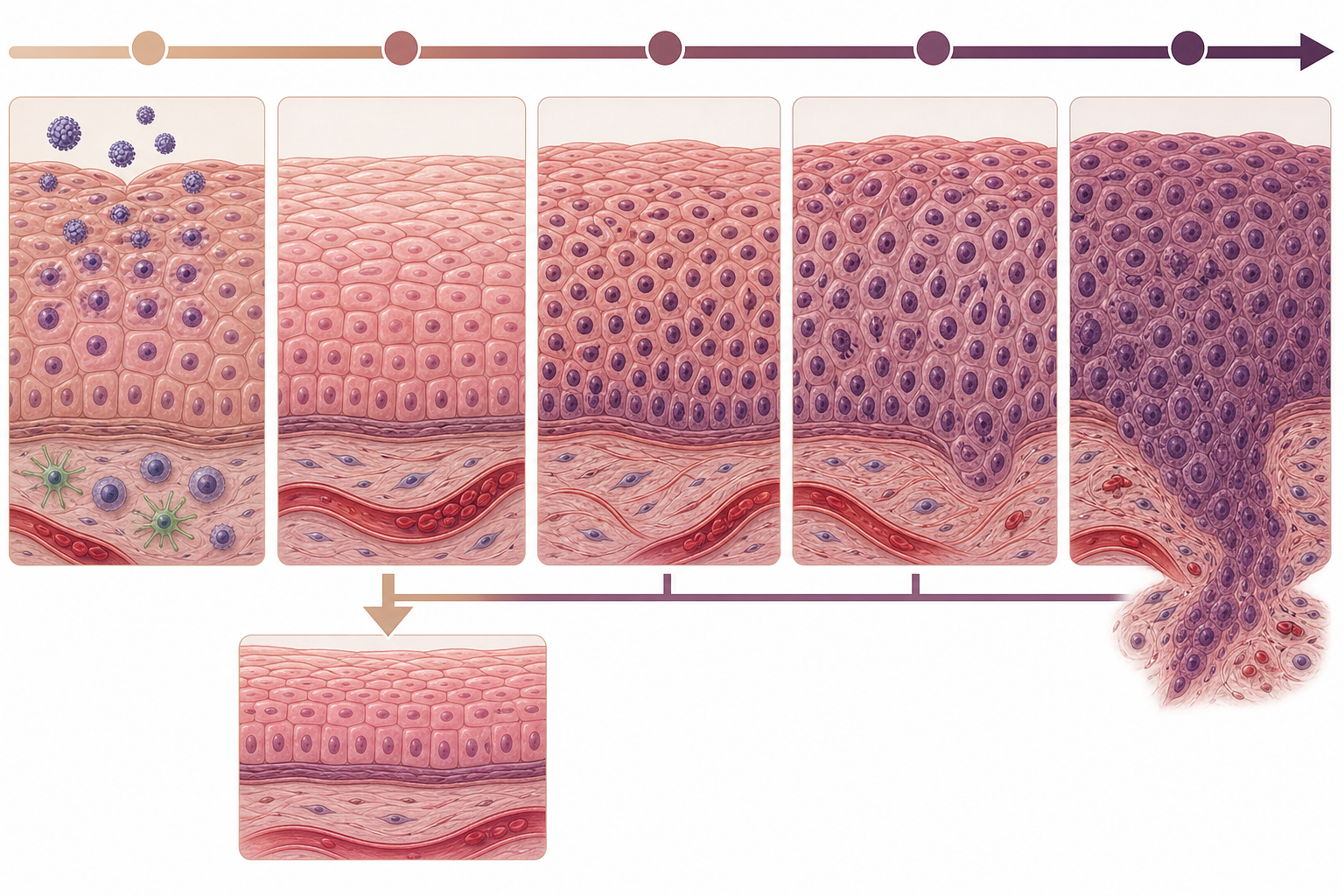
One of the most misunderstood things about HPV is how slowly it tends to move toward cancer, when it moves there at all. The vast majority of HPV infections resolve within one to two years without any treatment, especially in younger people whose immune systems clear the virus efficiently (National Cancer Institute). Cancer becomes a concern only when a high-risk HPV infection persists for years and the immune system fails to clear it.
For the small subset of infections that do progress, the typical timeline from persistent infection to invasive cancer is roughly 15 to 20 or more years, per WHO and NCI guidance. The interval shortens for people with weakened immune systems. That long window is the reason routine screening works so well. Precancerous cell changes can be caught and treated years before they become invasive cancer, and treatment at the precancer stage is generally far less invasive than treatment of cancer itself.
The shorthand for the precancer stage in the table below uses standard clinical terms. CIN 1 to 3 refers to cervical intraepithelial neoplasia (cervical tissue), AIN refers to anal intraepithelial neoplasia (anal tissue), and VIN refers to vulvar intraepithelial neoplasia (vulvar tissue).
| Stage | Average Timeframe | What It Means |
|---|---|---|
| HPV infection begins | 0 to 6 months | The virus enters cells after skin-to-skin contact. |
| Infection clears or persists | 6 to 24 months | Most cases resolve. High-risk types may linger silently in a minority. |
| Precancerous changes (CIN, AIN, VIN) | 5 to 10 years | Cell changes begin in mucosal tissue. Often reversible if caught at screening. |
| Invasive cancer | 15 to 20+ years | Untreated dysplasia progresses to cancer. Often without pain at early stages. |
HPV without warts: the silent high-risk strains
Here is the part that throws most readers off. The HPV types most likely to cause cancer often produce no visible symptoms at all. A person can carry HPV 16 or HPV 18 for years, look and feel completely well, and still have cellular changes developing inside the cervix, anus, throat, or penile tissue. The absence of warts is not the same as the absence of HPV.
In clinical terms, visible warts are a marker of low-risk HPV. High-risk strains tend to target mucous membranes, where you cannot see what is happening. That is why structured screening (cervical Pap and HPV co-testing for women, and anal Pap testing in certain high-risk groups) exists in the first place.
When a bump should make you pause
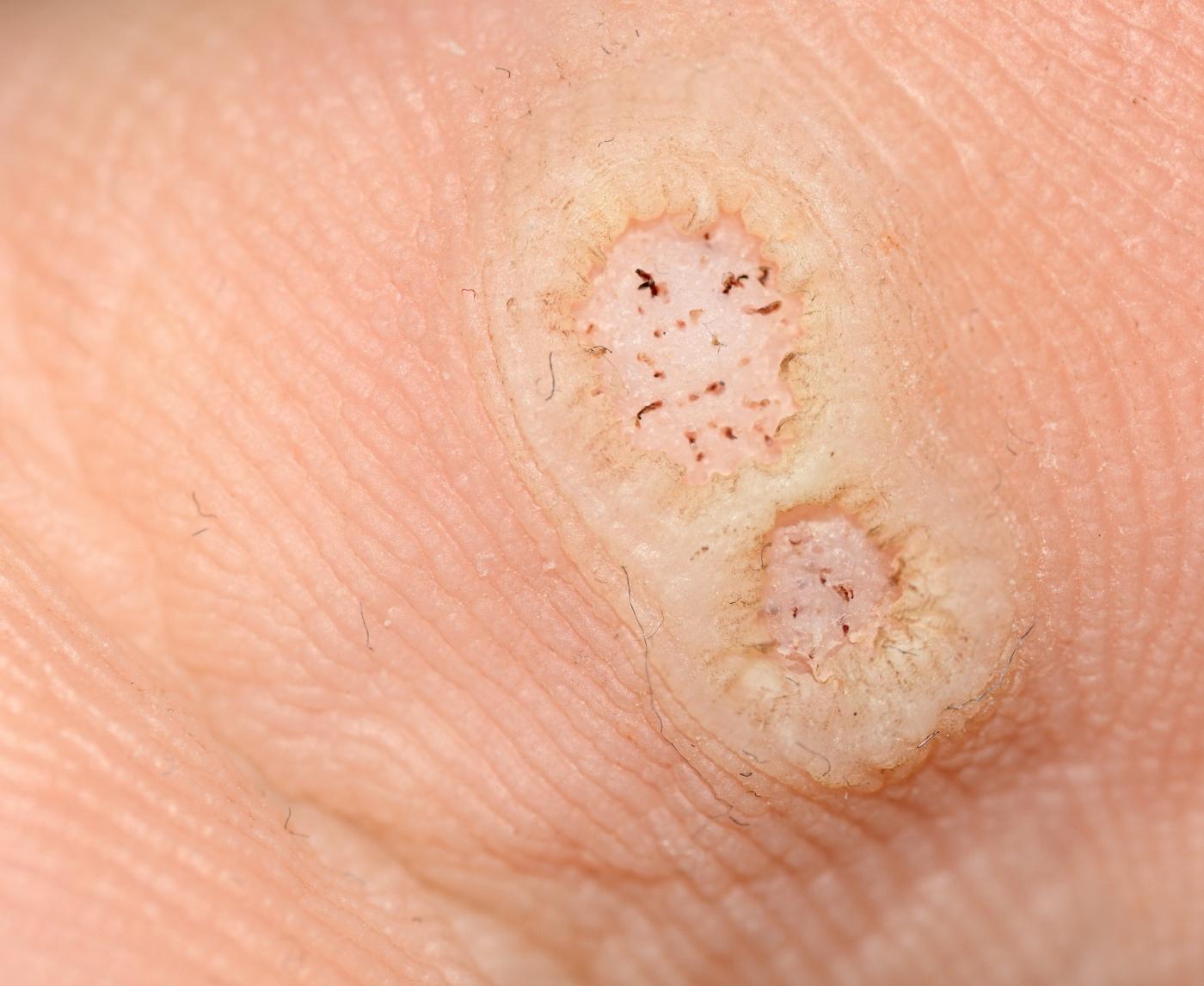
Most genital warts share a recognizable look. They appear as soft, flesh-colored growths that can be flat or raised, single or clustered. They sometimes resemble small cauliflower shapes, are usually painless, and may stay stable in size or grow gradually over weeks to months. Several other benign growths can mimic this appearance, including skin tags, seborrheic keratoses, and molluscum contagiosum lesions. Visual self-diagnosis is unreliable for any of these.
The features that warrant a clinic visit are different. A bump that ulcerates, bleeds easily on contact, develops irregular pigmentation, has uneven or rolled borders, or persists despite over-the-counter treatment is the kind of finding clinicians want to evaluate, often with a biopsy. Those features do not automatically mean cancer, but they shift the situation out of self-monitoring territory.
HPV typing and, when indicated, biopsy are the only ways to know what a lesion actually is. Some precancerous changes are invisible to the naked eye anyway, which is why visible inspection is never the whole answer. Routine Pap and HPV co-testing fills the gap for people with cervixes. Anal Pap testing fills part of the gap in higher-risk populations.
- The bump ulcerates or bleeds easily on contact.
- Irregular pigmentation develops on or around it.
- The borders look uneven, rolled, or hyperkeratotic.
- It persists despite over-the-counter treatment.
- Its size, shape, or color changes over weeks.
HPV testing access still varies, especially for men
For decades HPV has been treated primarily as a women's health concern, largely because cervical cancer is its most well-documented outcome and cervical screening has been a public-health priority for a long time. The biology does not respect that framing. HPV infects everyone, and in people without a cervix the testing landscape is much more limited.
There is currently no FDA-approved routine HPV screening test for men outside of specific high-risk anal cancer screening protocols (typically offered to men who have sex with men, people living with HIV, and other high-risk groups). That gap leaves many male patients unsure what to do, particularly when a partner is diagnosed with a high-risk HPV strain. The practical options for men are partner-aware monitoring, vaccination, attention to visible changes or persistent throat symptoms, and anal Pap screening when their clinical history warrants it.
Cervical co-testing (Pap plus HPV) is standard guidance for women aged 30 to 65, with intervals set by their clinician. People with a history of abnormal results, immune compromise, or HIV may be screened more frequently. Throat cancer screening for HPV-related oropharyngeal cancer is still evolving; persistent sore throat, unexplained neck lumps, voice changes, or trouble swallowing should prompt a clinic visit rather than self-monitoring.
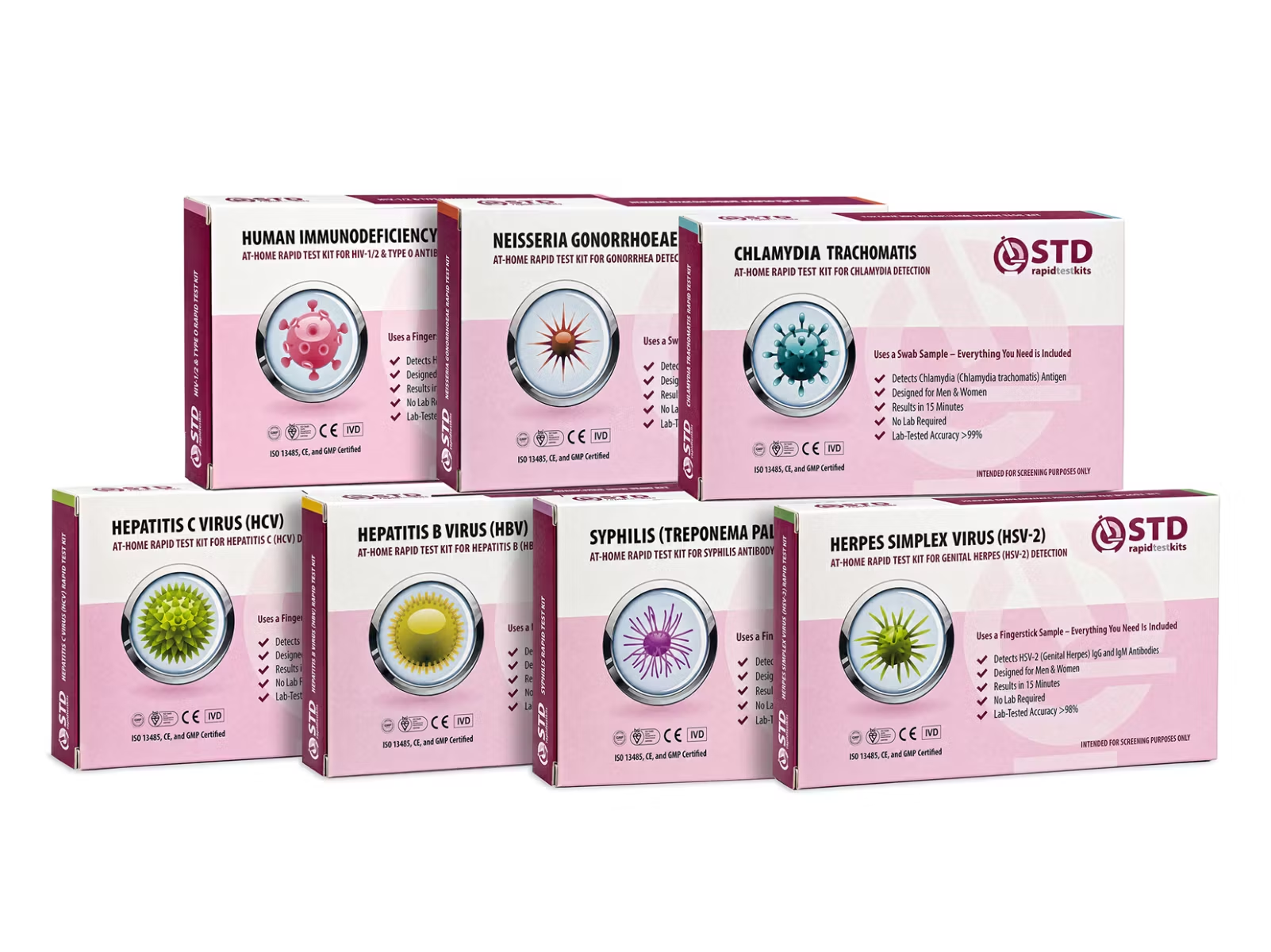
This site sells rapid lateral-flow STI test kits. The kit below is one option for ruling out common co-infections before a clinic HPV consult or cervical screening appointment.
Vaccination remains the strongest prevention layer
HPV vaccination is still one of the most effective tools available to prevent HPV-related cancers. The Gardasil 9 vaccine protects against nine HPV types, including the high-risk strains that cause most cervical, anal, oropharyngeal, and penile cancers, and the low-risk types 6 and 11 that cause the great majority of visible genital warts (National Cancer Institute).
Per current ACIP guidance, routine HPV vaccination is recommended through age 26. Adults aged 27 to 45 who were not adequately vaccinated earlier can be offered the vaccine through shared clinical decision-making with their provider, weighing the likelihood of additional exposure against the partial benefit at later ages. The vaccine is most effective before any HPV exposure, but it can still protect against strains a person has not yet encountered.
Vaccination does not treat an existing HPV infection. It is a forward-looking shield, not a rewind button. For people already living with one HPV strain, the value of the vaccine is that it still protects against the others, which matters because most people are not simultaneously infected with every high-risk type.
If you are sexually active, you can get HPV, even if you have had sex with only one person. Most people with HPV never develop symptoms or health problems from it.
Talking about it without panic or shame
HPV is sexually transmitted, and it is also one of the most common viruses adults will ever encounter. Carrying it does not signal anything about a person's character or hygiene. It means the immune system did not clear a particular HPV exposure before some of the virus integrated into cells. That is biology, not a verdict.
A clear conversation with a partner generally goes better when it centers on the next step, not on blame. Useful framing tends to sound like: I want both of us to be screened, or I had a visible wart treated and I want to share what that means, or my Pap result was abnormal and I am following up. Partners benefit from concrete information about what was found, what test or treatment is involved, and what they might want to ask their own clinician.
For people working through this alone, the same framework helps. Translate the situation into the next concrete step: book a Pap, schedule a clinic visit for a visible wart, ask about HPV typing if the lesion is unusual, or check whether vaccination still applies at your age.
- “I want both of us to be screened.”
- “I had a visible wart treated and I want to share what that means.”
- “My Pap result was abnormal and I am following up.”
What to do today if you are worried
If you have a visible wart, see a clinician for diagnosis and possible treatment. Topical prescriptions and in-office procedures (cryotherapy, prescription creams, surgical removal under local anaesthetic, or laser treatment) all work, with the choice depending on lesion location, count, and your medical history (NHS).
If you do not have symptoms but are sexually active, get current on STI screening anyway. At-home rapid tests can rule out the most common co-infections that get confused with HPV-related bumps, such as herpes, syphilis, and molluscum, and they let you walk into a clinic appointment with a clearer picture. For HPV itself, especially the high-risk types, you generally need a clinic visit: cervical co-testing for women 30 and older, anal Pap if you fall into a higher-risk group, and a focused exam if you have persistent throat or oral symptoms.
Vaccination, if it still applies to you, is the longest-term move in this list. Of all the actions you can take after a worrying bump, scheduling a Pap if you are due is the highest-value short-term one, and asking about vaccination is the highest-value long-term one.
Frequently asked questions
- Can genital warts actually become cancer?
- Most genital warts are caused by low-risk HPV types that do not cause cancer. The clinically relevant point is that warts and high-risk HPV can coexist; a visible wart is not evidence that high-risk strains are absent. That distinction is why clinicians recommend separate HPV typing or co-testing rather than relying on visual inspection alone.
- What does a cancerous wart look like?
- Strictly speaking, typical warts are not cancerous. Clinicians become concerned when a genital bump bleeds easily, ulcerates, develops irregular pigment, has rolled or uneven borders, or persists after treatment. Those features warrant a clinic visit and possible biopsy. Many benign lesions (skin tags, molluscum, seborrheic keratoses) can also look unusual without being dangerous, which is why visual self-diagnosis is unreliable.
- Can I have HPV and not know it?
- Yes, and that is the most common scenario. The majority of high-risk HPV infections cause no symptoms at all. They are detected through cervical Pap testing, HPV co-testing, or anal Pap testing in higher-risk groups. Feeling completely well does not rule out an HPV infection that would benefit from monitoring.
- Should men be tested for HPV?
- There is currently no FDA-approved routine HPV screening test for men in the way cervical co-testing exists for women. Anal Pap testing is offered to higher-risk groups, including men who have sex with men and people living with HIV. Outside of that, men can still take action through vaccination, attention to visible changes or persistent throat symptoms, and conversations with sexual partners about screening.
- How long does it take HPV to turn into cancer?
- For the small subset of infections that progress to cancer, the typical timeline is 15 to 20 or more years from persistent infection, per WHO and NCI guidance. The interval can be shorter in people with weakened immune systems. That long window is the reason routine screening works: precancerous cell changes can be caught and treated years before they become invasive cancer, and earlier treatment is generally far less invasive.
- I got the HPV vaccine late. Does it still help?
- Yes, with caveats. Gardasil 9 is FDA-approved through age 45 and works best when given before exposure. After exposure, it can still protect against strains a person has not yet encountered, which matters because most people are not infected with every high-risk type at once. ACIP recommends routine vaccination through age 26 and shared clinical decision-making between 27 and 45.
- Do condoms stop HPV?
- Condoms significantly reduce HPV transmission but do not eliminate it, because HPV spreads through skin-to-skin contact in areas a condom may not cover. Consistent condom use still meaningfully lowers transmission and is recommended alongside vaccination as part of a broader prevention strategy.
- Can HPV come back after it clears?
- It can appear to come back. HPV can stay latent at low levels in cells for years and reactivate, especially during stress, illness, or immune suppression. A negative HPV test years ago is not a guarantee of a current negative test, which is why screening on the schedule your clinician recommends matters more than relying on one past result.
How we sourced this article: Our article was constructed based on current advice from the most prominent public health and medical organizations, including the CDC, the World Health Organization, the National Cancer Institute, the NHS, and Mayo Clinic, and then molded into simple language based on the situations that people actually experience. Specific numerical claims, timelines, and strain attributions are linked inline to their primary sources, with a consolidated reference list below.
- Centers for Disease Control and Prevention. Fact sheet on genital HPV infection, covering transmission, that most people with HPV never develop symptoms or health problems, and that HPV types causing warts do not cause cancer. Source for the verbatim pull-quote in this article.
- Centers for Disease Control and Prevention. HPV landing page covering cancers caused by HPV, vaccination guidance, and links to clinical and public-health resources.
- World Health Organization. Cervical cancer fact sheet covering the role of HPV in global cervical cancer incidence, the 15-to-20-year progression interval from precancerous changes to invasive cancer, and the public-health impact of HPV vaccination programs.
- National Cancer Institute. Detailed reference on which HPV types cause which cancers, the proportion of each cancer that is HPV-attributable, and the typical progression timeline from persistent infection to invasive disease.
- National Health Service (UK). Patient-facing guide to genital warts including appearance, transmission, treatment options (topical creams, cryotherapy, surgical removal, laser), and when to seek clinical evaluation. Source for the inline treatment citation in this article.
- Mayo Clinic. Clinical overview of genital wart presentation, the role of low-risk HPV types 6 and 11, treatment options, and differentiation from cancer-causing high-risk strains.
