
Published: October 2025 | Last updated: April 2026 | Editorial review and quality control: Martina N.
Burning when you pee but nothing visible coming out? In bisexual men, that pattern is one of the most commonly missed presentations of chlamydia. The infection can sit at the urethra without obvious discharge, or hide entirely at the throat or rectum where most cases produce no symptoms at all. The standard urine test that most clinics order only checks one of those three sites, which is exactly why bisexual men, who often have exposure across multiple anatomical routes, get false reassurance more often than they should.
This guide walks through where chlamydia actually shows up in men's bodies, why a clean urine result can still leave you infected, how to time testing after a hookup so the result actually means something, and what to ask for at the clinic when your sexual history covers more than one type of partner.
Can chlamydia cause burning without discharge in bisexual men?
Yes. Chlamydia in men commonly produces mild burning, irritation, or no symptoms at all, especially at the rectum and throat where most infections stay silent. Standard urine testing only checks the urethra, so rectal or oral exposures need a separate site-specific swab collected at a clinic. The most reliable result comes from testing about 14 days after exposure, with retesting at 3 months after any positive treatment. Burning when urinating can also come from non-STI causes such as a UTI or minor urethral irritation; this guide focuses on when and how to test specifically for chlamydia given the exposure pattern.
Key Takeaways
- Chlamydia in men is often silent: rectal and pharyngeal infections frequently produce no symptoms, and urethral infection can show up as faint burning with no visible discharge.
- Site matters: a urine test only catches urethral infection. Anyone with oral or anal exposure needs separate clinic-collected throat or rectal swabs to actually rule out chlamydia.
When the System Doesn't Ask the Right Questions
If you have ever filled out a sexual health intake form that asked whether your partners are men or women, with no option for both, you already know the gap. Bisexual men often skip past the follow-up questions that would actually clarify exposure: which kind of contact, with which anatomy, when. Without those questions, the test that gets ordered defaults to a urine sample, and a urine sample only checks the urethra.
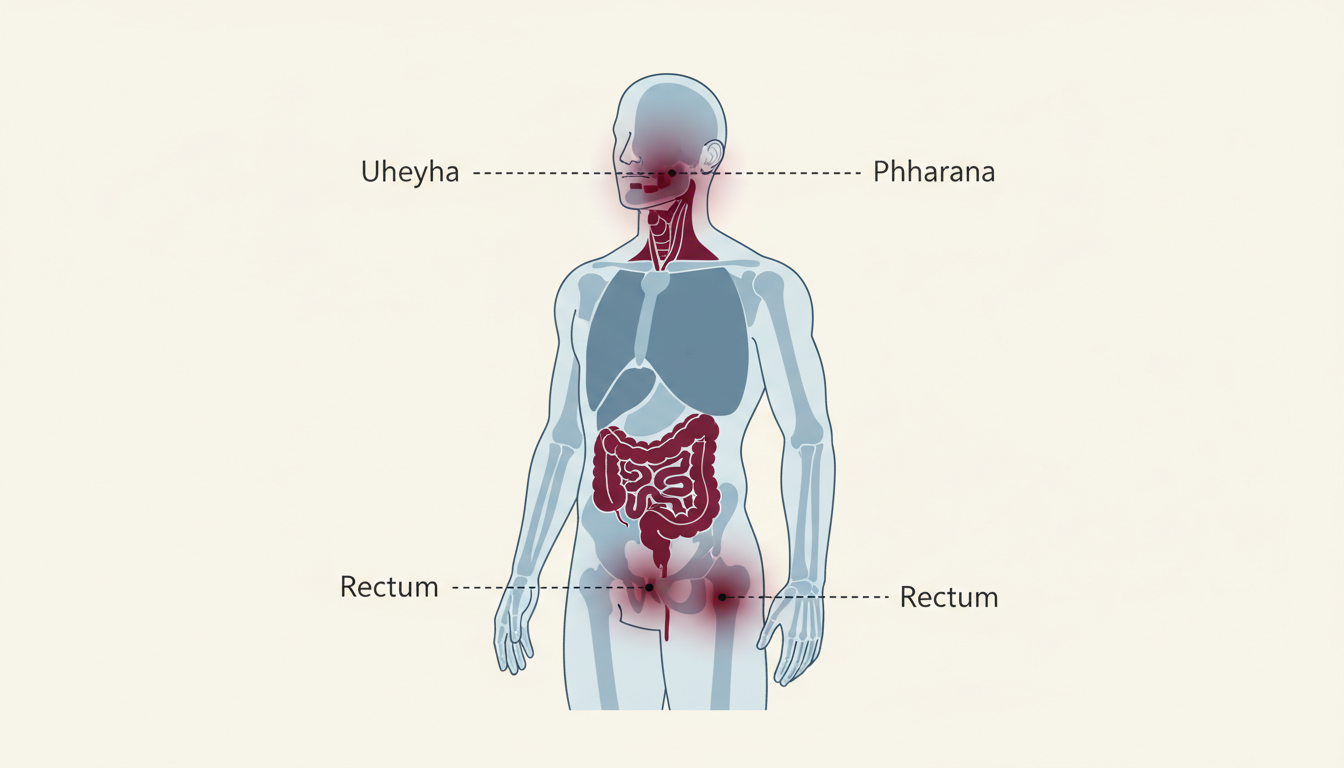
Chlamydia can infect three anatomical sites in men: the urethra (penis), the rectum, and the throat. Each site needs its own sample, collected from that site, to be detected. A bisexual man who received oral sex from a male partner and gave vaginal sex to a female partner could be carrying throat or rectal chlamydia while testing negative on urine. Missed infections then transmit silently, to partners of any gender.
According to the CDC's STI Treatment Guidelines for men who have sex with men, annual screening at all anatomical sites of exposure is recommended for MSM, but bisexual men often fall through the cracks of that guidance. Many do not identify with the MSM label, and providers rarely ask the follow-up questions needed to identify rectal or oral exposure routes. Under-testing at the silent sites is a predictable downstream effect.
Chlamydia can live independently at the urethra, the rectum, and the throat. A urine sample only rules out urethral chlamydia. If your sexual history includes receptive oral or anal contact, a clean urine result tells you nothing about the other two sites.
Where Chlamydia Hides in Men's Bodies
Unlike gonorrhea, which often announces itself with sharper symptoms, chlamydia is quieter, particularly at non-urethral sites. When men do have symptoms, they are usually mild: a faint burn while peeing, a sore throat that feels seasonal, mild rectal discomfort that gets dismissed as hemorrhoids or stress. Many infections produce no symptoms at all.
Per the CDC's surveillance of extragenital chlamydia and gonorrhea among MSM, chlamydia infections detected at the rectum and pharynx in men are often asymptomatic. The pattern is consistent across studies that systematically screen all three sites: rectal and pharyngeal infections are typically caught only when someone tests there directly, not because they felt sick first.
Below is an anatomical map of the three sites involved.
Symptoms and Samples by Site
What the infection feels like (when it feels like anything at all) and what kind of sample picks it up depend entirely on which site is involved. A sample from the wrong site will not catch an infection at the right one.
| Infection site | Common symptoms (when present) | Sample needed | Where to collect |
|---|---|---|---|
| Urethra (penis) | Mild burning when urinating, faint or no discharge, irritation at the tip; often no symptoms | Urine sample or urethral swab | At-home genital swab kit or clinic |
| Rectum | Mild itching, vague discomfort, occasional bleeding; usually no symptoms | Rectal swab | Clinic only |
| Throat | Mild sore throat; usually no symptoms | Pharyngeal (throat) swab | Clinic only |
Burning Without Discharge: A Common Misdiagnosis Pattern
Burning during urination without visible discharge is one of the more confusing presentations because it does not match the textbook picture of a male STI. A common pattern looks like this: a bisexual man with a recent oral or anal exposure mentions a faint burn, the provider hears 'burning urination, no discharge' and reaches for a UTI diagnosis, prescribes a short course of antibiotics, and sends him home without a swab. The antibiotics may partially mask the symptom, but the underlying infection has not been documented or fully treated, and partners go unnotified.
Two things can be true at the same time. A urinary tract infection without an obvious underlying cause is uncommon in younger men, AND chlamydia at the urethra can show up as low-grade burning with no discharge or with discharge so faint that it gets missed by both the patient and the provider. Per the CDC's STI Treatment Guidelines for men who have sex with men, approximately 70% of infections might be missed if only urogenital screening were performed, because so many cases live at the rectum or pharynx instead.
If you have urinary burning after a sexual encounter and your provider only orders a urine sample, ask whether the sample will be tested for chlamydia and gonorrhea by NAAT (urine NAAT picks up urethral infection). Then, if you had receptive oral or anal exposure, ask whether they will collect a throat or rectal swab as well. Those swabs are clinic-collected, not at-home tests.
Two requests to make explicitly: (1) confirm the urine sample will be tested for chlamydia and gonorrhea by NAAT; (2) if you had receptive oral or anal sex, ask for a throat swab or rectal swab on the same visit. Both swabs are clinic-collected and easy to add when you ask plainly.
When to Test After a Hookup
Timing matters more than people realize. Test too early, the bacterial load has not yet reached detectable levels and you get false reassurance. Test too late, you have already passed the infection along to a partner. The window period for chlamydia, the gap between exposure and reliable detection, depends on the test technology being used.
Lab-based NAAT (nucleic acid amplification testing) is the most analytically sensitive method available and is what most clinics use. Testing roughly 1 to 2 weeks after a known exposure gives the most reliable result for lab-based NAAT. Earlier than 7 days, bacterial load is often too low to detect. The CDC's STI Treatment Guidelines also recommend retesting about 3 months after a positive result and treatment to confirm clearance and check for reinfection.
For at-home rapid lateral-flow tests, the practical window is similar: about 14 days after exposure is the sweet spot. Earlier than 7 days, sensitivity drops because the infection has not amplified enough. Lateral-flow rapid tests use the same swab sample type as labs and screen quickly at home, but a positive at-home result is worth confirming with a lab NAAT for treatment documentation. The two technologies are complementary, not equivalent.
The table below lays out how to time testing based on the type of recent exposure.
| Exposure scenario | Earliest reasonable test | Best accuracy timing |
|---|---|---|
| Genital contact (condom slip, no condom, etc.) | 7 days | 14 days |
| Oral sex (giving or receiving) | 7 to 10 days | 14 days |
| New partner of unknown status | 10 days | 14 to 21 days |
| Persistent symptoms after a recent negative | Retest now | Retest at 14 to 21 days from exposure |
What Our At-Home Kit Actually Covers (and What It Doesn't)
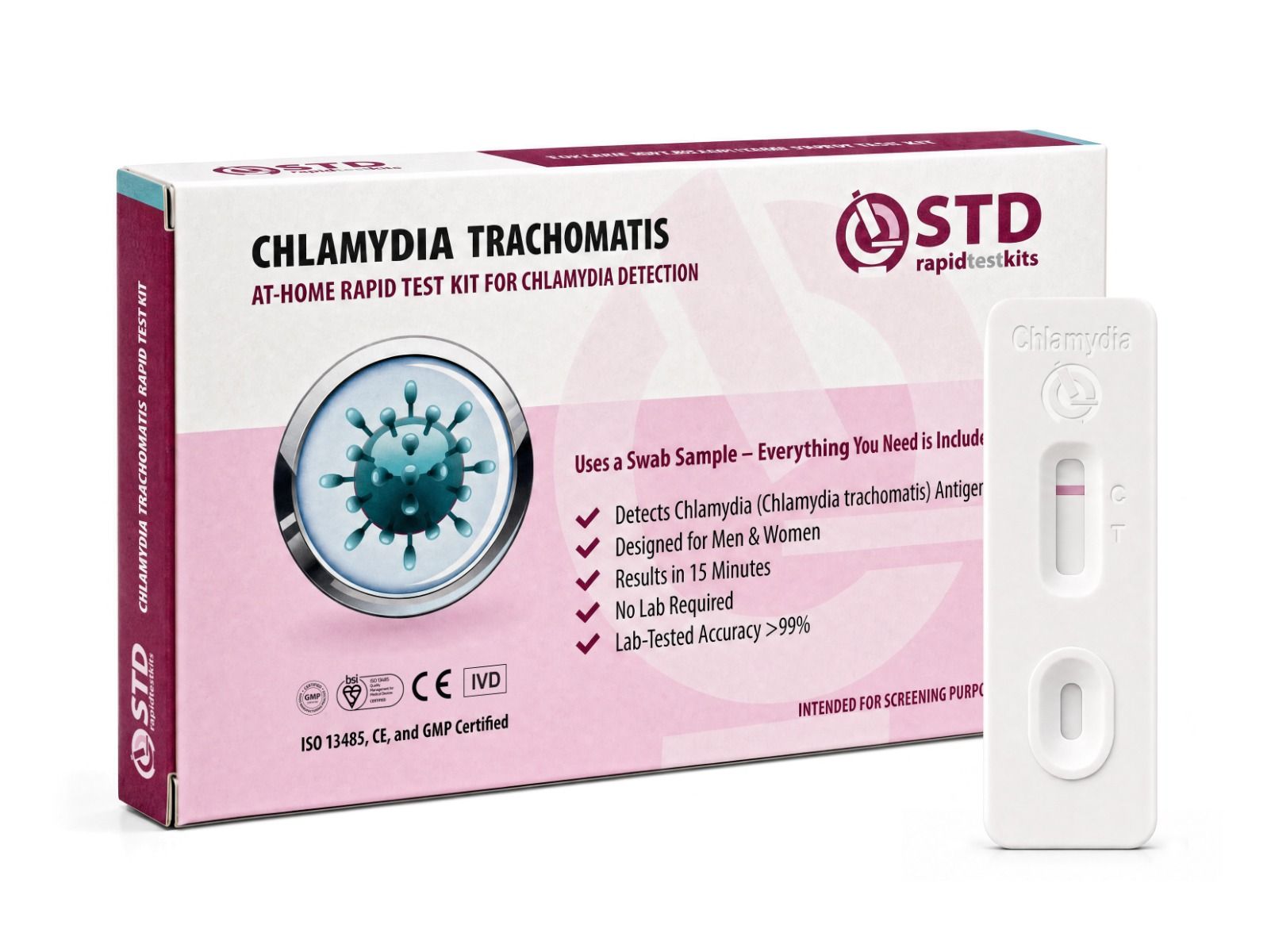
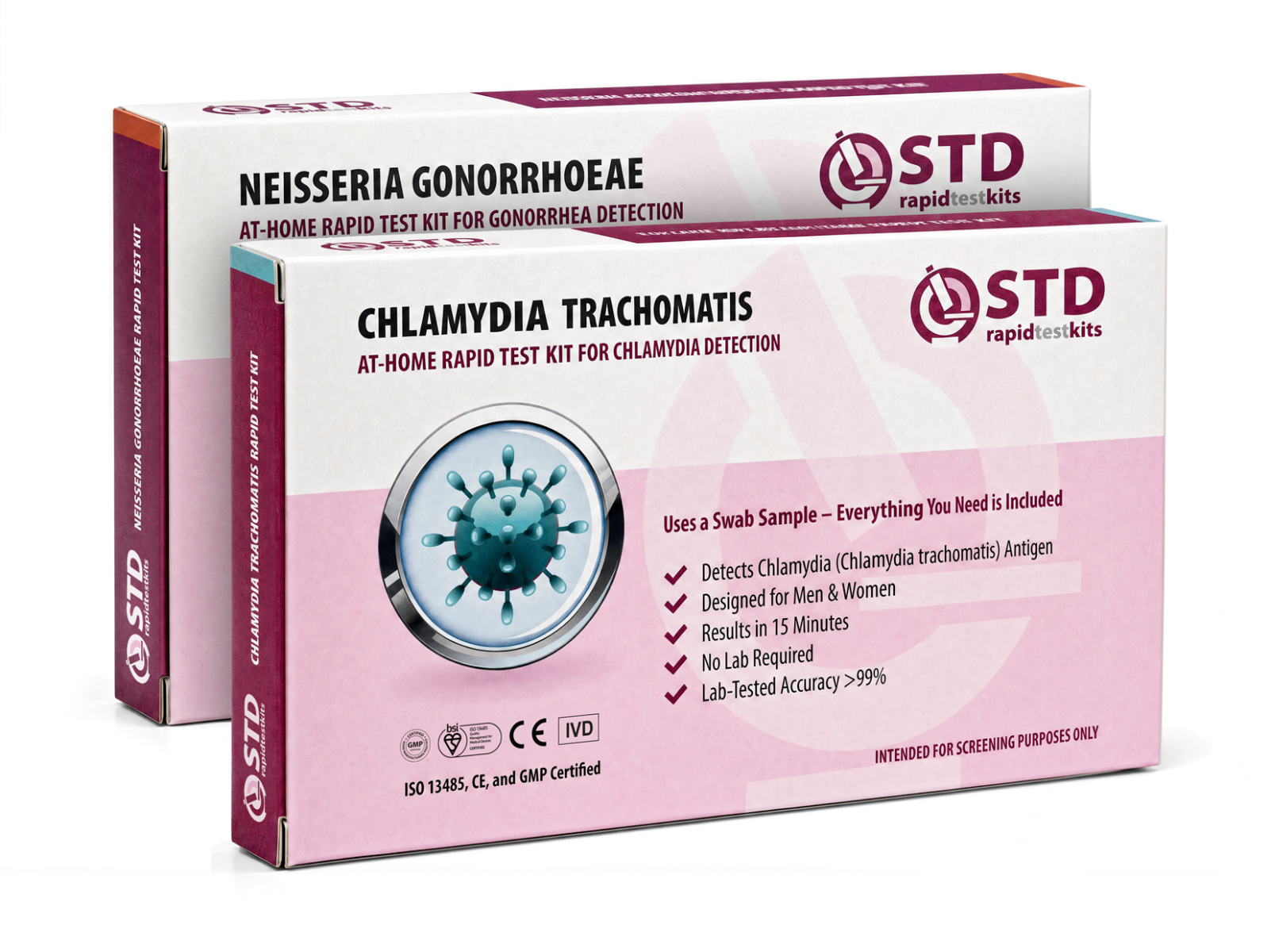
Our at-home chlamydia rapid test uses a self-collected genital swab. For men, that means a urethral swab. It tests for chlamydia at that one site with lateral-flow chemistry and gives a result in about 15 minutes at home. If your concern is genital exposure (insertive vaginal or anal sex without a condom, for example), the test does the job and matches the same swab sample type that labs use.
What our home kit does NOT cover: rectal swab samples or pharyngeal (throat) swab samples. We do not currently sell at-home rectal or throat test kits. If your sexual history includes receptive anal or oral exposure and you want to test the site that was actually involved, the path is a clinic visit. Most sexual health clinics, Planned Parenthood locations, and community LGBTQ-friendly health centers will collect rectal and throat swabs without judgment when you ask plainly for both.
That clinic visit is worth it because, per the CDC, extragenital chlamydia infections in men are typically only found when someone tests at the site directly. The two pathways are complementary. A clinic-administered throat or rectal swab catches infection where it lives. An at-home genital swab confirms or rules out urethral infection privately and quickly, often the same week as the encounter that prompted the question.
Quick disclosure: stdrapidtestkits.com sells the at-home rapid test kits linked below, so the product callouts are commercial. We recommend kits based on fit-for-purpose for the reader's exposure pattern, not commercial benefit, and we are explicit about which sample types our home kits do and do not cover.
Clinics use NAAT (nucleic acid amplification testing) for chlamydia, which is the most analytically sensitive method available. Our at-home kit uses lateral-flow rapid chemistry on the same genital swab sample type. A positive at-home result is worth confirming with a lab NAAT for treatment documentation; a negative at-home result is a useful screen but does not replace clinic-collected swabs at the rectum or throat, which we cannot test from home.
Heteronormative Bias and How to Push Back at the Clinic
Many bisexual men describe a familiar pattern at the clinic: mention a recent female partner and the consultation moves on; mention a recent male partner and the questions either freeze up or turn reductive. Provider bias toward heteronormative defaults is well documented in sexual health research, and one downstream effect is under-testing of bisexual men compared to their actual exposure profile.
That dismissal has clinical cost. If a provider does not ask whether you bottomed, gave or received oral, or had a partner whose status was unknown, they will not order the swab that would find the infection. The unspoken assumption that mostly-heterosexual encounters carry low STI risk filters into testing decisions, and the gap shows up in undiagnosed extragenital cases.
The most reliable way to avoid this is to lead with the request rather than wait for the question. Specific, calm, and direct works better than waiting for the provider to ask. Most providers will run the test once you ask plainly. If you encounter pushback, a sexual health clinic, an LGBTQ-friendly community health center, or a Planned Parenthood location is usually a faster path than arguing with primary care.
"I had oral sex with a male partner last week. I would like a throat swab today, plus the standard urine sample and bloodwork panel." Or: "I had receptive anal sex without a condom 10 days ago. I want a rectal swab for chlamydia and gonorrhea, and the urine NAAT." Specific, calm, no apology. Adapt the exposure detail to your situation; keep the request explicit.
Why Retesting After a Negative Sometimes Makes Sense
A negative test is a snapshot: one moment, one sample, one window period. It does not promise you are uninfected forever, and it does not catch infections at sites you did not sample. Three specific scenarios make a follow-up test worth running.
Retesting after lingering symptoms is also reasonable. If you tested negative but you still feel something is off (mild burning, vague rectal discomfort, persistent sore throat with no other cold symptoms), a second test that covers the right site is a smarter move than dismissing what you are noticing.
When to retest
- Initial test was within 10 days of exposure: bacterial load may have been too low to detect. Retest at 14 to 21 days from exposure.
- Only one site sampled (urine) but exposure happened at others: get clinic-collected swabs at the untested rectum or throat.
- After a confirmed positive and treatment: retest about 3 months later (per CDC), regardless of whether your partner was treated, to catch reinfection from untreated partners.
Treatment, Partners, and What Comes After a Positive Result
If you test positive, the next step is straightforward. The CDC currently recommends doxycycline 100 mg twice daily for 7 days as first-line treatment for urogenital, rectal, and pharyngeal chlamydia, with azithromycin as an alternative when adherence to a 7-day regimen is a concern. The same regimen covers infections at all three sites in most cases. Both partners should be treated to break the cycle, and abstinence (or consistent condom use) for 7 days after starting treatment helps prevent reinfection.
Notifying partners is ethically required, and the script is simpler than most people fear. "I tested positive for chlamydia. You may want to get tested too." That is enough. You do not have to share more context than you want to. Some health departments offer anonymous partner notification tools that send the alert by text or email without your name attached, which can be a useful option for one-time encounters or partners you would rather not contact directly.
After treatment, plan a retest at about 3 months. Reinfection from an untreated or newly exposed partner is the single biggest reason chlamydia comes back; the antibiotics themselves rarely fail.
Chlamydial infection in men is often asymptomatic, particularly at extragenital anatomic sites; routine annual screening at all sites of contact is recommended for men who have sex with men.
Untreated Chlamydia: What's Actually at Stake
The reason chlamydia gets called a 'silent' infection is not that it is harmless. It is that the bacterium can do real damage while staying invisible. In men, untreated chlamydia at the urethra can ascend to cause epididymitis, painful inflammation of the tubes behind the testicles, which presents as testicular pain, swelling, and tenderness. Untreated rectal chlamydia can cause proctitis, with rectal pain, discharge, or bleeding. A small fraction of cases trigger reactive arthritis, where joint pain follows the infection by weeks.
The bigger concern at population level is transmission. Bisexual men who are unknowingly carrying chlamydia at the throat or rectum can pass the infection to female partners, who can then develop pelvic inflammatory disease (PID), a leading preventable cause of infertility, ectopic pregnancy, and chronic pelvic pain. The WHO's chlamydia fact sheet identifies untreated chlamydia as a direct cause of pelvic inflammatory disease, infertility, and ectopic pregnancy. The bacterium clears with antibiotics; the complications it leaves behind are often permanent.
- For the infected person: epididymitis (testicular pain, swelling, tenderness), proctitis (rectal pain or discharge), and rare reactive arthritis.
- For female partners: pelvic inflammatory disease (PID), infertility, and ectopic pregnancy, per the WHO chlamydia fact sheet.
- For all partners: ongoing silent transmission until both people are tested and treated.
FAQs
- Can chlamydia cause burning without any discharge in men?
- Yes. Discharge is the textbook symptom but plenty of male chlamydia infections produce only mild burning, irritation, or no symptom at all. The absence of discharge does not rule out chlamydia, especially at the rectum or throat where infection is usually completely silent.
- How long after sex should I test for chlamydia?
- 14 days is the threshold for a reliable result. Before that, especially before 7 days, bacterial load is often undetectable. If circumstances pushed you to test early and you got a negative, treat that result as provisional and book a follow-up test at two weeks from the exposure date.
- Does a urine test catch rectal or throat chlamydia?
- No. Urine tests only sample the urethra. Rectal and pharyngeal infections require swabs collected from those specific sites. The CDC recommends MSM and other men with extragenital exposure get screened at all relevant sites annually, which means clinic-collected swabs.
- Can I get chlamydia from oral sex?
- Yes, though the per-act risk is lower than from anal or vaginal sex. Both giving and receiving oral sex can transmit chlamydia between the throat and the genitals. Oral chlamydia is usually asymptomatic and only gets caught with a clinic-administered throat swab.
- What happens if I do not treat chlamydia?
- In men, untreated chlamydia can cause epididymitis (painful inflammation behind the testicles), urethritis, proctitis (with rectal infection), and rarely reactive arthritis. It also keeps spreading to partners and can cause pelvic inflammatory disease and infertility in female partners.
- How is chlamydia treated?
- The CDC currently recommends doxycycline 100 mg twice daily for 7 days as first-line treatment for urogenital, rectal, and pharyngeal chlamydia, with azithromycin as an alternative when adherence is a concern. Both partners should be treated. Plan a retest about 3 months after treatment to check for reinfection.
- Does your at-home test kit cover throat or rectal swabs?
- No. Our at-home chlamydia rapid test uses a self-collected genital swab and detects urethral chlamydia. We do not currently sell at-home throat or rectal swab kits. For those sample types, see a sexual health clinic, Planned Parenthood, or a community LGBTQ-friendly health center.
- Should I retest after treatment?
- Yes. The CDC recommends a retest about 3 months after treatment, regardless of whether your partner was treated, because reinfection from untreated partners is the single biggest reason chlamydia comes back. A test-of-cure within 2 to 4 weeks is also reasonable for pharyngeal infections.
Product: STD-6KIT-ATH-2025
- U.S. Centers for Disease Control and Prevention. STI Treatment Guidelines: Chlamydial Infections. Source for first-line antibiotic regimen, retesting at 3 months post-treatment, and partner-treatment guidance.
- U.S. Centers for Disease Control and Prevention. STI Treatment Guidelines: Men Who Have Sex with Men. Source for annual extragenital screening recommendation and the figure that approximately 70% of infections might be missed with urogenital-only testing.
- U.S. Centers for Disease Control and Prevention. MMWR analysis of extragenital chlamydia and gonorrhea among MSM. Source for the pattern that rectal and pharyngeal infections in men are typically asymptomatic and only detected via direct site sampling.
- U.S. Centers for Disease Control and Prevention. About Chlamydia: symptoms, transmission, and general background on asymptomatic presentation.
- World Health Organization. Chlamydia fact sheet. Source for individual-level complications of untreated chlamydia: pelvic inflammatory disease, infertility, and ectopic pregnancy.
- MedlinePlus (U.S. National Library of Medicine). Chlamydia infections overview. Plain-language reference covering symptoms, transmission, and treatment in men.
