
Published: November 2025 | Last updated: May 2026 | Editorial review and quality control: Martina N.
Burning after sex: friction, contact reaction, UTI, or STI?
Surface burning that fades within 48 hours is usually friction, semen, latex, or lubricant. Burning during urination 1 to 2 days later, with frequent urge to pee, points to a UTI. Burning that starts 3 to 7 days after a new partner and persists suggests an STI. Test at 14 days if it lasts past 48 hours or brings fever, pain, or sores.
Post-sex burning is one of the most-Googled sexual-health questions, and the answer almost always falls into a small set of buckets: friction irritation, a reaction to semen, latex, or lubricant, a urinary tract infection, or, less often, a sexually transmitted infection. The body usually tells you which one within 24 to 72 hours, if you know what to watch for. This guide walks through the patterns, the timelines, the elimination tests, and the red flags so a stinging sensation does not turn into a sleepless week.
Genital tissue is thin, vascular, and easily irritated. Add limited lubrication, a new partner, condoms, toys, or a longer session, and a surface burn becomes plausible without any infection at all. The trick is reading what happens next, and not testing on day two when no test can give a useful answer yet.
Key Takeaways
- Burning that starts the same evening and fades within 48 hours is almost always friction, semen sensitivity, latex, or lubricant, not an active STI.
- If burning lasts longer than 48 hours, returns without sex, or pairs with discharge, pelvic pain, or fever, the right move is to test at the correct window (around 14 days after exposure for the common bacterial STIs).
This Is Not Just in Your Head
Genital tissue is thin, highly vascular, and packed with nerve endings. That biology is what makes sex feel intense, and what makes small disruptions sting more than the same stretch on, say, an elbow. Sex itself changes a surprising number of variables at once: friction stretches tissue, body heat raises local temperature, and skin meets semen, saliva, latex, lubricants, and sweat. Even when everything feels good in the moment, the tissue is briefly under mechanical and chemical stress.
Irritation and infection can feel similar at first: both can sting, both can appear within hours of sex, and both can make every trip to the bathroom feel like an event. The most useful pattern to keep in mind is that infections rarely behave like a light switch that flips on after sex and turns off again by morning. Contact reactions do exactly that.
Contact reaction: flares with sex, fades within hours to a day, and does not return on days you are not having sex.
Infection: builds over days, often shows up at times unrelated to sex, and tends to persist or worsen. The progression, not the initial severity, is the diagnostic signal.
Friction: When It's Mechanical, Not Microbial
Picture a scenario you have probably lived through. You hadn't had sex in a while. Or maybe you did, but this time it was longer, rougher, with less lubrication than you noticed in the moment. Everything felt fine then. An hour later, there's a surface-level burn around the opening or along the shaft.
Friction-related burning usually shows up quickly. It feels external, almost like chafing. The skin may look slightly red or swollen. If you touch the area, it's tender in a way that resembles scraped skin more than internal pressure.
What's happening is simple. Microscopic tears, called microabrasions, form when tissue stretches without enough lubrication. These are not dramatic injuries, and there may be no visible blood, but the nerve endings in genital tissue are sensitive enough that even small disruptions can sting.
Friction irritation usually improves within 24 to 48 hours if the area gets a brief break. If it steadily improves, that's a strong sign of irritation rather than infection. If it intensifies, spreads, or starts to involve deeper pelvic discomfort or discharge, the story may be shifting.
- No additional sex while the area is sore.
- Skip harsh soaps and douches.
- Loose, breathable underwear.
- Gentle rinsing with water only.
- Use lubricant next time, especially for longer sessions.
Semen, Latex, and Lube: Three Other Common Triggers
Friction is not the only contact reaction that can mimic infection. Three other triggers show up constantly in search bars, and each has its own fingerprint.
Semen sensitivity. Allergists describe a condition called human seminal plasma hypersensitivity, an immune response to proteins in semen rather than to any infectious agent. It is uncommon as a formal diagnosis, but milder versions of the same reaction (localized itch, redness, or warmth within minutes of ejaculation exposure) are widely reported. Semen also briefly shifts vaginal pH toward alkaline, since vaginas are naturally acidic. For people prone to yeast or bacterial vaginosis, that shift can quietly trigger irritation a few hours later. A flare in that setting is more likely a sensitive ecosystem reacting to a pH change than a sign of new infection. If discomfort consistently disappears when a condom is used, semen exposure is a stronger candidate than infection.
Latex allergy. Some people develop a reaction to latex condoms: itching, swelling, redness, or even hives exactly where the condom touched. The reaction typically starts during sex or within an hour or two afterward and fades once contact stops. Mayo Clinic describes latex reactions ranging from mild contact dermatitis to, in rare cases, more systemic responses, and notes that switching to non-latex barriers such as polyurethane or polyisoprene resolves most cases.
Lubricant sensitivity. Warming gels, flavored products, high-glycerin formulations, and fragranced additives can all disrupt sensitive tissue. People sometimes spend months convinced they have caught something when the real trigger is a specific product. A short troubleshooting test (one round without lube, or switching to a plain water-based or silicone option for a week) is a low-cost way to rule the product in or out before assuming infection.
- Onset within minutes of ejaculation exposure (vaginal, oral, or on external skin).
- Resolves within hours, rarely lasts past 24 hours.
- Disappears completely when a condom is used consistently.
UTI: The Burn That Shows Up in the Bathroom
Imagine a slightly different scene. You wake up the next morning, head to the bathroom, and the first pee feels like fire, and not only at the opening but deep inside, a sharp burn that lingers after you have finished.
Urinary tract infections often feel more internal than friction irritation. The burning is strongest during urination. There may be an urgent need to pee even when very little comes out. Some people describe it as "peeing shards of glass." Others just say it feels wrong.
UTIs are not sexually transmitted. Sex can still set one off, because during intercourse bacteria from the genital or anal area can move into the urethra. The Mayo Clinic's UTI overview notes that this is especially common in people with shorter urethras, which is why UTIs are more frequent in women and people with vulvas.
Friction Irritation vs UTI
| Feature | Friction Irritation | UTI |
|---|---|---|
| When burning starts | Immediately or within hours | Often 12 to 48 hours later |
| Where it burns | External skin or surface tissue | Internal, especially during urination |
| Urge to pee frequently | Uncommon | Very common |
| Improves with rest | Usually within 1 to 2 days | Typically worsens without treatment |
Friction tends to fade with rest; a UTI tends to escalate, especially during urination.
STD-Related Burning: What Feels Different
Now imagine the burning didn't start immediately. It showed up three or four days later. Or maybe a week. There's mild discomfort with urination, but also possibly something else: a subtle discharge, a pelvic heaviness, a faint new smell, or no additional symptoms at all. Sex is often simply when people first notice anything, because that is when attention turns to the genitals.
Sexually transmitted infections like chlamydia and gonorrhea commonly cause burning during urination. The CDC's chlamydia fact sheet notes that many people with chlamydia have no symptoms at all, and when symptoms do appear, they often include burning during urination and abnormal discharge. The World Health Organization makes the same point more broadly, observing that STIs are often asymptomatic. Unlike friction, this kind of burning tends to persist. Unlike a UTI, it may not include constant urinary urgency, and once the window period has passed an at-home chlamydia test can screen for it.
Timelines matter here. Bacterial STIs do not usually cause symptoms within hours; they typically need several days to incubate. If burning begins three to seven days after a new sexual partner, infection moves higher on the probability list. The idea that STIs always cause obvious discharge is a myth, and burning may be the only early clue, especially with chlamydia.
HIV is the worst-case fear that drives many late-night searches, and the math is worth knowing. The CDC's overview of how HIV spreads explains that per-act transmission risk varies by exposure type and stays well under 1 percent for most single heterosexual exposures, and consistent condom use lowers it further. After a genuine high-risk exposure, the CDC advises that post-exposure prophylaxis (PEP) be started within 72 hours from a clinic or emergency room, where it sharply reduces the chance of seroconversion. A modern fourth-generation HIV antigen-antibody test gives reliable results from roughly 18 to 45 days after exposure, depending on the assay.
Friction vs UTI vs Bacterial STI
| Feature | Friction | UTI | Chlamydia or Gonorrhea |
|---|---|---|---|
| Typical onset | Same day | 1 to 2 days | 3 to 7 days |
| Discharge | No | No | Sometimes |
| Pelvic or testicular ache | No | Possible mild pressure | Possible |
| Improves without antibiotics | Yes | Rarely | Unlikely |
Onset timing and persistence separate a contact reaction from a bacterial STI more reliably than severity does.
The "Used a Condom" Question
Condoms dramatically reduce the risk of most STIs but do not eliminate it. Skin-to-skin infections like herpes and HPV can spread from areas a condom does not cover, and friction can increase irritation when lubrication is low, especially with a dry condom.
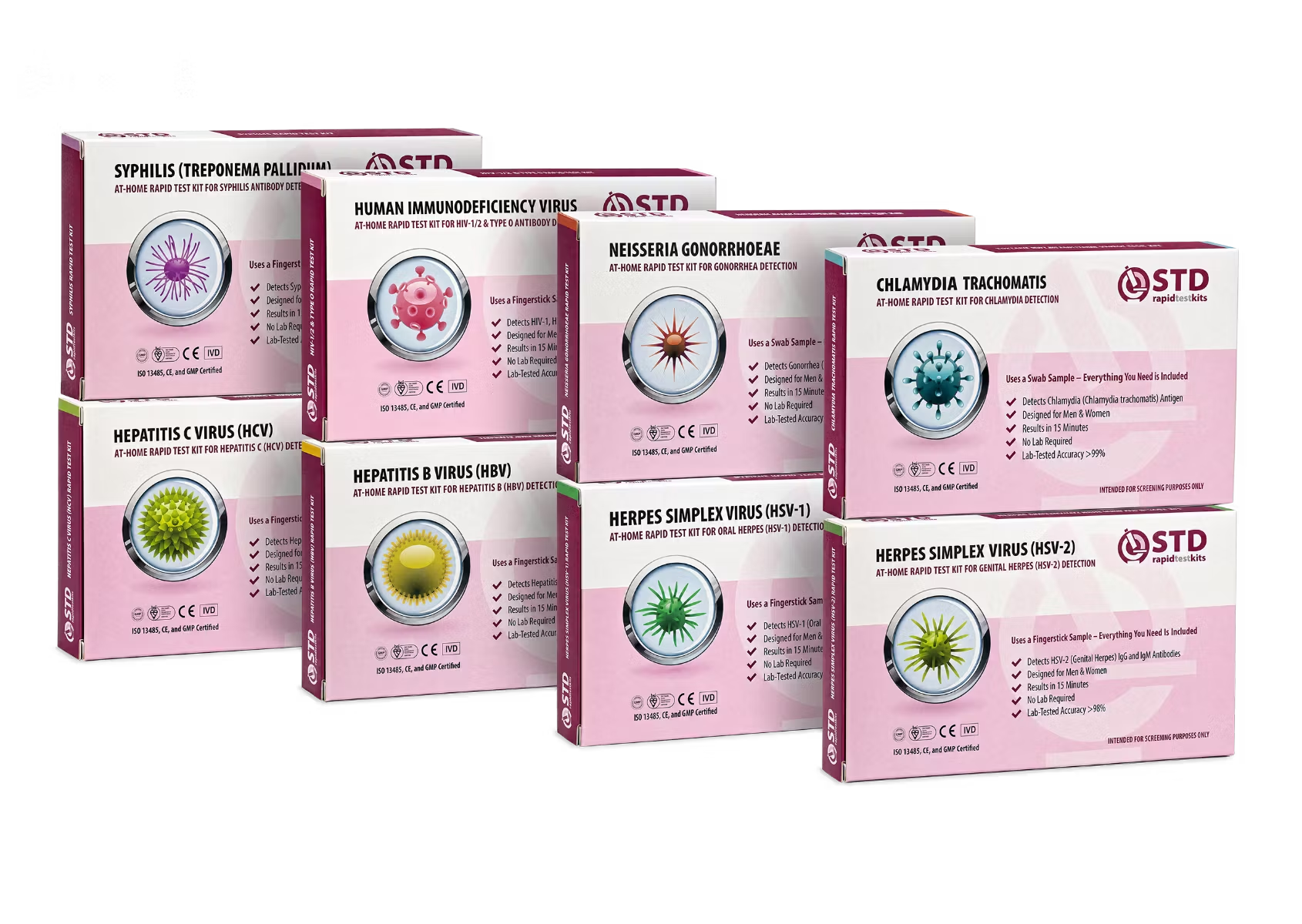
Latex sensitivity is another piece of this. Some people develop a mild allergic response to latex condoms: external burning, redness, or itching. Switching to non-latex condoms often resolves it within a session or two. Protected sex plus immediate surface burning that improves within a day points toward friction or sensitivity. Burning that worsens over days or brings new symptoms is when testing becomes the reasonable next step. This site sells rapid at-home STI test kits for readers who want a private first step before a clinic visit, and we recommend products based on fit-for-purpose for the reader's concern rather than commercial benefit.
When to Test, and When to Wait
Testing too early can give false reassurance. Bacteria need time to multiply before a test can detect them, and the immune system needs time to produce antibodies for viral infections. A negative result on day three feels reassuring but rarely reflects the real picture. The CDC's STI treatment guidelines describe nucleic acid amplification testing as the laboratory standard for chlamydia and gonorrhea, with shorter detection windows for some infections and longer for others.
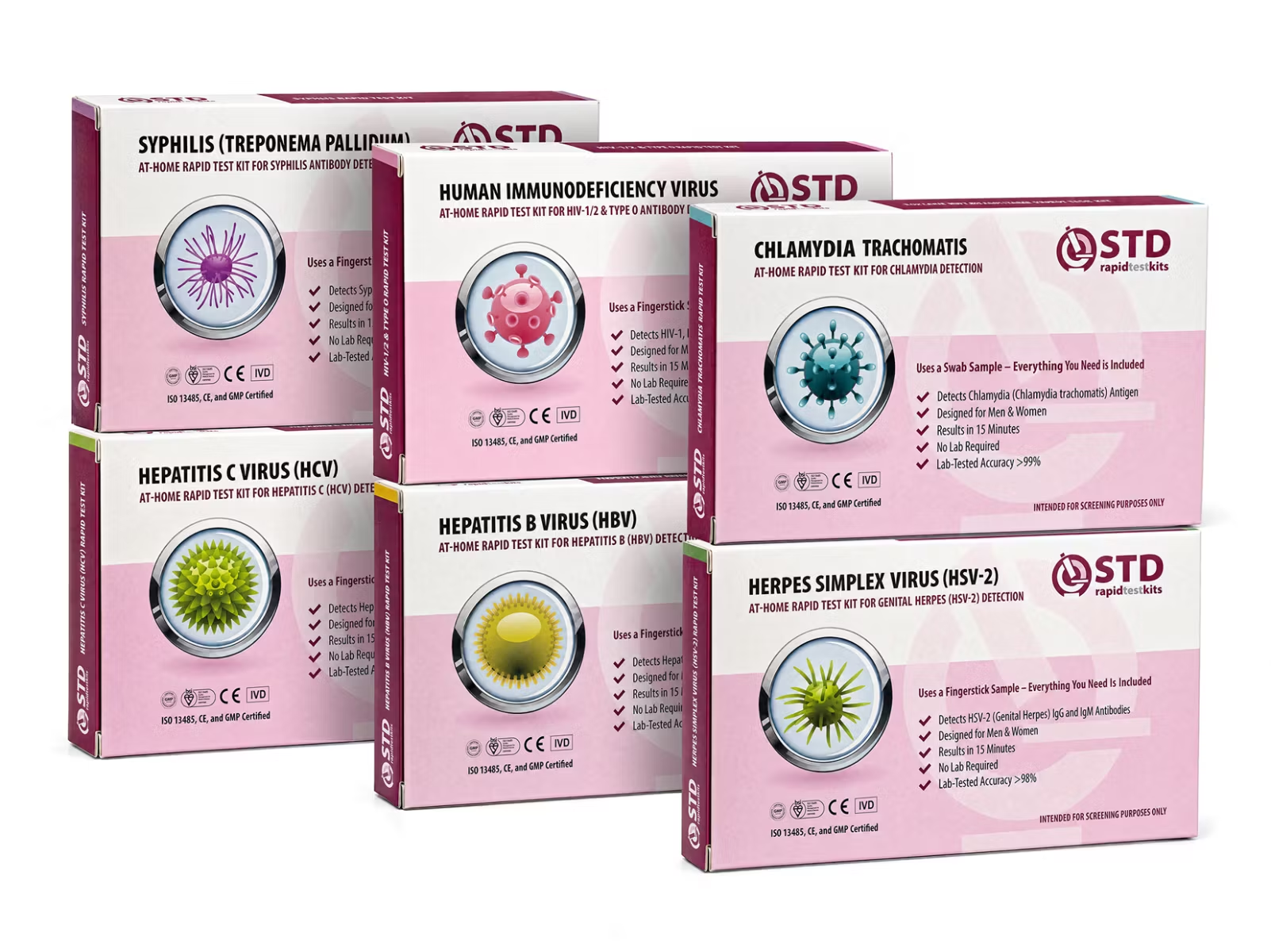
If symptoms are significant, testing earlier is still appropriate, just understand that a repeat test may be recommended if the first result is negative. When the situation feels ambiguous, discreet at-home options exist. This site's home kits use rapid lateral-flow chemistry, not lab-processed NAAT panels, and are best used as a fast initial screen. A positive lateral-flow result is worth confirming with a clinic NAAT when possible.
The table below pairs typical symptom onset with the reliable testing window for each infection. The window-period figures are drawn from the CDC treatment guidelines above; the NHS chlamydia page backs the symptom-onset timing. Use it as a sanity check before testing, and before treating any single negative as conclusive.
| Infection | Typical Symptom Onset | Reliable Test Window |
|---|---|---|
| Chlamydia | 1 week to several months; often no symptoms at all | About 14 days after exposure |
| Gonorrhea | Usually within about 2 weeks; sometimes longer | 7 to 14 days after exposure |
| Trichomoniasis | 5 to 28 days after exposure | About 14 days after exposure |
| Herpes (HSV-1, HSV-2) | 2 to 12 days for a primary outbreak | Swab a sore when present; blood antibody test reliable from 12 to 16 weeks, repeat a negative taken earlier |
| HIV (4th-gen antigen-antibody) | Acute symptoms 2 to 4 weeks for some, none for many | 18 to 45 days after exposure, depending on assay |
Three Ways to Test, Compared
Once the irritation window has passed and symptoms still point toward a possible infection, the next decision is how to test. Three routes cover almost everyone, and they trade off speed, sensitivity, and privacy differently. For the common case (no severe symptoms, a recent new partner, and a preference for privacy and a fast result), an at-home rapid kit is a strong first step. Clinics remain the right call for severe symptoms, pregnancy, or anything that needs a physical exam or a sample type a home kit does not cover.
| Testing Method | Speed | Best For | Trade-offs |
|---|---|---|---|
| At-home rapid test (lateral-flow) | Result at home in about 15 minutes | Private screening once the window period has passed | Screening-grade lateral-flow chemistry; a positive result is worth confirming with a lab NAAT |
| Mail-in lab kit | 1 to 3 business days after the lab receives the sample | Higher analytical sensitivity without a clinic visit | Adds shipping time in both directions |
| In-person clinic test | Same day to several days | Severe symptoms, pregnancy, throat or rectal swabs, or several concerns at once | Less private; access depends on local services and hours |
When It's Not Just Burning: Yeast, BV, and Other Curveballs
Not every post-sex flare is an STI, and not every one is a UTI either. Sometimes the cause is a vaginal imbalance that sex itself sets off.
Sex can temporarily shift vaginal pH. Semen is alkaline and vaginas are naturally acidic, so that shift can create conditions for yeast overgrowth or bacterial vaginosis. According to the NHS bacterial vaginosis guidance, BV is not classed as a sexually transmitted infection but is more common after a change in sexual partners. Yeast infections are also not STIs, though sexual contact with an infected partner can sometimes transmit the fungus, and the post-sex shift in the vaginal environment can let yeast already present overgrow.
Early symptoms overlap. A mild yeast infection can feel like irritation. Early chlamydia can feel like nothing but burning.
Yeast Infection vs BV vs Bacterial STI
| Feature | Yeast Infection | Bacterial Vaginosis | Chlamydia or Gonorrhea |
|---|---|---|---|
| Main sensation | Intense itching plus burning | Mild irritation | Burning with urination |
| Discharge type | Thick, white, clumpy | Thin, gray or white | May be yellow or green, or none |
| Odor | Usually none | Fishy smell | Usually mild or none |
| Sexual transmission | No | No (but sex can trigger) | Yes |
Discharge texture and odor help separate yeast and BV from a bacterial STI, but only a test confirms.
The Timeline Test: Watch What Happens Over 72 Hours
If you are unsure what you are dealing with, step back and observe instead of spiraling. Irritation typically improves. Infections tend to plateau or worsen.
In the first 24 hours, friction-related burning often feels surface-level and gradually calms. A UTI tends to escalate during urination and trigger frequent urge. An STI may stay mild but steady, sometimes adding discharge or deeper pain over the course of several days.
Two illustrative patterns help. After a weekend hookup, person A noticed mild burning the same night. By the next afternoon, it was already fading, with no discharge and no urgency. Within two days, it was gone, which points strongly toward irritation. Person B's burning didn't start until day four. It wasn't dramatic, but it didn't fade, and a week later there was slight discharge; testing confirmed gonorrhea. In that case, the four-day onset delay and the persistence of symptoms were the clearer early signals, days before any lab result confirmed it.
- Friction or contact reaction: burning starts the same day, surface-level, fading within 24 to 48 hours.
- UTI: burning builds 1 to 2 days after sex, sharpest during urination, paired with frequent urge to pee.
- Bacterial STI: burning appears 3 to 7 days after exposure, holds steady or worsens, sometimes adds discharge.
Red Flags That Warrant Immediate Testing
Some symptoms do not require guesswork. Fever, severe pelvic pain, testicular swelling, visible sores, or heavy discharge deserve medical evaluation quickly. Those signs go beyond simple irritation.
If burning is accompanied by flu-like symptoms or visible lesions, infections such as herpes or more advanced pelvic infections should be ruled out promptly, since waiting in those cases increases the risk of complications. Most burning after sex is not an emergency, but ignoring symptoms that don't go away, or that get worse, only adds anxiety on top of biology.
Red-Flag Symptoms That Warrant Prompt Evaluation
Any one of these is a reason to see a clinician quickly rather than wait out the 72-hour timeline. They do not all mean an STI, but they need a hands-on assessment.
- Fever or flu-like symptoms alongside genital burning Less common
- Severe pelvic or lower-abdominal pain Less common
- Testicular pain or swelling Less common
- Visible sores, blisters, or ulcers in the genital area Less common
- Heavy, discolored, or foul-smelling discharge Common
- Burning that worsens day over day instead of easing Common
When Anxiety Amplifies the Sensation
The burning isn't always the loudest sensation. Sometimes the fear is, with its mental replay and the moment you grab your phone and type "burning after sex STD" before you've even finished getting dressed.
Anxiety amplifies sensation. When attention focuses on a body part, nerve signals feel louder. A mild irritation can suddenly feel catastrophic because the brain has attached meaning to it. That doesn't mean the symptom isn't real. It means the story around it may be louder than the biology. Stress also raises pelvic-floor tension, which can make tissue feel more sensitive and prolong the sense that something is wrong.
The difference between responsible awareness and spiraling is action. Spiraling asks the same question repeatedly without acting. Responsible awareness asks once, then checks the timeline or, if the timeline is unclear, tests.
Spiraling loops the same question ("was it an STD? was it an STD?") without taking a step. Responsible awareness asks once, watches the 72-hour timeline, and tests if the timeline is unclear. The same worry, two very different nervous-system outcomes.
What About Oral and Anal Sex?
Burning after sex is not limited to vaginal intercourse. Oral sex can irritate urethral openings. Anal sex can cause both surface irritation and urinary symptoms if bacteria shift toward the urethra afterward. The body does not compartmentalize sex acts the way social labels do.
"But we only did oral" reduces certain risks but does not eliminate all of them. Per the CDC's gonorrhea fact sheet, gonorrhea can infect the genitals, rectum, and throat, and chlamydia can establish at extragenital sites too. Friction from oral contact can also cause temporary sensitivity without infection. The timeline still helps: immediate soreness that fades is usually mechanical, while delayed burning that lingers deserves testing.
- Same 72-hour rule applies. Soreness that fades within a day or two after oral or anal sex is mechanical or contact-based. Burning that lingers past 48 hours or builds over several days is the threshold for testing.
- Pharyngeal swab is a clinic test. This site sells genital swab and blood-based home kits. For a throat-specific (pharyngeal) NAAT after a confirmed oral exposure, see a clinic, which is the appropriate sample type for that anatomical site.
- Rectal symptoms. Persistent rectal burning, discharge, or pain after anal sex warrants in-person evaluation rather than a home swab.
- Partner gender does not change the rules. Friction, lubrication, toy material, and cleaning routines all shape irritation, and infection patterns stay consistent regardless of partner gender.
What If It Repeats Every Single Time?
Symptoms that occur after every act of intercourse and resolve every single time afterward are almost always a contact issue rather than an infection. Infections do not switch on and off with each session. They build and persist.
The fastest way to identify the trigger is a focused two-week elimination test, changing one variable at a time and tracking what happens. Most people identify the culprit within one or two cycles of the experiment.
- Switch condom material from latex to polyurethane or polyisoprene.
- Drop any spermicide or product containing nonoxynol-9.
- Replace any warming, flavored, or fragranced lubricant with a plain water-based or silicone option.
- Add more lubricant overall to reduce mechanical friction.
If the symptom disappears when one variable changes, that variable was the trigger. If it persists with every variable removed, infection becomes the more likely explanation and a properly timed test is the next step.
Microtears, Inflammation, and Why Genitals Overreact
Genital tissue is thinner, more elastic, and more densely packed with nerve endings than most other parts of the body. That biology is why sex feels good, and it is also why small irritation feels intense.
During penetration, vaginal or anal, tissue stretches. Limited lubrication or prolonged thrusting can produce tiny microscopic tears that are invisible, with no dramatic injury to see. But they create localized inflammation, which means the tissue gets warmer and more reactive, and that is why urine flowing over it can sting.
This is also why burning may feel worse the next morning. Overnight swelling can make irritated tissue more sensitive, and the first urination of the day hits raw nerve endings, so the sensation suddenly feels worse than the day before.
Inflammation behaves predictably and improves when the tissue is left alone. If the sensation decreases day by day, that is the body healing. Infections behave differently: they recruit immune cells, multiply, and sustain inflammation rather than calming it.
Inflammation from microtears calms day by day when the tissue rests. Infectious inflammation recruits immune cells and sustains itself. Day-over-day improvement points toward mechanical injury; day-over-day plateau or worsening points toward infection.
The Quiet Variable: Hydration and Aftercare
Hydration matters more than most articles admit. Concentrated urine is more acidic and can sting irritated tissue more aggressively, so dehydration after sex, especially after alcohol, can make that first urination feel disproportionately painful.
Peeing after sex does not "wash out" STIs. What it does do is help clear bacteria from the urethra before they can ascend and cause a UTI. Gentle rinsing with water is sufficient. Harsh soaps, douching, or scrubbing irritated tissue prolong burning rather than helping it.
Aftercare is as much physical as emotional. Resting tissue, breathable underwear, and using lubricant next time are practical follow-through.
- Drink water before sex and again after, so the first urination is dilute rather than concentrated.
- Pee within 30 minutes of sex to flush the urethra and reduce UTI risk.
- Rinse with water only, no soap, no douching, no scrubbing.
- Wear loose, breathable underwear for the next 24 hours if anything feels tender.
- Use lubricant next time, especially for longer sessions or after dry condoms.
What Most People Get Wrong About Burning After Sex
Two common errors muddle the picture for readers trying to figure out what's going on. Both have practical fixes, and both come up in roughly equal numbers in late-night search bars.
- Assuming intensity signals infection. Some of the worst friction burns clear completely in two days, while some STIs cause almost no discomfort at all. Mild burning that lingers for a week deserves clarity, not a wait-and-see approach; the nervous system relaxes when uncertainty ends, not when symptoms are ignored.
- Treating burning as a moral verdict. Shame has no diagnostic role. Burning after sex is a physiological signal, and reading it as a character flaw only delays the test that would resolve it.
If It Turns Out to Be an STI
If testing confirms chlamydia or gonorrhea, treatment is straightforward: a short course of antibiotics, followed by partner notification and a retest if recommended. The CDC's gonorrhea fact sheet confirms that the right treatment can cure gonorrhea when the full course is taken, and chlamydia is similarly curable when caught early. Trichomoniasis is curable with prescription antiprotozoals. Genital herpes is not curable but is manageable with antivirals that reduce both outbreak frequency and transmission risk.
The emotional response often outweighs the medical severity. People feel embarrassed, angry, betrayed, or ashamed. None of those feelings change the biology, they just add weight to it.
Practical next steps are concrete. Confirm a positive rapid result with a follow-up lab test. Take the prescribed medication on schedule. Notify recent partners so they can test. For chlamydia and gonorrhea, the CDC recommends a retest about three months after treatment to check for reinfection, which is common when untreated partners return to the picture.
Chlamydia often has no symptoms, but it can cause serious health problems, even without symptoms. If symptoms occur, they may not appear until several weeks after having sex with a partner who has chlamydia.
Should I Test, or Wait It Out?
Has the burning improved noticeably within 48 hours, with no discharge, fever, or sores?
Yes: It is most likely friction or a contact reaction. Rest the tissue, switch to a gentler lubricant, and watch the area over the next day. No test is needed yet.
Did the burning start 3 to 7 days after a new partner, or has it now lasted past 48 hours?
Yes: Plan to test at the correct window, around 14 days after exposure for chlamydia and gonorrhea. An at-home rapid kit is a private first screen; confirm any reactive result with a clinic NAAT, and notify recent partners if a test is positive.
No: If symptoms are mild and tied only to sex, run the two-week elimination test first. If anything worsens, returns without sex, or adds fever, pelvic pain, or visible sores, see a clinician promptly.
Guidance only. A clinician can advise based on your specific situation.
FAQs
- Is burning after sex usually just friction?
- A lot of the time, yes. Especially if it started the same night and feels like surface-level stinging or chafing. Think rug burn, not deep internal fire. If it's already easing up by the next day and there's no discharge, fever, or pelvic pain alongside it, the body is probably just asking for more lube and a little rest next time.
- Why does it only burn when my partner finishes inside?
- Semen briefly shifts vaginal pH and contains proteins some people react to. Mild localized burning for an hour or two after exposure is a recognized pattern, sometimes called seminal-plasma sensitivity. If using a condom consistently eliminates the symptom, contact is the more likely trigger rather than infection.
- What if it burns when I pee and that's the only symptom?
- Burning only during urination, especially with the feeling of needing to pee every 20 minutes, leans more toward a UTI. Burning that is mild but steady for days after a new partner deserves STI testing, even if it feels subtle rather than dramatic.
- It feels like razor burn. Could it still be an STI?
- It can be, but context usually points the way. Razor burn and friction sting on contact and improve steadily over a day or two. An STI-related sore tends to evolve over several days into more tenderness, sometimes with discharge or a visible lesion. If the area looks and behaves like irritated skin and is fading, it usually is irritation. If it progresses or lingers past 48 hours, test at the correct window.
- We used a condom. So I'm in the clear, right?
- Safer, not invincible. Condoms reduce the risk of infections like chlamydia and gonorrhea significantly, but they don't cover every inch of skin. Friction from a dry condom, or a mild latex sensitivity, can also cause irritation on its own. If burning starts immediately and fades quickly, that's probably mechanical or a contact reaction. If symptoms build over several days, test.
- How long is too long for irritation to last?
- A useful rule of thumb: bodies generally heal within 48 hours, so if improvement has not started by then, the wait-and-see window is over and gathering data through testing makes more sense than continuing to guess.
- Can an STI really show up with almost no symptoms?
- Yes. Chlamydia in particular is famous for being quiet. Sometimes the only clue is mild burning or a vague "something's off" feeling. Per the <a href="https://www.cdc.gov/chlamydia/about/" target="_blank" rel="noopener noreferrer">CDC chlamydia fact sheet</a>, many infections are asymptomatic. If your intuition is nudging you, listen to it. Testing exists for exactly this gray area.
- How soon after a new partner can I trust an STD test?
- For chlamydia or gonorrhea, two weeks is the reliable minimum, and a negative result before then tells you very little. A 4th-generation HIV test becomes reliable from roughly 18 to 45 days, and herpes blood antibody testing can take 12 to 16 weeks for full seroconversion. The symptom-onset table above pairs every common infection with its window.
- What's the smartest next step if I'm still unsure?
- Pause and notice the timeline. If the burning started immediately and is fading, it's likely friction or a contact reaction. If it's building or sticking around past a couple of days, especially after new or unprotected sex, schedule testing at the correct window.
- U.S. Centers for Disease Control and Prevention. Sexually Transmitted Infections Treatment Guidelines (NAAT detection-window guidance for chlamydia and gonorrhea, screening-interval guidance, and first-line treatment regimens).
- U.S. Centers for Disease Control and Prevention. Chlamydia basic fact sheet (asymptomatic presentation, the symptom-timing quote, urinary symptoms, and treatment outcomes for uncomplicated infection).
- U.S. Centers for Disease Control and Prevention. Gonorrhea basic fact sheet (infection of genitals, rectum, and throat, and curability with a complete antibiotic course).
- U.S. Centers for Disease Control and Prevention. How HIV Spreads (per-act transmission risk by exposure type) and Preventing HIV with PEP (72-hour window for post-exposure prophylaxis).
- World Health Organization. Sexually transmitted infections (STIs) fact sheet (supports the statement that STIs are often asymptomatic).
- NHS. Chlamydia overview (1-week-to-several-months symptom-onset window used in the symptom-onset table).
