
Published: November 2025 | Last updated: May 2026 | Editorial review and quality control: Martina N.
Bleeding after sex pulls your attention sideways. One moment intimacy felt easy. The next, you are staring at streaks of red on tissue paper and running through worst-case scenarios in your head. The reassuring truth: postcoital bleeding is common, and most causes are treatable. The harder-to-pin-down truth: the likely cause shifts with age. What triggers bleeding at 24 often looks nothing like what triggers it at 44, even when the bleeding itself appears identical.
This article walks through both decades, the biology underneath, and the specific patterns that should send you to a clinician versus the ones that genuinely resolve on their own.
Key Takeaways
- In your 20s, bleeding after sex is most often linked to a sensitive cervix, infections like chlamydia or gonorrhea, or hormonal birth control. In your 40s, the dominant drivers shift toward declining estrogen, vaginal tissue thinning, and structural changes like polyps.
- At any age, bleeding that repeats over several weeks, accompanies pain, is heavy, or happens after menopause needs a clinical evaluation. One-time light spotting after enthusiastic sex usually does.
First, Take a Breath: Postcoital Bleeding Is More Common Than You Think
Before separating 25 from 45, ground this in reality. Postcoital bleeding is not rare. It feels dramatic because it shows up unexpectedly, but many women experience it at least once during their reproductive years. The key difference between age groups is not whether it happens. It is why it happens.
In your 20s, the cervix tends to be softer and more hormonally reactive. In your 40s, estrogen fluctuations begin to reshape vaginal and cervical tissue in quieter but noticeable ways.
Estimates from gynecology literature place the prevalence of postcoital bleeding at roughly 0.7% to 9% of premenopausal women in any given year, and a much higher share over a lifetime. Most cases trace back to benign causes that respond to evaluation and treatment.
Your Cervix in Your 20s: Sensitive, Hormonal, and Easily Irritated
Picture someone in her mid-twenties on hormonal birth control, in a relatively new sexual relationship. One night she notices light spotting after sex: no pain, no cramps, just faint streaks of red when she wipes.
One of the most common causes of bleeding after sex in this age group is cervical ectropion. The term sounds clinical, but the meaning is simple: softer glandular cells from inside the cervical canal are sitting on the outer surface of the cervix. These cells are more fragile and bleed more easily during penetration. Ectropion is benign and common in people on hormonal contraception, during pregnancy, or simply because of natural anatomical variation. The bleeding can look alarming even when the underlying tissue change is harmless.
At the same time, the 20s are statistically peak years for sexually transmitted infections in the United States. The CDC's annual STI surveillance data consistently show women aged 15 to 24 among those with the highest chlamydia and gonorrhea rates (CDC STI Statistics). Both infections can inflame the cervix, a condition called cervicitis, making it bleed more easily during or after sex even when no other symptoms are obvious (CDC Chlamydia).
That is where testing earns its place. Cervical inflammation often whispers instead of shouting, so checking is reasonable even when nothing else feels off.
Your 40s: Thinning Tissue and Hormone Whiplash
Now picture someone in her mid-forties whose periods have turned irregular, with some months heavy and others barely there. She has noticed dryness she never used to have. One night after sex, she sees bright red spotting on the sheet. It scares her more than she expects.
Estrogen levels begin to fluctuate and gradually decline during the perimenopausal transition, which typically starts in the 40s and lasts several years before menopause (NHS: Menopause). Less estrogen means less elasticity and less natural lubrication. Vaginal walls thin, and tissue becomes more delicate and more prone to small tears during friction.
Bleeding after sex in the 40s is therefore often mechanical rather than infectious. Dryness raises friction, friction creates microtears, and microtears bleed.
That said, while dryness is common, persistent bleeding should not be brushed off as just aging. Cervical polyps, uterine lining changes, and, less commonly, precancerous cervical conditions can also present as postcoital bleeding. Persistent bleeding in this decade deserves evaluation, even when most causes turn out to be benign.
Heavy bleeding (soaking a pad within an hour), bleeding repeated over several weeks, or any bleeding after menopause should be evaluated promptly by a clinician. These patterns are the ones worth taking off the wait-and-see list.
What Changes and What Doesn't: A Side-by-Side Breakdown
The same bleeding can look identical at any age: a few drops, light spotting, or a bright red streak. What shifts is the likely driver behind it. The table below summarizes the dominant factors at each age.
| Factor | In Your 20s | In Your 40s |
|---|---|---|
| Hormonal influence | High estrogen; birth control impact common | Fluctuating or declining estrogen (perimenopause) |
| Tissue sensitivity | Cervix can bleed easily due to ectropion | Vaginal lining thinner, more tear-prone |
| STD-related risk | Higher statistical rates of new infections | Lower overall rates but still possible |
| Dryness | Less common unless medication-related | More common due to hormonal shifts |
| When to worry | Persistent bleeding, pelvic pain, discharge | Repeated bleeding, heavy flow, postmenopausal bleeding |
Could an STD Cause Bleeding After Sex at Any Age?
Short answer: yes. While rates are higher in younger populations, women in their 40s also contract sexually transmitted infections, and immune status has no age floor, especially after divorce, new relationships, or dating again following long-term partnerships.
Cervicitis, the inflammation of the cervix, is one of the most common infection-related causes of postcoital bleeding. It can occur with chlamydia, gonorrhea, and sometimes trichomoniasis (CDC Gonorrhea). The frustrating part: many of these infections are asymptomatic. A person can feel completely normal, with no burning, no unusual discharge, and no fever, and still have a cervix that bleeds easily when touched.
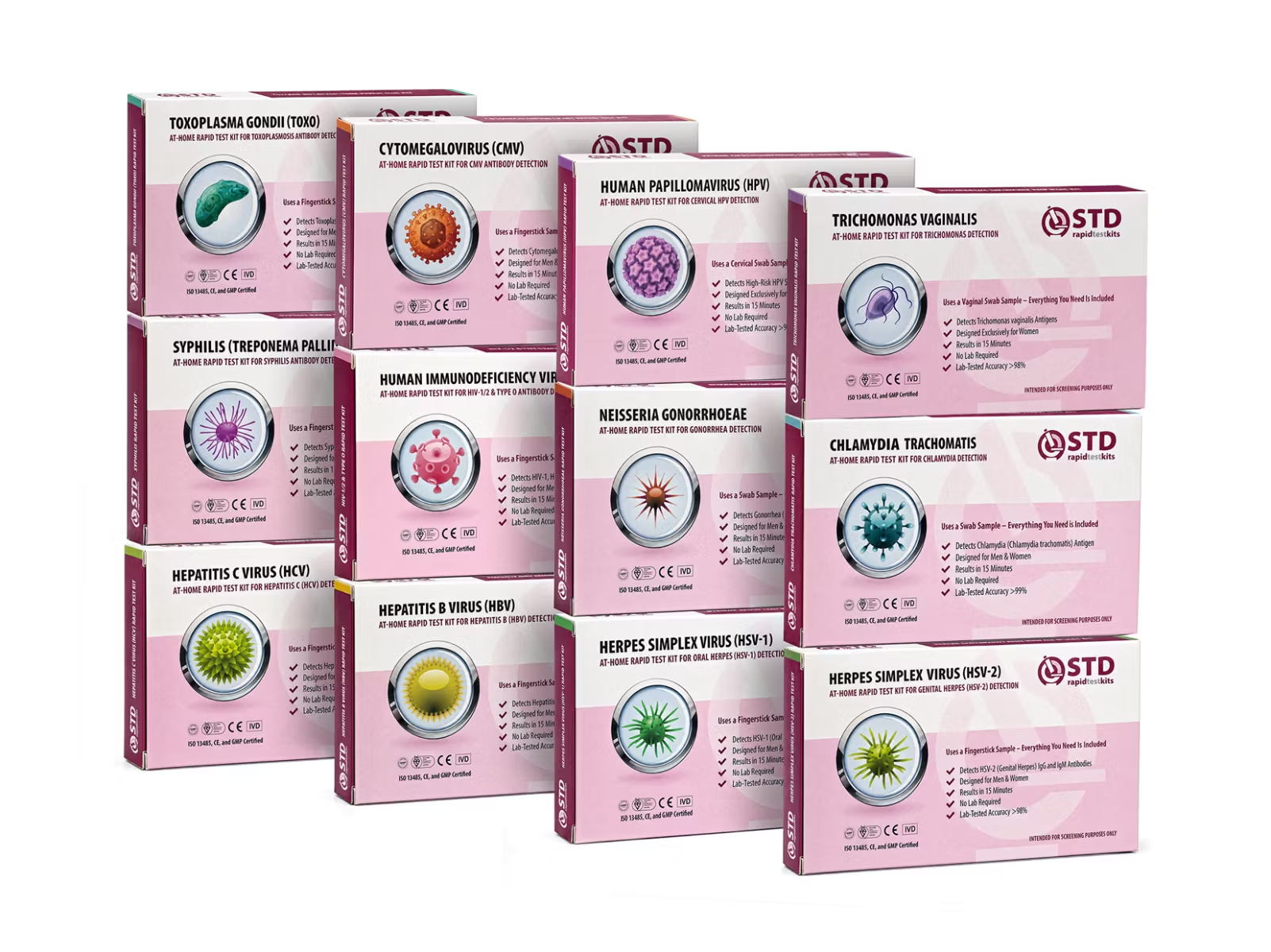
If there has been a new partner, a condom failure, or any uncertainty about exposure, testing is reasonable rather than an overreaction; it gives clarity instead of speculation. Discreet at-home options exist for the most common infections, with lab confirmation recommended when results are positive.
Cervicitis from chlamydia or gonorrhea is frequently asymptomatic. Many people have no discharge, no burning, and no other sign that the cervix is inflamed. Spotting after sex can be the only clue.
Friction, Infection, or Something Else? How to Read the Pattern
Back to that bathroom moment. Looking at the tissue, trying to figure out whether this is a one-time event or the start of something bigger. Context matters more than panic.
If bleeding happens once after particularly rough or prolonged sex, especially when lubrication was low, friction is the likely culprit. Microtears in vaginal tissue can bleed lightly and stop quickly. They usually heal within a day or two. In the 40s, this becomes more common as estrogen declines. In the 20s, it can still happen, especially when dehydration, anxiety, or insufficient arousal kept lubrication low.
If bleeding repeats regardless of gentleness, especially alongside subtle discharge changes, pelvic pressure, or a new partner, infection moves higher on the list of likely causes. Testing becomes less optional and more responsible at that point.
Then there is irregular bleeding tied to the cycle. In the 20s, hormonal birth control can thin the uterine lining, making it more prone to spotting after penetration. In the 40s, perimenopause can create unpredictable shifts where ovulation and lining stability change month to month.
One-time, after rough sex with low lubrication: friction is the likely cause; monitor and add lubricant next time.
Recurring, with discharge changes or a new partner: screen for chlamydia, gonorrhea, and trichomoniasis.
Recurring in your 40s, irregular cycle: book a pelvic exam to look at hormonal causes and structural findings like polyps.
How Long Is "Too Long"? When Bleeding Becomes Urgent
One of the hardest parts of postcoital bleeding is deciding when to escalate. A few pink streaks that disappear by morning rarely signal an emergency. Some situations, however, demand prompt evaluation rather than a wait-and-see approach.
If bleeding is heavy (soaking through a pad within an hour) or accompanied by severe pelvic pain, fever, dizziness, or fainting, that is urgent care territory. For anyone who is postmenopausal, meaning no period for 12 months or more, any bleeding after sex should be evaluated promptly: NHS guidance is direct that postmenopausal bleeding always needs to be checked by a doctor (NHS: Post-menopausal bleeding). That rule does not bend.
For people in their 40s who are still cycling but irregularly, repeated bleeding after sex over several weeks deserves a gynecologic exam. Patterns matter here; investigation is the appropriate response when bleeding recurs over weeks, even when the most likely explanation is something benign.
| Symptom Pattern | Likely Level of Concern | Recommended Action |
|---|---|---|
| Light spotting once, no pain | Low | Monitor; review lubrication and cycle timing |
| Repeated spotting over weeks | Moderate | Schedule gynecologic evaluation and STI testing |
| Heavy bleeding or severe pain | High | Seek urgent medical care |
| Any bleeding after menopause | High | Prompt clinical assessment required |
Testing Strategy: What Doctors Actually Check
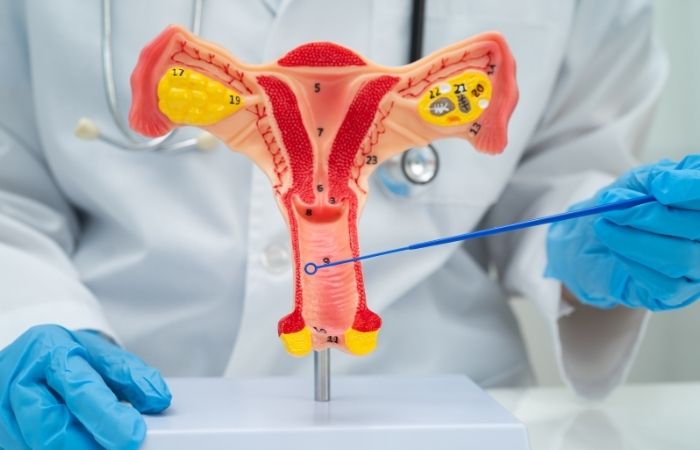
When someone presents with postcoital bleeding, the evaluation is usually methodical. First comes a pelvic exam to visualize the cervix. Clinicians look for visible irritation, polyps, or lesions. They assess discharge. They may perform a Pap smear if cervical cancer screening is due (NHS: Cervical screening).
If infection is possible, testing for chlamydia, gonorrhea, and sometimes trichomoniasis is standard. Lab nucleic-acid amplification testing (NAAT) is the gold standard for these infections; the rapid lateral-flow at-home tests sold here use the same swab sample type and are designed as accessible home screens, not NAAT replacements. In people over 40, particularly with irregular bleeding, an ultrasound may be ordered to evaluate the uterine lining. Hormonal change broadens the differential diagnosis at this age (polyps, lining changes, and other causes that are uncommon in the 20s become more likely), which is why clinicians order more tests as patients move through perimenopause.
Chlamydia often has no symptoms, but it can cause serious health problems, even without symptoms.
What Doesn't Change With Age
Whether someone is 22 or 47, three things stay constant across decades. Read them as a baseline regardless of which life stage you are in.
What stays the same
- The body deserves attention when something feels off. Dismissing bleeding because someone is "young and healthy" or because they are "just getting older" delays clarity in both directions.
- Infections do not check birth year before spreading. Anyone sexually active with new or multiple partners should consider STI screening regardless of age.
- Bleeding after sex is a physical event, not a moral verdict. Shame is unnecessary, and avoiding evaluation because of it tends to prolong the worry.
The Hormone Factor: Why Estrogen Is the Quiet Player
Estrogen keeps vaginal tissue thick, elastic, and well-lubricated. In the 20s, levels are typically stable unless influenced by birth control or medical conditions. The cervix can be sensitive but the tissue overall is resilient.
In the 40s, estrogen fluctuates unpredictably. Some months feel normal. Others bring dryness, irritation, or spotting between cycles. These hormonal waves can make sex feel slightly different even before any visible bleeding shows up.
Adaptation helps. Longer foreplay, added water-based or silicone-based lubricant, and checking in with your body can prevent friction-related bleeding that was not an issue in earlier years.
| Hormonal State | Tissue Effect | Bleeding Risk Pattern |
|---|---|---|
| High stable estrogen (20s typical) | Thicker lining, strong natural lubrication | Bleeding more often linked to cervical sensitivity or infection |
| Birth control regulated estrogen | Thinner uterine lining | Breakthrough spotting possible after sex |
| Perimenopause (40s) | Fluctuating estrogen, thinning tissue | Higher rate of friction-related spotting |
| Postmenopause | Low estrogen, fragile tissue | Any bleeding considered abnormal and needs evaluation |
The Emotional Side No One Talks About
Bleeding after sex does not just trigger medical questions. It hits something deeper. It interrupts intimacy. It injects doubt into what was supposed to feel connected or pleasurable. For some people in their 20s, it sparks embarrassment. For people in their 40s, it can feel like a betrayal by a body that used to feel predictable.
Some women describe feeling old. Others describe feeling dirty. Neither reaction is medically accurate, but both are emotionally real and worth naming out loud rather than carrying alone.
In the 20s, the fear is often about infection or judgment. There is a quiet cultural message that young people are reckless, and bleeding can feel like proof of that myth even when it is not. In the 40s, the fear shifts tone. It is less about morality and more about mortality. The Google searches change. Instead of "STD symptoms," they become "cervical cancer bleeding after sex."
Anxiety-driven Googling tends to escalate worry without resolving it. A short, specific plan (one clinical visit, one home screen if exposure is plausible, one window of days to watch for recurrence) usually moves the situation forward more than another evening of search results ever will.
Sex, Age, and the Confidence Gap
Clinicians commonly observe another pattern. In the 20s, people are more likely to seek testing quickly. There is less hesitation about STI screening because it feels normalized in that life stage: college clinics, dating culture, routine panels.
In the 40s, especially after long-term monogamy or divorce, people often underestimate infection risk. They assume STIs are a "young person issue." They delay testing because it feels out of character for their identity. That delay can stretch weeks or months.
Biology operates the same way regardless of identity. Anyone sexually active with a new partner should consider screening, at 22 and at 47. A private at-home test can lower the social friction of asking, replacing the waiting room and the awkward small talk with a result that stays between you and the kit.
Before You Spiral: A Practical Path Forward
If bleeding happened once and stopped, give your body a few days. Notice whether it recurs. Pay attention to discharge changes, pelvic discomfort, or cycle irregularity.
If there is any chance of exposure to infection, testing can happen quietly and privately at home, without drama. Discreet at-home screens are widely available, and a positive result on any home test should be confirmed in a clinical setting.
If bleeding repeats, schedule an exam. Especially in the 40s, patterns matter more than isolated events.
You Deserve Answers, Not Assumptions
Bleeding after sex can feel like the body sending a warning signal. Sometimes it is a whisper from irritated tissue, sometimes hormonal turbulence, occasionally infection, and rarely something more serious. The probabilities shift with age. Everyone deserves clear answers regardless of decade.
If you are in your 20s and worried about infection, or in your 40s and unsure whether the cause is hormones or something else, start with information. Add testing if exposure is possible. Add a clinical exam if bleeding repeats or shows up alongside any of the urgency signs above.
Health questions are practical, not dramatic. Take the next step that brings you peace of mind.
Frequently Asked Questions
- I'm 24 and I spotted after sex once. Do I really need to worry?
- Not necessarily. One-time light spotting, especially after enthusiastic sex, low lubrication, or close to your period, is often just a sensitive cervix rather than something dangerous. In your 20s, cervical cells can bleed easily on contact. If it keeps happening, or you have had a new partner recently, that is a good cue to test rather than wait and see.
- I'm 43 and this has never happened before. Why now?
- Hormones are the most likely explanation. As you move through your 40s, estrogen levels start fluctuating and gradually declining, and vaginal tissue can thin and dry out in ways that were not an issue at 28. That means more friction and easier tearing. If the bleeding repeats, feels heavier than light spotting, or comes with pelvic pain, get it checked. A new pattern is worth a new data point.
- What does STI-related bleeding actually feel like?
- Subtle is the usual presentation. Most chlamydia and gonorrhea infections in women are asymptomatic. You can feel completely normal and still have cervical inflammation that causes light bleeding during or after sex. Sometimes there is discharge, sometimes there is not. That is exactly why screening exists, not because of how someone looks but because cervical inflammation is often silent.
- If there's no pain, is it less serious?
- Not necessarily. Many infections and hormonal causes present without pain, and some serious conditions are also painless in early stages. Pattern and persistence are more useful guides than pain level. Absence of pain is reassuring on its own, but it does not tell you what is going on underneath.
- How do I know if it's just dryness?
- Think about context. Was there enough foreplay? Were you stressed, tired, dehydrated? In your 40s especially, dryness can show up even when arousal feels normal. If adding lubrication solves the problem and bleeding stops happening, friction was likely the culprit. If it keeps recurring regardless of gentleness, time for a medical conversation.
- I used a condom. Could it still be an STI?
- Condoms reduce risk significantly but do not cover every inch of skin. Some infections, like HPV and herpes, can transmit from areas a condom does not cover. If you had a new partner or any uncertainty about exposure, testing is reasonable rather than paranoid.
- Does bleeding after sex mean cancer?
- Usually no. Cancer is not the most common explanation, especially in your 20s. In your 40s, persistent or postmenopausal bleeding does need evaluation, but most findings are benign, including polyps and hormonal thinning. The point of seeing a provider is not to confirm worst-case scenarios. It is to rule them out.
How we sourced this article: This guide synthesizes current public-health guidance from the U.S. Centers for Disease Control and Prevention, the UK's National Health Service, and the World Health Organization. We focused on cervicitis presentations, perimenopausal hormonal changes, and the differential diagnosis of postcoital bleeding by age. The aim is medically sound, emotionally supportive information without shame or alarm.
- U.S. Centers for Disease Control and Prevention. Chlamydia. Reference for asymptomatic cervical infection and its role in postcoital bleeding.
- U.S. Centers for Disease Control and Prevention. Gonorrhea. Reference for cervicitis presentation and silent infections.
- U.S. Centers for Disease Control and Prevention. STI Statistics. Reference for age-stratified incidence patterns of chlamydia and gonorrhea diagnoses in the United States.
- U.K. National Health Service. Menopause overview. Reference for perimenopausal hormonal change and the timing of estrogen decline that drives vaginal tissue thinning.
- U.K. National Health Service. Post-menopausal bleeding. Reference for the rule that any bleeding after menopause requires prompt clinical assessment.
- U.S. Centers for Disease Control and Prevention. Trichomoniasis. Reference for trichomoniasis as a cause of cervicitis and postcoital spotting.
