How Accurate Is the At-Home HSV-1 Test? IgG and IgM Lines Explained
Two test lines, two antibody classes, and a lot of room for misreading. This guide sets the at-home HSV-1 strip against the lab tests clinicians use, explains what the manufacturer's figures actually measured, and walks through every line combination you could see, including why the IgM line says far less than most people assume.



- The HSV-1 kit's published figures measure agreement with ELISA kits on patient blood samples whose collection setting the insert does not state. They are not accuracy against a reference standard, and none of them come from home use.
- A T2 (IgG) line means HSV-1 infection at some point, with no date and no site. A T1 (IgM) line cannot show that an infection is new.
Published: October 2026 | Last updated: October 2026 | Editorial review and quality control: Martina N.
How does the at-home HSV-1 test compare with a lab test?
The manufacturer reports agreement with lab ELISA kits, not accuracy: the IgG line matched 50 of 51 positive and 59 of 60 negative samples, the IgM line 40 of 41 and 60 of 60; the insert does not state how the samples were collected. No home-use figure exists. A T2 (IgG) line means past infection; a T1 (IgM) line does not mean a new one.
A two-line herpes strip looks simple until you have to interpret both lines. This article covers one kit, the at-home HSV-1 rapid test, which reports IgM and IgG antibodies on separate lines. It sets the manufacturer's published figures against what a laboratory test does and explains what each line combination can and cannot tell you. If you are still choosing between an HSV-1 and an HSV-2 kit, start with which home herpes test you need. For the practical steps of taking a sample, see how herpes testing at home works.
Some context first. HSV-1 is extremely common: the World Health Organization estimates that 3.8 billion people under 50, or 64% of that age group, have it, and most pick it up in childhood as oral herpes (WHO herpes simplex virus fact sheet). For most adults under 50 worldwide, then, a positive antibody result is the expected one, per WHO's 2020 estimate, though prevalence varies by country and age. The harder questions are what a result adds to what you already know, and how much weight each line can carry.
What the strip measures, and what a lab test measures
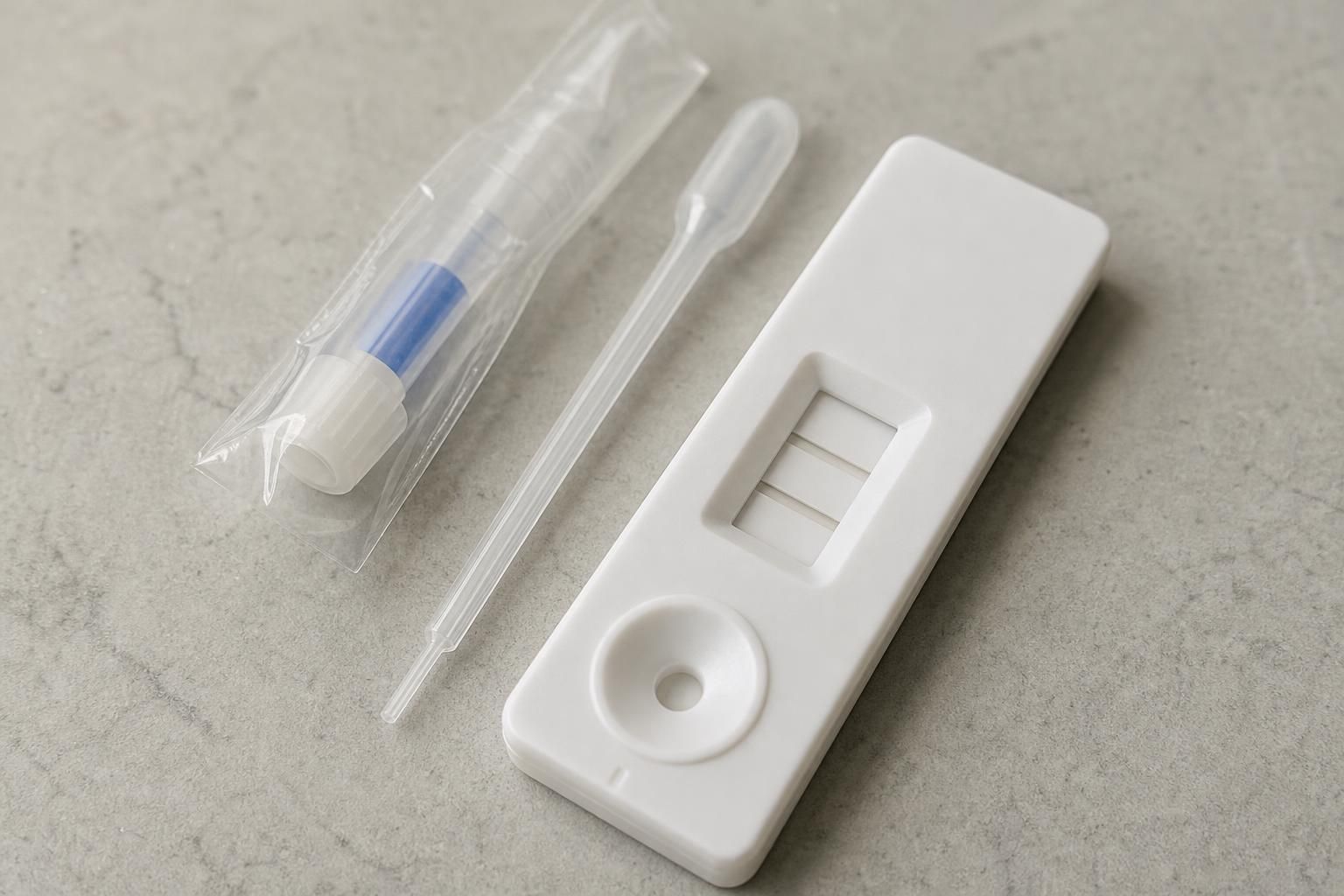
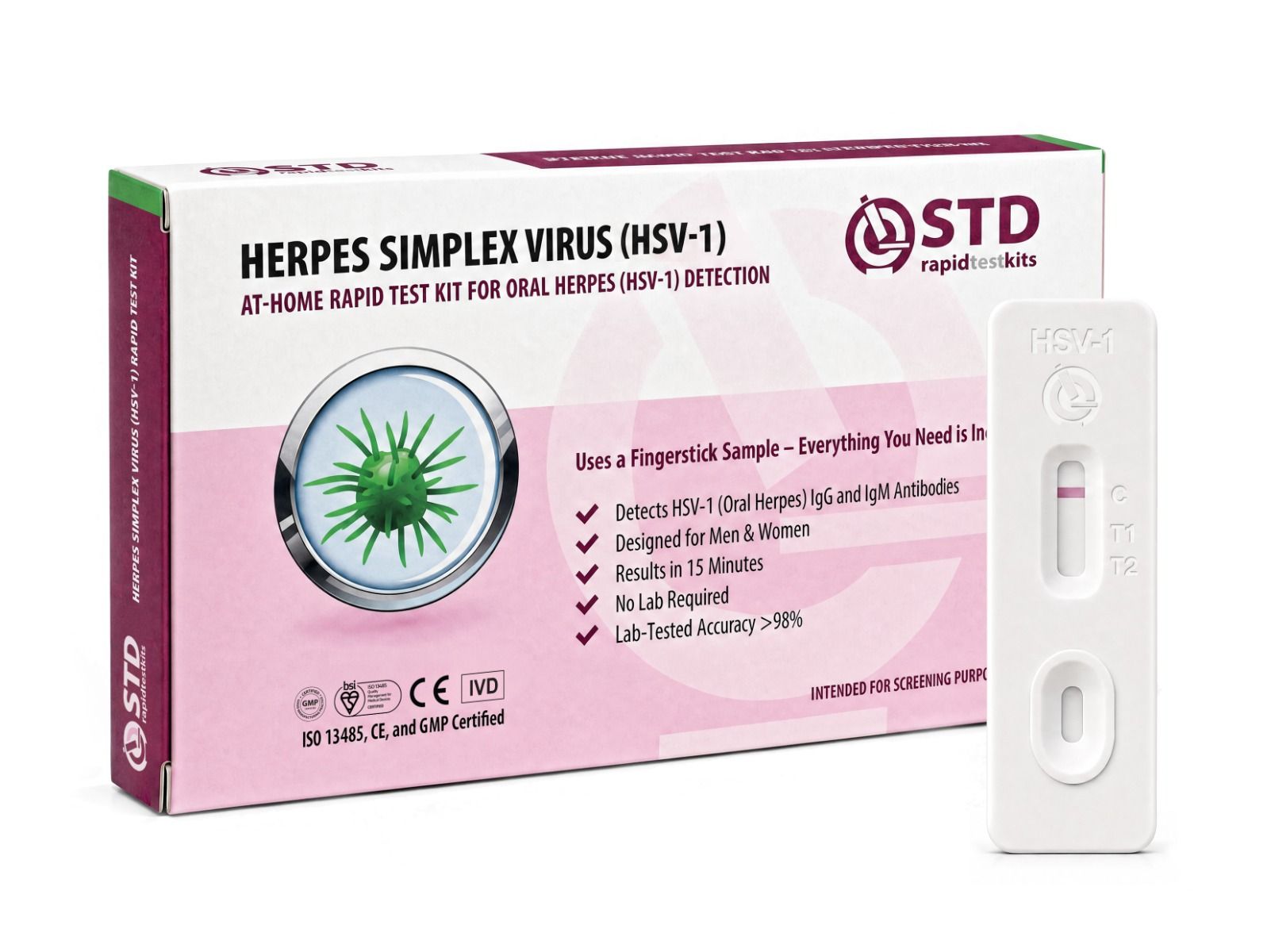
The home kit is a lateral-flow cassette. A drop of fingerstick blood runs along a strip, and antibodies to HSV-1 bind to two test zones: one for IgM, labeled T1, and one for IgG, labeled T2, according to the manufacturer's instructions. The kit detects antibodies, not the virus itself, and each line is simply present or absent.
A laboratory blood test for HSV-1 usually measures IgG against glycoprotein G1, a protein found only on type 1, and reports a numeric index value against a cut-off. CDC's STI treatment guidelines confirm that these type-specific assays exist. The same guidelines say that HSV-1 serology has low sensitivity for HSV-1 antibody and does not distinguish oral from genital infection (CDC STI Treatment Guidelines, genital herpes). A rapid strip has no numeric index value, so a borderline result cannot be flagged.
For a sore, neither blood test is the right tool. CDC calls nucleic acid amplification testing (NAAT, usually PCR) of a lesion swab the most sensitive option, with reported sensitivity from 90.9% to 100%. It finds the virus in the sore itself and identifies whether it is type 1 or type 2.
At-Home HSV-1 Strip vs Lab Serology vs Lesion PCR
| Feature | At-home HSV-1 rapid test | Lab type-specific HSV-1 IgG | Lesion PCR (NAAT) swab |
|---|---|---|---|
| What it detects | IgG and IgM antibodies to HSV-1, on separate lines | IgG antibodies to HSV-1 glycoprotein G1 | Viral genetic material in the sore |
| Sample | Fingerstick blood (the insert also lists venous blood, serum and plasma) | Blood drawn at a clinic or lab | Swab from an active, unhealed sore |
| Result format | Line present or absent, read at 15 minutes | Index value against a cut-off | Detected or not detected, typed as HSV-1 or HSV-2 |
| Shows oral vs genital site | No | No | Yes, from where the swab was taken |
| Dates the infection | No | No | Shows virus in the sore now, not when infection began |
| Published performance | Agreement with ELISA kits on patient samples (collection setting not stated); no home-use figure | CDC notes low sensitivity for HSV-1 antibody | CDC reports 90.9% to 100% sensitivity |
| Best use | Private preliminary screen of HSV-1 antibody status, with any line confirmed by a clinician | Clinician-ordered serology, interpreted with your history | Diagnosing a current sore |
Blood tests answer whether you have been infected at some point; only a lesion swab answers whether a sore is herpes.
What the HSV-1 kit's figures actually measure
The manufacturer's package insert compares each line with a commercial ELISA kit run on the same samples. That design measures how often two antibody tests agree. It does not show how often the strip detects true HSV-1 infection, because the ELISA is not a perfect reference either. The insert does not name the ELISA or say whether it is a glycoprotein G type-specific assay.
The comparisons are also small: 51 ELISA-positive samples for IgG and 41 for IgM. With numbers that size, the lower 95% confidence bound for positive agreement is about 90% for IgG and about 87% for IgM, well below the headline figure. The insert does not state how the samples were collected, and the manufacturer publishes no figure for a fingerstick sample taken and read at home. The HSV-2 kit has the same limits, as covered in how at-home HSV-2 rapid tests compare with a lab test.
The HSV-1 Insert's Comparison Data
- IgG line: agreed with a commercial HSV-1 IgG ELISA on 50 of 51 ELISA-positive and 59 of 60 ELISA-negative samples (positive agreement 98.0%, 95% CI 89.6 to 99.95%).
- IgM line: agreed with a commercial HSV-1 IgM ELISA on 40 of 41 ELISA-positive and 60 of 60 ELISA-negative samples (positive agreement 97.6%, 95% CI 87.1 to 99.9%).
- Study specimens: patient blood samples; the insert does not say who collected them, where, or how many were fingerstick, venous, serum or plasma.
- Home use: no study on file measures self-collected fingerstick blood read by the person testing.
- Figures here are recalculated from the printed counts, because the insert's own summary figures are internally inconsistent.
Reading the lines: C, T1 (IgM) and T2 (IgG)
The manufacturer's instructions say to read the cassette at 15 minutes and not after 20. A line that appears later does not count. The control line (C) must appear for any result to be valid. In this kit, T1 is IgM and T2 is IgG. Check the leaflet in your box anyway, because line labels differ between herpes kits.
Each combination below is a preliminary result. Any test line, T1 or T2, should go to a clinician for laboratory confirmation, and a control-only result does not rule HSV-1 out.
| Lines you see | What the strip detected | What it can and cannot tell you |
|---|---|---|
| C only | No HSV-1 IgG or IgM detected | Does not rule HSV-1 out, especially within 12 to 16 weeks of an exposure |
| C + T2 | IgG detected | HSV-1 infection at some point; no date, no site (oral or genital). Confirm with a clinician |
| C + T1 | IgM detected | Not proof of a new infection; IgM is not type-specific and can appear in recurrences. Needs clinician follow-up with lab IgG testing |
| C + T1 + T2 | IgM and IgG detected | The IgG line points to past infection; the IgM line does not make it recent. Confirm with a clinician |
| No C line | Invalid | Do not read the test lines; repeat with a new cassette |
Why the IgM line cannot date an infection
IgM is the antibody class the body tends to make first, so it is tempting to read a T1 line as a sign of a new infection. The manufacturer's insert says something similar. Current guidance does not agree: CDC does not recommend HSV IgM testing, for the reasons quoted below (CDC STI Treatment Guidelines). The American Sexual Health Association adds three more problems: IgM can appear in up to a third of people during outbreaks, it can be negative in up to half of people whose new infection was confirmed by swab, and it can cross-react with related viruses such as varicella zoster and cytomegalovirus (ASHA, herpes testing).
The IgM line's 40-of-41 agreement with an IgM ELISA does not solve this. Two IgM tests can agree on a line that says little about timing. A T1 line beside a T2 line can occur in a long-standing infection, for example during a recurrence, so it does not show the infection is new. Only a clinician, using lab IgG testing and your history, can interpret it. A T1 line on its own also needs a clinician, who can order laboratory type-specific IgG testing and repeat it later if needed.
Immunoglobulin M (IgM) testing for HSV-1 or HSV-2 is not useful because IgM tests are not type specific and might be positive during recurrent genital or oral episodes of herpes.
How long after exposure should you wait for an HSV-1 antibody test?
Antibodies take time to appear. CDC says type-specific antibodies develop during the first weeks after infection. For suspected recent HSV-2 acquisition, it advises repeating type-specific testing 12 weeks later (CDC STI Treatment Guidelines). CDC's screening page says current tests can take up to 16 weeks or more to detect infection (CDC, screening for genital herpes). For HSV antibodies generally, ASHA recommends waiting 12 to 16 weeks before a type-specific blood test, and MedlinePlus says the body can take up to three months to make HSV antibodies (MedlinePlus, herpes HSV test). The kit's leaflet does not state a window of its own.
Even after that wait, a control-only result is not a clearance. CDC's note on low HSV-1 antibody sensitivity applies to laboratory assays, and the home kit has no performance data from home use at all. Treat a negative as one piece of information. A sore at any point should be swabbed, whatever the strip showed.
Positive results work differently. HSV-1 is common in adults under 50 worldwide (the WHO estimate above), though prevalence varies by country and age, and a positive is more likely to be real when infection was likely to begin with. Even so, confirm it with a clinician before you treat it as settled. HSV-1 antibodies persist indefinitely, according to CDC, so a T2 line can reflect an infection from decades ago.
When HSV-1 Antibodies Become Detectable
- Week 0 Exposure
No antibodies yet; CDC says they develop during the first weeks after infection, and timing varies
- Week 12 Earliest recommended test time
ASHA advises waiting 12 to 16 weeks; MedlinePlus says HSV antibodies can take up to three months
- Week 16 Outer guidance bound
ASHA's upper limit; CDC's screening page notes up to 16 weeks or more
Timing from ASHA, MedlinePlus and CDC guidance on HSV antibodies generally; the kit's leaflet states no window of its own.
Home kit or clinic: matching the test to your question
The kit answers one question: whether your blood shows antibodies to HSV-1. It cannot tell you whether a sore is herpes, when you were infected, or whether the infection is oral or genital. CDC does not recommend herpes testing for most people without symptoms, because of the limits of blood tests, and it notes that wrong results are more likely in people at low risk (CDC, screening for genital herpes). Decide what you would do with a result before you test.
A private antibody check can still make sense in some situations. Say you have no sore, the exposure you are thinking of was more than 12 weeks ago, and you want to know your HSV-1 status before a conversation with a partner. In that case the at-home HSV-1 test works as a preliminary screen. Have a clinician confirm any test line, and do not treat a negative as ruling HSV-1 out. If you have a sore now, a clinician's swab is the right test. Most cold sores clear up on their own within 10 days (NHS, cold sores), and our guide to testing a cold sore covers that route. Pregnancy and a partner diagnosed with genital herpes are also situations for a clinician.
This article is published by stdrapidtestkits.com, which sells at-home STI testing kits, including the HSV-1 test discussed here.
Should You Use an HSV-1 Blood Test Right Now?
Do you have a sore or blister on your lip, in your mouth or on your genitals, or other genital symptoms that could be herpes?
Yes: Skip the blood test for now and see a clinician. A clinician can swab a sore for PCR, which identifies the virus type. An antibody kit cannot evaluate a sore.
Are you pregnant, or has a partner been diagnosed with genital herpes?
Yes: See a clinician, who can order laboratory type-specific serology and interpret it with your history.
Has it been at least 12 weeks since the exposure you are thinking of?
Yes: CDC does not recommend herpes blood tests for most people without symptoms because a positive may be wrong at low risk, so decide first what you would do with the result. If you still want to check, the at-home HSV-1 kit can serve as a preliminary screen of your antibody status. Have a clinician confirm any T1 or T2 line, and keep in mind that a negative does not rule HSV-1 out.
No: Antibodies may not be detectable yet. If you have symptoms, are pregnant or a partner has been diagnosed with genital herpes, see a clinician now instead of waiting. Otherwise wait until 12 to 16 weeks after the exposure before testing.
Guidance only. A clinician can advise based on your history and symptoms.
FAQs
- Does the HSV-1 kit also test for HSV-2?
- No. It reports antibodies to HSV-1 only. HSV-2 needs its own antibody test. A combined herpes panel pairs the two, and both strips have the same limits described here.
- Can I take the test while I have a cold sore?
- You can, but it will not tell you whether that sore is herpes. Antibodies in your blood may date from years ago, or may not have formed yet if this is a first episode. A swab of the unhealed sore, taken by a clinician, is the test that answers that question.
- Will a positive IgG line disappear after antiviral treatment?
- No. Antiviral medicine eases outbreaks but does not clear HSV-1 antibodies, so a repeat test will show the same T2 line. Retesting cannot track treatment or show whether the virus is active.
- My strip showed an IgM line, but a later lab IgG test was negative. What does that mean?
- An IgM line alone can be a false positive, so a negative lab IgG result does not conflict with it. Whether and when to repeat testing is a clinician's decision; ASHA advises waiting 12 to 16 weeks after a possible exposure before a type-specific blood test. A clinician can interpret the results alongside your history.
This article summarizes current guidance from the U.S. Centers for Disease Control and Prevention (CDC), the World Health Organization (WHO), ashasexualhealth.org and MedlinePlus and the other sources listed below. Each specific figure or recommendation links to the page that states it, and every page used is listed under Sources with what it supports. It is general health information written by our editorial staff, not a diagnosis or a treatment plan; how we choose topics and use sources is described in our editorial policy.
- U.S. Centers for Disease Control and Prevention. Sexually Transmitted Infections Treatment Guidelines, 2021: Genital Herpes. Supports the claims that IgM testing is not type-specific and not recommended, that HSV-1 serology has low sensitivity and does not distinguish oral from genital infection, that lesion NAAT sensitivity is 90.9% to 100%, that type-specific antibodies develop during the first weeks after infection, the 12-week repeat-testing advice for suspected HSV-2 acquisition, and that antibodies persist indefinitely.
- U.S. Centers for Disease Control and Prevention. Screening for Genital Herpes. Supports the claims that herpes testing is not recommended for most people without symptoms, that tests can take up to 16 weeks or more to detect infection, and that wrong results are more likely at low risk.
- World Health Organization. Herpes simplex virus fact sheet. Supports the estimate that 3.8 billion people under 50 (64%) have HSV-1, mostly acquired in childhood as oral herpes.
- American Sexual Health Association. Herpes Testing. Supports the IgM limitations (appearing in recurrences, missing new infections, cross-reactivity) and the 12- to 16-week wait before type-specific blood testing.
- U.S. National Library of Medicine, MedlinePlus. Herpes HSV Test. Supports the claim that the body takes up to three months to make HSV antibodies.
- NHS. Cold sores. Supports the claim that cold sores usually clear up on their own within 10 days.