Published: December 2025 | Last updated: May 2026 | Editorial review and quality control: Martina N.
Anal itching after sex is one of the more common symptoms people google at midnight and almost never bring up out loud. Sometimes the cause is mechanical: friction from a long session, residue from a lubricant your skin doesn't agree with, a fine fissure healing on its own. Sometimes the same itch is the only outward sign of a rectal infection like chlamydia or gonorrhea. The two can feel identical for the first couple of days, which is why timing and the right test matter more than the itch itself.
This guide walks through which sexually transmitted infections cause rectal itching, how to read your own body's clues, when each test becomes reliable, and what an at-home kit can and cannot do for an exposure that involved the rectum.
Why Rectal Symptoms Slip Under the Radar
Anal sex is part of many adults' sexual repertoires across orientations and genders, according to national survey data published by the CDC. Yet rectal symptoms get minimized far more often than vaginal or penile ones, partly because cultural shame keeps people from describing them clearly to a clinician, and partly because they're often genuinely subtle to begin with.
That subtlety is what makes rectal infections easy to miss. The CDC's STI treatment guidelines note that pharyngeal and rectal infections often go undiagnosed because clinicians forget to ask about extragenital exposure routes, and patients don't always volunteer them. So when something does show up, it might be a low-grade itch instead of obvious discharge or pain. Mild enough to dismiss, persistent enough to keep returning to your thoughts for days.
Most rectal itching after sex is benign mechanical irritation that resolves on its own within a few days. The remainder, the slice that doesn't resolve, is what the rest of this guide is for.
Key Takeaways
- Rectal chlamydia and gonorrhea are frequently asymptomatic; itching after receptive anal sex can be the only signal your body offers.
- The right test depends on what you're worried about: rectal NAAT swabs for chlamydia and gonorrhea are clinic-administered, while at-home blood tests cover HIV, syphilis, and hepatitis from the same exposure event.
Which STIs Can Cause Rectal Itching?
If the itch doesn't fade within a few days, or if it pairs with new sensations like rectal pressure, mild discharge, tingling, small bumps, or burning during a bowel movement, it's worth widening the differential. Several infections affect rectal tissue specifically, even when a urine test would miss them entirely.
The list below covers the infections most commonly associated with anal or rectal itching and how they typically present. Notice how often the right column reads 'often asymptomatic.' That phrasing is why the table below leads with asymptomatic frequency rather than visible symptoms.
| Infection | Can Cause Itching? | Other Possible Rectal Symptoms | Often Asymptomatic? |
|---|---|---|---|
| Chlamydia | Yes | Mild discharge, discomfort, urgency, soreness | Very common |
| Gonorrhea | Yes | Discharge, pain on bowel movement, rectal pressure | Common |
| Herpes (HSV-1 or HSV-2) | Yes | Burning, tingling, small painful blisters or sores | Sometimes |
| HPV | Sometimes | Anal warts, skin texture changes | Very common |
| Syphilis | Sometimes | Painless sore (chancre) at site of entry, later rash | Possible in early stages |
| HIV (acute) | Rarely the rectal itch itself | Flu-like illness, lymph node swelling at 2-4 weeks | Often |
Can anal itching after sex really be an STI?
Yes. Rectal chlamydia and gonorrhea are often asymptomatic, and when symptoms do appear, mild itching is one of the most common. If your itching started 2 to 14 days after receptive anal sex, especially without a condom, schedule a rectal NAAT swab at a clinic; pair it with at-home blood tests for HIV, syphilis, and hepatitis if those weren't covered recently. Mechanical irritation usually fades within two to four days; an infection lingers or evolves.
Irritation vs Infection: Reading the Difference
Plenty of post-sex anal itching has nothing to do with infection. Friction during a longer session, especially with insufficient lubrication, can inflame the delicate skin around the anus and the lining inside it. New lubricants (particularly silicone, glycerin-heavy, or warming and tingling formulas), latex sensitivities, fragranced soaps and wipes, and vigorous wiping can all leave the area irritated. Hemorrhoids can flare, and small fissures can form from passing a hard stool the next morning. All of these itch.
What distinguishes the two most cleanly is duration paired with evolution. Mechanical irritation tends to peak quickly and fade within two to four days as the tissue heals. An infection lingers, then often broadens its symptom set: a sense of rectal pressure that feels different from a normal urge to pass stool, a watery or yellow discharge unrelated to bowel movements, the urge to defecate when nothing is there (a clinical sign called tenesmus), or for herpes, a sharp tingling or burning that often precedes small painful sores.
| Feature | Irritation or Friction | Possible STI Infection |
|---|---|---|
| Onset | Immediately or within 24 hours of sex | Typically 2-14 days after exposure |
| Duration | Improves within 2-4 days | Persists or worsens past day 5 |
| Discharge | Rare | Possible with gonorrhea or chlamydia |
| Sores or blisters | No | Possible with herpes or syphilis |
| Rectal pressure / tenesmus | Uncommon | More suggestive of infection (proctitis) |
| Pattern with bowel movements | Often worse right after a hard stool | Independent of bowel pattern |
When and Where to Test for Rectal STIs
This is the part where most articles get vague. Reality is more specific.
The gold-standard test for rectal chlamydia and gonorrhea is a nucleic acid amplification test (NAAT) run on a swab taken directly from the rectum. The CDC's STI treatment guidelines on proctitis recommend extragenital screening (rectal and pharyngeal) for anyone whose exposure history fits, because urine NAATs miss most rectal infections. Rectal NAAT is widely available at sexual health clinics, Planned Parenthood, community health centers, and many primary care offices. Most insurance plans cover it; many sliding-scale clinics offer it for free or a nominal fee.
For HIV, syphilis, hepatitis B, and hepatitis C, the relevant test is a blood test, available either as a clinic blood draw or as an at-home fingerstick rapid kit. For herpes, an active rectal lesion can be swabbed and PCR-tested at a clinic; an antibody-only blood test is less specific and takes weeks to turn positive after a primary infection. For HPV, no routine rectal screening test exists in current US guidelines, though anal cytology and high-resolution anoscopy are available at specialty clinics for higher-risk patients.
If you're sitting at day three after a worrying exposure, the most useful single move is to mark your calendar for testing windows that match each infection. Earlier testing can be informative if it returns a strong positive, but a result obtained before the window closes can mislead you in either direction.
Our rapid kits are blood-based for HIV, syphilis, hepatitis B, hepatitis C, and herpes antibodies; and swab-based for genital chlamydia, gonorrhea, trichomoniasis, and HPV (the last two from a vaginal self-swab). They do not include rectal swabs. If you need a rectal NAAT for chlamydia or gonorrhea after a receptive anal exposure, the right path is a sexual health clinic, your primary care office, or a community health center, where the swab takes about thirty seconds. Use our kits for what they cover well; use a clinic for the rectal swab.
Window Periods: Why Timing Changes the Answer
The window period is the gap between exposure and when a test can reliably see infection. Test inside that gap and you can get a false negative; the test hasn't failed, the pathogen simply hasn't reached detectable levels yet.
For rectal chlamydia and gonorrhea NAAT, sensitivity becomes high by about 7 to 14 days post-exposure, with day 14 as the conservative retest point if you tested earlier (per the CDC's STI treatment guidelines). Herpes works on two clocks: an active lesion can be swabbed immediately for PCR, while antibody-based blood tests typically need 4 to 12 weeks to turn positive after a primary infection. Syphilis blood tests usually become reliable around 3 to 6 weeks after infection. HIV antibody-only rapid tests have a window of roughly 23 to 90 days post-exposure depending on the assay; CDC HIV testing guidance lists the specific window for each test type.
The table below collapses these into one practical view. The ranges are general estimates; your specific test's package insert will list its validated window.
| Infection | Earliest Useful Test | Best Testing Window | Retest Recommended? |
|---|---|---|---|
| Rectal chlamydia (NAAT swab) | 7 days | 14 days | Yes if tested before day 14 |
| Rectal gonorrhea (NAAT swab) | 7 days | 14 days | Yes if tested before day 14 |
| Herpes (active lesion swab/PCR) | Immediately, while sores present | Within 48 hours of lesion onset | Not usually if positive |
| Herpes (antibody blood test) | 4 weeks | 12 weeks for primary infection | Yes if early test was negative |
| Syphilis (blood test) | 3 weeks | 6 weeks | At 12 weeks if early test negative |
| HIV (rapid antibody fingerstick) | 23 days | 90 days for full reassurance | Yes if exposure was within 90 days |
| Hepatitis B (rapid blood test) | 4 weeks | 8-12 weeks | Yes if exposed 4-12 weeks ago |
| HPV | No window applies | No routine rectal screening | Anal cytology if symptoms persist |
Hemorrhoids, Fissures, and Skin Sensitivities
A meaningful share of post-sex anal itching has nothing to do with sexual transmission. Hemorrhoids are swollen blood vessels in or around the lower rectum and anus that often itch, sometimes bleed lightly, and tend to flare with constipation, straining, pregnancy, long sitting, or post-workout pressure. They aren't tied to a specific sexual encounter, though anal sex can aggravate existing hemorrhoidal tissue and make a quiet flare suddenly noticeable.
Anal fissures, small tears in the anal lining, often follow a hard stool or rougher sex. They produce sharp pain on bowel movements, sometimes a bright red streak of blood on toilet paper, and a slow-burning itch as they heal. Most fissures heal on their own in a week or two with sitz baths, dietary fiber, plenty of water, and topical care. Persistent fissures lasting beyond six weeks deserve a clinician evaluation to rule out other causes.
Skin sensitivities are an underrated cause. People react to specific lubricants (silicone, glycerin-heavy, warming, or tingling formulas), to condom latex or spermicide, to fragranced wipes, or to laundry detergent residue on underwear. The reaction looks like contact dermatitis: a band of redness or scattered tiny bumps, mild swelling, persistent itch that doesn't track with bowel movements.
Bodies don't pick one cause at a time, either. You can have hemorrhoids and an STI simultaneously. If your symptoms shifted noticeably after sex but you also have a long history of anal irritation, the responsible move is to test rather than to mentally separate the two yourself.
What an At-Home Rapid Kit Covers (and What It Doesn't)
Most readers searching this topic want practical next steps, and at-home rapid testing is the relevant tool for one specific slice of the question.
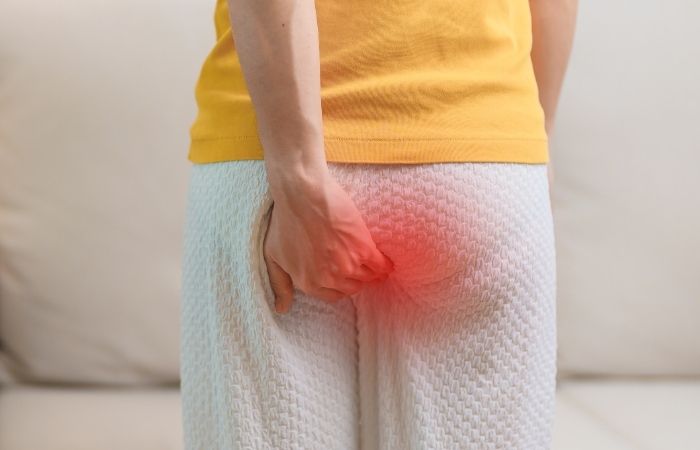
Our rapid lateral-flow kits are blood-based for HIV, syphilis, hepatitis B, hepatitis C, and herpes antibodies (fingerstick collection); and swab-based for genital chlamydia, gonorrhea, trichomoniasis, and HPV (vaginal or urethral self-collection where applicable). They produce a result in about fifteen minutes. They use the same lateral-flow chemistry that powers many clinic point-of-care tests, which is screening-grade rather than NAAT-grade analytical sensitivity. A positive result is worth confirming with a lab NAAT or clinician evaluation; a negative result well after the relevant window has closed is reassuring for the included infections.
What our kits do not cover: rectal swabs, pharyngeal (throat) swabs, urine NAAT, and lab-processed mail-in molecular panels. If your concern is specifically rectal chlamydia or gonorrhea (the most likely culprits behind rectal itching after a recent anal exposure), a clinic visit is the right tool. If your broader concern is the bloodborne risk profile of an anal exposure, including HIV, syphilis, and hepatitis, an at-home rapid blood test is a reasonable starting point once you're past each window period.
This article is published by stdrapidtestkits.com, which sells at-home STI kits. We recommend products based on fit-for-purpose for the reader's concern, not on commercial benefit. For a rectal swab specifically, see a clinic.

If You Test Positive
First step: breathe. Most rectal STIs are highly treatable and, once treated, do not leave permanent damage in healthy adults.
For rectal chlamydia or presumptive proctitis, CDC guidelines recommend a single intramuscular dose of ceftriaxone (500 mg) combined with doxycycline 100 mg twice daily for seven days, because gonorrhea co-infection is common and empirical coverage of both pathogens is the safer starting point. Your clinician may adjust this if only one pathogen is confirmed on testing. Retesting three months after treatment is recommended in many cases, because reinfection from an untreated partner is common and sometimes happens within weeks of clearance.
For herpes, antiviral medications like valacyclovir or acyclovir reduce outbreak severity, shorten the duration of any active sores, and lower the chance of transmission to partners. Most people with rectal herpes have flares that become less frequent over time. Daily suppressive therapy is an option for people with frequent recurrences.
For syphilis, early-stage treatment is highly effective; benzathine penicillin G as a single intramuscular dose for primary or early latent disease cures it, per the CDC syphilis treatment guidelines. Late-stage syphilis requires a longer regimen but remains curable.
For HIV, modern antiretroviral therapy is so effective that people who start treatment early and maintain an undetectable viral load have a near-normal life expectancy and cannot transmit the virus sexually (the U=U principle, supported by the PARTNER and Opposites Attract studies referenced in CDC guidance).
Performing tests at multiple anatomic sites yields a more accurate assessment of infection. Rectal and pharyngeal infections are common and would be missed if only urogenital sites were tested.
Telling a Partner
This part is where social anxiety often eclipses the medical reality. The actual conversation can be straightforward: 'I tested positive for [infection]. It's treatable. You should get tested too so we both know where we stand.' Most people land on something close to that script once they have to use it, and most partners receive it with concern rather than judgment.
If a face-to-face or phone conversation feels too charged, anonymous notification services like TellYourPartner.org let you send a message without disclosing your identity, with optional follow-up resources. Many local health departments employ disease intervention specialists who can do partner notification on your behalf, especially for syphilis and HIV.
The math at the population level is simple. Treating a rectal infection in one person and ignoring exposed partners means the infection bounces back into the same network within weeks. Telling partners is the second half of treatment, even when the social weight makes it feel theatrical.
If you are on the receiving end of one of these messages, the calmest response is the same regardless of direction: thank the person, schedule the appropriate test, and act on the results.
Bottom Line
Anal itching after sex is most often a benign mechanical irritation that resolves in a few days. When it doesn't resolve, when it pairs with discharge or pressure or small lesions, or when it follows a known unprotected exposure, it's worth taking seriously. The right test depends on the question.
For chlamydia and gonorrhea in the rectum, the answer is a rectal NAAT swab at a clinic, ideally 7 to 14 days after exposure. For HIV, syphilis, hepatitis, and herpes, an at-home blood-based rapid test is a reasonable starting point once you're past each window period. For HPV, anal cytology at a specialty clinic is the only screening currently available in routine US practice.
The most common mistake people make is testing too early and walking away with a false sense of certainty before the window has closed. Mark the right window for each test, then get the right test for each concern.
Right Test, Right Window: A Quick Checklist
- Rectal chlamydia or gonorrhea suspected: book a rectal NAAT swab at a sexual health clinic 7-14 days after exposure.
- Bloodborne concerns (HIV, syphilis, hepatitis B, hepatitis C, herpes antibodies): an at-home fingerstick rapid kit is a reasonable starting point once you're past each test's documented window period.
- HPV or persistent anal symptoms with no clear cause: ask about anal cytology at a specialty clinic; no routine rectal HPV screening exists in current US guidelines.
FAQs
- Can anal itching really be the only sign of an STI?
- Yes. Rectal chlamydia and gonorrhea are often described as 'silent' infections; the CDC notes most rectal infections are diagnosed during routine screening rather than because of severe symptoms. When symptoms do appear, they can be as subtle as a low-grade itch, mild rectal pressure, or the sense of needing to pass stool when there's nothing to pass.
- How soon after anal sex would an STI itch typically show up?
- Mechanical irritation usually appears within hours and fades within two to four days. Bacterial infections typically produce symptoms two to fourteen days after exposure. If the itch began the morning after sex and is gone within three days, irritation is the most likely cause. If it persists past day three or evolves into pressure or discharge, an infection moves higher on the differential.
- I don't have any discharge. Doesn't that mean I'm fine?
- Not necessarily. Rectal chlamydia and gonorrhea are frequently asymptomatic, and many positive cases are diagnosed in people who report only mild itching or no symptoms at all. Absence of discharge is reassuring; it isn't proof of an absent infection.
- Is this just hemorrhoids? How can I tell?
- Hemorrhoids tend to flare with constipation, straining, long sitting, or pregnancy, and they aren't linked to a specific sexual encounter. They often itch, sometimes bleed lightly, and improve with sitz baths and dietary fiber. If your itch began within days of receptive anal sex, infection sits higher on the differential. Keep in mind that hemorrhoids and an STI can coexist; testing settles the question.
- If we used a condom, am I in the clear?
- Condoms substantially reduce risk for chlamydia, gonorrhea, HIV, syphilis, and hepatitis B, but they don't eliminate it. Herpes and HPV can transmit through skin contact in areas a condom doesn't cover, like the buttocks or upper thighs. Protected anal sex carries lower risk than unprotected anal sex, not zero risk.
- Do I really need a rectal swab? Can a urine test cover it?
- Urine NAAT does not reliably detect rectal infections; the CDC's STI treatment guidelines specifically recommend rectal swab NAAT for anyone who has had receptive anal exposure. A urine test will catch a urethral infection, but a rectal infection requires a rectal swab. The swab itself is shallow, takes about thirty seconds, and is widely available at sexual health clinics.
- I tested negative at day five. Can I relax?
- Day five is inside the window for most tests. Sensitivity for rectal NAAT improves substantially by day 14, and the HIV antibody, syphilis, and herpes antibody windows are longer still. A negative test taken inside its window is informative but not final. Schedule the appropriate retest at the conservative end of the window before treating the result as definitive.
- Should I tell a partner before I have results?
- Timing is a personal decision. Some people prefer to wait for confirmed results before initiating any conversation; others tell partners early so both can test in parallel. The non-negotiable piece: if a test comes back positive, tell partners who could have been exposed, either directly or through an anonymous notification service, so they can test and treat.
How We Sourced This Article: This guide synthesizes current CDC sexually transmitted infections treatment guidelines, peer-reviewed clinical literature on rectal STI presentation and extragenital screening, and patient-facing materials from major public health organizations including the WHO and NHS. Recommendations align with national clinical guidance; specific testing windows reflect each test type's documented sensitivity profile rather than a single estimate.
- U.S. Centers for Disease Control and Prevention. Sexually Transmitted Infections Treatment Guidelines, including extragenital screening recommendations.
- U.S. Centers for Disease Control and Prevention. Chlamydia: basic facts, screening, and treatment.
- U.S. Centers for Disease Control and Prevention. Gonorrhea: basic facts, anatomic-site testing, and treatment.
- World Health Organization. Sexually transmitted infections (STIs) fact sheet, including global incidence and screening principles.
- U.S. Centers for Disease Control and Prevention. STI Treatment Guidelines: Proctitis, Proctocolitis, and Enteritis section, including empirical ceftriaxone + doxycycline regimen.
- U.S. Centers for Disease Control and Prevention. Genital Herpes basic facts, including testing methods (PCR vs antibody) and antiviral treatment.
- U.S. Centers for Disease Control and Prevention. Syphilis Treatment Guidelines, including recommended benzathine penicillin G regimens by stage.
