







Quick Answer: Viral STIs like Herpes and HPV now outpace bacterial STIs such as Chlamydia and Gonorrhea because they often spread silently, last for life, and aren’t stopped by antibiotics, making early detection and protection essential.
Janelle’s story is more common than most people realize. Across the globe, viral STIs are quietly becoming the dominant force in sexual health. CDC data shows that while Chlamydia remains the most reported bacterial STI in the U.S., the lifetime prevalence of HPV and Herpes dwarfs the yearly tallies of bacterial infections. The difference is visibility: bacterial STIs are more likely to trigger obvious symptoms and are curable with antibiotics, while viral infections often stay quiet and linger indefinitely.
It’s not just an American story. Global studies confirm the same trend: the age‑standardized incidence of HPV and Herpes remains higher than that of Gonorrhea or Chlamydia, and these viral infections continue to drive the bulk of long‑term sexual health complications, including cervical cancer and recurring outbreaks. Public health officials call it a “silent shift,” because the surge is easy to miss until it lands in someone’s life like a quiet storm.
“I wish someone had told me that negative tests don’t mean zero risk,” Janelle said later. Her quote is echoed in countless patient interviews and online forums, where people search late at night for terms like “tingling lips cold sore or allergy” or “std rash vs heat rash.” These micro‑panics are where most journeys begin: the moment of doubt that leads to Googling, second‑guessing, and eventually testing.
Understanding why viral STIs have surpassed bacterial ones requires untangling three threads: how modern dating and testing habits leave gaps, why viral infections are harder to detect and eliminate, and how stigma around the words “clean” or “dirty” distorts reality. Let’s start with the most human part, the quiet ways these viruses slip into lives like Janelle’s, unnoticed until they demand attention.

People are also looking for: Private, Fast, and 92% Accurate? At-Home STD Tests Explained
When Silence Becomes a Symptom
Two weeks after Janelle’s diagnosis, she sat in a coffee shop with Marcus, a friend she trusted. He leaned across the table, lowering his voice. “I had something like that last year,” he said. “Never felt a thing. Just went in for a checkup and they said, ‘You’ve got HSV‑1 genitally.’ I didn’t even know that was possible.” His words carried a quiet shame wrapped in relief, the kind you hear when people discover they’re not alone. Viral STIs thrive in this silence. They move through social circles, dorms, and dating apps with barely a ripple because most carriers never feel a symptom.
Globally, it’s estimated that over 3.7 billion people carry some form of Herpes Simplex Virus, and roughly 300 million new HPV infections occur each year. By contrast, reported bacterial STIs like Chlamydia and Gonorrhea number in the tens of millions. The scale isn’t even close. The mismatch is partly because bacterial infections announce themselves more loudly, with discharge, pain, or burning, while viral infections often pass as a whisper, if they speak at all.
That silence is deceptive. HPV can sit in the body for months or years before any warts appear or a Pap test flags abnormal cells. Herpes might show up as a single mild sore that looks like razor burn, then disappear for months. As Dr. Caroline Wu, an infectious disease specialist, told Healthline, “People assume no symptoms means no infection. With viral STIs, that assumption is how transmission thrives.”
For decades, public health messaging has leaned on bacterial STIs because they’re treatable and traceable. Get a positive chlamydia test, take your antibiotics, and the story is over. But viral infections turn sexual health into a lifelong conversation. A negative bacterial panel can lull someone into a false sense of safety, while a silent viral infection passes unnoticed to a new partner. That is the heart of the viral shift: visibility versus reality.
And yet, the words we use to describe sexual health make the stigma worse. The term “clean” still pops up on dating profiles and in casual conversations, as if an STD test is a moral report card. “I thought being ‘clean’ meant I couldn’t have herpes,” Janelle said in a follow‑up message. “Now I realize it just means I wasn’t educated enough.” The language of shame makes people avoid conversations and delay testing, the exact conditions viruses need to keep winning.
At the same time, the science is crystal clear. Viral STIs aren’t just rising because of biology; they’re rising because of behavior. European surveillance data shows that casual hookups, inconsistent condom use, and uneven vaccination rates fuel the viral takeover. Modern dating apps have compressed the time between meeting and intimacy, and people are testing less frequently for infections that aren’t part of standard bacterial panels. If you only screen for chlamydia and gonorrhea, the viruses keep slipping under the radar.
It’s an uncomfortable truth: what you can’t see is what’s most likely to follow you home.
Check Your STD Status in Minutes
Test at Home with Remedium7-in-1 STD Test Kit

 For Men & Women
 Results in Minutes
 No Lab Needed
 Private & Discreet
Order Now $129.00 $343.00
For all 7 tests
Data Meets Reality: Why Viral STIs Keep Winning
Three months after her first outbreak, Janelle found herself in a clinic waiting room for a follow‑up. A young man in a baseball cap sat two chairs over, staring at the floor. When the nurse called his name, he muttered, “I thought I was done with this stuff in college.” Their quiet exchange, unspoken but shared, reflects a larger truth: viral STIs turn sexual health into a long game, one most people never expected to play.
Public health numbers tell the same story, only without the human faces. According to the CDC’s 2023 STI summary, reported cases of Chlamydia and Gonorrhea remain high but relatively stable. Meanwhile, lifetime infection rates for Herpes and HPV dwarf the annual counts for bacterial STIs. A global analysis found that over 67% of adults carry HSV‑1, and roughly 13% carry HSV‑2, while nearly 80% of sexually active individuals will acquire some form of HPV during their lives. Even if these viruses never make headlines the way antibiotic‑resistant gonorrhea does, they are quietly reshaping sexual health as we know it.
The reasons are layered. Viral infections persist because the immune system doesn’t clear them completely, and antibiotics offer no help. Most people don’t know they’re infected, which means fewer disclosures and fewer interventions. By the time someone feels a tingle, sees a blister, or gets an abnormal Pap smear, the virus has likely been present for months or years. As Dr. Lena Morales, a sexual health researcher at Johns Hopkins, puts it, “Bacterial STIs are sprinting races; viral STIs are marathons you didn’t know you signed up for.”
There’s also the issue of testing gaps. Standard STI screenings often check for Chlamydia, Gonorrhea, sometimes Syphilis, but not Herpes unless specifically requested, and not HPV in men at all. That means millions of people are walking around with a sense of false security, exactly like Janelle did. The viral shift thrives in these blind spots.
But knowing the landscape is changing also brings power. Newer options for private, at‑home testing are designed for the very people who feel stuck between worry and stigma. They allow you to screen for common STIs from your own bedroom, without the awkward waiting rooms or whispered phone calls.
“I didn’t want to go back to the clinic again,” Janelle admitted. “I just wanted to know without the side‑eye.” She ordered a discreet at‑home kit that checked for Chlamydia, Gonorrhea, and Syphilis. It arrived in a plain box, and she had results the next day. That peace of mind is why many sexual health educators now recommend combining clinic visits with periodic home testing for anyone who’s sexually active.
If you’re in that same limbo, between the fear of the unknown and the need for answers, modern tools exist to break the silence. This at‑home combo test kit can screen for multiple STIs quickly and discreetly, putting the first step toward control back in your hands.
The Myth of Being “Clean”
On a Thursday night, Eric sat on his couch, thumbing through dating apps. Profile after profile read, “DDF/clean.” He swiped right on a girl with a bright smile and the same line in her bio. “Clean” had become his comfort word, like an invisible shield. A week later, after a spontaneous weekend hookup, he noticed a small sore near the base of his penis. Panic replaced confidence. When the clinic called with his results, it wasn’t chlamydia or gonorrhea. It was HSV‑2. He stared at the word “positive” and muttered, “But she said she was clean.”
This language problem isn’t new. “Clean” is shorthand for “I recently tested negative for bacterial STIs,” but in reality, it says nothing about HPV or Herpes. Viral STIs don’t obey the same rules because testing isn’t standard, symptoms often never appear, and the infections can last a lifetime. According to WHO data, more than 67% of adults worldwide have some form of herpes, and most will never know it. Calling oneself “clean” is less a statement of health and more a reflection of how little most people understand about viral risk.
The impact of this myth is personal and public. People like Eric and Janelle make choices based on a false sense of security, while the viruses quietly circulate. The emotional cost is just as real as the medical one. Eric described it this way:
“I didn’t feel dirty until I read that word in my results. Then I realized the word ‘clean’ was the problem, not me.”

People are also reading: You Can’t Get Tested if You Can’t Get There: Transportation Barriers and STD Rates
Modern Dating and the Viral Playground
Two friends, Kayla and Mari, were sipping iced coffee, swiping through dating apps, laughing at cheesy bios. “He’s cute,” Kayla said, “but his profile says ‘clean,’ and I don’t believe anyone anymore.” They laughed, but beneath it was a quiet truth: dating today moves faster than most people talk about STIs. A spontaneous weekend trip or a same‑night hookup often leaves no room for medical conversations. Even if someone tested last month, that doesn’t cover viruses acquired yesterday or infections that never show symptoms.
Public health researchers have started calling this the “viral playground.” On apps where meetings turn to intimacy in hours, viruses that live silently, like HPV and Herpes, spread in ways bacterial STIs rarely can. A recent study in Frontiers in Public Health showed that asymptomatic carriers drive the majority of new herpes transmissions, and only a fraction of people receive HPV vaccination or comprehensive viral screening.
The result? People feel blindsided. They pass through the dating world thinking negative results make them untouchable, when really, viral STIs are hiding in plain sight. Kayla summed it up over her straw:
“I guess the only thing that’s really safe is talking, testing, and… maybe slowing down a little.”
Her laugh softened the reality, but she wasn’t wrong.
How to Protect Yourself Without Fear
The shift toward viral STIs sounds scary, but knowledge makes it manageable. Unlike bacterial infections, you can’t rely solely on treatment after the fact. Protection comes from layered strategies: consistent condom use, open conversations, vaccination for HPV, and regular screening. But it also comes from removing shame from the process. People avoid testing because they don’t want the judgment. They whisper in waiting rooms. They feel like one diagnosis erases their worth. That stigma feeds the silence that viruses rely on.
“Once I tested at home, I felt like I could breathe,”
Janelle said. “I didn’t need anyone to hold my hand in the waiting room, and I didn’t have to explain to a nurse why I was back again.” Stories like hers highlight why discreet, at‑home testing can be a game changer. It bridges the gap between anxiety and action, letting people take control without feeling exposed.
Check Your STD Status in Minutes
Test at Home with Remedium3-in-1 STD Test Kit
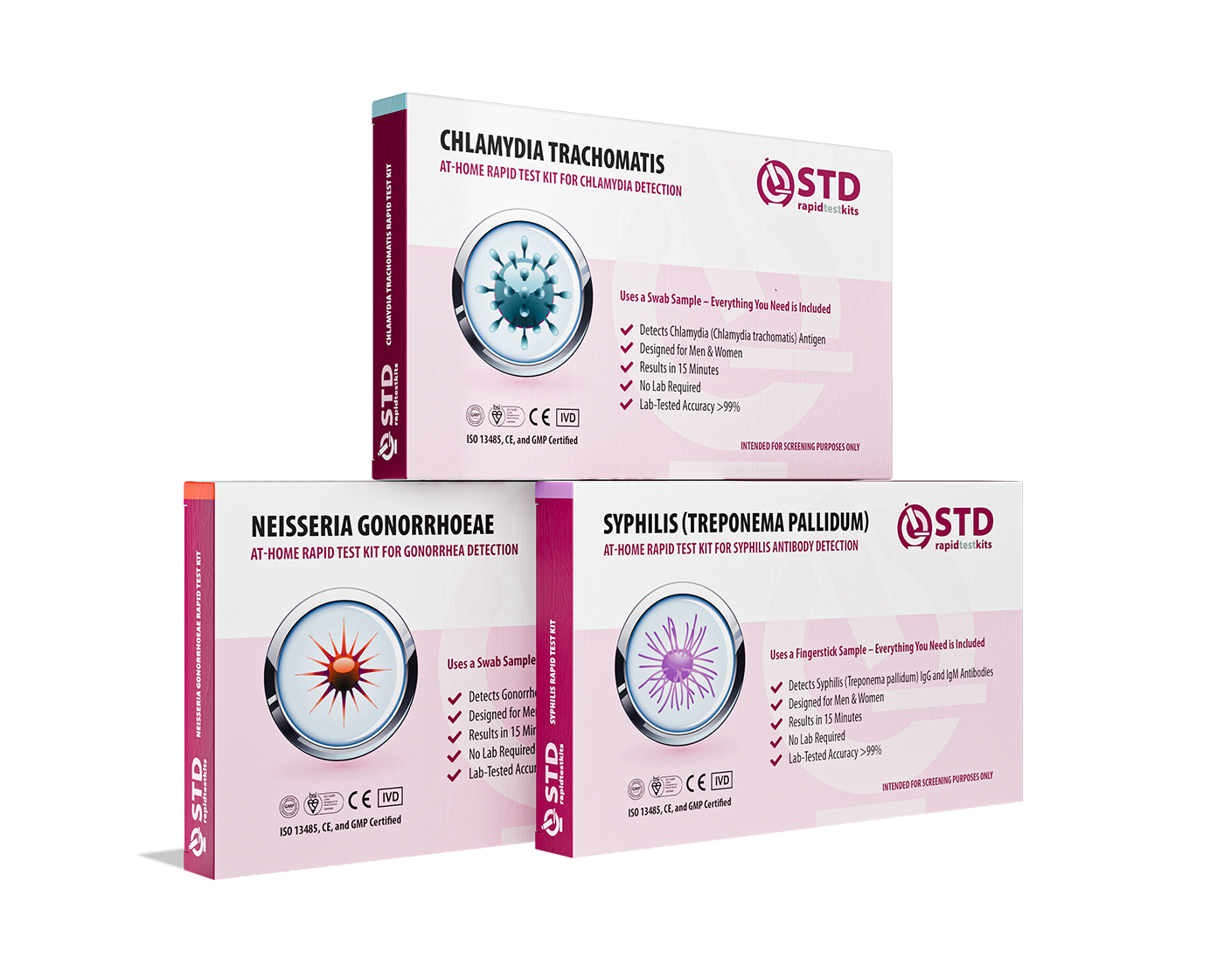 For Men & WomenResults in MinutesNo Lab NeededPrivate & Discreet
Order Now $69.00 $147.00
For all 3 tests
FAQs
1. Is it possible to get herpes even if your STI tests are negative?
Yes, and it surprises people all the time. Standard STI panels usually focus on bacterial infections like Chlamydia and Gonorrhea. Herpes testing isn’t routine unless you specifically ask for it, and many people never show clear symptoms. Imagine walking out of a clinic feeling “all clear,” only to notice a small blister two weeks later, that’s how this virus flies under the radar.
2. Why are viral STIs like herpes and HPV so hard to get rid of?
Unlike bacteria, viruses don’t just hang out, they move in. Herpes hides in nerve endings, and HPV can linger in tissue for months or years. Antibiotics can’t touch them. That’s why catching them early, and better yet, preventing exposure, is the real game changer.
3. Do condoms completely protect against herpes and HPV?
Condoms help a lot, but they’re not magic force fields. Viruses can live on skin that a condom doesn’t cover, like the groin or inner thighs. Picture a seatbelt: it saves lives, but it doesn’t make you invincible. Condoms plus open conversations and regular testing give you the best protection.
4. Is HPV dangerous for men even if there are no symptoms?
Yes. Men can carry and transmit HPV without ever seeing a wart. Most infections clear on their own, but certain strains can cause genital warts or, more rarely, cancers of the throat, anus, or penis. It’s the kind of silent risk most guys never hear about until a partner’s Pap test comes back abnormal.
5. Can you test for herpes and HPV at home?
Some home kits can check for Herpes, and women can now use certain at‑home swabs for HPV. For men, HPV testing is still usually done in a clinic. At‑home kits are perfect if you want privacy or peace of mind between partners, like opening a plain box that holds your own next step toward control.
6. What happens if chlamydia or gonorrhea goes untreated?
Untreated bacterial STIs can do more than just linger, they can lead to pelvic inflammatory disease, scarring, and even infertility. Think of it as a slow burn that can change your health quietly. That’s why early detection is just as important for bacterial infections as it is for viral ones.
7. Do viral STIs always show up eventually?
Not necessarily. Many people with Herpes or HPV never feel a thing. That silence is why regular testing, and in the case of HPV, vaccination, is so important. Not knowing you're sick won't protect you.
8. Can I still have a normal sex life after a herpes or HPV diagnosis?
Absolutely. Most people with viral STIs have full, satisfying sex lives. The keys are disclosure, protection, and, when needed, suppression therapy. Your diagnosis doesn’t define you; it just makes you a more informed and responsible partner.
9. Is HPV vaccination worth it if I’m already sexually active?
Yes. Even if you’ve been sexually active for years, the vaccine can still protect you from strains you haven’t encountered. It’s like closing doors before the virus ever gets a chance to walk in, and it significantly lowers your long‑term cancer risk.
10. When does at‑home testing make the most sense?
Home testing shines when you want privacy, quick answers, or a routine check between partners. Think of it as a bridge between anxiety and action.
You Deserve Answers, Not Assumptions
Viral STIs have changed the rules of sexual health. They thrive on silence, stigma, and the false comfort of a negative bacterial test. But being informed and proactive flips the script. Whether you’re single, partnered, or exploring, your sexual health is yours to protect without shame.
Don’t wait in the dark. If you’re questioning a new symptom or just want reassurance, an at‑home combo test kit can give you fast, private answers. Testing isn’t just about results, it’s about peace of mind and control over your health.
Sources
1. WHO – Global STI Fact Sheet: Herpes & HPV vs. Chlamydia & Gonorrhea
2. CDC – STI Prevalence & Incidence Estimates (2018 data)
3. NCBI/CDC – Patterns & Drivers of STIs in the U.S.
4. Global STI Prevalence Rankings: Herpes, HPV & More
5. Genital Herpes Epidemiology: Global & U.S. Prevalence
6. HPV Infection Epidemiology: Global Prevalence & Cancer Risk


