







Quick Answer: If you burn or itch after using a condom, it's usually not an STD but rather a latex allergy, friction irritation, or lubricant sensitivity. Allergic reactions usually happen within minutes to hours after sex. But most of the time, STD symptoms don't show up for days or weeks. You should get tested if your symptoms last longer than a few days or if you have sores, discharge, or a fever.
Why Burning or Itching Happens After Condom Use
The skin on the genitals is very sensitive. It is exposed to friction, pressure, fluids, and sometimes new materials like latex or lubricants during sex. That mix can cause reactions even when nothing contagious is going on.
Doctors who specialize in sexual health often see patients who assume itching equals infection. In reality, irritation after sex is surprisingly common, especially if someone used a condom for the first time, switched brands, or had longer or rougher intercourse than usual.
Three causes account for the majority of post-condom burning or itching symptoms: latex allergy, contact irritation, and sexually transmitted infections. Each behaves differently in the body.
The three most common causes
| Cause | Typical Timing | Common Symptoms | How Long It Lasts |
|---|---|---|---|
| Latex Allergy | Minutes to a few hours | Itching, redness, swelling, rash | Several hours to a few days |
| Friction Irritation | Immediately after sex | Burning, soreness, redness | 24–48 hours |
| STD Infection | Days to weeks | Sores, discharge, rash, flu-like symptoms | Persists without treatment |
Notice the most important difference: timing. Allergic reactions and irritation usually happen quickly, but STD symptoms usually take longer to show up because bacteria or viruses need time to grow inside the body.
Someone might feel fine right after sex but start to have symptoms a week later because of that delay. The infection was already there; it just needed some time to show up.
Latex Allergy Symptoms That Mimic STD Reactions
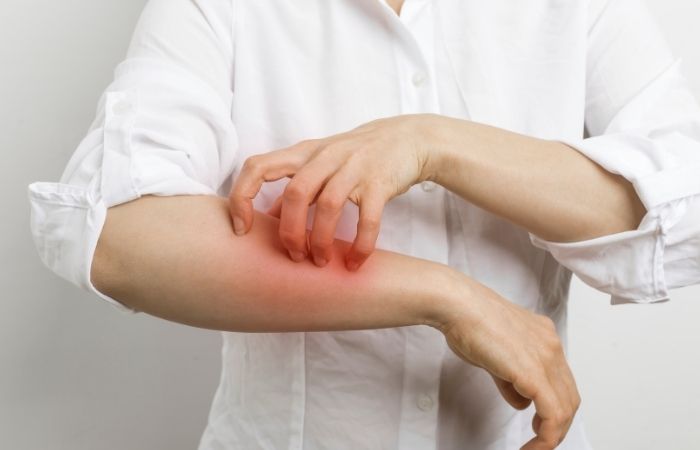
Latex allergies are more common than most people realize. Some people can have immune reactions to proteins in natural rubber latex. When latex condoms touch the skin, the body may see the proteins in them as a threat.
Within minutes or hours, the immune system releases chemicals that create itching, redness, swelling, or hives. In sensitive areas like the penis, vulva, or anus, the reaction can feel intense.
Because these symptoms happen right after sex, they can easily be mistaken for the start of an STD outbreak.
Typical genital latex allergy symptoms
| Symptom | What It Usually Feels Like | Where It Appears |
|---|---|---|
| Intense itching | Sudden itch or tingling | Areas touching the condom |
| Redness | Patchy or flushed skin | Genitals or inner thighs |
| Mild swelling | Skin feels puffy or irritated | Penis head, vulva, labia |
| Small rash or bumps | Similar to contact dermatitis | Where latex touched skin |
One key clue: allergic reactions usually match the shape of the condom contact area. If irritation appears exactly where the latex touched the skin and fades within a day or two, allergy or irritation is more likely than infection.
Another sign is repeat reactions. Many people discover latex sensitivity when they notice the same itching every time they use a certain brand of condom.
Switching to polyurethane or polyisoprene condoms often solves the problem entirely.
People are also reading: Telling a Partner About STD Exposure, Without Shame or Panic
A Real Scenario Doctors Hear All the Time
A patient we’ll call Jordan came into a clinic convinced they had contracted herpes. The night before, they had sex with a new partner using a condom. Within an hour, the skin around the genitals started itching and burning intensely.
“I thought I had ruined my life,” Jordan later admitted. “I was googling herpes symptoms at two in the morning.”
But during the exam, clinicians noticed something telling: the redness matched the exact outline of where the condom had been. There were no blisters, no ulcers, and the irritation faded within 24 hours.
The diagnosis wasn’t herpes. It was a mild latex sensitivity.
Situations like this happen frequently because the symptoms overlap so much in the early stages. Without context about timing and pattern, it’s easy to assume the worst.
How to Reduce Confusion After a Reaction
If burning or itching happens after condom use, the next step isn’t panic, it’s observation.
Sexual health clinicians usually recommend paying attention to three factors: timing, symptom pattern, and duration.
| Question | Why It Matters |
|---|---|
| Did symptoms appear within minutes or hours? | Immediate reactions often indicate allergy or irritation. |
| Did symptoms start several days later? | Delayed symptoms may signal infection. |
| Is the irritation exactly where the condom touched? | Contact reactions usually follow the contact area. |
| Do you have any sores, blisters, or discharge? | These are more typical STD indicators. |
When symptoms fade quickly, allergy or irritation is usually the explanation. When symptoms persist or worsen over time, medical testing becomes the safest step.
Testing Can Remove the Guesswork
One of the biggest problems with symptom-based diagnosis is that many STDs cause mild or invisible symptoms. In fact, public health studies consistently show that a large percentage of infections, especially chlamydia, produce little to no noticeable signs.
That’s why sexual health professionals often recommend testing after new partners, even when protection was used.
For people who feel anxious after a sexual encounter, at-home testing can offer quick clarity. Options like the STD Rapid Test Kits homepage provide discreet testing options that can screen for several common infections.
Many readers choose a broader screening option like the Combo STD Home Test Kit, which checks multiple infections in one test. This approach often removes the guesswork when symptoms are unclear.
The goal isn’t fear, it’s certainty. When symptoms overlap, testing is the fastest way to know what your body is actually dealing with.
Not All Condom Reactions Are Latex: Lube and Friction Matter Too
Latex gets blamed for a lot of reactions that actually come from something else entirely. Many condoms are coated with lubricants, spermicides, or preservatives that can irritate sensitive skin. In fact, sexual health clinics frequently see patients who assume they’re allergic to latex when the real trigger is a chemical additive on the condom.
The genital area has thinner skin and a dense network of nerve endings, which makes it particularly reactive. Something that wouldn’t bother the skin on your arm can cause itching, redness, or burning on the vulva or penis.
Lubricants containing glycerin, fragrances, or spermicides like nonoxynol-9 are especially common irritants. According to dermatology research and public health guidance, these ingredients can cause temporary inflammation that mimics an allergic reaction.
When irritation comes from a lubricant rather than latex itself, switching condom brands often solves the issue completely.
Common condom additives that trigger irritation
| Ingredient | Why It’s Used | Possible Reaction |
|---|---|---|
| Nonoxynol-9 | Spermicide coating | Burning, irritation, redness |
| Glycerin | Lubricant ingredient | Itching or yeast imbalance in some people |
| Fragrances or flavoring | Added scent or taste | Skin irritation or mild rash |
| Preservatives | Extend shelf life | Contact dermatitis |
If burning or itching appears after using a specific brand but not others, the formula is often the culprit rather than the condom material itself.
Trying a hypoallergenic condom or lubricant-free condom can help isolate the cause.
Check Your STD Status in Minutes
Test at Home with Remedium8-in-1 STD Test Kit
 For Men & Women
 Results in Minutes
 No Lab Needed
 Private & Discreet
Order Now $149.00 $392.00
For all 8 tests
The Timeline Trick: Your Body Usually Tells You the Difference
One of the most reliable ways doctors distinguish allergies from infections is by looking at the timeline of symptoms.
Think of the immune system like a security alarm. If the body recognizes something as irritating, like latex proteins, it reacts quickly. Infections work differently. Bacteria and viruses need time to multiply before the body notices them.
That biological difference creates a timeline pattern that doctors rely on heavily when evaluating sexual health symptoms.
| Condition | Typical Symptom Onset | Example Signs |
|---|---|---|
| Latex allergy | Minutes to hours after sex | Itching, redness, rash |
| Contact irritation | Immediately or same day | Burning, soreness |
| Herpes | 2–12 days | Blisters, pain, flu-like symptoms |
| Chlamydia | 1–3 weeks | Burning urination, discharge |
| Syphilis | 2–6 weeks | Painless sore (chancre) |
When symptoms show up almost immediately after sex, infection becomes much less likely. On the other hand, symptoms that appear days later deserve closer attention.
This is why clinicians often ask very specific questions during sexual health appointments: “Exactly when did the symptoms start?”
Why Condom Use Doesn’t Always Eliminate STD Anxiety
Even when someone used protection correctly, fear can still creep in after sex. Part of that anxiety comes from the fact that condoms reduce risk rather than eliminating it entirely.
For infections that spread through fluids, such as chlamydia and gonorrhea, condoms are extremely effective when used properly. But skin-to-skin infections behave differently.
You can get viruses like herpes and HPV by touching infected skin that isn't covered by a condom. Sexual health experts often call condoms a way to lower risk instead of a way to protect yourself completely.
That distinction doesn’t mean condoms are ineffective. In fact, they remain one of the most powerful tools for preventing sexually transmitted infections. It simply means that symptoms appearing after protected sex should still be evaluated thoughtfully rather than dismissed or assumed.
The Psychological Side of Symptom Panic
Sexual health professionals often notice something interesting: the fear surrounding STD symptoms is sometimes stronger than the symptoms themselves.
A mild itch that would normally be ignored suddenly feels alarming when it happens after a new sexual encounter. People begin checking their skin repeatedly, searching for photos online, and interpreting every small sensation as evidence of infection.
This cycle is extremely common. In sexual health counseling, clinicians sometimes call it post-encounter anxiety. It’s the brain trying to fill gaps in information.
The issue is that the internet doesn't often give calm, context-based explanations. Most search results show the worst possible outcomes, which can make anxiety worse instead of making it clearer.
Understanding how allergy reactions differ from infections can break that cycle. Once someone knows that immediate itching is usually linked to irritation or latex sensitivity, the panic often fades.
If It Happens Again, Here’s What To Try
If burning or itching appears every time condoms are used, the best approach is simple experimentation. Changing the material or ingredients often resolves the problem completely.
Sexual health specialists commonly recommend testing different condom types until the reaction disappears.
| Condom Type | Material | Benefit |
|---|---|---|
| Polyurethane | Plastic polymer | Latex-free and hypoallergenic |
| Polyisoprene | Synthetic rubber | Feels similar to latex but allergy-friendly |
| Lubricant-free condoms | Latex or synthetic | Allows choice of gentle personal lubricant |
| Silicone-lubricated condoms | Various materials | Less likely to irritate sensitive skin |
If you know you are allergic to latex, switching to synthetic materials like polyisoprene usually fixes the problem right away.
Many couples also find that adding a high-quality lubricant reduces friction-related irritation significantly.

People are also reading: I Took the Pills, Do I Still Need Another STD Test?
Where At-Home Testing Fits Into the Picture
Even when symptoms suggest irritation or allergy, some people still prefer confirmation that nothing infectious is present. That instinct is completely understandable. Sexual health is one of the few areas where uncertainty can create intense stress.
Testing provides clarity. Instead of guessing whether symptoms might represent an infection, a test result answers the question directly.
Discreet testing options are increasingly common. Services like STD Rapid Test Kits offer home-based screening for several infections, allowing individuals to check their status without visiting a clinic.
The Combo STD Home Test Kit is a better choice because it can check for more than one infection at a time. This can be very helpful when the symptoms are not clear or when someone just wants to feel better after having sex with a new person.
The goal isn’t to assume the worst, it’s to remove uncertainty so you can move forward with confidence.
The Overlap Problem: Why STD Symptoms Can Be Hard to Identify
One reason sexual health concerns cause so much anxiety is that many STD symptoms overlap with everyday skin reactions. A small rash could be irritation, an allergic response, a fungal infection, or a sexually transmitted infection.
Even clinicians sometimes rely on testing rather than visual diagnosis alone. The early stages of some infections look surprisingly mild.
For example, the first sign of herpes might begin as itching or tingling before blisters appear. Early syphilis may produce a painless sore that can be mistaken for a minor cut. And infections like chlamydia often produce no visible symptoms at all.
This overlap is exactly why symptom-based guessing rarely works. A reaction that looks harmless could occasionally be something more significant, while many alarming-looking reactions turn out to be simple irritation.
Why Timing Matters More Than Appearance
Many people try to compare their symptoms with pictures online. While visual comparison can sometimes help, doctors usually rely more on timing than appearance when narrowing down possible causes.
If burning or itching began immediately after condom use, the body is reacting to something external, latex, lubricant, or friction. The immune response happens quickly because the trigger is already touching the skin.
Infections operate on a different timeline. Viruses and bacteria must first enter the body, replicate, and trigger inflammation. That biological process takes time.
This is why someone could have completely normal skin after sex but develop symptoms a week later. The infection was present but still incubating.
| Symptom Pattern | Most Likely Explanation |
|---|---|
| Symptoms start within hours | Allergy or irritation |
| Symptoms appear days later | Possible infection |
| Symptoms disappear quickly | Temporary irritation |
| Symptoms worsen over time | Possible STD requiring testing |
Understanding this timeline can prevent a lot of unnecessary panic. It allows people to evaluate symptoms logically instead of assuming the worst-case scenario.
Check Your STD Status in Minutes
Test at Home with Remedium6-in-1 STD Rapid Test Kit
 For Men & WomenResults in MinutesNo Lab NeededPrivate & Discreet
Order Now $119.00 $294.00
For all 6 tests
Why Some People Discover Latex Sensitivity During Sex
Many individuals don’t realize they have a latex sensitivity until they start using condoms regularly. Latex appears in many medical and household products, but condoms create prolonged contact with extremely sensitive skin.
That extended exposure makes reactions more noticeable. A mild allergy that might go unnoticed when touching latex gloves can become obvious during sexual activity.
Latex allergies can also develop gradually. Someone who has used condoms for years without a problem may suddenly experience itching or irritation because the immune system has become sensitized over time.
Some doctors and nurses call this process "latex sensitization." Repeated exposure slowly teaches the immune system to see latex proteins as a threat.
Fortunately, the solution is usually simple: switching to a non-latex condom material.
FAQs
1. So… burning after using a condom. Should I panic about an STD?
Usually, no. When irritation shows up right after sex, within minutes or a few hours, it’s far more likely to be a latex sensitivity, friction, or something in the lubricant. Most STD symptoms take days or even weeks to appear because the infection needs time to develop.
2. What does a latex allergy actually feel like down there?
Most people say that it feels like sudden itching, warmth, or redness right where the condom touched the skin. The area may feel puffy or have small, irritated bumps on it at times. The most important thing is timing; it starts quickly and goes away as the skin calms down.
3. Why do I only itch with certain condoms?
There are different kinds of condoms. Some of them have spermicides, flavored coatings, or other lubricants that can irritate the skin. If one brand of condoms causes the reaction and another doesn't, it's probably because of the formula.
4. Could friction alone cause burning?
Absolutely. Genital skin is delicate, and longer or rougher sex without enough lubrication can leave it feeling raw or tender afterward. It’s similar to a mild skin scrape, annoying, but usually gone within a day or two.
5. If I used a condom, is an STD still possible?
It is less likely, but it is still possible. Condoms do a great job of keeping fluids from spreading infections like chlamydia and gonorrhea. But some viruses, like HPV or herpes, can sometimes get through the condom when they touch skin.
6. If it's just a reaction, how long should the irritation last?
Most mild reactions go away in one to two days. You should see a doctor if the itching or burning gets worse, lasts more than a few days, or turns into sores or strange discharge.
7. Is it normal to suddenly become allergic to latex?
It can happen. Some people develop sensitivity after repeated exposure over time. One day the body just decides it doesn’t like latex proteins anymore, and that’s when the itching starts.
8. What condoms should I try if latex irritates me?
Look for polyurethane or polyisoprene condoms. They’re latex-free but still protect against STDs and pregnancy. Many people who thought they “couldn’t use condoms” discover they just needed a different material.
9. Do STD symptoms ever start immediately after sex?
Not very often. It takes time for infections to show symptoms. When your skin itches or burns right away, it's usually because of something outside of you, not because of an infection.
10. If the irritation goes away, should I still test?
If you had a new partner or you’re unsure about exposure, testing is still a smart move. Many STDs don’t cause obvious symptoms, so screening removes the guesswork and lets you relax instead of wondering.
You Deserve Clarity, Not Guesswork
Burning or itching after sex can send your mind racing. One minute everything felt normal, and the next you’re wondering whether something serious just happened. The reality is that most reactions after condom use are simple skin responses, latex sensitivity, lubricant irritation, or friction, not infection.
The key is paying attention to timing. Allergies and irritation usually show up quickly and fade as the skin settles down. Infections tend to take days or weeks to appear and usually bring other symptoms along with them. Understanding that difference helps separate signal from noise.
If you want certainty instead of speculation, testing is the fastest way to get there. A discreet screen like the Combo STD Home Test Kit checks for several common infections from the privacy of home. No waiting room. No awkward conversations. Just answers.
How We Sourced This Article: This guide draws from clinical guidance on sexually transmitted infections, dermatology research on latex allergies and contact dermatitis, and sexual health education materials from major public health institutions. We reviewed CDC STI guidelines, allergy research, and peer-reviewed dermatology literature to clarify how allergic reactions, irritation, and infections can produce overlapping symptoms after condom use.
Sources
1. Centers for Disease Control and Prevention – Sexually Transmitted Diseases Overview
2. Centers for Disease Control and Prevention – Condom Effectiveness and STD Prevention
3. PubMed – Clinical Research Database
4. World Health Organization – Sexually Transmitted Infections Fact Sheet
5. Cleveland Clinic – Latex Allergy
6. DermNet NZ – Latex Allergy and Contact Reactions
7. Planned Parenthood – STDs and Safer Sex Guide
8. CDC – About Sexually Transmitted Infections (STIs)
About the Author
Dr. F. David, MD is a doctor who specializes in sexual health and infectious diseases. His job is to help people understand STI symptoms without fear or shame, as well as to stop STIs from spreading and make testing easier to get.
Reviewed by: Board-Certified Sexual Health Physician | Last medically reviewed: March 2026
This article is just for information and should not be used instead of professional medical advice, diagnosis, or treatment.


