
Published: July 2025 | Last updated: May 2026 | Editorial review and quality control: Martina N.
The hardest moment of an STI diagnosis is rarely the symptoms. It is the silence that follows. Your phone buzzes with the result, your stomach drops, and a question lands before any practical thought does: am I different now? Am I worth less than I was five minutes ago?
You are not. But the wave of shame that hits in those first hours is real, and it is not your imagination. Decades of fear-based public-health messaging, casual moral judgment in everyday language, and the medical system's own clinical labels all collaborate to make a routine infection feel like a moral verdict. This piece unpacks where that shame comes from, why so many people internalize it, and how to take your identity back from a virus or a bacterium that was never qualified to define you.
Key Takeaways
- Common is not the same as shameful. Public-health agencies estimate that roughly one in five people in the United States has an STI at any given time (CDC STI overview). The infection is biological. The shame attached to it is cultural.
- Stigma is a measurable public-health problem on its own. The CDC's Let's Stop HIV Together campaign links STI shame to delayed testing, missed treatment, and worse outcomes than the infection itself.
Why a positive test can feel like a verdict, not a result
Most other diagnoses do not carry this freight. A strep throat result is information. A herpes result feels like an indictment. The difference is not in the biology. Streptococcus pyogenes and herpes simplex are both common pathogens; both are manageable; both spread through routine human contact. The difference is the script our culture has built around the word sexually in the phrase "sexually transmitted infection."
That script tells you that a positive result reveals something about your character, when a positive result reveals only that an infection found a host, the way infections have done since the human body became a host worth finding. Acute streptococcal pharyngitis transmits when someone coughs near you. Genital herpes transmits when bare skin meets bare skin. Neither of those facts says anything about who you are.
If the panic feels disproportionate to the medical news, that is because it is. You are not reacting to a lab report. You are reacting to a culture that taught you sex was clean only when it was hidden, monogamous, and never quite acknowledged out loud. That culture is what needs rewriting, not you.
The CDC estimates that about one in five people in the U.S. has an STI at any given time, with roughly 26 million new infections reported each year (<a href="https://www.cdc.gov/sti/">CDC STI overview</a>). The biology is ordinary; the cultural reaction is the unusual part.
Where the language of "dirty" actually comes from
The shame you felt did not start with you. It was built, reinforced, and quietly marketed for more than a century. Public-health messaging in the United States historically wrapped sexual infection in moral framing. World War I and II era posters told soldiers that "loose women" were a battlefield risk. Mid-century textbooks treated infection as the predictable consequence of "promiscuity." The early HIV crisis was framed first as a moral failing of specific communities, only later as the unfolding viral epidemic it actually was.
That legacy still lives in the words we use casually:
- "Clean" and "dirty" still appear on dating profiles and in everyday conversation to describe STI status.
- Films and shows often frame a positive test as the consequence of bad decisions rather than the statistical outcome of being a sexually active human.
- Some clinical paperwork still uses phrases like "risky behavior" to describe perfectly ordinary sex.
None of that vocabulary is science. It is moral framing dressed up as health information, and the effect is to attach a personal failing to a routine medical event. The CDC and WHO both now explicitly advise against this language in patient communication, because it discourages people from testing and from telling partners (CDC, Let's Stop HIV Together). If your inner voice has internalized that vocabulary, that voice picked it up from somewhere outside you. It can be put down.
When shame turns into silence, and why silence is the dangerous part
After a diagnosis, retreat is common. People delete the dating apps. They cancel plans. They skip follow-up appointments. They postpone telling current and recent partners. Almost none of this is because the person is irresponsible. It is because the person is ashamed, and shame's first instruction is always: hide.
The problem is that hiding has measurable health consequences. Public-health research consistently links stigmatization to delayed testing, lower rates of partner disclosure, incomplete treatment, and later-stage diagnoses (CDC, Let's Stop HIV Together). The infection itself is rarely the thing that ends up doing the most damage. The silence around it is.
If you have been hiding a status for weeks, months, or longer, that is not a personal failure. It is the predictable outcome of being asked to manage a treatable condition alone, in a culture that taught you to be quiet about it. The way out is rarely a grand confession. It is one careful conversation, with one trusted person, at a time.
Public-health agencies including the CDC, WHO, and the American Sexual Health Association have documented that STI-related stigma reduces testing rates, partner disclosure, and treatment adherence. People who feel judged are more likely to delay or skip care, which is what turns a manageable infection into a worse outcome.
Internalized stigma and the voice that sounds like yours
Internalized stigma is what happens when the outside script becomes the inside voice. It is the moment you stop hearing the culture and start hearing yourself, except the words are still the culture's:
- "You deserved this."
- "Nobody will want you now."
- "You are dirty."
- "You should have known better."
This is the most damaging form of stigma because it does not require any other person to be in the room. You can be alone, fully informed about your diagnosis, surrounded by accurate facts, and still hear that voice. Many people who would never judge a friend with the same diagnosis judge themselves harshly for it.
The voice tends to get louder after specific triggers. A rejection on a dating app. A partner who reacts badly. A film or a comedian using a "dirty" punchline. The trick is to notice the voice as a script, rather than as your own conclusion. The thought "nobody will want me now" is a sentence the culture wrote, handed to you in your most vulnerable moment, and asked you to repeat in your own voice. You do not have to. You can read other lines.
The identity split: "who I was" versus "who I am now"
A diagnosis can fracture self-image in ways the medical chart never captures. People often report grieving things they did not realize they were attached to: the identity of being "clean," the half-conscious belief that this could never actually happen to them, and the fantasy of being permanently "normal," "healthy," or "untouched."
The rupture creates a split. There is the person you remember being before the diagnosis, and the person you suspect you have become after. Crisis lives in that gap. It is where people spiral, withdraw, or make decisions that work against their own interests.
The gap is also, quietly, an opportunity. Identities that survive a real shock tend to come out clearer than they started. The fantasy of being "untouched" was never doing useful work for you anyway. What can take its place is something more honest and more durable: a sense of self that includes the diagnosis as one fact among many, rather than as the headline.
- The identity of being "clean", even though the word was always doing harm.
- The half-conscious belief that this could never actually happen to them.
- The fantasy of being permanently "normal," "healthy," or "untouched."
None of these were ever physically true; they were psychological furniture. Letting them go often clears space for a more honest self-image.
How shame leaks into desire and consent
STI-related shame does not stay in the head. It moves into the body and changes the way you negotiate sex. The pattern is well-described in sexual-health literature and in patient-organization guidance like the American Sexual Health Association, and it tends to take one of three shapes:
- Avoidance. You stop having sex entirely because you believe nobody should want you.
- Compliance. You say yes when you would rather not, because you have convinced yourself this is your last chance.
- Capitulation. You stop negotiating condoms, disclosure, or testing because you have decided you no longer have the right to.
This is where the real risk of stigma shows up. The crisis is rarely the infection itself. The crisis is that shame talks people out of their boundaries, their pleasure, and their negotiating power, and replaces all three with the conviction that they no longer deserve any of them.
You still do. Enthusiastic consent, condoms when you want them, disclosure on your own terms, and partners who can hear the word "positive" without flinching are all things you are still allowed to want. The diagnosis does not revoke any of them.

Reclaiming your identity: a practical framework
Reclaiming an identity after a diagnosis is not a single decision. It is a set of small, repeatable practices that, taken together, restore the sense that you are still the author of your life. None of them require a clinician's permission. All of them work better with support, although most can be started alone.
The framework most often described by patient-advocacy organizations like Planned Parenthood and the American Sexual Health Association breaks down into four parts:
- Get specific information. Learn what your particular infection actually is, how it transmits, how it is managed, and what "managed" looks like over a year, five years, or longer. Vague fear feeds shame; specific facts starve it.
- Practice disclosure on your own terms. Start with one trusted person who is not a current or recent sexual partner. The point is to say the words out loud once before you have to say them under pressure.
- Find a community. One online forum, one local support group, one friend with the same diagnosis. Isolation is the soil shame grows in, and the cure is almost always other people.
- Audit your own language. Drop "clean" and "dirty" from your vocabulary entirely. Use "tested negative," "tested positive," "living with," "managing." Words shape the inside of your head as much as the outside of the conversation.
This is not a one-pass exercise. Most people work through these in cycles for months. Setbacks are routine, rather than signs of failure. Anger, grief, and confusion are all expected, and eventually they make room for something quieter and steadier. Many people describe arriving at a kind of quiet pride in how they handled the diagnosis, which is a separate feeling from being proud of having one.
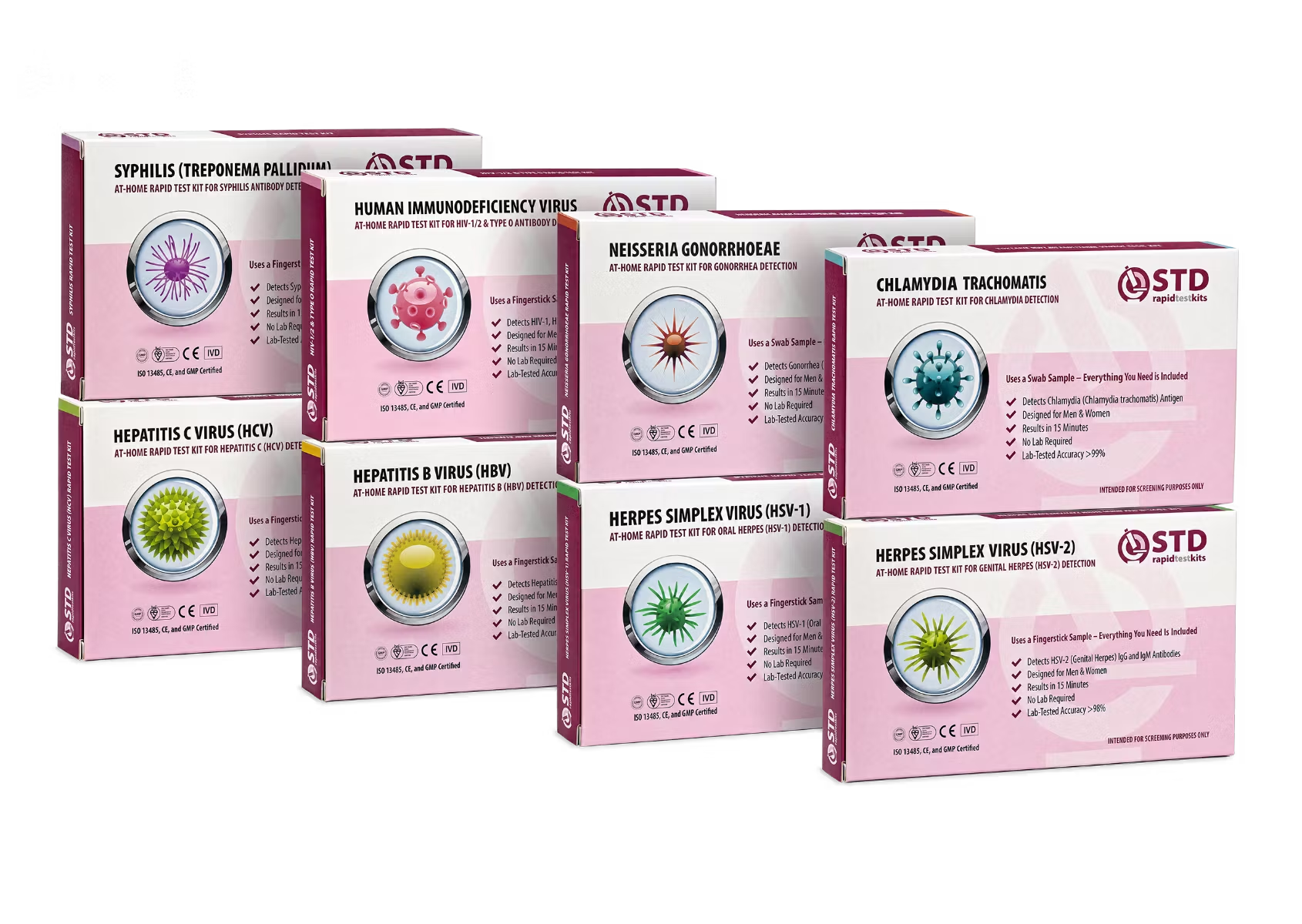
STD Rapid Test Kits, the publisher of this article, sells the at-home test kits referenced below. We recommend products based on fit for the reader's situation, not commercial benefit.
Why disclosure is, ultimately, for you
The most cited fear after diagnosis is having to tell someone. The vulnerability of saying the words out loud. The fear of being rejected. The inner voice that promises every partner will leave the room.
Some of them might. The right ones will not. They will ask questions. They will thank you for the honesty. They will see a whole person who happens to be giving them important information, rather than a label.
What is less often said is that disclosure rebuilds something in you, regardless of how the other person reacts. The act of saying the words proves to your own nervous system that you are not, in fact, defined by the secret. Every time you disclose to someone who can hear it, you take a small piece of your identity back from the shame that was holding it. Disclosure is something you do for the other person, technically. The part that matters most is what it does for you.
In many U.S. states and other jurisdictions, disclosing HIV status (and in some places certain other STIs) to a sexual partner before contact is a legal requirement. The specific rule varies by jurisdiction. Beyond the law, disclosure is the foundation of informed consent and one of the most direct ways to rebuild your own sense of self-worth. If you are unsure of the law where you live, your state or county health department can give you an accurate read.
Dating again, on your own timeline
There is no fixed timeline for returning to dating after a diagnosis. Some people are ready in weeks, others take a year, and both timelines are normal. The goal is not speed. The goal is to come back with your boundaries intact, your information script practiced, and your sense of worth restored enough that you can hear "no thanks" without it confirming the worst voice in your head.
Things that help, gathered from patient-organization resources and support-community guidance:
- Write out a short, factual disclosure script and practice it until the words feel ordinary rather than performed.
- Use dating apps and communities that are explicit about sexual-health affirmation when those exist.
- Find one community space, online or local, where the diagnosis is named openly and matter-of-factly.
- Treat each date as one date, rather than a referendum on whether you are still lovable.
The early conversations get easier. You stop bracing for impact every time. The diagnosis becomes one sentence in the longer conversation of getting to know someone, rather than the entire first paragraph.
The language medicine uses, and how to push back gently
Some of the heaviest stigma in this space comes from inside the medical system. Words like "infected," "carrier," and "positive" are technically accurate, although they land harder than the clinicians who use them often realize. They flatten a complex person into a single status.
A small shift in vocabulary changes the felt weight of the same information:
- Instead of "infected with herpes," a clinician can say "living with herpes" or "carrying HSV-2 antibodies."
- Instead of "clean" and "dirty," both clinician and patient can say "tested negative" or "tested positive."
- Instead of "risky behavior," the more accurate phrase is "higher-exposure activity," or simply naming the specific activity.
You are allowed to ask the people treating you to use different words. Most clinicians, when asked respectfully, will. Major organizations including the CDC, WHO, and the American Sexual Health Association have all published patient-language guidance over the past decade that explicitly recommends moving away from stigmatizing terms (NHS, sexual health uses similar plain-language framing). Asking for that language in your own care is not difficult. It is the standard the field is moving toward.
Stigma and discrimination toward people living with HIV or other sexually transmitted infections are significant barriers to testing, treatment, and care.
Healing is integration, not erasure
A common misunderstanding about healing is that it means forgetting. That if you have really moved on, the diagnosis no longer occupies any of your thinking, and you have been restored to some pristine pre-diagnosis state.
That is not what healing looks like in practice. Healing is the ability to say, in a steady voice, "yes, this happened, and I am still myself," and to mean both halves of that sentence equally. The diagnosis becomes a chapter in the longer book of your life. It shaped you. It did not rewrite you.
Let the experience inform your future without letting it foreclose any part of it. You do not have to forget the diagnosis to grow from it. The people who report the most stable peace with their status are usually the ones who can name it plainly when it matters, set it down when it does not, and otherwise live a life that contains many things larger than it.

Community as the antidote to silence
Stigma thrives in isolation. It loses most of its force in the company of people who have been through the same thing.
That community can take many forms. Some options that patient-support organizations consistently recommend:
- Online support communities such as Reddit's r/Herpes (large, active, and moderated for kindness) and the American Sexual Health Association's forums and support groups.
- Local Planned Parenthood centers and county sexual-health clinics, many of which run free support groups.
- Mental-health providers who specialize in sexual health, available through community health centers and online directories.
- One trusted friend or family member who has indicated they can hold this information without judgment.
You do not need to find a hundred people. One person who can hear the news without flinching often unlocks more healing than weeks of solo reading. Other people's casual acceptance of their own status, witnessed up close, is the most efficient corrective to the inner voice that has been telling you that you are uniquely broken.
Where to find community fast
- Reddit r/Herpes: large, active, moderated-for-kindness peer community covering HSV-1 and HSV-2 disclosure, dating, and emotional support.
- American Sexual Health Association (ashasexualhealth.org): patient forums, support groups, and plain-language guides for most common STIs.
- Planned Parenthood and county sexual-health clinics: many run free in-person or virtual support groups; staff are trained in non-judgmental disclosure conversations.
- Licensed mental-health providers who specialize in sexual health: available through community health centers, employee assistance programs, and online directories like Psychology Today's specialist filter.
The practice of naming it out loud
Shame thrives on quiet. The most direct intervention against it is also the simplest: say the thing.
Try this, alone, with no audience required:
- Say the diagnosis out loud. "I have herpes." "I am HSV-2 positive." "I have HPV." "I had chlamydia and I treated it." Whatever the truthful version is for you.
- Say it once at a normal speaking volume, without flinching, and without a built-in apology after the sentence.
- Then remind yourself: this is one fact about my body, and it is not a verdict about my worth.
The point of the exercise is not catharsis. It is rehearsal. Every time you can name the diagnosis without your nervous system spiking, the shame around it loses a small amount of power. Done often enough, the words become ordinary. That is the goal.
You are not gross. You are growing into the next version of yourself.
STI stigma is a funhouse mirror. It warps what you see, makes you question your worth, and traps you in silence. But you are not the label, you are not the punchline, and you are still the person you were the day before the result came back. You are still good, still worthy, and still allowed every kind of love and pleasure that was on the table that morning.
Getting diagnosed does not end your story. It begins a chapter with more honesty in it. The work of this chapter, slowly, is to take your identity back from a virus or a bacterium and put it back where it belongs: in your hands. When you are ready to move from worry to information, STD Rapid Test Kits offers discreet, at-home rapid testing so you can take the next step on your own timeline, in your own home.
FAQs
- Does having an STI change who I am as a person?
- No. An STI is a biological event, not a character revelation. The way you handle it can shape your sense of yourself, but the diagnosis itself adds and subtracts nothing from your worth.
- Will people still want to date me after a positive diagnosis?
- Yes. Many people are well-informed and matter-of-fact about STI status, especially in communities where testing is treated as routine. A rejection from someone uninformed is information about them, not a verdict on you.
- Is it normal to feel ashamed after a diagnosis?
- Yes. Shame is the predicted reaction in a culture that has framed sexual infection as a moral failing for more than a century. It is also temporary, and it responds well to information, community, and time.
- How do I stop feeling 'dirty'?
- Start by removing 'clean' and 'dirty' from your vocabulary entirely. Replace them with 'tested negative' or 'tested positive,' or simply name what you have. Pair the language shift with one trusted person, one accurate information source, and one supportive community.
- Do I have to disclose my status to a partner?
- In many jurisdictions, disclosing certain STIs (HIV in particular) is a legal requirement before sexual contact. Beyond the law, disclosure is a foundation of informed consent. It is also one of the most direct ways to rebuild your own sense of self-worth, regardless of how the other person responds.
- How do I tell someone without panicking?
- Stick to facts. Use short sentences. Say what the diagnosis is, how it is managed, and what testing or protection looks like going forward. You are giving information, not asking for forgiveness.
- Are STIs really that common?
- Yes. CDC estimates put STI prevalence in the United States at roughly one in five people at any given time. You are not statistically unusual.
- Where can I find support?
- Online communities (Reddit's r/Herpes, ASHA forums), local Planned Parenthood centers, county sexual-health clinics, and licensed mental-health providers who specialize in sexual health are all good starting points.
- U.S. Centers for Disease Control and Prevention. STI information, screening recommendations, and patient resources.
- U.S. Centers for Disease Control and Prevention. Let's Stop HIV Together: public guidance on stigma reduction and its impact on testing and care.
- World Health Organization. Sexually transmitted infections (STIs) fact sheet: prevalence, transmission, prevention, and stigma as a barrier to care.
- Planned Parenthood. STDs, HIV, and safer sex: patient-facing education and support resources.
- National Health Service (UK). Sexually transmitted infections (STIs): symptoms, testing, treatment, and plain-language guidance.
- American Sexual Health Association. Patient resources, support communities, and language guidance for STI care.
