
Published: November 2025 | Last updated: May 2026 | Editorial review and quality control: Martina N.
A partner who looks energetic, sleeps well, and has no visible symptoms is not the same as a partner who is free of sexually transmitted infections. The two often coexist. Many of the most common STIs (chlamydia, gonorrhea, HPV, herpes) circulate precisely because they make so little noise inside the body. A person can carry one for months without noticing anything different about their skin, energy, or cycles.
This is not a reason to approach every new partner with fear. It is a reason to stop using "looks healthy" as a substitute for actual information. Testing converts a visual guess into a real answer, and modern at-home kits plus standard clinic visits have made the process faster and more private than most people realize.
Key Takeaways
- Most chlamydia and HPV infections cause no symptoms at all, which is why CDC routine-screening guidance does not wait for symptoms to appear.
- Each infection has its own detection window. Testing too soon after exposure can produce a false negative even when an infection is present.
The Silent Reality of Most STIs
Sexual-health clinicians sometimes group certain infections under the label "silent STIs." The phrase is not meant to be dramatic. It is a plain description of how these infections behave once they enter the body.
Many do not cause early discomfort. Instead of producing obvious signs, they replicate quietly in the cervix, urethra, throat, or bloodstream while the person carrying them feels normal. The result is that absence of symptoms tells a clinician almost nothing about a person's STI status, which is why U.S. CDC guidance emphasizes routine screening for sexually active adults rather than waiting for visible signs.
The pattern below comes from how CDC, WHO, and NHS describe the most common infections. It is why so many positive results in clinics come from patients who walked in feeling fine, and why public-health programs treat universal testing (not symptom-triggered testing) as the baseline.
| STI | How often it is asymptomatic | Note |
|---|---|---|
| Chlamydia | Most cases | CDC notes chlamydia often has no symptoms and is mostly caught through routine screening |
| Gonorrhea | Often, especially in women | When symptoms appear they can be mistaken for a UTI |
| HPV | Majority of infections | Most clear naturally without ever causing visible warts |
| Genital herpes (HSV-2) | Most carriers | Many never recognize an outbreak as herpes |
| Trichomoniasis | Often | Especially common to be asymptomatic in men |
Why Looking at a Partner Cannot Diagnose an STI
People rely heavily on visual cues when judging health. A flu shows up as a flushed face and a cough. A skin infection produces redness or swelling. Sexually transmitted infections rarely cooperate with those instincts.
Inside the body, many STIs colonize areas that are simply not visible during sex or daily life. Chlamydia can live in the cervix, urethra, or throat. HPV can sit on cervical or anal tissue without any external sign. Herpes viruses spend long stretches dormant in nerve cells and shed from the skin in microscopic amounts during periods when there is no visible sore at all.
| Reason a visual check fails | What is actually happening |
|---|---|
| Hidden infection sites | Bacteria live on internal mucous membranes you cannot see |
| Mild symptoms | When symptoms exist, they often look like irritation, a UTI, or normal discharge variation |
| Delayed onset | Some infections take weeks before producing any sign |
| Dormant viruses | Herpes and HPV can stay inactive for long stretches, then shed silently |
Incubation vs. Testing Windows: The Two Timelines That Confuse People
If a recent exposure leaves no immediate symptoms, the next mental move is usually to wait a few days and re-check. That instinct misses an important detail. Each infection has two separate timelines that do not always overlap.
The incubation period is how long it takes for symptoms to appear, if they appear at all. The testing window is how long after exposure a test can reliably detect the infection. The mismatch between those two is where most testing confusion comes from. Someone can feel completely fine and still be inside a detectable window. A negative result on day four after exposure does not rule out infection; the body may simply not have produced enough of the detectable marker the test is looking for.
This is also why repeat testing is sometimes recommended after a known exposure. A test on day five is fine for some infections and unreliable for others. The CDC HIV testing page spells out window periods for antibody and antigen tests in detail, and CDC pages for the other infections give the same kind of timing.
| Infection | Earliest reliable test window | Symptoms (if any) appear |
|---|---|---|
| Chlamydia | About 1–2 weeks | Often none; sometimes mild discharge or burning |
| Gonorrhea | About 5–14 days | Often none in women; men may notice discharge |
| Syphilis | 3–6 weeks after exposure | A painless sore that often goes unnoticed |
| HIV (antibody/antigen) | 18–45 days depending on test type | Flu-like illness in some, nothing in others |
| Herpes (HSV-2 antibody) | Up to 12–16 weeks for seroconversion | Many never recognize an outbreak |
Can you really catch an STI from someone with no symptoms?
Yes. Chlamydia, gonorrhea, HPV, and herpes all transmit during periods when the carrier has no visible signs. CDC surveillance and WHO fact sheets are explicit on this point. The only reliable way to confirm a partner's status is testing, and the only reliable way to confirm your own is to wait out the testing window after exposure and then test.
Why Some Infections Stay Quiet for So Long
The biology behind silent infection is different for bacteria and viruses, but the surface effect is the same.
Bacterial infections like chlamydia and gonorrhea colonize the mucous membranes of the reproductive tract, the throat, or the rectum. These tissues do not always mount the kind of inflammation that produces obvious symptoms. The immune system holds the bacteria in check enough to feel normal, while the infection itself remains active and transmissible. Months can pass before tissue irritation becomes severe enough to notice, and during all that time the bacteria can transfer to a new partner.
Viruses behave differently. Herpes hides inside nerve cells between outbreaks. During those quiet stretches the virus is not visible on the skin, but it can still reach the surface in amounts capable of transmitting. This is called asymptomatic viral shedding, and per CDC herpes guidance it is a significant route of transmission. HPV is even subtler: most carriers never develop visible warts, and the immune system often clears the infection on its own, so people frequently have HPV without ever knowing.
Bacterial STIs (chlamydia, gonorrhea) sit on internal mucous membranes without triggering inflammation. Viral STIs (herpes, HPV) hide inside host cells and shed periodically from skin that looks completely normal. Both routes transmit during stretches when the carrier feels fine.
How Asymptomatic Transmission Actually Works
Most sexually transmitted infections spread through microorganisms (bacteria, viruses, or protozoa) that live in bodily fluids or on mucous membranes. They do not need visible symptoms to move between partners. They only need contact with the right tissues during sex.
Practically, that means transmission can happen during vaginal, anal, or oral sex, and in some cases through skin-to-skin contact alone (the path used by HPV and herpes). Chlamydia bacteria sitting on the cervix or in the urethra can transfer during sex even when the host has no symptoms whatsoever. Herpes can shed from skin that looks completely normal.

Why People Delay Testing Even When They Know Better
If testing is the only reliable way to know, why don't more people test routinely? The answer is usually psychological rather than logistical. Many people associate STI testing with mistrust, accusation, or judgment, even when their own primary care provider is doing the test. Others assume testing is only necessary when something feels wrong, so the absence of symptoms becomes its own reason not to go.
Practical barriers contribute too. Clinic appointments take time off work. Insurance coverage for STI panels varies. In smaller communities, the privacy of walking into a sexual-health clinic can feel like a social risk in itself. These are real obstacles, and they are exactly what at-home rapid testing was designed to solve. (This site sells the rapid at-home kits described below.)
The cost of the delay is invisible. A person carries something without knowing for six months, ends one relationship, starts another, and the cycle continues. By the time someone in the chain finally tests, the infection may have moved through several partners who all looked and felt fine.
What Routine Testing Actually Looks Like
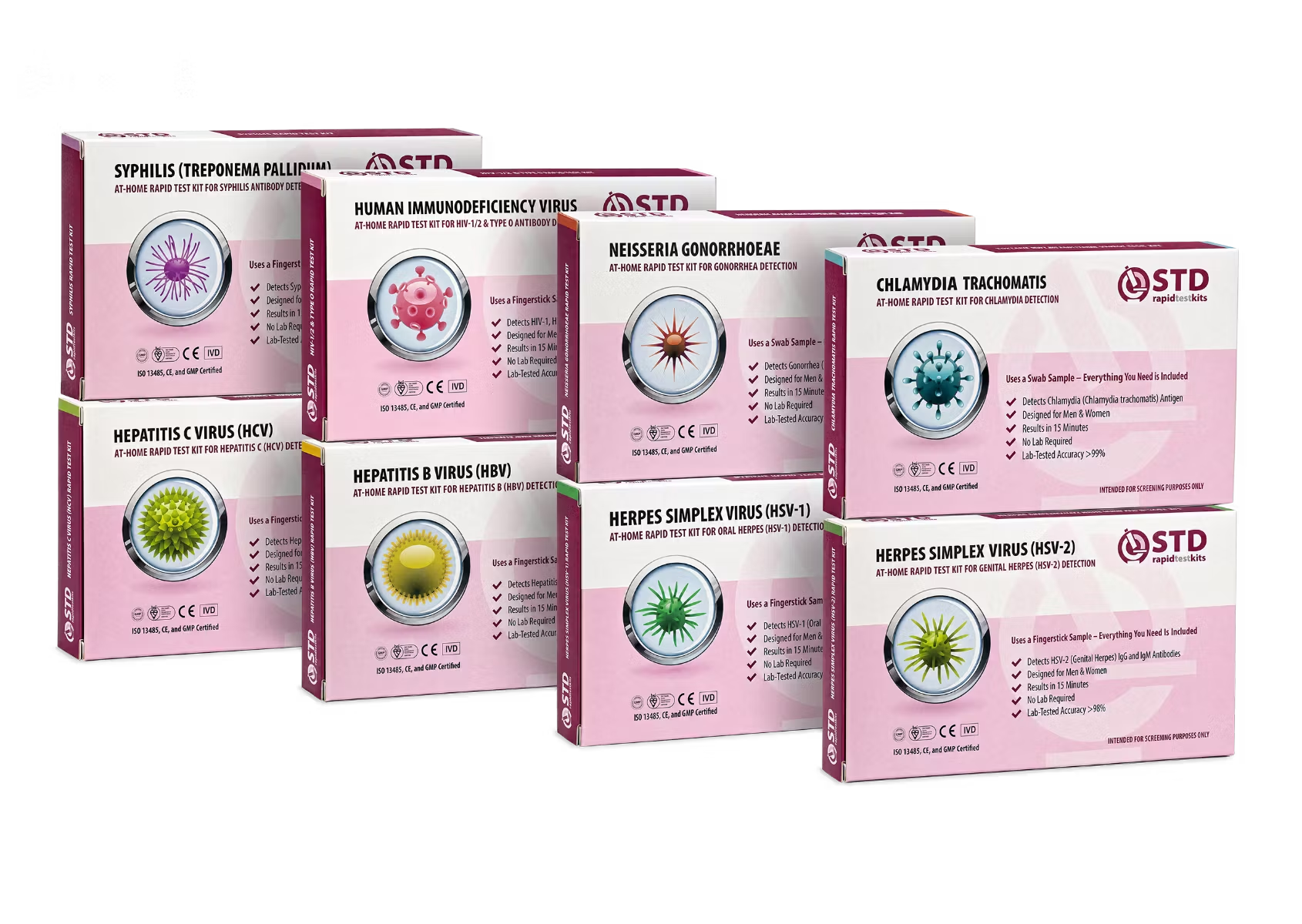
Contrary to the dramatic version some people imagine, routine STI testing is short and uneventful. Depending on the infection, it involves a self-collected swab, a small fingerstick blood sample, or a urine sample. Clinics run this kind of screening every day as part of regular adult primary care, and the same screening can now happen at home through several reputable rapid-test kits.
The split between swab and blood samples maps directly onto which infections are being checked, and a combination kit packages several of these into a single screening session when the concern is general rather than infection-specific.
At-home kits use lateral-flow chemistry, the same technology behind home pregnancy and rapid COVID tests. They are not the same as the lab-based NAAT (nucleic-acid amplification) tests clinics use for confirmation, and they are well-suited to screening between clinic visits or when privacy matters. A positive at-home result is worth confirming with a clinical lab test, particularly for blood-borne infections like HIV.
| Sample type | What it screens for |
|---|---|
| Self-collected swab | Chlamydia, gonorrhea, trichomoniasis, HPV |
| Fingerstick blood | HIV, syphilis, hepatitis B, hepatitis C, HSV (herpes antibodies) |
| Combination kit | Several infections in one screening session, swab plus blood |
How to Bring Up Testing Without Making It Sound Like an Accusation
One reason the "they look healthy" assumption persists is that the alternative (talking about testing out loud) feels awkward. People worry it will sound like suspicion, or that it will tank the mood of a new relationship.
In practice, the conversation usually goes better than expected. The framing that lands well is shared, not accusatory: "I usually get tested between partners. Want to do it together?" That positions testing as ordinary self-care, the way a dental cleaning or annual physical would be. Most partners are relieved someone said it first.
If saying it in person feels hard, the same conversation works over text. Two people can each test privately at home, share screenshots of negative results, and move forward with real information instead of a vague reassurance.
Many STIs have no symptoms or only mild signs. Testing is the only way to know for sure whether you have an STI.
The Mindset Shift: From Guessing to Knowing
The absence of symptoms is reassuring emotionally and almost meaningless medically. A person can feel completely well while carrying an infection that is detectable on a basic screening test. That gap between perception and biology is what testing exists to close.
The healthier mental model is "when did either of us last test?" rather than "is my partner safe?" The first question is a fact, and it can be updated regularly the same way other routine health information is updated. The second relies on a guess about another person's body.
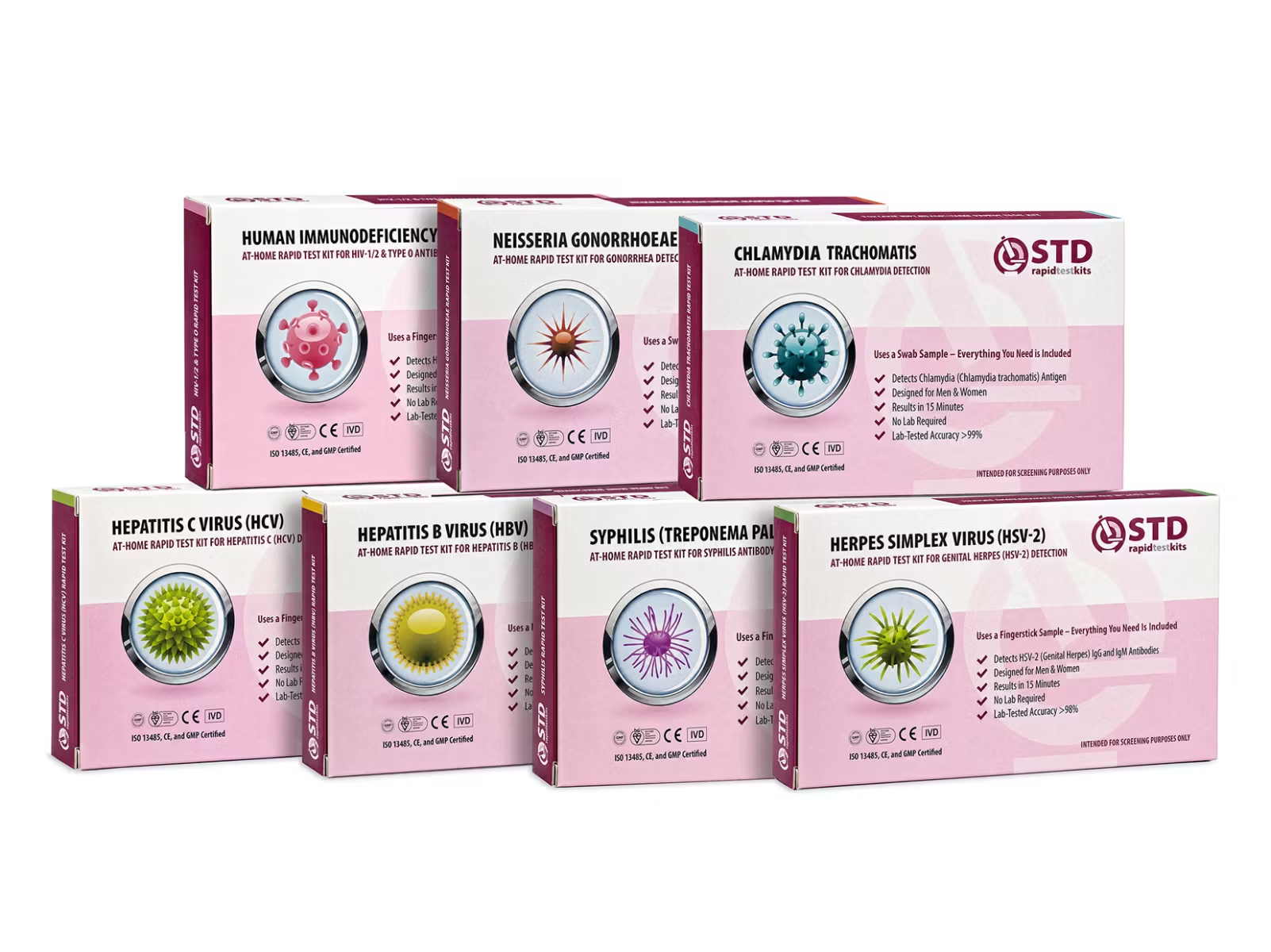
For people who prefer privacy or who find clinic appointments inconvenient, a rapid at-home kit is often the lowest-friction way to convert the question into an answer. For people with insurance and a regular provider, a routine clinic screening accomplishes the same thing.
FAQs
- My partner looks completely healthy. Am I overthinking this?
- Probably not. Asking the question is reasonable because many of the most common STIs (chlamydia, HPV, herpes) cause no visible symptoms in most carriers. You do not yet have enough information from appearance alone, and the only way to get it is to test.
- How common is it to have an STI and not know it?
- More often than most people expect. Routine screening programs, not symptoms, are how the majority of chlamydia and HPV cases get caught. Public-health surveillance consistently shows that most carriers have no idea until a standard screen turns positive.
- If someone had an STI, wouldn't they feel sick or notice something?
- Sometimes. But many infections produce no symptoms or mild ones that are easy to dismiss as a UTI, friction, or normal discharge variation. Symptoms confirm an infection when they appear; their absence does not rule one out.
- Can you catch an STI from someone with zero symptoms?
- Yes. This is how most STIs spread. Bacteria and viruses present in the body can transfer during sex even when neither partner has visible signs. Transmission depends on biology, not on appearance.
- How long can someone carry an STI without realizing it?
- Weeks to months, occasionally longer. Many people discover infections during routine screening and trace them back to a previous relationship. It is not a sign anyone lied; the infection was simply quiet long enough to go unnoticed.
- When should I test after a possible exposure?
- Each infection has its own window. Chlamydia and gonorrhea become detectable within about 1 to 2 weeks; HIV antibody tests typically need 3 to 6 weeks; herpes antibodies can take up to 12 to 16 weeks. CDC testing guidance recommends timing the test to the window for the specific concern, sometimes with a repeat test later.
- Is it awkward to ask a partner to get tested?
- Less than people expect. Framing it as a shared routine ("I usually test between partners, want to do it together?") almost always lands better than waiting until something feels wrong. Most partners are relieved someone brought it up.
- What if a test comes back positive?
- Most bacterial STIs (chlamydia, gonorrhea, syphilis) are curable with a short antibiotic course. Viral infections (HIV, herpes, HPV) are manageable with current treatment. The earlier a positive result is caught, the easier it is to treat and the less likely it is to spread further.
The Bottom Line: Information Over Assumptions
A partner who looks healthy might be exactly that. Or they might be carrying something neither of you can see. The point is not to assume the worst, and it is also not to assume the best. The point is that appearance is not a diagnostic tool, and using it as one is how the most common STIs have circulated for decades.
Testing replaces a guess with a fact. After that, decisions about protection, conversation, and care can be made on real information instead of inference. That is what reduces risk, both for you and for the people you are intimate with.
If you want privacy and a fast result, use an at-home rapid kit timed to the right window period for the exposure you are worried about. If you want lab-grade confirmation (especially after a positive at-home result), book a screen with your primary care provider or a sexual-health clinic. Most readers benefit from a mix of both over time.
- U.S. Centers for Disease Control and Prevention. Sexually transmitted diseases (STDs): screening, prevalence, and testing guidance.
- U.S. CDC. STI Treatment Guidelines: clinical recommendations referenced throughout.
- World Health Organization. Sexually transmitted infections fact sheet: asymptomatic prevalence and transmission routes.
- NHS. Sexually transmitted infections (STIs): symptoms, testing, and treatment.
- U.S. CDC. HIV testing guidance: window periods for antibody and antigen tests.
- U.S. CDC. Chlamydia: basic fact sheet covering symptoms, screening, and treatment.
