
Published: October 2025 | Last updated: May 2026 | Editorial review and quality control: Martina N.
An at-home hepatitis B rapid test answers one specific question: do I have an active HBV infection right now? Used correctly, it pulls a fingerprick blood sample, checks it for the hepatitis B surface antigen (HBsAg) on a lateral-flow strip, and gives you a reading in about fifteen minutes. Used carelessly, it hands back a result that means nothing, or worse, a number that misleads you for weeks.
The good news: almost every common failure on these tests comes from a handful of small mistakes during setup, sample collection, or result reading. Once you can name them, you can sidestep them. This guide goes through each one, then walks the test from foil pouch to confirmed reading, and finishes with the question most people forget to ask: when is the right moment to test in the first place.
Key Takeaways
- Most failed hepatitis B rapid tests trace back to three things: too little blood, opening the cassette before you are ready to test, or dismissing a faint line as a smudge. Each is preventable with careful prep.
- Even with perfect technique, a test taken in the first three weeks after exposure can miss an early infection. Plan a retest at six to twelve weeks if your concern is recent.
What Symptoms Push People to Test
Most people do not pick up a hepatitis B test because they feel great. It usually starts with a body cue that does not quite fit, a nervous message from a partner, or a quiet panic after scrolling a symptom checker at 1am. Maybe it was nausea that would not lift. Maybe your urine looked darker than usual, or your eyes had a yellowish tinge you wanted to blame on the bathroom light.
Hepatitis B is known for its silence. The incubation period typically runs from about 30 to 180 days, and many people have no symptoms at all for the first few weeks (CDC hepatitis B section). When symptoms do appear, they often look like everyday stress or the flu: fatigue, loss of appetite, mild fever, joint pain. Some acute cases do show clearer signs, which is what often pushes people to test.
Here is a closer look at the symptoms that commonly trigger someone to reach for a rapid test kit.
| Symptom | Why It Matters |
|---|---|
| Dark urine or pale, clay-colored stool | May indicate liver inflammation or bile flow issues from viral hepatitis |
| Yellowing of skin or eyes (jaundice) | Classic sign of liver strain, common in acute hepatitis B |
| Nausea, vomiting, or upper-right abdominal discomfort | Often mistaken for food poisoning or PMS, but can be liver-related |
| Persistent fatigue | One of the most common early symptoms, especially in chronic infection |
| Fever and body aches | Mimics the flu, but when paired with the symptoms above, points toward something else |
How the Hepatitis B Rapid Test Actually Works
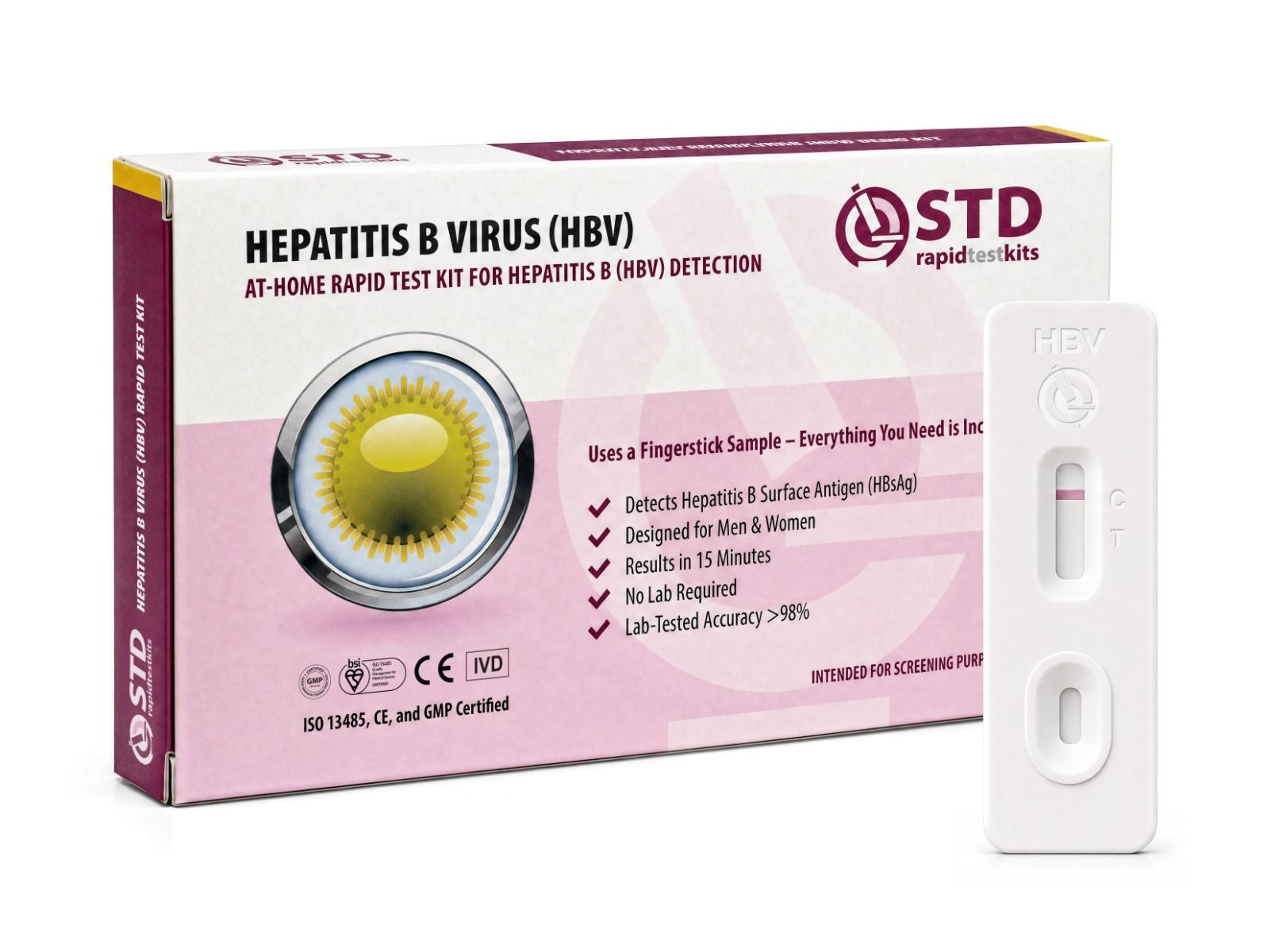
Most rapid HBV kits sold for home use are lateral-flow immunoassays that detect HBsAg, the hepatitis B surface antigen, in a small sample of fingerprick blood. A capillary tube pulls the sample, a buffer carries it across an antibody-coated strip, and within ten to fifteen minutes a control line confirms the test ran while a separate test line indicates HBsAg is present.
The home rapid test answers the question "do I have HBsAg circulating right now" and nothing else. It does not detect anti-HBs or anti-HBc antibodies, so it cannot tell you whether you cleared a past infection, whether you are immune from vaccination, or whether the virus is causing liver damage. The full picture lives in a laboratory hepatitis B panel that includes HBsAg, anti-HBs, and anti-HBc (both IgM and IgG). The CDC describes this layered serological approach in its overview of hepatitis B diagnosis (CDC hepatitis B section).
Treat the rapid test as a screening tool: a fast yes-or-no signal that points you toward the lab if anything looks off. It is not a substitute for a clinical workup, and a single negative does not equal lifetime safety.
Detects: HBsAg, the hepatitis B surface antigen circulating in blood right now. A positive line means the antigen is present above the assay's detection threshold.
Does not detect: anti-HBs antibodies (immunity from vaccination or a resolved past infection), anti-HBc IgM or IgG antibodies (past or recent infection markers), or any indicator of liver damage. For those, a clinic-based hepatitis B serology panel is the right tool.
Why Rapid Tests Sometimes Fail (And It Is Not Always Your Fault)
When the test does not work, the first instinct is self-blame. The line is too faint. No line shows up. The cassette leaks blood across the window. Before you spiral, know that some failures start with the kit itself. These devices are temperature- and humidity-sensitive. Stored in a hot bathroom over winter, shipped in a midsummer delivery truck, or pushed past the expiration date on the foil, the chemistry on the strip can degrade enough to throw off the result. All lateral-flow rapid strips carry a manufacturer-specified shelf life and storage range; outside those conditions, sensitivity drops.
That said, most failures we see in the field are user-driven. The cassette was opened too early, the sample volume was wrong, the timer was ignored, or the result was read in the wrong frame of mind. Those are the ones you can actually fix.
What is the single most common mistake on a Hep B home test?
Collecting too little blood. Most kits need a fingerprick sample that fills the pipette to the marked line, typically one to two well-formed drops. Half a drop, or a smear that mixed with sweat, dilutes the reaction with the buffer and produces an invalid result or a false negative. Warm your hand first, prick the side of the fingertip rather than the pad, and let gravity fill the dropper.
Common Mistakes That Wreck Your Result
Five errors account for the bulk of bad readings on a home hepatitis B test. Read through them once before you open the box.
- Not enough blood. Most rapid kits need the pipette filled to the marked line, usually one to two full drops. Half a drop will not start the reaction. Over-dilution with buffer or a partly filled pipette frequently returns an invalid strip or a false negative.
- Touching the test area. Skin oils on the collection well or strip window can interfere with the chemistry. If you handle the cassette mid-test, you risk contaminating the reaction zone.
- Bad fingerprick technique. Cold hands do not bleed. Squeezing the fingertip too hard produces a thin, hemolysed sample that confuses the assay. Warm your hand under tap water for thirty seconds, prick the side of the fingertip rather than the pad, and let gravity do the work.
- Opening the cassette too soon. The strip starts degrading the moment the foil pouch is broken. You have roughly fifteen to twenty minutes of usable life before ambient humidity affects the result. Prep everything else first, unseal last.
- Misreading the result window. A faint line is still a line. The control line confirms the test ran properly. If the control line is missing, the result is invalid regardless of what else appears. If both the control and test lines appear, even faintly, the test reads positive for HBsAg.
How to Use a Hep B Rapid Test, Step by Step
Reading the leaflet in the box is one thing. Running the test with shaky hands under a bathroom light, terrified that the next ten minutes will define your year, is another. The walkthrough below covers what is actually happening at each stage, what can go wrong, and how to know you did it right. Assume you are testing alone, somewhere private, after a recent exposure event.
Setup
Before you tear open the foil pouch, stop. Wash your hands thoroughly, then dry them with a clean towel. Find a flat surface to work on: bathroom counter, kitchen table, anything level. Lay out the components in the order you will use them: lancet, alcohol pad, buffer dropper, cassette pouch, pipette, gauze. Do not unseal the cassette until everything else is ready. Once the foil is broken, you have roughly fifteen to twenty minutes before ambient humidity affects the strip.
Fingerprick
Wipe the side of your fingertip with the alcohol pad and let it dry completely; wet skin smears blood and ruins the volume reading. Use the ring or middle finger, since they tend to be less callused than the index. Press the lancet against the side of the fingertip rather than the pad, then let gravity pull the blood out. Squeezing the finger like you are wringing a sponge produces a thin, hemolysed sample. If flow is slow, hold your hand under warm water for a minute first. You want a full, rounded drop, not a streak.
Apply the sample
Now open the cassette pouch. Place it flat on the counter. Drop the blood into the sample well, not the result window (yes, this is a real mistake people make). Add the buffer drops as the manufacturer instructs, usually one or two. Keep the cassette level so the sample flows evenly across the strip; a tilted device gives uneven line development. Start the timer at the moment you add the buffer. Most kits develop fully in ten to fifteen minutes. Reading earlier can produce a false negative; reading much later can introduce ghost lines that mimic a positive when no antigen is present.
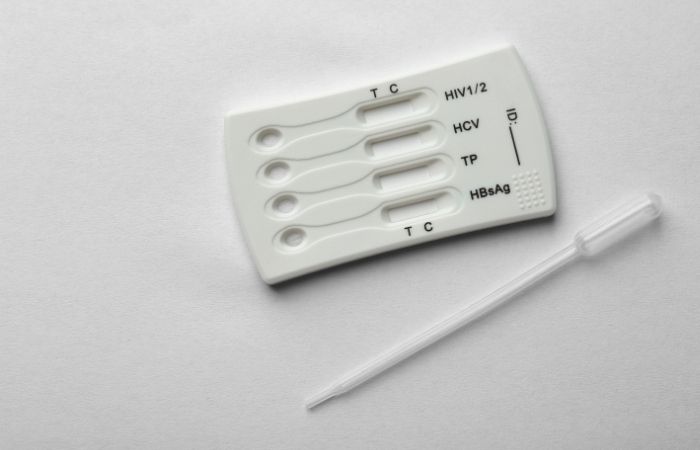
Reading the Result Window
This is where the stress hits. You have waited the right amount of time, you are standing over the cassette, and now you have to interpret what the strip is showing. The table below covers the four readings you might see.
| Visible Lines | What It Means | What to Do |
|---|---|---|
| Only the control line (C) | Negative for HBsAg right now | No active infection detected. Retest after the window period if your exposure was recent. |
| Control line (C) and test line (T), any intensity | Positive for HBsAg | Possible hepatitis B infection. Confirm with a lab panel and contact a clinician. |
| No control line | Invalid test | The test failed. Discard the kit and run a fresh one. |
| Faint test line plus a clear control line | Still positive | Faintness does not weaken the result. Confirm with a lab panel. |
How Long After Exposure Should You Test?
This is the part most people get wrong. HBsAg becomes detectable in blood a few weeks after infection, with the CDC noting that the antigen can typically be detected from about four to twelve weeks after exposure (CDC hepatitis B section). Test before that window and the virus may simply not be at detectable levels yet, which means a clean strip is not the same as a clean bill of health.
If your test is negative but you had a high-risk exposure in the last few weeks (a needlestick, condom failure, a partner who tested positive), do not wait for symptoms. Retest at the six-week mark, and again at three months if you are still inside the window. A laboratory hepatitis B panel that includes antibody markers offers the fullest answer: current infection, past exposure, and immune status from vaccination, all in one draw. Our home rapid kit cannot deliver the antibody picture; it answers only the active-antigen question.
This site sells rapid at-home hepatitis B tests; the guidance above applies to any lateral-flow HBsAg kit, ours or otherwise.
Myths About Rapid Tests, Broken Down
The internet is full of confident, wrong advice about home testing. Most of it comes from fear or embarrassment rather than malice, but the result is the same: people make decisions on bad information. Here are four claims worth correcting before they cost someone their peace of mind.
"The line is too faint to count"
If the cassette shows both a control line and a test line, no matter how pale, the test reads positive. The intensity of the test line does not indicate severity of infection; it indicates whether HBsAg is present above the detection threshold. Confirm with a lab, but do not dismiss a faint band as a smudge.
"One drop of blood is enough"
Most kits specify a precise volume, often around 30 to 50 microliters depending on the brand, which the pipette is calibrated for. Too little, and the buffer overwhelms the reaction. Too much, and you flood the strip, obscuring results. Follow the pipette fill line, not your estimate of what a drop looks like.
"You can reuse the lancet, it is just your own blood"
You cannot. Single-use lancets dull immediately on first puncture, which means the second attempt is more painful, more crushing, and produces a worse sample. Reused parts also defeat the sterility of the kit. Use the lancet once and discard it in a sharps container or sealed rigid container as your local guidance directs.
"An expired kit is fine if the foil is sealed"
Reagents degrade past the expiration date even inside intact packaging. The control line might still appear, but sensitivity drops, and weak positives are the first thing you lose. Check the date on the box every time before you open it.
The four myth corrections, at a glance
- A faint test line alongside a clear control line is a positive result, regardless of intensity.
- Volume matters: fill the pipette to its marked line, do not eyeball drops.
- Lancets and cassettes are single-use. Reusing parts produces a worse sample and unreliable results.
- Expired tests lose sensitivity even with intact packaging. Check the date every time.
What to Do After a Positive Hep B Test
The control line is solid, the test line is visible (even faintly), and you are staring at the cassette wondering what just happened. First, do not spiral. A rapid HBsAg-positive result is not a final diagnosis. It is a flag that says: confirm this in a lab and find out what kind of infection it is.
Your next step is a full hepatitis B serology panel through a clinic or laboratory. The panel typically includes HBsAg, anti-HBs, anti-HBc IgM, and anti-HBc IgG. Together those results reveal whether the infection is acute, chronic, resolved, or a false positive. False positives happen, particularly in people who are immunosuppressed, recently vaccinated, or testing with a low-sensitivity kit (CDC hepatitis B section).
Two facts are worth holding alongside the anxiety. Untreated chronic hepatitis B is associated with cirrhosis and hepatocellular carcinoma over decades, which is the longer-term reason this infection is taken seriously. At the same time, effective antiviral medications can suppress the virus and regular monitoring catches complications early, so confirming a positive result and getting into clinical care matters more than the rapid line itself.
Tell any recent partners, even before the confirmation comes back. Exposure can happen through sex, blood, shared needles, and shared razors or toothbrushes in close quarters. Most people who transmit hepatitis B do not know they are carrying it. Naming the possibility early lets others test on time rather than long after the window closes.
- Confirm with a full hepatitis B serology panel (HBsAg, anti-HBs, anti-HBc IgM and IgG) through a clinic or laboratory.
- Notify recent sexual partners and anyone you shared injection equipment with so they can test on time.
- Follow clinician guidance on acute versus chronic workup, liver function monitoring, and any antiviral treatment that may be appropriate.
When to Retest, and Why It Matters
If your first result was negative but you had a recent exposure, you need to retest. The window period is real, and skipping the retest is the single most common reason people walk around with a false sense of safety. Here is a working timeline.
If your first test came back invalid rather than negative, you do not have to wait for the window to pass before retesting; just open a fresh kit and run it again with the prep mistakes from the earlier sections firmly behind you.
| Days Since Exposure | What to Know |
|---|---|
| 0 to 21 days | Often too early for HBsAg to register. A rapid test is likely to read negative even if you were infected. |
| 21 to 42 days | HBsAg may begin to appear. Early positives are possible. Retest if symptoms develop. |
| 42 to 90 days | The most reliable window for acute infection detection. Most cases that will turn positive do so by now. |
| 90+ days | A persistent positive past six months points toward chronic infection. A full lab panel is the right next step. |
Prevention and Vaccination
Hepatitis B has something most STIs do not: a highly effective vaccine. If your test reads negative and you are not already immune, the vaccine is the next logical step. The standard schedule is three doses over six months, after which protection lasts decades for most healthy adults (CDC hepatitis B prevention).
The CDC updated its guidance in 2022 to recommend universal hepatitis B vaccination for all adults aged 19 through 59 years, with shared decision-making for adults 60 and older who have risk factors. Risk factors include multiple sexual partners, a partner with chronic hepatitis B, healthcare exposure, injection-drug use, and travel to or origin from countries where HBV is endemic. The NHS provides parallel guidance for adults at risk in the United Kingdom (NHS hepatitis B).
Rapid tests keep getting more reliable, faster, and less prone to error, but their accuracy still depends on the person running them: your prep, your sample volume, and your patience with the timer. They are tools, and tools work as well as the person holding them.
Universal hepatitis B vaccination is now recommended for all adults aged 19 through 59 years. Adults aged 60 years and older with risk factors for hepatitis B should also receive the vaccine.
How Hepatitis B Spreads, in Brief
Hepatitis B transmits through contact with infected blood, semen, and other body fluids. The most common routes are unprotected sex with an infected partner, sharing needles or other injection equipment, perinatal transmission from mother to infant, and contact with contaminated blood through shared razors, toothbrushes, or unsterile tattoo and piercing tools. The virus is durable, which is why blood-to-blood exposure carries real risk even when the contact seems incidental.
Knowing the routes also explains why people who test for hepatitis B often consider a broader STI panel at the same time. A single exposure event rarely raises only one question, and several infections that share these transmission routes have their own window periods worth screening within.
If You Want a Broader Screen
If you are weighing whether to also screen for HIV, syphilis, chlamydia, gonorrhea, and hepatitis C alongside hepatitis B, a multi-infection panel is usually more efficient than running individual tests one at a time. The combination kit below covers seven of the most commonly tested STIs in a single at-home session.

Frequently Asked Questions
- Can I get a false negative on a hepatitis B rapid test?
- Yes, and the most common reason is testing too early. HBsAg needs time to build up in blood after exposure, typically several weeks, before a rapid strip can pick it up. If you tested within the first three weeks after a known exposure, retest at six weeks, and again at three months if you are still inside the window.
- I saw a faint second line. Is that real?
- If a clear control line is present alongside any visible test line, however faint, the test reads positive for HBsAg. Line intensity does not correspond to severity or viral load; it only reflects whether antigen is above the detection threshold. Confirm with a laboratory hepatitis B panel.
- Does hepatitis B ever clear on its own?
- In many healthy adults, acute hepatitis B resolves within a few months as the immune system clears the virus. When HBsAg persists past six months, the infection is considered chronic, which is when long-term liver monitoring becomes important. This is why follow-up testing after a positive result actually matters.
- How soon after an exposure can I test?
- HBsAg typically becomes detectable about four to twelve weeks after exposure, with most acute cases showing by the twelve-week mark. Testing earlier risks a false negative. The practical timeline is to test at around six weeks and again at three months for a recent high-risk exposure.
- Can I reuse the lancet or other parts of the kit?
- No. Lancets are single-use; they dull immediately and cause more tissue trauma on a second attempt, which produces a worse sample. Open test strips also begin to degrade once the foil pouch is broken. Each kit is built for a single test run.
- What do I do if the test reads positive?
- Get a confirmatory laboratory hepatitis B panel through a clinic. The lab panel includes HBsAg, anti-HBs, and anti-HBc (IgM and IgG), which together tell you whether the infection is acute, chronic, resolved, or a false positive. Notify recent partners so they can test as well.
- Should I still get the hepatitis B vaccine if I tested negative?
- Yes, if you have not been vaccinated previously or do not have documented immunity. A negative HBsAg result only means you do not currently have an active infection; it does not mean you are immune. The CDC recommends universal hepatitis B vaccination for adults aged 19 through 59, and risk-based vaccination from 60 onward.
- Why does this test not tell me whether I am immune?
- Rapid home kits detect HBsAg, the surface antigen of the virus itself. Immunity is established by the presence of anti-HBs antibodies, which require a different laboratory assay. To check immune status from past infection or vaccination, you need a clinic-administered hepatitis B panel.
- U.S. Centers for Disease Control and Prevention. Hepatitis B overview, transmission routes, serological markers, incubation period, and diagnosis.
- World Health Organization. Hepatitis B fact sheet, including transmission routes and global epidemiology.
- U.K. National Health Service. Hepatitis B conditions page, including symptoms, risk groups, and adult vaccination guidance.
- Mayo Clinic. Hepatitis B symptoms and causes overview for general background on the infection.
- U.S. Centers for Disease Control and Prevention. Hepatitis B prevention and vaccination guidance, including the ACIP universal adult vaccination recommendation for adults aged 19 through 59 years.
