
Published: June 2025 | Last updated: May 2026 | Editorial review and quality control: Martina N.
Your partner has an STI. Maybe they told you yesterday. Maybe they told you weeks ago and you have been quietly running through every scenario since. Either way, the next move is methodical: figure out what you may have been exposed to, test on the right schedule for each one, treat anything that comes back positive, and retest at the three-month mark for the slower infections. Sexually transmitted infections are common, several are curable, and the rest are manageable with the right care. The sections below walk through what to test for, when to test, what to ask the clinic for if oral or anal contact was involved, and how rapid at-home testing fits alongside laboratory work.
Should I get tested if my partner has an STD, even if I feel fine?
Yes. Schedule a test now even if you have no symptoms. Most STIs stay silent for days to weeks, and several routinely cause no symptoms ever. The standard approach is to test once after the relevant window period for what you may have been exposed to, then retest at three months for HIV, syphilis, hepatitis B, hepatitis C, and herpes antibodies, since those infections take longer to show up on testing.
Key Takeaways
- Test once after the relevant window period for what you may have been exposed to, then retest at three months for HIV, syphilis, hepatitis B and C, and HSV-2 antibodies; one early negative is not the final answer.
- Symptoms are an unreliable signal for almost every common STI. Most infections are silent in the first weeks, and several rarely produce visible symptoms even when present, so testing is the only way to know.
When to test (and when to test again)
Yes, you should get tested even if you feel fine, even if a condom was used, and even if it was a single encounter. Most STIs do not cause symptoms in the first weeks, and several routinely cause no symptoms ever. Testing is the only way to know what is happening.
Timing matters because each infection has a window period: the gap between exposure and the point at which a test can reliably detect it. Test too early and the result can be falsely negative, which is worse than no test at all because it gives false reassurance. The table below summarizes the typical window periods for the most commonly tested STIs, drawn from the U.S. Centers for Disease Control and Prevention screening guidance and laboratory test labeling.
The general approach: test once after the relevant window period for whatever you may have been exposed to, then retest at three months for the slower infections. For chlamydia and gonorrhea specifically, the CDC also recommends a separate retest about three months after treatment, because reinfection from an untreated partner is common.
If you develop symptoms (sores, unusual discharge, painful urination, a rash on the trunk or palms, swollen groin lymph nodes, or persistent flu-like illness within four to six weeks of exposure), do not wait for the window period. Get evaluated promptly so any infection can be diagnosed and treated.
| Infection | Earliest reliable test | Recommended retest |
|---|---|---|
| Chlamydia and gonorrhea | 1 to 2 weeks after exposure | 3 months after treatment |
| Trichomoniasis | 1 to 2 weeks | After any new exposure |
| Syphilis (antibody) | 3 to 6 weeks | 90 days |
| HIV (4th-generation antigen/antibody) | 18 to 45 days | 90 days for confirmation |
| Hepatitis B and C | 3 to 11 weeks (varies by virus) | 90 days |
| Herpes (HSV-2 antibody) | 12 to 16 weeks | 16 weeks if the early test was negative |
Why symptoms are an unreliable signal
The most common reason people skip testing after a partner discloses is that they themselves feel fine. The reasoning is intuitive and wrong. Most common STIs are asymptomatic for the entire infection in a meaningful share of people, and even when symptoms do appear, they often arrive weeks or months later.
A few specifics worth knowing, drawn from CDC and WHO surveillance summaries:
- Chlamydia causes no symptoms in the majority of women and a substantial share of men. It is the most-reported bacterial STI in the U.S. for that reason: most cases are picked up only by screening.
- Gonorrhea in women is frequently silent. In men, urethral gonorrhea more often causes discharge or burning, but pharyngeal and rectal gonorrhea are typically asymptomatic at every site.
- HPV causes no symptoms for years in most people, and many strains never produce visible warts. Some show up only on cervical screening.
- HIV may produce a brief flu-like illness two to four weeks after infection, then nothing visible for years.
- Syphilis follows distinct stages with symptom-free gaps that can last months between the chancre, the secondary rash, and later complications.
The takeaway is that looking and feeling normal does not rule out infection, especially in the first weeks after exposure. Self-diagnosis by Googling photos at 2 a.m. is not a substitute for testing, and the worst-case images that surface there look nothing like the typical case for any of these infections.
What kind of test you actually need
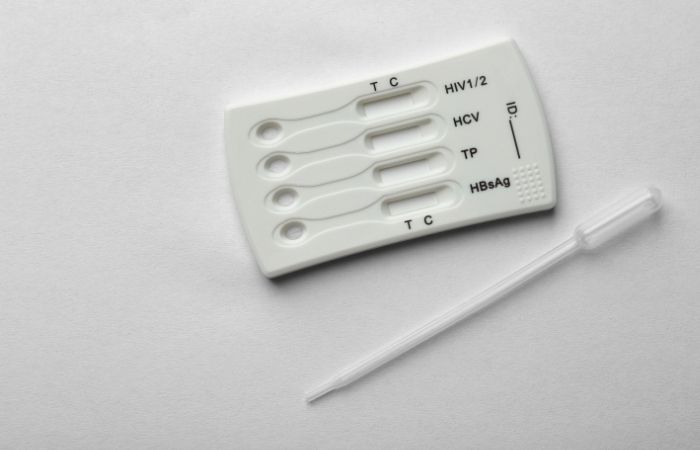
Not every STI uses the same kind of sample, and the right approach depends on what kind of contact occurred. The four main sample types are:
- Genital swab for chlamydia, gonorrhea, trichomoniasis, and HPV. Self-collected (vaginal or penile) at home or clinician-collected in clinic.
- Pharyngeal (throat) swab for oral chlamydia and gonorrhea. Required if you had oral exposure and want to detect infections in the throat. This is a clinic-administered test; we do not sell a home version.
- Rectal swab for chlamydia and gonorrhea after receptive anal exposure. Also clinic-administered.
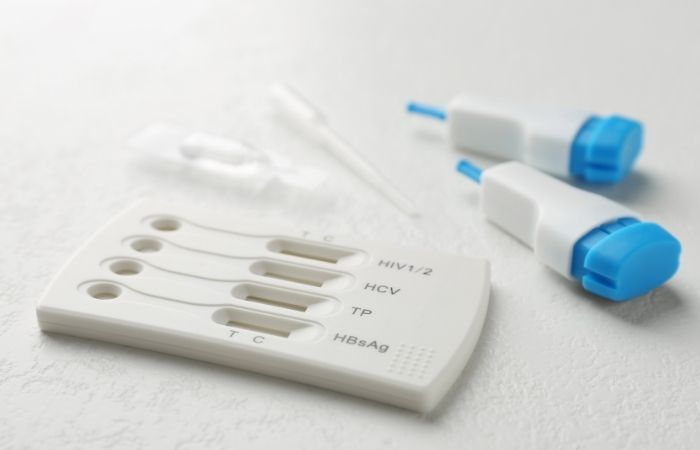
- Blood test (typically a fingerstick at home or a venipuncture in clinic) for HIV, syphilis, hepatitis B, hepatitis C, and herpes antibodies.
If your exposure included oral or anal sex, ask the clinic explicitly for site-appropriate swabs. Genital-only or urine-only testing will miss throat and rectal infections, which are commonly asymptomatic and which can keep transmitting in subsequent partners if left untreated.
Why the schedule matters beyond just knowing your status: untreated chlamydia or gonorrhea can ascend the reproductive tract. In women that can cause pelvic inflammatory disease (PID), which the CDC identifies as a leading cause of tubal-factor infertility and ectopic pregnancy. In men, the parallel complication is epididymitis, which can also affect fertility. Most cases of PID and epididymitis trace back to infections that were silent for weeks or months before causing damage, which is exactly why early screening after a partner disclosure is more than precaution.
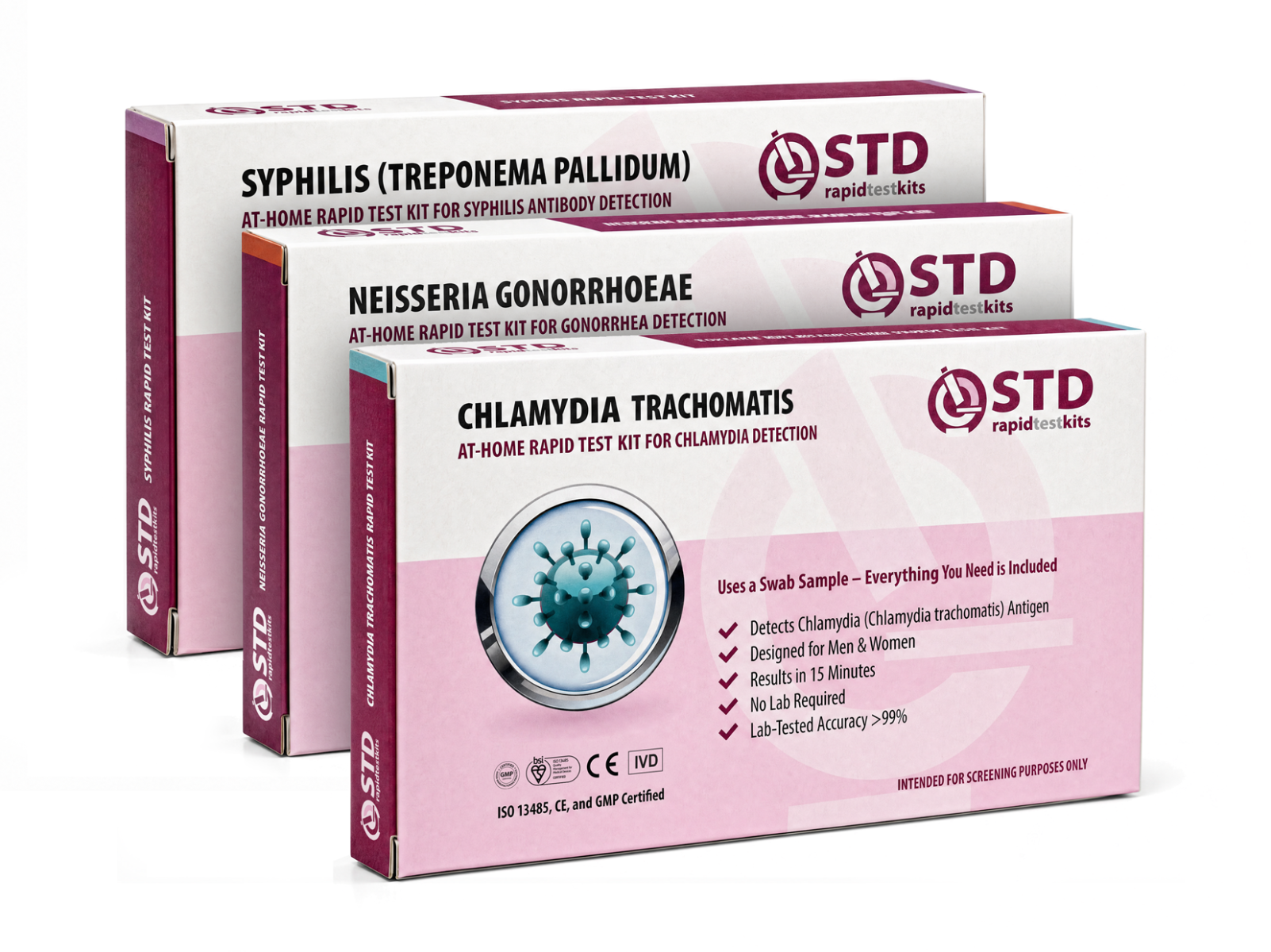
Our home tests are rapid lateral-flow cassettes: a small sample (a self-collected swab or fingerstick blood drop) goes onto a strip and a result line appears within about fifteen minutes. They are designed for fast at-home screening with high specificity. A positive home result should be confirmed with a laboratory NAAT or full antibody panel through a clinician, since labs use different chemistry that has higher analytical sensitivity for very early or low-burden infections.
For someone whose partner has just disclosed an infection, a sensible sequence is: home rapid screen now (covering whatever is within window for the exposure), home rapid screen again at three months, and confirm any positive at a clinic with full lab work and treatment if indicated. This article includes product recommendations from our store; editorial guidance is independent of those recommendations, and we point readers to clinic-only tests when those are the right tool.
Our rapid kits use lateral-flow chemistry: an antigen or antibody binds a labeled strip and a visible line appears. Clinics use NAAT (nucleic acid amplification tests) for chlamydia, gonorrhea, and trichomoniasis, which detect the pathogen's DNA or RNA and have somewhat higher analytical sensitivity for very early or low-burden infections. The two tools are complementary: rapid tests give a fast at-home answer; labs give maximum sensitivity. After a partner discloses an STI, using both at the right times is the strongest approach.
What if it was oral or anal sex?
STIs are not picky about anatomy. Oral and anal sex carry real risk for several common infections, and some specifically prefer the throat or rectum. The big ones to think about:
- Pharyngeal gonorrhea and chlamydia: usually silent, picked up only by a throat swab.
- Rectal gonorrhea, chlamydia, and lymphogranuloma venereum: usually silent or mistaken for a hemorrhoid, picked up only by a rectal swab.
- HIV: receptive anal sex without a condom is the highest-risk per-act exposure for HIV transmission, per CDC risk-by-exposure estimates.
- Syphilis: a primary chancre can appear in the mouth, throat, anus, or rectum after oral or anal contact.
- Herpes (HSV-1 and HSV-2): both types can transmit during oral and genital contact in either direction, including during asymptomatic shedding.
- HPV: oral HPV can cause oropharyngeal cancers years after infection.
If you had oral or anal contact with a partner who has been diagnosed, ask the clinic explicitly for throat and rectal swabs in addition to your routine workup. They are not always offered automatically, even at sexual-health clinics that handle these requests routinely once asked.
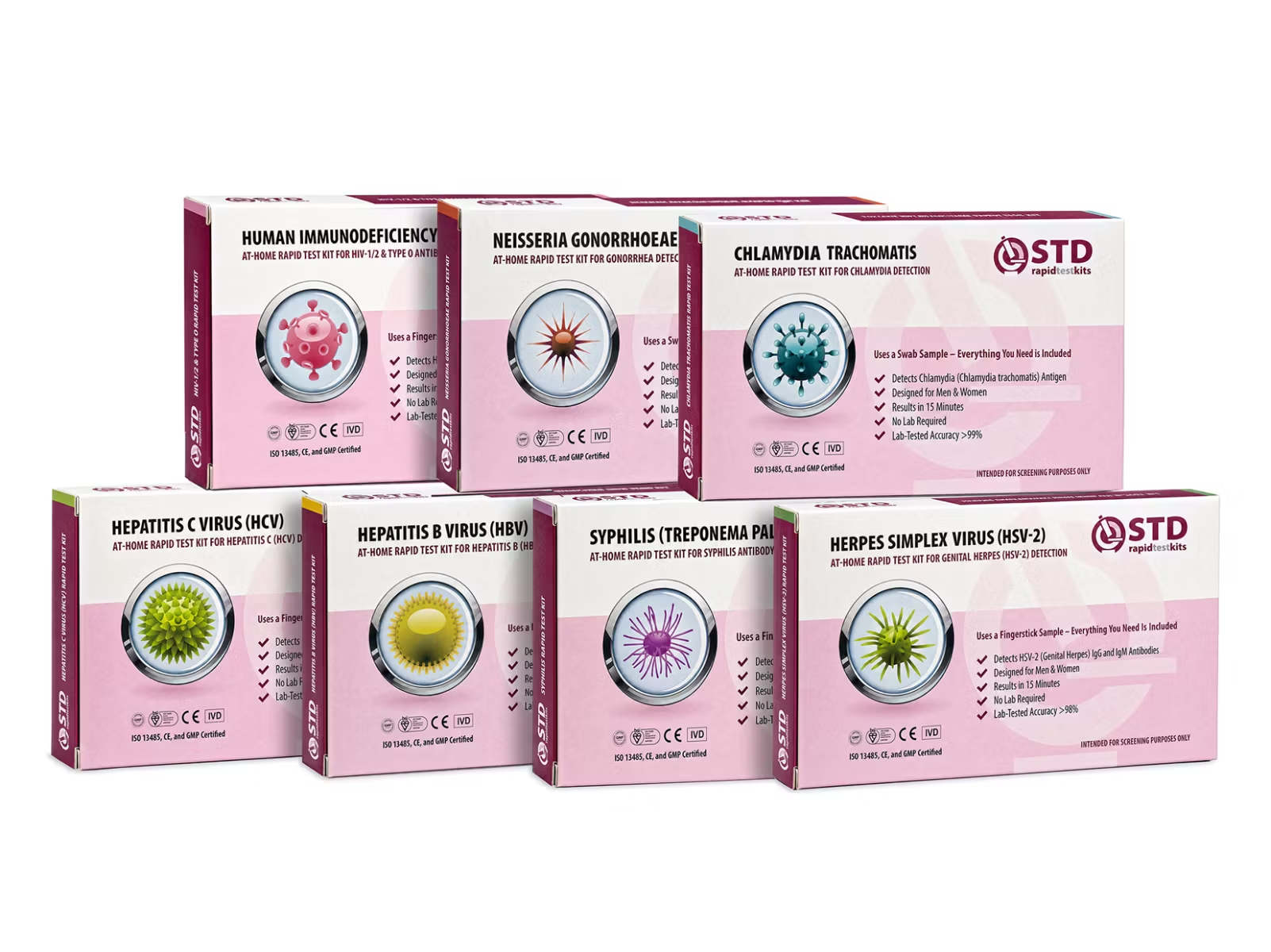
Our at-home rapid kits are validated for self-collected vaginal or penile swabs (for chlamydia, gonorrhea, trichomoniasis, and HPV) and fingerstick blood (for HIV, syphilis, hepatitis B, hepatitis C, and herpes antibodies). We do not sell pharyngeal-swab or rectal-swab home tests. If your exposure was oral or anal and you specifically need throat or rectal testing, ask your clinician or visit a sexual-health clinic for site-appropriate swabs. Our kits remain useful alongside that visit for screening any concurrent genital or systemic infection from the same encounter.
How much risk are you actually facing?
Per-encounter transmission probabilities vary widely by pathogen, sex act, and whether protection was used. Knowing the rough order of magnitude can calibrate worry without minimizing the situation.
HIV per-act estimates below are drawn from CDC risk-by-exposure data. Per-act and per-partnership estimates for the bacterial and viral STIs below are drawn from CDC STI surveillance summaries and published transmission-modelling literature; ranges are wide because study designs and partner-discordance assumptions vary.
- HIV, receptive anal sex: roughly 1 in 70 per act, the highest per-act sexual transmission probability tracked by the CDC.
- HIV, receptive vaginal sex: roughly 1 in 1,000 to 1 in 1,250 per act.
- HIV, insertive vaginal sex: roughly 1 in 2,500 per act.
- Gonorrhea, male-to-female receptive vaginal sex: per-act transmission probabilities have ranged in published studies from about 30 to 60 percent.
- Chlamydia: per-partnership transmission probabilities are commonly cited around 30 to 50 percent; per-act estimates are less well characterized.
- Syphilis (primary or secondary): roughly 30 percent per-contact transmission based on contact-tracing data.
- Genital HSV-2: per-act transmission is low, on the order of 0.1 to 0.5 percent for discordant heterosexual couples not using suppressive antivirals (extrapolated from annual transmission rates of roughly 5 to 10 percent in the published couples literature). Risk accumulates over time and can occur during asymptomatic shedding.
Three caveats. First, these are population averages; any individual encounter can land anywhere along that distribution. Second, having any other STI present (especially infections that cause sores, like syphilis or herpes) raises HIV transmission risk substantially. Third, condom use lowers risk for fluid-borne infections sharply but offers more limited protection against skin-to-skin infections like herpes and HPV that affect areas the condom does not cover.
Bottom line: per-act risk varies widely. Only your test result tells you whether transmission actually happened in your case.
If you already have an untreated STI that causes sores or inflammation (syphilis chancres, genital herpes lesions, or active gonorrhea or chlamydia), per-act HIV transmission risk goes up meaningfully. <a href="https://www.cdc.gov/hiv/">CDC estimates</a> put the relative increase at roughly two to five times baseline depending on the co-infection. A second reason to test the full panel after a partner disclosure rather than only the one infection your partner mentioned.
What to expect emotionally
An STI disclosure from a partner can produce a complicated emotional response, and pretending otherwise does not help. Common reactions include anger at the partner, shame about your own choices, anxiety about whether you are infected, anxiety about disclosing to a future partner, and a low-grade dread that resurfaces every time the topic crosses your mind.
A few things that tend to help:
- Get clear on the facts of your specific situation. Anxiety thrives on ambiguity. Knowing what you may have been exposed to, what your test windows look like, and when your retest will happen replaces a vague fear with a specific plan.
- Talk to one person you trust. A friend, a partner, a therapist, or an anonymous helpline. Holding the situation entirely in your own head usually turns it into rumination rather than action.
- Skip the late-night image searches. Worst-case photographs for a given infection do not reflect the typical case, and they will not change what your test says when the window period is up.
- Treat the emotional response as legitimate but separate from the medical question. The medical question (am I infected, do I need treatment) is answered by testing. The emotional question (how do I feel about this) is answered by talking it through.
A partner who chose to tell you about their diagnosis did something hard, and acknowledging that does not require minimizing your own anger about how or when the conversation happened. Both reactions can sit alongside each other while you make a testing plan.
The CDC's STI hotline (1-800-232-4636) and the National Sexual Health Hotline run by the American Sexual Health Association (1-919-361-8488) both offer free, confidential information. For a partner-disclosure conversation that has shaken you, a single session with a sex-positive therapist or a community health center counselor often does more than a week of internal looping.
Retesting: why one negative isn't the final word
The most common testing mistake after a partner exposure is treating the first negative result as the end of the story. It frequently is not.
Why retesting matters:
- Window periods are real. A test taken at week one for HIV cannot detect an infection that will become detectable at week six. A negative on day three says almost nothing about your final status.
- Different infections have different windows. Chlamydia and gonorrhea show up quickly; syphilis takes weeks; HIV depends on the test generation; herpes antibodies can take three to four months to develop.
- Reinfection is common. If you and your partner are not both treated and cleared concurrently, re-exposure during the gap can put you right back where you started. The CDC recommends a retest at three months after treatment for chlamydia and gonorrhea precisely because reinfection from an untreated partner is so frequent.
A practical schedule, assuming a single recent exposure:
- Now (or within the next week): rapid swab and blood screening for the infections within their window. Catches early-detectable cases and gives you a baseline.
- At six weeks: repeat HIV and syphilis testing if either is in scope.
- At three months: comprehensive retest of HIV, syphilis, hepatitis B, hepatitis C, and HSV-2 antibodies. This is the conclusive panel for almost everything except the slowest herpes seroconversions, which a final test at sixteen weeks resolves.
- At any new symptom: get evaluated immediately. Symptoms override the schedule.
Expedited partner therapy: how it works and where it stops
If your partner has been diagnosed with chlamydia or gonorrhea, you may be offered something called expedited partner therapy (EPT). EPT lets a clinician treating one partner write a prescription (or hand over a course of antibiotics) for the other partner without the second person needing their own appointment first. The CDC supports EPT as a way to interrupt reinfection cycles, and most U.S. states permit some form of it.
What EPT is good for:
- Treating a confirmed bacterial infection (chlamydia or gonorrhea) quickly when one partner already has a positive test.
- Reducing the chance that the diagnosed partner gets reinfected by the untreated partner.
- Lowering the practical barrier of two clinic visits.
What EPT is not:
- A substitute for testing. EPT covers chlamydia or gonorrhea only, not the rest of the panel. You may still have an undetected HIV, syphilis, herpes, or hepatitis exposure that needs its own workup.
- Available everywhere. A small number of states restrict or limit EPT, and your prescribing clinician will know what is allowed locally.
- An excuse to skip the conversation with a clinician. The standard rule is to take the medication if it is offered, and still complete your own testing on the schedule above.
Persons treated for chlamydia or gonorrhea should be retested approximately three months after treatment because the prevalence of repeat infections is high.
Common misconceptions that keep people from testing
A few persistent myths cause people to skip or delay testing after a partner exposure. Each one has a clean answer.
"If I have no symptoms, I'm fine."
Most STIs are silent in the early weeks, and several routinely cause no symptoms ever. Absence of symptoms is consistent with no infection, and it is also consistent with chlamydia, asymptomatic gonorrhea, early HIV, latent syphilis, asymptomatic herpes shedding, and many other realistic scenarios. Testing is the only way to distinguish them.
"My partner got treated, so I'm covered."
Treating one person does not treat the other. If you were exposed and have an active infection, you need your own treatment and your own retest. You can also reinfect a treated partner if your own infection goes undetected and untreated.
"We used a condom, so the risk is zero."
Condoms reduce risk meaningfully for fluid-transmitted infections (HIV, gonorrhea, chlamydia, hepatitis B and C). They reduce risk less effectively for skin-to-skin infections like herpes, HPV, and syphilis chancres, which can occur on areas the condom does not cover.
"One test rules everything out."
One test rules out the infections within their window at the time of testing. It says nothing about anything still inside its window period. The right move is to test now and retest at the long-window mark (typically three months) to be confident the result is final.
"At-home testing isn't real testing."
At-home rapid lateral-flow tests are validated screening tools with high specificity, and a positive result is meaningful and worth confirming with a clinic. They are not the laboratory NAAT used in clinics, which has higher analytical sensitivity for very early or low-burden infections, so a negative at-home result inside the window period does not have the same final weight. Used at the right time and confirmed appropriately, they are a real tool, not a placebo.
If any of these sound like your reasoning, run the test anyway: "I feel fine," "my partner already got treated," "we used a condom," "I tested last week." None of those statements rules out a current infection. A rapid at-home screen used after the appropriate window period takes about fifteen minutes and gives you something more reliable to act on than a confident assumption.
Final thoughts
An STI exposure is a fork in the road, not a verdict. Roughly half of sexually active adults will face a diagnosis (their own or a partner's) at some point, and the reasonable response is methodical: identify what you may have been exposed to, test on the right schedule for each, treat anything that comes back positive, and retest at three months for the slow infections. Talk to your partner if appropriate, talk to a clinician about anything outside our home-screening scope, and talk to one person outside the situation if it helps.
You can screen at home on your own schedule, with a result inside about fifteen minutes for what is in scope. For everything else (clinic-only swabs, treatment, full lab confirmation), a sexual-health clinic visit completes the picture. Whether you start at home or start at a clinic, the right next action is testing on the schedule above.
Your three-step plan
- Screen at home now for any infections within their window period (chlamydia, gonorrhea, and trichomoniasis from one to two weeks; HIV, syphilis, and hepatitis from about three to six weeks depending on the test).
- Retest at the three-month mark for HIV, syphilis, hepatitis B, hepatitis C, and HSV-2 antibodies. This is the conclusive panel for almost everything except the slowest herpes seroconversions.
- Confirm any positive at a clinic with full lab work (NAAT or full antibody panel), get treated promptly, and ask for pharyngeal or rectal swabs if oral or anal contact was involved.
Frequently asked questions
- Should I get tested if my partner has an STI but I have no symptoms?
- Yes. Most STIs are asymptomatic for weeks, and several rarely produce symptoms even when present. The only way to know is to test on the right schedule for what you may have been exposed to.
- How soon after exposure can I test?
- If you can only test once, three months after exposure is the conclusive window for most infections (HIV, syphilis, hepatitis, herpes antibodies). Chlamydia and gonorrhea are the fastest, detectable from one to two weeks. The window-period table above breaks down each infection.
- What if we used a condom?
- Condoms substantially reduce risk for fluid-transmitted infections (HIV, gonorrhea, chlamydia, hepatitis B and C). They offer more limited protection against skin-to-skin infections like herpes, HPV, and syphilis when the chancre or lesion is on uncovered skin.
- What kinds of tests should I ask the clinic for?
- Ask for the appropriate sample for what you were exposed to: a NAAT swab for chlamydia and gonorrhea, blood for HIV, syphilis, hepatitis, and herpes antibodies, and pharyngeal or rectal swabs if you had oral or anal contact. Many clinics will not add throat or rectal swabs unless you specifically request them.
- Can I be treated through expedited partner therapy without testing?
- In some cases, yes, for chlamydia or gonorrhea specifically. The CDC supports EPT and most U.S. states permit it. Take the medication if a clinician offers it, and still complete your own testing for the rest of the panel, since EPT does not cover HIV, syphilis, herpes, or hepatitis exposure.
- How accurate are at-home rapid STI tests?
- At-home lateral-flow tests are designed for high specificity (few false positives) and are validated screening tools when used after the appropriate window period. A positive result is meaningful and should be confirmed with a clinic NAAT or full antibody panel. A negative inside the window is not conclusive and should be repeated after the window closes.
- What should I do if my test comes back positive?
- See a clinician promptly. Most bacterial STIs (chlamydia, gonorrhea, syphilis, trichomoniasis) are curable with antibiotics. Viral infections (HIV, hepatitis B, hepatitis C, herpes, HPV) are managed with antivirals or other long-term care, and early diagnosis dramatically improves outcomes.
- Can I get an STI from a single sexual encounter?
- Yes. One unprotected encounter is enough to transmit chlamydia, gonorrhea, syphilis, herpes, HPV, hepatitis B, and HIV. Per-act probabilities vary widely (high for receptive anal HIV exposure, low for receptive vaginal HIV exposure, intermediate for the bacterial infections), but none are zero.
- U.S. Centers for Disease Control and Prevention. Sexually Transmitted Infections Treatment Guidelines and screening recommendations, including window periods and retesting schedules.
- U.S. Centers for Disease Control and Prevention. HIV transmission risk by exposure type and prevention guidance.
- U.S. Centers for Disease Control and Prevention. STD treatment guidelines covering expedited partner therapy and partner-services recommendations.
- World Health Organization. Sexually transmitted infections (STIs) fact sheet, including global incidence and asymptomatic-infection burden.
- NHS. Sexually transmitted infections (STIs) overview, including symptom and testing guidance for U.K. readers.
- Mayo Clinic patient health information hub for sexually transmitted diseases (STDs) symptoms, causes, and testing guidance.
