
Published: September 2025 | Last updated: May 2026 | Editorial review and quality control: Martina N.
Ask most adults to name the most common sexually transmitted infection in the world, and the answer comes back the same: chlamydia. The numbers tell a different story. Herpes simplex virus, both HSV-1 and HSV-2 combined, is by a wide margin the most prevalent STI on the planet. The World Health Organization estimates about 3.8 billion people under age 50 carry HSV-1, and roughly 520 million adults aged 15 to 49 carry HSV-2 globally (WHO Herpes Simplex Virus fact sheet).
The reason herpes feels invisible is not a public-health conspiracy. It is a combination of three forces working together: most carriers have no symptoms or mistake their symptoms for something else, standard STI panels do not include herpes blood testing, and the virus sheds quietly from the skin on days when nothing feels wrong. The result is a low-key epidemic that is not really hidden, just unmeasured by the tests most people receive.
Key Takeaways
- Herpes (HSV-1 plus HSV-2) is the most common STI worldwide. The WHO estimates the majority of adults under 50 carry HSV-1 and roughly 520 million adults aged 15 to 49 carry HSV-2 globally.
- Standard STI panels do not test for herpes unless you specifically ask. A clean routine screen does not mean you are HSV-negative; it means you were not screened for HSV.
Why herpes outranks chlamydia (by a lot)
Chlamydia leads the U.S. ranking of reported new cases each year, about 1.5 million in the 2024 CDC surveillance data (CDC STI surveillance). That headline gets repeated so often that people equate “most reported” with “most common.” They are different questions with different answers.
Reported cases measure how many people tested positive in a given year. Lifetime prevalence measures how many people are currently infected, period. Chlamydia is curable with a single course of antibiotics, so each new case drops out of the prevalence pool quickly. Herpes is not curable. Once acquired, HSV stays in the body for life, hiding in nerve ganglia between flare-ups. Every new herpes infection adds to the cumulative pool, year after year.
That is why prevalence numbers for herpes dwarf chlamydia by orders of magnitude. CDC surveillance data shows roughly 572,000 new genital herpes infections in the United States in 2018 alone, and because herpes is lifelong, those infections accumulate over decades into tens of millions of currently infected adults (CDC: About Genital Herpes). HSV-1 numbers are higher still, because many people acquire HSV-1 in childhood through non-sexual contact and then carry it for life. A meaningful share of new genital herpes cases in younger adults is now caused by HSV-1 transmitted through oral-to-genital contact, a trend the CDC notes in its herpes overview (CDC: About Genital Herpes).
| STI | Annual U.S. new cases (2024 CDC surveillance) | Cleared with treatment? | On routine STD panel? |
|---|---|---|---|
| Chlamydia | ~1.5 million | Yes, single antibiotic course | Yes |
| Gonorrhea | ~543,000 | Yes, antibiotic course | Yes |
| Syphilis (all stages) | ~190,000 | Yes, with antibiotics | Yes |
| HSV-2 (genital herpes) | ~572,000 new infections (2018 CDC estimate) | No; lifelong, managed with antivirals | No, unless requested |
| HSV-1 (oral or genital) | Not reportable; majority of U.S. adults carry it | No; lifelong, managed with antivirals | No, unless requested |
How a virus this common stays this invisible
The short version: most people with HSV either have no symptoms at all, or they have symptoms so mild they get attributed to something else. CDC fact sheets are explicit that the majority of HSV-2 infections are undiagnosed, and many of those people do experience occasional symptoms; the symptoms just do not look like the textbook picture of clustered painful blisters.
Common patterns that get misread include a small itchy patch on the inner thigh that fades in three days, a single tiny crack near the lip or buttock that the person calls a “razor nick,” recurrent shallow tears at the vaginal opening that get blamed on dryness, or brief tingling without any visible lesion. Once a person has named the problem something else (razor burn, ingrown hair, yeast irritation, a friction blister), it stops getting investigated, and the underlying virus continues quietly.
The second invisibility lever is that the testing infrastructure does not flag herpes by default. A primary-care physician running a “standard panel” will check chlamydia, gonorrhea, HIV, syphilis, sometimes hepatitis. Herpes blood testing has to be ordered separately, and clinical guidelines actively discourage routine asymptomatic screening for it. The reasons are reasonable in aggregate (the type-specific IgG blood tests are imperfect, false positives are real, and a positive result does not change clinical management) but they leave the individual person with a confidence gap.

Asymptomatic shedding, in plain English
One of the most persistent myths about herpes transmission is that you only spread it during a visible outbreak. The published evidence on viral shedding has been consistent for two decades: HSV-2 sheds from the skin and mucosa on days when no symptoms are present, and a meaningful fraction of transmissions happen during these silent periods.
After the initial infection, HSV travels back along sensory nerves and stays in the dorsal root ganglia (the cluster of nerve cells near the spinal cord), and periodically reactivates, sending viral particles back down the nerve to the skin surface to replicate locally. Sometimes that reactivation produces a sore. Often it does not, but viral particles still appear on the skin briefly. A person feels fine, looks fine, and is still capable of transmitting the virus during that window.
For practical risk reduction, this is why condoms reduce but do not eliminate transmission risk (the virus can shed from skin outside the area a condom covers), why suppressive antiviral therapy reduces transmission risk by roughly half in serodiscordant couples (per CDC STI treatment guidelines), and why daily medication is sometimes recommended even when the carrier feels completely well.
Most people with genital herpes do not know they have it. They may have no symptoms or have mild symptoms that they do not notice or that they mistake for another skin condition.
Why isn’t herpes on the standard STI panel?
Routine asymptomatic herpes screening is not recommended because the medical system has concluded that the costs of widespread testing outweigh the benefits for most people without symptoms. The U.S. Preventive Services Task Force has held this position for years, and the CDC echoes it in its STI treatment guidelines (CDC Genital Herpes Treatment Guidelines).
Several considerations sit behind that policy. Type-specific IgG immunoassays, the most widely available herpes blood tests, have a meaningful false-positive rate at low index values just above the cutoff; a positive result carries no immediate clinical action for an asymptomatic person since there is no curative treatment and antiviral therapy is generally reserved for symptomatic outbreaks or suppressive use in known transmission-risk situations; and the psychological burden of an incidental positive on someone with no symptoms can be substantial.
None of that argues against testing for someone who actually wants to know. It argues against blanket screening of everyone. The decision to test for herpes is, by design, a conversation rather than a default. Most people are never told that the conversation is theirs to start.
| Test panel type | STIs typically checked | Herpes included? |
|---|---|---|
| Basic clinic panel | Chlamydia, gonorrhea, HIV, syphilis | No |
| “Full” STD panel (most clinics and online services) | Above plus hepatitis B, hepatitis C, sometimes trichomoniasis | Usually no |
| Type-specific HSV blood test (IgG) | HSV-1 and HSV-2, reported separately | Yes (must be requested) |
| Swab of a visible sore (PCR or culture) | Confirms HSV in an active lesion | Yes (only when a sore is present) |
Should you get tested for herpes?
A useful starting point is to think about what you would do with the information. Testing is most worthwhile when a current or recent partner has disclosed an HSV-1 or HSV-2 diagnosis, when recurring unexplained genital symptoms (small splits, itchy patches, brief tingling) have never been investigated as possible HSV, when starting a new relationship calls for a baseline of what you are actually carrying, or ahead of a pregnancy. Acquiring a new HSV infection during pregnancy carries higher risks to a newborn than well-controlled chronic infection, which is why prenatal protocols often include partner status awareness.
Timing matters. Type-specific IgG antibodies take weeks to develop after a new exposure, so testing two days after a worrying contact will not give a meaningful answer about that specific event. A swab during an active episode is far more informative than a blood test during a quiet period; if a sore is present, that is the moment to see a clinician.
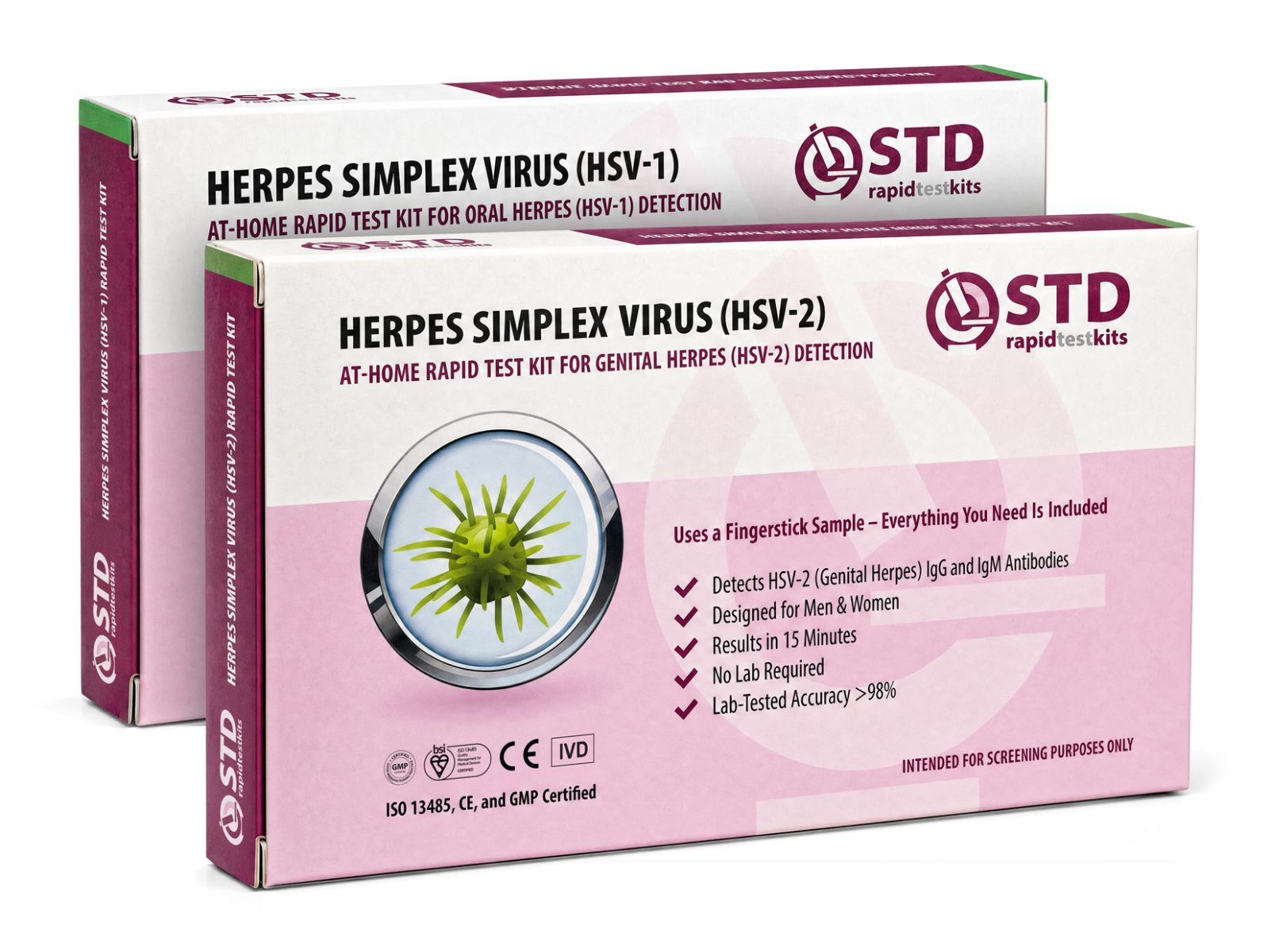
Note: this site sells rapid at-home STI test kits. The guidance above applies whether you test here or through a clinic.
| Time since possible exposure | Likelihood of antibody detection | What to do |
|---|---|---|
| 0 to 2 weeks | Too early; antibodies have not developed | If a sore is present, ask for a swab. Otherwise wait. |
| 3 to 6 weeks | Possible but unreliable; many true infections still test negative | An initial test is fine, but plan to retest. |
| 12 to 16 weeks | Most reliable window for type-specific IgG (per CDC STI treatment guidelines) | This is the definitive blood-test window. |

What an at-home herpes test can and cannot tell you
At-home rapid herpes tests and clinic-based lesion swabs answer completely different questions. Understanding which question you actually want answered determines which test belongs in your hand.
An at-home rapid herpes test uses a fingerstick blood sample and lateral-flow immunoassay strips to detect antibodies your immune system has produced against HSV. It answers the question “have you ever been infected with HSV?” It does not localize the infection to a specific body part, does not identify whether a current sore is herpes, and does not give a useful answer in the first few weeks after a new exposure (because antibodies take time to develop).
A swab test, by contrast, takes material from a visible lesion and looks for the virus itself, usually by PCR. It answers “is this specific sore on this specific day caused by HSV?” Swab tests are far more useful for identifying an active outbreak. They are also clinic-administered for the moment; at-home rapid kits do not include lesion-swab PCR.
If your concern is “have I ever been exposed,” the antibody test, lab or at-home rapid, gives you a yes-or-no answer. If your concern is “what is this thing on my body right now,” you want a clinic visit and a swab, ideally within the first three days of the lesion appearing.
Telling a partner without making it a crisis
The disclosure conversation is often the part people dread more than the diagnosis itself. The good news is that the response is usually far less dramatic than imagined. A short, factual conversation tends to land very differently than the catastrophic reaction people rehearse in their heads, especially when the disclosure leads with information rather than apology. Patient-facing resources from groups like the American Sexual Health Association describe disclosure as a manageable step, not the relationship-ending event it tends to be imagined as.
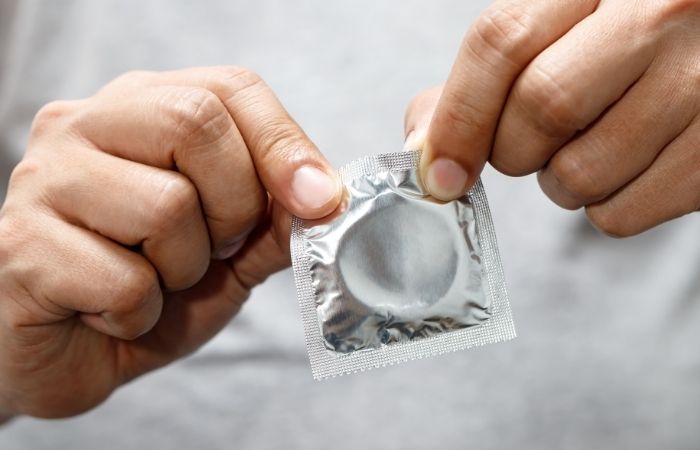
A workable opening is short, factual, and not loaded with shame. Something like: “Before we go further, I want you to know I have HSV-2. I manage it, transmission risk is reduced by condoms and daily antivirals, and I am happy to answer questions.” That is the whole conversation. It opens the door for the other person to respond honestly, and it shifts the dynamic from confession to information-sharing.
Two practical points worth mentioning early in any new relationship. First, oral HSV-1 (cold sores) can transmit to a partner’s genital area through oral sex, so HSV-1 is not strictly an oral-only infection. Second, if both partners already carry the same HSV type, there is no additional risk of acquisition between them; immunity to one type does not protect against the other type, but it does eliminate same-type re-transmission as a worry.
Living with herpes, factually
For most people who carry HSV, the day-to-day experience is uneventful. Many never have a recognizable outbreak. Those who do typically see flare frequency decrease over the years. Identifying personal triggers makes the pattern more predictable, which is the practical value of paying attention to it.
Suppressive antiviral therapy with daily valacyclovir or acyclovir reduces outbreak frequency, shortens individual episodes, and reduces transmission risk to a seronegative partner by roughly half in well-known studies. It is well tolerated and inexpensive. Episodic therapy, taken at the first sign of prodrome, can shorten a flare to a few days rather than a week or more.
The fertility and cancer risks people worry about with herpes are largely overstated. HSV does not cause infertility. HSV does not cause cancer (that worry usually belongs to HPV, which is a different virus). Neonatal herpes is a genuine concern, especially if a parent acquires a new infection in the third trimester, which is why prenatal disclosure and partner status matter; in established chronic infection well before pregnancy, the risk is much lower and is routinely managed by obstetric protocols.
- Physical illness, especially a fever or other viral infection
- Hormonal shifts, often around menstruation
- Sun exposure (a known trigger for HSV-1 cold sores on the lip)
- Periods of high stress or significant sleep deprivation
- Local skin trauma or friction at the usual outbreak site
The bottom line
Herpes is the most common STI in the world because it lasts a lifetime, often without symptoms, in a screening system that does not check for it by default. Most people who carry HSV will never know unless they ask for a type-specific blood test, or unless they happen to have an outbreak that gets swabbed by a clinician.
Asking for the test is the entire intervention. It costs little, it produces a definitive answer in the 12-to-16-week post-exposure window, and it converts an open uncertainty into a known fact you can plan around. Whether you do that with your primary-care clinic or with a rapid at-home kit is a logistics question, not a medical one. The choice that matters is choosing to find out.
Frequently asked questions
- Can I have herpes and not know it?
- Yes, and the majority of carriers have never been diagnosed. A type-specific IgG blood test is the only way to confirm HSV status without a visible sore. Mild recurring skin symptoms (a small split, brief tingling, a patch that fades in three days) are often misattributed to razor burn, ingrown hairs, or friction for years before anyone thinks to test for HSV.
- Was I tested for herpes during my last STI panel?
- Probably not. Basic and even most “full” STI panels skip herpes by default. A negative result on your last screen means you tested negative for what was on that panel; it does not mean you are HSV-negative. To find out, you need to ask specifically for a type-specific HSV-1 and HSV-2 IgG blood test.
- How do I actually get tested?
- Two main routes. If you have a visible sore, a clinician can swab it for PCR or culture; that is the most definitive way to identify an active lesion as HSV. If you do not have a sore and want to know your overall status, the type-specific IgG blood test is the standard. It is most reliable from about 12 to 16 weeks after a possible exposure. At-home rapid antibody tests use the same chemistry on a fingerstick sample.
- Can I get herpes from oral sex?
- Yes. HSV-1, the type most often associated with cold sores around the mouth, can transmit to a partner’s genital area during oral sex. This is now a significant share of new genital herpes infections in younger adults. HSV-2 can also transmit oral-to-genital but does so less efficiently than HSV-1.
- If I have herpes, am I contagious every day?
- No. Transmission risk is highest during a visible outbreak or prodrome (the tingling phase before a sore appears). Between outbreaks, the virus sheds intermittently from the skin on a meaningful minority of days. Daily antivirals reduce shedding and roughly halve transmission risk to an uninfected partner. Condoms reduce risk further but do not eliminate it.
- Do I have to tell a partner if I have no symptoms?
- Yes, because asymptomatic carriers can still transmit the virus. Disclosure also lets both partners decide together about condoms, suppressive antivirals, and timing. The conversation is short and factual: state what you have, state what you do to manage it, answer questions. Most partners respond with curiosity rather than rejection.
- Does a positive antibody test mean I have an active infection?
- Antibodies indicate that your immune system has encountered HSV at some point. They do not tell you when, where, or whether you are currently having symptoms. They also do not localize the infection to a specific body part. A positive type-specific IgG result simply says you carry that HSV type.
- Is herpes dangerous in the long term?
- For most people, no. Herpes does not cause infertility, does not cause cancer, and does not progress to organ damage in immunocompetent adults. The main exceptions are newborns (transmission during birth is serious, which is why prenatal screening matters), people with significantly suppressed immune systems, and rare ocular or neurologic complications. For ordinary healthy adults, it is a manageable lifelong infection with occasional flare-ups.
How we sourced this article: We summarized current public-health guidance from the CDC, WHO, and NHS, alongside the U.S. Preventive Services Task Force recommendation on serologic screening for genital herpes. Statistics are drawn from CDC STI surveillance and WHO global estimates current as of the most recent published reports. This article is not clinical advice; for symptoms or test interpretation, see a licensed clinician.
- U.S. Centers for Disease Control and Prevention. About Genital Herpes (incidence, symptoms, transmission, and HSV-1 vs HSV-2 epidemiology).
- U.S. Centers for Disease Control and Prevention. Genital Herpes Treatment and Care (STI Treatment Guidelines, including suppressive antiviral therapy and serologic testing recommendations).
- World Health Organization. Herpes Simplex Virus fact sheet (global HSV-1 and HSV-2 prevalence estimates).
- NHS. Genital herpes overview, symptoms, and treatment.
- American Sexual Health Association. Herpes resource center and disclosure guidance.
- U.S. Centers for Disease Control and Prevention. STI Surveillance annual report (national reported case counts for chlamydia, gonorrhea, syphilis).
