Published: November 2025 | Last updated: May 2026 | Editorial review and quality control: Martina N.
Most full STI panels do not include herpes. The omission is intentional and reflects a specific public-health policy decision rather than an administrative gap. The U.S. Centers for Disease Control and Prevention (CDC screening guidance for genital herpes) and the U.S. Preventive Services Task Force both advise against routine HSV blood testing in adults who have no symptoms. Their reasoning rests on two limits of the available test technology: the rate of false-positive results, and the small clinical change that a positive result usually produces.
For a reader who walked into a clinic asking to be tested and walked out told no, that policy is cold comfort. It is also not the final word. This article explains why your clinician likely declined, what current public-health guidance says about the test you wanted, and the concrete steps you can take if you still want a result, whether through your provider, a different clinician, or an at-home antibody test. This article is intended to inform without raising unnecessary alarm.
Key takeaways
- Major U.S. screening bodies advise against routine HSV antibody testing in adults without symptoms, mainly because available blood tests produce a meaningful share of false positives in low-risk populations.
- If you still want to know your status, you can ask your provider by name for a type-specific HSV-1 and HSV-2 IgG antibody test, order a private at-home antibody test, and request confirmatory testing for any low-positive result before treating it as final.
Why herpes is left off the standard panel
When most clinicians order a “standard STI panel,” the lab usually runs chlamydia, gonorrhea, syphilis, and HIV, sometimes alongside hepatitis B or hepatitis C. Herpes is rarely on that list. The omission is not a clerical mistake. It is the consensus position of the CDC and the U.S. Preventive Services Task Force, which both give serologic screening for genital herpes a recommendation against routine use in asymptomatic adolescents and adults.
Two reasons drive the position. The first is test performance. The commercial blood tests that detect antibodies to HSV-1 and HSV-2 are accurate enough on paper, but in a population where most people testing have a low pre-test probability of infection, the false-positive rate matters more. A positive antibody test in someone without symptoms can be a true infection, or it can be the assay reacting to something else. In low-prevalence groups the share of false positives among all positive results is high enough that USPSTF concluded routine screening produces more harm than benefit.
The second reason is clinical utility. Most people with genital HSV never develop bothersome symptoms. When symptoms do appear, antiviral medications are typically prescribed at that point rather than preventively, and treatment decisions in someone without symptoms rarely change based on antibody status alone. From the clinic's perspective, delivering a stigmatized diagnosis without a clear clinical action is a hard trade.
From your perspective, that same diagnosis might inform when you abstain, how you talk with partners, or whether you pursue confirmatory testing. Those interests are real. They are exactly the gap that the official guidelines do not fill, and they are the reason that asking for a herpes test, despite policy, is not an unreasonable request.
Test performance. Commercial HSV antibody blood tests perform well in higher-prevalence groups but produce a meaningful share of false positives in low-risk asymptomatic adults, especially in the low-positive index range.
Clinical utility. Most asymptomatic positives do not change treatment decisions, since antivirals are typically started when symptoms appear rather than preventively. The policy reflects this, not your individual interest in knowing.
CDC does not recommend HSV testing for people without symptoms, since diagnosing genital herpes in someone without symptoms has not been shown to change their sexual behavior or stop the virus from spreading.
What providers actually mean when they decline
The wording your clinician uses can sound dismissive even when the underlying reasoning is medical. The table below translates the common phrasing into what the provider is usually drawing on. The translations are not endorsements, they are context that may help you push back productively.
| What the provider says | What it usually reflects |
|---|---|
| "You don't have symptoms." | USPSTF and CDC advise against serologic herpes screening in asymptomatic adults. Without a visible lesion to swab, the provider is following standard guidance. |
| "Herpes is very common." | True. The CDC estimates a substantial share of U.S. adults carry HSV-1, often acquired in childhood, and a meaningful subset carry genital HSV-2. The phrasing is meant to reassure, not to dismiss your concern. |
| "The test isn't reliable." | A reference to the false-positive rate of IgG antibody tests in low-prevalence groups, especially in the low-positive index range. Type-specific assays are available, but providers may avoid the confirmatory workup. |
| "It won't change your treatment." | Antivirals are usually started when symptoms appear. The provider is signaling that an asymptomatic positive does not automatically lead to daily medication. That logic ignores disclosure and partner-protection decisions you may still want to make. |
You asked for a herpes test and your provider declined. What now?
Most U.S. clinicians follow CDC and USPSTF guidance against routine HSV testing in adults without symptoms, because antibody blood tests produce a meaningful share of false positives. If you still want to test, ask your provider by name for a type-specific HSV-1 and HSV-2 IgG antibody test, or order a private at-home antibody test. For any low-positive result, request a confirmatory test before treating the diagnosis as final.
Asymptomatic infection: what it looks like
One reason herpes screening is contentious is that the infection so often produces nothing visible. Many people with HSV-2 do not realize they carry it, according to CDC surveillance, and a large share of HSV-1 infections are acquired in childhood through nonsexual contact and never produce a noticeable outbreak. Even when symptoms do appear, they can be subtle enough to be mistaken for shaving irritation, an ingrown hair, a yeast infection, or a minor friction abrasion.
That clinical reality matters in two directions. It is the reason routine screening yields so many false positives relative to true cases: the test is being applied to a large pool of people who feel fine. It is also the reason some readers feel a herpes test is worth the cost and complexity. A positive result might not change a treatment plan, but it can change what someone discloses to a partner before sex, when they choose to abstain during prodromal sensations, or whether they pursue daily suppressive antiviral therapy after discussing it with a clinician.
It is worth naming the corollary plainly. Because herpes can be transmitted during periods of asymptomatic viral shedding, the absence of symptoms in a sexual partner is not proof that they do not have it. CDC and NHS guidance both emphasize this point. Disclosure of an untested status, condom use, and avoiding sex during prodromal symptoms are all separately useful, regardless of whether either partner has been tested.
CDC surveillance suggests most people with genital HSV-2 are unaware of their infection because symptoms are absent or attributed to other causes. Asymptomatic viral shedding is a documented transmission route. That is why condom use, suppressive antiviral therapy where prescribed, and honest disclosure all contribute to transmission reduction independently of whether either partner has tested.
When testing actually makes sense
Even within the official non-routine framing, several scenarios make a request for herpes testing reasonable. Asking for one of these specifically by reason can change how the conversation with your provider goes.
| Situation | Why testing may be useful |
|---|---|
| A current or recent partner discloses an HSV diagnosis | Your pre-test probability is meaningfully higher than the general population, which improves the predictive value of a positive antibody result. |
| Recurrent genital lesions or sores of unclear cause | PCR testing of an active lesion is the most accurate herpes test available, and it can distinguish HSV-1 from HSV-2 directly from the sample. |
| Recurrent “razor burn,” bumps, or skin irritation in the genital area | Several conditions can mimic mild HSV outbreaks. A clinician visit during an active episode allows a swab, which is more informative than blood antibody testing. |
| Planning a pregnancy or currently pregnant | HSV status affects delivery planning when a partner has known infection. This is a clinical reason a provider may agree to type-specific testing even outside routine screening. |
| You want clarity before starting a new relationship | This is a personal preference rather than a clinical indication, but it is a reasonable reason to request a type-specific IgG test or order an at-home antibody test. |
The tests, and what to ask for by name
If you decide to push for testing, knowing the names of the available tests improves your chances of getting what you want. There are three main options in U.S. clinical use, and each answers a different question.
For most people without active symptoms, the type-specific IgG antibody test is the only practical option. When you ask, the phrasing matters. “I would like a type-specific HSV-1 and HSV-2 IgG antibody test” is more likely to result in the right lab order than “I want to be tested for herpes,” which can be interpreted in several ways. If your provider still declines, ask them to document the request and the reason for the refusal in your chart, both for your own records and as a signal that you understand the guidance and still want the test.
| Test | Best for | How it works | Key limits |
|---|---|---|---|
| Type-specific HSV-1/HSV-2 IgG antibody test | Screening when no active lesion is present | Detects IgG antibodies to glycoprotein G of HSV-1 and HSV-2 separately, run on a blood sample | Antibodies take weeks to develop after exposure. False positives in the low-index range require confirmatory testing |
| HSV PCR or NAAT swab | An active lesion, sore, or vesicle | Tests fluid swabbed from the lesion for HSV DNA, identifying type 1 versus type 2 directly | Requires an active lesion. Lab turnaround is usually one to several days |
| Rapid at-home HSV antibody test | Private screening without a clinic visit | Lateral-flow antibody test on a fingerstick blood sample, with results typically read at home in minutes | Same antibody-based limits as lab IgG. Positive results, especially in the low-positive range, should be confirmed by a laboratory antibody test |
If your provider will not order it: the at-home antibody route
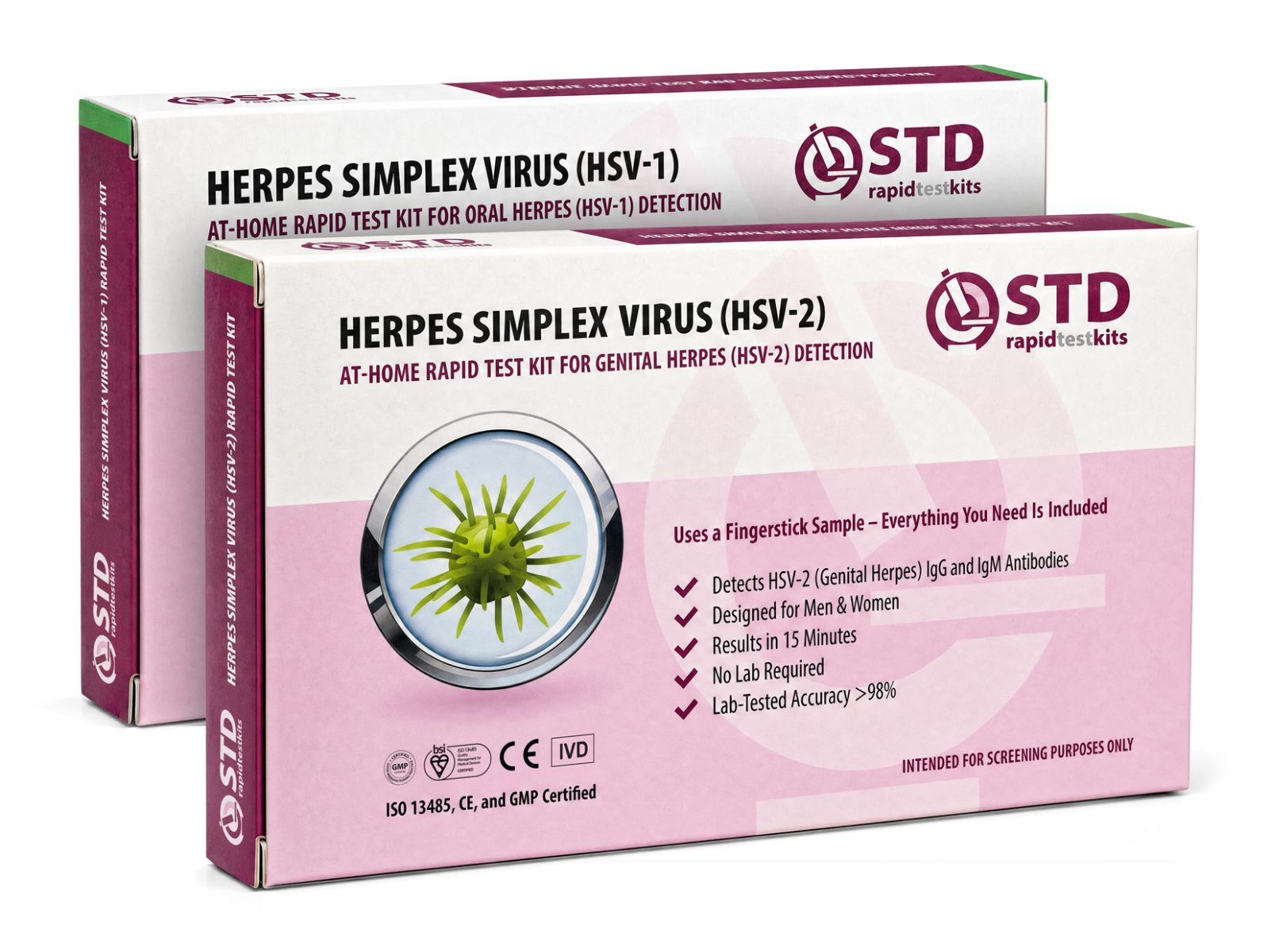
stdrapidtestkits.com sells rapid lateral-flow at-home test kits for HSV and several other STIs. The options described below are the kits this site offers, recommended where they fit the question a reader is actually asking.
When clinic-based testing is not available or is declined, at-home antibody testing is the most common alternative in the U.S. consumer market. The technology is the same lateral-flow antibody chemistry used in many other rapid kits, applied to a fingerstick blood sample. The strengths and limits track the IgG laboratory test rather than the PCR swab.
What at-home antibody testing can answer: whether you have detectable antibodies to HSV-1, HSV-2, or both. What it cannot answer: where in your body an infection is located, how recently you were exposed, or whether a low-positive index result reflects true infection. For any positive result in the low-positive range, a follow-up laboratory antibody test, and in some cases a Western Blot confirmatory test where available, is the appropriate next step before changing how you talk with partners or how you live with the result.
When broader screening makes sense alongside herpes
If your reason for wanting a herpes test is a single recent exposure or a new-partner conversation, you are likely also in the situation where a broader panel makes sense. The same lateral-flow chemistry is available as a combination kit that adds HIV, syphilis, hepatitis B and C, chlamydia, and gonorrhea coverage to the HSV-1 and HSV-2 antibody readout. One sample event, several questions answered in parallel. The same low-positive caveats apply to the HSV portion of any combination kit, so confirmatory testing on a low-positive result remains the appropriate next step.

Reading a herpes test result without spiraling
A positive antibody test is not a verdict on character, and the first reaction many people have to one is disproportionate to the medical reality. The result is also not always definitive on first look. Treat it like a piece of clinical information that may need to be interpreted alongside one more test, especially in the low-positive range.
Whatever the number on the report says, it tells you about your immune history. It does not tell you anything about your worth, cleanliness, or fitness as a partner. Use the result to make decisions, confirm anything ambiguous before acting on it, and move on. The categories below describe what each common result type generally means.
- Positive HSV-1 antibody result. HSV-1 is common in U.S. adults and is most often acquired in childhood through nonsexual contact. A positive result does not by itself indicate a genital infection. It does mean you have been exposed at some point, somewhere on the body, often years earlier.
- Positive HSV-2 antibody result, clearly positive index value. HSV-2 is predominantly a genital infection in adults. A clearly positive result is generally reliable on a type-specific IgG assay, although unusual cases are confirmed by Western Blot in research and reference labs.
- Low-positive HSV-2 antibody result, typically index value in the 1.1 to 3.5 range on the most widely used commercial assay. This range carries a meaningfully higher chance of being a false positive. Request a confirmatory test before accepting the result as definitive. Do not start a difficult disclosure conversation on the basis of a low-positive alone.
Window periods and when retesting matters
HSV antibody tests measure your immune response to the virus, not the virus itself. Because antibodies take time to develop after exposure, the timing of the test relative to when you were exposed changes how much you can read into a negative result. A negative test the week after a possible exposure is not the reassurance it feels like.
The practical guidance: if you test soon after a known or suspected exposure, plan from the start to retest at the 12-week mark before drawing conclusions from a negative. If you test positive in the low-positive range early after exposure, a confirmatory test at or after 12 weeks adds clarity that the first test cannot. The table below summarizes how the antibody window changes with time.
| Time since possible exposure | What an antibody test can tell you |
|---|---|
| 0 to 7 days | Too early. Antibodies have not had time to develop. A negative result reflects timing, not absence of infection. |
| 1 to 3 weeks | Some early antibodies may be detectable in some people, but a negative result is unreliable. Plan to retest later. |
| 3 to 6 weeks | A growing share of true positives will register. A negative at this stage is more meaningful than earlier results but is not final. |
| 12 to 16 weeks and beyond | The window typically cited by reference labs for a reliable type-specific IgG result. Use this timing for the result you intend to act on. |
Talking with a partner about an untested or positive status
Two related conversations come up around herpes, and many people conflate them. The first is what to say when you have never been tested for HSV specifically, which is the case for most people who have ever had an STI panel run. The second is what to say after a positive antibody result. Both are worth approaching honestly and without overstatement.
If you have not been tested for HSV, the accurate version of that disclosure is short. Something close to “most standard STI panels do not include herpes, and I have not had a separate type-specific HSV test” is more useful than implying you have been comprehensively screened. The framing also opens the door to mutual testing, which is often easier to navigate than a one-sided disclosure.
If you have a clearly positive HSV-2 result that has been confirmed where appropriate, disclosing the diagnosis is a separate conversation. Public-health and patient-advocacy organizations publish disclosure guides that focus on plain language, accurate prevalence framing, and the steps that reduce transmission risk during a sexual relationship. The goal of the disclosure is informed consent, not confession.
The cultural weight around herpes, much heavier than the medical weight, is part of why these conversations feel harder than they need to be. A diagnosis carries social meaning that is out of proportion to the day-to-day clinical reality, which is for many people very mild. Recognizing that gap, in yourself and in the people you talk to, is part of taking the diagnosis seriously without inflating it.
You can act on this without panic
If you were told no when you asked for a herpes test, the request was not unreasonable, and you have options. Ask your provider by the right name for the right test, document the conversation, consider an at-home antibody test when clinic-based testing is not available, and treat any low-positive result as a question rather than an answer until a confirmatory test resolves it. Better information makes the next steps easier to take, whether that is a follow-up lab test, a conversation with a partner, or doing nothing at all.
FAQs
- Is herpes part of a standard STI panel?
- No. Default panels cover chlamydia, gonorrhea, syphilis, and HIV. You have to ask for an HSV antibody test by name to get one added, and even then the request may be declined per current CDC and USPSTF guidance for adults without symptoms.
- Why would a clinician refuse a herpes test if I ask?
- Most clinicians follow the official guidance against routine screening. The reasoning is that antibody blood tests produce a meaningful share of false positives in low-risk groups, and a positive result in someone without symptoms rarely changes treatment. You can still request the test by name, and providers will often agree, especially if you have a clear reason such as a partner's positive result.
- Can I be tested without symptoms?
- Yes. Type-specific HSV-1 and HSV-2 IgG antibody tests detect immune response to the virus and do not require an active lesion. The same antibody chemistry is used in at-home rapid kits. Antibody tests are most reliable from roughly 12 weeks after possible exposure.
- How long should I wait after a possible exposure?
- 12 to 16 weeks for a reliable type-specific IgG result. Earlier testing is only useful when you have an active lesion that can be swabbed for PCR. A negative antibody result in the first few weeks after exposure should be retested after the 12-week window.
- What is a low-positive HSV-2 result and what should I do about it?
- On the most widely used commercial IgG assay, results in the roughly 1.1 to 3.5 index range carry a meaningfully higher chance of being false positives. Confirmatory testing, typically a repeat laboratory antibody test and in some settings a Western Blot, is the next step. A low-positive result is not by itself a definitive diagnosis.
- Should I tell a partner I have not been tested for herpes?
- Honesty about what your panel did and did not include is generally helpful. Saying that standard STI tests usually do not include herpes and that you have not had a type-specific HSV test is more accurate than implying full coverage. It also opens the door for mutual testing if you both want clarity.
- Can herpes be transmitted by someone with no symptoms?
- Yes, and this is why condoms, suppressive antiviral therapy where prescribed, and abstaining during prodromal sensations matter even when neither partner has visible symptoms. CDC and NHS guidance both note that asymptomatic viral shedding is a documented transmission route.
- What is the difference between HSV-1 and HSV-2?
- HSV-1 has historically been associated with oral cold sores and HSV-2 with genital infection, but either type can infect either anatomic site depending on the type of contact. Type-specific antibody tests distinguish the two, which is why asking for a type-specific test matters. The clinical course and transmission risk profile differ enough that the distinction is worth making.
- U.S. Centers for Disease Control and Prevention. Screening for genital herpes, position and rationale.
- U.S. Centers for Disease Control and Prevention. STI Treatment Guidelines, genital herpes section, including testing technology and clinical management.
- U.S. Preventive Services Task Force. Recommendation against serologic screening for genital herpes in asymptomatic adolescents and adults.
- MedlinePlus, U.S. National Library of Medicine. Herpes (HSV) test overview, sample types, and result interpretation.
- NHS. Genital herpes, including transmission, asymptomatic shedding context, and disclosure considerations.
