
Published: November 2025 | Last updated: May 2026 | Editorial review and quality control: Martina N.
You used a condom. Maybe even two. You picked the right size, checked the wrapper, paid attention to timing, and did everything sex-ed asked you to do. Then a sore showed up. Or a test came back positive. Or something just feels off, and a quiet, uncomfortable question is now sitting in your head: "How?"
Condoms are powerful, but they are not a full barrier against every sexually transmitted infection. They reduce risk a lot for some infections, only partly for others, and for a few skin-to-skin infections they cannot reach the skin that is doing the transmitting. There is a real gap between what most of us were taught about "safe sex" and what condoms actually prevent.
This guide walks through what condoms block well, what they block partially, what they cannot really touch, when symptoms tend to show up after exposure, and what a sensible testing plan looks like when you did everything right and still want clarity.
Key takeaways
- Condoms cut HIV, gonorrhea, chlamydia, and trichomoniasis risk dramatically (those spread through fluids), but only partially reduce herpes, HPV, and syphilis risk, because those three spread through skin contact in areas a condom does not cover.
- After protected sex with a new partner, time your tests to the window: chlamydia and gonorrhea at 1 to 2 weeks, HIV via lab antigen/antibody test at around 6 weeks (rapid antibody tests need up to 12 weeks), syphilis at 3 to 6 weeks, and an HSV blood antibody test at 12 to 16 weeks if there's a specific reason to suspect it.
How Condoms Work, and Where Coverage Runs Out
Condoms are one of the most studied tools in public-health history. The U.S. Centers for Disease Control and Prevention summarizes decades of evidence in a single careful sentence: "Correct use of condoms reduces the risk of disease but does not eliminate it" (CDC, Condom Use). That clause does a lot of quiet work. Real-world condom use is messier than lab use, and "I used a condom" is not the same statement as "the condom did its job perfectly from start to finish."
There is also a question condoms cannot answer at all: what about the skin that was exposed but not covered? A male latex condom covers most of the penile shaft. It does not cover the scrotum, the perineum, the inner thigh, the labia majora, the pubic mound, the buttocks, or the mouth. For infections that need fluids to spread, those uncovered regions are mostly irrelevant. For infections that spread skin to skin, those uncovered regions are the whole story.
The CDC is explicit about this asymmetry: "Condoms will not provide protection against STDs spread by skin-to-skin contact (genital herpes or syphilis). They will provide protection against STDs spread by genital fluids (such as gonorrhea or chlamydia)". The same logic applies to human papillomavirus, which behaves like a skin-to-skin infection rather than a fluid-borne one.
Latex blocks the area it covers. Every centimeter of skin outside the latex, including the scrotum, inner thigh, labia, and mouth, is still in contact during sex. Fluid-borne STIs are blocked. Skin-to-skin STIs go around the latex.
What Condoms Block Well, What They Block Partially
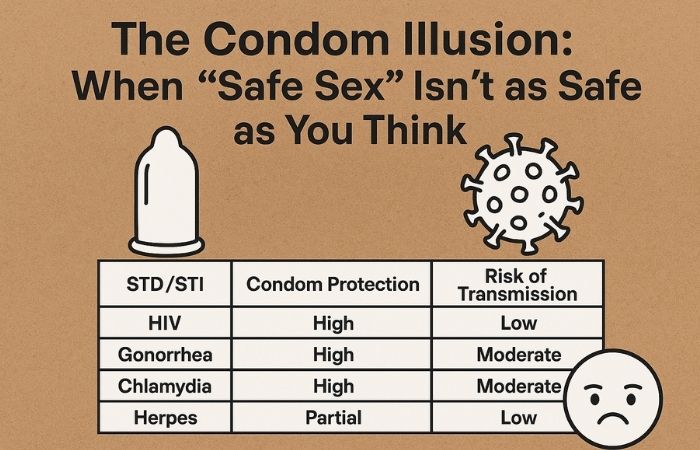
The cleanest way to think about condoms and STIs is by transmission route. Fluid-borne infections (HIV, gonorrhea, chlamydia, trichomoniasis) need an exchange of semen, vaginal secretions, or, in HIV's case, blood. Latex blocks that exchange. Skin-to-skin infections (herpes, HPV, syphilis) need direct contact with infected tissue. Latex blocks the area it covers and is silent about every other square centimeter of skin.
The World Health Organization's STI fact sheet states the trade-off directly: "When used correctly and consistently, condoms offer one of the most effective methods of protection against STIs, including HIV", while also noting that "although highly effective, condoms do not offer protection for STIs that cause extra-genital ulcers (i.e., syphilis or genital herpes)" (WHO).
Approximate real-world effectiveness by transmission route:
| Infection | Transmission route | Approximate condom protection |
|---|---|---|
| HIV | Blood, semen, vaginal fluids | Very high with consistent correct use |
| Chlamydia | Semen, vaginal fluids | High |
| Gonorrhea | Semen, vaginal fluids | High |
| Trichomoniasis | Semen, vaginal fluids | High |
| Syphilis | Skin-to-skin (chancre) | Moderate, falls when sores are extra-genital |
| Herpes (HSV-1, HSV-2) | Skin-to-skin (often asymptomatic) | Partial |
| HPV | Skin-to-skin (genital area) | Partial, vaccination is the stronger tool |
The Three Skin-to-Skin Infections People Catch After "Safe Sex"
Three infections cause most of the "but I used a condom" confusion in clinics: herpes, HPV, and syphilis. Each one spreads through direct contact, and each one can shed from areas a condom does not reach.
Herpes (HSV-1 and HSV-2). Herpes spreads through skin or mucous-membrane contact during oral, vaginal, or anal sex. The virus can shed from skin that looks completely normal, a process called asymptomatic viral shedding. The CDC's genital herpes page is blunt about the implication: "Be aware that not all herpes sores occur in areas that a condom can cover. Also, the skin can release the virus (shed) from areas that do not have a visible herpes sore. For these reasons, condoms may not fully protect you from getting herpes" (CDC, About Genital Herpes). The same page notes that you can catch it from a sex partner who does not have a visible sore or is unaware of their infection.
Human papillomavirus (HPV). HPV is extraordinarily common. The CDC describes it as spreading through intimate skin-to-skin contact and notes that you can catch it from someone "even if they don't have signs or symptoms" (CDC, About HPV). Condoms reduce HPV transmission risk and have been associated with faster clearance of existing infections, but they do not eliminate the risk because HPV lives on skin a condom does not cover. The stronger protective tool against HPV is vaccination. The Advisory Committee on Immunization Practices recommends routine HPV vaccination through age 26, with shared clinical decision-making for catch-up vaccination through age 45.
Syphilis. Syphilis transmits through direct contact with a syphilitic sore, called a chancre. The CDC's syphilis treatment guidelines state plainly that "Sexual transmission of T. pallidum is thought to occur only when mucocutaneous syphilitic lesions are present". Those lesions most commonly appear on the genitals, but they can also show up on the mouth, lips, throat, anus, or anywhere infected secretions touched skin. U.S. syphilis case counts have been rising for more than a decade per CDC STI surveillance reports, and a meaningful share of new diagnoses involve oral or extra-genital chancres that a condom would never have covered.
A small but important note for our women-only readers: the at-home HPV swab we sell is validated for vaginal self-collection only. Male readers who want HPV evaluation should see a clinician, because we do not offer a male-compatible HPV home test.
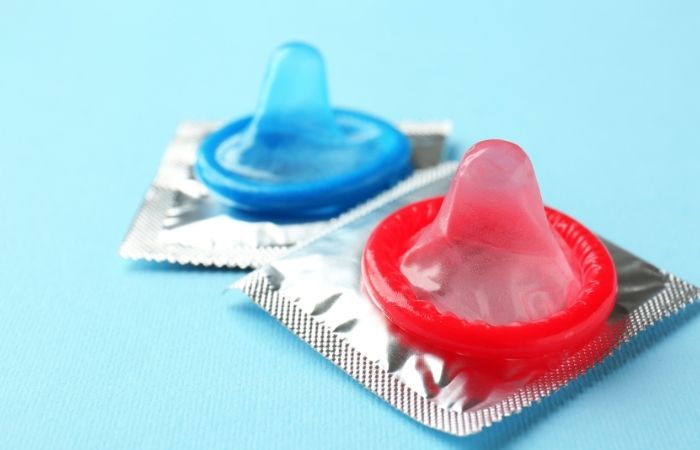
When the Condom Broke and Nobody Noticed
Condoms can fail in three quiet ways that people often miss in the moment. They can develop microtears from friction, especially without lubricant. They can slip partway off during sex without an obvious snap or shift. They can be compromised before the wrapper even opens, because latex degrades when stored in hot environments, after the printed expiry date, or when the foil has been damaged.
The CDC's condom guidance is direct that effectiveness depends on "correct and consistent use" (CDC, Condom Use), and a meaningful share of real-world condom failures (slippage, late application, removed before sex ended, partial breakage) go unnoticed at the time. That does not mean condoms are unreliable. It means that "the condom seemed fine" is a weaker statement than people sometimes assume, particularly when paired with rushed sex, alcohol, or skipping lubricant.
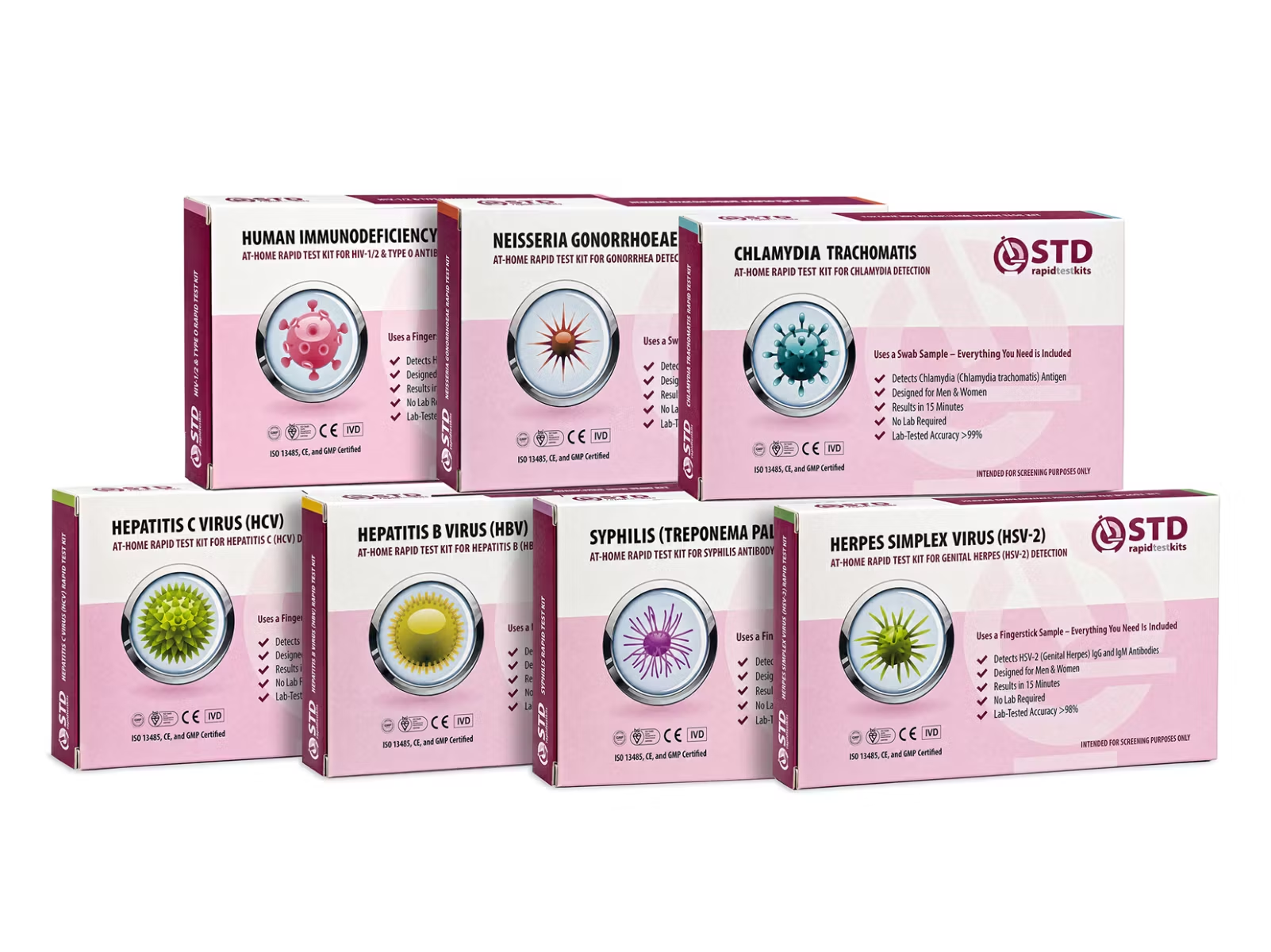
If symptoms started after a sexual encounter you describe as protected, you are not being dramatic by considering an STI cause. Other plausible causes (folliculitis from shaving, allergic contact dermatitis from a new lubricant, urinary tract irritation, normal cycle-related discomfort) are also worth knowing. This site is published by stdrapidtestkits.com, which sells at-home rapid STI test kits; the panel suggested below is available for purchase here, and we recommend products based on fit for the reader's situation rather than commercial benefit.
Window Periods, the Number Most People Get Wrong
Testing only works when you test at the right time. Every infection has a window period: the gap between exposure and the moment a test can reliably detect the infection. Test too early and a negative result tells you very little. Test at or after the recommended window and a negative result becomes meaningful.
Approximate windows from official sources, useful as a planning reference:
- Chlamydia and gonorrhea: reliably detectable from about 1 to 2 weeks after exposure with lab NAAT (nucleic acid amplification test) testing. Home rapid swab tests use the same sample type and should be interpreted with the kit's own package insert.
- HIV: HIV.gov reports that nucleic acid tests (NAT) can usually detect HIV 10 to 33 days after exposure, lab antigen/antibody tests at 18 to 45 days, and rapid antibody tests at 23 to 90 days. Most infections are detectable by 12 weeks.
- Syphilis: blood tests typically detect infection from about 3 to 6 weeks after exposure, with some labs recommending a repeat test at 90 days if early results are negative and the exposure risk was high.
- Herpes (HSV-2): blood antibody tests usually reach reliable detection at 12 to 16 weeks after exposure, because antibodies take time to develop. Earlier antibody tests can return false negatives.
- HPV: there is no routine antibody blood test. In women, high-risk HPV is detected via cervical screening on a schedule guided by age and prior results. Our at-home HPV swab is validated for women only; male readers needing HPV evaluation should see a clinician.
The practical lesson is that a single negative test the morning after a worrying encounter does not prove much. Two well-timed tests, the first soon after exposure and the second weeks later, is the pattern most clinicians use.
When used correctly and consistently, condoms offer one of the most effective methods of protection against STIs, including HIV. Although highly effective, condoms do not offer protection for STIs that cause extra-genital ulcers (i.e., syphilis or genital herpes).
The Common Pattern Clinicians See: "I Used Protection Every Time"
Sexual-health clinicians routinely meet patients who feel angry and bewildered because they believed they had done everything right. The pattern looks like this: a new partner, a few months of dating, condoms every encounter, no obvious symptoms in either person, and then an unexpected diagnosis weeks or months later.
The frustration is real, and so is the explanation. Three forces collide.
First, many STIs are silent in the source partner. They cannot warn what they do not know they have. The CDC's chlamydia page states that "Chlamydia often has no symptoms", and the same is true for a large share of gonorrhea, HPV, and genital herpes infections.
Second, skin-to-skin infections shed from skin a condom does not cover. Even perfect, every-time use cannot prevent contact between, say, the inner thigh of one partner and the genital skin of the other.
Third, condom use is rarely as perfectly consistent as people remember. Research has consistently found that self-reported condom use tends to overstate actual use. People genuinely think they were careful, and mostly they were, but a missed moment, a delayed application, or a partial slip can be enough.
None of this is a moral failing. It is the way these infections move through human relationships. The honest framing is the one the public-health field has been moving toward: there is no "safe sex." There is safer sex, which means using condoms, communicating with partners, vaccinating where possible (HPV, hepatitis B), and testing on a sensible schedule.
How to Plan Testing After Protected Sex
A practical plan, in three steps.
Step 1: Pick a target test panel based on what happened. Not every encounter calls for the full panel. Genital sex with a new partner: chlamydia, gonorrhea, HIV, and syphilis as a minimum, with herpes added on if there is a symptom or specific partner concern. Oral sex only: oral gonorrhea, oral chlamydia, oral HSV-1, and oral syphilis are the relevant infections; the home swab kits sold on this site are validated for genital swab samples, not pharyngeal swabs, so a clinic visit is the right tool for oral-site testing. Anal sex: chlamydia and gonorrhea need site-specific rectal swab testing, which our at-home kits do not cover; the bloodwork panel (HIV, syphilis, hepatitis) is the same regardless of which type of sex happened.
Step 2: Time the test to the window. The pattern most useful for "I used a condom but want clarity" is one early test for chlamydia and gonorrhea at about 1 to 2 weeks after exposure, then a bloodwork panel at around 6 weeks (which catches most HIV via lab antigen/antibody testing and most syphilis), with a final retest at 12 weeks if you used a rapid antibody HIV test, and an HSV blood antibody test at 12 to 16 weeks if there is reason to suspect HSV.
Step 3: Know what each at-home test actually measures. The at-home rapid kits sold on this site are lateral-flow tests. They use the same sample types as lab tests (a swab for chlamydia and gonorrhea, a fingerstick blood drop for HIV, syphilis, hepatitis, and herpes antibodies) but they are screening tools, not laboratory NAAT or PCR. A positive home result should be confirmed by a clinician's lab test. A negative result at the right window is meaningful, especially when paired with no ongoing symptoms.
Clarity Is the Real Protection
Using a condom mattered. The old phrase "safe sex" implied a binary that does not exist. The replacement, "safer sex," names what condoms, vaccines, communication, and routine testing do: they shift the odds in your favor, layer by layer, without pretending any single layer is invincible.
Testing is the layer most people skip, because it can feel like an admission of failure. In practice, testing is what responsible people do after they have already taken every reasonable precaution. A test takes a vague worry and turns it into a definite answer.
Identify which infections fit your exposure type, pick a panel that matches, wait for the right window, then test and move forward.
Common questions about condoms and STI risk
- If condoms are not perfect, are they worth using?
- Yes. The evidence is unambiguous. Consistent condom use cuts HIV transmission risk by roughly 90% or more in real-world studies, and substantially reduces the risk of gonorrhea, chlamydia, and trichomoniasis. The right framing is that condoms are one strong layer of protection, not the only layer.
- How is it possible to catch herpes from someone with no visible sore?
- Herpes can shed from skin and mucous membranes without any visible outbreak, a process called asymptomatic viral shedding. The CDC notes that you can catch genital herpes from a partner who has no visible sore or is unaware of their own infection. This is one of the main reasons herpes spreads so quietly.
- Does the condom really not protect against HPV?
- Condoms reduce HPV transmission risk but do not eliminate it, because HPV lives on skin areas a condom does not cover. The stronger tool is the HPV vaccine, which is recommended routinely through age 26 and with shared clinical decision-making through age 45. Cervical screening catches established high-risk HPV in women on an age-appropriate schedule.
- How long after protected sex should I wait to test?
- It depends on the infection. Chlamydia and gonorrhea become detectable at about 1 to 2 weeks. HIV is detectable at 10 to 33 days via NAT, 18 to 45 days via lab antigen/antibody tests, and 23 to 90 days via rapid antibody tests (per HIV.gov). Syphilis: 3 to 6 weeks. HSV-2 blood antibody: 12 to 16 weeks.
- Can I get an STI from oral sex even if a condom was used?
- Yes. Oral STIs (oral gonorrhea, oral chlamydia, oral HSV-1, oral syphilis) can transmit from areas a condom does not cover, and many people do not use condoms or dental dams for oral sex at all. The home rapid kits on this site cover genital sites and bloodwork; for pharyngeal swabs, a clinic visit is needed.
- If I have no symptoms, do I really need to test?
- Most STIs produce no symptoms for long stretches. Chlamydia, gonorrhea, HPV, and herpes are all commonly asymptomatic. Testing based on exposure history rather than symptom presence is the approach recommended by major public-health organizations.
- What does the at-home herpes test actually measure?
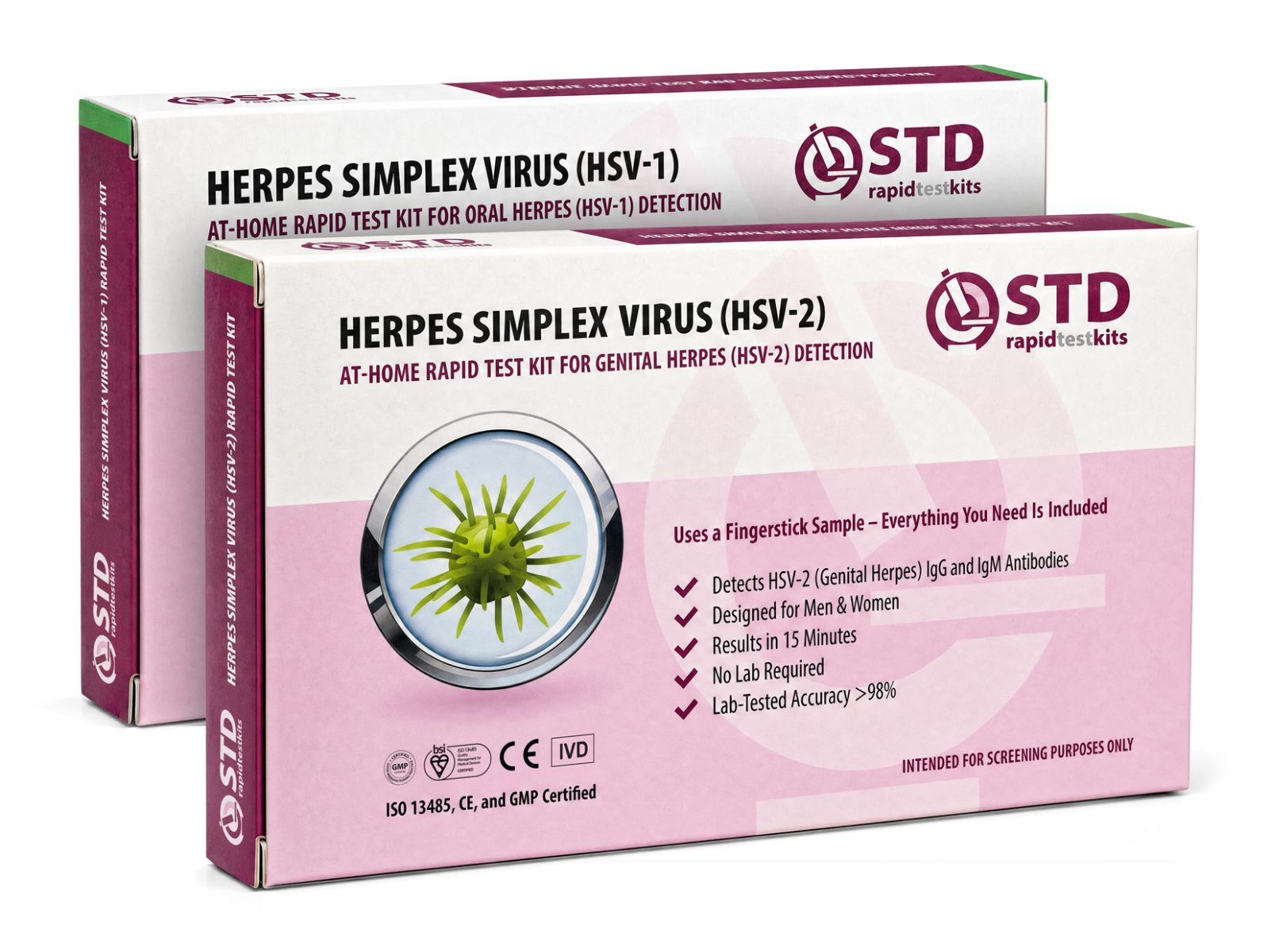
- Our home herpes test is a fingerstick blood antibody test. It detects antibodies your immune system makes in response to HSV-1 or HSV-2 infection, after about 12 to 16 weeks. It does not test a sore directly. For an active sore today, a clinician's swab and PCR is the standard of care.
- Is there a single test that covers every STI?
- Not quite. The combination panels on this site cover the most common STIs through a mix of swab and blood samples, but they do not include pharyngeal or rectal swab sites, and the HPV kit is validated for vaginal self-collection in women only. For a complete sexual-health workup including those sites, a clinic visit covers what at-home testing does not.
- U.S. Centers for Disease Control and Prevention. Condom Use overview, including the limits of condom protection against skin-to-skin STIs.
- World Health Organization. Sexually transmitted infections fact sheet, including condom effectiveness and the extra-genital-ulcer limitation.
- U.S. Centers for Disease Control and Prevention. About Genital Herpes, including asymptomatic viral shedding and the limits of condom coverage.
- U.S. Centers for Disease Control and Prevention. About HPV, including skin-to-skin transmission and vaccination guidance.
- U.S. Centers for Disease Control and Prevention. Syphilis treatment guidelines, including transmission via mucocutaneous lesions.
- U.S. Centers for Disease Control and Prevention. About Chlamydia, including the high rate of asymptomatic infection.
- U.S. Centers for Disease Control and Prevention. Annual STI surveillance reports, including U.S. syphilis case trends.
- HIV.gov. HIV testing overview, including window periods for NAT, antigen/antibody, and antibody tests.
