
Published: December 2025 | Last updated: May 2026 | Editorial review and quality control: Martina N.
You meet someone who looks healthy, smells good, talks well, and seems careful with their body. Your gut says safe. In this one specific case, your gut has no idea what it's talking about. Sexually transmitted infections don't show up on the surface of a person. They live in cells, fluids, and tissues that aren't visible during a date, a hookup, or even an annual physical that doesn't include the right tests. That's why a partner can be honest, sober, hygienic, and still pass on chlamydia or HSV-2 without ever knowing they had it.
The reassurance you came here for: if a recent partner tested clear and you're feeling fine, you probably are fine. The catch is that 'probably' isn't a sample size you want to bet your fertility, your liver, or your immune system on. Testing is what turns 'probably fine' into a real answer, and modern at-home rapid tests have made that answer cheap, fast, and private.
Can you tell if someone has an STI by looking at them?
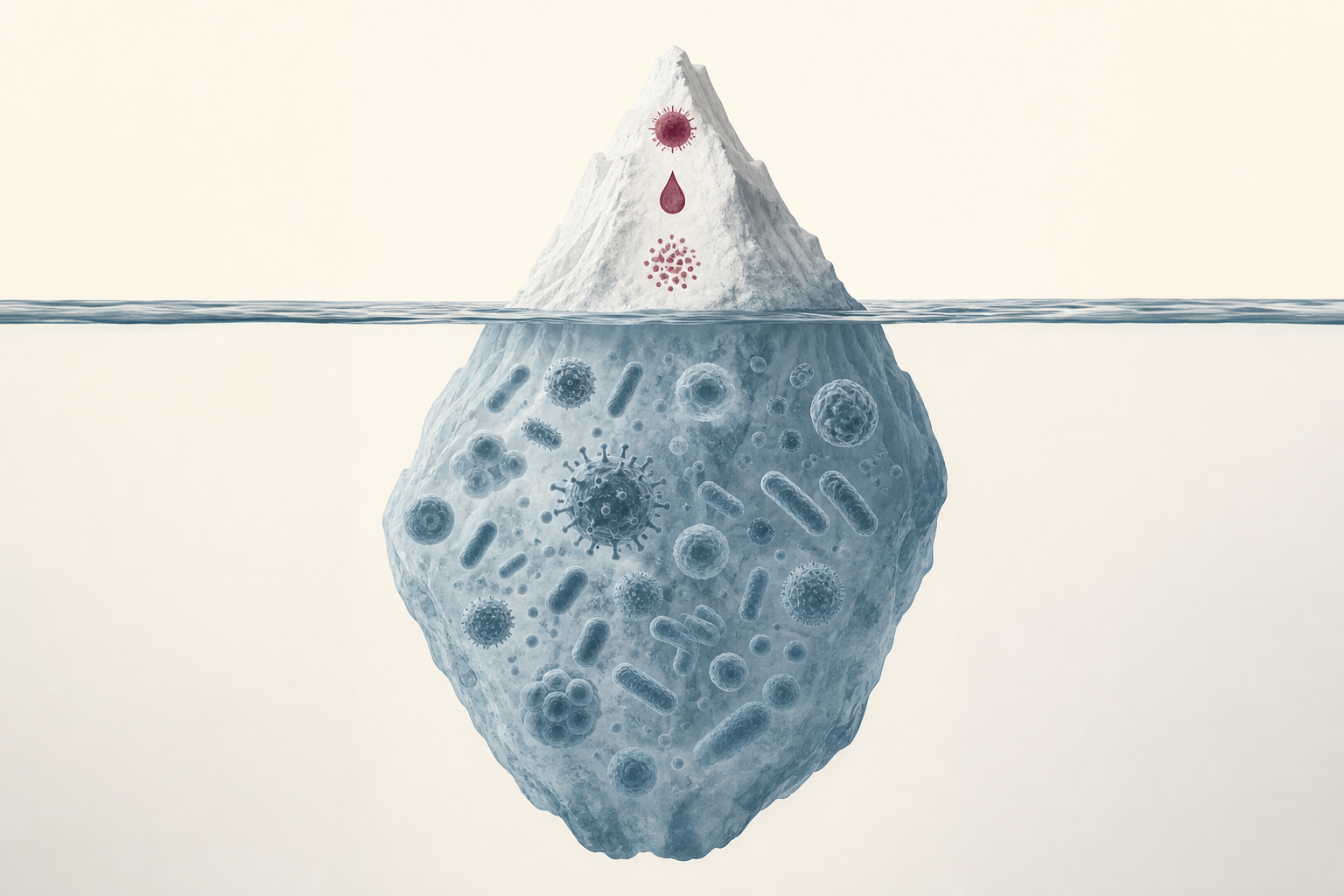
No. Most chlamydia, gonorrhea, herpes, and HIV infections produce no visible symptoms, especially in the early weeks and months after exposure. The CDC states that many STIs cause no symptoms or only mild symptoms, so people can carry an infection without knowing. The only way to be confident in a partner's status, or your own, is a current test result. Rapid lateral-flow home kits return same-day answers for the most common infections in about 15 minutes.
Key Takeaways
- Most women and about half of men with chlamydia have zero symptoms; most people with HSV-2 never recognize an outbreak. Visual checks miss almost everything.
- The CDC recommends routine screening, not symptom-watching. At-home rapid tests cover the most common STIs in about 15 minutes without a clinic visit.
The 'he looked clean' myth costs people their health
The myth survives because it feels true. We are wired to read faces, posture, hygiene, and confidence as health signals, and most of the time those signals work fine. A person with the flu looks tired. A person with strep avoids talking. A person with food poisoning excuses themselves. Sexually transmitted infections break that pattern entirely.
The CDC's overview of sexually transmitted infections is direct on the point: many STIs cause no symptoms or only mild symptoms, so people can have an infection without knowing (CDC STI overview). Public-health surveillance counted more than 2.2 million reported chlamydia, gonorrhea, and syphilis cases in the United States in 2024, and that figure leaves out the silent infections that never get diagnosed (CDC 2024 STI surveillance summary). Most asymptomatic transmission happens because the infections produce no symptoms, mild symptoms easy to confuse with razor burn or yeast irritation, or symptoms that come and go on a schedule the carrier never connects back to a specific exposure.
Here's the part the 'he looked clean' line gets wrong: an STI usually doesn't change a person's appearance until it has been progressing for weeks, months, or in some cases years. Many infections are most contagious in the early window, often before any visible sign would have appeared. So even if your partner would eventually develop symptoms, you can absolutely catch the infection during the silent stretch.
Three things STIs don't care about:
- How clean someone smells.
- How healthy their skin looks.
- How careful they say they are with partners.
People also read a recent doctor visit as a clean bill of health, when most physicals don't include STI tests unless specifically requested. The same applies to the absence of visible sores, unnoticed discharge, or a partner's personal conviction that they would feel something if something were wrong; none of these substitute for an actual test result, and people who report feeling totally fine still test positive at rates close to the general population.
For the most common STIs, more carriers feel fine than don't. Visual checks miss almost everything because the infections evolved to hide from visual inspection in the first place. The only reliable input is a current test result, your own or a partner's, with a date and a test type attached.
How often do STIs actually show no symptoms?
Specific numbers help here, because 'most people don't know' is the kind of phrase that bounces off a brain in dating-mode. Real ranges, with citations:
- Chlamydia. Most women and about half of men with active chlamydia have no symptoms, per the CDC's chlamydia overview, which describes the infection as one that 'often has no symptoms' and still causes serious health problems (CDC chlamydia overview). Untreated, it can scar the fallopian tubes and contribute to pelvic inflammatory disease and infertility.
- Gonorrhea. Most women with gonorrhea have no symptoms, and rectal infections are even quieter and frequently missed entirely (CDC gonorrhea overview). Our at-home swab kit screens the genital site; a clinic swab is the right tool for throat or rectal exposure.
- Genital herpes (HSV-2). The CDC states that most people with genital herpes have no symptoms or only very mild symptoms, and most carriers never realize they have a herpes infection (CDC herpes overview). Mild symptoms get mistaken for ingrown hairs, razor burn, friction, or yeast irritation.
- HIV. The acute phase causes flu-like symptoms in some people, but a substantial fraction notice nothing. The CDC describes a chronic phase (clinical latency) that may last a decade or longer with no symptoms while HIV continues to replicate and remain transmissible (CDC HIV overview).
- Syphilis. The first-stage chancre is usually firm, round, and painless, which the CDC notes makes it easy to miss entirely (CDC syphilis overview). It heals on its own in a few weeks. The infection then moves into the bloodstream and continues for years if untreated.
- HPV. Most HPV infections clear naturally within two years and never cause noticeable changes (CDC HPV overview). The high-risk strains that drive cervical and other cancers don't typically produce visible symptoms until cellular changes are well underway.
Add the patterns up and the takeaway is consistent: for the most common STIs, more carriers feel fine than don't, which means looking at someone tells you almost nothing about their actual status.
The CDC's screening recommendations are built around routine testing for sexually active adults rather than symptom-based testing (<a href="https://www.cdc.gov/std/treatment-guidelines/screening-recommendations.htm" target="_blank" rel="noopener">CDC STI screening recommendations</a>). Frequency depends on age, sexual activity, and risk factors; intervals cover chlamydia, gonorrhea, syphilis, HIV, and hepatitis. The guidance is built around screening because symptom-watching misses the carriers who feel fine, which for the most common STIs is a majority of carriers.
Six common STIs and how quietly each one can hide
The table below summarizes what the most common asymptomatic STIs are doing while a carrier feels fine, plus the sample type our at-home rapid kits use. Two notes on the technology: our home kits are lateral-flow rapid tests, not lab nucleic acid amplification tests, and a positive home result is worth confirming with a clinic. They are screening tools, fast and private, and they do that job well.
One product-scope note before the table. Our HPV at-home kit is validated for vaginal self-swab only. Male readers concerned about HPV should plan a clinic visit; we don't currently sell a male-compatible HPV home test. The same is true for trichomoniasis. Our other rapid kits, including the multi-STI panels, work for any-gender users.
| STI | Asymptomatic rate | What untreated infection can do | Sample type for at-home test |
|---|---|---|---|
| Chlamydia | Most women, about half of men | PID, fallopian tube damage, infertility, chronic pelvic pain | Self-collected genital swab |
| Gonorrhea | Most vaginal cases silent; throat and rectal often silent | Joint inflammation, infertility, raised HIV susceptibility | Self-collected genital swab |
| Genital herpes (HSV-2) | Most carriers undiagnosed | Recurrent outbreaks; transmission to partners and newborns | Fingerstick blood antibody test |
| HIV | Often years without symptoms after acute phase | Immune-system damage; opportunistic infections without treatment | Fingerstick blood antibody-antigen test |
| Syphilis | Early sores often unnoticed or internal | Damage to brain, heart, nerves if untreated | Fingerstick blood antibody test |
| HPV | Most cases silent; many clear naturally | High-risk strains: cervical and other cancers; some genital cancers in men | Vaginal self-swab (women only) |
Why your brain keeps trusting looks over labs
Humans assess threat in milliseconds using visual cues that worked well for most of evolutionary history, when 'looks healthy' was a reasonable proxy for 'can hunt with us tomorrow.' This isn't a character flaw; it's a mismatch between an ancient shortcut and a modern pathogen that learned to avoid detection. STIs evolved a workaround: don't damage the host's appearance, just keep replicating.
In dating and hookup contexts the bias compounds. Attraction releases neurochemistry that biases us toward trust. Your brain wants the answer to be that this person is safe, because the alternative interrupts the experience you're already invested in. Studies in social psychology and sexual decision-making consistently find that perceived attractiveness lowers risk perception, raises trust ratings, and reduces the probability of using a condom or pausing for a testing conversation.
None of that is unique to one gender, age group, or sexual orientation. The pattern is universal because the underlying mechanism is universal. What's specific is the cost of acting on it: a few hours of intimacy can transmit an infection that takes months or years of treatment, monitoring, or lifelong management to address.
The fix isn't suspicion. It's structure. Replace 'trust your gut about a partner's health' with 'trust your gut about a partner's character; trust a test about their biology.' Most people never separate those two judgments, which is exactly why infections pass between partners who are otherwise honest with each other.
Why 'clean' is the wrong word, and what to say instead
The phrase 'I'm clean' is the most common mistake in modern sexual-health conversation. It does three damaging things at once.
First, it implies that people who do have an STI are dirty. That framing is medically wrong (most STIs are common, treatable, and don't reflect any personal hygiene failing) and socially harmful. It pushes anyone with an active or past infection toward shame, which delays testing and treatment for everyone.
Second, 'clean' is unverifiable. It can mean 'I tested last year before any of my recent partners,' 'I don't currently see anything unusual,' 'my last partner said they were clean too,' or simply 'I want to skip this conversation.' Without a date and a test type, the word means nothing.
Third, 'clean' shuts down the conversation. Someone who says it is signaling that they consider the topic closed. If you ask a follow-up, you risk seeming distrustful. The dynamic is exactly why couples skip the testing step that would have caught the infection.
The replacement phrase is short and works in any tone: 'I tested negative for [X] on [date]. What about you?' Add specificity for the infections that matter to you. If a partner can't or won't answer with the same detail, you have your answer about whether to wait, to use protection that covers as much as possible, or to move on.
Instead of 'clean,' say: 'I tested negative for [chlamydia, gonorrhea, HIV, syphilis, HSV-2] on [date]. What about you?'
The date and the test type are what turn a vague claim into a useful one. If a partner can't supply either, you still have a useful answer about how to proceed.
When to test, even if you feel fine
The CDC's screening recommendations for sexually active adults include annual chlamydia and gonorrhea screening for women under 25 and for older women with new or multiple partners; HIV screening at least once for everyone aged 13 to 64 (opt-out); and additional annual screening for men who have sex with men, people with multiple recent partners, and anyone whose partner's status is uncertain (CDC STI screening recommendations). CDC guidance is the minimum baseline, not the recommended personal standard. Above that baseline, any of the following are clear triggers for an extra test:
- A new sexual partner in the last 30 to 90 days, especially if a condom wasn't used every time.
- A partner you trust telling you they tested positive for anything.
- A condom break, slip, or non-use in a moment when you would normally have used one.
- Any genital symptom that isn't clearly explained by something familiar (a known yeast pattern, a known razor reaction).
- Pregnancy planning. Several STIs affect pregnancy outcomes and newborn health.
- Restarting after a long gap in sexual activity. The window for prior infection has expanded.
One mechanical detail: test timing relative to exposure matters. Chlamydia and gonorrhea swabs become reliable around 7 to 14 days after exposure. HIV antibody-antigen tests reach reliability around 18 to 45 days depending on the assay. For HSV-2 IgG antibody testing after a suspected exposure, the CDC's STI Treatment Guidelines recommend repeat type-specific antibody testing 12 weeks after the presumed time of acquisition, since false-negative results are more frequent at early stages of infection (CDC STI Treatment Guidelines, herpes section). If your exposure is recent, test now AND retest after the appropriate window. The first test catches established infections, the second catches anything newly seroconverting.
Many STIs have no symptoms or may only cause mild symptoms, so people can have an infection but not know it.
How at-home rapid testing fits into modern sexual health
The rapid home kits described below are sold by STD Rapid Test Kits; the links go directly to our product pages. We recommend tests based on fit-for-purpose for the reader's concern, not commercial benefit.
Five years ago, getting tested usually meant scheduling a clinic visit, asking specifically for the panel you wanted (most 'physicals' don't include STI testing), and waiting up to a week for results. The friction was the point of failure. People who would have tested simply didn't.
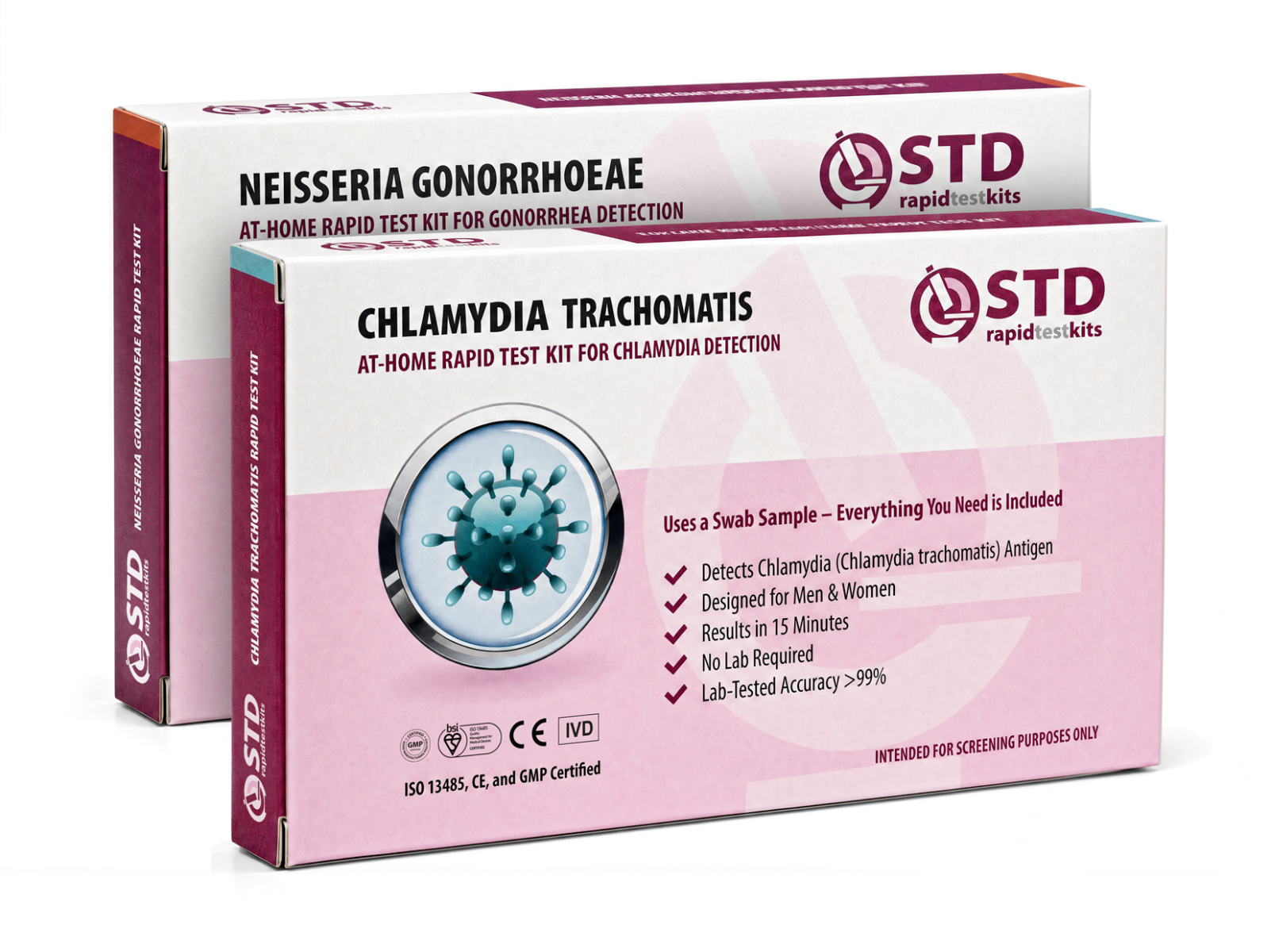
Lateral-flow rapid home tests change the math. They use the same sample types lab tests use (a self-collected vaginal or penile swab for chlamydia and gonorrhea, a fingerstick drop for HIV, syphilis, hepatitis B, hepatitis C, and the herpes panels), run in about 15 minutes, and don't require a clinician to read the result.
What home tests are good at:
- Speed. A result in the time it takes to make coffee.
- Privacy. No clinic, no pharmacist, no shipping a sample to a lab.
- Repeatability. You can test, wait through a window period, and test again.
- Couple-friendliness. Two kits, one conversation, two answers.
What they don't replace:
- Throat or rectal swab testing. We don't sell those; a clinic does. If your exposure was oral or anal, plan a clinic visit for those sites.
- Lab confirmation of a positive result. A positive home test is a strong signal worth confirming with a lab NAAT (nucleic acid amplification test) and getting treated for. Treatment requires a clinician.
- HPV screening for men. Our HPV kit is validated for female anatomy only.
Home rapid tests are screening tools; lab NAATs are confirmation tools. The two are complementary, both useful. Pretending one fully replaces the other is what the previous generation of sketchy direct-to-consumer kits did, and it's not what we sell.
Our rapid kits screen for HIV, syphilis, hepatitis B and C, HSV-1 and HSV-2 antibodies, chlamydia, gonorrhea, trichomoniasis (women), and HPV (women). They use the same sample types as lab tests; they don't replace lab confirmation of a positive result. We don't sell pharyngeal or rectal swabs, urine NAATs, or male-anatomy HPV / trich kits; for those, plan a clinic visit.
How to bring up testing without killing the mood
The hardest version of this conversation is the one you imagine in your head, where saying the word 'test' feels like accusing someone of being dirty. The actual version is simpler if you frame it as something you do, not something they have to prove.
One framing that consistently works is to treat testing as something you already do: 'I get tested every few months as a baseline. When were you last tested?' Another is to make it a shared activity rather than a request for proof: 'Want to do a quick home test together this weekend? It's about 15 minutes and we both get results.' If you want to be direct: 'I'd feel more relaxed if we both had recent results before this gets physical.'
What to do if a partner reacts badly to any of the above. Their reaction tells you a lot about how they handle the broader topic of sexual health. Someone who treats a polite testing question as an insult is showing you how the relationship will handle anything more serious, a useful signal to have early rather than after an infection has been shared.
One nuance: if a partner discloses a positive status (HSV-2, HIV with an undetectable viral load, HPV history), the conversation deserves more than a one-line response. People living with manageable STIs are not unsafe partners by default. Modern medication regimes (suppressive antivirals, antiretroviral therapy, HPV vaccination) dramatically reduce transmission risk. The right move is to learn the specifics of their situation, not to walk away by reflex.
The frame that works best is parallel: you mention your own testing routine, then ask about theirs. The setup positions both partners as equals instead of casting one as the inspector and the other as the applicant. If a partner can't reciprocate the openness, the information itself is worth having before becoming intimate.
Bottom line: trust the person, trust the test
The 'clean' myth costs people health, time, fertility, and in rare cases life. It costs them because it's a substitute for information they could have had in 15 minutes. The replacement for the clean myth is a habit, not an accusation: when sexual activity changes (new partner, restart after a gap, condom failure), test. Don't wait for symptoms, because for the most common STIs, there usually aren't any.
Your partner can be honest, kind, healthy-looking, and infected. You can be all of those things and infected. The pattern is a property of the infections themselves rather than any individual person, and treating it as a property of biology rather than character is what makes the conversation easy and the testing routine.
When something changes (a new partner, a condom failure, restarting after a long gap), test. Don't wait for symptoms. For the most common STIs, there usually aren't any.
FAQs
- Can I have an STI with no symptoms at all?
- Yes, very commonly. Most chlamydia, gonorrhea, herpes, HIV, and HPV infections produce no symptoms in the early stages, and many never produce noticeable symptoms at all. Routine testing is the only reliable way to know.
- Does a partner saying 'I'm clean' mean I'm safe?
- No. 'Clean' usually means 'I haven't noticed anything' or 'I tested at some point in the past.' Without a recent test result for the specific infections that matter, the word doesn't tell you anything reliable. Ask for a date and a test type.
- How soon after exposure should I test?
- The safest approach: test once now to catch anything already established, then test again once the window closes for whatever infection you're most concerned about. As a quick reference for assay windows: chlamydia and gonorrhea (1 to 2 weeks); HIV combo antigen/antibody (around 18 to 45 days, depending on the assay); HSV-2 IgG (CDC recommends repeat testing at 12 weeks if HSV-2 acquisition is suspected). For any home kit, check the package insert for the assay-specific window before relying on a single negative result.
- Are at-home rapid tests as accurate as lab tests?
- Home rapid tests use the same sample types as lab tests but use lateral-flow chemistry rather than NAAT. They are high-quality screening tools, and a positive result is worth treating as a positive and confirming with a clinician. For the highest analytical sensitivity, especially right at the edge of a window period, a lab NAAT is the gold standard.
- Can I get an STI without penetration?
- Yes. Herpes, HPV, and syphilis can transmit through skin-to-skin contact alone. Gonorrhea, chlamydia, and syphilis can transmit during oral sex. The risk per act is lower than with penetrative sex, but it's not zero.
- Should I retest after every new partner?
- If you're not in a mutually-monogamous-and-tested relationship, yes. After a new partner, after a condom failure, or after any period of multiple partners, a screening test catches anything that came in. The CDC recommends at least annual screening for sexually active adults regardless.
- What's the most common STI someone could be carrying without knowing?
- HPV is the most prevalent overall, and most cases clear naturally without symptoms. Among the infections most worth catching early, chlamydia and HSV-2 lead the silent-carriage rankings.
- Will the home test packaging be discreet?
- Yes. Our packaging is plain and unbranded. Nothing on the outside indicates what's inside. Shipping is private and the same as any other small parcel.
- U.S. Centers for Disease Control and Prevention. About sexually transmitted infections: many STIs cause no symptoms and people can have an infection without knowing.
- U.S. Centers for Disease Control and Prevention. 2024 STI surveillance summary: more than 2.2 million reported chlamydia, gonorrhea, and syphilis cases in the United States.
- U.S. Centers for Disease Control and Prevention. About chlamydia: chlamydia often has no symptoms but can cause serious complications including PID and infertility.
- U.S. Centers for Disease Control and Prevention. About gonorrhea: most women with gonorrhea have no symptoms; rectal infections often silent.
- U.S. Centers for Disease Control and Prevention. About genital herpes: most people with herpes have no symptoms or only mild symptoms and don't know they're infected.
- U.S. Centers for Disease Control and Prevention. About HIV: chronic-phase HIV may last a decade or longer with no symptoms while remaining transmissible.
- U.S. Centers for Disease Control and Prevention. STI Treatment Guidelines, 2021: Genital HSV infections, type-specific antibody testing, and recommended retest at 12 weeks after suspected acquisition.
- U.S. Centers for Disease Control and Prevention. STI screening recommendations: specific intervals for chlamydia, gonorrhea, syphilis, HIV, and hepatitis by age, sex, and risk group.
- World Health Organization. Sexually transmitted infections fact sheet: global burden, screening principles, and prevention.
