Penis Discharge in the Morning: STDs, UTIs, and Other Causes
Waking up to an unfamiliar drip on your boxers turns into a long Google session pretty fast. Sometimes it points to an early bacterial STI like chlamydia or gonorrhea. Sometimes it is prostate fluid, irritation, or a urinary tract infection. This guide walks through how to read the color, the timing, and the surrounding symptoms, plus when home testing makes sense and when to head to a clinic instead.




- Yellow, green, or thick cloudy discharge is a red flag for bacterial STIs (most often gonorrhea), particularly when it follows unprotected sex in the last 2 weeks.
- Clear or thin white morning discharge can also come from chlamydia, prostatitis, urethral irritation, or a UTI; testing is the only way to tell them apart.
Published: November 2025 | Last updated: April 2026 | Editorial review and quality control: Martina N.
Waking up to an unfamiliar drip on your boxers turns into a long search history fast. The reflex is panic, then shame, then more searching. The honest answer to whether this is a sexually transmitted infection, a stressed prostate, a urinary tract infection, or just irritation from a new soap depends on three things: the color of the discharge, when it started, and what has been happening sexually in the last few weeks. The rest of this article walks through each possibility using what the CDC and NHS actually publish about urethral discharge in men.
One thing worth knowing up front: many people with chlamydia, the most common bacterial STI, notice no symptoms at all. So a small amount of discharge, even without pain or burning, can be the only signal something needs attention. It is also common for the cause to turn out to be non-sexual, particularly in men who have not had a recent partner change. Both outcomes are normal results of testing; the goal of this article is to help you decide whether testing is the right next step.
So is morning penile discharge an STI or not?
It can be either. Cloudy, yellow, or green discharge points strongly toward a bacterial STI like gonorrhea, chlamydia, or trichomoniasis, especially if you have had unprotected sex in the last 1 to 4 weeks. Clear or thin white discharge can come from chlamydia but also from prostatitis, a urinary tract infection, or simple irritation. The most reliable testing window for chlamydia and gonorrhea is 7 to 14 days after exposure; testing earlier risks a false negative. If discharge is yellow, green, foul-smelling, or accompanied by burning or testicular pain, treat it as urgent and test promptly.
Key takeaways
- Yellow, green, or thick cloudy discharge is a red flag for bacterial STIs (most often gonorrhea), particularly when it follows unprotected sex in the last 2 weeks.
- Clear or thin white morning discharge can also come from chlamydia, prostatitis, urethral irritation, or a UTI; testing is the only way to tell them apart.
Why this morning drip is worth a closer look
The urethra (the tube that runs through the penis) does not normally leak fluid outside of sexual arousal or right after urination. Pre-ejaculate during arousal is expected. A few drops of cloudy fluid right after peeing can come from the prostate or seminal vesicles and is generally fine. What sets up real concern is fluid that appears overnight, while sleeping or right after waking, with no recent sexual activity to explain it.
The other category to keep in mind is non-infectious irritation: harsh soaps, fragranced laundry detergents, tight underwear, latex allergy, prolonged friction during sex, or topical lubricants. These can produce a small amount of clear or slightly cloudy fluid that resolves once the irritant is removed. Plenty of men spend a week worrying about an STI, switch laundry detergent, and the discharge disappears on its own.
The fork in the road is whether you have had a sexual contact in the last month or so. If yes, infectious causes lead the differential. If no, non-infectious causes (and prostatitis, which we cover below) become more likely, but infectious causes do not drop to zero, since chlamydia in particular can sit silent for weeks before producing a symptom.
Clinicians group infectious causes of penile discharge under the term urethritis, meaning inflammation of the urethra. According to the <a href="https://www.cdc.gov/std/treatment-guidelines/urethritis-and-cervicitis.htm" target="_blank" rel="noopener">CDC treatment guidelines for urethritis and cervicitis</a>, men with urethritis can have discharge that is clear, white, yellow, or green, sometimes with burning during urination and sometimes with no pain at all. Asymptomatic infection is common, particularly with chlamydia, which is part of why morning discharge gets ignored for weeks before someone finally tests.
Bacterial STIs that cause penile discharge
Three bacterial infections produce most cases of STI-related discharge in men: chlamydia, gonorrhea, and trichomoniasis. Mycoplasma genitalium is a fourth that home rapid kits do not detect. Each has its own pattern, though they overlap enough that the discharge alone cannot diagnose any of them.
Chlamydia. The most common reportable bacterial STI in the United States. The CDC chlamydia fact sheet opens by stating that chlamydia often has no symptoms, and notes that symptoms may not appear until several weeks after having sex. The NHS chlamydia page uses similar wording: most people who have chlamydia do not have any symptoms. When symptoms in men do appear, the discharge is typically thin, clear or slightly cloudy, sometimes with mild burning when urinating. Subtle enough to miss until it stains underwear in the morning. Clinical references commonly summarize the earliest-onset window as 1 to 3 weeks, an editorial summary that is not a specific CDC-published figure.
Gonorrhea. Per the CDC gonorrhea page, the discharge in men is white, yellow, or green, alongside painful or burning urination and painful or swollen testicles. Onset is generally faster than chlamydia. Clinical references commonly cite a 2-to-14-day window from exposure to first symptoms; that range is an editorial summary, not a figure published on the CDC page itself. Untreated gonorrhea can climb to the epididymis (the coiled tube behind each testicle) and cause swelling, fever, and fertility problems.
Trichomoniasis. Less common in men than in women but possible. When men do develop symptoms, the discharge is usually clear or slightly white, sometimes frothy, with mild irritation or itching inside the penis. Men with trichomoniasis are often asymptomatic but can still transmit it to sexual partners, which is part of why CDC screening guidance covers symptomatic male contacts of women diagnosed with trichomoniasis.
Mycoplasma genitalium. A less commonly tested but increasingly recognized cause of urethritis, particularly in cases where chlamydia and gonorrhea have been ruled out and discharge persists. Standard at-home rapid swab kits do not detect it. If you have negative chlamydia and gonorrhea results but ongoing discharge, ask a clinic about specific mycoplasma testing.
Chlamydia often has no symptoms.
When discharge isn't an STI
Plenty of men with morning discharge do not have a sexually transmitted infection. The four most common non-STI causes are worth knowing because they each look different, respond to different treatment, and need different follow-up.
Prostatitis. Inflammation of the prostate gland, which sits beneath the bladder and produces seminal fluid. Bacterial prostatitis can produce a sticky white or milky discharge, particularly first thing in the morning, often with a deep ache in the pelvis or lower back. Nonbacterial prostatitis, also called chronic pelvic pain syndrome, is more closely tied to long periods of sitting, stress, dehydration, and infrequent ejaculation. Long-haul drivers, desk workers under chronic stress, and men who go weeks without ejaculation are over-represented in prostatitis cases. The fluid pattern can look almost identical to a mild STI but does not respond to STI antibiotics.
Urinary tract infection (UTI). Less common in men than in women, but still possible, particularly in older men or men with prostate enlargement. UTI-related discharge is usually milky or cloudy, mixed with the first stream of urine, and accompanied by frequent urination, urgency, and burning. UTIs in younger men should always be checked for an underlying cause, including STIs.
Non-gonococcal urethritis from irritants. The catch-all term for urethritis that is not caused by gonorrhea. Sometimes the cause is chlamydia, mycoplasma, or trichomoniasis (still an STI). Other times the trigger is chemical irritation from a new soap, bubble bath, fragranced laundry detergent, or condom material allergy. The discharge is usually clear, scant, and resolves once the irritant is removed.
Post-ejaculatory leakage. After ejaculation, even from a sexual dream during sleep, a small amount of residual seminal fluid can appear in underwear hours later. This is mechanical, not pathological, and usually small in volume with no smell.
STI discharge: typically yellow, cloudy, or persistent over multiple mornings. Often follows a sexual contact in the last 1 to 4 weeks. May come with burning urination, itching, or tender testicles.
Non-STI discharge: usually clear, scant, mostly in the morning only, and resolves on its own once an irritant is removed or the prostate calms down. Often has no smell and no other symptoms.
Either way: if discharge is new and you cannot pin it on a clear non-sexual cause, testing is the only way to be sure.
Reading the discharge: color, texture, and smell
The look and smell of discharge gives partial clues but never a definitive diagnosis. Two infections can produce nearly identical fluid, and one infection can present completely differently in two people. That said, the patterns below tend to hold up across the published guidance.
Color is the most reliable rough sorter. Yellow, green, or grey-green almost always points to a bacterial infection, most often gonorrhea. Thick consistency reinforces that. Clear or slightly cloudy fluid covers the widest range of causes, from chlamydia to non-gonococcal urethritis to irritation. Milky white sits between, leaning toward chlamydia, prostatitis, or post-ejaculatory leakage.
Smell matters less than color but is not nothing. A strong fishy or fetid odor usually indicates active bacterial growth, often co-infection with multiple organisms. Discharge with no smell does not rule out infection (chlamydia is famously odorless), but a foul smell on its own should push you toward testing within days, not weeks.
Volume changes between infections too. Gonorrhea typically produces enough discharge to visibly stain underwear or appear at the tip of the penis without provocation. Chlamydia is often a small amount that has to be expressed by gently squeezing the urethra in the morning before urinating, which is part of why it gets missed. Prostatic discharge is usually only present first thing in the morning and disappears once you have urinated.
One pattern that should not be ignored: discharge that changes character over time. If it starts clear, then becomes cloudy, then turns yellow over several days, the underlying cause is often a bacterial infection that is progressing. That progression is a testing cue regardless of whether pain is present.
Yellow or green: bacterial infection, most often gonorrhea. Test promptly.
Cloudy or milky white: chlamydia, prostatitis, or post-ejaculatory leakage. Context decides which.
Clear or slightly cloudy: the widest range, from early chlamydia to simple irritation. Recurrence over multiple mornings is the testing cue.
Foul-smelling at any color: active bacterial growth, often co-infection. Test within days, not weeks.
STD vs non-STD discharge at a glance
The table below summarizes the most common patterns. It is a starting point for asking whether testing makes sense; it does not replace testing. A clinician or a properly timed home test is the only way to confirm what is causing discharge in any specific case.
| Condition | Discharge appearance | Other symptoms | STI? |
|---|---|---|---|
| Gonorrhea | Yellow or green, thick, pus-like | Burning urination, tender testicles, sometimes fever | Yes |
| Chlamydia | Clear or slightly white, often thin and scant | Mild burning or none at all in many men | Yes |
| Trichomoniasis | Clear or white, sometimes frothy, mild odor | Itching inside the penis, slight burning | Yes |
| Mycoplasma genitalium | Clear or cloudy, persistent over weeks | Mild burning, often follows negative chlamydia/gonorrhea tests | Yes |
| Bacterial prostatitis | White or milky, sticky, mostly in the morning | Pelvic or lower back ache, weak urine stream, urgency | No |
| Urinary tract infection | Milky or cloudy, mixed with urine | Frequent urination, urgency, burning | No |
| Irritant urethritis | Clear, scant, resolves quickly | Mild irritation; new soap, detergent, or condom material in use | No |
| Post-ejaculatory leakage | Clear or slightly white, small volume | No other symptoms; follows ejaculation or arousal | No |
When to test, and when to retest
Window periods matter more than people expect. Test too early and a real infection looks negative because there is not yet enough bacterial load for a swab or urine test to detect. Test too late, particularly without symptoms, and you have already had weeks of potential transmission risk to a partner.
For chlamydia, the CDC chlamydia fact sheet states that symptoms may not appear for several weeks after sex when they appear at all; clinical references commonly summarize the earliest-onset window as 1 to 3 weeks, an editorial summary not specifically published on the CDC page. Gonorrhea has a generally faster onset; clinical references commonly cite a 2-to-14-day window from exposure to first symptoms, again an editorial summary rather than a specific CDC-published figure. Most home swab tests achieve their best detection sensitivity around 7 to 14 days after exposure. Lab nucleic-acid amplification tests (NAATs) used in clinics have a similar window, though they can detect lower bacterial loads earlier in the incubation period than home rapid kits can. Testing on day 1 or 2 risks a false negative; waiting beyond 21 days without retesting risks missing an asymptomatic infection that has already been transmitting.
Trichomoniasis follows a similar 5-to-28-day window, with peak detectability around 14 days. Mycoplasma genitalium can take 1 to 3 weeks for reliable detection and currently requires clinic testing rather than a home rapid kit.
The retest rule of thumb: if you test within the first week after exposure and the result is negative but symptoms persist, repeat the test 2 weeks later. The CDC also recommends a retest at 3 months after treatment for chlamydia and gonorrhea, regardless of partner status, because reinfection from an untreated partner is one of the most common reasons for recurrence. (Disclosure: stdrapidtestkits.com publishes this article and sells the at-home tests linked below; the kits we recommend are matched to the symptom pattern, not to commercial benefit.)
| Your situation | When to test | When to retest |
|---|---|---|
| Morning discharge with no recent sexual contact | Test now to rule out infection | Only if symptoms persist past 2 weeks |
| Discharge after unprotected sex 2 to 5 days ago | Test now for early signal | Retest at the 2-week mark for accuracy |
| Discharge after unprotected sex 7 to 14 days ago | Test now (in the reliable window) | Retest at 4 weeks if symptoms continue |
| Discharge after multiple recent partners | Test now for the full bacterial panel | Retest at 3 months per CDC guidance |
| Discharge after completing antibiotics | Wait 3 to 4 weeks post-treatment | Confirm clearance; retest if discharge returns |
| New discharge after a previous negative test | Test again immediately | Retest in 2 weeks if still symptomatic |
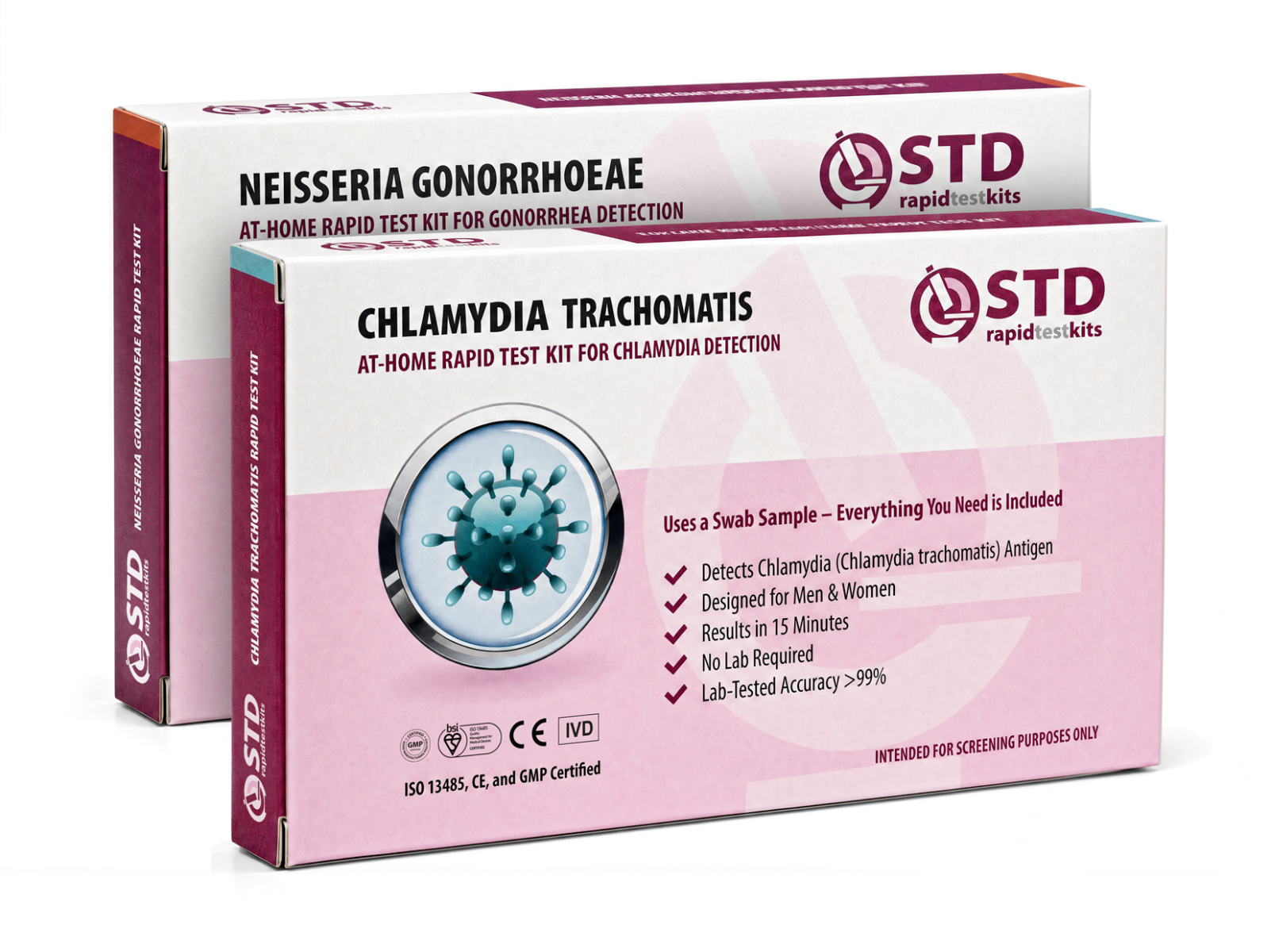
What home testing actually looks like
Home STI tests are not a gimmick or a workaround. Swab-based lateral-flow cassettes use antigen-detection chemistry: antibody-coated strips capture bacterial proteins from the swab sample and produce a visible line if the target is present. Blood-based rapid tests (HIV, syphilis, herpes) measure the patient's own antibody response via a fingerstick sample. Both technologies have decades of clinical use behind them, and both are less analytically sensitive than the lab NAAT or lab serology a clinic would run, which is why a positive home result should always be confirmed by a clinic.
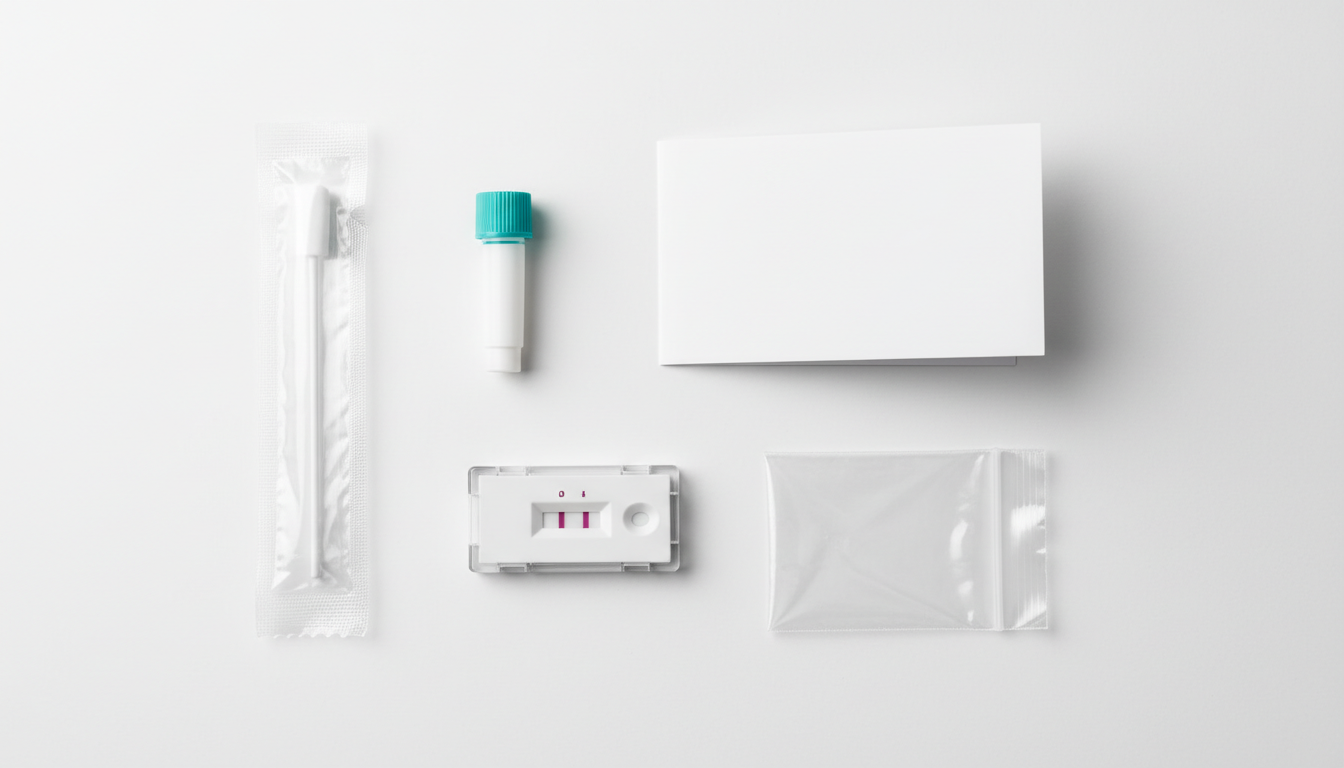
The process for a swab-based test (chlamydia, gonorrhea, trichomoniasis): you receive a kit in plain packaging, typically with a sterile self-collection swab, a buffer tube, a lateral-flow cassette, an instruction card, and sometimes a return envelope if it is a mail-in lab test instead of a rapid in-home test. You self-collect by inserting the swab a short distance into the urethra (the kit's instructions show exactly how far), agitate the swab in the buffer, drop the buffer onto the cassette, and read the result in roughly 15 minutes. Two visible lines means positive; one line on the control means negative; no control line means an invalid test that needs to be redone.
For blood-based tests (HIV, syphilis, hepatitis B, hepatitis C), the process is a fingerstick blood draw with a small lancet onto a cassette, then the same 15-minute read window. Combination kits include both swab and fingerstick components in one package, with separate cassettes for each infection.
What home testing cannot do: replace a clinic NAAT for confirming a positive, test for mycoplasma genitalium, or evaluate complications like epididymitis. If you test positive at home, the standard next step is a clinic visit to confirm and get the right antibiotic prescription. If you test negative but symptoms persist past two weeks, that is also a clinic visit, since mycoplasma or a non-STI cause may be responsible.
Why waiting it out can backfire
The instinct to wait a few days and see if the discharge clears on its own is understandable. If the cause is irritation from a new soap or post-ejaculatory leakage, waiting is genuinely fine and the discharge resolves. If the cause is a bacterial STI, waiting is the worst possible response, because none of these infections clear without antibiotics.
Untreated chlamydia and gonorrhea can ascend the urethra into the epididymis and prostate. Epididymitis is a common downstream complication of untreated bacterial urethritis in young men; the most common cause in men under 35 is exactly this scenario, an untreated STI that climbed. Symptoms include severe testicular pain, swelling, and fever, often requiring an emergency-room visit and a longer course of antibiotics than would have been needed for the original urethritis.
Untreated gonorrhea also has a small but documented risk of disseminating into the bloodstream, producing skin lesions, joint pain, and rare but serious complications like endocarditis or meningitis. The risk is low in any individual case but high enough that the CDC recommends prompt treatment in every confirmed case.
For chlamydia specifically, the long-term concern in men is reduced fertility through epididymal scarring. The risk per single untreated infection is small, but it accumulates over multiple infections and over months of untreated carriage. Treatment is a short antibiotic course; the cost-benefit math heavily favors testing and treating early.
Discharge plus testicular pain, swelling, or fever can mean the infection has already reached the epididymis. This needs same-day or next-day medical attention, not a home test. Go to a clinic or urgent care; a home rapid kit does not evaluate the complication and can delay the right treatment.
Talking to a partner without making it weird
If your test comes back positive, the next conversation is usually with a current or recent partner. The framing matters less than people think; what matters is timing and clarity. The CDC's expedited partner therapy guidance, and most clinic counselors, suggest a short factual message early rather than a long emotional message later: the test was positive, here is the infection, here is when treatment will be done, here is how soon retesting makes sense for them.
For chlamydia and gonorrhea, partners from the last 60 days should be notified and tested. For trichomoniasis, current sexual partners should be notified. For HIV or syphilis (which can also occasionally show up alongside discharge if there is a co-infection), the recommended notification window is longer, often back to the last negative test result. Most jurisdictions also offer anonymous partner-notification services through the local health department, which can deliver the message without naming you if a direct conversation is genuinely not safe.
The most common reason for chlamydia or gonorrhea reinfection is an untreated partner. If both of you treat at the same time and abstain from sex for the recommended seven days afterward, the chance of reinfection drops sharply. If only one of you treats, reinfection is so likely the CDC builds the 3-month retest into its standard guidance specifically to catch it.
Chlamydia and gonorrhea: notify partners from the last 60 days.
Trichomoniasis: notify current sexual partners.
HIV or syphilis: notify back to the last negative test result, which is usually a longer window.
Local health departments can deliver an anonymous notification on your behalf if a direct conversation is not safe.
When to skip the home kit and see a clinic
Home rapid kits work well for the typical case: an otherwise healthy adult with new discharge, no fever, no testicular pain, and a sexual exposure within the last few weeks. They are a fast, private, low-cost way to get a useful answer at home. They are not the right tool for every situation.
Some situations need a clinic the same day, not a home test. Severe testicular pain or swelling, fever above 38°C or chills, visible blood in urine or semen, and inability to urinate are all reasons to skip the kit and go straight to urgent care or an emergency department. Any concern about HIV exposure that needs post-exposure prophylaxis also belongs in clinic same-day, since PEP must start within 72 hours of the exposure to be effective.
Other situations need a clinician's eye but not necessarily that day: persistent discharge after a previous full course of antibiotics, recurrent infections within a few months, pelvic or lower-abdominal pain, or pregnancy in a partner alongside a recent exposure. A clinic appointment within the week, rather than another at-home strip test, is the right move for any of these.
You should also see a clinic, not a home kit, if you have negative chlamydia and gonorrhea results but ongoing discharge. The most likely culprit at that point is mycoplasma genitalium, which home rapid kits do not detect, and which sometimes requires specific antibiotic combinations because of growing resistance to azithromycin and doxycycline.
Home testing and clinic care are complementary, not competing. The home kit is the right starting point for most men; the clinic is the right escalation point when results are unexpected, symptoms are severe, or complications are possible.
Quick decision summary
- New discharge after a sexual contact in the last 1 to 4 weeks: home test for chlamydia + gonorrhea is a reasonable first step.
- Yellow or green discharge, with or without burning: act within days, not weeks; gonorrhea is the leading suspect.
- Negative home result but ongoing discharge after 2 weeks: see a clinic for mycoplasma testing and a fuller workup.
- Discharge with testicular pain, fever, blood in urine, or inability to urinate: skip the home kit and go to urgent care.
Frequently asked questions
- I have discharge but no pain. Could it still be an STI?
- Yes. Many men with chlamydia have no symptoms, and even when discharge appears it can be light enough to miss without underwear staining. Pain is not a reliable filter for whether infection is present. If discharge is new, persistent, or follows a sexual contact in the last 1 to 4 weeks, get tested even if you feel completely fine.
- What does gonorrhea discharge look like?
- Any discharge that is yellow, green, or pus-like within two weeks of a sexual contact should be tested promptly. That combination is the classic gonorrhea pattern in men, often with burning during urination or tender testicles, though plenty of cases show only the discharge. Even a single episode warrants testing; delaying risks complications like epididymitis and onward transmission to partners.
- Is clear morning discharge always a problem?
- Not always. Pre-ejaculate from a sexual dream or arousal during sleep is common and not a sign of infection. The pattern that warrants testing is clear discharge that recurs over multiple mornings, comes with itching or burning, or follows a sexual contact within the last 3 weeks. Chlamydia can produce a thin clear discharge that looks indistinguishable from physiological fluid, which is why testing is the only way to be sure.
- How soon after sex can discharge appear?
- Gonorrhea symptoms commonly appear within 2 to 14 days of exposure. Chlamydia commonly takes 1 to 3 weeks, though the CDC notes symptoms may not appear for several weeks at all. Trichomoniasis can take 5 to 28 days, with peak around two weeks. Some men develop noticeable discharge within 24 hours; others go weeks before any symptom shows. There is no universal incubation period, so timing alone cannot rule out infection.
- Can stress or going a long time without ejaculating cause discharge?
- Sometimes. Long periods of sexual abstinence, combined with stress and prolonged sitting, can contribute to chronic prostatitis or what is sometimes called prostatic weeping, where the prostate produces extra fluid that leaks into the urethra. The pattern is usually a small amount of sticky white discharge, particularly first thing in the morning, with no smell. Testing rules out infection before settling on a stress-related explanation.
- Why does penile discharge usually show up in the morning?
- Urination flushes the urethra throughout the day, so any discharge present is mostly washed out. Overnight, with no urination for 6 to 8 hours, fluid that does form can pool at the tip of the penis and become visible on underwear by morning. This is why morning samples are often the most useful for noticing discharge, even if testing itself can be done at any time of day.
- Can I test too early after a possible exposure?
- Yes. Testing within the first 5 days after exposure can produce a false negative because bacterial load has not yet built up enough to be detected. The most reliable testing window for chlamydia and gonorrhea is 7 to 14 days after exposure. If you have symptoms now, test now, and plan a retest at the 2-week mark to confirm.
- Should I avoid sex until I figure out what is going on?
- Yes, until you have a result. Sexual contact while symptomatic risks transmitting whatever is causing the discharge to a partner. The pause is usually only a week or two, less if you test promptly and your result is negative. After a confirmed bacterial STI is treated, the standard guidance is to avoid sex for seven days after finishing antibiotics.

- Centers for Disease Control and Prevention. STI treatment guidelines for urethritis and cervicitis: symptom patterns, bacterial causes of penile discharge, and retesting guidance.
- Centers for Disease Control and Prevention. About Chlamydia: 'Chlamydia often has no symptoms,' and that symptoms may not appear until several weeks after having sex.
- Centers for Disease Control and Prevention. About Gonorrhea: discharge characteristics in men (white, yellow, or green from the penis), complications including epididymitis, and antibiotic treatment guidance.
- NHS. Chlamydia: 'Most people who have chlamydia do not have any symptoms,' typical discharge pattern in men, and asymptomatic carrier framing for the UK population.