
Published: September 2025 | Last updated: May 2026 | Editorial review and quality control: Martina N.
You had the awkward conversations. You made it feel almost normal to ask questions about sex, protection, or consent. That matters. It also doesn't mean your teen is fully protected. Across the United States, sexually transmitted infections in adolescents and young adults keep climbing, and the rise is showing up in households that thought they had the bases covered.
This guide explains what's driving that gap, what STIs in teens really look like (often: nothing), how the testing system fails them, and the small low-pressure moves at home that move the needle. No alarmism, no shame, no pretending one conversation is enough.
Key Takeaways
- Most STIs in teens are silent. The majority of chlamydia and gonorrhea infections cause no noticeable symptoms, so 'they'd tell me if something was wrong' is not a safety net.
- Knowledge alone doesn't change behavior. The fix is structural: easy private testing, repetition over time, and a household where 'I got tested' is a normal sentence.
Why this guide matters for every parent
Open communication is a meaningful protective factor in adolescent sexual health. CDC adolescent health resources emphasize the role of positive parental practices, including open communication, in supporting teen health outcomes. So if you've been having those conversations, you're already doing something measurable.
The catch is that talking is necessary but not sufficient. Teens absorb information from peers, social media, partners, and porn at the same time they're absorbing it from you. They live with peer pressure, hookup culture, alcohol, and an app-driven dating environment that did not exist when most parents were figuring out their own sexual health. Even teens who can recite the risks back to you accurately may not act on them in the moment.
That's the gap this article is about. It's a structural problem, solvable with practical tools added to the conversations you've already started.
CDC adolescent and school health resources highlight positive parental practices, including open communication, as part of a supportive environment for teen health.
The silent epidemic: what STIs look like in teens
The single most important thing for a parent to understand is this: most STIs do not announce themselves. A teen can be infected for months and feel completely fine.
Chlamydia is the clearest example. It's the most commonly reported bacterial STI in U.S. adolescents and young adults, and the CDC's chlamydia overview states that chlamydia often has no symptoms even when it is causing health problems internally. When symptoms do show up, they tend to be subtle: a little discharge, mild burning when urinating, slight pelvic discomfort, a sore throat after oral sex, or an irritation easy to write off as something else.
Gonorrhea behaves similarly. The CDC's gonorrhea overview notes that rectal infections often cause no symptoms, and pharyngeal infections frequently produce nothing noticeable as well. HPV, which is now extremely common in sexually active young people, almost always shows nothing visible at all.
So the assumption that 'I'd notice if my teen had something' is the assumption to retire first. The point isn't whether they'd tell you. There's often nothing to tell.

Why "The Talk" isn't working by itself
One conversation, even a great one, has a short half-life. Teens face dozens of small decisions a year that have nothing to do with the chat you had two summers ago. Adolescent decision-making is also developmentally limited: the prefrontal cortex, the part of the brain that weighs long-term consequences, doesn't finish maturing until the mid-20s, as NIMH's overview of the teen brain describes. Delayed long-term-consequence weighing is predictable at this stage of brain development, not a character flaw.
There's also a timing problem. Parents often wait for the "right moment" to bring up testing. Teens almost never volunteer the information that creates that moment, so testing only comes up after a scare, a symptom, or a friend's diagnosis.
And then there's the message-versus-meaning gap. Many teens hear "you can always come to me" as "please don't actually need to." In families where being responsible is core to the family identity, admitting a sexual mistake can feel like admitting failure. So they don't.
| Parent assumption | Common teen reality |
|---|---|
| "They'd tell me if they had sex." | Many teens conceal activity to protect how parents see them, even when the parent is supportive. |
| "We talked about condoms." | Condoms get used inconsistently, especially during oral sex, first-time encounters, or after drinking. |
| "They know the risks." | Knowing isn't the same as acting on it under pressure. Risk knowledge does not predict risk behavior. |
| "They'd notice symptoms." | The majority of bacterial STIs in young people are asymptomatic. There may be nothing to notice. |
| "Oral sex doesn't really count." | Gonorrhea, syphilis, herpes, and HPV all transmit through oral sex; throat infections are typically silent. |
The testing problem: access, shame, and false reassurance
Even when a teen has decided they should get tested, doing it is a gauntlet. Clinics feel intimidating. School nurses may not be set up to refer for STI testing. Many teens fear being recognized in a waiting room. And if the family insurance plan is used, the explanation-of-benefits letter mailed to the household can out them.
Most U.S. states allow minors to consent to confidential STI testing and treatment, but the rules vary by state and the system is hard to navigate at 16. The Guttmacher Institute has tracked state-by-state minor consent policies; check their policy pages or contact them directly for current guidance on what your teen can do where you live.
The result is a population of teens who know testing exists, intend to do it eventually, and never quite get there. CDC STI surveillance reporting has consistently shown that adolescents and young adults bear a disproportionate share of new STI cases in the United States relative to their share of the sexually active population. The gap is access, not awareness.
Condoms are highly effective against fluid-borne infections like HIV, gonorrhea, and chlamydia when used correctly every time. They are less protective against skin-to-skin infections like herpes and HPV, where a lesion or shedding area can sit outside the covered skin. Condoms substantially lower risk for most STIs, and routine testing covers what condoms miss.
Why even "good" teens take risky chances
The cliché that responsible teens make safer choices is half true. They make safer choices on average. They still make risky ones in specific situations: when alcohol is involved, when a partner pushes back on protection, when the relationship feels serious, or when they assume same-gender sex doesn't carry STI risk.
That last one is a particularly dangerous gap. Sex education curricula in many U.S. states focus on heterosexual penetrative sex and skip over oral sex, digital contact, and same-gender encounters. Gonorrhea, herpes, syphilis, and HPV all transmit through these routes. When teens don't see themselves represented in the risk messaging, they often assume the messaging doesn't apply to them. Then they don't test.
Shame compounds the problem. A teen who took a risk they were warned about often feels they don't "deserve" to ask for help, so they sit with the worry instead of resolving it. The job at home is to make testing feel like routine maintenance, not a confession.
- Alcohol involvement during the encounter, when impulse control is lower than usual
- Partner pushback against using protection
- A relationship feeling serious enough that protection seems unnecessary
- Same-gender sex assumed to carry no STI risk because school sex-ed skipped over it
What testing actually looks like and when it should happen
STI testing is not one-size-fits-all. Different infections take different amounts of time to become detectable after exposure (the "window period"), and using the wrong test at the wrong time produces a false reassurance worse than no test at all.
Lab "gold standard" testing for chlamydia and gonorrhea uses a method called NAAT (nucleic acid amplification test). At-home rapid kits, including the lateral-flow tests sold on this site, screen using a different chemistry. They are useful for fast private screening, and a positive result on a rapid test is worth confirming with a lab NAAT through a clinic or telehealth service.
Herpes testing is more complicated than the others. Standard rapid panels typically don't include herpes. Blood antibody tests can confirm past infection but cannot distinguish a recent exposure from a long-standing one, and they don't tell you which body site is affected. If your teen has visible sores, a clinic-administered swab of the lesion is the most useful test.
The table summarizes the typical window periods used by U.S. clinical labs and home test manufacturers. Specific products will state their own validated windows on the kit instructions.
| STI | Earliest typical detection | Best time to test | Sample type at lab |
|---|---|---|---|
| Chlamydia | About 7 days post-exposure | 14 days post-exposure | Genital swab or urine (lab NAAT) |
| Gonorrhea | About 5 days post-exposure | 14 days post-exposure | Genital, throat, or rectal swab; urine |
| Trichomoniasis | About 5 days post-exposure | 7 to 14 days post-exposure | Vaginal swab or urine |
| Syphilis | About 3 weeks post-exposure | 6 to 12 weeks post-exposure | Blood (fingerstick or draw) |
| HIV (4th-gen Ag/Ab) | About 18 to 45 days post-exposure | 45 days (initial confirmation); 90 days for highest confidence | Blood or oral fluid |
| HSV-2 antibody | About 4 to 6 weeks post-exposure | 12+ weeks post-exposure if asymptomatic | Blood (fingerstick or draw) |
When privacy matters more than ever
The most empowering thing a parent can do for an unsure teen is separate concern from control. That can mean offering to help them test, or stepping back and letting them test entirely on their own.
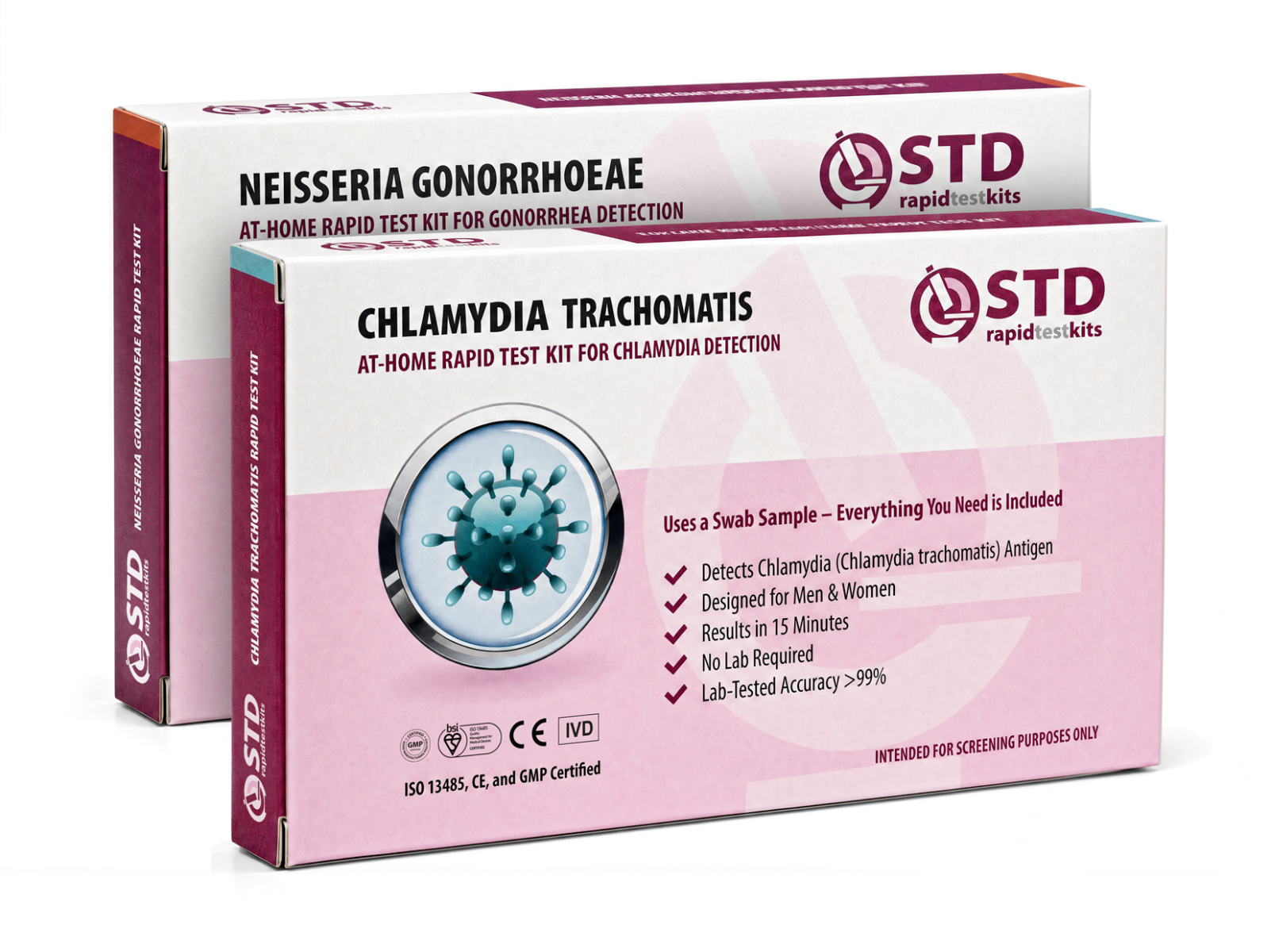
At-home testing has changed adolescent sexual health by removing the two biggest barriers: being seen, and being judged. Some kits use self-collected swabs or fingerstick blood and produce a result at home in about 15 minutes. Others mail the sample to a lab and return results through a private app or portal in a few days, often with telehealth follow-up if treatment is needed.
If you want to make this an option in your house, do it casually. A kit on the bathroom shelf next to the Tylenol with a one-line note: "if you ever want it, no questions asked." Or a text with a link: "saw this, made me think of nobody in particular, here if useful." Skip the speech. What actually moves the needle is removing the practical friction between intention and action.
We sell rapid lateral-flow tests for at-home use. Genital self-swab tests cover chlamydia, gonorrhea, trichomoniasis (vaginal swab, women only), and HPV (vaginal swab, women only). Fingerstick blood tests cover HIV, syphilis, hepatitis B, hepatitis C, and herpes. We don't sell pharyngeal (throat) swab tests or rectal swab tests; if your teen needs throat or rectal testing for any reason, that's a clinic visit.
The emotional fallout no one prepares you for
An STI diagnosis can be the first time a teen encounters real shame about their body. They may worry they're "damaged," that they have to disclose to every future partner forever, that the parent finding out will change everything. Some go quiet. Some pretend it's nothing while carrying it alone.
In that moment, a parent's job is to listen, thank them for the trust, and help them get care. Correction and strategizing can wait until the immediate crisis has passed.
Most STIs are treatable. Chlamydia and gonorrhea are typically cleared with prescribed antibiotics. Syphilis is treated with penicillin. HIV is now a chronic, manageable condition with daily medication. Herpes and HPV are not curable but are manageable, and HPV is largely preventable through vaccination, which the CDC recommends routinely through age 26, with adults aged 27 to 45 advised to discuss the decision with their doctor based on individual risk. Every infection on this list has a treatment path, and the teens who get care early go on to live the lives they planned.
Adolescents and young adults bear a disproportionate share of new sexually transmitted infections in the United States.
How to normalize STI testing in your home
You brush your teeth. You wear a seatbelt. You see a dentist once a year. STI testing belongs in that mental category, but teens don't end up there on their own. They get there because the adults around them treat it as normal.
Concrete things that work in real households:
- Keep a kit visible in a shared bathroom. The presence is the message.
- Mention your own testing matter-of-factly. "I had a physical and I asked them to add an STI panel" is a sentence a teen will absorb.
- Offer a pattern: once a year, like a checkup, or after any new partner.
- If your teen tests positive, react the way you'd react to strep throat. No big speech, just "okay, what's the next step." That one reaction shapes how they think about their own body for years.
Notice that none of this requires a confession from your teen. Testing becomes routine when it is easy to access, not when honesty is compelled.
What if they don't want to talk about it
Sometimes a teen shuts down completely. They dodge, change the subject, eye-roll, walk away. That doesn't mean you've failed; it means they're still figuring out how to talk about something hard, and that takes time.
Try changing the question. Direct interrogation rarely produces honest answers about sex; an open frame produces more. The reframes below show patterns that often work better than asking head-on.
Give them tools even if they don't ask. Drop a link, leave a kit on the shelf, send a short text with no reply expected. The signal is consistent across all of these moves: testing is easier when they want it.
| Avoid asking | Try instead |
|---|---|
| "Have you had sex?" | "Do you have the information you'd want if you ever needed it?" |
| "Are you being careful?" | "Is there anything you're unsure about that I could help with, no follow-up questions?" |
| "Do you need to get tested?" | "If you ever wanted to, would you rather do it at home or at a clinic?" |
You've done the hard part
If you've had the conversations, you've already done what most parents never quite get to. The next step is smaller than it sounds: making the practical tools available, in your house, without a speech attached. A kit in a drawer, a link in a text, and a reaction script you've rehearsed for the day a positive result comes home.
Teen STI rates are rising in part because the testing system is hard to access, especially for someone who's 16, embarrassed, and using shared family insurance. The gap between knowing and doing closes when you make doing easier. The kit on the shelf, the link in a text, the rehearsed reaction script: these are the small structural changes that move the numbers.
- Keep a test kit accessible in a shared bathroom. No announcement needed; the presence is the message.
- Send a relevant link with no reply expected, framed as "saw this, here if useful."
- Rehearse a calm, brief response for the day a positive result comes home, so panic doesn't decide the first 24 hours.
Frequently asked questions
- Can teens really get an STI from oral sex?
- Yes. Gonorrhea, syphilis, herpes, and HPV all transmit through oral sex. Throat infections are usually silent, so a sore throat that lingers after a hookup is worth investigating. Many teens treat oral sex as risk-free; medically, it isn't.
- My teen says they've only had sex once. Should they still get tested?
- Yes, if the encounter happened within the relevant window period. STIs do not require multiple partners or repeat exposure. One unprotected encounter is enough for transmission. A test 14 days after for chlamydia and gonorrhea is the most common starting point.
- Do most teens with STIs really have no symptoms?
- Correct, and that is why testing is the only reliable way to know. Symptoms are absent in most chlamydia and gonorrhea cases in young people, per CDC guidance. HPV almost always shows nothing visible. Feeling fine tells you nothing about whether they're infected.
- Can my teen get tested without me knowing?
- In most U.S. states, yes. Minors can typically consent to confidential STI testing and treatment, though specific rules vary by state. The Guttmacher Institute has historically tracked state-by-state policies; check their site or contact them directly for current information. The bigger barrier is logistical, not legal: shared insurance EOB letters, transportation, time during the school day. At-home tests bypass most of those.
- How soon after a possible exposure should they test?
- It depends on the infection. Chlamydia and gonorrhea are typically detectable around 14 days post-exposure. HIV antibody tests can give a reliable result around 45 days, with 90 days providing the highest confidence for a true negative; syphilis testing is most reliable at 6 to 12 weeks. The standard pattern after a worrying encounter is one test at about two weeks for bacterial STIs and a follow-up panel at three months for HIV and syphilis.
- Are at-home rapid STI tests reliable?
- Lateral-flow rapid tests typically report sensitivity in the mid-to-high 90s percent range and high specificity, when used after the correct window period and according to the kit instructions. They are not equivalent to lab NAAT, which is more analytically sensitive in low-burden infections. Think of a rapid test as a fast private screen, with any positive result worth confirming through a clinic.
- What do I do if my teen tests positive?
- Book a clinical follow-up within 48 hours and thank them for telling you before you do anything else. Most STIs clear with a prescribed course of treatment, and the faster the response, the less emotional weight the diagnosis carries over time. They need a confirmatory lab test where appropriate, a treatment plan, and a conversation about partner notification. The single biggest variable in how they recover emotionally is how the people they trust respond in the first 24 hours.
- Which STIs should a teen actually be tested for?
- The standard starting panel for sexually active teens is chlamydia, gonorrhea, syphilis, HIV, and trichomoniasis (for those with vaginal anatomy). Add herpes testing only when there are symptoms, since asymptomatic blood antibody screening for herpes can be misleading. HPV is typically caught later through Pap testing in those with cervical anatomy.
How we sourced this article: Our editorial team reviewed current public-health guidance from the CDC, the National Institute of Mental Health, the NHS, and the Guttmacher Institute, alongside the CDC's STI surveillance reporting program. We translate that source material into plain-English explanations for parents and adolescents making at-home decisions. We do not provide clinical diagnosis. For symptoms or a concerning exposure, see a licensed provider or a confidential adolescent health clinic.
- U.S. Centers for Disease Control and Prevention. STI surveillance reporting program landing page; supports the general claim that adolescents and young adults bear a disproportionate share of new STI cases in the U.S.
- U.S. Centers for Disease Control and Prevention. About chlamydia, including the typical asymptomatic course of infection.
- U.S. Centers for Disease Control and Prevention. About gonorrhea, including throat and rectal infection presentation patterns.
- U.S. Centers for Disease Control and Prevention. HPV vaccination recommendations and age guidance.
- U.S. Centers for Disease Control and Prevention. Adolescent health resources on positive parental practices, including open communication.
- National Institute of Mental Health. The teen brain: 7 things to know. Adolescent prefrontal-cortex development and decision-making.
- Guttmacher Institute. Policy resource on minors' access to confidential STI services (resource currently being updated; contact directly for current state-by-state guidance).
- NHS. Sexually transmitted infections (STIs) overview and testing guidance.
