
Published: October 2025 | Last updated: May 2026 | Editorial review and quality control: Martina N.
HSV doesn't disappear after your first outbreak. The virus settles into your sensory nerve cells and stays there for life, kept quiet by an immune system that's usually handling the job in the background. Then a hard week shows up, your sleep slips, and a few days later you feel that familiar tingle. The link between stress and a flare-up is not coincidence or imagination. It is a measurable shift in how your immune system polices a virus that never actually left.
This article walks through what stress does inside your body, why some people flare up more than others, the typical 2 to 4 day delay between a stressful event and a visible outbreak, and the small adjustments that genuinely reduce how often it happens. You will not see a "just relax" recommendation here. What helps is recognizing the pattern early and supporting your immune system before it has to compensate.
Key Takeaways
- Stress does not create herpes. It temporarily weakens the immune surveillance that keeps HSV dormant in nerve cells, which is what allows the virus to reactivate and produce a visible sore.
- The trigger almost always happens 2 to 4 days before the lesion appears, so catching the early prodrome (tingling, itching, localized sensitivity) is the most effective window for shortening or even aborting a flare-up.
What Stress Actually Does Inside Your Body (And Why HSV Pays Attention)
Stress is more than a feeling. Within minutes of a stressor, your adrenal glands release cortisol and adrenaline, and a wave of inflammatory signals follows. Those hormones evolved to help you outrun a short threat. They are less helpful when the "threat" is a six-week project deadline and the response stays elevated for weeks instead of minutes.
HSV does not care why your immune system is distracted. It just notices that it is. The virus lives inside the sensory nerve ganglia near your spine, held in latency by specialized immune cells that patrol nervous tissue, a mechanism described in the World Health Organization HSV fact sheet. When cortisol stays elevated and sleep quality drops, those patrolling cells become less efficient. The virus uses that window to travel back down the nerve toward the skin.
That dip in efficiency does not mean your immune system is failing. It means your body is prioritizing what it reads as the most urgent threat. HSV takes advantage of that temporary shift in attention, which is one reason flare-ups so often arrive in the middle of an already exhausting week rather than during calmer stretches.
Cortisol suppresses the specialized immune cells that patrol nerve tissue. HSV uses that suppression window to travel from the sensory ganglion back toward the skin. The window is temporary, but it is enough.
This Isn't Just "Emotional". Physical Stress Counts Too
The word "stress" gets used as if it only means anxiety, deadline pressure, or relationship strain. To your immune system, that is only one input. A bad night's sleep, a respiratory infection running through your office, a hard workout you couldn't recover from, sun-burnt skin, and a difficult conversation all show up as the same underlying signal: strain.
That matters because most flare-ups happen when several types of strain stack on the same week. The table below shows the strain categories most commonly linked to HSV reactivation, per the UK NHS guidance on genital herpes triggers and the World Health Organization HSV fact sheet.
| Type of Strain | What It Does to Your Body | Why It Can Trigger HSV |
|---|---|---|
| Emotional stress | Raises cortisol, disrupts sleep architecture | Weakens nerve-tissue immune surveillance |
| Sleep loss | Reduces deep-sleep immune housekeeping | Lowers resistance to reactivation |
| Acute illness (cold, flu, GI) | Diverts immune resources to fight the new pathogen | Creates an opportunity window for HSV |
| Physical overexertion | Drains glycogen, raises inflammatory cytokines | Reduces general immune efficiency |
| Sun exposure / UV | Damages local skin cells, especially on lips | Most common trigger for oral HSV-1 outbreaks |
| Hormonal shifts (menstruation) | Changes cytokine balance cyclically | Linked to recurrent perimenstrual outbreaks |
Why Some People Flare Up Under Stress, and Others Don't
You probably know someone who has had HSV for years and rarely sees an outbreak. Their threshold is higher. Yours might be lower. That difference is not a measure of discipline or "toughness." It is a difference in immune baseline and how many smaller triggers your body is juggling at the same time.
Several factors influence your personal trigger threshold:
- Time since infection. Outbreak frequency typically declines over the years, a pattern noted in the CDC genital herpes overview. The longer your immune system has been managing HSV, the more efficient the suppression usually becomes.
- Immune baseline. Underlying conditions, medications that suppress immunity, autoimmune disease, and chronic poor sleep all lower the baseline before any acute trigger is added.
- Trigger stacking. One stressor on its own rarely tips the balance. Three at once almost always does.
- Sleep quality. Cuts in deep, slow-wave sleep correlate most directly with outbreak frequency, since the body does its heaviest immune housekeeping during those sleep stages.
- HSV type and site. Genital HSV-2 tends to recur more often than oral HSV-1 in the same person, per the Mayo Clinic genital herpes overview.
It's Not Your Fault
There is a quiet guilt that comes with stress-triggered outbreaks. The internal monologue runs: "if I just handled stress better, this wouldn't happen." That belief sticks harder than it should, partly because most cultural advice about stress treats it as a character problem rather than a biological one.
Stress is a biological state, not a personal failure. Your nervous system, your hormones, and your immune system are reacting the way they were designed to react when the cumulative load goes up. HSV responding to that load is a reflection of how the virus behaves when its host's immune surveillance is temporarily stretched. It is not a reflection of how disciplined you are or how well you "manage" your emotions.
Moving from blame to biology is the shift that lets the rest of this article be useful. Once you read outbreaks as data, you can act on the pattern rather than react to the surprise.
Stress is a biological state, not a personal failure. HSV reactivating under load is a property of the virus, not of the person carrying it.
How Stress Becomes an Actual Outbreak: The Timeline Most People Miss
One of the most confusing things about stress-triggered outbreaks is the delay. You don't feel stressed at 2 PM and see a sore at 3 PM. The reactivation process takes days. By the time the lesion is visible, the original trigger window has usually closed and you are already in the recovery phase of the stressful event.
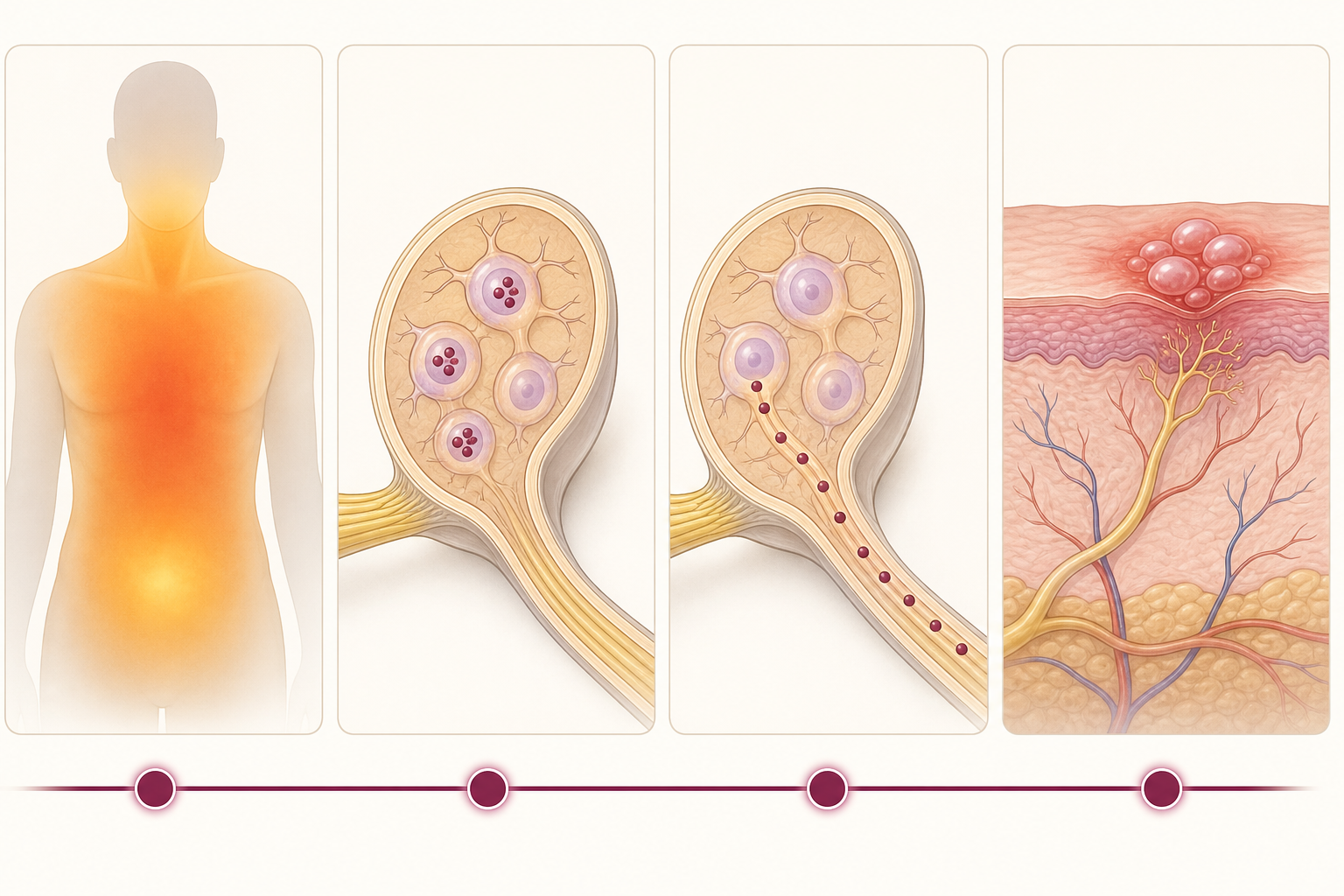
The general sequence runs like this: a stressful event raises cortisol, sleep quality drops, and immune surveillance shifts. Over the next 2 to 4 days, HSV begins reactivating along the affected nerve pathway. The earliest sensations, called prodrome symptoms, start before any visible change. A visible outbreak typically appears between days 4 and 7 after the original trigger.
| Stage | What's Happening Internally |
|---|---|
| Day 1 to 2 | Cortisol rises, sleep architecture shifts, immune surveillance dips |
| Day 2 to 4 | HSV begins reactivating in nerve ganglion and travels along the nerve fiber |
| Day 3 to 5 | Earliest prodrome: tingling, itching, mild local skin sensitivity |
| Day 4 to 7 | Visible outbreak develops at the typical skin site |
What "Early Signs" Feel Like Before a Stress-Triggered Flare-Up
Most people who have lived with HSV for a year or two start noticing the pre-outbreak signals. They are easy to miss the first few times. Once you have felt them on a few cycles, they become specific and predictable. Clinicians call this phase the prodrome: the warning window between viral reactivation in the nerve and the appearance of a visible lesion on the skin. The Mayo Clinic genital herpes overview describes the prodrome as a reliable forewarning of recurrent outbreaks.
The most consistent prodrome signs:
- Tingling. A light buzzing or electric sensation under the skin in the area where outbreaks normally appear.
- Itching. Mild but persistent, localized to the typical outbreak site rather than diffuse.
- Skin sensitivity. The area feels irritated or "raw" before anything is visible.
- General fatigue or feeling "off." Often paired with the local sensation rather than independent of it.
- Mild localized swelling. Subtle puffiness in the same spot recurrences usually start.
Catching this stage is the single highest-leverage thing you can do to shorten an outbreak. Prescription antivirals (acyclovir, valacyclovir, famciclovir) started during prodrome rather than after lesions appear consistently reduce both severity and duration, and can sometimes prevent a visible outbreak entirely.
How to Stop or Reduce Stress-Triggered Outbreaks (What Helps Most)
You cannot eliminate stress, and chasing a stress-free life is not the goal. What helps is buffering the impact, so that when cortisol rises, the immune dip is shallow and brief enough that HSV doesn't get a useful window.
These adjustments have the most consistent evidence behind them:
| Strategy | Why It Works |
|---|---|
| Protect sleep on stressful weeks | Slow-wave sleep is when nerve-tissue immune cells reset; cutting it raises reactivation risk |
| Stay hydrated and eat regularly | Skipping meals raises cortisol further; dehydration impairs general immune function |
| Start antivirals at first prodrome sensation | Acyclovir, valacyclovir, and famciclovir block viral replication; earlier dosing means shorter outbreak |
| Daily suppressive antiviral therapy | For people averaging more than 6 outbreaks per year; reduces frequency and asymptomatic shedding |
| Brief stress-recovery routines (walks, breathing, short naps) | Lowers cortisol curve over the day, even when the stressor itself can't be removed |
Track, Don't Guess
Most people rely on memory when trying to figure out what triggered an outbreak. Memory is unreliable here, especially under stress. The actual triggers tend to fade from awareness precisely when you most need to see them.
Tracking changes that. A short note on your phone is enough. Log the basics for two to three months:
- Average hours of sleep that week
- Stress level (low, moderate, high)
- Any illness, even mild (cold, sore throat, GI bug)
- Any unusual physical strain (long flight, hard workout, sunburn)
- The day prodrome symptoms started
After two or three cycles, the pattern usually becomes obvious. The trigger is rarely random.
When It's Worth Testing or Double-Checking Symptoms
Not every bump, irritation, or skin change during a stressful period is herpes, even for someone who has lived with HSV for years. Stress reduces overall skin resilience and raises the likelihood of unrelated issues: friction sores, ingrown hairs, contact irritation, yeast overgrowth, bacterial folliculitis, and minor unrelated infections that can look similar at first glance.
If a symptom looks or feels different from your usual outbreak pattern (different location, different sensation, longer healing time, or a presentation you have not seen before), it is worth confirming what you are dealing with rather than assuming. Recurrent HSV typically reappears in the same general anatomical area each time, so a presentation that breaks that pattern is worth a closer look.
Herpes simplex virus infection is lifelong, and the virus can periodically reactivate to cause recurrent symptoms, often during periods of physical or emotional stress, illness, or fatigue.
stdrapidtestkits.com sells the home rapid tests linked in this article. We recommend products that fit the reader's specific concern, not based on commercial benefit.
What Lowers Your Risk During High-Stress Periods
Think of this as building a buffer rather than avoiding stress. When the next hard week shows up, the immune dip is shallower, recovery is faster, and HSV gets a smaller window to work with. These are small, consistent adjustments, not a wellness overhaul.
The habits that buffer best:
- Consistent sleep schedule. Going to bed and waking at the same time, even on weekends, keeps slow-wave sleep intact during stressful weeks and prevents cortisol spikes from stacking.
- Eating on a roughly regular schedule. Skipping meals signals scarcity and pushes cortisol higher; even a small breakfast on a hard morning helps.
- Short, frequent recovery breaks. Two or three 5-minute breaks across a stressful day blunt the cortisol curve more than one long break at the end.
- An early antiviral plan. Talk to your provider in advance about an antiviral prescription you can keep on hand for prodrome dosing. The plan is most useful when it's already in your medicine cabinet before you need it.
Notice what is not on this list: perfection. You do not need a flawless routine.
When Stress, Sleep, and Illness Collide
The most frustrating outbreaks happen when multiple stressors stack on the same week. You are stretched at work, you are not sleeping well, you can feel a cold trying to start, and your usual prodrome shows up on day 5. That combination is what many people call a "guaranteed outbreak window."
Recognizing the stack matters more than reacting to any single component. If you can see three stressors lining up at the start of a week, that is the moment to act early: protect sleep, hydrate more than usual, and start antivirals at the first prodrome sensation rather than waiting to confirm "if it really is one."
High-risk stack
- Two or more nights of cut sleep in a row
- Sustained emotional stress (deadline, conflict, grief)
- Acute illness, even mild (cold, sore throat, GI bug)
- Any unusual physical strain (long flight, hard workout, sunburn)
- Any two or three of the above inside the same 7-day window
You're Not "Causing" This. You're Noticing It.
There is a real difference between causing something and recognizing what triggers it. Stress does not manufacture herpes. It reveals when your immune system is under load. The outbreak is a signal, the same way a cough is a signal during a cold. The signal is information, not evidence of failure.
Once that frame shifts, living with HSV gets quieter. You stop interpreting each outbreak as evidence you have done something wrong, and you start treating it as data your body is offering you. Treating each outbreak as information rather than verdict makes the rest of this article usable.
When It's Not Just Stress: Knowing When Something Else Is Going On
Not every outbreak during a stressful time is purely stress-driven. Stress quietly changes your other behaviors at the same time: you sleep less, eat irregularly, drink more caffeine, skip workouts or overdo them, push through the start of a cold, lose track of hydration. Underneath the "just stress" label, your body is usually dealing with three or four shifts at once that all affect immune function.
This is why two equally stressful weeks can produce different outcomes. One passes without symptoms. The other lands as a flare-up. The difference is usually what came with the stress, not the stress itself.
There is also a separate layer worth holding in mind: not every irritation is HSV. Friction sores, shaving irritation, yeast infections, contact dermatitis, ingrown hairs, and general skin sensitivity all increase during stressful periods. Stress can make your skin more reactive overall, which means stress-period symptoms are not always herpes reactivation.
The practical takeaway is to stay familiar with what your typical outbreak looks like: the location, the sensation, the rough timeline. When a symptom does not match that pattern, a multi-STI rapid panel can tell you what you are actually dealing with rather than leaving you to guess.

FAQs
- Can stress really trigger a herpes outbreak, or is that just something people say?
- It is well-documented. Elevated cortisol and disrupted sleep temporarily reduce the immune surveillance that keeps HSV dormant in your nerve cells. When that surveillance loosens, the virus can travel back down the nerve to the skin and produce a visible outbreak. Stress does not manufacture herpes; it opens a window the virus has been waiting for.
- Why do outbreaks always seem to arrive after the worst of the stress has passed?
- Reactivation takes 2 to 4 days from trigger to early symptoms, and another 1 to 3 days before lesions are visible. By the time you see the outbreak, the original trigger window has usually closed and you are already in recovery from the stressful event.
- Is anxiety enough to trigger an outbreak even when nothing 'big' is happening?
- Yes. Ongoing low-grade anxiety keeps your nervous system in an activated state, which keeps cortisol elevated even when life looks calm from the outside. Over weeks of chronic activation, that can be enough to lower your trigger threshold.
- Is there a way to stop an outbreak once I feel the tingling?
- Sometimes, especially with prescription antivirals (acyclovir, valacyclovir, famciclovir) started at the first prodrome sensation. Acting during the prodrome rather than after lesions appear consistently shortens the outbreak and can occasionally prevent a visible lesion entirely. Pair antivirals with rest, hydration, and reduced load that day.
- Do stress-related outbreaks feel worse than regular ones?
- They can. Mostly because your body is already low on immune and recovery resources. The same level of viral activity feels harder to push through when you are already exhausted. The lesions themselves are not medically more severe, but the overall experience often is.
- What if I'm doing everything right and still getting frequent outbreaks?
- It usually means one of three things: an undertreated chronic stressor (sleep apnea, untreated anxiety, ongoing low-grade illness), a lower personal trigger threshold than average, or a need for daily suppressive antiviral therapy rather than episodic treatment. Talk to your provider about suppressive therapy if you average more than 6 outbreaks per year.
- How do I actually figure out my personal triggers?
- Two to three months of short phone notes usually reveals it. Record sleep quality, stress level, any illness, and when prodrome sensations start. The trigger is rarely the most obvious stressor; it is usually a quieter stack of inputs that accumulated in the background. The brain tends to attribute outbreaks to whatever felt most stressful at the time, which is often not the actual driver.
- Am I causing this by being stressed?
- No. Stress is a normal physiological response, and HSV reactivating under stress is a normal property of the virus. Blame is not a useful frame here. What helps is recognizing your pattern early enough to act on it, not policing your emotional reactions.
You Deserve Clarity, Not Guesswork
Stress-triggered outbreaks feel personal because they arrive at the moments you are already stretched thin. The frame worth holding onto is this: the outbreak is a signal that your immune system is being asked to do too many things at once, not a sign of personal failure. Once you can see the pattern, you can plan around it instead of bracing for it.
If the outbreak you are looking at does not quite match your usual pattern, or you want to rule out something unrelated showing up at the same time, a multi-STI rapid panel like the 6-in-1 or 8-in-1 kits can confirm what you are dealing with privately and quickly. For most people, the relief is knowing what they are dealing with rather than guessing at 11 PM.
How we sourced this article: This article synthesizes guidance from the U.S. Centers for Disease Control and Prevention, the World Health Organization, the UK National Health Service, the Mayo Clinic, and the U.S. National Library of Medicine (MedlinePlus) on genital and oral herpes, the biology of HSV latency and reactivation, the role of cortisol and sleep in immune surveillance, and the clinical use of prodrome-stage antiviral therapy. It is written by a medical writer and reviewed for clinical accuracy by a licensed physician. It is not a substitute for a clinical consultation. If your symptoms are new, severe, unusually located, or different from your usual pattern, see a healthcare provider.
- U.S. Centers for Disease Control and Prevention. Genital herpes overview, including recurrence frequency declining over time and lifelong viral latency.
- World Health Organization. Herpes simplex virus fact sheet, covering HSV-1 and HSV-2 latency, periodic reactivation under stress, illness, or fatigue, and asymptomatic shedding.
- UK National Health Service. Genital herpes information, including the list of common reactivation triggers (stress, illness, friction, menstruation, UV) and prodrome description.
- Mayo Clinic. Genital herpes symptoms, causes, prodrome as forewarning of recurrent outbreaks, and antiviral treatment options.
- MedlinePlus (U.S. National Library of Medicine). General overview of herpes simplex virus infection, transmission, symptoms, and management.
